

Lina Yassin is a Sudanese climate policy researcher at the International Institute for Environment and Development (IIED).
As New York Climate Week approaches, excitement is building. It is, after all, a crucial moment to generate momentum toward COP30 and to place climate justice at the centre of the global climate agenda.
Yet this year, many of the voices that most need to be heard, those from countries on the frontlines of the climate crisis, those who carry the greatest moral authority in this struggle, will not even be in the room. Not because they lack the will or the expertise to engage, but because US travel bans and visa barriers have barred their entry.
In June this year, President Trump reinstated and expanded a travel ban. It fully bars citizens from Afghanistan, Myanmar, Chad, the Republic of the Congo, Equatorial Guinea, Eritrea, Haiti, Iran, Libya, Somalia, Sudan, and Yemen.
Another seven countries face partial restrictions. In total, nearly 20 countries now face exclusion from the US, and it is no coincidence that many of them are Least Developed Countries (LDCs). These are the very nations on the frontlines of climate breakdown – countries that should not just be in the room, but leading the conversation.

Conditional place at the table
I will not be in New York this time because my passport is on the wrong list. Unfortunately, for those of us carrying low-mobility passports, this kind of exclusion is nothing new. Our access to global spaces is always conditional. We are only allowed in after proving our worth through endless paperwork, interviews, background checks and layers of suspicion. We are treated as potential risks rather than as contributors.
And even when we do everything asked, access is never guaranteed. The travel ban formalises what we already knew: our place at the table is never secure, always dependent on whether those holding power feel comfortable with us being there.
-
Countries trail COP30 clash over global response to shortfall in national climate plans
China, India and Saudi Arabia rejected a COP30 dialogue on an upcoming UN review of climate plans, widely expected to show the world is not on track to limit global warming to agreed levels -
In new book, WRI chief argues for climate optimism despite obstacles
Ani Dasgupta tells Climate Home the UN climate process is working, but politicians must do more to champion the benefits of green growth and get everyone on board for a system-wide economic transition -
Addis summit trumpets African climate solutions, while quietly backing gas
African nations sent a strong message on driving green growth with homegrown resources, but were criticised for their softer stance on fossil fuels


This year’s ban is not an isolated moment. Earlier in Bonn, at the UN climate negotiations, many developing country delegates were denied visas. Imagine that – people barred from participating in the very forum where they are supposed to defend their countries’ future. This is not just an inconvenience. It is an active silencing of the people most affected by the climate crisis.
And this matters deeply, because climate justice cannot be treated as an isolated bubble. It cannot be reduced to speeches about inclusivity while, in practice, the most vulnerable are excluded. A just response to climate change must start with equal rights at the table. Without that, all the language of “hearing the most vulnerable” and “centering climate justice” means nothing to us.
Climate justice can’t be built on exclusion
Eight years ago, I wrote another op-ed for Climate Home about how Trump’s Muslim Ban at the time meant that I could no longer pursue postgrad studies in the United States. I wrote trying to process what it meant to be told that I was not wanted. Today, eight years later, I am writing again on this theme. The fact that I still have to do this is heartbreaking.
Ethiopia’s preparedness puts it ahead of Nigeria in bid to host COP32, campaigners say
New York Climate Week will produce reports, headlines and key messages. But it will do so without many of the people whose lived experiences are the most urgent reminder of why climate justice matters.
I hope that the organisers and participants will acknowledge this gap. I hope they will recognise that climate justice cannot be built on exclusion, and that real solidarity means fighting to dismantle the barriers that silence the most vulnerable.
I hope that in a few years, I will not find myself writing these same words for a third time.
The post Banned from the US: The voices missing at New York Climate Week appeared first on Climate Home News.
Banned from the US: The voices missing at New York Climate Week

Three countries have been named by the Paris Agreement’s compliance committee for failing to submit a nationally determined contribution (NDC) and repeatedly snubbing offers of help with their climate plans.
After months of internal debate over whether to identify serial non-responders, the Paris Agreement’s Implementation and Compliance Committee (PAICC) named the three countries which have failed to engage with it over their NDCs on Friday.
It named Democratic Republic of Congo, Senegal and North Korea in a footnote of its annual report, adding that it decided to name them “with a view to facilitating engagement”, adding that representatives of the three nations had been invited to its meeting in early 2027 “with the purpose of identifying any challenges and constraints”.
“The Committee noted the importance of Parties engaging with the Committee in a timely manner, while noting that some delays may be due to the national capabilities and circumstances of the Parties”, the report said.
-
Under US pressure, World Bank says it will back gas “where appropriate”
The US wants the World Bank to expand its gas support while climate campaigners are pushing for it to end – its head spoke this week of limited backing for the fossil fuel -
IPCC scientists vow to press on with climate reports despite political deadlock
After governments again failed to agree a timeline, nearly 120 IPCC authors pledged to complete their assessment on time and with full scientific rigour -
Paris Agreement committee snubbed over missing NDC climate plans
Many governments have still not submitted a nationally determined contribution to the UN, breaching a key requirement of the Paris Agreement

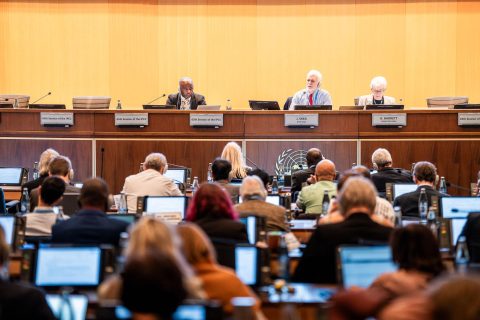

In July, PAICC said 12 countries had ignored its repeated attempts to discuss why they had not published an NDC as required every five years under the 2015 Paris accord.
Members of the committee had been divided over whether to name them, but at a September meeting decided to do so in their annual report to the annual climate COP summit.
By the time the report was published on Friday, only Congo, Senegal and North Korea “had not communicated an NDC or submitted a [Biennial Transparency Report] and had not yet responded to any of the Committee’s notifications, despite several reminders issued by the Committee in this regard”.
Rainforest and renewable energy ambitions
The silence from Congo and Senegal is notable because the former is home to much of the Congo Basin rainforest while the latter has sought billions of dollars in climate finance to support its renewable energy ambitions.
After Brazil, Congo has more rainforest than any country in the world. This forest, and the country’s peatlands, absorb huge amounts of greenhouse gas but are fast being lost to expanding farmland, charcoal production, logging and mining.
Senegal signed a Just Energy Transition Partnership with Canada and wealthy European nations in 2023, to help it meet its renewable energy targets under the-then government of Macky Sall. It was chair of the Least Developed Countries group between January 2022 and December 2023.

Tejas Rao, who is researching the PAICC as part of a doctoral thesis at Cambridge University, said the governments of the three countries should engage with the committee.
“Engagement costs these governments very little and the committee has shown it will listen,” he said.
“Silence leaves the committee with no basis to help, and it leaves the [governments] exposed to the narrative that they are simply disengaged,” he told Climate Home News.
Paris Agreement requirement
The 2015 Paris Agreement requires all parties to publish an NDC every five years outlining their emissions reduction targets, with each plan meant to be more ambitious than the country’s last NDC.
The latest set – the third round of plans, with new targets for 2035 – was due in February 2025. While most countries missed this deadline, all but around 30 – mostly small emitters but including Egypt, Vietnam and Argentina – have now submitted them.
Over the year, the PAICC – which is made up of government climate officials from developed and developing countries – has been communicating with governments that have not submitted NDCs and trying to overcome barriers to them doing so.
Some nations have cited exceptional circumstances as the reason for not submitting an NDC, a process that requires a significant amount of work in tracking emissions and consulting on how to curb them across the economy. For example, a letter from a Sudanese official to the PAICC, seen by Climate Home News, said that the country’s civil war had led to the suspension of its NDC preparation.
-
IPCC scientists vow to press on with climate reports despite political deadlock
After governments again failed to agree a timeline, nearly 120 IPCC authors pledged to complete their assessment on time and with full scientific rigour -
Under US pressure, World Bank says it will back gas “where appropriate”
The US wants the World Bank to expand its gas support while climate campaigners are pushing for it to end – its head spoke this week of limited backing for the fossil fuel -
Who shapes climate science? The equity question facing the IPCC
Early completion of the next global climate science assessment reports risks excluding research from the Global South, which is key to ensuring the findings are fair
The US and Iran are not signed up to the Paris Agreement and so do not have active NDCs, nor does Taiwan, which is not a UN member state.
Rao said that because the PAICC is “facilitative and non-punitive”, naming the countries “is meant to open a door, not close one – the invited consultation is the point”.
“In recent months, governments that explained their constraints, whether capacity, finance or domestic process, have been met with follow-up and support rather than sanction, and the number of silent governments has fallen sharply,” Rao said.
The post Paris Agreement committee names three countries snubbing it over NDCs appeared first on Climate Home News.
Paris Agreement committee names three countries snubbing it over NDCs