

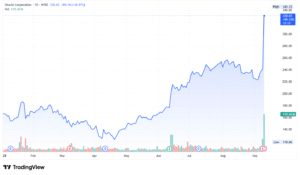
Oracle Corporation (NASDAQ: ORCL) surprised the markets today with a dramatic stock rally. Its shares jumped more than 40%, reaching record highs and placing the company near the trillion-dollar club. This sharp increase was powered by huge demand for Oracle’s cloud services, especially for artificial intelligence (AI) and big partnerships.
Wall Street focused on the financial side, but Oracle also highlighted something else: its environmental goals. The company wants to show that fast growth can go hand in hand with sustainability. By investing in both AI and green programs, Oracle is shaping an image as a modern tech leader that balances profit with responsibility.
Record-Breaking Rally: Oracle’s Biggest Jump in Decades
The jump in Oracle’s stock was its largest in more than 30 years. Investors reacted to news that Oracle signed multiple multi-billion-dollar contracts with tech giants such as OpenAI, Meta, and NVIDIA.
These contracts are tied to AI cloud services and pushed Oracle’s contract backlog to around $455 billion, a sharp rise from $130 billion just a quarter earlier.
This backlog shows how fast demand for Oracle Cloud Infrastructure (OCI) is growing. The company responded by raising its forecast for OCI revenue. It now expects 77% growth this fiscal year, higher than its earlier estimate of 70%. The company also predicts $18 billion in cloud revenue in 2025 and has set a long-term target of $144 billion by 2030.
The growth reflects the global rush to build AI systems. Oracle has placed itself at the center of this movement, partnering in major projects such as the Stargate initiative led by SoftBank and OpenAI. These deals highlight Oracle’s role in powering the next generation of AI.
Recent Developments Strengthening Oracle’s Position
On top of these strong results, Oracle has made headlines with two new announcements that underline its growing role in AI.
The first is a massive deal with OpenAI. Beginning in 2027, OpenAI will purchase at least $300 billion worth of computing power from Oracle over five years. This is one of the largest cloud agreements in history, and it shows how central Oracle has become to advanced AI systems. For Oracle, it marks a major vote of confidence from one of the most important AI companies in the world.
Oracle’s stock surged to a record high. This boosted the company’s market value to nearly $1 trillion. The rally also made headlines for another reason: it boosted co-founder Larry Ellison’s wealth by more than $100 billion in a single day, making him the world’s richest person.
Greener Growth: Oracle’s Path to Net Zero
Amid the AI excitement and stock rally, Oracle is pushing its green message. The company has promised to be carbon neutral by 2050. It also set a nearer goal to cut greenhouse gas emissions in half by 2030, using 2020 as its baseline year. These goals cover its offices, data centers, and cloud services.

Oracle has already achieved some key milestones:
- Renewable power: 86% of OCI’s global energy came from renewables in 2023.
- Regional progress: Europe and Latin America already run on 100% renewable power.
- Global ambition: Oracle plans to hit 100% renewable energy worldwide by 2025.
- Water and waste: Since 2020, water use has dropped by almost 25% and landfill waste by more than 35%.
- Travel impact: Employee air travel emissions have been cut by 38% thanks to more virtual meetings.
These achievements prove Oracle is not only talking about sustainability but also acting on it. For a company scaling up fast in cloud and AI, these steps are important. They show Oracle is trying to balance expansion with its responsibility to the planet.
Pushing Green Standards Across the Supply Chain
Oracle knows its environmental impact extends beyond its own walls. A big part of its footprint comes from suppliers. That’s why the company is pushing its partners to meet strict environmental standards.

Here are some of the key steps:
- Supplier programs: All major suppliers must have environmental programs.
- Emission targets: At least 80% of suppliers are expected to set formal climate goals.
- Progress: More than four in five suppliers already meet these expectations.
- Broader impact: By setting these standards, Oracle ensures its ESG efforts reach across its global supply chain.
This approach boosts Oracle’s credibility. It tells investors and clients that the company’s sustainability commitments are not limited to its own operations. Instead, they cover the full ecosystem of partners that make its technology possible.
AI-Powered Tools for Climate Accountability
Oracle is also building tools to help other companies meet their climate goals. One of these is Fusion Cloud Enterprise Performance Management (EPM) for ESG. This platform allows organizations to automate sustainability reporting, integrate emissions data with financial information, and align with global standards.
The system uses AI to make reporting easier and more accurate. This is important as regulators push companies to disclose their environmental impacts in more detail.
-
It combines Scope 1, 2, and 3 emissions data based on the GHG Protocol Corporate Standard. This links emissions to financial and operational data, helping with better ESG management.
-
Oracle improved its ESG reporting with this platform. They cut reporting timelines by 30% using automation and AI-driven process management.
-
The platform collects unique identifiers from source documents. This ensures clear data tracking and auditability. It boosts transparency and lowers compliance risks.
-
It supports global reporting standards like IFRS, ESRS (CSRD), and GRI. This helps organizations align their disclosures with changing regulations easily.
Oracle has also introduced features in its cloud infrastructure that estimate emissions from customer workloads. This means clients can see how much carbon their computing generates and adjust operations to stay on track with their own sustainability commitments. By doing this, Oracle is not only greening its own business but also helping others.
The Tough Road Ahead: Energy Demands vs. Climate Goals
Still, Oracle faces challenges in meeting its promises. Reaching 100% renewable energy worldwide is difficult, especially in regions where clean energy options are limited. Ensuring suppliers stick to emissions goals is also complex, given the size of Oracle’s global network.
Another challenge is the massive energy demand of AI. As Oracle expands its role in AI infrastructure, its energy use will rise. Balancing this growth with its climate goals will require new investment in efficient data centers, renewable sourcing, and innovations in green computing.
Oracle’s record-breaking stock surge highlights its importance in the AI and cloud industry. But what makes its story more powerful is the balance it is trying to strike between growth and sustainability. By pledging net zero emissions by 2050, setting ambitious near-term targets, and building tools for others to track emissions, Oracle is showing that technology and responsibility can go together.
For investors, Oracle now offers both a high-growth AI story and a strong ESG narrative. For customers, it provides powerful cloud services backed by renewable energy and transparent carbon data.
As Oracle continues to grow, its ability to deliver on both financial and environmental goals may define its future as one of the world’s most influential technology leaders.
The post Oracle (ORCL) Stock Soars 40% on AI Boom and $455B Cloud Backlog While Going Green appeared first on Carbon Credits.

EU carbon credit claims changed on 27 September 2026, the day the Directive (EU) 2024/825 began to apply across the European Union. The change is narrow. It changes how a company can talk about the credits it buys. A product can no longer be called neutral on the strength of compensation alone; however, every specific, evidenced statement about what a company measured, reduced, and funded stays fully available.

The post Promoting Improved Cooking Practices in Nigeria appeared first on Terrapass.



-
Climate Change1 year ago
Guest post: Why China is still building new coal – and when it might stop
-

 Greenhouse Gases2 years ago
嘉宾来稿:满足中国增长的用电需求 光伏加储能“比新建煤电更实惠”
-
Greenhouse Gases1 year ago
Guest post: Why China is still building new coal – and when it might stop
-

 Climate Change2 years ago
嘉宾来稿:满足中国增长的用电需求 光伏加储能“比新建煤电更实惠”
-

 Renewable Energy12 months ago
Sending Progressive Philanthropist George Soros to Prison?
-
Climate Change2 years ago
Bill Discounting Climate Change in Florida’s Energy Policy Awaits DeSantis’ Approval
-
Greenhouse Gases1 year ago
嘉宾来稿:探究火山喷发如何影响气候预测
-

 Climate Change2 years ago
Analysis: China’s CO2 falls 1% in Q2 2024 in first quarterly drop since Covid-19