


Carbon removal is one of the most talked-about tools in the global climate fight. Companies and governments are using engineered carbon dioxide removal (eCDR) projects. They aim to balance emissions that are hard to reduce. These projects are seen as a “safe haven” in the voluntary carbon market as they offer lasting, long-term carbon storage.
But a new report from Meta and Calyx Global warns of a critical blind spot. Many of these projects do not properly account for embodied emissions—the carbon “debt” created when building and running removal infrastructure. This includes the energy and materials used in construction, machinery, and infrastructure.
By excluding or amortizing these emissions, some registries allow carbon credits to be issued before any real climate benefit occurs. If projects stall or fail, the result is phantom removals—credits with no actual climate impact.
The report shows a need for quick reforms in these areas:
- Upfront accounting,
- Full transparency, and
- Better alignment across registries
With eCDR credit purchases growing at record speed, the stakes are rising fast.
The Boom in Engineered Carbon Removals
Engineered carbon dioxide removal, or eCDR, is a set of technologies. These technologies pull CO₂ directly from the air and store it safely for centuries.
eCDR approach differs from nature-based solutions like reforestation. It focuses on long-lasting carbon removal. It uses techniques like direct air capture (DAC), biochar, bio-oil, enhanced mineralization, and biomass carbon removal and storage (BiCRS).
These approaches are energy- and capital-intensive but are seen as critical for reaching net zero because they provide permanent storage.
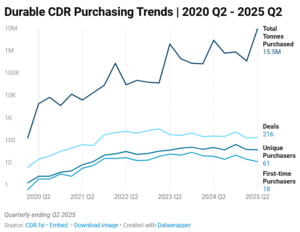
Notably, interest in engineered removals has exploded. Purchase agreements for future eCDR delivery grew seven times from 2022 to 2023. Then, they nearly doubled again to 8.2 million credits in 2024, according to cdr.fyi.
Another 25 million credits have already been bought in 2025, with Microsoft leading the way. At the same time, traditional nature-based credits, like afforestation, have slowed down a lot. This increase in demand has opened up more interest in engineered options.
- SEE MORE: Microsoft (MSFT Stock) Tops Q2 2025 Record-Breaking Surge in Durable Carbon Removal Credit Purchases
Buyers see eCDR as more durable and technically verifiable. Yet without proper embodied emissions accounting, the credibility of these credits is at risk.
The report warns that if projects shut down early, the embodied carbon debt may never be repaid. This leaves the market with phantom credits or removals that never actually occurred.
How Embodied Emissions Get Overlooked
Carbon markets usually track process emissions, such as energy used in operations. These emissions are measured in real time. But embodied emissions are treated inconsistently. Some registries ignore them. Others allow developers to amortize emissions, spreading them over many years of the project.
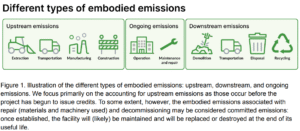
This means projects can start issuing credits even when they are still net emitters. For example:
- A biochar project might have embodied emissions equal to 20% of its first year’s credits. If those emissions are spread out, the project sells credits as if it has already removed CO₂. But the atmosphere still has more CO₂.
- A DAC facility with heavy upfront infrastructure may take years to break even. If the project halts early, its credits will have overstated its climate benefit from the start.
This accounting gap creates a major risk for buyers who assume their carbon offsets are delivering immediate impact. The report stated:
“It makes it difficult for a buyer to understand when projects start to deliver actual atmospheric benefits…Until the amortization period is over, projects will issue more credits than the net removals they have delivered. The true benefit comes when those over-credited removals have also been paid back.”
How Registries Differ: A Patchwork of Rules
The white paper highlights wide differences among carbon standards:
- No Accounting: Registries like the Verified Carbon Standard (VCS), American Carbon Registry (ACR), and Climate Action Reserve (CAR) do not require embodied emissions accounting. This means credits are almost always overstated.
- Default Deduction: Some standards, like Carbon Standards International, apply only small default deductions—not tied to actual project data.
- Amortization Allowed: Gold Standard, Puro.Earth, and others require accounting but allow amortization, sometimes over decades. A project could issue credits for years before becoming truly net-negative.
- Upfront Deduction Option: Isometric is the only registry that allows—but does not require—upfront accounting. This method provides the highest integrity but is rarely chosen.
This patchwork approach undermines transparency and comparability, creating uncertainty for investors and credit buyers.
When Offsets Aren’t Real: The Phantom Removal Problem
The risk of “phantom removals” is not just theoretical. If embodied emissions are amortized and a project ends prematurely, the carbon debt remains unpaid. Yet the credits already sold continue circulating in the market, allowing buyers to claim offsets that never happened.
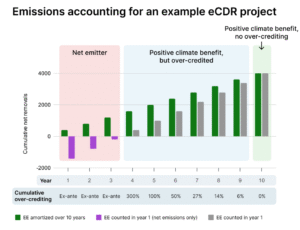
By spreading these embodied emissions over 10 years, the project claims 400 tCO₂ net removals each year. However, the atmosphere initially sees a “carbon debt,” with the project acting as a net emitter for three years. Carbon credits issued during this period are overestimated by up to 300% before balancing by year 10.
This gap not only erodes trust in carbon markets but also raises reputational risks for companies using these credits to meet climate pledges. For firms that value credibility, like Microsoft and Meta, phantom credits can hurt their net-zero goals.
What Needs to Change
The Meta–Calyx Global paper calls for immediate reforms to strengthen eCDR crediting integrity:
- Upfront Accounting – Require all upstream embodied emissions to be deducted in the first reporting period.
- Lifecycle Transparency – Publicly report full life-cycle emissions, including upstream (construction), ongoing (maintenance), and downstream (decommissioning).
- Buyer Safeguards – Encourage buyers to be cautious. They should “right-size” claims to cover uncounted emissions or pair credits with others that offer durability.
- Registry Reform – Push registries to standardize approaches and eliminate amortization practices that delay real climate benefits.
Buyers should ask for more transparency. They can delay using credits until projects show net removals. Stacking credits can also help hedge risks.
Why Credibility Matters in a Net-Zero World
Engineered removals are central to global net-zero strategies. The Science-Based Targets initiative (SBTi) has emphasized its importance. And demand from corporations is rising rapidly. Because these technologies are often energy- and infrastructure-intensive, embodied emissions can represent a large share of their footprint.
The market cannot afford another crisis of confidence like past controversies in carbon markets. Fixing embodied emissions accounting now can help registries and buyers ensure eCDR meets its promise. This way, it won’t create more questionable credits.
Meta and Calyx Global’s report sends a clear warning: ignoring embodied emissions risks flooding the market with phantom credits. With eCDR purchases growing at record speed, there’s a need to ensure transparency and credibility. The path forward requires upfront accounting, registry alignment, and greater buyer diligence.
The post Meta and Calyx Global Warn Engineered Carbon Removal Boom Risks “Phantom Credits” appeared first on Carbon Credits.

EU carbon credit claims changed on 27 September 2026, the day the Directive (EU) 2024/825 began to apply across the European Union. The change is narrow. It changes how a company can talk about the credits it buys. A product can no longer be called neutral on the strength of compensation alone; however, every specific, evidenced statement about what a company measured, reduced, and funded stays fully available.

The post Promoting Improved Cooking Practices in Nigeria appeared first on Terrapass.



-
Climate Change1 year ago
Guest post: Why China is still building new coal – and when it might stop
-

 Greenhouse Gases2 years ago
嘉宾来稿:满足中国增长的用电需求 光伏加储能“比新建煤电更实惠”
-
Greenhouse Gases1 year ago
Guest post: Why China is still building new coal – and when it might stop
-

 Climate Change2 years ago
嘉宾来稿:满足中国增长的用电需求 光伏加储能“比新建煤电更实惠”
-

 Renewable Energy12 months ago
Sending Progressive Philanthropist George Soros to Prison?
-
Climate Change2 years ago
Bill Discounting Climate Change in Florida’s Energy Policy Awaits DeSantis’ Approval
-
Greenhouse Gases1 year ago
嘉宾来稿:探究火山喷发如何影响气候预测
-

 Climate Change2 years ago
Analysis: China’s CO2 falls 1% in Q2 2024 in first quarterly drop since Covid-19