

The highest court of the UN has issued a landmark “advisory opinion” stating that nations can be held legally accountable for their greenhouse-gas emissions.
Recognising the “urgent and existential threat” facing the world, the International Court of Justice (ICJ) concluded that those harmed by human-caused climate change are entitled to “reparations”.
Their opinion largely rests on the application of existing international law, clarifying that climate “harms” can be clearly linked to major emitters and fossil-fuel producers.
The case, which was triggered by a group of Pacific island students and championed by the government of Vanuatu, saw unprecedented levels of input from nations.
In a unanimous decision issued on 23 July, the 15 judges on the ICJ concluded that the production and consumption of fossil fuels “may constitute an internationally wrongful act attributable to that state”.
The opinion also says that limiting global warming to 1.5C should be considered the “primary temperature goal” for nations and, to achieve it, they are obliged to make “adequate contributions”.
While the ICJ opinion is not binding for governments, it is expected to have a significant impact as vulnerable groups and nations fight for climate compensation in court.
Below, Carbon Brief explains the most important aspects of the ICJ’s 133-page advisory opinion and speaks to legal experts about its implications.
- How did this case come about?
- How has the case been decided?
- What does the ICJ say about climate science?
- What does the ICJ say about countries’ climate obligations?
- What does it say about the legal consequences of breaches?
- What does it say about historical responsibility and reparations?
- What does it say about the Paris Agreement and 1.5C?
- What does it say about fossil fuels?
How did this case come about?
The case stems from a campaign led by 27 students from the University of the South Pacific in Fiji.
In 2019, they established a youth-led grassroots organisation – dubbed the Pacific Island Students Fighting Climate Change (PISFCC) – and began efforts to persuade the leaders of the Pacific Islands Forum to take the issue of climate change to the world’s top court.
PISFCC joined forces with other youth organisations from around the world in 2020, lobbying state representatives to take action.
In 2021, the government of Vanuatu announced that it would lead efforts to gain an “advisory opinion” from the ICJ. It worked to engage with the Pacific island community first, to build a “coalition of like-minded vulnerable countries”, reported Climate Home News.
Following on from this work, Vanuatu received a unanimous endorsement for its efforts from the 18 members of the Pacific Island Forum. It continued to work diplomatically, engaging in discussions across Europe, Asia, Africa and Latin America to encourage other countries to join the effort.
After three rounds of consultations with other states, the resolution was put before the UN general assembly with the backing of 105 sponsor countries.
Finally, on 29 March 2023, the assembly unanimously adopted the resolution formally requesting an “advisory opinion” from the ICJ.
The resolution posed two questions for the ICJ. In answering these questions, it asked the court to have “particular regard” to a range of laws and principles, including the UN climate regime and the universal declaration on human rights.
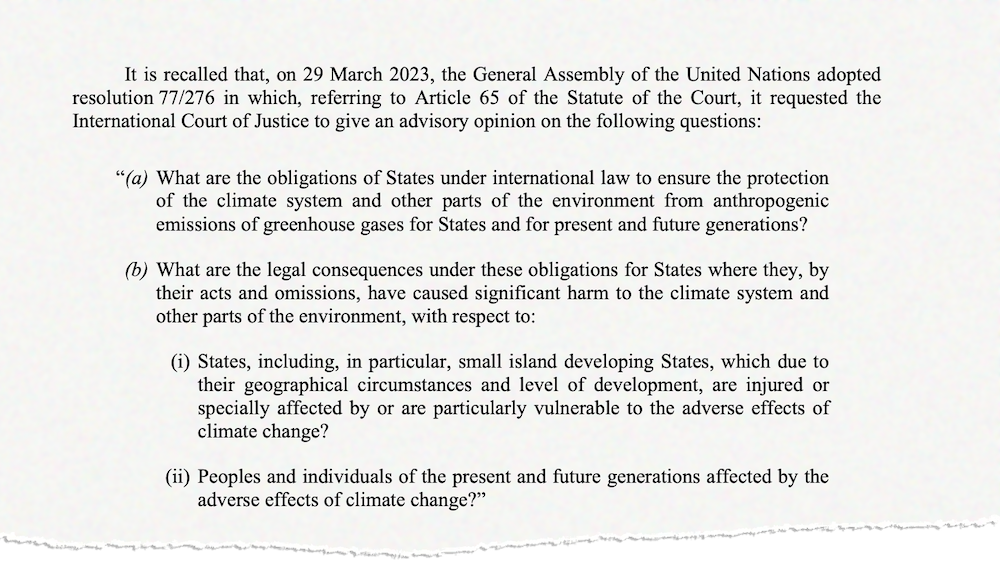
First, the resolution asked what are the legal obligations of states under international law to “ensure the protection of the climate system”.
Second, it asked what are the legal consequences flowing from these obligations if states, by their “acts or omissions”, have caused “significant harm to the climate”.
The resolution asked for the court to consider, in particular, states that are “specially affected” or are “particularly vulnerable” to the impacts of climate change.
It also pointed to “peoples and individuals of the present and future generations affected by the adverse effects of climate change”.
Therefore, the advisory opinion issued this week by the ICJ, in response to these questions, is the culmination of a years-long process.
Although the opinion is not binding on states, it is binding on UN bodies and is likely to have far-reaching legal and political consequences at a national level.
How has the case been decided?
The ICJ was tasked with interpreting international law and arriving at an advisory opinion. While its legal advice will, therefore, not be binding for nations, it will be binding for other UN bodies.
This two-year process involved the judges defining the scope and meaning of the broad questions put to them by the UN general assembly. (See: How did the case come about?)
They then considered which international laws and principles were relevant for these questions.
Among the relevant laws identified were the three UN climate change treaties – the UNFCCC, the Kyoto Protocol and the Paris Agreement.
They also considered various other treaties covering biodiversity, ozone depletion, desertification and the oceans, as well as legal principles such as the principle of “prevention of significant harm to the environment”.
The ICJ’s process has also seen nations and international groups, such as the Organisation of the Petroleum Exporting Countries (Opec), offer their views on the case.
These groups had the opportunity to feed into the judges’ deliberations over several stages, including two sets of written submissions, followed by oral statements to the court.
In total, the court received 91 written statements, a further 107 oral statements – delivered at the Hague in December 2024 – and 65 responses to follow-up questions by the judges.
This is the “highest level of participation in a proceeding” in the court’s history, according to the ICJ. Some nations, including island states such as Barbados and Micronesia, appeared before the court for the first time ever.
These contributions demonstrated broad agreement among nations that climate change is a threat and that emissions should be cut in order to meet the objectives of the Paris Agreement.
But there were major divergences on the breadth and nature of obligations under international law to act to limit global warming, as well as on the consequences of any breaches, as specifically being addressed by the ICJ.
Overall, the main divisions were between high-emitting nations trying to limit their climate obligations and low-emitting, climate-vulnerable nations, who were pushing for broader legal obligations and stricter accountability for any breaches.
Specifically, “emerging” economies such as China and Saudi Arabia, along with historical high-emitters such as the UK and EU, argued that climate obligations under international law should be defined solely by reference to the UN climate regime.
In contrast, vulnerable nations said that wider international law should also apply, bringing additional obligations to act – and the potential for legal consequences, including reparations.
This is a departure from UN climate talks, where the main divide tends to be between “developed” and “developing” countries – with the latter encompassing both high- and low-emitting nations.
In an unusual move, the ICJ judges also organised a private meeting in November 2024 with scientists representing the Intergovernmental Panel on Climate Change (IPCC).
Among those present were IPCC chair Prof Jim Skea and eight other climate scientists from various countries and with different areas of expertise.
A statement issued by the ICJ said this was an effort to “enhance the court’s understanding of the key scientific findings which the IPCC has delivered”.
On 23 July 2025, after some seven months of deliberation, the ICJ issued a unanimous opinion in response to the UN general assembly’s request.
This is only the fifth time the court has delivered a unanimous result, according to the ICJ, after nearly 88 years in operation and 29 opinions.
(In addition to the unanimous opinion of the full court, several of the ICJ judges also issued their own declarations and opinions, individually or in small groups.)
What does the ICJ say about climate science?
When considering the “context” for the issuing of the advisory opinion on climate change, the court provides information on the “relevant scientific background”.
This was drawn from reports by the IPCC, which the court says “constitute the best available science on the causes, nature and consequences of climate change”.
It comes after ICJ judges held a private meeting with IPCC scientists in 2024. (See: How has the case been decided?)
The advisory opinion states that it is “scientifically established that the climate system has undergone widespread and rapid changes”, continuing:
“While certain greenhouse gases [GHGs] occur naturally, it is scientifically established that the increase in concentration of GHGs in the atmosphere is primarily due to human activities, whether as a result of GHG emissions, including by the burning of fossil fuels, or as a result of the weakening or destruction of carbon reservoirs and sinks, such as forests and the ocean, which store or remove GHGs from the atmosphere.”
It continues that the “consequences of climate change are severe and far-reaching”, listing impacts including the “melting of ice sheets and glaciers, leading to sea level rise”, “more frequent and intense” extreme weather events and the “irreversible loss of biodiversity”. The document adds:
“These consequences underscore the urgent and existential threat posed by climate change.”
The advisory opinion further adds that the “IPCC notes that adaptation measures are still insufficient” and that “limits to adaptation have been reached in some ecosystems and regions”.
On the need to address rising emissions, the document quotes the IPCC directly, saying:
“According to the panel, climate change is a threat to ‘human well-being and planetary health’ and there is a ‘rapidly closing window of opportunity to secure a liveable and sustainable future for all’ (very high confidence). It adds that the choices and actions implemented between 2020 and 2030 ‘will have impacts now and for thousands of years’.”
It adds that the “IPCC has also concluded with ‘very high confidence’ that risks and projected adverse impacts and related loss and damage from climate change will escalate with every increment of global warming”.
In regards to how states should consider climate science when implementing climate policies and measures, the court says that countries should exercise the “precautionary principle”, adding:
“The court observes that where there are threats of serious or irreversible damage, lack of full scientific certainty should not be used as a reason for postponing cost-effective measures to prevent environmental degradation.”
What does the ICJ say about countries’ climate obligations?
In response to the first question on legal obligations, the ICJ says that countries have “binding obligations to ensure protection of the climate system” under the UN climate treaties.
However, the court’s unanimous opinion flatly rejects the argument, put forward by high emitters, such as the US, UK and China, that these treaties are the end of the matter.
These nations had argued that the climate treaties formed a “lex specialis”, a specific area of law that precludes the application of broader general international law principles.
On the contrary, the ICJ says countries do have legal obligations under general international law, including a duty to prevent “significant harm to the environment”, with further obligations arising under human rights law and from other treaties.
As such, the court, “essentially sided with the global south and small island developing states”, says Prof Jorge Viñuales, Harold Samuel professor of law and environmental policy at the University of Cambridge.
Moreover, the court finds that countries’ obligations extend not only to greenhouse gas emissions, but also to fossil-fuel production and subsidies, says Viñuales, who acted for Vanuatu in the case.
Speaking to Carbon Brief in a personal capacity, he says: “That is important because major producers are not necessarily major emitters and vice-versa.”
In terms of the UN climate treaties, such as the Paris Agreement, the court affirms that these give countries binding obligations including adopting measures to mitigate greenhouse gas emissions and adapt to climate change.
Developed countries – parties listed under Annex I of the UNFCCC – have “additional obligations to take the lead in combating climate change”, the ICJ notes.
States also have a “duty” to cooperate with each other in order to achieve the objectives of the UNFCCC, acting in “good faith” to prevent harm, it adds.
Beyond the climate treaties, it says that “states have a duty to prevent significant harm to the environment”. Therefore, they must act with “due diligence” and use “all means at their disposal” to prevent activities carried out within their jurisdiction or control from causing “significant harm” to the climate system.
The court sets out the “appropriate measures” that would demonstrate due diligence, including “regulatory mechanisms…designed to achieve deep, rapid and sustained reductions” in emissions. This repeats language from the IPCC, but attaches it to countries’ legal obligations.
As with action under the climate treaties, countries’ obligations under broader international law should be taken in accordance with the principle of “common but differentiated responsibilities” it adds, a point reaffirmed throughout the advisory opinion.
Furthermore, countries have obligations to act on climate under a raft of other international agreements, covering the ozone layer, biological diversity, desertification and the UN convention on the law of the sea, the ICJ notes.
The court affirms that states that are not party to UN climate treaties must still meet their equivalent obligations under customary international law. This “addresses the unique situation of the US, but without naming it”, notes Sébastien Duyck, a senior attorney at the Center for International Environmental Law, on Bluesky.
Following his re-election last year, US president Donald Trump signed an order to pull the country out of the Paris Agreement again. As such, there is a question around how the ICJ’s opinion might apply to the US – the country that has contributed more to human-caused climate change than any other nation.
Additionally, states have obligations under international human rights law to “respect and ensure the effective enjoyment of human rights by taking necessary measures to protect the climate system and other parts of the environment”, according to the ICJ.
This follows a ruling from the European Court of Human Rights (ECHR) in 2024 that found that the Swiss government’s climate policies violated human rights, as governments are obliged to protect citizens from the “serious adverse effects” of climate change.
Announcing the opinion to the Hague, judge Iwasawa Yuji, president of the court, said:
“The human right to a clean, healthy and sustainable environment is essential for the enjoyment of other human rights.”
What does it say about the legal consequences of breaches?
The second part of the advisory opinion deals with the “legal consequences” of countries causing “significant harm to the climate system and other parts of the environment”.
This refers to nations breaching their “obligations”, as defined in the first part of the opinion. (See: What does the ICJ say about countries’ climate obligations?)
Crucially, the court says that countries can, in principle, face liability for climate harms, opening the door to potential “reparations” for loss and damage. Prof Viñuales tells Carbon Brief:
“Perhaps the main take away from the opinion is that the court recognised the principle of liability for climate harm, as actionable under the existing rules.”
Prof Viñuales notes that the court says “climate justice is governed by the general international law of state responsibility, which provides solutions for the recurrent arguments levelled to escape liability for climate harm”.
Essentially, the ICJ rejects the notion that it is too difficult to hold countries accountable for climate damages.
Examples of breached obligations given by the court include failing to set out or implement climate pledges – known as nationally determined contributions (NDCs) – under the Paris Agreement, or to sufficiently “regulate emissions of greenhouse gases”.
The ICJ stresses that it is not responsible for pointing fingers at particular countries, only for issuing a “general legal framework” that countries can follow.
As part of this process, it lays out a justification for why states can be held responsible for climate change.
During the ICJ process, some countries argued that greenhouse gas emissions are not like other environmental damage, such as localised chemical pollution. They said that emissions arise from all sorts of regular activities and it is difficult to tie climate damage to specific sources.
Others argued that it is perfectly possible to attribute such damage to states that, for example, have laws to “promote fossil-fuel production and consumption”.
This is important, as the ICJ points out that attribution is necessary if an activity is to be defined as an “internationally wrongful act”. Ultimately, the court agrees that it is feasible to attribute climate damage to specific states, on a “case-by-case” basis.

The court also finds that it is possible, at least in principle, to link climate disasters to countries’ emissions, though it notes that the causal links may be “more tenuous” than for localised pollution. It cites IPCC findings that climate change has amplified heatwaves, flooding and drought, stating:
“While the causal link between the wrongful actions or omissions of a state and the harm arising from climate change is more tenuous than in the case of local sources of pollution, this does not mean that the identification of a causal link is impossible.”
With this established, the court sets out what the consequences could be for countries that are deemed to have carried out “wrongful acts”.
First, the ICJ stresses that nations must meet their existing climate obligations. This means that if, for example, a government publishes an “inadequate” NDC, a “competent court or tribunal” could order it to supply one that is consistent with its obligations under the Paris Agreement.
Second, it also says that if a state is found responsible for climate damage, it must stop and ensure that it does not happen again.
States may be required to “employ all means at their disposal” to carry out this duty, according to the ICJ. In practice, the court says that this could mean governments revoking administrative or legislative acts in order to cut emissions.
In theory, this could lead to more stringent climate policies. For example, Dr Maria Antonia Tigre, director of global climate change litigation at the Sabin Centre for Climate Change Law, tells Carbon Brief:
“The ICJ made clear that the standard of due diligence is stringent and that each state must do its utmost to submit NDCs reflecting its highest possible ambition. That may strengthen pressure – political, legal and public – on states to raise their climate targets, especially before the next global stocktake.”
Finally, the ICJ opens the door for countries to seek “reparations” for climate harms from other countries.
It says these reparations could be expressed in different ways – including paying compensation or issuing formal apologies for wrongdoing.
This outcome was widely celebrated by climate justice activists and vulnerable nations, who see it as ushering in a “new era” in the fight to obtain financial compensation for climate disasters.
Harj Narulla, a barrister at Doughty Street Chambers and legal counsel for the Solomon Islands, tells Carbon Brief:
“The ICJ’s ruling has provided a legal pathway for developing states to seek climate reparations from developed States…States can bring claims for compensation or restitution for all climate-related damage. This includes claims for loss and damage, but importantly extends to any harm suffered as a result of climate change.”
What does it say about historical responsibility and reparations?
One of the most significant parts of the ICJ opinion is the assertion that nations and “injured individuals” can seek “reparations” for climate damage.
This ties in with a long and contentious history of climate-vulnerable nations in the global south seeking compensation from high-emitting nations.
The notion of “climate reparations” has often been linked to developing countries pushing for so-called “loss and damage” finance in UN climate negotiations, including the – ultimately successful – fight for a “loss-and-damage fund”.
However, the US and other big historical emitters have ensured that any progress on loss-and-damage funding has not left them legally accountable for their past emissions.
The Paris Agreement states explicitly that its inclusion of loss and damage “does not involve or provide a basis for any liability or compensation”.
Crucially, the ICJ opinion makes it clear that such language does not override international law and states’ responsibilities to provide “restitution”, “compensation” and “satisfaction” to those harmed by climate change.
Danilo Garrido Alves, a legal counsel for Greenpeace International, tells Carbon Brief that this means loss-and-damage finance is not a replacement for reparations:
“If a state contributes to the loss and damage fund and at the same time breaches obligations…that does not mean they are off the hook.”
Legal experts, including Prof Viñuales, tell Carbon Brief that this outcome is not surprising, given its grounding in international law. He says:
“It is the correct understanding of international law, but, in law, progress often takes the form of moving from the implicit to the explicit and that’s what the court did.”

Nevertheless, the outcome could have major implications for climate politics and lead to a wave of new climate litigation. Dr Tigre, at the Sabin Centre for Climate Change Law, tells Carbon Brief:
“[It] could shift the conversation from voluntary climate finance to legal obligations to repair harm, particularly for vulnerable communities and states already suffering loss and damage.”
Notably, the court says that while some states are “particularly vulnerable” to climate change, international law “does not differ” depending on such status. This means that, in principle, all nations are “entitled to the same remedies”.
As for individuals or groups taking legal action for both “present and future generations”, the ICJ notes that their ability to do so does not depend on rules around “state responsibility”. Instead, they would depend on obligations being breached under “specific treaties and other legal instruments”.
The ICJ says that reparations would be determined on a case-by-case basis, noting that the “appropriate nature and quantum of reparations…depends on the circumstances”. It also notes that:
“In the climate change context, reparations in the form of compensation may be difficult to calculate, as there is usually a degree of uncertainty.”
The question of precisely which nations will be liable for paying climate reparations is also predictably complex. Much of this discussion centres around responsibility for emissions, both currently and in the past.
Under the Paris Agreement, “developed” countries – a handful of nations in the global north – are obliged to provide climate finance to “developing” countries, which includes major emitters such as China.
In ICJ submissions, major emitters and fossil-fuel producers categorised as “developing” under the UN system stressed their low historical emissions. Some developing countries blamed climate change on a small group of “developed states of the global north”.
For their part, some countries with high historical emissions argued that it is difficult to assign responsibility for climate change.
However, the ICJ concludes that this is not the case. It says it is “scientifically possible” to determine each state’s contribution, accounting for “both historical and current emissions”.
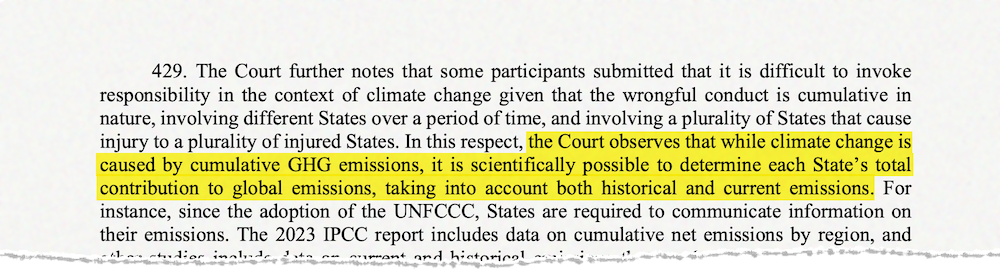
Therefore, while the court explicitly avoids identifying the countries responsible for paying reparations, it makes clear that historical responsibility should be accounted for when considering whether states have met their climate obligations.
Finally, the court also says that “the status of a state as developed or developing is not static” and that it depends on the “current circumstances of the state concerned”.
This is notable, given that the current definitions of these terms – which determine who gives and receives climate finance – are based on definitions from the early 1990s.
What does it say about the Paris Agreement and 1.5C?
The advisory opinion offers clear guidance on the Paris Agreement and its aim to limit global temperature rise to “well-below” 2C by 2100, with an aspiration to keep warming below 1.5C.
It says that limiting temperature increase to 1.5C should be considered countries’ “primary temperature goal”, based on the court’s interpretation of the Paris Agreement.
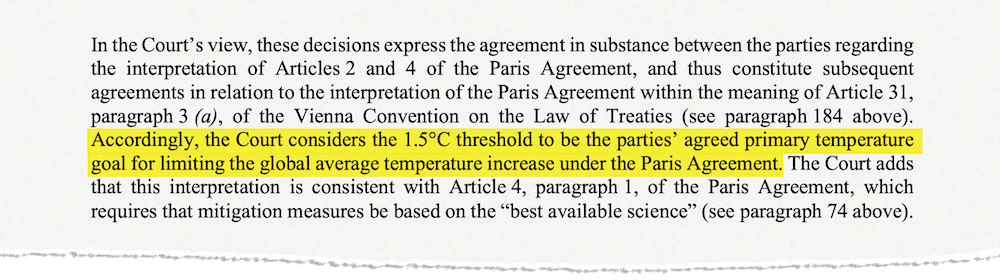
The court adds that this interpretation is consistent with the Paris Agreement’s stipulation that efforts to tackle climate change should be based on the “best available science”.
(In 2018, four years after the Paris Agreement, a special report from the IPCC spelled out how limiting global warming to 1.5C rather than 2C could, among other things, save coral reefs from total devastation, stem rapid glacier loss and keep an extra 420 million people from being exposed to extreme heatwaves.)
Following this, the advisory opinion also makes it clear that countries are not just encouraged – but “obliged” – to put forward climate plans that “reflect the[ir] highest possible ambition” to make an “adequate contribution” to limiting global warming to 1.5C.
(The climate plans that countries submit to the UN under the Paris Agreement are known as “nationally determined contributions” or “NDCs”.)
Moreover, contrary to the arguments of some countries, the advisory opinion states:
“The court considers that the discretion of parties in the preparation of their NDCs is limited.
“As such, in the exercise of their discretion, parties are obliged to exercise due diligence and ensure that their NDCs fulfil their obligations under the Paris Agreement and, thus, when taken together, are capable of achieving the temperature goal of limiting global warming to 1.5C.”
Dr Bill Hare, a veteran climate scientist and CEO of research group Climate Analytics, noted that the court’s stipulations on the 1.5C and NDCs represent a “fundamental set of findings”. In a statement, he said:
“The ICJ finds that the Paris Agreement’s 1.5C limit is the primary goal because of the urgent and existential threat of climate change and that this requires all countries to work together towards the highest possible ambition to limit warming to this level.
“All countries have an obligation to put forward the highest possible ambition in their NDCs that represent a progression over previous NDCs; it is not acceptable to put forward a weak NDC that does not align with 1.5C.
“The ICJ points to potential for serious legal consequences under customary international law if countries do not put forward targets aligned to 1.5C.”
The court also notes that the concept of equity is essential to the Paris Agreement and other climate legal frameworks, commonly referred to by text noting that countries have “common but differentiated responsibilities and respective capabilities”.
Significantly, it adds that the Paris Agreement differs from other climate frameworks by also stating that these responsibilities and capabilities should be considered “in the light of different national circumstances”.
The advisory opinion continues:
“In the view of the court, the additional phrase does not change the core of the principle of common but differentiated responsibilities and respective capabilities; rather, it adds nuance to the principle by recognising that the status of a state as developed or developing is not static. It depends on an assessment of the current circumstances of the state concerned.”
The verdict comes after debate – considered highly controversial by many – about whether “emerging” economies, such as China and India, should be considered “developing countries” at climate summits.
What does it say about fossil fuels?
One of the most eye-catching paragraphs of the advisory opinion relates to its verdict on fossil fuels.
In a section labelled “determination of state responsibility in the climate change context”, the court specifically addresses countries’ obligations when it comes to producing, using and economically supporting fossil fuels. (See below).
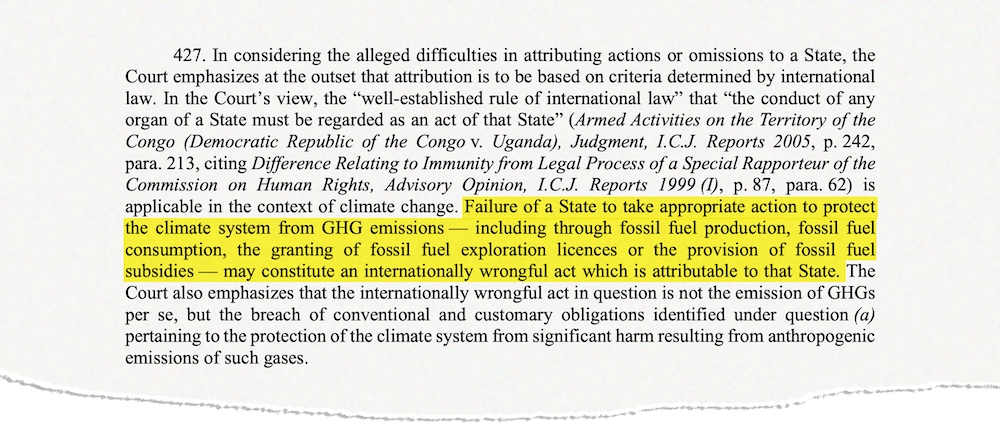
The court says that fossil-fuel production, consumption, the granting of exploration licences or the provision of subsidies “may constitute an internationally wrongful act” attributable to the state or states involved.
It comes after multiple analyses have concluded that any new oil and gas projects globally would be “incompatible” with limiting global warming to 1.5C.
Speaking to Carbon Brief, climate law expert Prof Jorge Viñuales notes that the clear mention of fossil fuels comes despite not being featured in the questions posed to the court:
“The request characterised the conduct to be assessed by reference to emissions, so the court could have stayed there. Yet, the relevant conduct was expanded to production and consumption of fossil fuels, including subsidies.”
Though the advisory opinion is not legally binding on countries, it could influence domestic decision-making around granting permissions to new fossil fuel projects going forward, adds Joy Reyes, a policy officer at the Grantham Research Institute on Climate Change and the Environment at the London School of Economics. She tells Carbon Brief:
“Litigants can cite the advisory opinion in future climate litigation, which includes the language around fossil fuels. While not legally binding, the advisory opinion carries moral weight and authority, and can influence domestic decision-making around new fossil-fuel projects. If states and corporations fail to transition away from fossil fuels, their risk for liability increases.”


The post ICJ: What the world court’s landmark opinion means for climate change appeared first on Carbon Brief.
ICJ: What the world court’s landmark opinion means for climate change

Türkiye and Australia risk losing their credibility as hosts of this year’s COP31 UN climate summit if they keep betting on fossil fuels at home, climate policy experts have warned.
As governments are expected to continue fraught talks over how to advance the global transition away from oil, coal and gas in Antalya this November, both of the co-host countries are pursuing fossil fuel expansion at home, without a national timeline to phase out their use.
Türkiye has accelerated its rollout of wind and solar energy in recent years. But that progress has yet to make a dent in the country’s dependence on fossil fuels for power, as demand growth has outpaced the renewables build-out, new analysis by Climate Action Tracker (CAT) has found.
The share of electricity generated by burning coal and fossil gas – 56% in 2025 – has barely changed since 2019, and total fossil fuel use in the power sector, and the emissions it produces, are still rising, according to the report released on Friday.
The Turkish government has also signalled that fossil fuels will remain a central component of its energy mix and has outlined plans to expand the country’s burgeoning domestic gas production in the Black Sea.
‘Need to demonstrate seriousness’
Australia, which will chair the Antalya negotiations, relies on fossil fuels for over 60% of its electricity, with coal alone still supplying 45%. According to experts, it lacks an ambitious plan to shift away from fossil fuels at home, relying heavily on carbon offsetting to reach its climate targets.
Australia is also the world’s third-largest fossil fuel exporter and has plans to expand its coal and gas production, which is backed by significant government subsidies. It recently upset climate groups by approving an extension of the Saraji open-cut coal mine in Queensland.
Türkiye says it has “final decision” at COP31 despite Australia running negotiations
Jennifer Morgan, a senior fellow with the Fletcher School of Law and Diplomacy at Tufts University and former climate envoy for Germany, said Türkiye and Australia need to demonstrate their seriousness about their COP presidency roles by leading by example on the energy transition.
“They have made progress in renewable energy,” she told reporters this week. “But I think their credibility – and their ability to therefore bring momentum and good outcomes to the COP – will depend on their taking further action at home.”
Türkiye’s electrification homework
The co-hosts’ fossil fuel policies are being scrutinised in the run-up to the annual UN climate summit, with much riding on the signal climate diplomacy sends on the energy transition.
Türkiye has so far stopped short of putting any overt political capital behind the fossil fuel transition itself. It has instead been rallying support for a new global electrification target of 35% by 2035, seen as the centrepiece of this year’s non-negotiated Action Agenda put forward by Ankara.
COP31 president Murat Kurum said last week the push to electrify economies – through measures like electric vehicles and heat pumps – will “automatically” lead to a reduction in the use of fossil fuels.
Türkiye’s own energy plan projects the country’s electrification rate would fall short on the global target and only hit 25% by 2035, according to the CAT report, which called for a “substantial step-change” in electrification policies and the deployment of more renewable power and grid infrastructure.
Coal still dominant
CAT’s analysts also warned that, without a parallel phase-out of fossil fuels, rising electricity demand risks being met in part by coal and gas, failing to deliver the emissions reductions the electrification target is meant to achieve.
Türkiye has had some success in its clean energy build-out: the share of electricity generation from wind and solar rose to 22% in 2025, up from 12% in 2020, according to the CAT report.
But coal’s role in Türkiye’s electricity mix has also grown, in both its share and absolute terms, over the past decade. And while reliance on fossil gas has declined overall, it still plays an important role in Ankara’s energy policy, which is pushing to boost domestic gas production in the Black Sea.
Dr Niklas Höhne from the NewClimate Institute said the government could demonstrate leadership as COP31 president by building on its recent successes in increasing its renewable energy capacity and announcing targets and plans to phase out coal and gas ahead of the summit.
According to CAT, Türkiye should phase out coal by 2040 and fossil gas by 2045 at the latest to align its power sector with global efforts to limit the rise in global temperatures to 1.5C above preindustrial times.
Türkiye quiet on fossil fuel roadmap
Ümit Şahin, coordinator of climate change studies at the Istanbul Policy Center (IPM), said Türkiye’s strategy is to approach the fossil fuel debate exclusively from the “end-use point of view”.
“I don’t expect any push from the Turkish presidency to the producer countries in terms of fossil fuel production,” he told reporters.
Neither does Şahin believe the Turkish presidency will throw its political weight behind another big-ticket item for COP31: a new global roadmap to transition away from fossil fuels.
Brazil took on the responsibility to voluntarily draft this document outside of the formal negotiations as a way to break the deadlock at last year’s UN summit in Belém when governments clashed over whether to develop one.
The outgoing COP30 presidency will deliver the roadmap in early November – but it will be up to Türkiye and Australia to guide countries towards a decision on how the blueprint will be taken forward, either inside or outside the negotiations.
Leadership needed
Australia’s Chris Bowen, COP31’s president of negotiations, promised to lobby producing countries to deliver a “meaningful step forward” on the fossil fuel transition in an interview with The Guardian earlier this year. But he has been quiet on the role Australia sees for the fossil fuel transition roadmap.
Natalie Jones, senior policy advisor at the International Institute for Sustainable Development (IISD), said the COP31 co-presidents “must provide clear leadership” on this process.
“This roadmap cannot be left in a dusty drawer,” she told journalists. “Rather, it must be translated into action, with all countries identifying what elements they can adopt or develop in their own national roadmap.”
-
Made in Nigeria: The race to build an African solar industry from scratch
A solar power revolution is gathering pace in Africa and Nigeria wants a slice of the fast-growing industry, but competing with Chinese imports won’t be easy -
China’s industrial engine starts to break its fossil fuel habit
Despite a rebound in coal generation this year, clean energy from wind and solar is gaining ground on the fossil fuels that have powered decades of industry growth

Like Türkiye, Australia has yet to produce a national blueprint for winding down coal, gas and oil. Rather than moving toward a phase-out, state and federal governments have kept expanding fossil fuel licensing over the past year, according to a new analysis published this month by Climate Analytics.
Under existing policy, both coal and gas are on track to remain in Australia’s power system as late as 2050 – a trajectory the report defines as incompatible with the 1.5C limit the country says it’s committed to.
No binding end dates for the Netherlands
Analysts are watching out for national transition roadmaps as a bellwether for governments that claim to be leaders in the global shift away from fossil fuels.

The Netherlands, which co-hosted the first fossil fuel transition conference in Santa Marta this year, published its own domestic roadmap earlier this week. The document followed through on a pledge that “leadership on transitioning away from fossil fuels must be backed by concrete action, not just ambitious words”, said a spokesperson for Stientje van Veldhoven, the Dutch minister for climate policy.
But experts criticised the plan for failing to set a binding end date for the country’s fossil fuel production and use. While targeting a rapid increase in renewables capacity, the Dutch government only commits to phasing out oil, gas and coal “in the energy and feedstock system to eventually zero, and to minimise fossil use” by 2050.
Yvo de Boer, a former Dutch diplomat and executive secretary of the UN climate body, said the Dutch roadmap falls short of what’s needed to give industry the confidence to deploy capital in support of the energy transition with greater predictability.
“Ultimately, a roadmap without deadlines is nothing more than a footpath paved with good intentions,” he added, writing on LinkedIn.
The post Fossil fuel expansion threatens COP31 hosts’ credibility, experts warn appeared first on Climate Home News.
Fossil fuel expansion threatens COP31 hosts’ credibility, experts warn
Despite millions of dollars in grants and technical help for African businesses to power farming and other food production activities with renewable energy, most efforts remain stuck at the early stages because they struggle to find the investors, markets and expertise they need to grow.
This was the message from a coalition of global institutions working on energy, water and agriculture at this month’s Africa Food Systems Forum in Kigali, Rwanda.
“Energy, agriculture, water and nutrition actors rarely design solutions together,” the Agri-Energy Coalition said in a Call to Action on powering food systems with clean energy.
Using more renewables – especially solar power – to drive food systems would reduce food losses, ensure year-round availability and affordability of healthy foods, and improve productivity, income and resilience among farmers, food processors and other small enterprises, the coalition added.
In an interview with Climate Home News at the forum, Olamide Niyi-Afuye, CEO of the Africa Minigrid Developers Association (AMDA) – a body representing private-sector developers of small-scale, off-grid electricity systems across the continent – said its members are starting to recognise this interdependence and are increasingly considering businesses that combine energy with agricultural activities.
-
Second Africa Climate Summit seeks to jump hurdles to green industrialisation
A report on progress since the first summit in 2023 says financial, infrastructure and trade obstacles are hampering “climate-positive growth” on the continent

This, Niyi-Afuye added, could lead to greater supply and use of clean power for key processes like irrigation, food processing and storage, creating new sources of revenue for both sectors.
CHN: Conversations at the Africa Food Systems Forum highlighted how organisations working in energy and agriculture often operate in silos. What has hampered their collaboration, and how has that affected Africa’s economic development?
A: Most mini-grid companies in Africa were primarily incentivised to achieve connections. If you look at some ongoing projects, you see a cost-per-connection model [of revenue]. When a subsidy is tied to achieving a connection, regardless of whether it is a productive connection, you might not notice the problem until five years down the line, when you realise the cash flows are not what you projected.
Despite African walkout, fractious land COP ends without drought deal
So now we’re in a “come-to-Jesus moment” as an industry, where we’re righting the wrongs and adjusting our business models to make sure companies do not go bust and there is some level of sustainability over the long term.
The saying is not wrong that we’ve been working in our own silos because we’ve focused on the smaller things instead of the helicopter view. There needs to be cross-pollination [between the energy and agriculture sectors] because, if we are thinking about industrialisation, energy is a key driver of industrialisation. We will not achieve that if we’re not in the room and part of those conversations.
CHN: Productive use of energy is intended to ensure electricity access goes beyond lighting homes to improving livelihoods, creating jobs and powering equipment. But what happens when farmers cannot afford the equipment they need to do that? How can energy, agriculture and equipment players work together to make the transition more accessible?
A: That’s why we’re having conversations with companies set up to de-risk the agriculture sector. By leveraging that connection, we’re able to aggregate potential energy needs and develop instruments that make equipment more affordable through bulk procurement.
We can have arrangements that make it easier for farmers and food producers to lease equipment and eventually own it over a period. There’s no real pressure to recover the capital very quickly because you’re looking at scale.
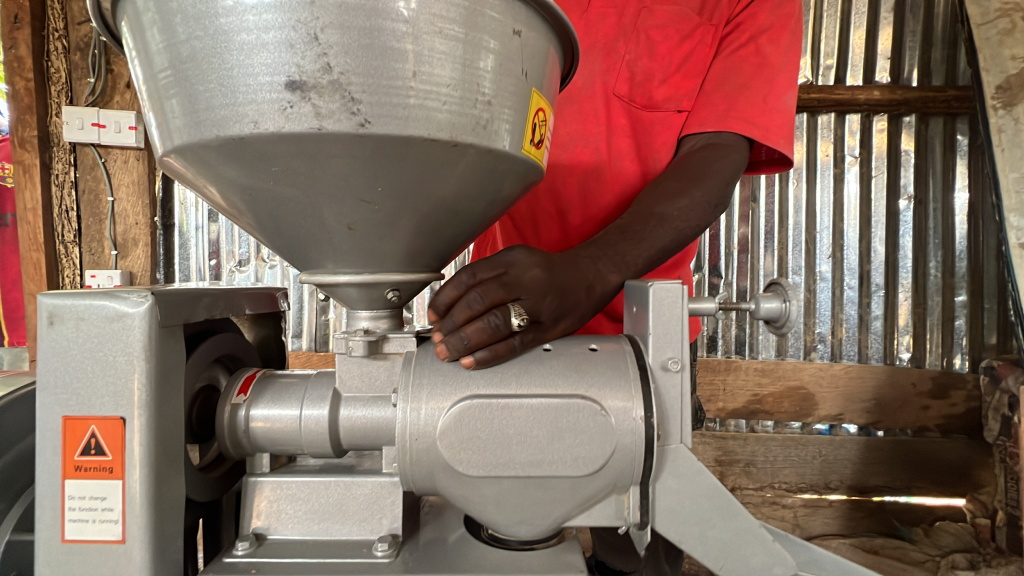
There is a whole lot across the agricultural value chain that needs energy, from farming and harvesting to food processing and value-addition. We need to understand the energy needs across the value chain and bring our members in to provide solutions.
Developers do not necessarily need to provide every productive-use solution themselves. They can partner with equipment suppliers, financiers, agribusinesses and other service providers to enable customers to use electricity productively. The objective is simple: do not just electrify communities; enable economic activity that uses that electricity.
CHN: When Africa’s industrialisation is discussed, you hear things like renewables cannot provide enough baseload, while some food processors are sceptical about switching to renewable energy because of these concerns about reliability. What is your response?
A: It’s not a controversial statement to say that a typical baseload is usually from the grid, and it’s usually from multiple sources including renewable energy. For large-scale operations, we can look at blending multiple sources of energy. But how do we solve the problem of a mid-sized farmer? We can solve it with a mini-grid using renewable energy.
Comment: Every country needs a model to help optimise its energy transition
If you go to a small farmer in a rural area, they don’t care about what source of energy they’re getting. They just want something that can help them get from A to B. If you look at the direct energy needs of farmers and food processors, I’m sure 90 percent of their consumption can be solved by renewable energy. Let’s start with that problem first. Then, as they scale, they might need to ramp up, and we can start talking about a bigger baseload.
CHN: How much agricultural value is lost because farmers and food businesses lack reliable, affordable electricity?
A: If you look at, for example, the fact that we need to maybe plant tomatoes or strawberries in Jos before it gets to Lagos [Nigeria], which most likely is by road, I can assure you that a good chunk, if not stored properly, would be bad by then. So the fact that we do not have energy is in itself a lost opportunity to maximise the potential of the agriculture sector. So until we’ve solved the energy problem, we will not salvage waste – and for me that is a lost opportunity.
CHN: AGRA, an institution focused on scaling agricultural innovations to help smallholder farmers, estimates a massive shortfall between current investments in the continent’s food systems and what is actually needed to build a resilient, profitable agricultural economy – to the tune of $180 billion per year. Can integrating energy into food systems help bridge that gap?
A: Yes – if energy can help unlock the potential to earn more money, investors will follow the money. Investments go where there is certainty, and until there is certainty around cash flow and revenue, investment will be limited.
My vision is to see more Power Purchase Agreements (PPAs) being signed between energy players and the agriculture sector. We can start by getting people into the room, understanding their pain points, crafting a framework and documentation that works for both parties, and then seeing deals happen.
This interview was shortened and edited for clarity.
The post How clean energy can boost business for Africa’s food producers appeared first on Climate Home News.
How clean energy can boost business for Africa’s food producers
Cristina Rumbaitis del Rio is a senior advisor on adaptation and resilience with the United Nations Foundation and Mattias Söderberg is global climate lead at Danish NGO DanChurchAid.
Recent extreme events – from wildfires and heatwaves in Europe to flash flooding following a glacier collapse in Nepal – have shocked and devastated communities, bringing years of warnings about such climate impacts to the doorstep of communities around the world.
One thing is certain: the new climate reality is here – and the adaptation strategies designed for yesterday’s world are no longer sufficient.
Attribution science has since shown that the hotter and more frequent heatwaves we’re experiencing around the world would have been virtually impossible without today’s high concentrations of greenhouse gases in the atmosphere. Climate shocks are now so severe that they reverberate through supply chains, food and water systems, financial markets and the movement of people.
-
Foreign minister: Nepal needs “meaningful” international support to face climate threats
Following its recent Himalayan flooding disaster, the South Asian nation is seeking urgent help from a new UN climate fund, appealing for “stronger global solidarity” -
Palestine: Israel’s bombing has left Gaza vulnerable to climate change
With homes, hospitals and water storage destroyed, Palestine’s government says that Gazans have little protection from climate impacts and sets conditional emissions targets
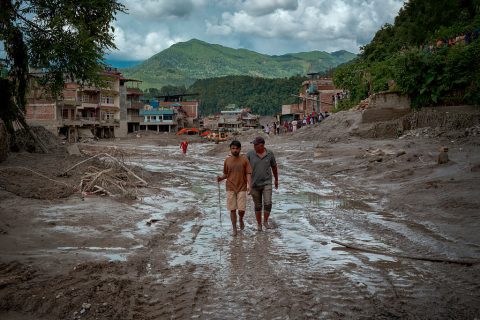

They must be a catalyst for a new way of thinking about adaptation and resilience, and how we finance solutions that work. A failure to invest in adaptation in one region can create costs far beyond it, which is why the concept of shared resilience is critical for leaders to grasp.
Investment not charity
At the UN General Assembly (UNGA 81) this month, leaders have an opportunity to translate today’s urgency into concrete commitments on adaptation and loss and damage finance ahead of COP31.
Those commitments are needed to underpin global stability, shared prosperity and human security. Governments should use this moment to show what a new response looks like: finance that reaches communities faster, supports locally grounded solutions, strengthens national systems, and helps countries prepare before the next shock arrives.
If we want sustained economic growth, food and water security, and resilient and prosperous societies across every region, adaptation must be at the heart of today’s development and security agenda. It cannot be just a future planning consideration or a narrow issue for climate ministries. Adaptation is now everyone’s business – and it must be financed fast and fair.
UN Secretary-General António Guterres has repeatedly framed climate finance as an investment rather than charity, warning that “a world in climate chaos cannot be a world at peace” and describing human security as freedom from the chronic and sudden disruptions that climate change multiplies.
What’s more, adaptation delivers a real return-on-investment, with researchers estimating that every dollar invested produces $10 in benefits, saving lives, protecting livelihoods, and reducing the costs of future disasters.
Hitting adaptation limits
The urgency to scale adaptation systematically is growing. The newly released “Limiting Overshoot” report from the UN Environment Programme (UNEP) confirms what scientists have long warned: exceeding global warming of 1.5C is now unavoidable under current policies. Yet, how high temperatures rise – and how long the world remains above the 1.5C threshold – will determine whether communities, economies and entire ecosystems can keep pace.
There are limits to adaptation. When we breach those limits, lives and livelihoods are lost, and people and ecosystems suffer greatly. We cannot simply build yesterday’s infrastructure a little stronger and assume it will be enough.
Nepal flood destruction shows “limits to adaptation”, scientists say
We need to fundamentally change the systems that determine how societies anticipate, absorb and recover from both immediate and evolving non-linear climate shocks. This includes transforming physical systems, such as infrastructure, and the governance systems that affect where and how we live to how we maintain our health and wellbeing.
Finance today is nowhere near the scale of the challenge.
The UNEP “Adaptation Gap Report 2025” estimates the shortfall in adaptation finance in developing countries at $284 billion–$339 billion a year – roughly 12 to 14 times current international public flows of around $26 billion. That gap is a development, economic and human security problem, especially for the most vulnerable populations who have contributed the least to causing the climate crisis.
Building resilience into financial systems
There are already signs of what a more systemic adaptation response could look like. Communities around the world are delivering practical solutions at local level, even as adaptation finance remains notoriously, and appallingly, difficult to access. Cyclone-resistant homes, local forecasting capacities, drought-resistant crops, heat insurance for pregnant informal workers and mangrove restoration are rooted in local knowledge and lived experience, while delivering benefits far beyond the communities where they originate from.
But local innovation alone is not enough; the systems around it need to be resilient too.
Jamaica offers one example. The country has built a multi-layered disaster-risk financing framework, including a catastrophe bond and contingency funds, through sustained fiscal discipline and proactive investment. Its debt-to-GDP ratio fell from around 147% in 2012 to around 62% in 202-25. That groundwork matters when disaster strikes.
Hurricane Melissa’s destruction shows need for climate resilience push
Following Hurricane Melissa, Jamaica was able to secure billions of dollars in reconstruction financing from multilateral banks – finance that might otherwise have been much harder to access. The lesson is clear: resilience can be built into the financial architecture of a country before a crisis arrives. That is the shift we now need to make at scale.
The foundations already exist – in Kingston’s fiscal reforms, in early-warning systems from the Sahel to the Pacific, and in every community that adapted before disaster struck. What is still missing is the political will, and the finance, to take what works and put it to work everywhere, at the speed our world’s new climate reality demands.
To hear more on this issue from high-level officials and experts, sign up for this event during Climate Week NYC, at 8am EDT on September 24 (in person or online), moderated by Climate Home News Editor Megan Rowling: Adapting to the New Climate Reality: Why Accelerating Impacts Demand New Responses.
The post Human security relies on adapting to the world’s new climate reality appeared first on Climate Home News.
Human security relies on adapting to the world’s new climate reality



-

 Greenhouse Gases2 years ago
嘉宾来稿:满足中国增长的用电需求 光伏加储能“比新建煤电更实惠”
-
Climate Change1 year ago
Guest post: Why China is still building new coal – and when it might stop
-
Greenhouse Gases1 year ago
Guest post: Why China is still building new coal – and when it might stop
-

 Climate Change2 years ago
嘉宾来稿:满足中国增长的用电需求 光伏加储能“比新建煤电更实惠”
-

 Renewable Energy11 months ago
Sending Progressive Philanthropist George Soros to Prison?
-
Climate Change2 years ago
Bill Discounting Climate Change in Florida’s Energy Policy Awaits DeSantis’ Approval
-
Greenhouse Gases1 year ago
嘉宾来稿:探究火山喷发如何影响气候预测
-

 Carbon Footprint2 years ago
US SEC’s Climate Disclosure Rules Spur Renewed Interest in Carbon Credits