

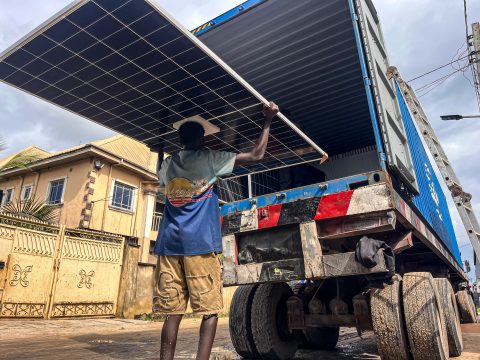
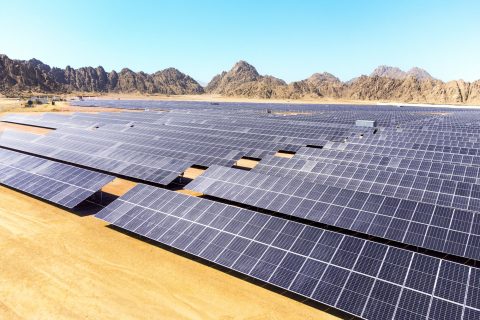
More than 300,000 solar panels and 120 battery containers are helping to power Africa’s largest copper mine with continuous clean energy in the Democratic Republic of the Congo, as miners turn to solar as an alternative to expensive diesel and energy imports.
The project at the Kamoa Copper mine in the south of the DRC, which became operational last month, is one of the largest solar and battery facilities generating baseload power on the continent.
The clean electricity is displacing millions of litres of polluting diesel and costs less than a fifth of the price of generator power per kilowatt hour, the mining company said.
The project is part of a massive solar deployment across the continent. Recent data from global energy think-tank Ember found record solar capacity of 17 GW will be installed in Africa this year – a 45% rise from 2025.
Installed by CrossBoundary Energy, a developer of distributed renewable energy systems, the solar-battery facility at the DRC mine is “proof of concept” that solar and battery systems can provide the reliable power at scale needed by remote industrial operations, Annebel Oosthuizen, managing director at Kamoa Copper, told Climate Home News in an interview.
“There’s always been this perception in the DRC that solar isn’t ideal because it is raining half of the year. But it’s perfectly ideal. We are seeing a lot of interest from other mines that are still depending on generators and power imports,” she said.
Mining drives solar and battery surge
Like Kamoa Copper, a growing number of miners in the DRC are looking to solar power to compensate for the country’s chronic energy deficit at a lower cost as global diesel prices hit record highs amid ongoing attacks on oil infrastructure in the Middle East.
As a result, the mining sector has become a key driver of the country’s growing clean energy demand and one of the biggest importers of large-scale solar equipment.
Ember found the DRC is set to install a record 1.7 gigawatts (GW) of solar panels this year – a 544% increase compared to 2025 and the equivalent of adding more than 60% of the country’s entire 2023 grid capacity.
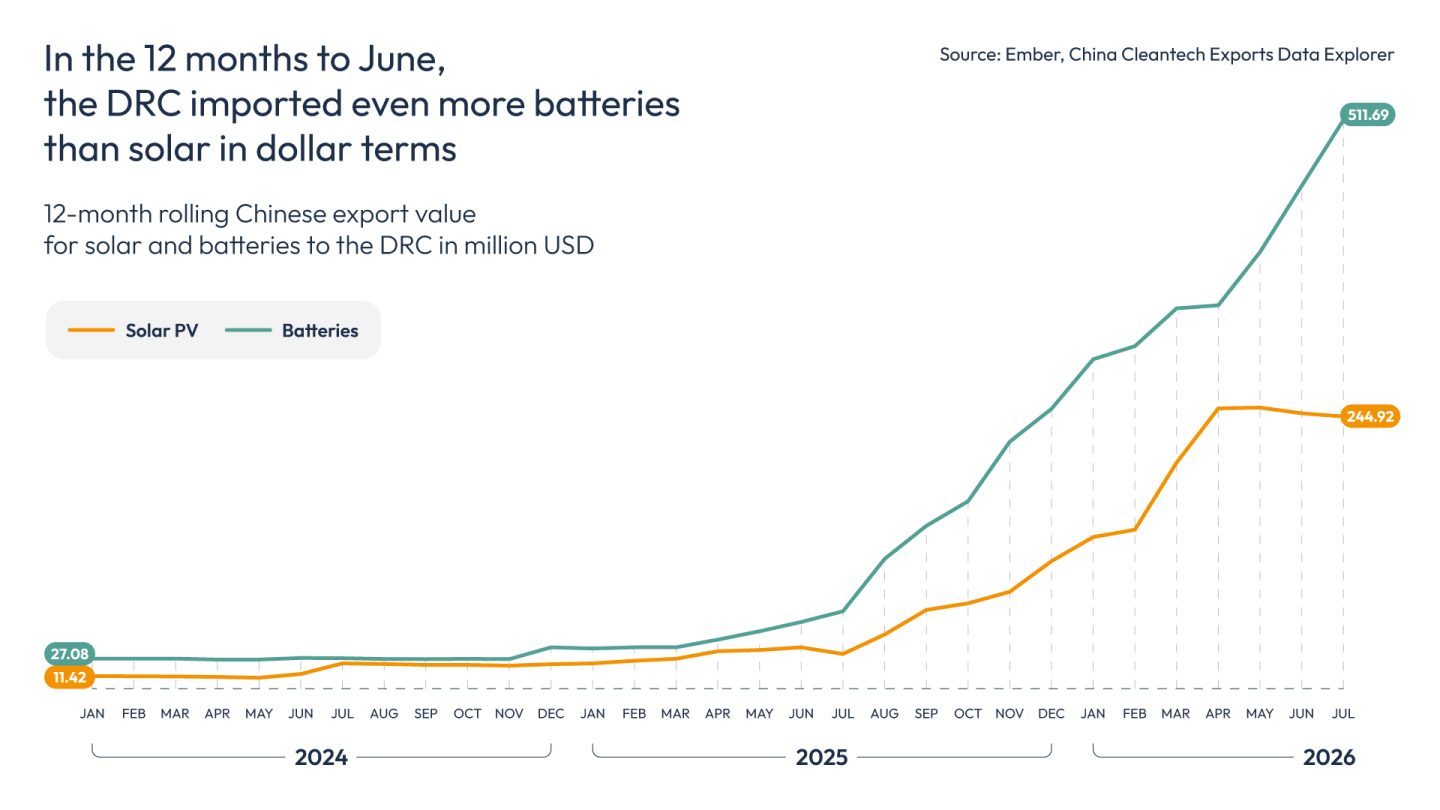
The deployment of combined solar and battery storage solutions to deliver stable energy supplies to mines has also caused battery imports to surge. In dollar terms, the DRC’s imports of batteries from China far exceeded that of solar in the year to June 2026, according to Ember.
A crippling power deficit
The DRC holds significant energy resources and some of the world’s largest reserves of the minerals required to manufacture clean energy technologies. It is the world’s largest producer of cobalt, which is needed to make batteries, and Africa’s top producer of copper – a metal sought after for its electrical conductivity which is pivotal to the world’s electrification efforts.
Yet just 22.5% of the DRC’s population had access to electricity in 2024 – one of the lowest rates in the world, according to the World Bank. And as mining expands and more of the minerals extracted are being processed in the country, unreliable power supply has become a major constraint for the sector, which contributed to more than a quarter of the country’s GDP in 2024, excluding oil and gas.
The country has enormous hydropower potential, with the hydroelectric potential of the Congo River estimated at around 100 GW. But only a fraction is being harnessed.
-
Made in Nigeria: The race to build an African solar industry from scratch
A solar power revolution is gathering pace in Africa and Nigeria wants a slice of the fast-growing industry, but competing with Chinese imports won’t be easy -
Can giant batteries unlock Africa’s green industrial future?
Battery energy storage systems (BESS) could drive clean tech manufacturing in Africa but shortfalls in finance and data are still limiting deployment at scale -
Egypt seeks to unlock renewable potential to power regional clean energy hub
Europe is investing in Egypt’s bid to position itself as a clean electricity exporter to reduce its emissions and generate a new source of income

Still, virtually all of the DRC’s grid-connected electricity is generated by hydropower by the state-owned utility, Société Nationale d’Électricité (SNEL).
The electricity then has to be transported more than 1,500 kilometres to reach the mining belt in the south – a challenge made more difficult by ageing grid infrastructure and limited transmission capability. SNEL did not respond to a request for comment.
“It is estimated that there’s around a 1 GW energy deficit for the DRC mining sector,” said Matt Tilleard, CEO of CrossBoundary Energy, which owns the solar and battery equipment at the Kamoa Copper mine and provides the power as a service.
“The interest in solar from the mining industry is not theoretical – it is already translating into large-scale solar and battery procurement for mining operations in the region,” he added.
Solar displaces gas, saves energy costs
The facility installed by CrossBoundary is part of a plan by Kamoa Copper to supply more of the electricity it needs with solar energy and batteries as its operations expand, a faster solution than relying on harder-to-build hydropower projects.
“Our processing capacity has increased drastically over the last couple of years. We’ve constructed the largest copper smelter in Africa and that is so power-intensive,” said managing director Oosthuizen.
A joint venture between Canadian firm Ivanhoe Mines, Chinese company Zijin Mining Group and the DRC government, the mine needs 235 megawatts (MW) of power, which is expected to nearly double to 450 MW in the next five years.
Kamoa Copper currently receives 100 MW from state utility SNEL – “and the rest we have to find a solution for”, said Oosthuizen.
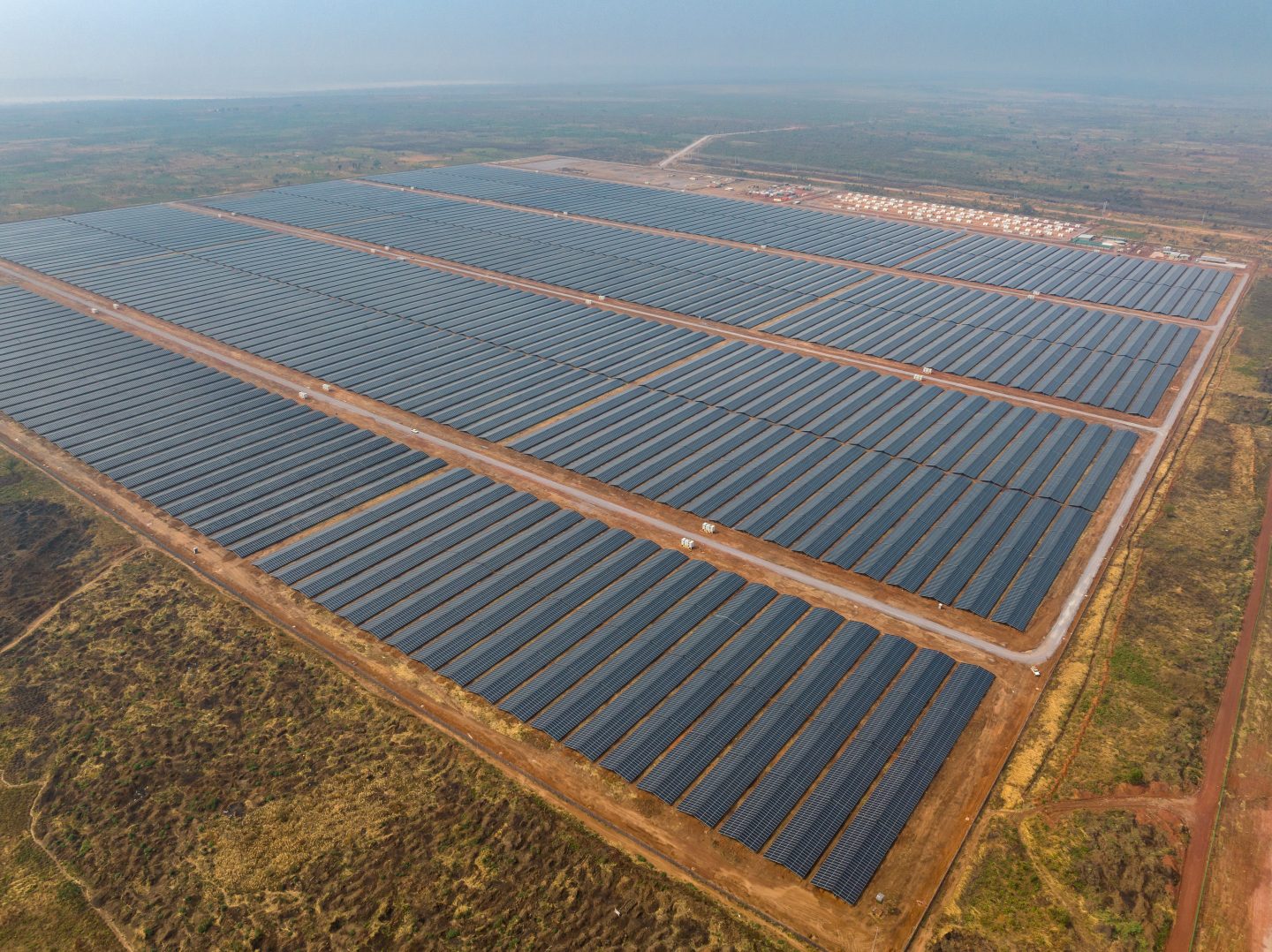
Another 30 MW solar and battery baseload facility is expected to come into operation this month, enabling around 25% of the mine’s power needs to be generated by solar energy. An additional 60 MW of continuous solar power will be added by the end of 2027, and the company is exploring options for more solar capacity and two hydropower projects.
The operational 30 MW of clean electricity provided by CrossBoundary Energy will power pumps that prevent 400 million litres of water from flooding the underground mine every day.
In August alone, the facility has reduced the mine’s diesel consumption by around four million litres, generating an estimated $11 million dollars in savings at current diesel prices, Oosthuizen said.
The mine still relies on generators to meet a 20-40 MW deficit and to power the trucks used in the mine, which Oosthuizen said would be difficult to electrify in the next five years because the technology isn’t yet ready to operate in the mine’s tough and wet conditions.
Avoiding a two-speed transition
To prevent a major imbalance between industrial players’ access to clean, reliable energy and the millions of Congolese who remain without power, the government requires private electricity producers to reserve at least 10% of their generated power for local communities living near rural production sites.
Delivering this, combined with rural electrification, mini-grid development and national grid expansion, is critical to prevent a two-speed energy transition that leaves people behind, said Catherine Mukobo, head of ACERD, the Congolese Association for Renewable and Decentralised Energies.
“Without implementing these policies, the DRC could get in a situation where mines have access to abundant modern energy while a large part of the population remains without electricity,” she said.
The post DR Congo’s power-hungry mining sector drives record solar surge appeared first on Climate Home News.
DR Congo’s power-hungry mining sector drives record solar surge

Next week, diplomats from around the world will descend on Yerevan, Armenia, to negotiate a series of decisions under the UN Convention on Biological Diversity (CBD).
Between 19 and 30 October, 196 parties will gather to hammer out the precise wording of the dozens of legal texts that make up the decisions under the Conference of the Parties (COP) to the CBD.
This year’s summit is particularly significant, as it marks the halfway point between the agreement of the Kunming-Montreal Global Biodiversity Framework and the deadline for achieving its targets.
The CBD has found that countries are currently not on track to meet 22 out of the framework’s 23 targets.
During the fortnight, delegates will also be negotiating decisions relating to the two supplemental protocols to the CBD: the Cartagena Protocol, which covers biosafety; and the Nagoya Protocol, which covers access and benefit-sharing for the use of genetic resources.
(The Cartagena and Nagoya Protocols, which are each governed by a “meeting of the parties”, or “MOP”, have fewer parties than the CBD as a whole, with 173 and 141, respectively.)
Carbon Brief is tracking the progress of countries towards consensus on dozens of negotiating texts using the interactive table below.
The tracker includes texts from the COP, as well as the MOPs for the Cartagena and Nagoya protocols. It also includes draft decisions from the most recent subsidiary body meetings, as these form the starting point for the negotiations in Yerevan.
The CBD has three subsidiary bodies: the subsidiary body on scientific, technical and technological advice (SBSTTA), the subsidiary body on implementation (SBI) and the subsidiary body on article 8(j) and other provisions (SB8J).
SB8J focuses on issues related to the Indigenous peoples and local communities. It was established at COP16 in Cali, Colombia, in 2024.
The first two columns of the interactive tracker list the topic of each agenda item and the relevant body, with subsequent columns including dates, page counts and links to the original documents.
The table is searchable and can be sorted using the arrows in the header.
Areas of disagreement in UN draft texts are denoted by square brackets. Counting the brackets in a particular iteration of a text therefore gives a sense of how far parties are from reaching consensus.
The bracket column is colour-coded, with dark green indicating a low number of brackets and red indicating a high number of brackets remaining.
Texts can also present parties with choices using “options” or alternatives (“alt”), which are counted together in the sixth column of the table.
The key discussions in Yerevan will centre around two agenda items in particular. The first is the global review, which will assess progress towards the GBF and make recommendations for accelerating action.
The second is finance, which can be separated into two parts: resource mobilisation and the financial mechanism. On resource mobilisation, biodiverse global south countries are likely to push for an increased amount of international finance for conservation.
Disagreement over the creation of the financial mechanism led to the suspension of COP16 in Cali in October 2024, as parties failed to find agreement on the mobilisation of finance before the end of the summit.
Global south countries want the establishment of a separate financial mechanism under the control of the CBD; global north countries largely prefer to maintain the existing mechanism, which sits under the Global Environment Facility.
At the resumed session of COP16 in Rome in early 2025, countries agreed on a roadmap that would lead to the establishment of a permanent mechanism.
related

Analysis: Lula presidency saved at least 20,000km2 of Brazilian Amazon since 2022

Why land-use emissions have fallen by a third this century – in six charts

Analysis: 84% of nations miss deadline to identify ‘nature-harming’ subsidies by 2025

UK withdraws millions in funding from world’s second-largest rainforest in Congo
The post Interactive: Tracking negotiating texts at the COP17 biodiversity summit appeared first on Carbon Brief.
Interactive: Tracking negotiating texts at the COP17 biodiversity summit
A beacon of love
On an outer island of Fiji, two thousand nautical miles from Sydney, is a shining light of hope and resilience for our troubled world.
The island of Kioa is home to a Tuvaluan community who migrated from their atoll of Vaitupu in the late 1940s. It is a land of warm hearts, big smiles, and deep cultural roots; a place where the sound of a conch still summons the island together, where islanders paddle out to fish in carved outrigger canoes, and healthy happy children walk barefoot to school.
Here, culture is life. Kioans live sustainably through their traditional knowledge and practices. The island is alive with song, dance and the rhythms of a life tied to the tides, the winds, and the seasons.

Facing the future
Greenpeace has been lucky to have a relationship with Kioa for a number of years now, and we are continually learning from this remarkable community.
Last week, as part of our Voyaging Oceania project, we returned to the island. Our purpose was twofold —- to carry messages from the island to leaders gathering in Nadi this week for the Pacific Pre-COP, and to support the Kioa community in their efforts to improve water security for the island.
Unlike Tuvalu itself, with its eight atolls, Kioa is a mountainous, forested and richly fertile island. It will remain habitable far into the future. Kioans did not initially migrate from Vaitupu due to climate change, but the move was prophetic. They now have a lifeboat.
However, even Kioa faces challenges on our rapidly warming planet, in particular when it comes to water. Climate change is shifting once reliable rainfall patterns. On top of this, the island is already feeling the effect of this year’s intensifying El Niño event, which for Fiji means reduced rainfall and prolonged dry spells.
Right now, fresh water has to be carefully rationed, and is only available for a few hours a day. During last week’s visit aboard our campaigning ship Oceania, Greenpeace was privileged to work with the Kioa community on a new solar-powered water distribution project for the island.
Designed and led by the island, the project involves using a solar pump to move water from a reliable source to a storage tank and then using gravity to distribute the water around the village.
It was a lesson in how local knowledge and ingenuity can be the backbone of today’s climate solutions. To build a dam around the source, the local community knew the exact spot where they could gather gravel at low tide to mix with the cement. They took only what was needed, knowing that all resources must be carefully conserved. Kioa has no roads and no machinery, and it was an all-of-island effort to carry the materials up to the project site, including many heavy bags of sand and rock.
Such projects truly bring to life the vision of a resilient, locally-led, fossil fuel free Pacific.