


Advanced Micro Devices (NASDAQ: AMD) has been in the spotlight lately. This is due to its record stock price and strong environmental, social, and governance (ESG) efforts, as well as its sustainability programs. The company’s strong financial growth is driven by the soaring demand for its AI and data center chips.
AMD’s focus on sustainability gives it a competitive edge, which may help the company thrive for years to come. Let’s dive into the chipmaker’s record-breaking achievements.
AMD Hits Record Highs on AI Momentum
AMD’s stock recently climbed significantly as shown in the chart. The excitement around its MI300 series GPUs and EPYC processors drives this surge. These products are made for artificial intelligence (AI) and high-performance computing (HPC). These products are allowing AMD to compete aggressively with rival tech giant Nvidia.
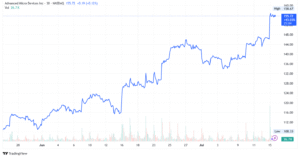
Analysts are hopeful about AMD’s future, with HSBC upgrading its stock. They see the MI350 chip as a strong competitor to Nvidia. As such, AMD’s forward price-to-earnings (P/E) ratio is about 21x. This is attractive, especially when you compare it to Nvidia’s P/E of around 38x.
The broader AI market is also booming. According to International Data Corporation (IDC), AI server spending is expected to grow by over 25% annually through 2027. This growth is likely to increase demand for AMD’s AI-specific chips.
Notably, AMD now powers 157 of the world’s top Green500 supercomputers, platforms that combine raw computing power with energy efficiency. This highlights AMD’s dual focus on performance and sustainability.
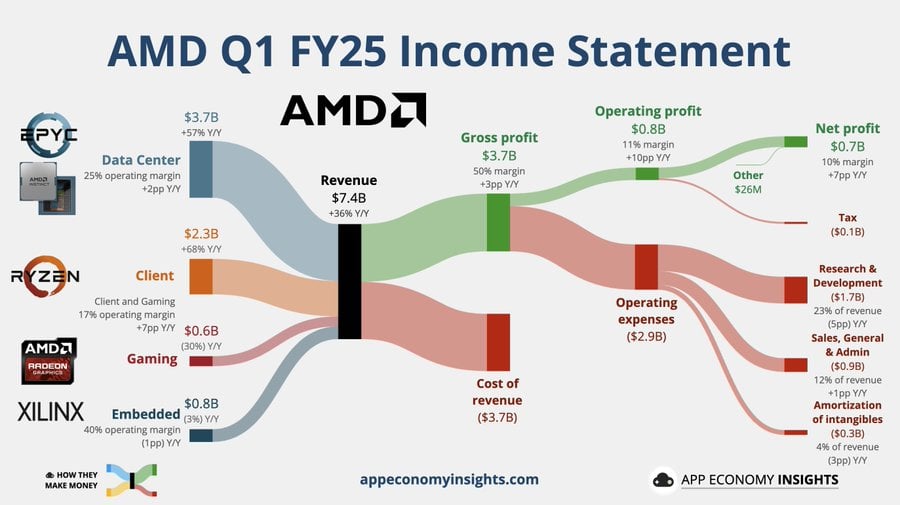
AMD’s recent financial reports reflect this momentum. In the first quarter of 2025, AMD posted double-digit revenue growth and improved gross margins. Strong sales in data centers and AI platforms boosted earnings. This sparked greater confidence among both analysts and investors.
AMD’s Blueprint for Responsible, Greener Growth
Beyond its technology leadership, AMD puts great emphasis on sustainability and responsible governance. The company was named Newsweek’s #1 Greenest Company in 2024. It also earned top scores for environmental transparency from various ESG rating agencies.
AMD’s governance and ESG framework includes:
- Conducting thorough materiality assessments in partnership with BSR (Business for Social Responsibility).
- Aligning reporting and disclosures with industry-leading frameworks like the Task Force on Climate-related Financial Disclosures (TCFD), Sustainability Accounting Standards Board (SASB), and CDP (formerly Carbon Disclosure Project).
- Committing to achieving full net-zero emissions throughout its entire value chain by 2050, with interim targets already set.
This strong ESG framework builds investor trust. It also aligns AMD with new global policies. These include Europe’s Corporate Sustainability Reporting Directive (CSRD) and the International Sustainability Standards Board (ISSB) guidelines. Both are shaping future sustainability reporting needs.
From Silicon to Sustainability: AMD’s Net Zero Game Plan
AMD’s environmental goals focus heavily on reducing its greenhouse gas (GHG) emissions. It has pledged to cut absolute Scope 1 and 2 emissions (direct emissions and those from purchased electricity) by 50% by 2030, compared to 2020 levels.
By 2023, AMD achieved a 24.5% reduction, lowering emissions to 46,605 metric tons of CO₂ equivalent from a baseline of 61,754 in 2020. Third-party assurance standards (ISAE 3000) have verified this data, adding credibility to its progress.
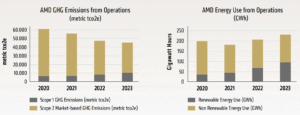
AMD completed the acquisition of Xilinx in 2022. This increased its emissions baseline because of larger operations. However, AMD has kept making progress despite this challenge. This shows the company’s ability to manage decarbonization efforts even while growing.
AMD boosted its renewable energy use. It jumped from 18% in 2020 to around 40% by 2023. This means over 83 gigawatt-hours (GWh) of clean power each year. It more than doubles renewable electricity use in just three years. This cuts down the environmental impact of its operations. It also supports the sustainability goals of its data center customers.
Importantly, AMD’s climate ambitions extend beyond its own operations to its supply chain. The company asks all its manufacturing suppliers to set public GHG reduction targets by 2025. So far, approximately 84% of these suppliers have already published emissions targets, and 71% source at least some renewable energy.
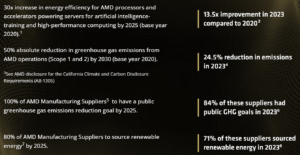
AMD aims for full alignment by 2025, with 80% of suppliers sourcing renewable energy by that time. Also, 83% of supplier manufacturing sites have been audited by the Responsible Business Alliance (RBA). This checks for responsible labor and environmental standards.
This approach boosts AMD’s role across the value chain. It starts from chip making and goes to finished electronics. This helps the whole industry make progress on climate change.
ESG Risk Management and Regulatory Alignment
AMD also incorporates climate risk into its long-term strategic planning. It is part of the Semiconductor Climate Consortium. This group creates climate transition strategies by looking at physical and market risk scenarios.
By doing this, AMD prepares for future regulatory demands, including the U.S. Securities and Exchange Commission (SEC) Climate Rule and the EU’s CSRD.
Energy Efficiency: The 30× by 2025 Goal
In addition to emissions reductions, AMD pursues ambitious energy efficiency targets. The company set a goal to improve the energy efficiency of its AI and HPC chips by 30 times by 2025 compared to 2020 levels. As of late 2023, AMD recorded a 13.5× efficiency gain using its MI300A APU chip.
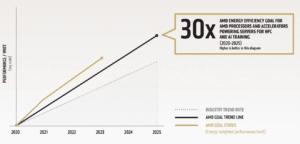
If used worldwide, this efficiency could save data centers billions of kilowatt-hours in 2025. This would cut carbon emissions and lower operational costs. AMD’s modular chiplet-based design, along with AI chips, cuts power use. This also lowers the environmental impact during manufacturing.
AMD-powered supercomputers, like the Frontier system at Oak Ridge National Laboratory, are among the most energy-efficient high-performance computers worldwide. These gains give AMD a real advantage in securing contracts with big companies and government agencies that want sustainable, high-performance computing.
ESG as a Competitive Advantage, Yet Risks & Challenges Remain
AMD’s sustainability credentials provide several key competitive benefits, in:
- Cost Savings and Emissions Mitigation: Energy-efficient products help customers reduce electricity costs and meet their own ESG goals.
- Winning Contracts: Governments and enterprises are increasingly selecting AMD’s technology, appreciating both its performance and sustainability profile.
- Attracting Investors: More ESG-conscious investors want companies that reduce emissions and report clearly. AMD’s ESG achievements improve its appeal to these capital sources.
Despite its momentum, AMD must navigate several ongoing challenges:
- Scope 3 Emissions: AMD tracks direct emissions effectively. However, fully capturing and reducing Scope 3 emissions—those from the whole value chain, like product use and end-of-life—is still just starting. Addressing this is critical as Scope 3 typically represents the largest portion of a tech company’s carbon footprint.
- Intense Competition: Rivals such as Nvidia, Intel, and a host of AI chip startups compete fiercely for market share.
- Supply Chain Complexity: As AMD expands globally, it will be harder to ensure suppliers meet emissions targets and ESG standards.
When Technology Meets Sustainability: The AMD ESG Equation
AMD’s recent stock rally is not merely a product of hype around AI demand. It reflects a robust technology leadership combined with serious, measurable ESG progress. AMD shows that economic growth can go hand in hand with environmental responsibility. It achieves this through strong energy efficiency goals, confirmed emissions cuts, and climate-friendly actions in its supply chain.
Thus, AMD stands out for investors interested in tech innovation and climate action. Its strong AI chip performance, increasing use of renewable energy, and strict sustainability governance make it an appealing option.
The post AMD Stock Soars: Can ESG and Net-Zero Momentum Sustain the Rally? appeared first on Carbon Credits.

EU carbon credit claims changed on 27 September 2026, the day the Directive (EU) 2024/825 began to apply across the European Union. The change is narrow. It changes how a company can talk about the credits it buys. A product can no longer be called neutral on the strength of compensation alone; however, every specific, evidenced statement about what a company measured, reduced, and funded stays fully available.

The post Promoting Improved Cooking Practices in Nigeria appeared first on Terrapass.


-
Climate Change1 year ago
Guest post: Why China is still building new coal – and when it might stop
-

 Greenhouse Gases2 years ago
嘉宾来稿:满足中国增长的用电需求 光伏加储能“比新建煤电更实惠”
-
Greenhouse Gases1 year ago
Guest post: Why China is still building new coal – and when it might stop
-

 Climate Change2 years ago
嘉宾来稿:满足中国增长的用电需求 光伏加储能“比新建煤电更实惠”
-

 Renewable Energy12 months ago
Sending Progressive Philanthropist George Soros to Prison?
-
Climate Change2 years ago
Bill Discounting Climate Change in Florida’s Energy Policy Awaits DeSantis’ Approval
-
Greenhouse Gases1 year ago
嘉宾来稿:探究火山喷发如何影响气候预测
-

 Climate Change2 years ago
Analysis: China’s CO2 falls 1% in Q2 2024 in first quarterly drop since Covid-19