The Northern Lights project is expanding its carbon capture and storage (CCS) capacity, with the big oil firms making their final investment worth around $714 million. This will help lower carbon emissions from industries in Europe.
The project will now store at least 5 million tonnes of CO₂ per year, up from 1.5 million tonnes. The decision comes after a deal with Stockholm Exergi, a Swedish energy company. The company will send up to 900,000 tonnes of CO₂ each year for 15 years.
A Bold Vision for European CCS
Equinor, Shell, and TotalEnergies are the companies behind the Northern Lights. Each of them has an equal share of 33.3%.
The European Commission also supports the project. It provided €131 million through the Connecting Europe Facility for Energy (CEF Energy) fund. The Norwegian government has played a key role in making the project possible.
Initiated as part of Norway’s Longship project, Northern Lights represents the world’s first cross-border, open-source CO₂ transport and storage service. Its primary objective is to provide industries across Europe with a reliable solution for capturing and securely storing CO₂ emissions beneath the North Sea seabed.
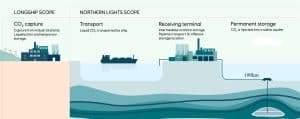
Source: Equinor
Phase one of the project became operational in September 2024, offering an annual storage capacity of up to 1.5 million tonnes of CO₂.
The project is key to Norway’s climate strategy. It helps industries cut emissions that are hard to reduce otherwise. Northern Lights also offers a cost-effective way for heavy industries to transport and store CO₂. This helps them meet stricter environmental rules.
Scaling Up: From 1.5M to 5M Tonnes of CO₂
In March 2025, the consortium announced a substantial investment of 7.5 billion Norwegian kroner (approximately $714 million) to fund the second phase of the project. This expansion aims to increase the storage capacity from 1.5 million to over 5 million tonnes of CO₂ per year by the latter half of 2028.
To facilitate this growth, the development will include additional onshore storage tanks, a new jetty, and more injection wells, leveraging existing infrastructure to expand operations efficiently.
The enhanced capacity will help accommodate a growing demand for carbon storage services from European industries seeking compliance with stricter emissions regulations and ambitious net-zero targets.
The first phase of Northern Lights is already finished. The project will begin operating in mid-2025. The first CO₂ shipment will come from a cement factory in Norway. This is part of Norway’s Longship CCS project.
Leaders of the companies involved see this as a major step for CCS in Europe. Tim Heijn, Managing Director of Northern Lights, said the project will provide a real solution for cutting emissions. He believes it will help create a strong CCS market.
Anders Opedal, CEO of Equinor, said this project shows how governments and companies can work together. He added that CCS is key to reducing risks and attracting more customers.
Huibert Vigeveno from Shell said that CCS plays an important role in reaching net-zero emissions. He also noted that Northern Lights is part of Shell’s global CCS efforts. Nicolas Terraz from TotalEnergies agreed, saying the expansion will help industries in Europe cut emissions.
Anders Egelrud, CEO of Stockholm Exergi noted:
“I am very pleased that Northern Lights has decided to move forward with its project. This is a crucial step in our collaboration. Permanent carbon storage will play a key role in achieving the climate targets. Together, we are laying the foundation for what could become an entirely new industry – one with the potential to make the Nordics and Europe global leaders in this field.”
The expansion of the Northern Lights could substantially reduce Europe’s industrial CO₂ emissions. The project will boost storage capacity to over 5 million tonnes each year, which will tackle almost 10% of Norway’s annual emissions. It offers a scalable solution for industries looking to reduce their carbon footprint.
Stockholm Exergi Joins Northern Lights
As part of this expansion, Northern Lights has signed a deal with Stockholm Exergi. The company runs a biomass power plant in Stockholm. Their plan is to capture and store biogenic CO₂, which comes from burning organic materials. This process, known as Bio-Energy Carbon Capture and Storage (BECCS), can create negative emissions. This means it removes more CO₂ from the air than it releases.
Anders Egelrud, CEO of Stockholm Exergi, said he is happy to see Northern Lights move forward. He believes permanent CO₂ storage will help meet climate goals. He also said this project could help Europe become a leader in CCS.
Per the International Association of Oil and Gas Producers (IOGP Europe), the carbon storage injection capacity in the region could hit 200 million tonnes by 2038.
Source: IOGP Europe
Aker Solutions Wins CCS Contract
Aker Solutions, a Norwegian engineering company, has won a contract for the expansion. The company will handle engineering, procurement, and construction (EPC) for the onshore facilities. While the exact contract value is not disclosed, it is estimated to be between 1.5 billion and 2.5 billion NOK ($142–237 million).
Aker Solutions has worked on other CCS projects before. Henrik Inadomi, an executive at the company, said this is their fourth CCS project. He also noted that their past experience has helped lower costs. Work on this expansion will begin in the second half of 2025.
Why CCS Matters for Net-Zero Goals
Carbon capture and storage is important for reaching net-zero emissions. Many industries, like cement and steel production, produce a lot of CO₂. Some emissions are hard to eliminate using renewable energy alone. CCS provides a way to capture and store CO₂ instead of releasing it into the air.
The International Energy Agency (IEA) says CCS needs to capture about 1.6 billion tonnes of CO₂ per year by 2030 to meet global climate goals. Right now, the world only captures about 40 million tonnes per year. This shows there is still a long way to go.
Source: IEA
CCS is especially useful for “hard-to-abate” sectors. These are industries where cutting emissions is very difficult. Northern Lights and other CCS projects are helping these industries reduce their carbon footprint.
Northern Lights is one of the first large-scale CCS projects in the world. Many experts see it as a model for future projects. If successful, it could inspire other CCS developments in Europe and beyond.
As governments and companies focus on cutting emissions, CCS will likely play a bigger role. Northern Lights’ expansion is an important step in that direction. It shows that with the right investments and partnerships, CCS can become a key tool in fighting climate change.
China is backing a Beijing-based startup called Orbital Chenguang with about 57.7 billion yuan ($8.4 billion) in credit lines to build space-based data centers, according to media reports. The funding comes from major state-linked banks and signals one of the largest known investments in orbital computing infrastructure.
The move highlights a growing global race to build computing systems in space. It also puts China in direct competition with companies like SpaceX, which is exploring space-based data infrastructure, too.
Orbital Chenguang Builds State-Backed Space Computing System
Orbital Chenguang is a startup in Beijing supported by the Beijing Astro-future Institute of Space Technology. This institute works with the city’s science and technology authorities.
The company has received credit line support from major Chinese financial institutions, including:
Bank of China,
Agricultural Bank of China,
Bank of Communications,
Shanghai Pudong Development Bank, and
CITIC Bank.
These are credit lines, not fully deployed cash. But the scale shows strong institutional backing.
The project is part of a wider national strategy focused on commercial space, AI infrastructure, and advanced computing systems.
China’s state space contractor, CASC (China Aerospace Science and Technology Corporation), has shared plans under its 15th Five-Year Plan. These include ideas for large-scale space computing systems, aiming for gigawatt power.
Space Data Center Plan Targets 2035 Gigawatt Capacity
According to Chinese media reports, Orbital Chenguang plans to build a constellation in a dawn-dusk sun-synchronous orbit at 700–800 km altitude. The long-term target is a gigawatt-scale space data center by 2035.
The development plan is divided into phases:
2025–2027: Launch early computing satellites and solve technical barriers.
2028–2030: Link space-based systems with Earth-based data centers.
2030–2035: Scale toward large orbital computing infrastructure.
The design relies on continuous solar energy and natural cooling in space. These features could reduce reliance on land-based power grids and cooling systems.
China has proposed two satellite constellations to the International Telecommunication Union (ITU). These plans include a total of 96,714 satellites. This shows China’s long-term goals for space infrastructure and spectrum control.
The AI Energy Crunch Pushing Computing Into Orbit
The push into orbital data centers is closely linked to rising AI demand. Global data centers consumed about 415–460 terawatt-hours (TWh) of electricity in 2024, equal to roughly 1.5%–2% of global power use. This figure is rising quickly due to AI workloads.
Some industry projections show demand could exceed 1,000 TWh by 2026, nearly equal to Japan’s total electricity consumption.
AI systems require massive computing power, which increases energy use and cooling needs. In many regions, electricity supply—not hardware—is now the main constraint on AI expansion.
China’s strategy aims to address this by moving part of the computing load into space, where solar energy is more stable and continuous.
Data centers already create a large carbon footprint. In 2024, they emitted about 182 million tonnes of CO₂, based on global electricity use of roughly 460 TWh and an average carbon intensity of 396 grams of CO₂ per kWh. This is according to the International Energy Agency report, as shown in the chart below.
Source: IEA
Future projections show even faster growth. The sector could generate up to 2.5 billion tonnes of CO₂ emissions by 2030, driven by AI expansion. This is where orbital systems come in. They aim to reduce emissions during operation by using:
However, space systems also introduce new emissions. Rocket launches used about 63,000 tonnes of propellant in 2022, producing CO₂ and atmospheric pollutants. Lifecycle studies suggest that over 70% of emissions from space systems typically come from manufacturing and launch activities.
In addition, hardware in orbit often has a lifespan of only 5–6 years, which increases replacement cycles and launch frequency. This creates a key trade-off:
Lower operational emissions in space, and
Higher lifecycle emissions from launches and manufacturing.
Research suggests that, in some scenarios, orbital computing could produce up to 10 times higher total carbon emissions than terrestrial systems when full lifecycle impacts are included.
China’s Expanding Space-Tech Ecosystem
Orbital Chenguang is not operating alone. Several Chinese companies are working on similar in-orbit computing systems, including ADA Space, Zhejiang Lab, Shanghai Bailing Aerospace, and Zhongke Tiansuan.
These firms are developing satellite-based computing and AI processing systems. This shows that orbital computing is not a single project. It is part of a broader national push across government, industry, and research institutions.
China’s space strategy combines commercial space growth with national technology planning. It aims to build integrated systems that connect satellites, cloud computing, and terrestrial networks.
The Space-AI Arms Race: China vs SpaceX vs Google
China is not alone in exploring space-based computing. Companies in the United States are also developing orbital data infrastructure concepts. These include early-stage research and private sector projects by firms such as SpaceX and Google.
SpaceX is building one of the largest satellite networks through its Starlink constellation, with thousands of satellites already in orbit. While its main goal is global internet coverage, the network also creates a foundation for future edge computing in space. The company’s reusable rockets, including Starship, are designed to lower launch costs, which is a key barrier to scaling orbital data infrastructure.
Google, through its cloud division, has been investing in space data and satellite analytics. It partners with Earth observation firms to process large volumes of data using cloud-based AI tools. This work could extend to hybrid systems where data is processed closer to where it is generated, including in orbit.
Other players are also entering the field. Amazonis developing Project Kuiper, a satellite internet network that could support future space-based computing layers. Microsoft has launched Azure Space, which connects satellites directly to cloud computing services and supports real-time data processing.
Government agencies are also involved. NASA and the U.S. Department of Defense are funding research into orbital computing, edge processing, and secure data transmission in space. These efforts aim to reduce latency, improve data security, and enable faster decision-making for both civilian and defense applications.
Together, these developments show that space-based computing is moving beyond theory. While still early-stage, both public and private sector efforts are building the foundation for future data centers and processing systems in orbit.
However, these systems face major challenges:
High launch costs,
Heat and thermal control issues,
Limited data transmission bandwidth, and
Hardware durability in space.
Despite these challenges, interest is growing because AI demand is rising faster than Earth-based infrastructure can scale. The competition is now moving toward who can solve energy and computing limits first—on Earth or in space.
Market Outlook: AI, Energy, and Space Infrastructure Converge
The global data center industry is entering a period of rapid expansion. Electricity demand from data centers could double by 2030, driven mainly by AI workloads and cloud computing growth. Power supply is becoming a limiting factor in many regions.
At the same time, the global space economy is expanding into a multi-hundred-billion-dollar industry, supported by satellites, communications, and emerging technologies like orbital computing.
Orbital data centers sit at the intersection of three major trends: rapid AI growth, rising energy constraints, and expansion of space infrastructure.
China’s $8.4 billion credit-backed push through Orbital Chenguang signals confidence in this convergence. However, key barriers remain, such as high cost of launches, engineering complexity, short satellite lifespans (5-6 years), and regulatory uncertainty in orbital systems.
Because of these limits, orbital data centers are unlikely to replace Earth-based systems in the near term. Instead, they may form a hybrid system where some workloads move to space while most remain on Earth.
Space Is Becoming the Next Data Center Frontier
China’s investment in Orbital Chenguang marks one of the most significant moves yet in the emerging field of space-based computing. Backed by major Chinese banks, municipal science institutions, and national space contractors like CASC, the project shows how seriously China is treating orbital infrastructure.
The strategy connects AI growth, energy demand, and climate pressures into a single long-term vision. But the trade-offs are complex. Orbital data centers may reduce operational emissions, but they also introduce high lifecycle carbon costs and major technical challenges.
The global race is now underway. With companies like SpaceX, Google, and Chinese tech firms exploring similar ideas, space is becoming a new frontier for digital infrastructure. The outcome will depend on whether orbital systems can scale efficiently—and whether their carbon benefits can outweigh the emissions cost of building them.
When General Motors (GM) committed $625 million to develop Thacker Pass in Nevada, it did more than fund a lithium project. It established a new model for how automakers secure critical minerals, and in doing so, it reshaped how investors should evaluate the next generation of U.S. lithium assets.
This was not a passive investment. It was a fully structured supply chain partnership, combining equity, long-term offtake, and pricing strategy into a single agreement.
For investors watching Nevada’s clay lithium sector, the implication is clear: the first project has been validated – now the market is looking for what comes next.
A Landmark Deal and a New Partnership Model
GM’s $625 million investment in Lithium Americas remains one of the largest commitments by an automaker into upstream battery materials. The structure of the deal matters as much as its size.
GM secured exclusive access to Phase 1 production, locking in long-term supply from Thacker Pass, which is expected to produce around 40,000 tonnes per year of battery-grade lithium carbonate. That output alone could support hundreds of thousands to up to 1 million EVs annually.
More importantly, the agreement evolved into a joint venture structure, with GM ultimately taking a 38% ownership stake in the project while securing long-term offtake rights. This started as a TopCo equity investment but changed into a JV.
John Evans, LAC CEO, said in an interview on the GM agreement:
“They view this as an investment as much as they do a hedge to ensure that they get low-cost lithium. They want to run this JV as a business.”
A key highlight of the Thacker Pass deal is GM’s offtake agreement, which now serves as a template for a world-class OEM arrangement. GM must purchase at least 20% of its North American lithium demand, with the option to increase to 100%.
The floor price is “meaningfully above” the August 2024 low (~$10,000/t) but below current prices (~$21,000/t), as noted by Evans. GM was given an effective discount at higher price levels, lightly structured when prices at that time were at ~$60,000/t.
GM provides rolling three-year forecasts, with the next year’s volume fixed, allowing Lithium Americas to commit remaining volume to third parties. The agreement covers up to three years of contracted volume at a time.
GM Moves Upstream: From Automaker to Lithium Investor
The GM–Thacker Pass agreement highlights a shift in the lithium market. Automakers are moving upstream, directly into mining, to secure supply, manage costs, and reduce geopolitical risk. This approach is driven by both market forces and policy, with the U.S. pushing for domestic sourcing of critical minerals to support EV supply chains.
Key elements of this emerging model include:
Equity participation in the mining project,
Long-term offtake agreements tied to production, and
Structured pricing mechanisms to manage volatility.
Thacker Pass sits at the center of that strategy. It is widely recognized as the largest known lithium resource in the United States, and with construction underway, it is moving from concept to execution.
Breaking the Clay Lithium Barrier
For years, sedimentary clay lithium has carried a persistent discount in the market. Unlike brine operations in South America or hard-rock mining in Australia, clay deposits had never been proven at a commercial scale. The uncertainty around processing, recovery rates, and operating costs limited investor confidence.
Thacker Pass is now changing that, with construction underway, production targeted later this decade, and processing planned using sulfuric acid leaching at an industrial scale. Once operational, it will mark the first large-scale commercial validation of clay lithium extraction.
In resource markets, once a new extraction method is proven, capital follows. Financing improves, development timelines accelerate, and the entire category begins to reprice. This is exactly what happened in Chile’s brine sector decades ago. Clay lithium in Nevada may now be entering a similar phase.
GM’s investment provides a real-world benchmark for what a bankable lithium project looks like in today’s market. It demonstrates that:
OEMs are willing to invest upstream
Long-term offtake agreements can anchor financing
Domestic lithium supply is now a strategic priority
It also answers a key question that has held back the sector: Will major industrial players commit to clay lithium at scale? The answer is now yes.
The Next Project in the Queue: NNLP
With Thacker Pass moving forward, investor focus naturally shifts to the next project capable of attracting similar strategic interest. That brings attention to Surge Battery Metals’ Nevada North Lithium Project (NNLP), a structurally aligned next-tier candidate.
NNLP is not competing with Thacker Pass as a first mover; it is emerging as a next-generation project within a now-validated category.
NNLP stands out based on core project metrics that directly impact economics. Its average lithium grade of 3,010 ppm is significantly higher than Thacker Pass Phase 1 material, which ranges from 1,500 to 2,500 ppm. Higher grades typically translate into more efficient recovery and lower processing intensity per tonne.
The project also benefits from near-surface mineralization and a low strip ratio of approximately 1.16:1. This may reduce mining complexity and indicate efficient material movement.
From a cost perspective, NNLP’s estimated operating cost of around $5,243 per tonne LCE compares favorably to LAC’s Thacker Pass guidance of roughly $6,200 per tonne.
Beyond geology, NNLP aligns with the same development framework that defines Thacker Pass. The project has secured a strategic partnership with Evolution Mining, funding up to C$10 million toward the Pre-Feasibility Study (PFS), while Fluor Corporation, the engineering firm involved in Thacker Pass, is leading the PFS at NNLP.
Leadership expertise also matters: Steffen Ball, a key member of the team, previously led battery raw material sourcing strategies at major automakers. These include Nissan North America and Ford Motor Company, aligning with the type of OEM agreements now seen in GM–Thacker Pass.
Scale, Market Tailwinds, and Second-Wave Opportunities
Scale is critical to attract major OEM partners. NNLP outlines a 42-year mine life with average annual production of approximately 86,300 tonnes of lithium carbonate equivalent. That output positions it to support long-term anchor offtake agreements, similar in structure to what GM secured at Thacker Pass.
Market fundamentals continue to support these developments:
Global lithium demand is projected to more than double by 2030.
EV production is scaling rapidly across major markets.
Governments are prioritizing domestic supply chains for critical minerals.
Even with recent lithium price volatility, long-term fundamentals remain intact. GM’s investment reflects a forward-looking strategy: secure supply today to avoid constraints tomorrow.
Thacker Pass carries the burden of being first, proving the process, building infrastructure, and validating the economics of clay lithium. This creates opportunities for projects that follow, like NNLP, which benefit from reduced technical uncertainty, clearer financing pathways, and a market that now understands clay lithium.
First Project Validated, Next Project Poised to Follow
GM’s $625 million investment was not just a bet on one project. It was a commitment to a new supply chain model for lithium—one that integrates mining, manufacturing, and long-term demand into a single structure. Thacker Pass is now proving that model, and NNLP is positioned to fit within it.
With higher grades, favorable mining characteristics, strong development partners, and the right scale, NNLP aligns with the criteria that attracted one of the world’s largest automakers to Nevada clay lithium in the first place.
For investors, the takeaway is straightforward: the first project is being built, the template is established, and the next project in the queue is becoming easier to identify.
New Era Publishing Inc. and/or CarbonCredits.com (“We” or “Us”) are not securities dealers or brokers, investment advisers, or financial advisers, and you should not rely on the information herein as investment advice. Surge Battery Metals Inc. (“Company”) made a one-time payment of $75,000 to provide marketing services for a term of three months. None of the owners, members, directors, or employees of New Era Publishing Inc. and/or CarbonCredits.com currently hold, or have any beneficial ownership in, any shares, stocks, or options of the companies mentioned.
This article is informational only and is solely for use by prospective investors in determining whether to seek additional information. It does not constitute an offer to sell or a solicitation of an offer to buy any securities. Examples that we provide of share price increases pertaining to a particular issuer from one referenced date to another represent arbitrarily chosen time periods and are no indication whatsoever of future stock prices for that issuer and are of no predictive value.
Our stock profiles are intended to highlight certain companies for your further investigation; they are not stock recommendations or an offer or sale of the referenced securities. The securities issued by the companies we profile should be considered high-risk; if you do invest despite these warnings, you may lose your entire investment. Please do your own research before investing, including reviewing the companies’ SEDAR+ and SEC filings, press releases, and risk disclosures.
It is our policy that information contained in this profile was provided by the company, extracted from SEDAR+ and SEC filings, company websites, and other publicly available sources. We believe the sources and information are accurate and reliable but we cannot guarantee them.
CAUTIONARY STATEMENT AND FORWARD-LOOKING INFORMATION
Certain statements contained in this news release may constitute “forward-looking information” within the meaning of applicable securities laws. Forward-looking information generally can be identified by words such as “anticipate,” “expect,” “estimate,” “forecast,” “plan,” and similar expressions suggesting future outcomes or events. Forward-looking information is based on current expectations of management; however, it is subject to known and unknown risks, uncertainties, and other factors that may cause actual results to differ materially from those anticipated.
These factors include, without limitation, statements relating to the Company’s exploration and development plans, the potential of its mineral projects, financing activities, regulatory approvals, market conditions, and future objectives. Forward-looking information involves numerous risks and uncertainties and actual results might differ materially from results suggested in any forward-looking information. These risks and uncertainties include, among other things, market volatility, the state of financial markets for the Company’s securities, fluctuations in commodity prices, operational challenges, and changes in business plans.
Forward-looking information is based on several key expectations and assumptions, including, without limitation, that the Company will continue with its stated business objectives and will be able to raise additional capital as required. Although management of the Company has attempted to identify important factors that could cause actual results to differ materially, there may be other factors that cause results not to be as anticipated, estimated, or intended.
There can be no assurance that such forward-looking information will prove to be accurate, as actual results and future events could differ materially. Accordingly, readers should not place undue reliance on forward-looking information. Additional information about risks and uncertainties is contained in the Company’s management’s discussion and analysis and annual information form for the year ended December 31, 2025, copies of which are available on SEDAR+ at www.sedarplus.ca.
The forward-looking information contained herein is expressly qualified in its entirety by this cautionary statement. Forward-looking information reflects management’s current beliefs and is based on information currently available to the Company. The forward-looking information is made as of the date of this news release, and the Company assumes no obligation to update or revise such information to reflect new events or circumstances except as may be required by applicable law.
Disclosure: Owners, members, directors, and employees of carboncredits.com have/may have stock or option positions in any of the companies mentioned: .
Carboncredits.com receives compensation for this publication and has a business relationship with any company whose stock(s) is/are mentioned in this article.
Additional disclosure: This communication serves the sole purpose of adding value to the research process and is for information only. Please do your own due diligence. Every investment in securities mentioned in publications of carboncredits.com involves risks that could lead to a total loss of the invested capital.
Amazon has signed a long-term carbon credit agreement with Bayer-backed The Good Rice Alliance (TGRA), aiming to cut methane emissions from rice farming across India. The move reflects a growing push toward agriculture-based climate solutions that deliver both environmental and economic value.
Rice cultivation remains a major source of methane emissions globally. The problem comes from traditional farming methods, where paddy fields stay flooded for long periods. These waterlogged conditions create an oxygen-free environment that allows methane-producing bacteria to thrive. As a result, rice farming contributes roughly 8–10% of global methane emissions, making it one of the largest sources after livestock.
India’s Rice Fields: A Major Methane Hotspot
India is at the center of this issue. It has one of the largest rice-growing areas in the world, with around 42–44 million hectares under cultivation. This massive scale makes the country a key contributor to agricultural methane emissions.
Estimates suggest that globally rice fields release anywhere between 20 and 60 teragrams (Tg) of methane each year, depending on how emissions are measured.
Some national-level studies also point to the amount of CH4 emitted from paddy fields of India is 3.396 teragram (1teragram = 109 kilograms) per year or 71.32 MMT CO2 equivalent.
Together, these figures highlight how rice farming accounts for a meaningful share of India’s overall methane footprint and a notable portion of global emissions.
Certain regions, especially the Indo-Gangetic Plain, show even higher emission levels. Warm temperatures, heavy flooding, and high organic matter in soils create ideal conditions for methane generation. This makes India not just a large emitter, but also a high-impact opportunity for methane reduction.
The Good Rice Alliance (TGRA): Turning Farming Practices into Climate Solutions
TGRA’s program focuses on simple but effective changes in how rice is grown. Farmers are encouraged to adopt techniques such as Alternate Wetting and Drying (AWD) and Direct Seeded Rice (DSR). These methods reduce continuous flooding, which directly cuts methane production.
The impact can be significant. Studies show that improved water management and better nutrient practices can reduce methane emissions from rice fields by 30–50%. At the same time, these changes reduce irrigation water use by up to 30%.
Advancing sustainable rice farming through precision GHG estimation
Source: TGRA
The benefits go beyond emissions. Farmers often see lower input costs, better yields, and improved resilience to climate stress. TGRA currently works with over 13,000 smallholder farmers across multiple states, covering more than 35,000 hectares. The program provides training, financial incentives, and regular on-ground support to ensure long-term adoption.
ALSO READ:
Amazon Leans on High-Quality Credits Amid Rising Emissions
Amazon continues to face challenges in reducing emissions. The company reported 68.25 million metric tons of CO₂ equivalent emissions in 2024, marking a 6% increase from the previous year. Growth in data centers for AI and rising fuel use in logistics were the main drivers.
This highlights the complexity of balancing rapid business growth with climate commitments. Still, Amazon remains focused on its goal of reaching net-zero emissions by 2040 under the Climate Pledge.
Carbon credits play a supporting role in this journey. The company emphasizes high-quality, science-based credits that meet strict standards for transparency and impact.
Driving Verified Methane Reductions
Most significantly, the retail giant plays a central role in scaling this initiative. The company has committed to purchasing more than 685,000 metric tons of CO₂ equivalent carbon credits during the project’s initial phase. This makes it the primary buyer and a major supporter of methane reduction in Indian agriculture.
These credits represent verified emission reductions. They are measured directly in the field, supported by satellite data, and validated under global carbon standards. This focus on quality is critical as companies face increasing scrutiny over carbon offset claims.
Thus, for Amazon, the deal boosts its broader climate strategy. The company follows a “reduce first, then neutralize” approach. It prioritizes cutting emissions through renewable energy, electrification, and logistics improvements. However, some emissions remain difficult to eliminate, especially across its vast supply chain.
Carbon credits help bridge that gap. Methane-focused credits are particularly valuable because they deliver faster climate benefits in the near term compared to carbon dioxide reductions.
Science, Data, and Trust in Carbon Markets
A key strength of TGRA’s program lies in its strong measurement system. Emissions are tracked using direct, field-based methane measurements in collaboration with the International Rice Research Institute. This data is backed by satellite monitoring and digital tools.
Each carbon credit is supported by multiple layers of verification. Field data is cross-checked with remote sensing records, ensuring accuracy and transparency. This approach addresses concerns around over-crediting and builds confidence in the voluntary carbon market.
It has also received an ex-ante A rating from BeZero Carbon, reflecting strong confidence in its design and integrity.
Why Methane Cuts Matter Right Now
Methane is often called a “super pollutant” because it traps over 27 times more heat than carbon dioxide over 100 years. More importantly, it has a shorter atmospheric life, which means cutting methane can slow warming more quickly in the near term.
Given India’s large rice footprint and high emission intensity, even small changes per hectare can lead to massive reductions at scale. This makes projects like TGRA’s highly strategic for companies like Amazon looking to close their short-term emissions gap.
Beyond emissions reduction, the program delivers strong social and economic benefits. Farmers receive hands-on support, including field visits, training, and financial incentives. Lower water use reduces costs, while improved practices can increase productivity.
This combination of climate and livelihood benefits is key to long-term success. It ensures that farmers remain at the center of the transition to sustainable agriculture.
Amazon also extends the impact through its Sustainability Exchange and Carbon Credit Service. These platforms allow suppliers and partners to access similar agricultural carbon projects, spreading climate action across their broader ecosystem.
Source: IEA
Overall, the partnership between Amazon and TGRA shows how global companies can support large-scale climate solutions at the grassroots level. By creating demand for high-integrity carbon credits, they help finance sustainable farming practices.

