Weather Guard Lightning Tech

Wind Turbine Cost: How Much? Are They Worth It in 2025?
by Dan Blewett
How much does a wind turbine cost in 2025? While renewable energy is no longer a “new” idea and large, green energy wind farms are more common – and more efficient – the combination of technology, construction, and operating expenses mean that a wind turbine’s initial cost is very expensive.
And calculating the “simple” cost of a wind turbine isn’t simple at all. Current projections for the cost of an offshore turbines cost is about $1.5M per Megawatt of power produced – meaning a 10MW wind turbine would come to about $15,000,000. But myriad factors go into the actual calculations.
For regular updates on wind turbine costs and the technology , people and policies driving the industry, follow the Uptime Wind Energy Podcast and subscribe to Uptime Tech News. It’s free! Subscribe now: https://substack.com/@uptimetechnews

Header image credit: GE Vernova
This article provides the numbers you need to understand how much does a wind turbine cost, do they actually pay for themselves over time, and is the upfront investment worth it?
As development for offshore wind farms has accelerated, over the past 20 years, the Biden Administration created some additional opportunities in the industry in the United States. As wind anticipated a second Trump administration, the economics of wind energy in the US were initially called into question. But both wind and the larger renewables market are bigger than shifting political policies. Since the renewable energy transition is well underway all over the world, the US is almost certain to remain a significant player. The mix of onshore and offshore wind energy is one of many unknowns that will affect the market, and specifically, the initial cost of a wind turbine.
When considering the cost of a wind turbine, it seems reasonable to pick one model of turbine to compare costs “apples to apples.” That alone is a daunting task, with cost estimates for off-shore wind more difficult to pin down than onshore wind, and costs of turbines designed for even modest-sized onshore wind farms vary based on the conditions of various wind farm locations.
Calculating even an “average” cost of a wind turbine in 2025 is a complicated math problem – actually, it involved numerous math problems and multiple conditions. We’ll explore several “solutions” to this problem.
In 2024, there were hints that manufacturers may reduce the number of models that they offer, for two basic reasons: profitability, and engineering reliability. If you’re not familiar with the wind energy market, it helps to start with a bit of an industry overview to understand how wind turbine costs are determined.
Are Wind Energy costs REally going down? Is Wind Energy Getting Too Cheap?
In recent years, wind turbine manufacturers like Siemens have expressed concerns that the cost of wind energy is getting too low to maintain the development and growth of the market. Rising costs, and government pricing structures present constant challenges to manufacturers.
In 2022, Nordex raised its turbine prices (approximately 12%) due to cost increases and rising interest rates; other turbine manufacturers increased prices as well. In 2023, wind turbine prices were more steady. Midway through the year, Nordex, based in Germany, recorded an average selling price of €890,000/MW or about $965,000/MW USD. [1]
In May 2023, Siemens’ Tim Dawidowsky famously commented, “it’s all about cash.” Obviously, Dawidowsky wanted to see European turbine makers get more money – and he’s not alone. When we reported on Dawidowsky’ s comment in an Uptime Podcast episode, we explained it in context with other concerns about energy pricing strategies. Nothing happens in a vacuum, and wind energy costs – including almost every piece of hardware in a wind turbine – are affected by myriad global factors more than most industrial products .
Of those factors, energy costs are the most difficult to pin down. Because different countries finance energy in vastly different ways, the industry absolutely does not enjoy a level playing field. While many European countries control energy developments outright – and other countries, like the US, has a long history of incentives and subsidy programs – it is difficult to determine actual costs, true profits and losses, and almost impossible to compare energy costs between nations. Even ‘simple’, hard costs – like blade and nacelle structures – fluctuate due to political policies and how they are expected to influence future prices.
The Biden administration’s IRA (Inflation Reduction Act) committed billions to green energy incentives from 2021-2024, and the effects of some of those programs continue. For weekly discussions on wind industry business and technology, listen to the Uptime Wind Energy Podcast here.
How Much Does a Wind Turbine Cost Initially?
For commercial wind turbines, the answer is millions of dollars per turbine.

Wind turbines cost a lot, and as such the investment is to be recouped over a long period of time.
Turbines produce significant electricity and sell it back to local power utilities where it flows to the power grid, to be used by homes and businesses.
The Breakdown of Initial Wind Turbine Costs
- $2.6 – $4 million per average-sized commercial wind turbine
- Typical cost is $1.3 million per megawatt (MW) of electricity-producing capacity
- Most commercial wind turbines have a capacity of 2-3 MW, but offshore turbines can be as large as 16-18 MW
- Cost increases as turbine size increases, though there are benefits to using fewer, larger turbines – complexity and construction of the overall farm site is greatly reduced with fewer and larger turbines.
Interested in Wind Energy? Check out Our Wind Energy Podcast: Uptime
Listen to Uptime on Any Podcast Platform
Costs vary widely around the world. Why? It’s complicated
From Australia to Brazil to Canada to the UK, energy project are developed (read: funded and subsidized) in vastly different ways, largely due to different forms of governments. But there are many other stickier issues that make determining the cost of a wind turbine more difficult than your average accounting problem.
Different countries “adjust” the cost of materials, labor and land though artificially (or actually) reducing wages, and adding tariffs and taxes. In the US, well-intentioned initiatives like the Jones Act can increase the initial cost of wind turbine manufacturing – but in the long term, they should increase the value of the country’s wind energy market. The US isn’t the only country that creates such political constraints. Since 2022, throughout 2023, 2024 and well into 2025, the Jones Act is significantly impacting offshore wind turbine costs. In one August 2024 podcast episode, we detailed some of Orsted’s financial troubles. (Orsted is based in Denmark.) For more information on the business side of wind turbine costs and overall industry growth, listen to the Uptime Wind Energy Podcast every week. It’s eye-opening!
Wind Turbine Maintenance Costs
Once built, maintenance is an ongoing expense.
- 1-2 cents per kilowatt-hour produced, or
- $42,000 – $48,000 per year
Operation and maintenance costs can be significant, but all of these machines are long-term investments continue to (hopefully) pay for themselves over time.

A wind turbine study using German data showed that these costs can be 1-2 Eurocents per kilowatt hour (kWh) produced, on average.

This number climbs as the the turbine ages, which is not surprising considering the wear and tear and harsh environments these machines operate in.
How Operation & Maintenance Requirements Impact Wind Turbine Cost
Operation & maintenance (O&M) typically includes the following:
- Insurance
- Land costs, rent and taxes
- Service, repair and spare parts
- Administrative tasks
- Power (it does take some electricity to run)
- Miscellaneous
These recurring costs are not too significant, and the turbine will significantly outproduce the maintenance costs.
Repairs can be a significant capacity reducer (more on this later), and lightning strikes on wind turbines can be a real problem.
Though turbine blades leave the factor with a lightning protection system, often they are inadequate.
Especially for offshore wind turbines–where transporting workers for repair is costly and time-consuming–additional layers of lightning protection is important.
Products like segmented lightning diverters can provide additional protection from lightning strike damage to wind turbines.
How Much Electricity Does a Wind Turbine Produce?
We’ve covered costs, so now lets turn to the big question: how much electricity does a wind turbine generate?

Wind turbines are sized in megawatts (MW), which refers to their capacity to create electricity.
One megawatt = 1,000,000 watts of power. One megawatt can power about 1000 homes for a month but in reality, wind turbines don’t come close to producing their rated capacity because of changing wind speeds.
Size of the Wind Turbine Affects Electricity-Producing Capacity
Wind turbines cost more the bigger they get, but they produce more electricity with larger nacelles and turbine blades.

In its latest report on average rotor diameter size, Statistica said rotors for onshore wind turbines had risen to 129 meters (423 feet).
Common commercial wind turbine sizes in megawatts:
- 1.5 MW (onshore, or land-based)
- 2.5 MW (onshore)
- 4 MW (onshore)
- 6-8 MW (offshore)
- Up to 15 MW (GE Haliade-X produces 12 MW and the Siemens Gamesa SG 14-222DD is a 15MW Turbine)
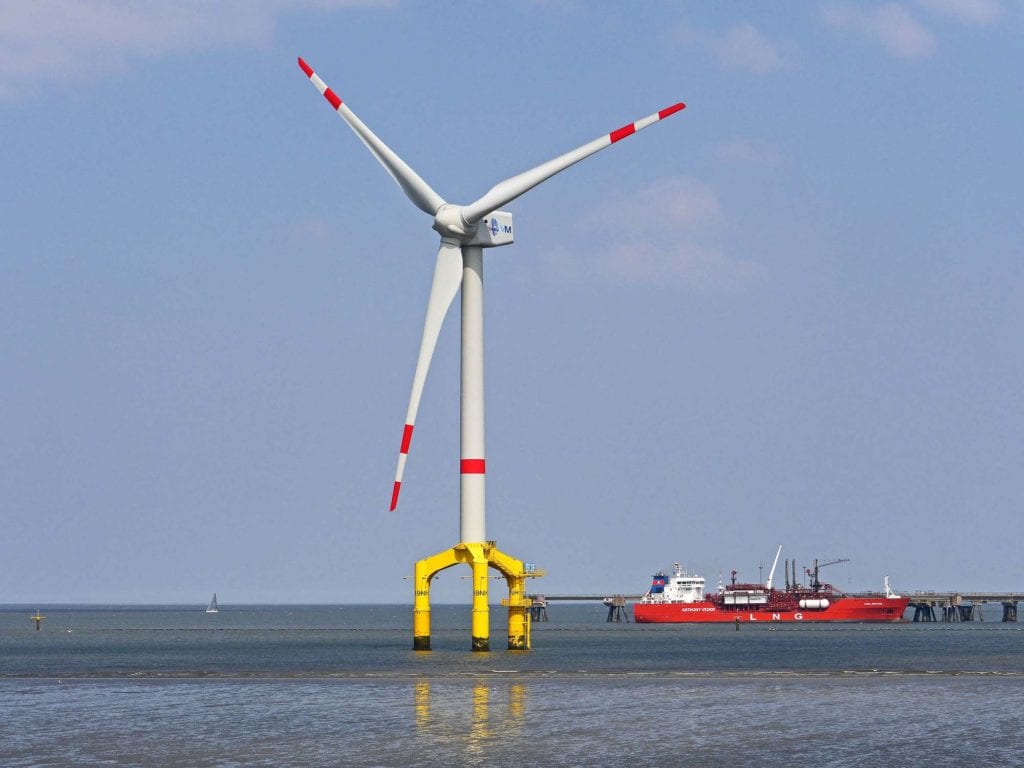
Offshore wind farms choose larger wind turbines in part because of the high cost of installing them and transporting the electricity, as well as the increased efficiency they gain with consistent, faster wind speeds.
It’s preferable to build one turbine rather than many smaller ones because fewer towers and ground anchoring systems have to be constructed, making everything less complicated.
Wind Speed & Direction Affects “Capacity Factor” in Electric Production
At full wind speed, a turbine can produce at it’s full capacity. If a turbine is rated for 2.5 MW, then at peak wind speed it will crank out 2.5 MW of power.
Yet, we all know that wind is never constant.

Because the wind dies down, changes direction, etc., overall averages will be much lower, usually in the 30-40% range for onshore wind turbines and up to 65% (occasionally higher in rare circumstances) for offshore turbines.
Biggest Wind Turbine: GE Haliade-X 12-14.7 MW Turbine
The GE Haliade-X is…insane.
This enormous wind turbine was the first to offer 12 MW capacity, with blades 107m (351 feet) long and an overall footprint that reaches 260m (853 feet) into the sky. The Haliade-X offshore turbine features a range of power rating covering 12-14.7MW capacity. Want to buy one? It will run you $12M – $20Million. See how they’re installed:
<iframe width="1344" height="840" src="https://www.youtube.com/embed/XX2-DE0etcQ" title="Haliade-X offshore wind turbine - installation time lapse" frameborder="0" allow="accelerometer; autoplay; clipboard-write; encrypted-media; gyroscope; picture-in-picture; web-share" referrerpolicy="strict-origin-when-cross-origin" allowfullscreen></iframe>
Turbines of this size are typically used offshore, where wind speeds are consistently much higher and delivering power is more complicated. Fewer, bigger turbines = easier power transport, fewer long-distance cables and a simpler overall system.
If you’re curious how these turbines stay upright in the crazy waves and wind out to sea, check out this article featuring some great illustrations.
How Much Money Does a Wind Turbine Produce From Electricity it Generates?
Remember that a wind turbine has a maximum rated capacity (such as 4 megawatts), but it will only produce electricity at a “capacity factor” or “load factor” that is a percentage of this maximum.
In the chart below, you’ll find some numbers based on the typical sale price (2019 data) of electrical power created by wind turbines. This power is sold back to the electrical grid of utility companies, and the price has been falling as turbine technology has improved.
This sale of electricity is how wind turbines pay for themselves and create renewable energy.
We want this power to be cheap, and it’s moving in the right direction.

The goal is for turbines to produce at a higher capacity factor, which means they’re creating more electricity for the time they’re in operation. A majority wind farms worldwide are heavily subsidized by government investment, however, wind farms in the US and elsewhere in North America operate in a more businesslike manner.
Many US wind farms not only pay private land owners for the use of their land, the energy producers also contribute mightily to the larger community through direct investment in addition to job creation and tax payments. To learn how some US wind farms contribute to their communities, see this brief overview of Wind Farms featured in the Uptime Wind Energy Podcast in 2024.
Need Lightning Protection For Your Wind Turbine?
Our StrikeTape wind turbine segmented lightning diverters are the most durable, highest-performing product in the world. Wind turbine maintenance costs skyrocket when constantly damaged by lightning strikes, so protect your turbines with the best.
Use StrikeTape lightning protection on your wind farm.
More Wind Turbine Questions & Answers
Check out our common wind turbine questions below, including many about wind turbine cost, specifications and more.
If you have a question, leave it below and we’ll update this article with our answer!
The towers on most commercial wind turbines are in the range of 200-260 feet tall. The blades, often well over 100 feet long, when counted in total height push the number well into the 300s. The Gamesa G87 model wind turbine’s blades reach a height of 399ft.
Wind turbine blade tip speeds regularly range from 120-180 miles per hour, though they vary due to wind conditions. Because of their enormous size (with blades well over 100ft), they look like they’re spinning slowly, when in reality blade tip speeds are very, very fast.
$1,300,000 USD per megawatt. The typical wind turbine is 2-3 MW in power, so most turbines cost in the $2-4 million dollar range. Operation and maintenance runs an additional $42,000-$48,000 per year according to research on wind turbine operational cost. See the National Renewable Energy Laboratory’s website for the most recent (December 2022) Cost of Wind Energy Review.
Yes, and these smaller turbines can now cost less than $1000. Energy production will vary greatly to the size, specs and wind conditions of a person’s home, and some homes may not be suited well for a turbine at all. There’s a reason that wind farms are carefully placed in very wind, often harsh conditions–high winds occur in places people often don’t want to live. If your home doesn’t get consistent, strong wind, it may not make financial sense to install any type of wind turbine. New turbine designs are constantly being proposed and tested.
Unfortunately, they sometimes do, but it’s not the largest threat to the bird population. Cats, and cell phone towers, are far more deadly to the bird population. This article sheds light on the issue: https://www.usatoday.com/story/money/business/2014/09/15/wind-turbines-kill-fewer-birds-than-cell-towers-cats/15683843/.
The number can vary greatly due to factors including size, wind conditions, blade length and of course, average home energy consumption. A typical wind turbine is generally capable of powering 1000-2000 homes in one year. One megawatt of energy production capacity will power about 1000 homes, and many onshore wind turbines have a 2-3 MW capacity.
The capacity factor–or load factor–is the actual power generation over time, rather than the theoretical maximum a turbine could produce. Because wind turbines can’t maintain peak production at all times (not even close) due to changing wind conditions, downtime for service, etc. – it’s important to consider capacity factor when calculating the expected power a turbine can produce over a year or more.
Most recent update May 30, 2024. Original article by Dan Blewett published December 20, 2021. Edited by Dan Blewett and Diane Stresing. The most recent and substantive changes since original publication date are noted below.
[1] (New citation, May 2024 update) https://www.windpowermonthly.com/article/1829900/nordex-sells-16gw-wind-turbines-pricing-holds-steady-q2#
- The largest offshore wind turbines were updated to 18 MW
- The National Renewable Energy Laboratory’s website was added to the frequently asked questions linking to the most recent (December 2022) Cost of Wind Energy Review.
- Statistica’s latest figures on the Global Wind Power Market Statistics and Facts were reviewed in 2023 and 2024 when the latest figures available for most stats were based on a report completed 2021, available here. In January 2025, additional information was referenced from the Global Wind Energy Council’s report based on 2023 data.
- References to recent podcasts and articles have been added.
- This article may be updated periodically and substantive changes will be noted here.
- This article was updated on January 5, 2025, to include some of the latest (2024) wind energy analyses and opinions from global data analytics and solution provider Wood Mackenzie
- This article was previously on September 30, 2024 to include additional complications of breaking down wind turbine costs in various countries due to tariffs, subsidies, and other financial/political differences around the world.
https://weatherguardwind.com/how-much-does-wind-turbine-cost-worth-it/
Renewable Energy
The Trump Delusion
As shown here, there are (formerly credible) people who are telling us that Trump is restoring Americans’ trust in government.
Do they truly believe this?
Renewable Energy
When Truth No Longer Matters
One of the casualties of the post-truth era is that the statements of our “leaders” no longer are required to have any basis in fact. What Jim Jordan says here is a fine example.
When he says “better” here, is he referring to runaway inflation? Trump’s purposeless and illegal war with no end in sight? His blatant corruption and criminality? His having, quite successfully, divided the American people into groups that hate each other? The enrichment of billionaires at the expense of the working class? The carefully engineered collapse of the environment so as to favor his donors in fossil fuels? The demise of the U.S. educational system?
Please be clear.
Renewable Energy
CNC Onsite Cuts Repair Costs With Uptower Machining
Weather Guard Lightning Tech

CNC Onsite Cuts Repair Costs With Uptower Machining
Søren Kellenberger, CEO of CNC Onsite, joins to discuss uptower yaw gear repairs, flat tower flanges, and replacing 1,000 blade root bushings across 26 turbines.
Sign up now for Uptime Tech News, our weekly newsletter on all things wind technology. This episode is sponsored by Weather Guard Lightning Tech. Learn more about Weather Guard’s StrikeTape Wind Turbine LPS retrofit. Follow the show on YouTube, Linkedin and visit Weather Guard on the web. And subscribe to Rosemary’s “Engineering with Rosie” YouTube channel here. Have a question we can answer on the show? Email us!
Allen Hall 2025: Soren, welcome back to the podcast.
Søren Kellenberger: Thank you, Allen, and, uh, nice doing it, uh, face-to-face- Yes, it’s great … and not as a team, uh, call. Right. That’s
Allen Hall 2025: true. Yeah. You’ve been doing a good bit of traveling, and you’re the new head of CNC Onsite.
Søren Kellenberger: I am, yes.
Allen Hall 2025: So congratulations on that.
Søren Kellenberger: Thank you very much.
Allen Hall 2025: And all the exciting new things that CNC Onsite [00:01:00] is doing, plus all the things you have developed and are now out in the field implementing, the, the list goes on and on and on.
I’m alwa- every time I talk to you, “Oh, we got a new-” Yeah … “machine to do something uptower.” So it’s all uptower, which is the, the beauty of CNC Onsite. You’re thinking about the operator and the cost to pull the blades off and do lifting the cell off and all those things. If we can do it uptower, we can save 30, 40, 50% of the cost of a repair.
Søren Kellenberger: Yeah.
Allen Hall 2025: That’s where CNC Onsite is just really killing it. You guys are doing great. Thank
Søren Kellenberger: you. Of course, we like what we do, but, uh, thank you.
Allen Hall 2025: Yeah. Yeah. Yeah, yeah. No, it’s good, it’s good. And, and so w- let’s talk about the things that I know about, and we’ll start there, and then we’ll go to all the new things you’re doing.
So the one that I see a lot of operators asking about is yaw tooth. Yeah.
Søren Kellenberger: Uh,
Allen Hall 2025: deformations, broken teeth on the yaw gear. That’s a big problem. And when I talk to [00:02:00] technicians, and I have them texting me about this, like, “Oh, well, I just weld on the gear back on, weld the tooth back on.” That’s a short-term solution.
That’s not gonna be long-term. The long-term solution is the CNC Onsite. Can you explain what you do to permanently fix these yaw gear problems?
Søren Kellenberger: Yeah. So what we do is actually we start by getting information about the, uh, original yaw ring, so the dimension of the teeth, and we get some load data. And, uh, then we start designing a replacement segment.
Uh, so what we ac- the process is actually that we bring a CNC controlled machine uptower, mount it on the yaw ring, and then we mill away that worn area, uh, creating a small pocket. And then those, uh, segments that we have designed, they are prefabricated. We bring them up and mount them in, in that, uh, pocket and bring the- The yaw ring back to where it’s, you can say, original design, uh, [00:03:00] that way.
Yeah
Allen Hall 2025: It’s better than the original design, ’cause you’re actually putting in better teeth than the, the manufacturer did originally.
Søren Kellenberger: True. Yeah, yeah.
Allen Hall 2025: So that happens, so you’re, you’re machining out those old teeth, broken teeth, putting the new set of teeth in th- and that all bolts in, and that’s it. That’s it.
But the, the difficulty is getting the machinery uptower to do that. That’s where a lot of your, your technology comes from, is getting this very accurate, uh, well-defined machine uptower and doing very controlled grinding and milling. Yes. So can you explain what that system looks like? If I’m gonna grind off those yaw, broken yaw teeth, how big is that kit?
Søren Kellenberger: It… Obviously, it depends a little bit on the turbine size. Sure, okay. Yeah. So, uh, it, so the, the newer five, six, uh, 10 megawatt turbines have larger teeth, so yeah, there you need a, a larger machine.
Allen Hall 2025: Okay.
Søren Kellenberger: But let’s say for, uh, Vestas three megawatt, the, the [00:04:00] complete machine weighs about 250 kilos. That’s it? So yeah.
So it, it comes up in smaller components. We just use, uh, the, the internal crane in, in the nacelle, and, uh, then we can lift the components to the yaw ring, assemble the machine, and then we are basically good to go. So it take, takes less than a day to get everything up and, uh, get set and be ready to, to machine.
Allen Hall 2025: So if you wanna fix a yaw gear problem, how long does it take from start to finish to get that done?
Søren Kellenberger: It typically, it takes one day to get everything up and get ready, and then per six teeth, which is a typical segment, it takes about a day to machine that. Okay. So, uh, let’s say you have, uh, somewhere between 10 and 15 teeth, it’s, uh, two to three segments.
So we do that in a week. Um-
Allen Hall 2025: Wow … and- ‘Cause the alternative is call a crane, have them lifting the cell off.
Søren Kellenberger: Yeah.
Allen Hall 2025: Take the yaw gear off, put a yaw gear on, if you can find a yaw gear. Yes. Put the nacelle back on. [00:05:00] Well, and I guess obviously the rotors are coming down too, so- Yeah. You’re talking about- Yes
hundreds of thousands of dollars in downtime. Yeah. It’s a big ordeal. The CNC Onsite method is so much easier.
Søren Kellenberger: We will just put our equipment in the back of our truck- … and then, uh, we’ll, we are ready to mobilize in a few days. So yeah, we can significantly, uh, bring down the downtime and, and as you said, the crane cost is of course extremely high.
And then you can add all the project management. You know, con- do I actually have my access roads, uh, still available? Right. Is the crane pad intact? And all of that stuff you need to organize. You can just forget about that and, uh- And
Allen Hall 2025: get it done …
Søren Kellenberger: get it done. Yeah.
Allen Hall 2025: Yeah. There’s, there’s a lot of owners, we, everybody knows who the machines are that have the, the, the yaw tooth problem.
Søren Kellenberger: Yeah.
Allen Hall 2025: So if you’re one of those owner operators, you better get ahold of CNC Onsite. Now, flanges on tower sections. It’s become a, a really critical issue. You hear a lot of, of [00:06:00] operators, OEMs talking about, “I’m putting together these tower sections and those flanges don’t really meet up quite right.”
Søren Kellenberger: Yep.
Allen Hall 2025: “I’m creating uneven torque patterns, bolt pat- my bolt tightening is not quite right.”
Søren Kellenberger: Yeah.
Allen Hall 2025: And it never really seats right, so you have this mechanical, built-in mechanical problem. CNC Onsite is now fixing that so those flanges are actually really flat. Really flat, yes. ‘Cause that’s what you need.
Søren Kellenberger: Yeah.
Allen Hall 2025: Yeah. They’re highly loaded.
Søren Kellenberger: If, if you want, uh… If you want your joints to be, uh, basically maintenance free, uh, we can, uh, achieve that with machining the flanges. And then, of course, you need to be in control with your bolt tightening process. Sure. But if you do those two things, you can have maintenance free bolted connections, and there’s so much money to be saved in the operations.
Um, and of course, when you have these bolts that end up fatiguing, some of them don’t get caught in time and you end up ha- having a catastrophic failure on the turbine. Uh- We’ve [00:07:00] seen that … because you have that zipper effect. Once a bolt starts breaking, the neighboring ones take that extra load and it accelerates really quickly.
Uh, yeah. Sure does.
Allen Hall 2025: Yeah. It’s a very serious situation, but it starts with this very simple solution which is just make the flange flat.
Søren Kellenberger: Yeah. But I think it’s some… a part of the issue is that those buying the towers aren’t necessarily responsible for the operational cost of maintaining that bolted connection.
So they might save a little bit of money when they buy the tower sections with rougher tolerances, but you will spend the money 10 times in the operations. Uh, and, and that’s, I think that’s where some of the operations, uh, re- the, the, those responsible for operational costs should, uh, get a little bit more CapEx spend, uh- Oh, sure.
Yeah. And, and then, uh, actually save a lot of money and, and reduce risk. Uh, it’s a huge, huge risk
Allen Hall 2025: It’s, it’s one of those lessons learned. You [00:08:00] don’t know that they should be flat. You shouldn’t know… You don’t know your flanges should be flat until you experience the problems, and then you want all your flanges flat from here on out.
Søren Kellenberger: Yeah.
Allen Hall 2025: But there’s only one way to do that really, and that’s to call CNC Onsite to come in and to make them flat.
Søren Kellenberger: Yeah.
Allen Hall 2025: Because it’s a difficult thing to do. You really need to have the machining prowess and the tight tolerances that CNC Onsite’s gonna deliver in a tool that can actually be adapted to that tower ring and make those surfaces flat.
It’s complicated. Exactly.
Søren Kellenberger: It is. Uh, but that is what we do every day, so, uh- Yes, I’ve noticed … yeah, so
Allen Hall 2025: so- You take on those challenges
Søren Kellenberger: So we are optimizing our machines to be not only fit for one-offs, but actually to go into a manufacturing, uh, process. So we have op- optimized our machines a lot with, uh, automatic alignment and, uh, stuff like that to, to really make that process, uh, easier.
Because it has been considered that when you had to machine a flange, you weren’t in [00:09:00] control with your production, uh, processes. But I think that is, um, a bit of a misinterpretation. It’s, it’s a little bit like saying when I have a casted component, I cannot get a bearing fit, uh, in my cast process. That’s not because your cast process is wrong, there’s just some limitations to what you can do.
Sure. And it’s basically the same here. Yes. And, and if you apply that con- uh, planned machining, you can gain some real benefits, uh, later on and the cost will, of course, drop dra- dramatically if you plan it, rather than call for one, uh, every time you have one that is out of tolerances and, and you can even narrow those tolerances down and get the benefits from maintenance-free bowler connections.
Allen Hall 2025: Right.
Søren Kellenberger: Uh-
Allen Hall 2025: Right, ’cause you’re gonna pay for it for the next 20, 30 years. Yeah. Yeah. That’s absolutely right. Now, you’re getting involved in some of the safety aspects of operating a turbine. Uh, some of the pins and the lockouts on the low-speed gearboxes get a little worn over time, so the hole [00:10:00] you put the pin in gets worn.
There’s a lot of loads on that and- Yeah … it starts to oblong out and eventually, if you’re trying to work on that gearbox, you’re trying to keep that and your technicians safe, which is what you’re doing- Yeah … that lockout pin doesn’t quite fit in the hole and it creates a little bit of a safety risk.
Yeah. So now CNC on-site’s coming in and saying, “Hey, wait a minute. We can realign that, clean that hole up, make that safe again.”
Søren Kellenberger: Yes.
Allen Hall 2025: Explain what that looks like and what that process is to do that.
Søren Kellenberger: Yeah. So again, it’s the same thought like with the, with the O-ring, uh, that instead of bringing a component down and trying to fix it, we have designed some machinery we can bring uptower and then make that repair.
So basically what we do is that, that we mill that hole a little bit larger and then we bring a bushing, uh, that we, uh, freeze into that hole- Okay … and to recreate that tight fit again with a, with a locking pin. Uh, so it’s, it’s not that [00:11:00] complicated, but you still need to know, of course, what you are doing.
So finding the center of the original hole is one of the critical things because you want the center of the new ring to be in that same position- Sure … to make sure it fits with the pin
Allen Hall 2025: right. So- Right. You can’t just take a drill up there and try to clean out that hole. No, no. That is not the way to do that
That,
Søren Kellenberger: that
Allen Hall 2025: won’t work. No, no . I’m sure it’s been tried, but- Yeah … no, you wanna have accurate mach- actual, uh, tight tolerance machinery up there to, to align that hole, drill it properly, put that insert back into that spot- Yeah … which is gonna be a hardened insert so it’ll last longer, right?
Søren Kellenberger: Yeah, yeah.
Allen Hall 2025: So once you do that, y- it’s a permanent fix to a otherwise nagging problem.
That’s wonderful.
Søren Kellenberger: Yeah.
Allen Hall 2025: So, th- again, that kit just goes right uptower, right up the, the lift, right up the cl- crane- Exactly … and bang, you’re done. Yeah. Okay.
Søren Kellenberger: So all our machines are designed to be able to be lifted with the internal crane-
Allen Hall 2025: Yeah …
Søren Kellenberger: of that specific nacelle.
Allen Hall 2025: Okay.
Søren Kellenberger: So obviously as the cells go bigger, they have more load cap- uh- Me too
load capacity. Yeah. So for the smaller [00:12:00] turbines, the machines come in, in a bit smaller parts- Okay … so that we are sure we stay within that 250 or 500 kilogram or even whatever the limit is of, of that- Yeah, yeah, yeah … crane. And then we can, uh, reassemble everything uptower and still do tolerances within a few hundredths of a millimeter.
And, and I think that is, that is really the core of, of what we do that, that we can achieve those workshop tolerances on site, um-
Allen Hall 2025: It’s crazy when I tell people that. I say, “Well, you know, CNC on-site, they can’t… I mean, those, those tolerances can’t be that tight.” And I say, “No, no, no, no. They’re talking about, you know, fractions of a millimeter,” which in, in American terms means fractions of a mil.
Yeah. That’s 1/1000th of an inch. That’s the tolerance you’re doing.
Søren Kellenberger: Yeah.
Allen Hall 2025: Uh, and that means quality at the end of the day. If you can machine things that tight, that means what you’re getting is gonna be right for that job. Yeah. It’s gonna fix that, fix that problem permanently, which is the goal. Yes. Don’t recreate the problem.
Just fix it once and be done. Now, blade root [00:13:00] inserts, huge issue. CNC on-site has been developing tooling to drill out those existing inserts and, and put in new inserts, and you’re having success with that.
Søren Kellenberger: Yeah.
Allen Hall 2025: That’s a… it seems like a complicated process, but you have owned that quite well. Talk about what that machinery looks like today, how you’re doing that process, and what have you learned from doing some, uh, field work.
Søren Kellenberger: It’s, uh… we actually, we’ve, we’ve developed two different machines now. Okay. So we, we have, we have one that is, uh, fully CNC controlled, uh, when you need to do a lot of bushings. Yeah. Um, that one takes a bit more, uh, time to set up, but, but, uh, each drilling process is, is really fast. Uh, and then we have developed a semi-automatic machine as well, uh, which is a little bit easier to mount, mounts directly on the blade.
And it’s, uh, really perfect when you only have smaller areas of the, the blade root where you don’t need to replace all bushings- But maybe typically it’s, it’s in the high load [00:14:00] area, which is 15 to 20 bushings maybe. Right. Something like that, right? Yes.
Allen Hall 2025: Yeah.
Søren Kellenberger: So, so there we can just mount it directly on the blade and, and then drill from, uh, from there.
Um, and it works really well. We completed, uh, the first large scale, uh, commercial, uh, project, uh, together with our good friends from, uh, We4C. Uh- Right.
Allen Hall 2025: Yes.
Søren Kellenberger: And, uh, and now we are producing, uh, two more drilling machines- Oh … uh, for, for new upcoming, uh, projects also together with, uh, the guys from, from We4C.
Allen Hall 2025: Wow.
Søren Kellenberger: So now it’s, it’s starting to, uh, to pick up. Um, it’s been a relatively long process, and I guess no one really wants to be the first mover on, uh, on new technology, right? Right. So we’ve had a lot of questions. Oh, that… And that looks interesting, but how many, uh, turbines, uh, or how many blades have you repaired?
And it’s been up until now, well, it’s only tested in the lab. Uh, but now we have the first, uh, large scale commercial, uh, project with, uh, 26, uh, turbines, [00:15:00] uh, repaired and, uh, and 1,000 bushings, uh, that were replaced, uh, across those, uh, 26 turbines. So-
Allen Hall 2025: Wow …
Søren Kellenberger: so I guess that is now large scale. Uh-
Allen Hall 2025: That’s large scale.
Yeah. Yeah. I would consider 1,000 a large scale test. Yeah. Yeah. Yes. And that brings all those turbines back to life.
Søren Kellenberger: Absolutely. They are up running, uh, full power again, so, uh, that is, uh-
Allen Hall 2025: That’s huge …
Søren Kellenberger: really nice.
Allen Hall 2025: For the operator, I’m sure they love that.
Søren Kellenberger: Yeah. And, and of course, uh, there’s, there’s been a lot of discussions about blades and, uh, bla- the, the waste, uh, issue you have on, on worn- Oh
out blades. Sure. So by being able to fix them instead of replacing them, not only is the, the cost for fixing a blade a lot lower than buying new ones, uh, but, but also from a, an environmental perspective. The not having to scrap them and create that waste is, uh, is also a nice, uh,
Allen Hall 2025: thing. Yeah, it’s one of the things that pops up more recently about replacing blades, and I think the [00:16:00] industry and the operators are pushing back on that.
Uh, because a lot of times the OEM wants to replace a blade, it’s just easier for them to do.
Søren Kellenberger: Yeah.
Allen Hall 2025: But the reality is, is that yeah, you’re creating this additional problem. What are you gonna do with the disposal of this blade? Do we really need to do that? Is it so far gone that I can’t recover it? I think a lot of times, especially with fiberglass blades- Yeah
you can bring them back to life.
Søren Kellenberger: Yeah.
Allen Hall 2025: Just with a little bit of engineering, uh, prowess and some good machinery- Yeah. You can, you can make magic happen, and that’s what CNC OnSite is doing. So that, that’s really amazing that, uh, you’re starting to get more adoption of that on, on the blade root inserts. I know across the United States there’s all kinds of issues, and you’re proving it out.
I think the adoption rate in America and all over is gonna really step up. Now, uh, you always have some cool new project, sort of top secret. What are you working on that the world needs to know about?
Søren Kellenberger: Yeah. W- I mean, we are constantly, uh, [00:17:00]expanding our, our line of services. Uh, so- Sure … so we are just out there trying to listen to what kind of issues do we see in, in the industry-
Allen Hall 2025: Yeah
Søren Kellenberger: and how can that be fixed, uh, uptower. So, so some of the, the latest, uh, innovations we’ve been doing is a, a new machine on, um… to, to do shaft milling. Uh, so that c- that can be on generator shafts, uh, for instance. There are some machines out there, but we’ve decided to go, uh, against CNC control- Okay
because it gives us a lot of, uh, opportunities both on, on speed, uh, of the process. It’s a more safe, uh, way to, uh, to do it.
Allen Hall 2025: Sure.
Søren Kellenberger: And we can actually also do different, uh, shapes on the shaft, so, so we can do more advanced, uh, repairs. Okay. We, we don’t need to stick to a certain diameter all the way. Now we can, we can mo- make grooves, and we can do, uh- Really?
all sort of sorts of stuff, uh- Oh … along that process because it’s CNC controlled.
Allen Hall 2025: Oh, sure. Okay. Um, and- Boy, okay. That makes a lot of sense. So you can actually take a, a, a basic, [00:18:00] basic, basic design of a shaft and make modifications to it- Yeah … to extend the lifetime and make it work better.
Søren Kellenberger: Yes. So typically we would mill down, uh, the shaft and- Sure
install a sleeve- Sure … to recreate a, a bearing fit, for instance.
Allen Hall 2025: Right. Yeah.
Søren Kellenberger: But we have possibilities to, uh, to create, um, grooves or anything that would do a stress relief or whatever you need, lubrication, or if you, if you want to do something, uh, afterwards, we, we can do that with, uh, with our machines.
Uh- Yeah. So yeah, we, we have some new machines for, for hollow shaft, uh, machining, so we can do stuff, uh, inside the main shaft, for instance. We can do stuff on the, the outside, as I mentioned on, on the generator shaft, but that could be on the gearbox as well. So- Sure … sometimes we see issues on the main shaft to, to gearbox, uh, connection.
Allen Hall 2025: Yeah.
Søren Kellenberger: We are able to, to fix, uh, those, uh, things uptower. Wow. And, uh, so yeah, lot of new, uh, stuff being, uh, developed.
Allen Hall 2025: That’s, that’s awesome.
Søren Kellenberger: [00:19:00] Yeah.
Allen Hall 2025: And I, I know you guys are busy, but- If somebody wants to get ahold of CNC Onsite and get work done this year, they better be making phone calls to you- … quickly. So I, I know your order book is filling up and you’re, you’re having to devote crews and machinery and time.
Yeah. How do people get ahold of you and get on that contact list and can start working the process?
Søren Kellenberger: I would say go into, uh, cnconsite.dk and, uh, there we have all our, our contacts. Uh, so just reach out. There’s a, yeah, formula you can, uh, fill in, uh, or you can find our direct contacts in our webpage, and, uh, then we can start looking at it.
So we are quite busy, but we are always- Yeah … open for, uh, discussions and, uh, yeah. That,
Allen Hall 2025: that’s a problem with being successful, is you’re just always busy running around trying to take care of problems, and that’s the thing, is that everybody I talk to that’s used CNC Onsite loves it-
Søren Kellenberger: Yeah …
Allen Hall 2025: and loves the process and loves the work you do.
So there’s gonna be a lot more phone calls and a lot more orders coming your way, and that’s- Yeah … that’s awesome. [00:20:00] Soren- Yeah … it’s so good to see you again and it’s so good to see you in person. Yeah. And congratulations on the promotion and everything that’s happening at CNC Onsite.
Søren Kellenberger: Thank you, Allen. It’s a pleasure.
-
Climate Change9 months ago
Guest post: Why China is still building new coal – and when it might stop
-
Greenhouse Gases9 months ago
Guest post: Why China is still building new coal – and when it might stop
-
Greenhouse Gases2 years ago嘉宾来稿:满足中国增长的用电需求 光伏加储能“比新建煤电更实惠”
-

Climate Change2 years ago
Bill Discounting Climate Change in Florida’s Energy Policy Awaits DeSantis’ Approval
-
Climate Change2 years ago嘉宾来稿:满足中国增长的用电需求 光伏加储能“比新建煤电更实惠”
-
Renewable Energy7 months agoSending Progressive Philanthropist George Soros to Prison?
-
Carbon Footprint2 years agoUS SEC’s Climate Disclosure Rules Spur Renewed Interest in Carbon Credits
-
Greenhouse Gases10 months ago
嘉宾来稿:探究火山喷发如何影响气候预测