

Weeks before African leaders travelled to Nairobi for the continent’s first climate summit in September, climate justice groups wrote to Kenyan president William Ruto accusing consultancy firm McKinsey of “undue influence” on the summit’s agenda.
The American firm had offered Ruto support in running the summit during a meeting with him and US ambassador to Kenya Meg Whitman in late May, several sources told Climate Home News.
A few days later, in early June, McKinsey wrote the concept note, which set the summit’s structure, and later drafted a paper to frame its outcome.
“For a few weeks, it was their way or the highway,” a source close to the summit’s organisation told Climate Home.
At the time, the Kenyan government said civil society accusations that Mckinsey had captured the summit were “extremely far from the truth”. McKinsey said the claims were “inaccurate”.
But the backlash publicly exposed the influence McKinsey wields on Africa’s climate agenda – a position it would prefer to keep discreet.
Leaked documents
Now, Climate Home has obtained leaked documents and interviewed multiple sources, who have asked to remain anonymous because of the sensitivity of the issue.
They show how McKinsey dominates an ecosystem pushing carbon markets in Africa and processes designed to help governments develop long-term energy plans.
This has been facilitated by McKinsey’s deep-rooted ties with Sustainable Energy For All (SEforAll), which is responsible for delivering on a 2030 sustainable development goal for everyone to have access to affordable, reliable and sustainable energy; and the Global Energy Alliance for People and Planet (GEAPP), which works to accelerate the energy transition.
Climate Home’s investigation reveals that SEforAll staff complained of CEO Damilola Ogunbiyi’s “preferential treatment” of McKinsey in a whistleblower report in 2020.
That year, SEforAll brought in the firm to facilitate a leadership retreat and develop the organisation’s business plan. At the time, SEforAll’s top management dismissed the allegation.
Three years on, documents show how McKinsey has turned initial pro-bono work into lucrative contracts.
A source close to SEforAll told Climate Home that McKinsey encountered hardly any competition and enjoyed “almost unrestricted access to the highest levels of the UN and national governments”.
An SEforAll spokesperson said: “All SEforALL processes are followed at all times in the selection and engagement of any advisory services,” adding that any idea to the contrary was “baseless”.
“Come to take over”
African government insiders say McKinsey’s domination is problematic because it is pushing a top-down tunnel vision and non-Afro-centric view of how to address the continent’s climate and development challenges, which, if unquestioned, could constrain its ambition.
“The role of McKinsey is highly problematic because they don’t come in a capacity support role, they come to take over,” said one source.
There is a role for consultants to help governments and international organisations plug skill and knowledge gaps.
But consultancies should advise “from the sidelines in a transparent way… rather than be allowed to run the show from the centre,” economist Mariana Mazzucato and researcher Rosie Collington write in their book about the consulting industry The Big Con.
Michael Marchant is head of investigations at Open Secrets, an NGO which advocates for private sector accountability and investigated McKinsey’s work in South Africa.
He told Climate Home that despite receiving large amounts of public money, large consultancy firms like McKinsey “operate in secrecy and with almost no public accountability”.
Heart of climate governance
Yet, allowed in by governments, McKinsey has found a place at the heart of critical climate governance processes. France24 recently reported that McKinsey is pushing fossil fuel interests in its advisor role to the UAE, which will preside over the Cop28 climate talks in Dubai starting next week.
The company’s client list includes some of the world’s biggest fossil fuel companies, including Saudi Aramco, Chevron, ExxonMobil, and Shell, according to court filings in the US, where McKinsey is being sued alongside Big Oil. McKinsey rejects the accusations.
In more recent years, McKinsey has advised polluters, including oil and gas companies, on how to use the carbon market to offset their emissions or raise revenue. A 2022 internal McKinsey document, seen by Climate Home, names Chevron and BP among clients of its carbon market business line.
Meet the Italian fugitive advising Emirati start-up Blue Carbon
In Africa, the consultancy is behind a push to significantly grow the continent’s carbon offset offering, working closely with both GEAPP and SEforAll.
In 2021, McKinsey supported the Rockefeller Foundation to design and establish GEAPP, according to a McKinsey document seen by Climate Home. The following year, GEAPP asked SEforAll to hire McKinsey to develop the African Carbon Market Initiative for $1.5 million as part of its grant to the organisation, Climate Home understands.
Launched at Cop27 in Egypt, the initiative aims to scale carbon markets on the continent 19-fold by 2030.
While GEAPP and SEforAll publicly sponsored the initiative, McKinsey described its role in a sustainability report as “shaping and refining the initiative’s ambition” and “developing its strategy”. McKinsey’s concept note for the Africa Climate Summit elevated carbon markets to a core theme.
President Ruto appointed Joseph Ng’ang’a, GEAPP’s vice president of Africa, CEO of the summit.
President William Ruto has appointed Mr Joseph Ng’ang’a, Vice President of Africa at the Global Energy Alliance for People and Planet (GEAPP, as Chief Executive Officer of the inaugural Africa Climate Summit, which will take place in Nairobi from 4- 6 September 2023.… pic.twitter.com/eKtjGri5s8
— Kenyan Wallstreet (@kenyanwalstreet) June 12, 2023
Climate campaigners denounced the focus on carbon markets as “a dangerous distraction” from African climate priorities and accused McKinsey of working to protect the interests of its western corporate clients.
McKinsey has repeatedly dismissed these allegations, arguing there is no way to deliver emissions reductions without working with high-emitting industries and that it has rigorous policies to manage conflict of interests.
A spokesperson for the company said “sustainability is a mission-critical priority for McKinsey”, which has “committed to rapidly scale this work to help clients in all industries reach net zero by 2050”.
A GEAPP spokesperson said it was established “to unite a diverse range of partners” to rapidly facilitate a global shift towards renewable energy. In doing so, it “leverages a spectrum of… experts and consultants”.
A close relationship
McKinsey’s rapidly growing climate work in Africa has been facilitated by a close relationship between its African Sustainability Practice lead Adam Kendall and SEforAll’s CEO Ogunbiyi, who also serves as a UN special representative for sustainable energy.
Before joining SEforAll, Ogunbiyi worked closely with Kendall, who led McKinsey’s natural gas practice in Lagos, Nigeria. He helped build the Nigerian vice president’s advisory power team and worked with the Rural Electrification Agency, which Ogunbiyi both headed.
A McKinsey document describing its previous work for SEforAll said the firm “provided strategic support to Ms. Ogunbiyi during her transition” into her new CEO role, starting in January 2020.
Weeks later, Kendall was invited to co-facilitate an SEforAll leadership retreat in London and subsequently developed the organisation’s 2021-2023 business plan, effectively for free.
Thanks @Shell for hosting our Leadership Team meeting and @RockyMtnInst and @McKinsey for facilitating #SEforALL 3.0 strategy in making. pic.twitter.com/BPue9Fhyez
— Sustainable Energy for All | #SDG7BeBold (@SEforALLorg) January 24, 2020
The same year, McKinsey seconded employee Ugo Nwadiani to SEforAll. An SEforAll recruitment note shows he was directly appointed Ogunbiyi’s special assistant.
Whistleblower report
An anonymous complaint prepared by several SEforAll staff raised concerns about these developments.
A source said the complaint was backed widely among employees and sent to the organisation’s whistleblowing account and to one of its major funders.
It described “a culture of fear” at SEforAll, and accused Ogunbiyi’s leadership of being “marked by favouritism”, including towards McKinsey.
During the business planning process, McKinsey “had direct access to SEforALL financial information and organizational systems and processes” putting the company “in a privileged position” to apply for any future tender, it said.
It raised concerns that McKinsey had been the only firm asked to comment on terms of reference for work to update Nigeria’s integrated energy plan which SEforAll was seeking to contract out. McKinsey had worked with the Nigerian government on the first version of the plan the previous year. It was eventually hired for the job.
Responding to the complaint at the time, SEforAll’s management said it had strengthened procurement oversight and put in place mechanisms to help “create a climate of trust”.
Since then, SEforAll has hired McKinsey to work on at least three of its five core initiatives in Africa: developing energy transition plans, scaling up the carbon market, and boosting renewable energy manufacturing capabilities.
Francesco Starace, chair of SEforAll’s governance board, said the board was satisfied with the outcome of a review process following the complaint. “We are confident with the integrity of the SEforALL procurement process and the leadership demonstrated by the CEO and the executive management team,” he said.
McKinsey’s work in Nigeria
McKinsey’s extensive work for SEforAll in the early days of Ogunbiyi’s leadership set it up for further opportunities.
In Nigeria, McKinsey provided the modelling which underpins the country’s energy transition plan pro bono, working with SEforAll and the former government. A new government, which came into office in May, has warned that it will need a lot more investment to deliver
Chukwumerije Okereke, a Nigerian climate governance expert, said the exercise was a “cautionary tale”. The use of McKinsey-owned tools prevented robust scrutiny of the assumptions in the model, he told Climate Home. And the “closed door” process and lack of consultation may partly explain diminished political momentum to implement it, he added.
Ghana’s flood victims blame government for overflowing dam destruction
More recently, SEforAll and Kendall’s McKinsey team have sought funding to develop energy transition plans in up to ten developing countries, according to a 2021 joint concept note for funders, obtained by Climate Home.
With support from Bloomberg Philanthropies, the pair has developed a plan for Ghana, and is working to do the same in Kenya and Barbados using a joint open-source model. In Kenya, draft plans, seen by Climate Home, would increase gas power capacity in the 2040s.
SEforAll told Climate Home these plans were procured through an open and transparent process, rigorously peer reviewed and subject to civil society consultations.
For Okereke, international consultants can bring quality and gravitas to energy planning. “But it’s about the way they do it.”
The post Leaks reveal how McKinsey drives African climate agenda appeared first on Climate Home News.

Three countries have been named by the Paris Agreement’s compliance committee for failing to submit a nationally determined contribution (NDC) and repeatedly snubbing offers of help with their climate plans.
After months of internal debate over whether to identify serial non-responders, the Paris Agreement’s Implementation and Compliance Committee (PAICC) named the three countries which have failed to engage with it over their NDCs on Friday.
It named Democratic Republic of Congo, Senegal and North Korea in a footnote of its annual report, adding that it decided to name them “with a view to facilitating engagement”, adding that representatives of the three nations had been invited to its meeting in early 2027 “with the purpose of identifying any challenges and constraints”.
“The Committee noted the importance of Parties engaging with the Committee in a timely manner, while noting that some delays may be due to the national capabilities and circumstances of the Parties”, the report said.
-
Under US pressure, World Bank says it will back gas “where appropriate”
The US wants the World Bank to expand its gas support while climate campaigners are pushing for it to end – its head spoke this week of limited backing for the fossil fuel -
IPCC scientists vow to press on with climate reports despite political deadlock
After governments again failed to agree a timeline, nearly 120 IPCC authors pledged to complete their assessment on time and with full scientific rigour -
Paris Agreement committee snubbed over missing NDC climate plans
Many governments have still not submitted a nationally determined contribution to the UN, breaching a key requirement of the Paris Agreement

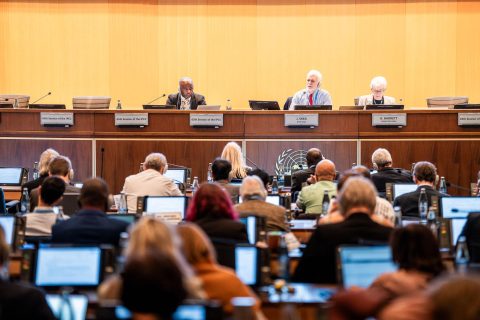

In July, PAICC said 12 countries had ignored its repeated attempts to discuss why they had not published an NDC as required every five years under the 2015 Paris accord.
Members of the committee had been divided over whether to name them, but at a September meeting decided to do so in their annual report to the annual climate COP summit.
By the time the report was published on Friday, only Congo, Senegal and North Korea “had not communicated an NDC or submitted a [Biennial Transparency Report] and had not yet responded to any of the Committee’s notifications, despite several reminders issued by the Committee in this regard”.
Rainforest and renewable energy ambitions
The silence from Congo and Senegal is notable because the former is home to much of the Congo Basin rainforest while the latter has sought billions of dollars in climate finance to support its renewable energy ambitions.
After Brazil, Congo has more rainforest than any country in the world. This forest, and the country’s peatlands, absorb huge amounts of greenhouse gas but are fast being lost to expanding farmland, charcoal production, logging and mining.
Senegal signed a Just Energy Transition Partnership with Canada and wealthy European nations in 2023, to help it meet its renewable energy targets under the-then government of Macky Sall. It was chair of the Least Developed Countries group between January 2022 and December 2023.

Tejas Rao, who is researching the PAICC as part of a doctoral thesis at Cambridge University, said the governments of the three countries should engage with the committee.
“Engagement costs these governments very little and the committee has shown it will listen,” he said.
“Silence leaves the committee with no basis to help, and it leaves the [governments] exposed to the narrative that they are simply disengaged,” he told Climate Home News.
Paris Agreement requirement
The 2015 Paris Agreement requires all parties to publish an NDC every five years outlining their emissions reduction targets, with each plan meant to be more ambitious than the country’s last NDC.
The latest set – the third round of plans, with new targets for 2035 – was due in February 2025. While most countries missed this deadline, all but around 30 – mostly small emitters but including Egypt, Vietnam and Argentina – have now submitted them.
Over the year, the PAICC – which is made up of government climate officials from developed and developing countries – has been communicating with governments that have not submitted NDCs and trying to overcome barriers to them doing so.
Some nations have cited exceptional circumstances as the reason for not submitting an NDC, a process that requires a significant amount of work in tracking emissions and consulting on how to curb them across the economy. For example, a letter from a Sudanese official to the PAICC, seen by Climate Home News, said that the country’s civil war had led to the suspension of its NDC preparation.
-
IPCC scientists vow to press on with climate reports despite political deadlock
After governments again failed to agree a timeline, nearly 120 IPCC authors pledged to complete their assessment on time and with full scientific rigour -
Under US pressure, World Bank says it will back gas “where appropriate”
The US wants the World Bank to expand its gas support while climate campaigners are pushing for it to end – its head spoke this week of limited backing for the fossil fuel -
Who shapes climate science? The equity question facing the IPCC
Early completion of the next global climate science assessment reports risks excluding research from the Global South, which is key to ensuring the findings are fair
The US and Iran are not signed up to the Paris Agreement and so do not have active NDCs, nor does Taiwan, which is not a UN member state.
Rao said that because the PAICC is “facilitative and non-punitive”, naming the countries “is meant to open a door, not close one – the invited consultation is the point”.
“In recent months, governments that explained their constraints, whether capacity, finance or domestic process, have been met with follow-up and support rather than sanction, and the number of silent governments has fallen sharply,” Rao said.
The post Paris Agreement committee names three countries snubbing it over NDCs appeared first on Climate Home News.
Paris Agreement committee names three countries snubbing it over NDCs