



- What timeline options were delegates debating?
- How did the timeline discussions unfold?
- What were the main points of disagreement?
- Why is the IPCC in a ‘serious funding crisis’?
- How have scientists reacted?
- What other issues remain unresolved?
- How are the IPCC AR7 reports progressing?
- How might the IPCC use AI and enhance gender inclusivity?

A few months ago, I was hiking along the Hooker Valley trail at the base of Aoraki Mt. Cook in Aotearoa, New Zealand.
The sky was a light blue, the sun was reflecting off the snow capped mountains and glaciers, and the river was rushing beneath the suspension bridges. How was it even possible that I, a girl from Cleveland, Ohio, could be experiencing this? How could I be standing under the looming shadow of Aoraki Mt. Cook? I don’t know if I will ever be able to come up with the correct words to describe this experience, but it raises a question: can you be in a constant state of awe when experiencing nature? Awe is defined as, “a feeling of reverential respect mixed with fear or wonder,” and as I reflect on my time spent at Aoraki Mt. Cook, I can’t help but think that I was in awe. The day before the hike I had some free time after class and decided to go for a run along a different trail: a winding path that led to a small look out of one of the glaciers. I was running in a place that I could never create in my dreams, a place that has made me understand my climate story.


My climate story begins on a snowy December morning as I shopped for a new fleece sweatshirt before my 8am class in high school. I clicked on the Patagonia website and was greeted with the phrase “The President Stole Your Land” printed in plain white letters against a black background. This happened at a point in my life where I had no idea what I was interested in.
As a sophomore in high school, I was pretty sure I wanted to be a biologist of some sort but as I began to learn exactly what Patagonia was talking about, I learned that my real passion lay in the world of politics.
On December 4th, 2017, former President Donald Trump announced that he was reducing the size of Bears Ears and Grand Escalante National Monuments. Shortly thereafter I walked around school with a shirt that said, “Protect Bears Ears,” talked about the issue to anyone who would listen, and I wrote two different research papers on various aspects of the controversy. I have continued to follow the Story of Bears Ears until President Joe Biden reinstated the original boundaries when he entered office. But as I continually checked on this issue for five years, some questions arose: Why did I care about this? Why did I allow the Southeast corner of Utah to occupy my thoughts on so many occasions?
The answers are not simple, as they are rooted in different parts of who I am. When I was a toddler, my dad would push me in a baby jogger as he ran along the Tow Path Trail in the Cuyahoga Valley in Ohio, and subsequently the Valley became my favorite place to run. I would go alone, with family, or with friends. But the key point is that I had continual access to a place I could explore and wander on my own time. I was unimpeded by any outside laws or circumstances, there was nothing stopping me from running along the crooked river under red and orange painted leaves. I grew up being in awe of the Valley and everything that lived within the boundaries of the national park.
Maybe that is why I was drawn to the issue of Bears Ears having the National Monument Status taken away. The Indigenous people that maintained their ancestral lands were suddenly barred from continuing their preservation and stewardship of key parts of the National Monument because of political battles that favored big oil companies. Political systems should help people, not tear them down. Political systems should empower people to protect what they believe in while also ensuring the continued rights of people and the environment. If I have an odd passion for the world of politics, why not use that to help lift the voices of those around me? If I love running in the Cuyahoga Valley then there is someone like me who loves running in Bears Ears or another natural area, and they have the same rights as I do to seek access to the land in a respectful way.
Learning about Bears Ears sparked a curiosity in me that forced me to learn about the intersection of politics and the environment.

I forgot to reflect on one key component of the definition of awe. The aspect of fear. While I respect nature and enjoy my time in it, is there ever a time where I am scared. Have I been scared while running through the Cuyahoga Valley or hiking under Aoraki Mt. Cook or any number of times where I have immersed myself in nature?
The answer is yes. Mother Nature has created some of the most beautiful things and places on this planet. Ocean reefs, old growth forests, and mountains that scrape the sky all the way down to plains that stretch for miles. But, Mother Nature also encompasses mudslides, droughts, wildfires, and flooding. These are natural processes that have existed long before humans roamed the Earth, and will exist long after we are gone. While it may not seem evident in every part of nature, climate change is disrupting and shifting pre-existing patterns. Climate change is destroying the world around us, creating more intense weather events, causing glaciers to melt, drought and diseases are becoming more prevalent, and the temperature is clearly rising around the globe.
If part of being in a constant state of awe of nature is fear, then I am in awe because I am scared that climate change is only getting worse. I am scared that running outside will be replaced with running on a treadmill with a screen as my window to the world. I am scared for the people who are forced to embark on a dangerous journey as they migrate across countries to seek refuge from climate change. I am scared because the political systems enacted to address climate change are failing. And I am scared because the power of nature cannot be harnessed by humans.
My climate story may not even be a story so much as it is a realization within myself that my future will involve seeking climate solutions. My climate story begins and ends with the confirmation that I am in awe of nature and will continue to be as I find my place in the world.

Julia is a Summer Climate Resilience Fellow with the Education Team at Climate generation for the 2023 summer. She is currently a senior at St. Olaf College where she is double majoring in political science and environmental studies. She is originally from Cleveland Ohio where she spent a vast amount of time exploring the Cuyahoga Valley National Park with her family and more importantly, her dog Fable. Throughout college, she has conducted research on various political and environmental topics and even presented research on the connection between voting behavior and abortion attitudes during the 2022 midterm election at an undergraduate conference. After recently studying abroad in Aotearoa New Zealand and Australia, she is excited to learn more about environmental and climate education while working at Climate Generation.
The post To Stand in Awe of Nature appeared first on Climate Generation.
Continue Reading
Three countries have been named by the Paris Agreement’s compliance committee for failing to submit a nationally determined contribution (NDC) and repeatedly snubbing offers of help with their climate plans.
After months of internal debate over whether to identify serial non-responders, the Paris Agreement’s Implementation and Compliance Committee (PAICC) named the three countries which have failed to engage with it over their NDCs on Friday.
It named Democratic Republic of Congo, Senegal and North Korea in a footnote of its annual report, adding that it decided to name them “with a view to facilitating engagement”, adding that representatives of the three nations had been invited to its meeting in early 2027 “with the purpose of identifying any challenges and constraints”.
“The Committee noted the importance of Parties engaging with the Committee in a timely manner, while noting that some delays may be due to the national capabilities and circumstances of the Parties”, the report said.
-
Under US pressure, World Bank says it will back gas “where appropriate”
The US wants the World Bank to expand its gas support while climate campaigners are pushing for it to end – its head spoke this week of limited backing for the fossil fuel -
IPCC scientists vow to press on with climate reports despite political deadlock
After governments again failed to agree a timeline, nearly 120 IPCC authors pledged to complete their assessment on time and with full scientific rigour -
Paris Agreement committee snubbed over missing NDC climate plans
Many governments have still not submitted a nationally determined contribution to the UN, breaching a key requirement of the Paris Agreement
In July, PAICC said 12 countries had ignored its repeated attempts to discuss why they had not published an NDC as required every five years under the 2015 Paris accord.
Members of the committee had been divided over whether to name them, but at a September meeting decided to do so in their annual report to the annual climate COP summit.
By the time the report was published on Friday, only Congo, Senegal and North Korea “had not communicated an NDC or submitted a [Biennial Transparency Report] and had not yet responded to any of the Committee’s notifications, despite several reminders issued by the Committee in this regard”.
Rainforest and renewable energy ambitions
The silence from Congo and Senegal is notable because the former is home to much of the Congo Basin rainforest while the latter has sought billions of dollars in climate finance to support its renewable energy ambitions.
After Brazil, Congo has more rainforest than any country in the world. This forest, and the country’s peatlands, absorb huge amounts of greenhouse gas but are fast being lost to expanding farmland, charcoal production, logging and mining.
Senegal signed a Just Energy Transition Partnership with Canada and wealthy European nations in 2023, to help it meet its renewable energy targets under the-then government of Macky Sall. It was chair of the Least Developed Countries group between January 2022 and December 2023.

Tejas Rao, who is researching the PAICC as part of a doctoral thesis at Cambridge University, said the governments of the three countries should engage with the committee.
“Engagement costs these governments very little and the committee has shown it will listen,” he said.
“Silence leaves the committee with no basis to help, and it leaves the [governments] exposed to the narrative that they are simply disengaged,” he told Climate Home News.
Paris Agreement requirement
The 2015 Paris Agreement requires all parties to publish an NDC every five years outlining their emissions reduction targets, with each plan meant to be more ambitious than the country’s last NDC.
The latest set – the third round of plans, with new targets for 2035 – was due in February 2025. While most countries missed this deadline, all but around 30 – mostly small emitters but including Egypt, Vietnam and Argentina – have now submitted them.
Over the year, the PAICC – which is made up of government climate officials from developed and developing countries – has been communicating with governments that have not submitted NDCs and trying to overcome barriers to them doing so.
Some nations have cited exceptional circumstances as the reason for not submitting an NDC, a process that requires a significant amount of work in tracking emissions and consulting on how to curb them across the economy. For example, a letter from a Sudanese official to the PAICC, seen by Climate Home News, said that the country’s civil war had led to the suspension of its NDC preparation.
-
IPCC scientists vow to press on with climate reports despite political deadlock
After governments again failed to agree a timeline, nearly 120 IPCC authors pledged to complete their assessment on time and with full scientific rigour -
Under US pressure, World Bank says it will back gas “where appropriate”
The US wants the World Bank to expand its gas support while climate campaigners are pushing for it to end – its head spoke this week of limited backing for the fossil fuel -
Who shapes climate science? The equity question facing the IPCC
Early completion of the next global climate science assessment reports risks excluding research from the Global South, which is key to ensuring the findings are fair
The US and Iran are not signed up to the Paris Agreement and so do not have active NDCs, nor does Taiwan, which is not a UN member state.
Rao said that because the PAICC is “facilitative and non-punitive”, naming the countries “is meant to open a door, not close one – the invited consultation is the point”.
“In recent months, governments that explained their constraints, whether capacity, finance or domestic process, have been met with follow-up and support rather than sanction, and the number of silent governments has fallen sharply,” Rao said.
The post Paris Agreement committee names three countries snubbing it over NDCs appeared first on Climate Home News.
Paris Agreement committee names three countries snubbing it over NDCs
Countries have failed – for the sixth time running – to agree on the timeline for publishing the Intergovernmental Panel on Climate Change’s (IPCC) next set of influential reports.
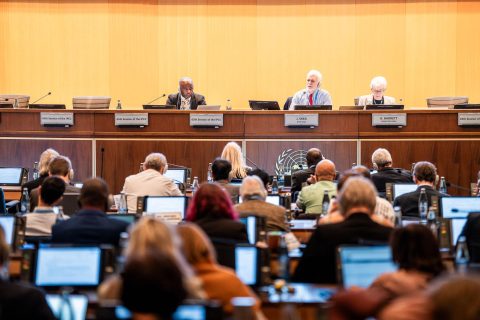
The IPCC’s 65th session (IPCC-65) was seen by many to be the final opportunity for countries to agree on a schedule where its seventh assessment report (AR7) would be published in time for the UN’s second “global stocktake” of climate action.
Before last week’s meeting in Addis Ababa, Ethiopia, IPCC chair Prof Sir Jim Skea had warned that releasing the reports in time for the stocktake in 2028 would depend on a timelines being agreed by the end of 2026.
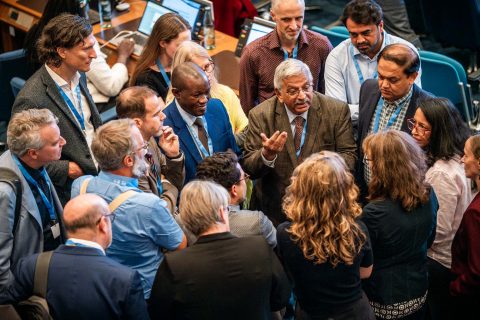
But the week-long meeting descended into fraught disagreements between governments, resulting in Skea “suspending” the talks on Friday evening with no decision made.
Countries were also unable to agree on the IPCC’s budget for the rest of the AR7 cycle, leaving the body with a “serious funding crisis”.
The IPCC has pledged to reconvene the meeting at the “earliest opportunity”; however, it has not yet given an indication of when this will be.
In his concluding remarks, Skea described the Addis Ababa summit as a “profound disappointment” and “among the most difficult IPCC meetings”, according to reporting from the Earth Negotiations Bulletin (ENB).
Some countries have reacted with dismay to the breakdown of negotiations, warning that a failure to have the IPCC’s latest assessments on climate adaptation and mitigation ready for the UN stocktaking exercise would undermine global climate action.
A climate envoy from a Pacific island state said it was a “travesty that a handful of countries continue to delay the IPCC’s reports – the science we need back home to help us save lives and livelihoods”.
Below, Carbon Brief explores the key developments, debates and disagreements at the IPCC meeting.