A wave of anti-“greenwashing” litigation is seeking to hold major players in the aviation industry to account for sensational claims of being sustainable, low-carbon or contributing to net zero.
While the industry has faced legal backlash in the past, the dramatic proliferation of these cases may spell disaster for major airlines.
It’s not hard to see why the aviation industry has provoked the ire of climate activists. Flying is responsible for a staggering 5% or so of human-induced global warming and its climate impact is still growing at a rate far greater than almost any other sector.
In this context, a profusion of “green flying” and “sustainability” advertising campaigns has turned the industry into an emblematic example of the debate between growth and sustainability.
Why greenwashing?
The rise in greenwashing litigation can in part be attributed to the relative ease with which cases can be brought. It’s simply a lot easier to attack an airline’s advertising compared to other activities that might be targeted by strategic climate litigation.
Consumers can use legal mechanisms such as commercial practice or consumer protection regulations, as happened in a recent greenwashing complaint to the European Commission filed by consumer groups in 19 countries against 17 airlines.
It’s an effective form of climate action due to the power exerted by advertising on public perception and social norms. The UN’s Intergovernmental Panel on Climate Change (IPCC) has underscored the importance of reducing demand for flying in the first place, something significantly hindered by adverts that downplay its environmental impact.
Exposed: carbon offsets linked to high forest loss still on sale
A report by Greenpeace and think tank the New Weather Institute claimed that in 2019 airline advertisements influenced 34 million tonnes of CO₂ equivalent emissions worldwide.
This litigation is also buoyed by the demonstrable falsehoods that riddle the sustainability strategies of these companies. The pillars upon which their net-zero strategies rest vary from the broadly ineffective to the dangerously fraudulent and facilitate growth in a sector in dire need of reduction.
Airlines all rely on some form of carbon offsetting – planting trees, for instance, to “offset” the carbon emitted by the planes – or sustainable aviation fuel or carbon capture and storage, in order to “mitigate” their climate impacts.
Common litigation strategies
Thus far, there have been six climate change-related cases brought against major airlines (four in Europe, one in the US and one in Brazil). These cases are buttressed by numerous legal complaints taken through the European Commission or the UK and US advertising standards boards which have already successfully ordered Ryanair, Lufthansa and Etihad to pull ad campaigns.
In each of these three cases, authorities found that terminology like “protecting the future”, “sustainable aviation” or “low-emissions airline” amounted to wilful misleading of consumers and breached advertising regulations.
A recent case taken by Dutch campaigners against airline giant KLM is the most daring example yet. Climate action group FossielVrij(Fossil-free) argues that KLM’s “Fly Responsibly” campaign constitutes misleading advertising under EU consumer law.
Following coup, Gabon climate officials face corruption allegations
The group asserts that flying responsibly is impossible at present, and that KLM seeks company growth and increased flight sales, when it should be reducing emissions by reducing the number of flights. KLM said its “communications comply with the applicable legislation and regulations”, but has dropped the Fly Responsibly campaign.
Interestingly, this case builds upon a ruling of the Dutch Advertisement Code Commission and indicates the “snowballing” trend inherent in anti-greenwashing litigation, wherein cases rely upon precedent set by previous authorities. With this borne in mind, the recent 19-country complaint by the European Consumer Organisation could provide the strongest foundation to date for future litigation.
Delta Airlines is also facing a class action suit in the US, brought by a California resident who alleges that by marketing itself as a “carbon-neutral” Delta has grossly misrepresented its environmental impact. This points to a growing understanding of the ineffectiveness of carbon offsetting, a net-zero tactic adopted by almost every major airline.
A Delta spokesperson said the case is “without legal merit” as the airline has “transitioned its focus away from carbon offsets” towards decarbonising its own activities. European companies should follow this case closely as American-style “class action” litigation will soon be made possible in the EU.
Does this litigation have teeth?
These cases might result in companies simply pulling their green campaign while maintaining their existing corporate framework and growth models. More promisingly, recent research suggests that any climate-related case taken against a major emitting company will affect the firm’s value (on average by 0.057% following the filing of a case, and by 1.5% following an unfavourable decision).
In reality, these early cases are merely scratching the surface of what’s possible. Once these cases enter the public conversation, a growing understanding of consumer protection is bound to follow.
Green Climate Fund ambition at risk after ‘disappointing’ pledges
In many jurisdictions, such as my home country of Ireland, significant damages can be awarded against companies for misleading advertisement. The UK’s Competition and Markets Authority, which is currently investigating claims of greenwashing in other sectors, will soon be able to fine companies 10% of their global turnover for non-compliance.
While anti-greenwashing litigation might not halt the growth of this industry altogether, it is no doubt an invaluable tool. At its most effective, it can stop blatant profiteering from the climate crisis and force the aviation sector to confront the chimera that is green growth.
Calum Maclaren, PhD Candidate, Climate Litigation, University College Dublin. This article is republished from The Conversation under a Creative Commons license. Read the original article.
The post Why airlines are perfect targets for anti-greenwashing legal action appeared first on Climate Home News.
Why airlines are perfect targets for anti-greenwashing legal action

For the first time, new-energy vehicles (NEVs) made up 67% of new car sales in China in September, according to the latest data from the China Passenger Car Association (CPCA).
The figures show that NEVs, which include battery electric cars and plug-in hybrids, captured a record share of sales, even though fewer were sold than last year.
This is because sales of combustion-engine cars are falling steeply, a trend that the CPCA has attributed to rising petrol prices following the start of the Hormuz crisis.
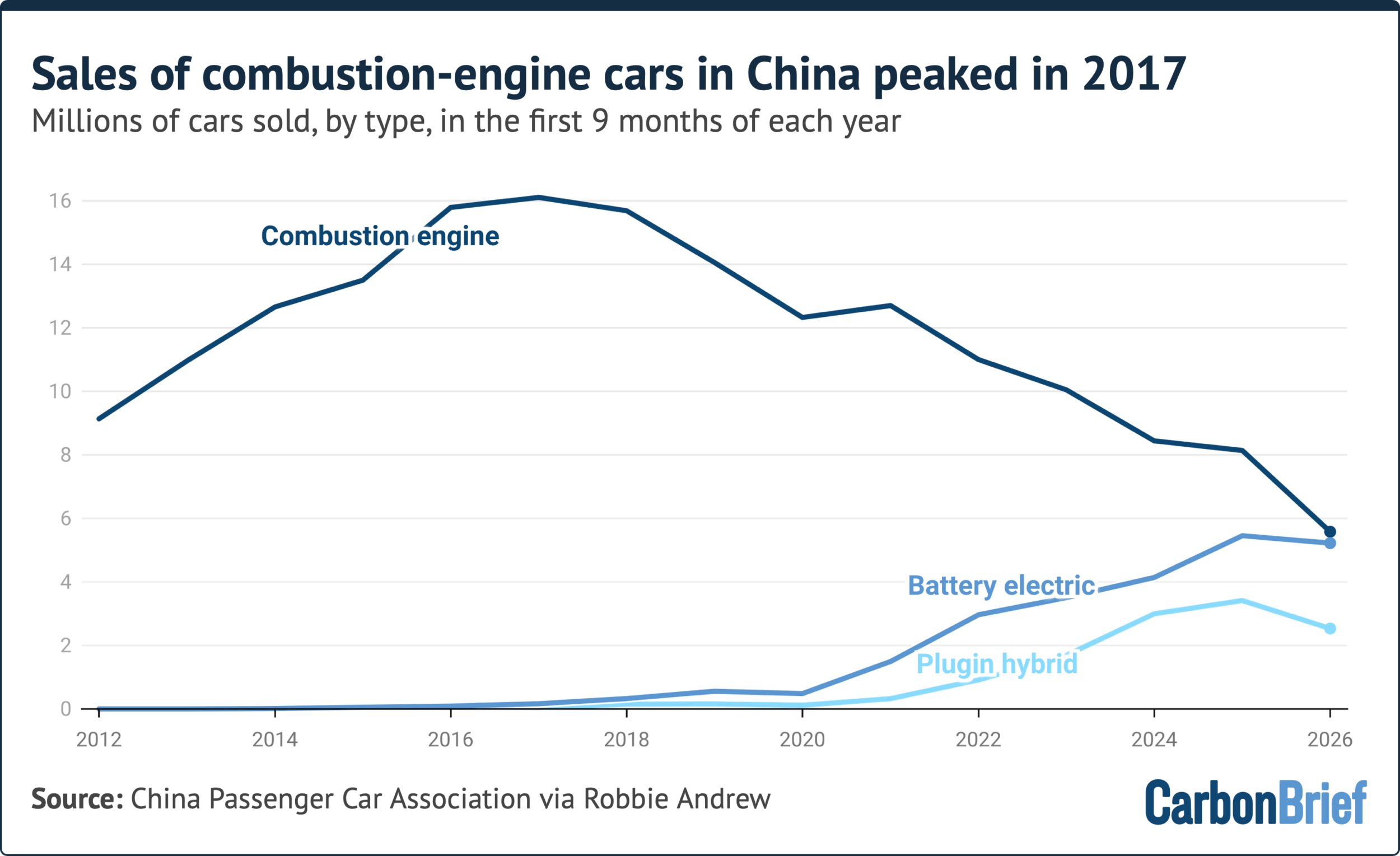
Indeed, sales of fuel-only cars were down 31% year-on-year in the first nine months of 2026, with plug-in hybrid sales down 26% – whereas battery EV sales were only down 4%.
One analyst tells Carbon Brief that China’s rapidly growing EV fleet has offset demand for 143m barrels of oil since the start of the Hormuz crisis.
Another says that the crisis is “reinforcing China’s electrification of road transport”.
Meanwhile, amid slowing domestic sales, Chinese carmakers’ exports of NEVs more than doubled [in 2026 to date / in September] from a year earlier.
NEV record
A record two out of every three cars sold in September in China were NEVs, according to CPCA data, as shown in the figure below.
(NEVs predominantly include battery electric vehicles – BEVs – and plug-in hybrids – PHEVs. BEVs only run on electricity, whereas PHEVs also have a combustion engine.)
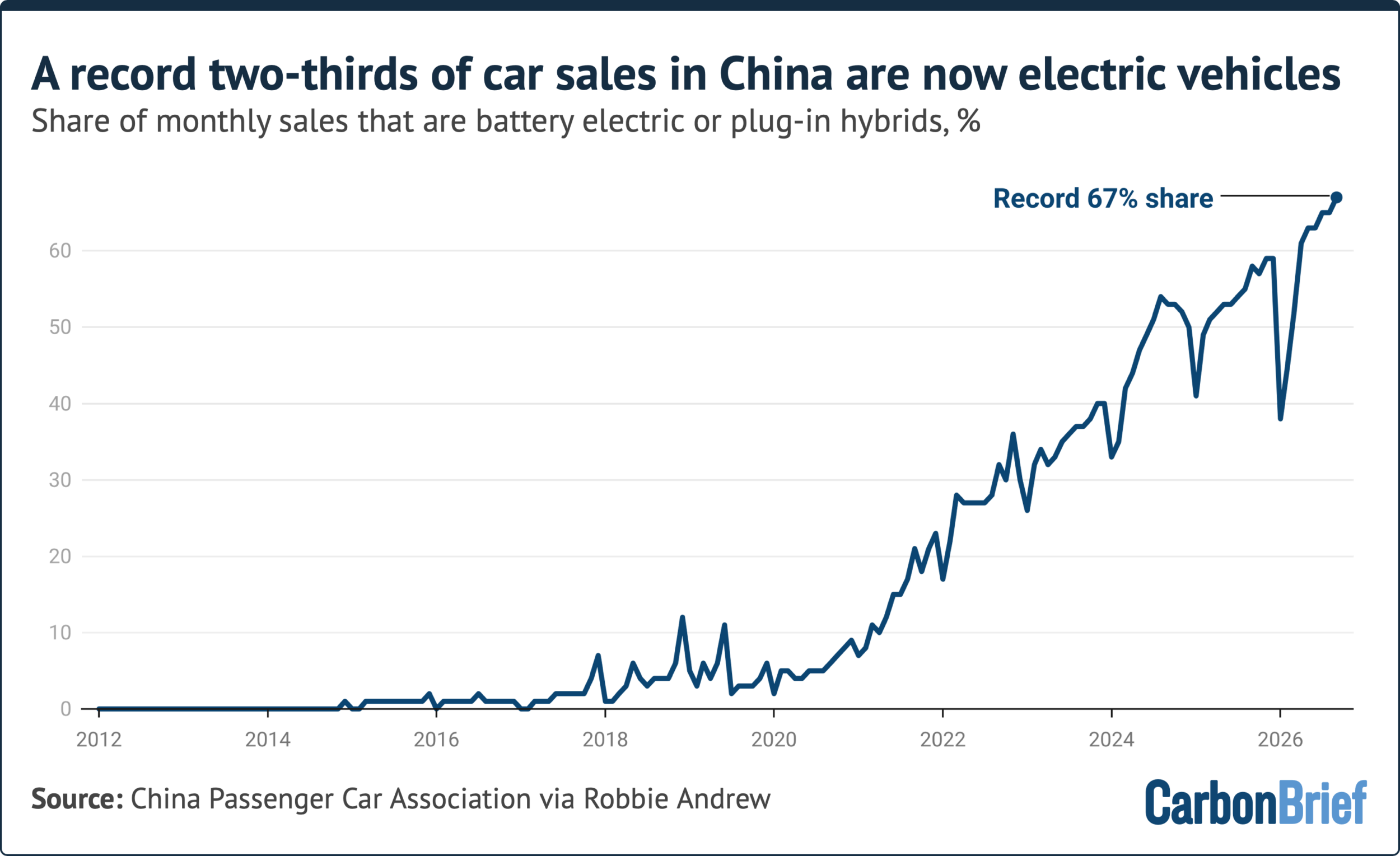
This marks a rapid rise for NEVs from just 6% of new car sales in 2020 up to 58% in 2026 to date – and a record 67% in the month of September.
This year, NEVs’ share of sales has also bounced back from a low of 39% in January, after the full purchase tax exemption that had been in place for more than a decade came to an end in December 2025.
The gain in NEV share in 2026 has come amid a slowdown across the wider domestic passenger-car market, which has hit sales of combustion-engine vehicles particularly hard.
This September, passenger-car retail sales across all categories declined, with overall sales volumes falling 28% year-on-year.
The contraction was led by combustion-engine vehicles, which saw sales fall 43% year-on-year in September and 31% in 2026 to date.
However, sales of PHEVs also fell by 36% year-on-year in September and by 26% in 2026 to date. By comparison, BEVs performed better, although sales still declined 8.5% from a year earlier in September and 4% in 2026 to date.
As a result, NEV sales overall fell by 17% in September and 13% in 2026 to date.
While the market changes in 2026 to date were particularly dramatic, they reflect a broad continuation of trends seen over the past decade.
Indeed, sales of combustion-engine cars in China peaked in 2017 and they have been declining ever since, shown in the figure below.
Impact of Hormuz
Part of the reason for the advance of NEVs in 2026, said Chinese technology news outlet OFweek, was petrol cars “giving up market share” as they were outperformed by electric alternatives.
Cui Dongshu, secretary-general of the CPCA, cited higher petrol prices as an explanation for September’s weak combustion-car sales, in comments to financial news outlet National Business Daily.
Imports of oil into China in January-September have fallen 15% compared to 2025, equivalent to 470m barrels, as ongoing conflict tightened supply and drove up prices.
China’s passenger-car NEV fleet has displaced 143m barrels of oil so far during the strait of Hormuz crisis, Euan Graham, senior energy analyst at thinktank Ember, tells Carbon Brief.
EVs “accounted for 12% of the decrease in China’s oil use post-Hormuz”, according to an estimate provided to thinktank the Brookings Institute by an unnamed analyst.
Erica Downs, a senior research scholar at Columbia University’s Center on Global Energy Policy, tells Carbon Brief that the strait of Hormuz crisis and higher oil prices are “reinforcing China’s electrification of road transport”.
She says the “world’s largest oil supply disruption” vindicates China’s early bet on EVs, which was partly driven by concerns about oil-supply security.
NEV demand down
Nevertheless, NEV sales have fallen year-on-year, albeit at a slower rate than overall car sales. The growth in NEV market share has also been decelerating.
Zhang Yichao, a partner at consulting firm AlixPartners, tells Carbon Brief that NEVs benefit from government trade-in policies and a “strong pipeline” of new models, particularly those involving innovation.
He says these factors help explain why NEVs sales have fallen at a slower rate to their combustion-car counterparts.
Cui told the state-run China National Radio that the fall for NEVs and for cars overall in September 2026, is also due to a high baseline of sales from the same month in 2025, as well as changes to trade-in policies and disruptions from the holiday period.
Other factors, says consulting firm Wood Mackenzie, are the weakened demand due to “demand pull-forward” in 2025 caused by the end of subsidies, as well as “tighter financing conditions”.
Zhang tells Carbon Brief he does not “see much more room ahead” for further growth in NEVs’ market share.
He adds that, in his view, their share in China is unlikely to exceed 80%, as some premium-market segments and specific use cases will continue to require combustion-engine vehicles.
Exports surge
Meanwhile, while domestic NEV retail sales fell 17% in September 2026, exports more than doubled, increasing 164% year-on-year, according to the CPCA.
This extends the decline in domestic sales and very strong growth in exports seen across 2026 to date, as shown in the figure below.
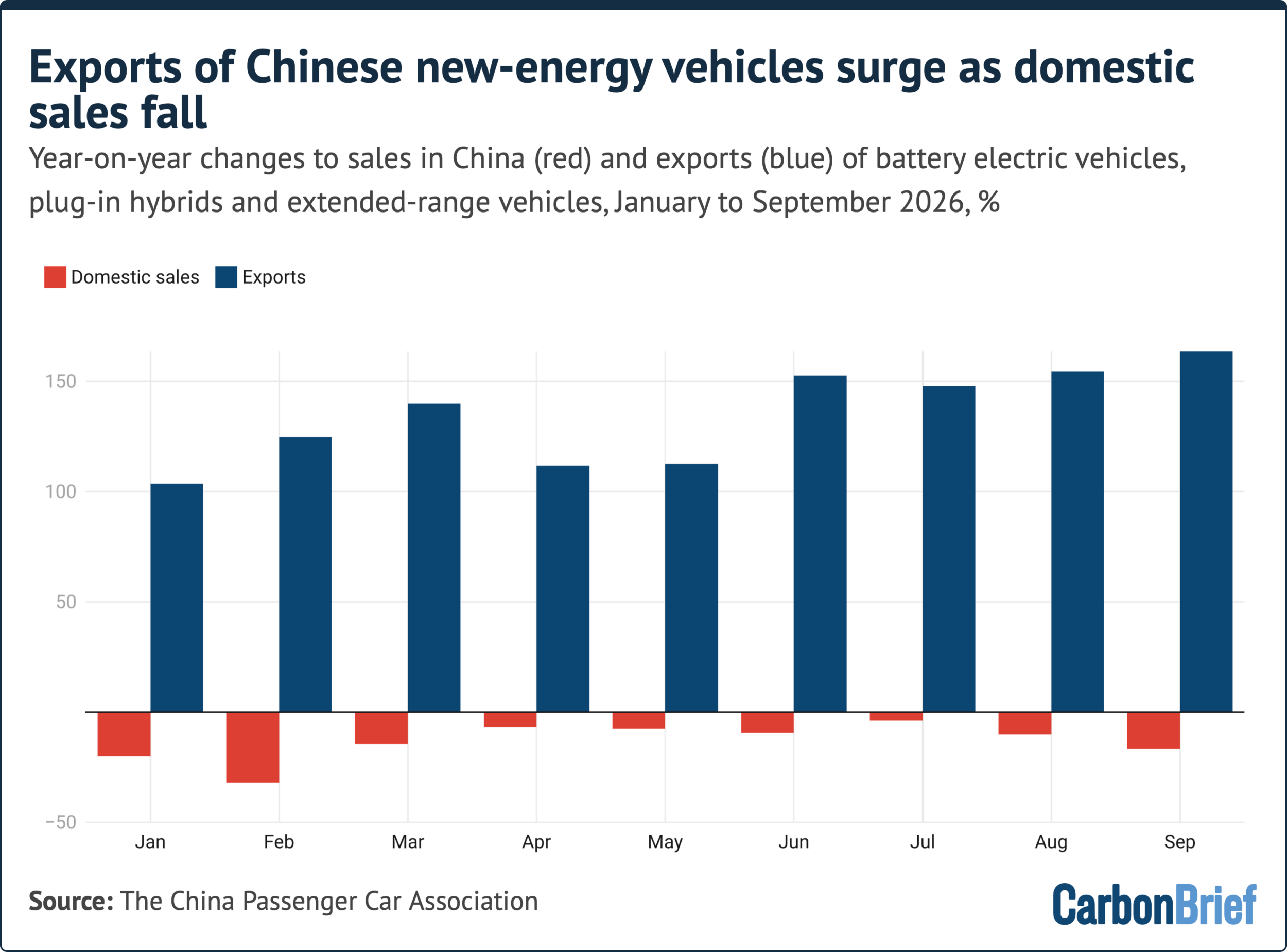
In September, 1,084,000 NEVs were sold domestically in China, while 558,000 NEVs were exported.
Exports are becoming increasingly important to Chinese carmakers, in the face of weaker domestic demand and cut-throat industrial competition.
The CPCA says exports have become “a core priority” for some carmakers.
However, the surge in exports from China has created concern in the EU, which has placed tariffs on imports of EVs from China and recently agreed plans to cut imports of hybrids.
Countries including Mexico and Turkey have also placed tariffs on Chinese EV imports.
At the same time, the Chinese government is putting policies in place that might be expected to disincentivise exports, such as cutting VAT export rebates.
Analysts differ on what impact this policy shift will have, with some saying it will be limited, while others believe it could cause the price of exported cars to rise.
Related