

Around 60 governments are due to gather in the Colombian city of Santa Marta this week for what is being billed as the first global summit on phasing out coal, oil and gas, where experts say new coalitions could help speed up the energy transition beyond the slower pace of UN climate talks.
At last year’s COP30 UN conference, a group of some 80 countries backed the idea of a global roadmap away from fossil fuels, but it was blocked by fossil fuel-producing nations. To move past these obstructions, Colombia and the Netherlands decided to convene the fossil fuel phase-out summit, which will host ministers for high-level discussions on April 28 and 29.
The group of countries headed to Santa Marta includes COP31 hosts Australia and Türkiye, as well as European, Latin American, Asian, African and Pacific nations. Some large fossil-fuel producers are on the list, including Canada, Norway, Brazil and Nigeria, but the US, China, India and Russia will not attend.
At this week’s Petersberg Climate Dialogue, German Chancellor Friedrich Merz told governments that “when multilateral processes move slowly, concrete alliances of the willing can take us a long way”, in a hint at the voluntary initiatives expected to emerge from the Santa Marta discussions.
-
Fossil fuel crisis offers chance to speed up energy transition, ministers say
As climate diplomacy resumes in Berlin, ministers say the Iran war-driven fuel crisis is exposing the risks of fossil dependence -
To avoid COP mistakes, Santa Marta conference must be shielded from fossil fuel influence
The first global conference on transitioning away from fossil fuels must learn the lessons from the struggling UN climate process and free itself from polluting influence


Brazil’s COP30 CEO Ana Toni told journalists this week that UN negotiations can “take a long time”, adding that the Santa Marta summit can start a complementary process to “keep the debate about transitioning away at the highest political level”. Brazil is working on a separate roadmap for a global fossil fuel transition due to be presented ahead of COP31, which will draw on the Santa Marta conclusions as well as submissions from countries and other interested parties.
At a webinar hosted by Climate Home News, Colombia’s environment minister Irene Vélez Torres said the Santa Marta summit is winning “global attention” in part because countries have reached a “breaking point” at UN climate talks, which have been gridlocked by fossil fuel-producing countries.
“There is a natural blockade of those themes in the multilateral agendas,” the Colombian minister said. The recent conflict in the Middle East has added renewed importance to the debate by “showing us that we cannot be dependent on fossil fuels anymore”, she emphasised.
Toni also noted that, in the context of the war in Iran, “if anybody had a doubt, I think now it’s absolutely clear we need to take those very hard steps.”
Several climate ministers at the Petersberg Dialogue – including Türkiye’s COP31 president Murat Kurum – urged countries to reduce their reliance on fossil fuels by boosting renewable energy deployment not only for climate reasons but also for energy security.
The effects of the oil and gas crisis driven by the Iran war, which has cut off exports from the Middle East, are already showing in the real economy. Countries in Africa and Asia are importing record amounts of solar power components from China, in an effort to reduce their reliance on fossil fuels.
Opportunity for “inflection point”
While the Santa Marta conference will not deliver a major negotiated agreement, observers said it could spur new coalitions and contribute to speeding up the energy transition by exploring the concrete policies and finance needed to drive an equitable shift away from fossil fuels. A summary report of the proceedings is due to be published by June.
WWF’s global climate lead, Manuel Pulgar-Vidal, who served as COP president for Peru in 2014, said in a statement that reducing the world’s dependence on fossil fuels requires “a rapid, global shift to renewable power, smarter grids and efficiency”.
“We need a ‘coalition of the willing’ to show us the way. Santa Marta is an inflection point and an opportunity that we should not miss,” he said.
Natalie Jones, senior policy advisor at the International Institute for Sustainable Development (IISD), said countries have the opportunity to form a “coalition of doers” that sends the message that “the transition is happening, and the countries that are here are the ones making it happen”.
To phase out fossil fuels, developing countries need exit route from “debt trap”
In the lead-up to the conference, a group of Pacific island nations – which have historically championed a 1.5C limit to global warming and a phase-out of fossil fuels – launched a declaration for a “fossil fuel-free Pacific” and urged countries to “support the ongoing development of a comprehensive, robust, actionable global roadmap” away from fossil fuels. Many island economies are still highly dependent on expensive fossil fuel imports, though most are already adding solar, geothermal and other renewables.
Toni noted that several coalitions on fossil fuels already exist – such as the Beyond Oil and Gas Alliance (BOGA) in which members commit to phasing out oil and gas domestically or a Dutch-led coalition to phase out fossil fuel subsidies – but these must be strengthened.
Beginning of a process
Aside from governments, the Santa Marta conference will also host Indigenous people and local communities, scientists, cities, unions, green groups and the private sector to share research and recommendations on how to best phase out fossil fuels.
These civil society actors will meet from April 24 to 27 for preliminary discussions that will inform the debate among ministers.
On Friday, scientists are expected to launch a new high-level panel that will provide advice for policy-makers to support the international transition away from fossil fuels, as well as a scientific report laying out key recommendations for governments. According to a draft seen by Carbon Brief, these range from halting fossil fuel expansion to cutting methane emissions from the energy sector and phasing out fossil fuel subsidies.
Another barrier to the clean energy transition that will be on the agenda in Santa Marta is an international system formally known as “investor-state dispute settlement” (ISDS), which enables companies to use trade agreements to sue governments that block private-sector projects like coal mines or oil exploration.
Ahead of the conference, more than 340 civil society organisations signed an open statement saying that ISDS “threatens a just transition from fossil fuels and the urgent need for a social and ecological transformation for people and the planet”. They called on governments to start building a coalition of countries committed to freeing themselves from ISDS, after Colombia announced recently it would withdraw from the system. Doing so will be complicated in practice and require coordinated action among states, experts told Climate Home News.
Colombia pledges to exit investment protection system after fossil fuel lawsuits
Colombian minister Vélez explained that one of the key outcomes from Santa Marta will be to kickstart a longer process that continues next year with a second fossil fuel phase-out conference in the Pacific island state of Tuvalu. Jones of IISD said “this is only the start of a process” in which more nations can decide to participate later.
“Other countries that wish to join this space in good faith would be welcome, so it’s a question of whether fossil fuel producers are ready to have these conversations in all their complexity,” she added.
The post Sixty countries head to Santa Marta to cement coalition for fossil fuel transition appeared first on Climate Home News.
https://www.climatechangenews.com/2026/04/23/sixty-countries-head-to-santa-marta-to-cement-coalition-for-fossil-fuel-transition/

For the first time, new-energy vehicles (NEVs) made up 67% of new car sales in China in September, according to the latest data from the China Passenger Car Association (CPCA).
The figures show that NEVs, which include battery electric cars and plug-in hybrids, captured a record share of sales, even though fewer were sold than last year.
This is because sales of combustion-engine cars are falling steeply, a trend that the CPCA has attributed to rising petrol prices following the start of the Hormuz crisis.
Indeed, sales of fuel-only cars were down 31% year-on-year in the first nine months of 2026, with plug-in hybrid sales down 26% – whereas battery EV sales were only down 4%.
One analyst tells Carbon Brief that China’s rapidly growing EV fleet has offset demand for 143m barrels of oil since the start of the Hormuz crisis.
Another says that the crisis is “reinforcing China’s electrification of road transport”.
Meanwhile, amid slowing domestic sales, Chinese carmakers’ exports of NEVs more than doubled [in 2026 to date / in September] from a year earlier.
NEV record
A record two out of every three cars sold in September in China were NEVs, according to CPCA data, as shown in the figure below.
(NEVs predominantly include battery electric vehicles – BEVs – and plug-in hybrids – PHEVs. BEVs only run on electricity, whereas PHEVs also have a combustion engine.)
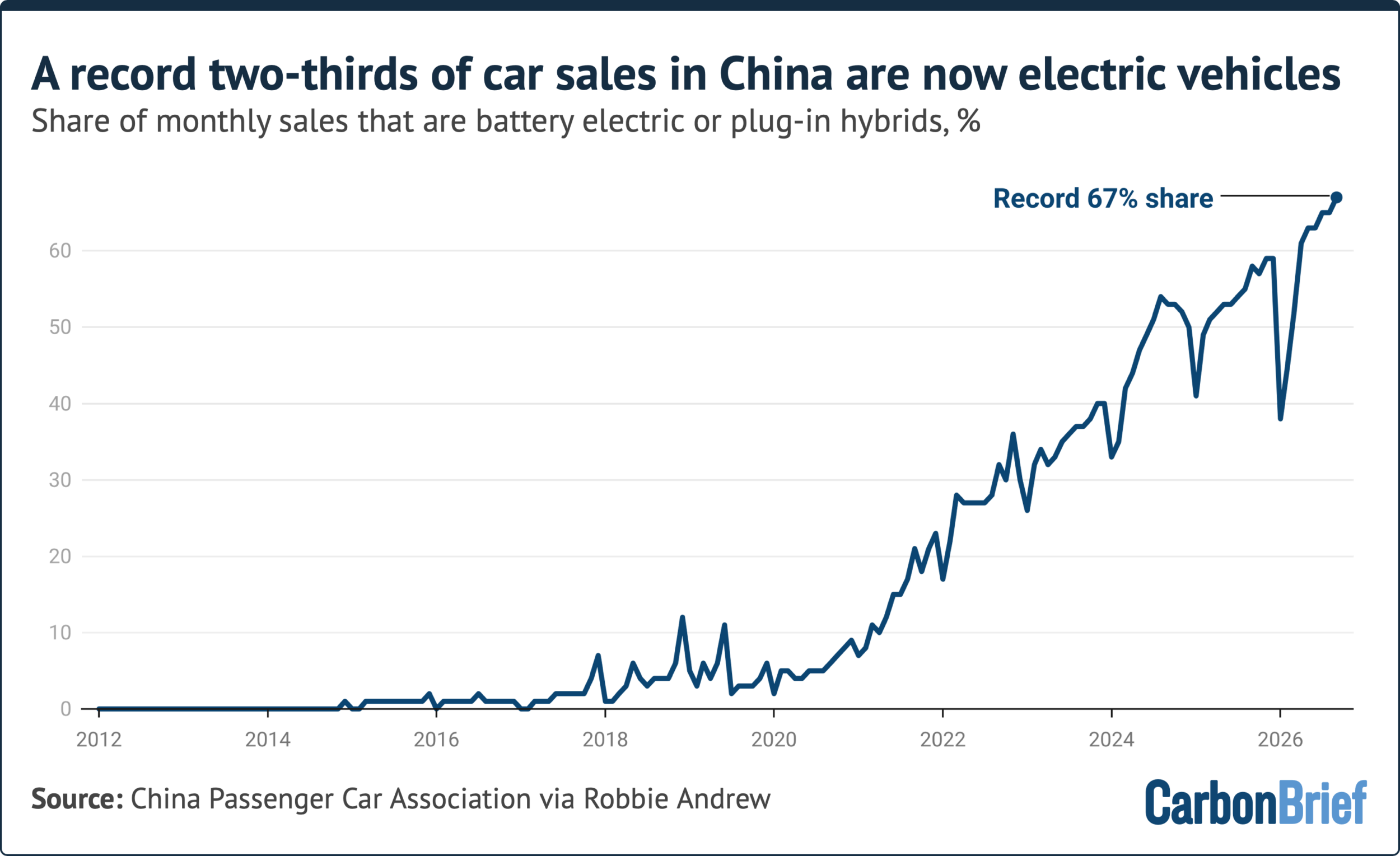
This marks a rapid rise for NEVs from just 6% of new car sales in 2020 up to 58% in 2026 to date – and a record 67% in the month of September.
This year, NEVs’ share of sales has also bounced back from a low of 39% in January, after the full purchase tax exemption that had been in place for more than a decade came to an end in December 2025.
The gain in NEV share in 2026 has come amid a slowdown across the wider domestic passenger-car market, which has hit sales of combustion-engine vehicles particularly hard.
This September, passenger-car retail sales across all categories declined, with overall sales volumes falling 28% year-on-year.
The contraction was led by combustion-engine vehicles, which saw sales fall 43% year-on-year in September and 31% in 2026 to date.
However, sales of PHEVs also fell by 36% year-on-year in September and by 26% in 2026 to date. By comparison, BEVs performed better, although sales still declined 8.5% from a year earlier in September and 4% in 2026 to date.
As a result, NEV sales overall fell by 17% in September and 13% in 2026 to date.
While the market changes in 2026 to date were particularly dramatic, they reflect a broad continuation of trends seen over the past decade.
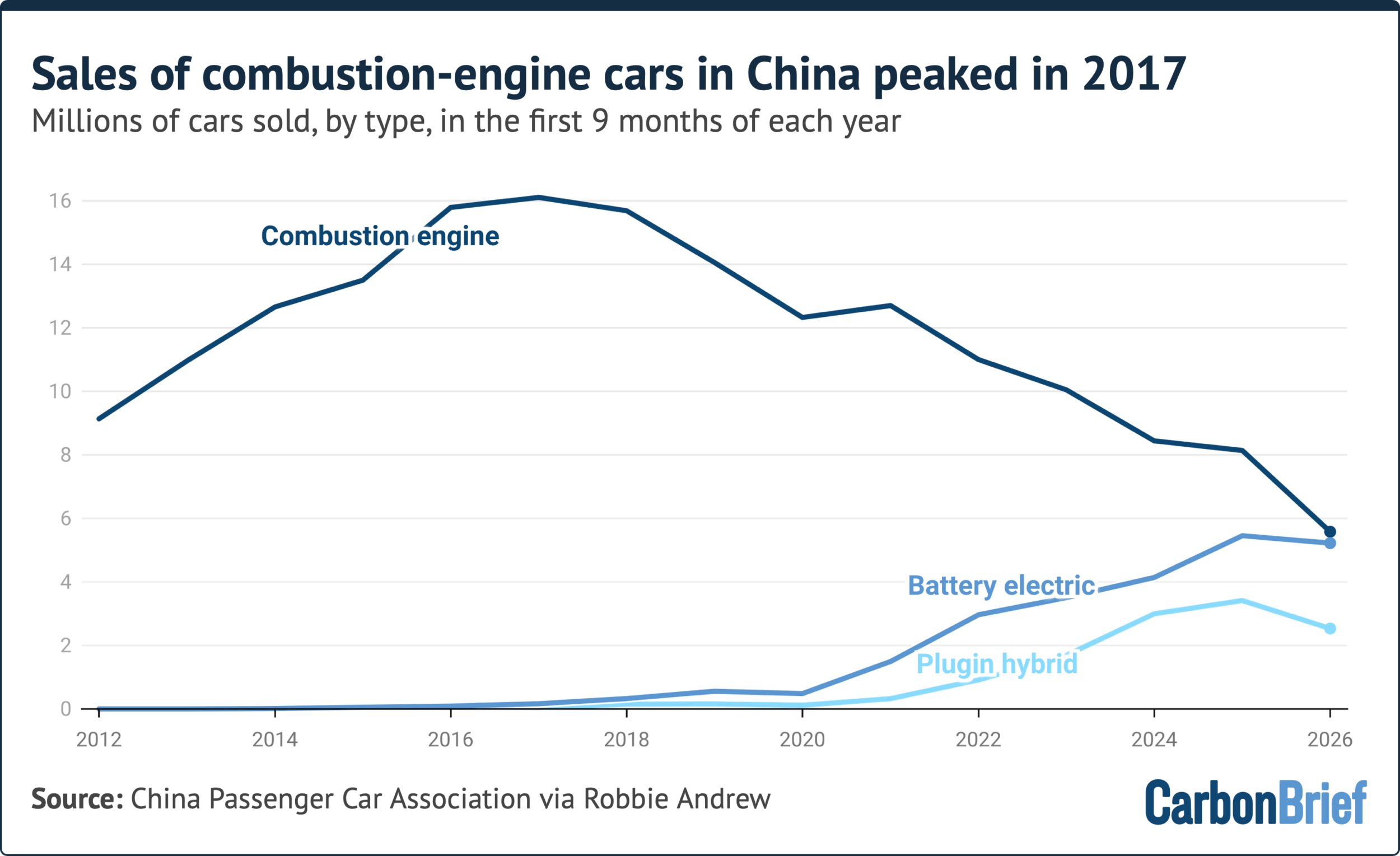
Indeed, sales of combustion-engine cars in China peaked in 2017 and they have been declining ever since, shown in the figure below.
Impact of Hormuz
Part of the reason for the advance of NEVs in 2026, said Chinese technology news outlet OFweek, was petrol cars “giving up market share” as they were outperformed by electric alternatives.
Cui Dongshu, secretary-general of the CPCA, cited higher petrol prices as an explanation for September’s weak combustion-car sales, in comments to financial news outlet National Business Daily.
Imports of oil into China in January-September have fallen 15% compared to 2025, equivalent to 470m barrels, as ongoing conflict tightened supply and drove up prices.
China’s passenger-car NEV fleet has displaced 143m barrels of oil so far during the strait of Hormuz crisis, Euan Graham, senior energy analyst at thinktank Ember, tells Carbon Brief.
EVs “accounted for 12% of the decrease in China’s oil use post-Hormuz”, according to an estimate provided to thinktank the Brookings Institute by an unnamed analyst.
Erica Downs, a senior research scholar at Columbia University’s Center on Global Energy Policy, tells Carbon Brief that the strait of Hormuz crisis and higher oil prices are “reinforcing China’s electrification of road transport”.
She says the “world’s largest oil supply disruption” vindicates China’s early bet on EVs, which was partly driven by concerns about oil-supply security.
NEV demand down
Nevertheless, NEV sales have fallen year-on-year, albeit at a slower rate than overall car sales. The growth in NEV market share