Connect with us

Published

on

Get thrifty with our lineup of the best online secondhand stores that carry casual wear, childrenswear, outdoor gear, and luxury items you can purchase or trade-in — and earn some extra cash while you’re at it.

Shopping secondhand instead of brand new is one of the most sustainable decisions you can make when it comes to fashion. Not to mention how the monetary reward of selling off your old clothes can encourage you to take better care and offer them a new lease on life. Don’t just take our word for it, consumers are increasingly seeing a lot of merit in resale purchases. According to a recent report by ThredUp, “60% say shopping secondhand apparel gives them the most value for money.”

If you find yourself agreeing with the statistic, we’ve got a few tips to help you make informed purchases on online thrift stores:

  • Always keep your measurements handy. Sizes are always limited and tend to differ based on brand
  • Don’t just sort listings by price, filter your search further by preferred material, color, and item condition to find something worthwhile
  • Get keyword-specific with your searches as most platforms now use AI to offer better search results 
  • Use websites like Secondarie to find specific items without the work of sifting through several resale platforms or install the Beni chrome extension to find the best resale alternatives
  • Take a minute to go over information like return and payment policies especially when purchasing an investment piece 
  • Look at how the platform authenticates luxury or designer items

And now that you’re armed with the basics of making a sound secondhand purchase, here’s our roundup of where to buy used clothes and sell them.

Note, that this guide is separated into:

  • Online Secondhand Stores for Wardrobe Staples
  • Online Secondhand Stores for Childrenswear and Maternity Clothing
  • Online Secondhand Stores for Outdoor Apparel and Gear
  • Online Luxury Consignment Stores

Online Secondhand Stores for All Types of Clothing

1. ThredUp
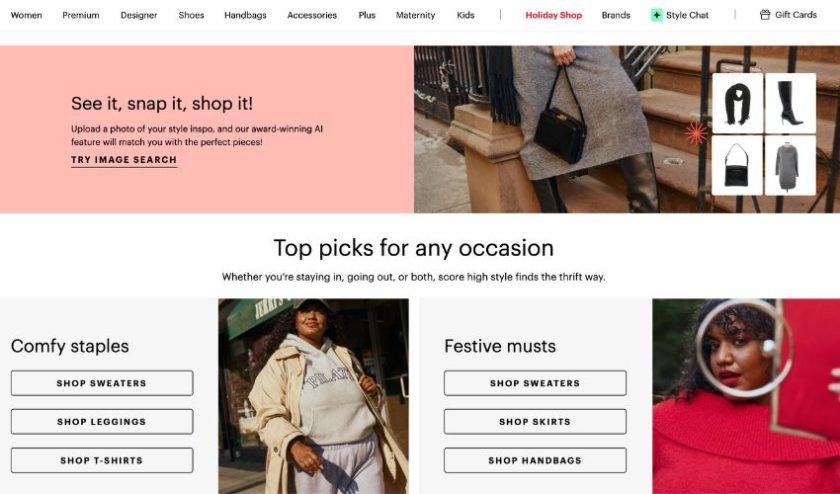
ThredUp Home Page, online thrift store

What You’ll Find: Women’s Clothing, Kids and Junior’s Clothing, Maternity Clothing, Plus Size Clothing, Shoes, Handbags, Accessories

Known for offering some of the most well-curated collections of secondhand finds online, ThredUp is the online thrift store to sell and buy nearly everything in your sartorial rotation.

With impressive AI enhancements like image search and an improved search function, shoppers can upload a picture of an item or look — directly from Instagram as well — to find similar dupes on their site. You can also type in the most specific searches like “cocktail outfit for an office party” or “beach wedding guest dresses” for a more efficient shopping experience.

2. Depop

Depop home page, online thrift store

What You’ll Find: Women’s Clothing, Men’s Clothing, Shoes, Accessories, Jewelry

Depop is an online fashion resale app that uses social commerce to make shopping a user-friendly experience. Similar to a typical social media app, Depop allows you to discover people and celebrities alike to shop their pre-owned closets or even get inspired to create your profile to offer some of your well-loved items a second lease on life.

The rating feature also helps sellers and shoppers thoroughly vet each other to make an informed decision.

3. Vinted

online thrift store, Vinted Home page

What You’ll Find: Women’s Clothing, Men’s Clothing, Kids Clothing, Accessories, Bags, Shoes, Beauty, Homeware, Electronics, Books & Games, Pet Care

Vinted is an online secondhand store which sets itself apart for allowing users earn some extra cash for decluttering their closets and also their home.

Shoppers can avail themselves of a range of well-maintained electronics, books, games, and even pet care products among their next wardrobe finds. Conscious-minded buyers can also filter products by materials to make finding quality pieces easier.

4. Swap

Swap home page, online thrift store

What You’ll Find: Women’s Clothing, Men’s Clothing, Baby & Kids Clothing, Shoes

Swap is an all-in-one online secondhand shop where you can find something for the whole family. They’ve got a wide selection of everything from mass market to premium brands to shop from which includes daily clothing, outerwear, swimwear, and shoes for men, women, and children.

Swap also lets its shoppers further filter their inventory by products with tags still on them, among new, fair, or in good used condition so you can find a quality item without much of a hassle.

5. Poshmark

online thrift store, Poshmark secondhand fashion app

What You’ll Find: Women’s Clothing, Men’s Clothing, Kids Clothing, Accessories, Bags, Shoes, Jewelry, Beauty, Homeware, Pet Care, Electronics

Poshmark is an online thrift store delivering a social experience to buyers and sellers alike. Similar to a social media app, secondhand listings appear on the main feed and buyers can discover specific items through the shop tab.

They’ve even got a homeware category where you can choose to trade in well-kept decor or fine china you no longer need.

6. Thrifted

Online thrift store, Thrifted UK home page

What You’ll Find: Women’s Clothing, Men’s Clothing, Kids Clothing

Looking for your next streetwear-inspired fit? Then Thrifted is the place to be. Based out of the UK, Thrifted is an online vintage clothing store that stocks slick secondhand styles from brands like Nike, Carhartt, Patagonia, The North Face, Adidas, and a lot more.

They’ve even got a dedicated sportswear section where you can cop cool finds like a vintage NASCAR bomber jacket and some Harley Davidson graphic tees for kids.

Online Secondhand Stores for Children’s and Maternity Clothing

7. Bounce Mkt

Bounce Mkt home page, Childrens Online thrift store

What You’ll Find: Dresses, Tops, Bottoms, Outerwear, Co-ord Sets, Swimwear, Shoes | Price Range: $-$$

For the little ones who outgrow their clothes rapidly, Bounce Mkt is an online thrift store offering a practical and economical solution.

Founded by a mom who is all too familiar with children’s growth spurts, this online resale boutique lets parents sell pre-loved clothing and purchase styles for infants and children up to age 12.

We love that they have sections for boys, girls, and gender-neutral to shop from.

8. Retykle

Retykle home page, childrens secondhand online store

What You’ll Find: Baby & Kids Clothing, Shoes, Bags, Maternity Clothing

Founded in Hong Kong, Retykle is an online used clothes store where you can buy and sell pre-loved children’s clothing and maternity wear.

Shoppers can peruse through their wide range of clothing categories with sizes that go up to 14 years of age for boys, girls, and gender-neutral little ones. New moms can also find a great selection of maternity and nursing clothes for pre-natal and post-natal needs.

While Retykle ships worldwide, they are making a difference locally by offering parents access to secondhand uniforms in schools based out of Hong Kong and Singapore.

Online Secondhand Stores for Outdoor Apparel and Gear

9. Re/Supply by REI

Re/Supply by REI home page, secondhand outdoor gear store

What You’ll Find: Women’s Clothing, Men’s Clothing, Kids Clothing, Footwear, Gear

Spending on your next adventure outdoors? Don’t let clothing and gear drive up your budget. REI’s Re/Supply is an outdoor online thrift store where you can find nearly everything you need for your next camping, hiking, or skiing trip. Apart from their own label REI Co-op, you can also find gently used pieces from Patagonia, The North Face, and many more.

If you’re a seasoned adventurer seeking to let go of some old gear or clothing, trade-ins receive between 10%-40% of the original price of the item in the form of an REI Gift Card.

10. Worn Wear by Patagonia

Worn Wear by Patagonia home page, secondhand outdoor clothing store

What You’ll Find: Women’s Clothing, Men’s Clothing, Kids Clothing, Packs & Gear

Worn Wear is Patagonia’s in-house initiative to keep their clothing and gear in circulation for longer. The brand’s secondhand vertical allows you to trade in eligible gear for credit and buy well-maintained items that have more life to live. Whether you’re into snowboarding, hiking, or climbing, you’ll find Patagonia’s quality items at a bargain. 

They’ve even got a collection of gently used everyday clothing as a bonus for the downtimes spent between outdoor activities.

11. The North Face Renewed

The North Face Renewed home page, online secondhand store

What You’ll Find: Women’s Clothing, Men’s Clothing, Kids Clothing, Footwear, Bags & Gear

When it comes to buying outdoor clothing and gear, The North Face Renewed goes the extra mile by making sure its pre-owned items are inspected, washed, tuned up, and ready for their next adventure.

Their online secondhand store is divided into two sections, like-new items that are cleaned up with no visible repairs and reconditioned items that have tiny repairs listed in detail for every product. You could also trade in your old clothes and gear by The North Face for store credit.

12. Geartrade

Geartrade home page, online secondhand gear store

What You’ll Find: Gear, Women’s Clothing, Men’s Clothing, Kids Clothing, Footwear, Accessories

Geartrade is an online thrift store that lets adventurists buy and sell used gear for skiing, snowboarding, hiking, camping, biking, climbing, water sports and fly fishing among a lot more.

While they do specialize in an expansive collection of gear for every type of adventure, they also stock outdoor clothing from brands like Under Armour, Adidas, Tentree, and PrAna, to name a few.

13. ReGEAR by Arc’teryx

ReGEAR by Arc’teryx home page, secondhand outdoor clothing and gear store

What You’ll Find: Women’s Clothing, Men’s Clothing, Footwear, Packs

ReGEAR is Arc’teryx’s way of reintroducing its gently used items back into play by thoroughly inspecting trade-ins and repairing it before it becomes available for resale on their secondhand online store.

Shopping is made easy through their categories of intended use which include rock climbing, hiking, trekking, snow activities, and trail running, along with a collection of everyday essentials. Outdoorsy folk will appreciate the detailed summary of the product’s features that include characteristics like being lightweight and breathable to construction information like vent placements for perspiration.

14. Cotopaxi Más Vida

Cotopaxi Más Vida home page, secondhand clothing and gear

What You’ll Find: Women’s Clothing, Men’s Clothing, Packs & Gear

Cotopaxi is a sustainably-minded brand offering pre-owned outdoor apparel and gear through its secondhand online store. Aptly titled “Más Vida” which is Spanish for “more life”, Cotopaxi doesn’t just take in new products for repairs but also takes care of any tuning up your secondhand purchase may need in the future.

The brand works with Tersus Solutions to clean their products for resale where they wash everything for Cotopaxi Más Vida in a machine that uses recycled liquid CO2, collects microfibers, and uses minimal energy. 

Online Luxury Consignment Stores

15. The RealReal

The RealReal home page, secondhand online store for luxury goods

What You’ll Find: Women’s Clothing, Men’s Clothing, Kids Clothing, Bags, Shoes, Jewelry, Watches, Homeware

Dreamed of owning an iconic Hermès Birkin? Then The RealReal might just help you make those wishes come true. One of the most well-known secondhand luxury marketplaces, The RealReal is the place to find a good deal on your favorite pre-loved luxury piece minus the five year waitlist.

Every item that’s traded in goes through an authentication process with their in-house experts who know the typography, production codes, hardware, materials, and construction details that signal authenticity. You can also choose to consign with them for a handsome payout and earn rewards along the way. 

16. Vestiaire Collective

Vestiaire Collective home page, secondhand online store for luxury goods

What You’ll Find: Women’s Clothing, Men’s Clothing, Kid’s Clothing, Bags, Shoes, Jewelry, Watches

Vestiaire Collective is a online secondhand store for luxury items well-known for its creative marketing campaigns and noteworthy collaborations with shows like Emily in Paris. Suffice to say, it’s the internet’s favorite secondhand luxury store that walks the talk with its authenticated curation of designer items.
The site allows its shoppers to negotiate with sellers through its “Make an Offer” button encouraging them to go down to a maximum of 30% off the original price. Potential sellers can even work out an approximate payout through their secondhand price calculator.

17. What Goes Around Comes Around

What Goes Around Comes Around home page, secondhand online store for luxury goods

What You’ll Find: Women’s Clothing, Men’s Clothing, Bags, Jewelry, Watches, Accessories

With its highly collectible and covetable designer vintage items, What Goes Around Comes Around is an online luxury vintage store worth exploring for your next high-end purchase.

They make shopping a delightful experience owing to their curation of “Edits” that are divided into categories like the classics, iconic investments, among handbags and accessories under specified budgets.

18. 2nd STREET USA

2nd STREET USA home page, secondhand online store

What You’ll Find: Women’s Clothing, Men’s Clothing, Bags, Shoes, Accessories

If you’ve always admired model-off-duty style or streetwear with a luxurious edge then 2nd STREET USA might just have what you’re looking for.

Founded in Japan, this online thrift store features slick pre-loved fashion from the biggest names in the premium and luxury fashion industry among several Japanese designers worth having on your radar. You can also peruse through their collections in person at their stores across the US.

19. Farfetch Pre-owned

FARFETCH Pre-owned home page luxury consignment store

What You’ll Find: Women’s Clothing, Jewelry, Bags, Accessories, Shoes

Farfetch Pre-owned is the secondhand arm of the London-based multi-designer store where you can find a wide selection of vintage luxury items that’ll be sure to turn heads your way.

Their collection of designer vintage bags deserves a thorough perusal for offering some highly sought-after limited-edition pieces. Every product features detailed highlights on the condition it is in, which mostly show only minimal signs of use.

20. Grailed

GRAILED home page,  luxury consignment store

What You’ll Find: Women’s Clothing, Men’s Clothing, Bags, Accessories, Jewelry, Footwear

Grailed is a luxury online secondhand store where you can find streetwear and designer pieces from the finest names in fashion. Whether it’s a hot pair of Jordan sneakers or a vintage jacket from Burberry, you’ll be exercising some sartorial street cred in no time. 

The website also allows you to shop by collections like Tisci’s Givenchy, The Best of Phoebe Philo, and Pre-Demna Balenciaga for the ones who love fashion and its storied creative directors.

21. Sign of the Times

Sign of the Times UK Home page,  luxury consignment store

What You’ll Find: Women’s Clothing, Bags, Accessories, Jewelry, Shoes, Homeware

Based out of London, Sign of the Times is a online secondhand store who opened its storefront back in 1976 to sell clothes belonging to celebrities. Having been in the business for so long, the store prides itself on authenticating its curation of sought-after designer items online and in-store. 

Featuring beautiful pieces from designers like Prada, Chloe, Chanel, and beyond, their selection of clothes are available up to size UK 14.

About The Author:

Jharna Pariani is a fashion writer and creative strategist whose work is rooted in honesty and deep observation of the world around her. When she isn’t busy penning down her thoughts, she moonlights as a video editor creating fashion and food reels on Instagram for several brands and influencers

The post 21 Best Online Secondhand Stores to Shop (& Sell!) Pre-Loved Fashion appeared first on .

21 Best Online Secondhand Stores to Shop (& Sell!) Pre-Loved Fashion

Continue Reading

Green Living

Earth911 Inspiration: A Serious Look at Modern Lifestyle

Published

on

Today’s quote comes from Pope John Paul II’s message for the celebration of the World Day of Peace, 1990. He wrote, “Modern society will find no solution to the ecological problem unless it takes a serious look at its lifestyle.”

Earth911 inspirations. Post them, share your desire to help people think of the planet first, every day.

Pope John Paul II quote from World Day of Peace message

The post Earth911 Inspiration: A Serious Look at Modern Lifestyle appeared first on Earth911.

https://earth911.com/inspire/earth911-inspiration-take-serious-look-lifestyle/

Continue Reading

Green Living

Best of Sustainability In Your Ear: Making Billions of Square Feet of Commercial Space Sustainable with CBRE’s Rob Bernard

Published

on

The built environment, particularly office buildings other urban facilities, are responsible for 39% of the global energy-related emissions, according to the World Green Building Council. About a third of that impact comes from the initial construction of a building and the other two-thirds is produced over the lifetime of a building by heating, cooling, and providing power to the occupants. Our guest today is leading a key battle to reduce the impact of the built environment. Tune in for a wide-ranging conversation with Rob Bernard, Chief Sustainability Officer at CBRE Group Inc., which manages more than $145 billion of commercial buildings, providing logistics, retail, and corporate office services across more than than 100 countries.

Rob Bernard, Chief Sustainability Officer at the commercial real estate giant CBRE, is our guest on Sustainability In Your Ear.

Rob cut his sustainability teeth at Microsoft, as its Chief Environmental Strategist for 11 years, as the company was developing its world-leading approach and collaborating with other tech giants to lobby for policy and funding to accelerate progress. He discusses CBRE’s Sustainability Solutions & Services for commercial building owners, as well as the accelerating progress for renewables, carbon tracking, and economic, health, and lifestyle benefits of living lightly on the planet. You can learn more about CBRE and its sustainability services at cbre.com

Take a few minutes to learn more about making construction and building operations more sustainable:

Editor’s Note: This podcast originally aired on April 15, 2024.

The post Best of Sustainability In Your Ear: Making Billions of Square Feet of Commercial Space Sustainable with CBRE’s Rob Bernard appeared first on Earth911.

https://earth911.com/podcast/earth911-podcast-making-billions-of-square-feet-of-commercial-space-sustainable-with-cbres-rob-bernard/

Continue Reading

Green Living

Sustainability In Your Ear: Zena Harris Brings a Green Spark to Hollywood

Published

on

An average big-budget movie creates about 3,370 metric tons of CO₂, according to the Sustainable Production Alliance’s 2021 report. That’s like driving over 700 gas-powered cars for a year, or about 33 metric tons of CO₂ for each day of filming. A single TV season can have the same impact as 108 cars. With thousands of productions happening every year in North America, Hollywood’s environmental impact is hard to overlook. Zena Harris, founder and president of Green Spark Group, has spent more than ten years helping the industry turn sustainability goals into practical steps that productions can track. On this episode of Sustainability In Your Ear, she shares how to build sustainable practices into film and TV projects from the very start, instead of adding them at the end when most waste has already been created. Zena started Green Spark Group in 2014 after earning a master’s in sustainability and environmental management at Harvard. She pitched Vancouver’s major studios on a simple idea: sustainability can save money. Her first big project, the X-Files reboot, managed to divert 81% of its waste across 40 filming locations. Since then, her certified B Corp consultancy has worked with Disney, NBCUniversal, Amazon, and other major studios, and she founded the Sustainable Production Forum, which is now in its tenth year.

Zena Harris, founder and president of Green Spark Group, is our guest on Sustainability In Your Ear.

This conversation comes at an important time. Soon, California’s climate disclosure laws will require studios to report emissions from every vendor in their production supply chain, both before and after filming. Zena points out that while studios are getting ready, most of their suppliers—like small companies that rent generators, handle waste, or provide lumber on tight schedules—are not prepared. The Sustainable Entertainment Alliance has released Scope 3 guidance for productions, and updated Scope 1 and 2 guidance came out in August 2025, but there is still no single tool that everyone uses. The real challenge over the next two years will be closing the gap between what studios must report and what their suppliers can provide. Zena also makes a bigger point about culture. After 12 years in the industry, she sees sustainability experts facing the same obstacles again and again because the way content is made hasn’t changed. The day-to-day work is important, but the bigger opportunity is in climate storytelling. Only about 13% of recent top-rated films mention climate change at all. Tracking the carbon footprint of a TV season is important, but what really matters is how a billion viewers see what’s normal on screen. That’s the influence Hollywood hasn’t fully used yet.

To follow Zena’s work, visit greensparkgroup.com. You can also learn more about the conference she started at sustainableproductionforum.com, or listen to her podcast, The Tie-In, which she co-hosts with Mark Rabin.

Interview Transcript

Mitch Ratcliffe  0:00

Hello, good morning, good afternoon, or good evening, wherever you are on this beautiful planet of ours. Welcome to Sustainability In Your Ear. This is the podcast conversation about accelerating the transition to a sustainable, carbon-neutral society, and I’m your host, Mitch Ratcliffe. Thanks for joining the conversation today.

We’re going to talk about film and television, because every film and TV production starts the same way: with a creative vision, a budget, a shooting schedule, and a huge amount of stuff. Generators burn diesel all day and night at shooting locations. Trucks idle as they wait to move between locations. Sets are built from raw materials only to end up in the landfill when filming ends. Craft services rely on single-use items for literally everything that’s placed on the table for the production team.

Now multiply that by the thousands of productions happening in North America each year, and the scale of the problem becomes clear. The average feature film emits 3,370 metric tons of carbon dioxide, which is like driving more than 700 gas-powered cars for a full year. And a single season of a TV show can match the emissions of 108 cars — and that’s not even counting the supply chain, everything that comes onto a set and everything that leaves. Hollywood has promised to be more sustainable many times, and our guest today has spent the last 10 years figuring out what it really takes to make these promises come to life in practice.

Zena Harris is the founder and president of Green Spark Group, a certified B Corp sustainability consultancy that she launched in 2014 with a mission to change the environmental impact of entertainment. She holds a master’s degree from Harvard in sustainability and environmental management, and she came to this work not as an environmentalist, but as a systems thinker — someone who spent her early career in engineering and HR identifying where organizations were leaking efficiency and money. But when she moved to Vancouver and discovered that nobody was focused on sustainability in what had become one of North America’s largest film production hubs, she saw a gap and filled it.

For more than a decade, she’s worked with major studios — including Disney, NBCUniversal, and Amazon — helping them embed sustainable practices in video production projects, and she’s developed measurable goals and built cross-industry collaborations that make lasting change possible.

She also founded the Sustainable Production Forum, which is now in its 10th year and has become the industry’s premier gathering place for turning sustainability talk into coordinated action.

We’ll talk with Zena about what it looks like when a production plans for sustainability from the very beginning, instead of adding it on at the end of the process like we usually do with all of our waste. And she’ll explain her idea of radical collaboration and why making real progress in Hollywood requires everyone — that includes unions, guilds, city governments, power companies, and those top-talent stars — to work together. We’ll also discuss how she uses the circular economy on set, the accountability gap that remains even as California’s new climate disclosure laws start to roll out, and whether the same systems-thinking approach can help business outside the film world.

To find out more about Zena’s work and Green Spark Group, visit greensparkgroup.com — that’s all one word, no space, no dash. Hollywood has the power to change how people think about sustainability, but can it also change how it works behind the scenes? Zena Harris is tackling both challenges at the same time. Let’s see what she’s discovered, right after this brief commercial break.

Mitch Ratcliffe  3:49

Welcome to the show, Zena. How you doing today?

Zena Harris  3:50

Hi. Thanks for having me. I’m doing great. The sun is shining in Tacoma, Washington, and I’m happy to be talking with you.

Mitch Ratcliffe  3:59

Well, I’m so happy to hear that you live in Tacoma. I lived there for almost 50 years. It’s a beautiful place, and I’m glad you’ve inherited it. I really like it. But you started your sustainability career in Vancouver, and you had no entertainment experience, and your first project was helping The X-Files reboot series divert material at 40 shooting locations — and you reduced their waste by 81%. What gave you the confidence to, you know, just call and say, ‘Hey, can I make you more sustainable?’

Zena Harris  4:31

It was a little more than that. You know, there was a lead-up to it. I had studied the film and TV industry in graduate school — I did my master’s thesis on it — so I had a little bit of a background. And the reason I studied it in grad school: I was in a sustainability master’s program, and I wanted to figure out how to shift culture. The first thing I thought of was, okay, people watch TV, we all love movies — that’s where I should start digging in to see what they’re doing. And they weren’t doing a ton. They were doing a little bit, but not too much.

So I talked to all the studio reps and found out what was going on and created a whole framework, like you do in graduate school, and wrote it all up. And then I pitched it to every studio. I sent out a white paper, essentially, to all the studios, and I was like, ‘Hey, let’s talk about this.’ Flew to LA, met with people in person. And I’m like, ‘I’m in Vancouver. I know it’s a major film hub. Put me to work.’ And one person did. She said, ‘Hey, you know, The X-Files is coming. It’s a big show. We have room in the budget to make this great. Let’s see what we can do.’ And that’s what really got me going.

One of the first people I met in the industry was Kelsey Evans. She is the owner of Keep It Green Recycling, which is a local vendor in Vancouver. Now, I had studied the film and TV industry, I know management practices and sustainability and the science, and she knew — like, really knew — the industry. So we worked together on that production, and we still work together today. She’s a friend of mine. She’s fantastic.

We got a lot of stuff done on that show, and that was my introduction into the film industry in practical terms. Vancouver, because it’s a major film hub, has — let’s just say — 20 shows filming at any given time. Sometimes it’s a lot more. But I knew that the work I was doing on that one show could scale. We needed to do it on all the shows. We needed to engage the industry. We needed to train people. So I started Green Spark Group as a vehicle to do this in the industry more broadly.

I think my past experience — prior to even going to grad school — in HR for a multinational company, and I was also an executive director at an international nonprofit where we had working groups and people from all over the world coming together to solve problems and create programs, all that gave me confidence to step into the film industry, look around, learn from others, apply my skills, and build this momentum locally. The company, locally, ended up — now we work across North America and even in other countries. So it’s been a journey.

Mitch Ratcliffe  7:52

Well, you point out that they said, ‘We’ve got room in the budget to make this great,’ but that isn’t always the case. So what’s the pitch to a new client?

Zena Harris  8:00

Yeah, yeah. Well, those are the magic words: ‘We can save you money.’ That is it. That’s it. I mean, look, this has been a movement over the last, let’s say, 12 years — that’s how long I’ve been working in this space. And it’s rare for folks to say, ‘Yeah, we can figure this out in the budget.’ Sometimes it happens, but most people want to know how they can save money. So if you can show them very clearly that they can save money, that pushes the door open. And then you can talk about lots of other things too.

Mitch Ratcliffe  8:43

So tell us about The Amazing Spider-Man 2. You saved them a lot of money. How’d you do it, and how much did you save them?

Zena Harris  8:48

I did not work on that. A colleague of mine, Emellie O’Brien, worked on that. That was actually one of the first productions publicized for saving a lot of money. I think they saved something like — well, I have the number here — $400,000. The cool thing about what happened with that, and also what happened with The X-Files and some others shortly thereafter, is that the studio recorded behind the scenes. They interviewed crew members to talk about what they had done. Then they published some of the stats in a case study and a video.

People in our industry love watching videos, right? So we did a behind-the-scenes for The X-Files, which caught lightning in a bottle — really created a whole movement in Vancouver. We showed that little five-minute behind-the-scenes video to everyone, and they saw their peers in that video because they were crew members speaking about what they had done. Things like that really sparked action in people and this excitement that, ‘Wow, things I have seen and kind of felt uncomfortable with — like waste, nobody likes seeing waste — people saw solutions in those videos. People saw themselves, saw their peers, and that inspired action, awareness, intrigue — like all the stuff you would want to create a movement. I can’t say enough about those early videos. They really helped kind of put us on a trajectory for more awareness and more action.

Mitch Ratcliffe  10:42

A set is kind of like a microcosm of a city. A lot of stuff comes together and then disperses again. We actually did some consulting a few years ago with Hollywood about recycling the material on site — they use the PCs for the first time and then send them to recycling. It’s amazing how wasteful it could be. Tell us about what happens on a set. What’s the input, and what’s the output?

Zena Harris  11:10

Yeah, you are right. It is definitely akin to a city. I mean, if you think about it, for a large film or TV series, there can be 20 different departments working together to make that project happen. Each of those departments brings in some kind of material, some kind of input. The production office will have lots of office supplies, equipment, office equipment, furniture for the office — that kind of thing. Those things are coming in, and then you use them, and then they go out.

Then you can think of production design and construction. These two departments work really closely together, and they’re the ones creating and then building the sets in the sound stage. You can think about all the materials that might be associated with that. Construction is a big input department, where we’re bringing in lots of wood — and other types of material. It’s not just wood, but essentially we’re building a village inside a sound stage to shoot. And it’s all the wood and any other material that goes into that: wallpaper, paint, all sorts of props, set dressing that will go into that space.

So all that’s coming in, and then we use it for a short period of time, and then we have to do something with it. A lot of times, set walls are kind of standard — they can be reused. These are things that, if we recognize the patterns here, we’re using these things all the time. We’re breaking them down, and then we do something with them. A lot of times the breakdown is fast. You don’t have a ton of opportunity to really think. But if we know that there’s a pattern associated — prep, production, and wrap every single show — we know that we can disrupt that pattern. We can plan for it.

This is where thinking ahead and planning like, ‘Hey, we can reuse these walls. Got a lot of doors here — we’re going to reuse these doors. We’re going to send them to a place that will hold them temporarily, like a reuse center, and then those can be redistributed back into the industry.’ Some productions will store this stuff on their own if they have reshoots they think they might have, or another series they might come along. So all of these are options.

The default historically has been — because this is a dynamic industry, because timelines are short, people need to get out of their stage space — to use it, break it down, put it in the dumpster, get that thing out of here, and move on. So we’re saying there’s another way to do it, and just that alone saves the production a lot of money, because those big dumpsters at the end of it all are expensive to haul away. If we can reduce even a few of those, that is a cost savings, and then that material can be diverted and reused. So everything coming in — food, big material like construction material that people think a lot about, anything coming in — has an opportunity to be diverted, redistributed on the back end. And then that action saves money.

Mitch Ratcliffe  14:59

Well, you describe what’s needed as radical collaboration. I’m wondering if you can explain what that means, because Hollywood’s going through a lot of changes right now, and it sounds like sustainability may be the keystone of some new talent or new careers during the production process. So what are the hardest stakeholders in that radical collaboration to get to move from where they are today?

Zena Harris  15:22

Yeah. I think, like I said, I’ve been doing this for a really long time, and one of the things that I’ve picked up over the years is that people in the industry have been conditioned to point fingers. There are different stakeholders in the industry. Crew will point to the union or the studio, for example, and say, ‘You know, those folks need to do something so that I can integrate sustainable practices.’ The unions will point to crew or studios. The studios will point to production or unions. And so at the end of the day, that doesn’t get us anywhere. We’re kind of swirling in this finger-pointing. And nobody really knows what to do. They’re waiting for something. So progress is slow when you do that.

In order to move the needle, I think one of the things we need to do is actually work together in ways that might seem unconventional or radical. I keep reminding myself of the saying, ‘What got us here won’t take us forward.’ So we have to get over ourselves and do something differently. We know that there’s no single organization that’s going to solve all the problems or change the existing system. We need a different approach, a different narrative around all of this — not just kind of deferring to another stakeholder.

This is what I call radical collaboration, because it’s different. Collaboration between crew and unions and studios and creatives and suppliers and industry organizations — in ways that have been different than we’ve tried before, that really haven’t worked so well, or not to the degree we wanted them to work. So instead of reinventing the wheel on that, we need a whole different tack. I think that in order to see success, we need positive reinforcement for people. We need to actually say, ‘Yes, this worked,’ and in increments too — not just the big things. When people see that positive reinforcement, they actually lean in. They actually have more confidence in what they’re doing. And then this increases momentum. That’s kind of my view of radical collaboration and what I think is needed to keep the ball rolling.

Mitch Ratcliffe  18:07

Well, you’re making a really interesting point, which is that people don’t dislike change. They may be a little afraid of it, but they want to see that the extra effort involved in making the change actually is paying off. As the orchestrator of the sustainability activities on set, how do you communicate that to them so that the Teamsters and the members of the Screen Actors Guild all say, ‘Oh, I’m in’?

Zena Harris  18:37

Yeah, yeah. Well, you know, it’s interesting. You mentioned a couple of different positions there — Teamsters and actors and these sorts of things. Everybody is coming to the production with a different perspective, a different viewpoint, kind of a different mandate within their department. Like, their job is to do this. So everybody sees sustainability in a slightly different way.

One of the things we really strive to do — and I would say this is kind of a standard practice, but what we’re trying to do as a team at Green Spark Group — is go beyond surface-level conversations. Not just say, ‘Here are a few things you could do,’ but really try to have a deeper conversation with people in each of these departments and ask them what they see, what they need to be successful in doing any one of the things that they might want to do differently, and really help them get there. If they’re afraid to talk to someone, well, we’ll help them do that. We will have their back. We will go with them and be a backstop for anything they may not know or feel confident talking about. If it is finding a vendor and they don’t have time to look around, we’ll help them do that.

You know, people say, ‘Meet you where you are.’ But it’s really going beyond surface-level conversations. It’s really tapping into people’s wants, needs, level of confidence, and helping them grow that and helping them shine in their role — whatever it is. I think that sort of human-centric approach is really helpful, and what really moves the needle, or actually builds trust. Because at the end of the day, we can go in there and talk about all sorts of gear. There’s a lot of gear out there. There’s a lot of batteries out there that are going to save emissions. But I have seen multiple times where batteries have been rented, they sit in the gear truck, and people are afraid to use them. Why is that? Let’s talk about that. Let’s really unpack it, and let’s find a safe space to do it. Maybe it’s that lightweight one over there, and we want to just test it out. Totally cool. Let’s make that happen. What’s it going to take to get there?

Mitch Ratcliffe  21:24

This very meta moment — talking about telling stories to storytellers to get them to change their behavior — is a great place to take a quick commercial break. Folks, we’re going to be right back to continue this really interesting conversation.

Welcome back to Sustainability In Your Ear. Let’s get back to my conversation with Zena Harris, founder and president of the Hollywood sustainability consultancy — although Vancouver, too — Green Spark Group. Zena, your mission is to change the climate of entertainment, and that has a double meaning that clearly was deliberate. But I’m wondering, in the current environment and thinking about the stories we tell about why we do things, with all the whiplashing political winds of the last couple of years, how has that changed your message and your perception of what Hollywood’s trying to accomplish?

Zena Harris  22:16

Yeah, I mean, I’ve said this a few times. We have a lot of momentum. Right now, in 2026, there are more organizations, there are more people thinking about sustainability, there are more tools out there for people to use. There’s a lot of momentum in the industry. So for us at Green Spark Group, we are on a mission to change the climate of entertainment, and it’s incremental, year over year, year over year — and so we’re still working on it. It’s very relevant for us today.

We have had a hand in changing a lot in the entertainment industry over the last 12 years. We started programs, we’ve created strategic plans for industry organizations and training in the C-suite, and started the industry’s first conference. We’re uplifting people and trying to give a platform to people to collaborate and share their ideas. But there’s a lot of opportunity out there. There are still a lot of people who are new to sustainability, and they need someone to help them make sense of it all. It’s taking all this wonderful information that’s been created by various organizations — and we’ve contributed as well — and distilling it and helping them make sense of it all, make decisions that are in line with their values, and implement the things that they want to implement. Save the money that they can save, that they know they can, when they start doing the math.

Mitch Ratcliffe  24:11

Is the money the key thing right now? Is it the sustainable savings, or is it still a commitment to the climate, in the context of, again, all the backlash against the idea of environmentalism?

Zena Harris  24:24

Yeah, I mean, the idea of environmentalism, I think, is kind of in the broader ethos. I think when you get down to talking to people one on one, they want solutions to things — waste they’ve seen, or emissions they’ve encountered on production, or food waste, or whatever it is. Whether they call themselves an environmentalist or they just are a caring and concerned person, everybody wants a positive working experience. And they don’t want that tension internally between, ‘I’m doing this great, creative, wonderful thing in my job, and then I look over here and some negative thing is happening environmentally or whatever.’ People want a holistic, positive work experience. So I think that’s core at the end of the day — to tap into that, and, like I said, just go beyond surface-level conversations and really help people figure that out.

Mitch Ratcliffe  25:35

Let me ask about the other side of that equation, about changing the climate of entertainment. Hollywood has enormous cultural reach, but we did a little research and found that only about 10%, 13% was the number we came up with, of recent top-rated films even acknowledge the idea of climate change on screen. Do you hear creatives on the content side talking about climate? Do they ask you? Do they say, ‘You know, this is interesting, I’d like to learn more, and I might tell a story about it someday’?

Zena Harris  26:05

Yeah. I mean, this idea that the industry reach is certainly enormous — the cultural influence of the industry, wherever you’re interacting with it, whether you love a character on screen, whether you follow an actor in real life and kind of just like what they do, whether you follow — like, I’m an operations kind of person, I like looking at how things work and trying to improve that. But this idea of climate storytelling, a lot of people are thinking about it right now. It’s a huge lever. You will hear that batted around a lot. A lot of industry organizations are doing research on it and trying to get into writers’ rooms and in film schools.

There’s a lot of momentum in that space. We have been engaged a few times in that effort, and it’s proven beneficial. So I would say that 13% — there’s a lot of momentum around this subject, and I can see that number increasing over time. People want stories that reflect the current reality they’re feeling in real life. There are a lot of people working in environmental jobs, or in some shape or form, and I think those kinds of professions will be reflected on screen a lot more in the future. So, yeah, I think there’s a lot of momentum in that space.

Mitch Ratcliffe  27:52

I can see a film about a ranger saving a family from a fire.

Zena Harris  27:57

You can think it, they can do it.

Mitch Ratcliffe  28:00

Let’s turn back to the operational question, as you pointed out you focus on that. One of the common problems that production has, along with every other business, is trying to fully measure what’s going on. Like we were talking about, this set is this midpoint in a very complex supply chain where stuff has flowed in, now it needs to go somewhere in order to either be reused or appropriately recycled, but we can’t fully measure all that. What’s still in the invisible category of information? In the same sense that Scope 3 emissions are hard for a typical corporation to measure, is there a comparable issue with production sustainability?

Zena Harris  28:36

Oh yeah, 100%. Look, there are always more things to measure. As an industry, we have focused a lot on carbon emissions from things like utilities, fuel, air travel, and accommodations. We have a really good handle on that. But those are, like, four categories, right? And, as you said earlier, materials are coming onto production — food, wood, office supplies, you name it, it comes onto production. So those are the things we don’t have a solid handle on. There’s embedded carbon and all that stuff.

There are also lots of industry tools, industry carbon calculators out there — some measure more than others.

Mitch Ratcliffe  (interjects)

Are any of them any good?

Zena Harris  (continues)

Yeah, yeah, they’re good. But some have more inputs than others. Some will only measure those four categories that I mentioned. For years, for example, everybody in the industry wants to know the waste diversion rate, right? But nobody focuses on the carbon emissions associated with that material. We just get a diversion rate, and we call it good. So you have to choose: if you want to know all of that, you have to choose a tool that will allow you to input more of that information. And we don’t have a standard tool yet in the industry that everybody uses, so we can compare apples to apples.

We have guidance in the industry, and that’s really helpful. The Sustainable Entertainment Alliance, which is an industry consortium, has put out guidance on Scope 1, Scope 2, and Scope 3. Their Scope 3 guidance is the most recent, and with new information, new methodology, a lot of people don’t really know what to do with that, and maybe aren’t sure which tool to use to capture some of that stuff. So there’s a lot of uncertainty even around the guidance that’s out there. That’s where you can seek out professionals to help you understand all that stuff.

Mitch Ratcliffe  31:11

One of the characteristics of the change we’re undergoing right now is the recognition of externalities. And in Hollywood production generally — I have some friends who are in the industry — it seems to me that they focused almost entirely on who was in front of the camera and who was behind the camera, and only now are starting to recognize that they’re part of this deeper supply chain. And now California’s new climate disclosure laws are going to require studios to report indirect, upstream and downstream emissions from every vendor by this year. How’s that going to change? And is the industry actually getting the traction on trying to respond to that requirement?

Zena Harris  31:47

The studios are very aware of this. They’ve been preparing for this. The suppliers upstream, downstream are not as [prepared].

Mitch Ratcliffe  31:58

So how are they not prepared? What do we need to do?

Zena Harris  32:00

Well, they haven’t been tracking.

Mitch Ratcliffe  32:10

So they’re the typical company.

Zena Harris  32:13

They are a typical company. These are small companies servicing these projects, these productions. And we’ve been so focused in the industry on pre-production and production — that piece of the content creation process. So if you think of a book that has 10 chapters, we’ve been essentially focusing on one chapter. So you’ve got all of the other ones, and all of the service companies and suppliers and all of that that still incorporates the book, and all of those are contributing in some way.

Now we’ve been collecting data from waste haulers. We’ve been collecting data from people who supply equipment, and even those folks are still trying to get organized with their data. So you can imagine, like every other company, they all have their own operations. So that’s one thing. You can incorporate sustainability into your own company operations, and then you can provide data associated with the product or service that you are providing. And that’s going to matter. Those things roll up into this production reporting, and that production reporting rolls up into the larger studio, who’s going to have to incorporate that into their corporate reporting.

Mitch Ratcliffe  33:54

So do you see this regulation as catalyzing the potential for sustainability at scale in entertainment production?

Zena Harris  34:05

Yeah. I mean, I think it provides people a solid talking point to go up and shake the tree a little bit and say, ‘Hey, we’re going to have to be doing this.’ Look, they’re not going to have all the information they need, probably, in year one. So they’re going to take what they do have, and they’re going to estimate probably across their slate. And then they’re going to work really hard to make that better, more accurate in the coming years. So if you’re not asked in year one as a supplier for certain information, you might be in year two and three. It would be wise, I think, to kind of get your house in order and be able to start reporting on these things, even if you’re never asked. It’s good for you as a company, because you start to understand where your waste is, where your emissions lie, and then you can start making changes accordingly. And yes, that stuff saves money. So it’s good for everyone to be thinking about this, whether you’re asked by a studio or not.

Mitch Ratcliffe  35:16

Well, that’s really the key — that it’s also rewarding to make that kind of additional positive impact, as well as save some money and make more profit in the long run. I mean, that’s what’s rewarding about progress in general.

Zena Harris  35:30

Totally, totally. It’s a ripple effect, right? And then we just get better as an industry, and then an industry that contributes to broader society.

Mitch Ratcliffe  35:40

So after 10 years, how far has the industry come toward the vision that you had when you started Green Spark Group?

Zena Harris  35:50

Oh, gosh. Well, there’s a lot that has happened over these years. Like I said, more people are aware, more people are engaged. But I think that we are swirling within the existing system. Sustainability practitioners that started working on production like I did years ago — we just entered this existing content creation system. And what I’m noticing now is that we’re swirling within the same system. We’re all running up against similar challenges around the world with regard to implementing sustainable practices. So we’re coming up against consistent hurdles, barriers within this system.

For me, that’s an opportunity to look a little bit bigger and say, ‘Okay, well, if we keep running into the same barriers, what if the system shifted? What if the entire system shifted? What are the incentives involved in the system to keep it the way it is?’ And there’s a lot — that’s a whole separate podcast — but all to say, this is where we need to be thinking: how we shift the system, how we have that radical collaboration, how we shift the needle on what suppliers are doing and reporting, and these sorts of things. And that’s what’s going to take us to the next level. We’re going to get over the hump.

Mitch Ratcliffe  37:34

So, given that, imagine that you are Zena, goddess of sustainability, and can put your finger on one thing and change it. What would it be, in order to drive much more rapid transition to a more sustainable production environment?

Zena Harris  37:51

I mean, I think it all comes down to the people — the people in the system that are either allowing or not allowing, either making excuses or open to possibility. It all comes down to that. There are some core elements associated with people, behavior change, these sorts of things. I think mindset is core, absolutely core. I think courage — even to talk about this stuff within your small team or your department, or even in a larger conversation — is pretty critical, to voice some things you’re noticing, or what ideas you have for doing things differently. I think that collective confidence — once you do that, people get on board. They come together. Confidence is critical as well. If you don’t have it, you’re not going to take the next step, right? So there are fundamental human elements that need to be developed, to be encouraged, to be demonstrated. And I think that is going to shift the needle.

Mitch Ratcliffe  39:08

It’s a storytelling challenge in a lot of ways. There’s some carrot, there’s some stick, there’s a lot of nuance to that tale that we need to really make embedded into everybody’s approach to thinking about the work. Zena, thanks so much for your time today. How can folks follow both Green Spark Group and the work you’ve done with the Sustainable Production Forum?

Zena Harris  39:28

Sure. You’re always welcome to check out our website, greensparkgroup.com. We post insights there monthly and have a lot of great information for folks. Also on social media at @greensparkgroup — pick a platform, we’re probably on it. And then the Sustainable Production Forum is online as well, sustainableproductionforum.com, and from there you can get to all of their content, videos, anything you want to know is there too.

And I’ll also just give a quick plug for my podcast that I co-host with my longtime friend Mark Rabin. It’s called The Tie-In, and so folks can also check out stories from crew members, from people doing amazing work behind the scenes. We talk to them all there.

Mitch Ratcliffe  40:21

Zena, thanks so much. It’s been a fascinating conversation. Really enjoyed it.

Zena Harris 

Thank you.

Mitch Ratcliffe  40:31

Welcome back to Sustainability In Your Ear. You’ve been listening to my conversation with Zena Harris, founder and president of Green Spark Group, the certified B Corp sustainability consultancy she launched in 2014 to change the climate of entertainment. You can find Zena and her team’s work at greensparkgroup.com — that’s all one word, no space, no dash. And check out their conference, the Sustainable Production Forum, now in its 10th year, at sustainableproductionforum.com, also all one word, no space, no dash.

I think the headline from Zena’s work is a pitch, not a principle: ‘We can save you money.’ That’s how she opens a conversation with a studio, and it’s why The Amazing Spider-Man 2 became an early case study, based on the work of a colleague of hers at Green Spark who helped that production save roughly $400,000 through sustainable practices. The implications of these savings are clear when you stand next to the dumpster at the end of a chute and watch a village’s worth of lumber, furniture, wallpaper, and props get hauled away to a landfill because the stage needs to be empty by Monday.

The sustainability opportunity in film and TV isn’t a values problem — the industry’s values are already stated on the record. It’s an operational capacity problem, and Zena’s work is translating aspiration into line items a production accountant can track. And that’s to the benefit of the environment, even if it’s not visible on the bottom line.

California’s new climate disclosure laws are about to change the equation, too. Beginning this year, studios will have to report upstream and downstream emissions from every vendor in their production supply chain. That’s the chapter of the book, as Zena put it, that the industry has never actually opened. The studios knew that this is coming, and they’ve been preparing for it. Their suppliers — the small companies servicing productions on short timelines — mostly haven’t. That gap is the real story over the next 24 months in the entertainment sustainability business.

Zena’s advice to suppliers is the same advice my recent guest Steve Wilhite, who leads Schneider Electric’s power management division, offered corporate energy buyers just a few weeks ago: get your house in order now, because even if you’re not asked for data today, you will be in two or three years. The companies that can report cleanly will win work, while those that can’t will become a balance sheet burden to the studios.

A digital nervous system is arriving now in Hollywood, and every waste hauler, every generator rental company, every lumber supplier is becoming a data-producing node in a network that didn’t exist just one or two production cycles ago. California’s environmental policy is forcing that network into being, and once it exists, it will not unbuild itself, because people are going to see the benefits. They’re going to see the savings that we’ve been talking about throughout this conversation.

And after 12 years in the business, I think Zena’s comment near the end of our conversation — that sustainability practitioners in entertainment are ‘swirling within the existing system’ — is important to note. The hurdles they hit on one production look identical to the hurdles they hit on the next, because the content creation system itself hasn’t changed. That’s the green living myth problem I discussed recently with author Michael Maniates, but with a Hollywood accent: individual actors are doing the right thing inside a structure that continues to produce the same outputs by default. And that can easily become disenchanting. On-set greening is necessary and it’s real, but the industry’s deepest cultural lever is the one that we discussed in passing.

Only about 13% of recent top-rated films even acknowledge climate change on screen. The carbon accounting for a single TV season matters, but the cultural accounting — for what a billion viewers see, what they feel is normal, and what film and television characters drive and eat and care about — that’s the lever that this industry hasn’t yet pulled. Production sustainability builds the operational muscle and the credibility, but climate storytelling is where that credibility will be built at scale, because it will spread these ideas, changing not only Hollywood’s practices, but the practices of an entire world. One without the other leaves the most influential narrative engine on the planet running on the old script, and it’s time for a change.

So stay tuned. We’re going to keep talking with people rewriting what’s possible on set and on screen. And could you take a moment to help spread the word about the sustainable future we can build together? You are the amplifier that can spread more ideas to create less waste. So please take a look at any of the more than 550 episodes of Sustainability In Your Ear in our archives. Writing a review on your favorite podcast platform will help your neighbors find us. So please tell your friends, family, and co-workers they can find Sustainability In Your Ear on Apple Podcasts, Spotify, iHeartRadio, Audible, or whatever purveyor of podcast goodness they prefer.

Thank you, folks, for your support. I’m Mitch Ratcliffe. This is Sustainability In Your Ear, and we will be back with another innovator interview soon. In the meantime, take care of yourself, take care of one another, and let’s all take care of this beautiful planet of ours. Have a green day.

The post Sustainability In Your Ear: Zena Harris Brings a Green Spark to Hollywood appeared first on Earth911.

https://earth911.com/podcast/sustainability-in-your-ear-zena-harris-brings-a-green-spark-to-hollywood/

Continue Reading

Trending

Copyright © 2022 BreakingClimateChange.com