

火山喷发对科学家及其气候模型构成了根本性挑战。
众所周知,剧烈的火山喷发会导致地表气温突然下降,多次喷发则会在几十年乃至几个世纪的时间尺度上影响气候变率。
当火山喷发将二氧化硫注入平流层时,会形成气溶胶,从而阻挡阳光到达地球表面。
与人类对气候变化的影响不同,后者发生缓慢且可以在各种社会经济情景下被纳入气候模型进行考量。火山喷发具有突发性,这给气候预测带来了挑战。
目前科学家尚无法预测火山喷发的发生时间、地点以及二氧化硫的排放量。
那么,在进行未来气候预测时,如何考虑火山喷发对气候的影响呢?

在我们最近发表于《通讯-地球与环境》(Communications Earth & Environment)的研究中,我们表明火山喷发对全球气温预测的不确定性产生了重大影响。
我们的研究结果发现,如果将偶发的火山喷发纳入气候预测,突破《巴黎协定》所设定的1.5C升温上限的时间会略有延迟,但与此同时,未来几十年也将出现更多快速升温和降温的时期。
气候预测中的火山强迫
气候科学家将火山喷发对气候的影响——主要是通过释放出二氧化硫气体进入大气——称为“火山强迫”(volcanic forcing)。
当前的气候模型在进行未来预测时采用一个恒定的火山强迫值,该值是根据1850年至今的历史平均强迫值计算得出的。
国际耦合模式比较计划(CMIP)也是如此,这项全球模型工作为政府间气候变化专门委员会(IPCC)发布的重要评估报告提供基础数据。
然而,这种方法存在显著局限。
首先,历史平均强迫值无法表示火山爆发的偶发性。
大规模火山喷发呈零星分布——有时好多事件集中发生在某几个十年内,有时两个事件之间则可能相隔上百年。
此外,与数千年尺度的记录相比,从1850年至今的参考时期中,发生过的大规模喷发事件 ——指排放超过3太克(Tg)二氧化硫的喷发事件——相对较少。
最后,早期国际耦合模式比较计划气候模型中所使用的火山强迫重建数据并未包含排放量少于3太克二氧化硫的中小规模喷发。
这是因为这些喷发在1980年卫星时代开始之前大多未被探测到。然而,这些体量较小但发生频率更高的喷发事件,在长期火山强迫中贡献了30%至50%。
采取新方法
传统上,气候科学家认为气候预测中主要存在三种不确定性来源:内部变率、模型不确定性和情景不确定性。
其中,“内部”变率是指气候系统内部自然产生的波动,如厄尔尼诺现象;模型不确定性是指不同气候模型之间结果的差异;情景不确定性则涉及未来几十年全球可能的发展路径。
我们的研究结果表明,火山喷发应被明确视为气候预测中第四个重要的不确定性来源。
为了探究在考虑火山强迫不确定性的情况下,气候预测会发生怎样的变化,我们的研究采用了一种概率方法,这一方法建立在Bethke等人于2017年提出的研究基础之上。
为此,我们构建了“随机强迫情景”,其本质是1000种延续至本世纪末的火山活动可能时间线预测。
这些情景基于冰芯中记录的过去1.15万年火山活动历史,以及卫星观测和地质证据。每个情景都呈现了不同的喷发强度、地点、时间和频率的组合。
(在数学中,“随机”系统是指结果包含随机性或不确定性的系统,因此不可预测;这与“确定性”系统相对,后者的结果可以通过初始条件和一套规则或方程完全预测。)
随后,我们利用2015至2100年期间的随机火上强迫和历史平均火山强迫模拟气候预测,研究共享社会经济路径(SSPs)中三种不同排放情景下的升温变化:低排放情景(SSP1-1.9)、与现行气候政策相符的中等排放情景(SSP2-4.5)、非常高排放情景(SSP5-8.5)。
在这一步中,我们使用了一种称为FaIR的简化气候模型,也称“模拟器”。
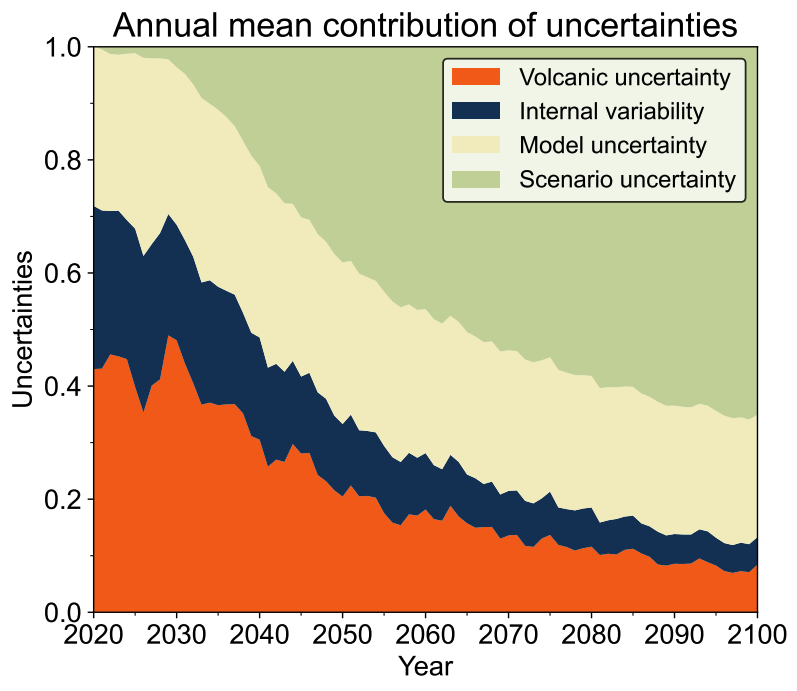
通过模拟1000种不同的火山未来情况,我们发现在21世纪未来时期火山喷发所引起的气候不确定性,可能超过同期气候系统本身的内部变率。
我们还发现,到2030年代,火山喷发可能占全球气温预测总不确定性的三分之一以上。
下图中能看到这些结果。图中展示了不同来源对总不确定性的影响。火山为橙色、内部变率为深蓝色、气候模型响应为黄色,未来人类排放情景为绿色。
对1.5C临界值的意义
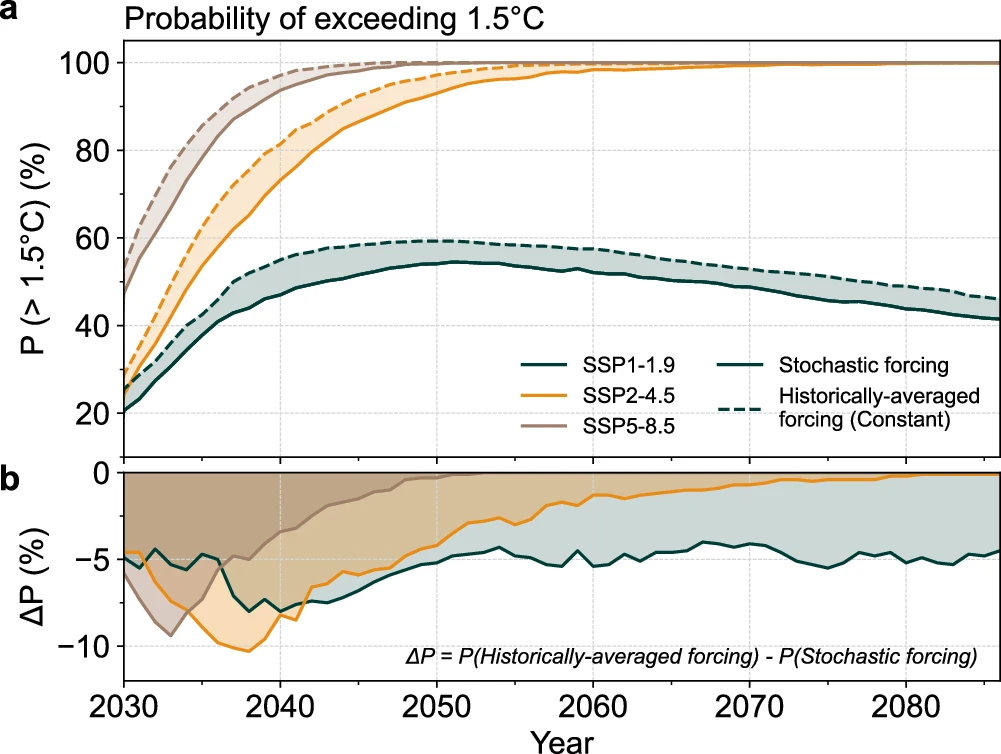
我们的模拟结果表明,在气候预测中纳入可能的火山活动时间线后,短期内突破《巴黎协定》设定的1.5C升温上限的概率略有下降。
根据不同的排放情景,相较于使用恒定火山强迫的预测,模拟发现超过1.5C升温上限的概率下降了4%至10%。
尽管这一结果听起来似乎令人鼓舞,但未来的火山活动并不能在长期缓和由人类引起的全球变暖。
1815年坦博拉火山的喷发事件就是一个强有力的例证。这次喷发使全球气温平均下降了约0.8C,带来了“无夏之年”,导致欧洲、北美和中国大范围的作物歉收和饥荒。
火山喷发带来的降温效应是短暂的,通常只持续几年,其并不会改变由人类排放所导致的长期变暖趋势。
我们的研究发现,即使考虑多种可能的未来火山活动,在除了最低排放路径以外的所有情景中,全球变暖仍将在几十年内超过1.5C。
即便21世纪火山活动频繁,其对全球变暖的抵消作用也仅占很小一部分——这意味着减排对于实现长期气候目标仍然至关重要。
下方图表展示了在三种排放情景下,使用随机火山强迫(实线)与恒定火山强迫(虚线)时超过1.5C的概率(上图),以及两种强迫方式之间的概率差异(下图)。
十年尺度的气温变率
我们的研究提供的另一个重要发现是:一旦将火山强迫的变率纳入考虑,将更有可能出现极端温暖和寒冷的十年期。
在中等排放情景下,我们发现出现负向十年期趋势——即全球表面温度在某个十年内平均下降——的概率增加了10%到18%。
与此同时,出现极端温暖十年期的概率也随之增加,这反映出火山强迫的变率会同时提高变暖和变冷极端事件发生的可能性。
这一结果凸显了火山喷发如何在十年时间尺度上对全球气温趋势带来显著的波动。
迈向更完善的气候预测
了解火山对气候的影响,对于全面评估农业、基础设施和能源系统在未来所面临的风险至关重要。
使用全面的地球系统模型运行数千种火山情景并不切实际,因为这需要极高的计算资源。但与此同时,当前的方法也存在上文提到的显著局限。
不过,在未来的气候模型工作中,仍有折中方案可行。
即将开展的下一阶段气候建模实验——即CMIP7情景模式比较计划——可以采用更具代表性的“平均”火山强迫基线,这一基线纳入了历史记录中常被遗漏的小型喷发事件的影响。这一偏差现已在用于下一代气候模型模拟的历史火山强迫数据集中得到纠正。
此外,建模团队还应额外运行包含高频和低频未来火山活动的情景,以全面捕捉火山不确定性对气候预测的影响范围。
虽然人类导致的温室气体排放仍是气候变化的主导因素,但若能妥善考虑火山活动的不确定性,将有助于我们获得更全面的未来气候图景及其对社会的潜在影响。
The post 嘉宾来稿:探究火山喷发如何影响气候预测 appeared first on Carbon Brief.

The amount of finance for nature delivered to date “falls far short” of what is needed to meet the UN’s global goals, according to a report released ahead of the COP17 biodiversity summit.
The global stocktaking report, prepared by the UN Convention on Biological Diversity (UN CBD) ahead of this month’s summit in Armenia, finds that developed nations are failing to close the $200bn “biodiversity finance gap”.
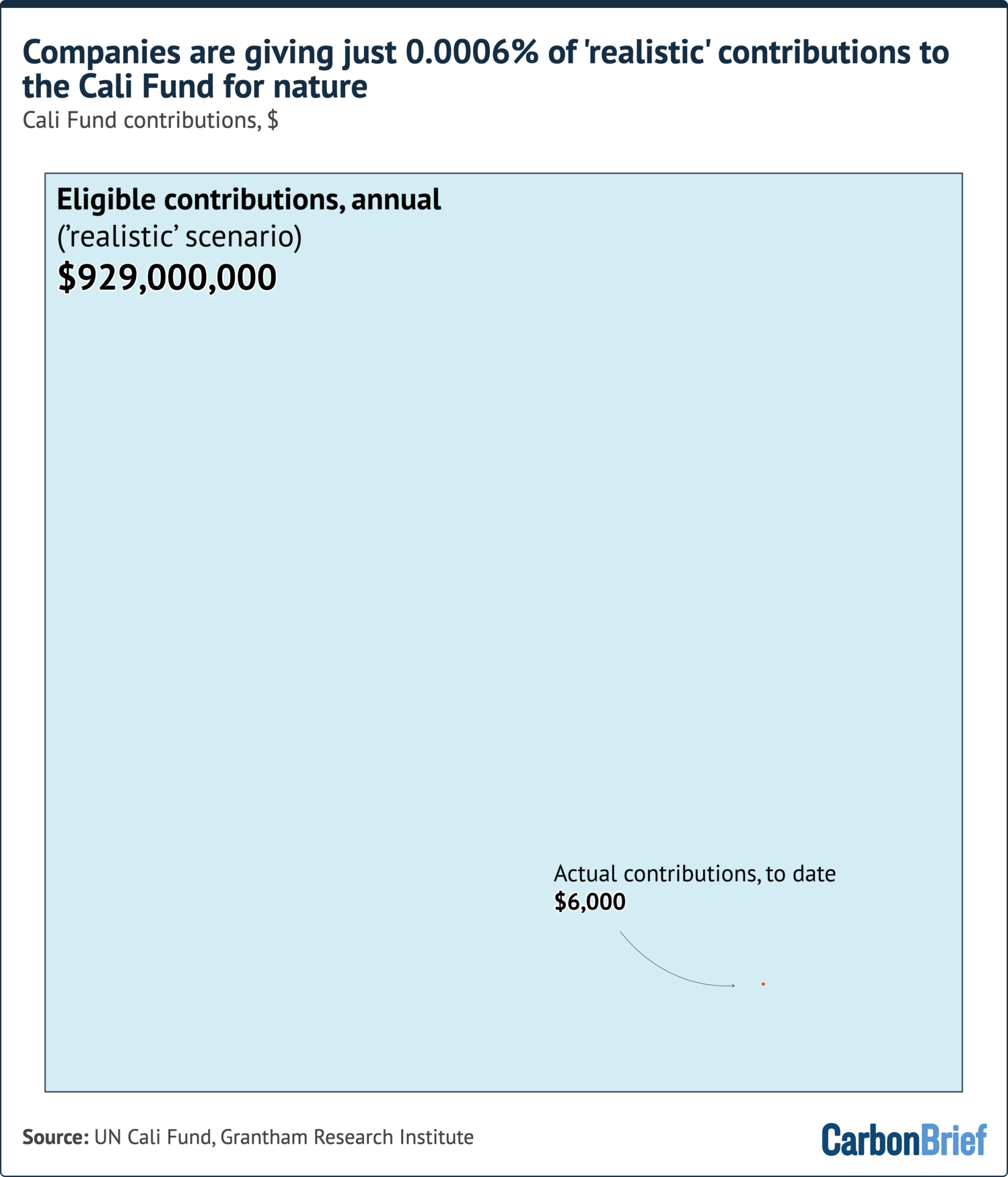
Initiatives designed to support this goal are also stumbling, with a special “framework” fund for biodiversity receiving less than $140m from developed countries in the past two years and the “landmark” Cali Fund receiving only $6,000 from private companies.
The availability of finance – or lack thereof – is likely to be a key point of contention in negotiations at COP17 in Yerevan, Armenia, which begin on 19 October.
Target for 2025 ‘not achieved’
At COP15 in 2022, 196 countries agreed to an ambitious global deal to reverse biodiversity loss by 2030, dubbed the Kunming-Montreal Global Biodiversity Framework (GBF).
Goal D of the agreement, shown below, states that countries must “close” a $700bn “biodiversity finance gap” by 2030.
This overall $700bn is made up of two parts: changes to nature-harming subsidies; and raising financial resources to support biodiversity.
Target 18 within the text calls for countries to “identify by 2025, and eliminate, phase out or reform incentives, including subsidies, harmful for biodiversity…progressively reducing them by at least $500bn per year by 2030”.
The remaining $200bn should be met by “mobilising” resources, according to target 19 of the GBF. It states that countries should “substantially and progressively increase the level of financial resources from all sources” to “at least” $200bn per year by 2030.
The overarching $200bn can be from national budgets, multilateral development banks or money “mobilised” from the private sector.
However, the target also specifically states that “at least $20bn per year by 2025 and…at least $30bn per year by 2030” should be public biodiversity funding provided to developing countries by developed countries – or others that “voluntarily assume” their obligations.
According to the global stocktaking report prepared by the CBD, between 2020 and 2023, countries mobilised a cumulative total of just $186.4bn. This is equivalent to an average of less than $50bn per year.
While the report – published on 10 September 2026 – cautions that it is “still too early to draw any conclusions”, it adds that this total “falls far short” of what is needed to close the $200bn-per-year biodiversity finance gap.
It continues to specify that the milestone of raising “at least $20bn per year by 2025” in public finance was also “likely not achieved”.
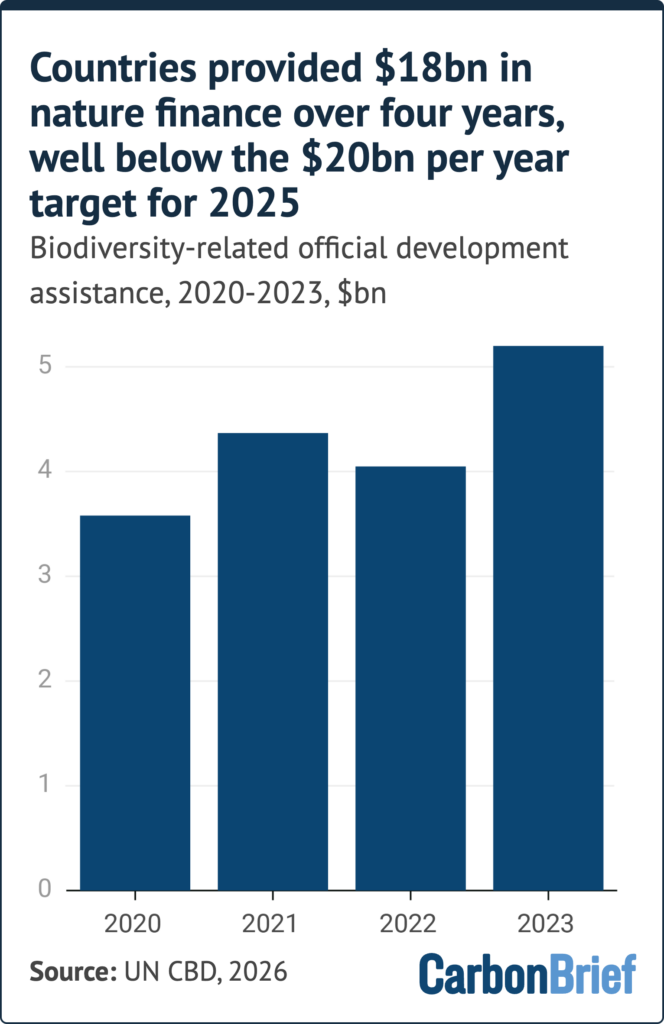
The report states that reporting countries raised a cumulative total of just $17.7bn in international public funding for biodiversity, across four years from 2020-23, as shown in the figure below. This amounts to an average of just $4.4bn per year.
These figures are supported by a report from the Organisation for Economic Co-operation and Development (OECD), which suggests that global biodiversity finance reached $74.9-92.4bn per year between 2023 and 2025.
It adds that, of this, international public finance contributed around $16.1bn per year on average – nearly $4bn below the 2025 goal.
Moreover, the OECD report says that only $7.9bn in 2023 to $8.5bn in 2024 was “biodiversity-specific” funding, with another $5.7bn and $6.5bn, respectively, coming in the form of funds for other priorities, in which support for biodiversity was a secondary aim.
While the GBF sets targets for nature finance in 2025 and 2030, developed countries should be making similar contributions every year, according to thinktank Third World Network.
Faltering initiatives
There are two main channels of international public finance that developed countries can use to meet their biodiversity finance commitments under the GBF. These are official development finance (ODF) and the Global Biodiversity Framework Fund (GBFF).
Separate figures for these channels also show financing falling behind the subtargets set out in the GBF.
This includes the Global Biodiversity Framework Fund (GBFF), which was established at COP15 in 2022.
It is currently housed under the Global Environment Facility (GEF) and reports directly to the biodiversity COP.
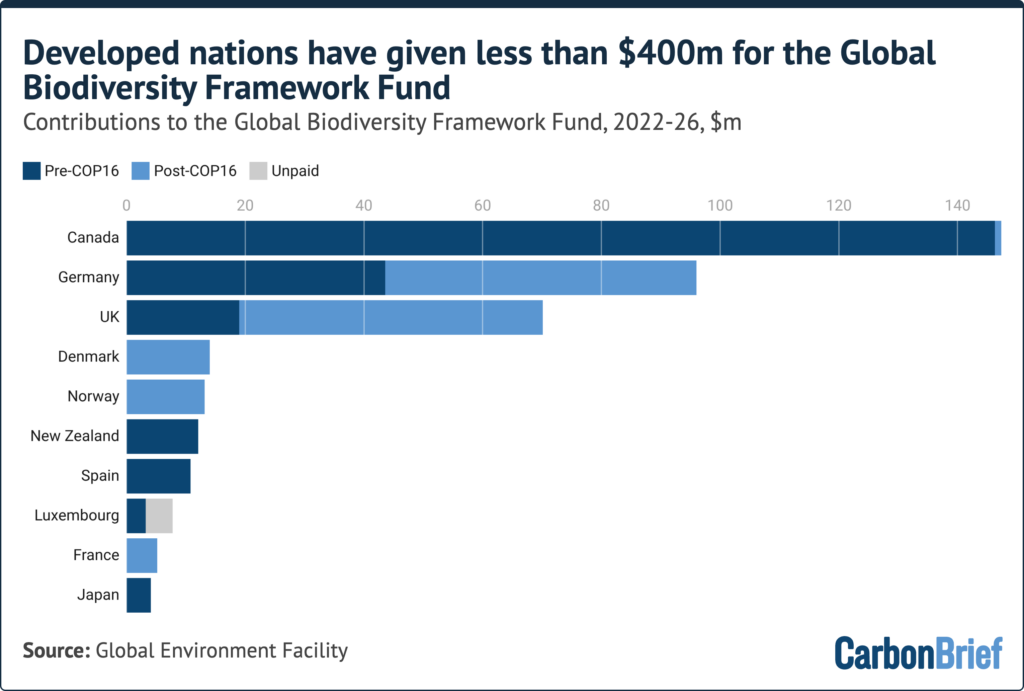
Despite an initial flurry of pledges for the initiative, developed nations had contributed less than $400m to the fund, as of July this year, according to data shared with Carbon Brief by the GEF.
Between August 2023 and 30 June 2026, the GBFF has received only $387.2m in signed commitments from 11 countries and one subnational government (Quebec in Canada).
The figure below shows that, after the initial pledges ahead of COP16 in 2024, there have only been a handful of new contributions to the fund.
Elsewhere, the Cali fund was created at the COP16 nature negotiations in Colombia in 2024.
It is the first-ever global fund for companies profiting from genetic data to contribute to conservation goals.
According to a working paper from the Grantham Research Institute at the London School of Economics, if all 21,690 eligible firms shared their profits according to the fund’s rules, they could raise $3.6bn for nature annually. The paper adds that, under a realistic uptake from companies, this could generate $929m annually for nature.
To date, however, the fund has received only two contributions, totalling $6,000.
Finance gap ‘fight’
Ahead of COP17 in Armenia, experts tell Carbon Brief that finance will be the most closely watched element of the stocktake of progress.
For developing countries that “hold most of the world’s biodiversity and bear the greater burden of implementation” of nature targets, the need for this financing is “very real”, says Lim Li Ching of the Third World Network speaking to Carbon Brief. She adds:
“These amounts fall far short of the GBF’s target 19. Developed countries have regrettably not met their legal obligations…[T]his failure should not be used as an excuse to pivot to the private sector or market-based mechanisms, which struggle to raise finance at scale and often deepen social and ecological harm.”
Options for private and “innovative” finance include debt-for-nature swaps, biodiversity offsets and carbon credits, but these are harder to monitor and have often faced criticism.
The Cali Fund is one avenue for companies to contribute directly to the CBD’s goals, with dedicated, transparent allocations for conservation projects and Indigenous peoples.
Dr Siva Thambisetty, associate professor of law at the London School of Economics, tells Carbon Brief that the fund is still a voluntary measure and it is up to countries “to create a constructive, ethical obligation” for companies to contribute. She adds:
“The private sector is doing what it always does: minimising outgoings and liability and maximising freedom to operate. I don’t believe the shift we need can be generated internally by businesses alone without outside pressure. States with jurisdiction over business need to take action.”
A non-profit initiative called the Cali Watch finds that “not a single government” has passed a law requiring companies to contribute to the fund. It estimates that eight companies alone should contribute more than $2bn, as part of what it calls their “Cali debt”.
Dr June Rubis, the Indigenous peoples and local communities lead on the Cali Fund’s steering committee, tells Carbon Brief that she is “worried about the pace” at which biodiversity finance is moving. Rubis continues:
“Each part of the finance architecture needs to start sending credible signals at the same time: developed countries on the $20bn commitment; donors on predictable finance for the GBFF; companies on Cali Fund contributions; and the Cali Fund itself on allocation and access. If one part moves while the others are repeatedly deferred, confidence in the wider biodiversity bargain becomes harder to sustain.”
She points out that for Indigenous peoples and local communities, “success also depends on whether finance can actually be accessed” to support communities’ priorities. She concludes:
“[H]eadline commitments matter, but so do the pathways through which money reaches people.”