

中国的气候和能源政策呈现出一种悖论:在以惊人的速度发展清洁能源的同时,也未停下新建燃煤电厂的步伐。
仅在2023年,中国就新建了70吉瓦(GW)的煤电装机容量,比2019年增长了四倍,占当年全球新增煤电装机容量的95%。
煤电产能的激增引发了人们对中国二氧化碳(CO2)排放和气候目标能否实现,以及对未来出现搁浅资产风险的担忧。
由于光伏和风能发电量不稳定,中国政府将煤炭作为保障能源安全和满足快速增长的用电高峰的手段。
与此同时,中国的电力行业在成本、需求模式、监管和市场运作方面正在发生重大变化。我们的新研究表明,用于证明新煤炭产能合理性的传统经济计算方式可能已经过时。
我们使用一个简单的分析指标来评估能满足用电高峰需求的最经济方式是什么。结果表明,光伏加电池储能的组合可能是比新建煤电更具成本效益的选择。
中国电力格局发生了怎样的变化?
在过去十年里,可再生能源和电池储能的成本大幅下降,高峰时段的住宅和商业用电需求激增,电力交易市场获得了更大的吸引力。
与此同时,中国还宣布了“双碳”目标,即在2030年前实现碳达峰、2060年前实现碳中和。鉴于这些转型,建设更多未减排的煤电厂与中国的长期气候承诺相冲突,而且对满足用电需求对增长来说,可能不再是最具成本效益的选择。它还占用了清洁能源系统转型急需的资金。
替代指标如何评估成本?
我们的研究引入了一种替代指标,用于计算在满足不断增长的高峰用电需求的情况下,所需的最优成本投资。

这一指标,即“净容量成本”(net capacity cost),是满足用电高峰需求所需的基础设施投资的年化固定成本,减去该设施带给电力市场的收入,或其“系统价值”(system value)。 在该指标中,负数意味着这些投资将带来利润,而非支出。
为了探索在中国使用的情境,我们使用了一个简单的例子:在一个假定省份,高峰用电需求增加了1500兆瓦(MW)、全年需求增加了6570吉瓦时(GWh)。
然后,我们概述了满足高峰和全年能源需求的五种策略(情况),其涵盖了从严重依赖煤电到光伏和电池储能相结合的方式。
在不同的案例中,资源衡量的规模基于它们能够可靠地满足高峰供应需求和年度能源需求的程度。
- 情况1:新的煤炭发电能力可满足高峰和年度能源需求的所有增长。
- 情况2:光伏可满足70%的年度能源需求增长,煤炭可满足30%的年度能源需求增长;光伏可满足525兆瓦的高峰供应需求(由于光伏发电可能不在高峰期间,因此基于“容量可信度”进行折减),而煤电可提供剩余的975兆瓦。
- 情况3:光伏可满足所有年度能源需求增长;光伏和煤炭均可满足750兆瓦的高峰供应需求,同样通过容量可信度对光伏发电量进行折减。
- 情况4:光伏满足所有年度能源需求增长;光伏和电池均为高峰供电需求提供750兆瓦;电池提供调频储备(用于管理精确至分钟的供需差异的备用电源)。
- 情况5:光伏满足所有年度能源需求增长;广泛和电池均为高峰供电需求提供750兆瓦;电池提供能源套利(在价格或成本较低时充电,在价格或成本较高时放电)。
如下图所示,我们针对每种情况都计算了单个资源(煤、电池或光伏),以及整个系统每年获得1千瓦(kW)发电容量的年净成本,单位为人民币元。
表上半部分的资源净容量成本是指该资源的净成本(即年化固定成本减去该资源从提供能源和辅助服务,如调频,所获得的年收入)。正数表示电网运营商在增加或获取该资源时的净成本。
表下半部分的系统总净容量成本,是在每种情况下利用资源组合满足高峰需求增长的净成本。
我们用于计算系统净成本的权重是基于装机容量与高峰需求增长的比率。
不同能源组合满足用电需求的成本
| 情况 1 | 情况 2 | 情况 3 | 情况 4 | 情况 5 | |
|---|---|---|---|---|---|
| 资源净容量成本 (元/千瓦/年, 每千瓦装机容量) | |||||
| 煤炭 | 424 | 424 | 512 | ||
| 电池 | 248 | 781 | |||
| 光伏 | -128 | -128 | -128 | -128 | |
| 系统净容量成本 (元/千瓦/年, 每千瓦满足高峰用电需求且折减容量可信度后) | |||||
| 煤炭 | 471 | 306 | 236 | ||
| 电池 | 138 | 434 | |||
| 光伏 | -223 | -319 | -319 | -319 | |
| 总计 | 471 | 83 | -83 | -181 | 115 |
为了对这一简单分析进行压力测试,我们研究了不同来源的各种价格的敏感性。
由于中国的光伏价格已经很低,我们的敏感性分析主要集中在煤炭、电池和其他分析所需投入的价格上。
满足高峰用电需求最经济的方法是什么?
我们的结果表明,当电池储能提供调频储备时(情况4),光伏和储能的组合是满足高峰用电需求增长最具成本效益的选择。
在这种组合下,每获得1千瓦发电装机容量,电网运营商的成本为-181元(约-25美元或-20英镑)。
相比之下,新建煤电产能以满足高峰用电需求增长(情况1)是最昂贵的方案,每获得1千瓦装机容量的净容量成本为471元(约合65美元或52英镑)。
情况3,即大型煤电厂仅用作备用电源(几乎不发电),在中国可能出于政治原因而至少在短期内不可行。
另外两种情况(情况2和情况5)更具可比性,但鉴于自本分析报告发布以来,电池价格下降了30%以上,约为每瓦时(Wh)1元人民币(约合0.14美元或0.11英镑),因此情况5中的电池可能比情况2中的煤炭更具经济吸引力。
我们的解决方案如何助力中国实现气候目标?
我们的分析表明,为了应对不断变化的形势,在满足中国日益增长的能源需求的同时,实现其气候目标的近期战略是将电池储能纳入电力市场。
目前,中国政府允许包括电池在内的“新型储能”参与电力市场。然而,详细规定尚不明确,电池的参与可以更简单。
例如,电池储能不被允许提供“运转储备”,即为应对意外的供需误差所预留的发电量。如果允许电池储能提供运转储备,将增强其商业价值。
允许电池储能更多地参与市场将促进电池储能系统的持续创新和降低成本,同时为系统运营商提供宝贵的运营经验。
这种策略将与市场效益相符,并反映美国和欧洲近期的电力市场经验。
这也将有助于解决近期的产能和能源需求,因为电池和光伏发电通常比燃煤电厂的建设速度更快。
此外,它还有助于缓解未来新增燃煤发电与可再生能源之间的冲突。主要作为可再生能源发电备用电源的新建燃煤电厂要么很少运营,要么侵占了其他现有煤炭发电厂的运营时间和净收入,从而产生新搁浅资产的风险。
通过继续进行电力市场改革,也将促进对可再生能源发电和电力储存进行更有效的投资。
允许市场制定批发市场电价、允许可再生能源发电和电力储存参与批发市场,这可以提高其收入和利润。
此外,改革还将鼓励高效利用储能,这是我们的关键发现。储能可以为电力系统提供多种功能;批发电价有助于引导储能运营以最低的成本实现具有最高价值的功能。
中国国家能源局最近发出指令,要求将新型储能设施(非抽水蓄能)纳入电网调度运行,这是向我们概述的改革迈出的一步。
可能需要进一步确定适当的补偿机制,例如在某些省份对此类储能设施提供的所有服务进行容量补偿,以促进这些储能设施的可持续发展和并网。
最后,仅靠增加供应不太可能成为满足中国电力需求增长的最低成本方式。提高终端使用效率和“需求响应”也有助于降低供电的总体成本。
随着中国电力市场改革的不断深入,连接多个省份的区域市场设计,以及鼓励省份间资源共享的区域资源充裕性规划,也有助于以最具成本效益和最低碳的方式满足中国不断增长的用电量和高峰需求。


The post 嘉宾来稿:满足中国增长的用电需求 光伏加储能“比新建煤电更实惠” appeared first on Carbon Brief.

A new report from Greenpeace Australia Pacific advocates for a Pasifika-led transition toward a future free from coal, oil, and gas. It emphasises that while Pacific island nations contribute minimally to global emissions, they face existential threats from rising sea levels and coral reef destruction.


Leadership from the frontlines
Three decades ago, the world united to confront the greatest challenge of our age: climate change and transitioning away from fossil fuels.
The Pacific has been there at every step, playing a central role in shaping the global climate regime. We have defended science, been a voice for ambition and justice, and delivered successive breakthroughs — from securing the 1.5°C goal in the Paris Agreement to taking the world’s biggest problem to the world’s highest court. Today, we are spearheading efforts — both inside and outside the formal process of UN climate negotiations — towards a just and equitable transition away from fossil fuels.

Timeline
| 1980s | Pacific island countries first warn of the threats to physical and cultural survival from climate change. |
| 1990 | Together with island nations of the Caribbean and the Indian Ocean, the Pacific forms the Alliance of Small Island States (AOSIS). |
| 1991 | Vanuatu makes the first proposal for what we now call loss and damage finance. |
| 1994 | Nauru puts forward the first draft of what became the Kyoto Protocol. |
| 2009 | Pacific island countries press for a binding agreement that would limit warming to 1.5°C, with Tuvalu and AOSIS offering text for a new legal protocol. |
| 2015 | The Pacific plays a pivotal role in securing the Paris Agreement — including the all-important goal of limiting warming to 1.5°C, and a stand-alone article on addressing loss and damage from climate change. |
| 2022 | Vanuatu is the first country in the world to support a Fossil Fuel Treaty, followed shortly by Tuvalu. |
| 2023 | Pacific island countries help secure the first ever reference to fossil fuels in a UN climate decision, with COP28 calling on countries to “transition away from fossil fuels”. The Fund for Responding to Loss and Damage becomes operational. |
| 2024 | Following a request by Pacific and Caribbean island countries, the International Tribunal for the Law of the Sea clarified states’ obligations to protect the world’s oceans from the impacts of climate change. |
| 2025 | Following a campaign led by Pacific island students, a historic ruling from the International Court of Justice affirms that countries are legally obliged to limit warming to 1.5°C, and that continuing down the path of fossil fuels may be an internationally wrongful act. |
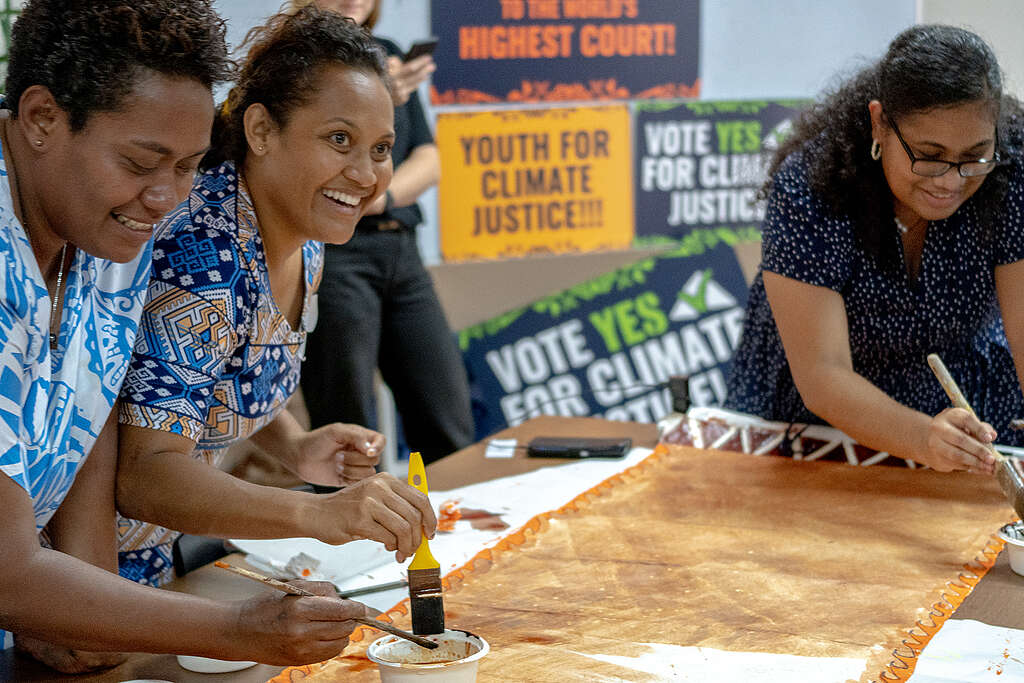
| 2026 | Pacific Ministers and civil society gather in Vanuatu to set the ongoing course of Pacific leadership towards a fossil fuel free future. The Tassiriki Call reaffirms the vision of a Fossil Fuel Free Pacific and agrees to establish an Inter-Governmental Taskforce. |
1.5°C and the transition away from fossil fuels
By the 2000s, it was clear that warming beyond 1.5°C posed a profound threat to communities in the Pacific and worldwide.
Rising seas, destructive storms, extreme heat, shifting rainfall patterns, ocean acidification… no level of warming is ‘safe’. Every fraction of a degree increases the risks to our food and water supply, our physical and mental wellbeing, our cultures, and our sovereignty.

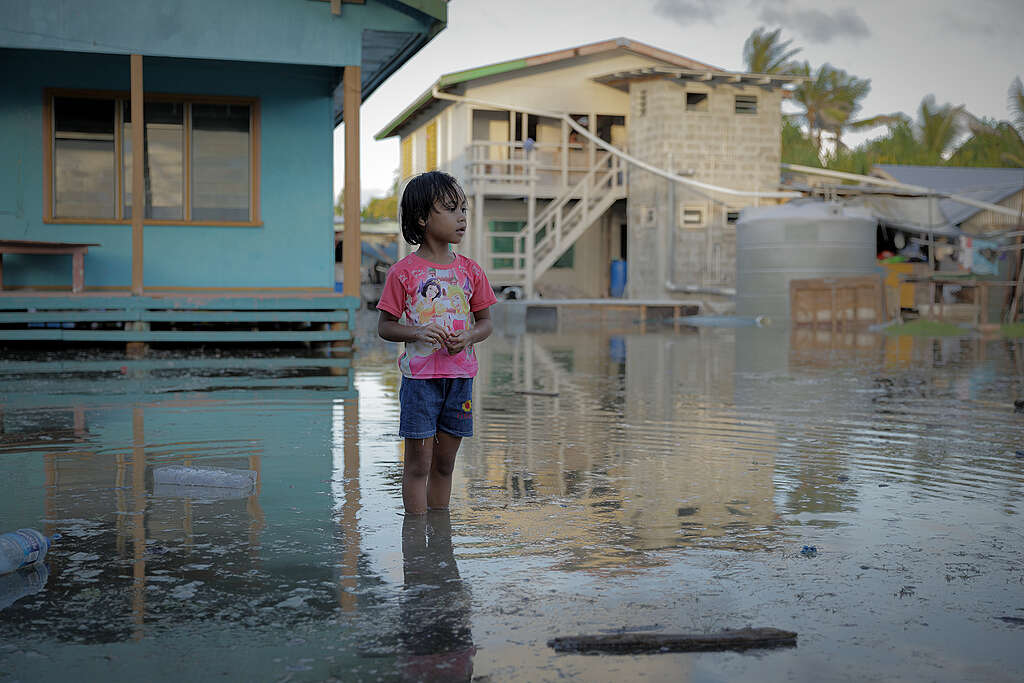
Only when you have seen sacred land swallowed by the rising ocean and the graves of your ancestors washed out to sea, cared for elders suffering through extreme heat, watched the familiar rhythm of the seasons change before your eyes, or lied awake at night worried whether your children will still have a nation to call home, do you truly understand what is at stake. For some people and communities, 1.5°C is a point of no return.
In Paris, we held the line, and refused to negotiate away our futures. The result — a universal agreement to strive to limit warming to 1.5°C — became a lifeline for Pacific communities, and a gift to the entire world.
In the decade since Paris, the case for limiting warming to 1.5°C has only grown stronger. Beyond 1.5°C, the risks grow from highly destructive to truly existential. How? The impacts of climate change do not merely increase in a linear fashion as the global temperature climbs. At a certain point we start to trigger far more severe and abrupt changes — such as the destabilisation of polar ice sheets, committing the world to much faster sea level rise, or the mass death of critical ecosystems we depend on for our sustenance.
Cross these ‘tipping points’ and we will set in motion changes at a pace to which it may be impossible to adapt, and which will continue to play out for millenia. We will have left behind the relatively stable climate of the last 11,000 years, in which today’s modern civilisations evolved, and which is the only Earth they have known. We will have tipped our Earth into a far more chaotic state, and our survival as a species will be by no means assured.
“The salt spray of the Pacific Ocean is in my blood; I grew up watching the tides shape the shores of the islands of Tuvalu. But now, those tides are rising relentlessly, eroding lands, swallowing homes, decimating livelihoods and washing away the futures of communities.
— Dr Maina Talia, Minister for Home Affairs, Climate Change and Environment, Tuvalu
We now know that even at today’s level of global warming, of just below 1.5°C, we may have crossed tipping points for the tropical coral reefs upon which millions of people in the Pacific and worldwide depend for their food and livelihoods, and for some of the world’s major ice sheets. At warming of beyond 1.5°C, crossing these and many other tipping points becomes not merely possible but a greater and greater certainty.
Let us make this urgent reality even clearer by speaking more about the ocean — the big blue beating heart of our planet. Like the blood in our veins, ocean currents distribute nutrients, oxygen and heat around the planet. Without this planetary pulse, life simply would not exist. As the world warms, these ocean currents are slowing. The planet’s pulse is becoming fainter. Ignore these planetary health warnings, and push our ocean currents beyond a tipping point, and that pulse may stop — unable to be resuscitated — with consequences for all life connected to the ocean, including our own. The ocean that raised us is now carrying a stark warning.
We are already deep in the danger zone, and it is going to take all of us pulling in the same canoe to get back to safer shores.
Course correction
Our world is changing rapidly. Around the globe, solar panels now adorn millions of roofs and windfarms dot the landscape. Growth in renewable energy has outstripped all projections.
But here’s the rub: despite remarkable progress with renewable energy, we have seen no slowdown in the burning of coal, oil and gas. Globally, our hunger for energy has been growing fast, and with it our consumption of fossil fuels, even as renewable energy has grown alongside. We are on track to be producing double the amount of fossil fuels in 2030 than would be consistent with limiting warming to 1.5°C.
The lesson? We need, as a global community, to be far more proactive about transitioning away from fossil fuels. Merely betting on growing renewable energy is not going to save us. It is like trying to mop up a flooded floor while leaving the tap running — unless we turn down fossil fuel production, the flood only rises. In the decade since Paris, and in the three years since the world agreed explicitly to transition away from fossil fuels, consumption has reached dangerous new highs, bringing us to the brink of all-out climate catastrophe.
We need roadmaps that help us remove the barriers to action, overcome technical obstacles, and help us finally break away from fossil fuels.
But we must also ask ourselves what we truly value. Today, so much growth in energy demand is coming not from meeting our basic needs, but from material excesses and overconsumption of energy among wealthy nations and corporations, or powering artificial intelligence and technologies that only separate us further from each other and the land and oceans that sustain us. Is this really the world we want?
The Pacific has much to remind the world about what truly matters — family, connection, reciprocity, and living in harmony with our shared home.

The course ahead
The Paris Agreement, its underlying Convention, and the ongoing process of negotiations on its implementation, provide legitimacy, universality and accountability. They offer the only forums where every country has a seat at the table. They provide the legally binding framework for our common but differentiated responsibilities, and the obligation of advanced economies, whose wealth was built off the back of fossil fuels, to support the majority world in transitioning to renewable energy, adapting to the impacts of climate change, and addressing loss and damage from climate change.
But we now know that this is not enough. The greatest strength of this all-in process is also its weakness. The process of consensus decision-making provides legitimacy and durability, but also puts a brake on ambition. At best, it offers the lowest common denominator. At worst, it allows the process to be held hostage by one or more regressive forces.
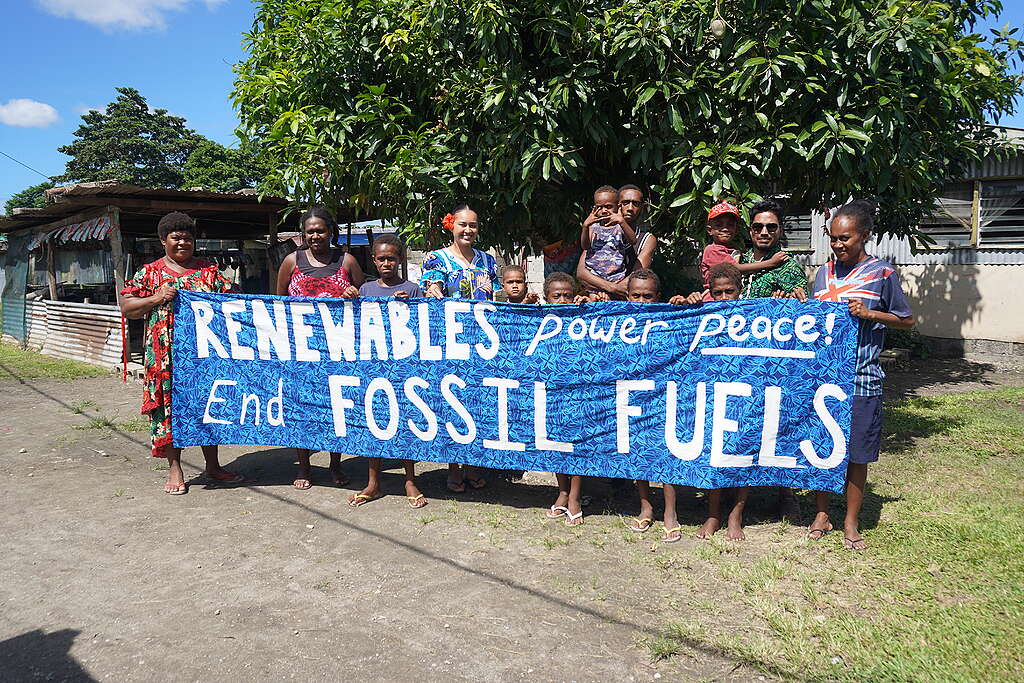
Alongside the formal process of UN climate negotiations, we must continue to grow and strengthen the coalition of committed nations already getting on with the work of building a vibrant future beyond fossil fuels. We must carry forward the momentum generated by the landmark conference on transitioning away from fossil fuels in Santa Marta, as we voyage towards the second conference in Tuvalu next year. We will build a fossil fuel free Pacific, shaped by Pacific values. We will continue to be a voice of science, ambition and conscience, and we will seek justice and accountability through the full implementation of the historic ruling from the International Court of Justice.
Recommendations
1.5°C as our guiding star
The transition away from fossil fuels must be anchored to the fundamental scientific, moral and legal imperative of limiting warming to 1.5°C. This means timelines, targets and trajectories that minimise the duration and extent of any overshoot, and return the long-term average temperature rise to 1.5°C as soon as possible.
Strengthening global cooperation
The COP31 Presidency of Negotiations, to be held by Australia, must be a meaningful partnership with the Pacific. This means elevating the voices of our leaders, backing Pacific-led solutions, and maximising the opportunity of the Pacific pre-COP to ensure the 1.5°C imperative and the transition away from fossil fuels are central to the agenda at COP31 in Antalya.
COP31 must operationalise and accelerate the commitment to transition away from fossil fuels, building on the momentum from COP30 and the Santa Marta conference.
Alongside and complementary to the UN climate negotiations, willing countries should work to accelerate implementation through parallel initiatives such as the Brazilian COP30 Presidency-led roadmap, the follow-up to the Santa Marta conference, bilateral and regional collaborations, and implementation of the advisory opinion from the International Court of Justice.
National roadmaps that promote justice
All governments should develop national roadmaps for a just transition away from fossil fuels, aligned with their fair share of the global action needed to limit warming to 1.5°C, and identify needs for international support.
National roadmaps should include an immediate commitment to no new fossil fuel expansion, rule out false solutions, set timelines to phase out production and consumption — with developed countries moving fastest — and maximising the opportunities for increasing energy sovereignty, access and security.
From extraction to regeneration
The transition away from fossil fuels must also aim to reduce future energy use and demand for transition minerals. This means focussing on energy efficiency, a return to regenerative approaches, and reorienting our energy, transport, food systems and built environments away from material excesses and over-consumption, aligning instead with the values, wellbeing and long-term interests of our communities.
The transition must not lead to new industries that harm our environment and communities, and that repeat and compound the injustices of past extractive models. In particular, governments should put a permanent ban on deep sea mining.
Funding
Developed countries must provide adequate and accessible finance for transitioning away from fossil fuels, adapting to the impacts of climate change, and addressing loss and damage. This should include an increase in grants and direct budget support, be accompanied by debt relief, and be enabled through taxing polluters and ending fossil fuel subsidies.
Authored by the Pacific team at Greenpeace Australia Pacific. Words by Simon Bradshaw, Shiva Gounden, Moemoana Schwenke. Edited by Kate O’Callaghan.
Photos curated by Olivia Louella.
REPORT: Where the Ocean leads us, A Pacific way to a fossil fuel free future
Climate Change
Guest post: How US renewable-energy growth persists despite federal policy uncertainty
Despite recent shifts in federal energy policies, our analysis shows that the US transition to renewable energy is continuing.
The current administration has enacted a range of changes to prioritise fossil-fuel energy and environmental deregulation in the US, while withdrawing support for renewables.
Yet solar, wind and battery storage accounted for over 90% of new energy capacity in 2025.
This is thanks to the falling cost of renewable energy technologies, investments spurred by the Inflation Reduction Act and Bipartisan Infrastructure Law and local and state policies, according to our research at the Center for Global Sustainability, University of Maryland.
Our analysis examines recent trends in the US energy landscape, focusing on rising electricity demand, new electricity capacity additions and generation, as well as fossil-fuel production and state-level case studies.
Rising electricity demand in the US
A key shift in the calculus is the fact that US electricity demand is now projected to increase rapidly, after a period of relative stagnation.
Between 2005 and 2020, electricity demand was relatively flat, after surging in the 1990s due to growth in the economy and population, as well as rising electrification.
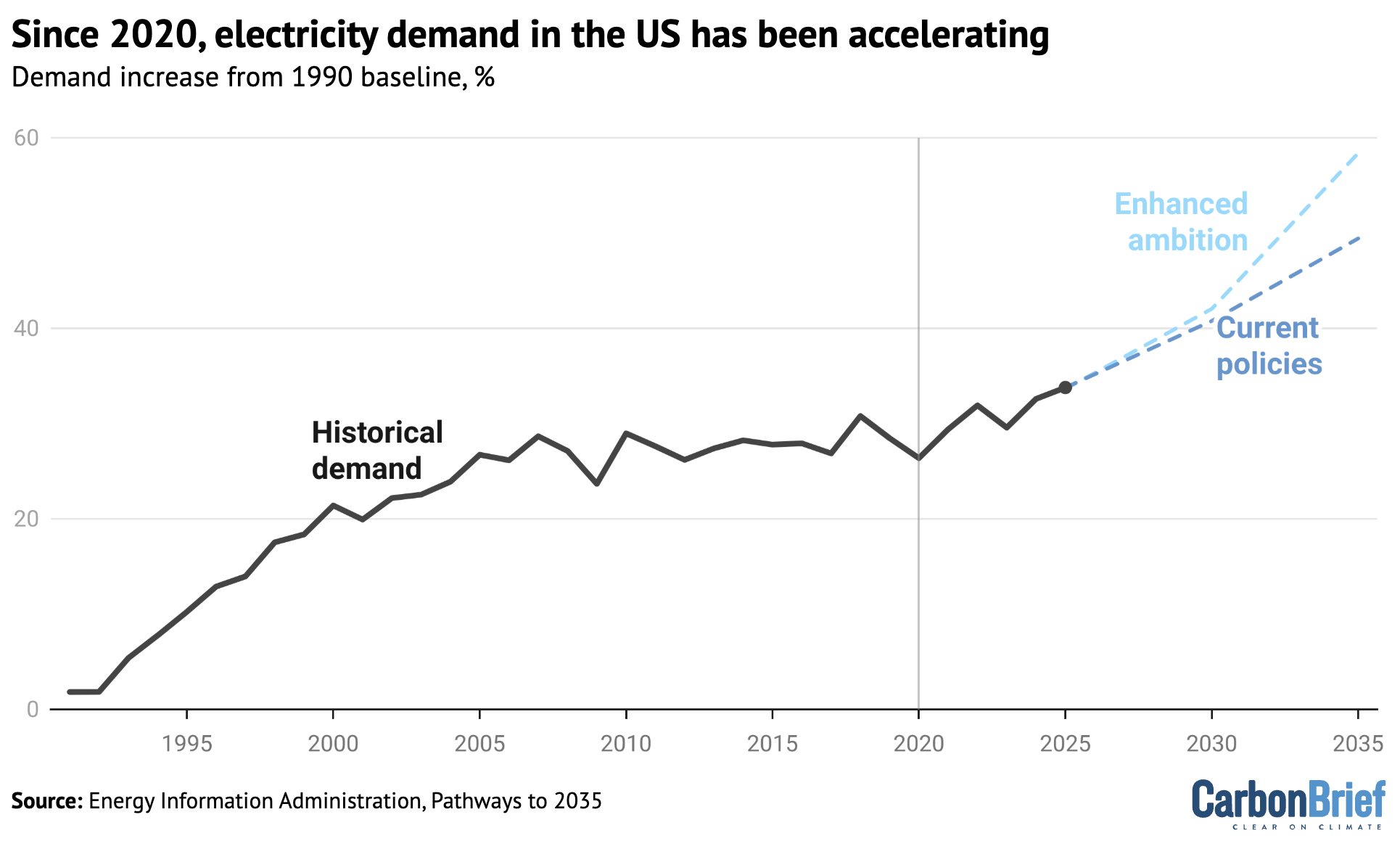
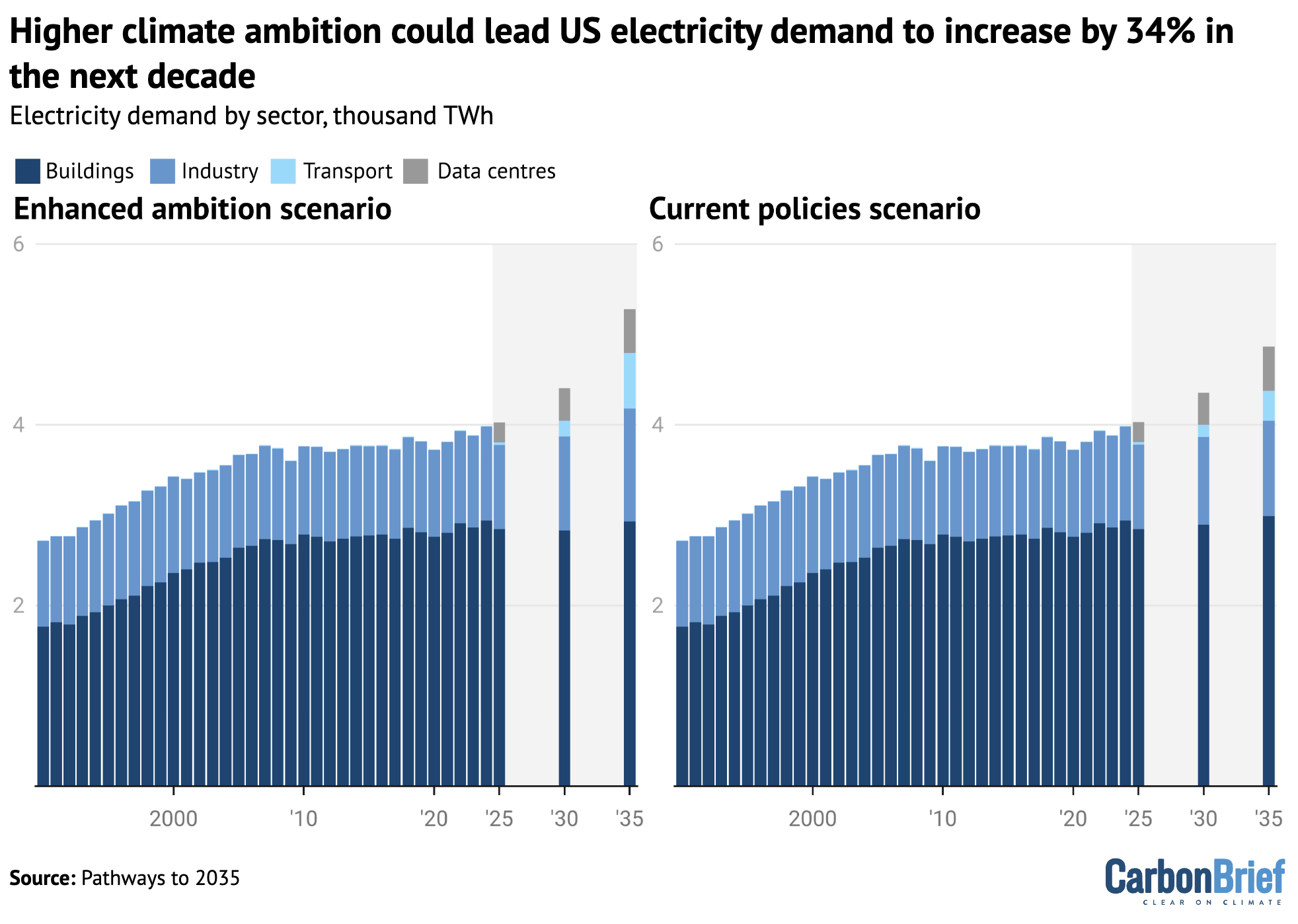
However, as the chart below shows, demand has grown by 7% since 2020 – and this is set to accelerate.
Rising transport electrification, along with new demand from data centres, buildings and industry are expected to drive additional electricity growth in the near term.
Our recent report finds that US electricity demand could increase by 24-34% in the next decade, relative to 2021 levels, as shown in the figure below. It shows that electricity demand would be higher if there is enhanced climate ambition, due to higher shares of electrified transport, industry and buildings.
While demand has been relatively flat over the past decade or two, there have been major shifts in the source of electricity supply over this period.
(Note that changes in generating capacity do not correspond directly to patterns in electricity demand shown earlier.)
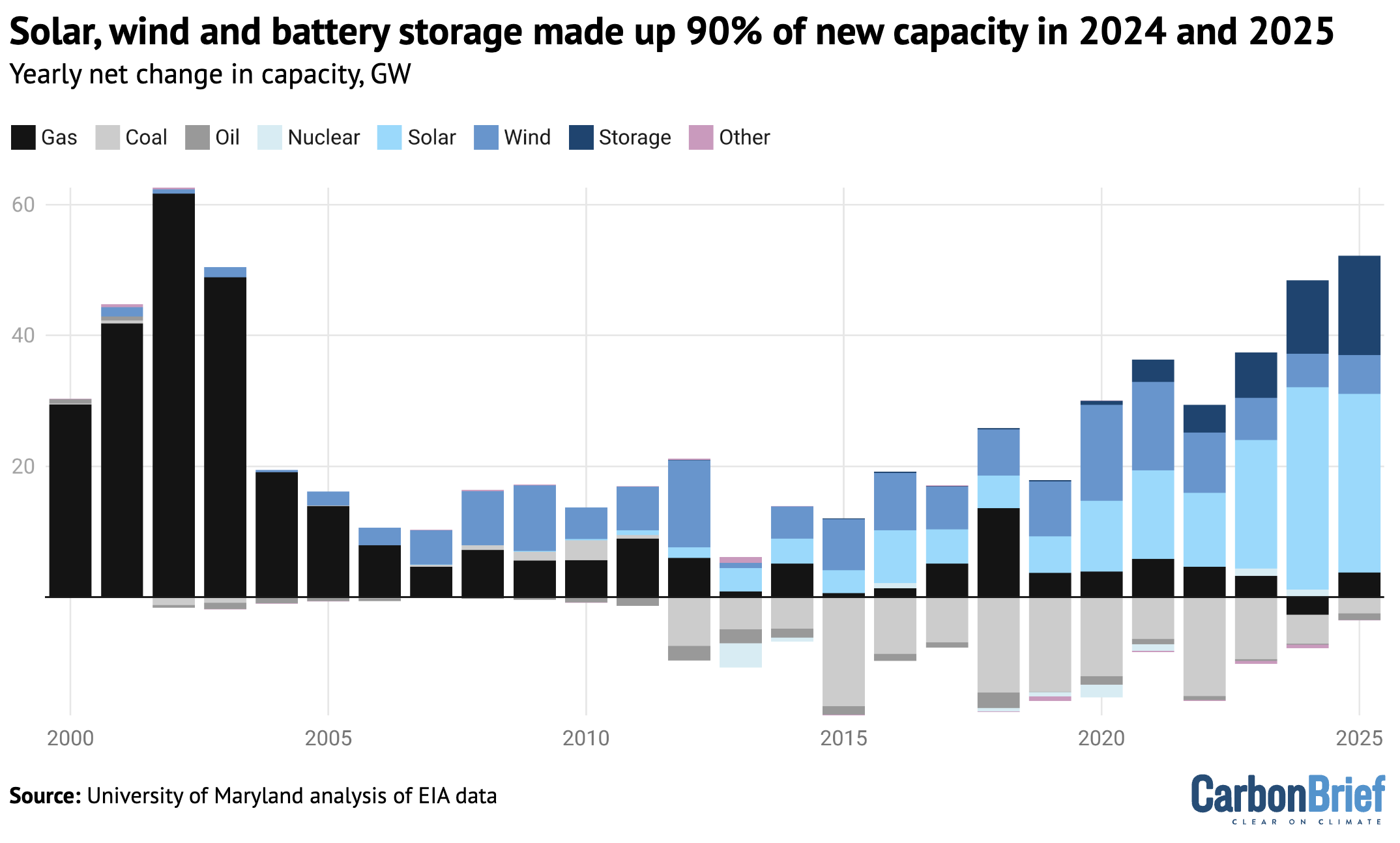
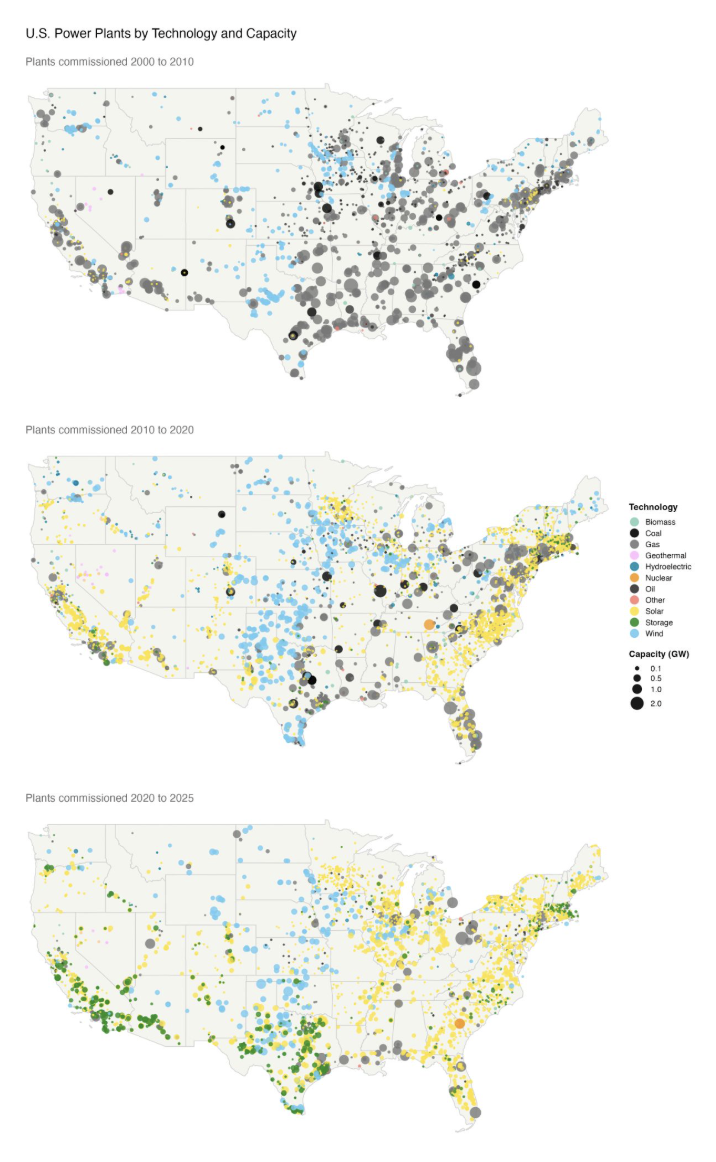
Whereas huge numbers of gas-fired power plants were built in the 2000s, renewable energy has been the primary source of new capacity for the past decade. With demand largely flat, much of this new capacity helped offset the loss from significant coal retirements during this period.
Indeed, capacity additions from renewable energy have outpaced that of every other technology since 2011, according to our research.
Accelerating renewable-energy buildout is increasingly viewed as an immediate, low-cost and practical solution to meet demand growth.
As shown in the figure below, additions of solar, wind and battery storage capacity reached more than 90% of total additions in 2024 and 2025 at 47 gigawatts (GW) and 48GW a year, respectively.
This pace of renewable deployment is attributable to quickly declining costs, driven by improvements in manufacturing technology, maturing supply chains and better economies of scale.
Meanwhile, 112GW of coal capacity was retired over the last decade due to market forces, health concerns and clean-energy policies.
Gas-power additions have remained at a low but steady level, our research shows.
Renewables surpass coal
As a result of the shifts in generating capacity, solar generation has increased nearly tenfold over the last decade, while wind generation has doubled.
As such, solar and wind reached 9% and 10% of the generation mix last year, respectively, as shown in the chart below.
Coal generation has fallen by more than 50% over the same period, replaced by a combination of renewables and gas, which has risen steadily.
(Note that coal-power output increased in 2025, primarily due to higher gas prices, while federal policy changes forced some old plants to stay open.)
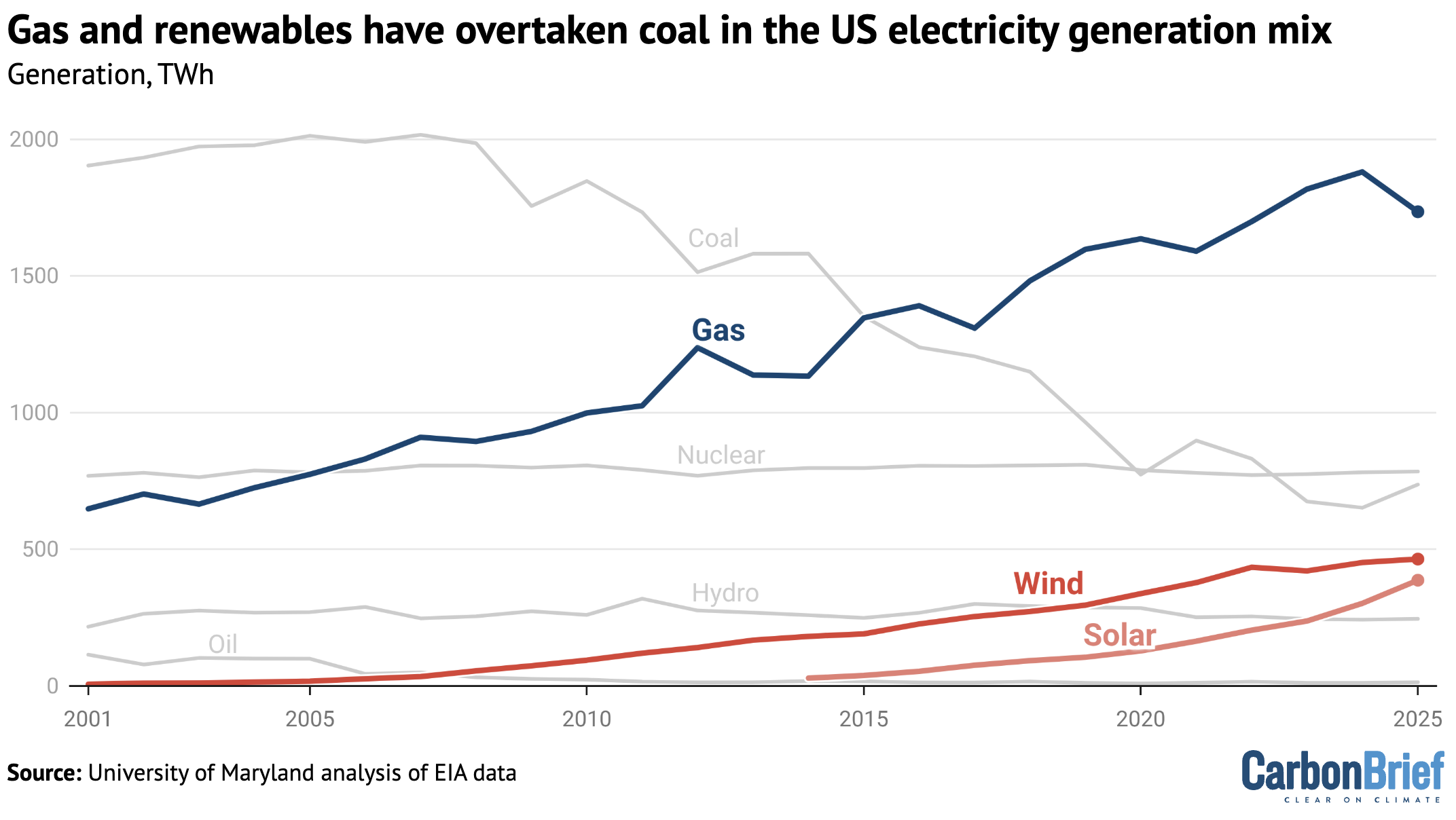
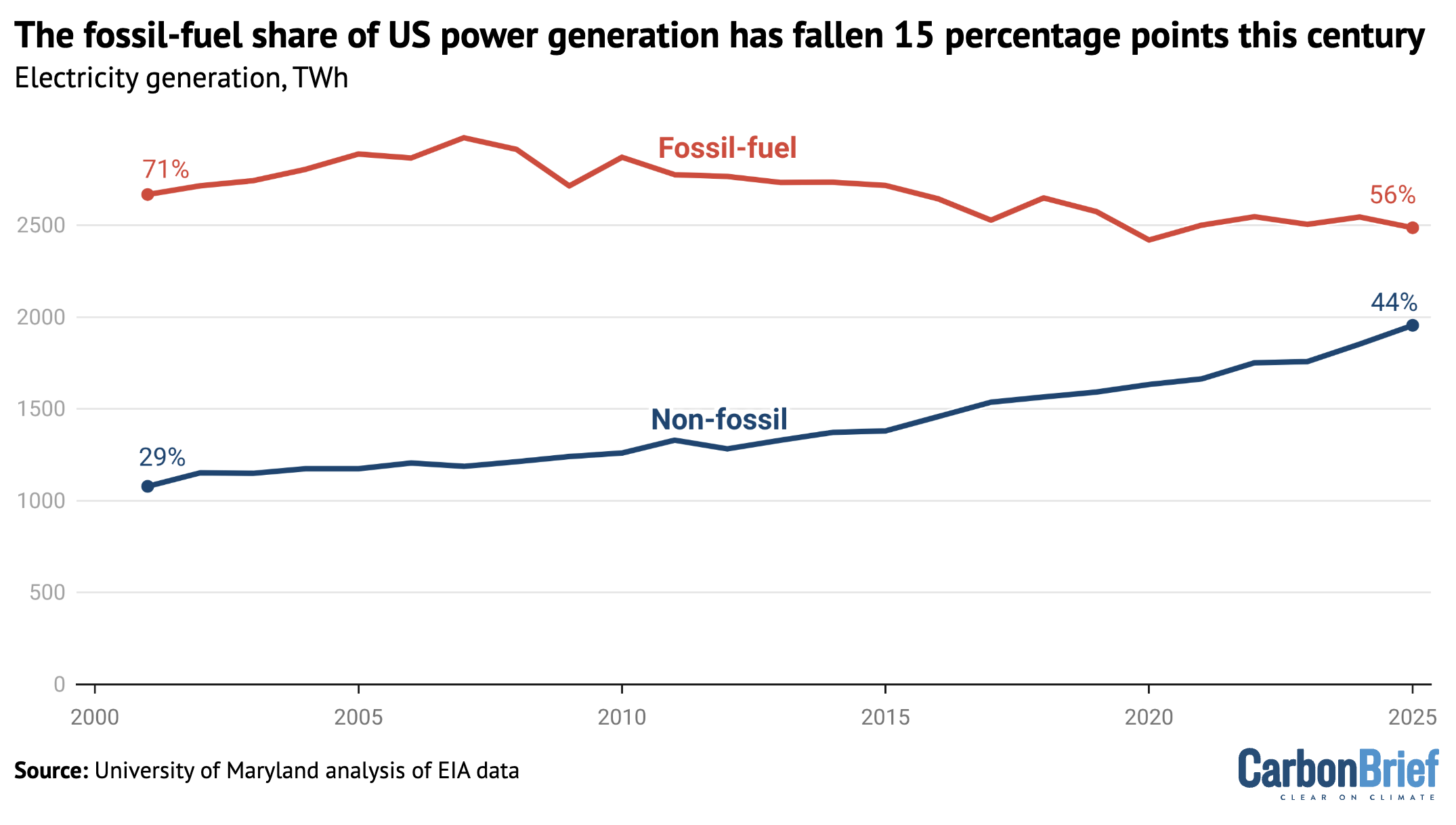
Gas generation has steadily increased in the US, reaching a 39% share of the generation mix last year. Roughly speaking, the growth in wind and solar – around 600 terawatt hours (TWh) – in the past decade was sufficient to match the decline in coal generation, while growing gas generation covered the roughly 300TWh increase in demand through 2025.
As a result, as shown in the figure below, fossil-fired electricity as a whole has fallen to 56% of the mix.
Our research shows that a rapid renewable energy buildout is occurring across states regardless of political allegiance, driven by strong economic advantages, policies such as state “renewable portfolio standards” and other environmental and health benefits.
Over the last decade, land- and wind-rich states such as Texas, Oklahoma and Iowa, have accounted for 62% of new wind capacity. Meanwhile, “sun-belt” states such as Texas, California and Florida have built 52% of new solar capacity.
Clean-energy policies have further driven renewable deployment. For example, California has a binding law requiring 100% of electricity to come from renewable and zero-carbon energy sources by 2045, with an interim target of 60% by 2030.
This has contributed to a 44% renewable generation share in the state in 2025, up from 16% only a decade ago.
Similarly, New Mexico has a legislated goal to reach 80% renewable electricity by 2040 and 100% zero-carbon electricity by 2045.
More than half of New Mexico’s electricity is now generated by renewables, up from only 9% in 2015. The state’s 3.5GW SunZia wind and transmission project is set to be the largest renewable energy project in the western hemisphere when completed.
At the same time, our research suggests that the increasing partisanship of climate policy has been a key barrier for many states.
Some states have tried to restrict climate action, spanning a potential solar-farm construction moratorium in Alabama to a ban on net-zero policy and greenhouse-gas regulation in Florida.
Renewables transcending politics
Importantly, the factors driving the transition to renewables are now frequently transcending politics.
Our research shows that lower cost, quick-to-deploy and energy-secure renewables make practical sense in many market contexts in the US – and globally. Businesses, local governments and consumers are voting with their wallets to address immediate needs.
For example, Texas leads the nation in renewable-energy expansion, despite its lack of decarbonisation goals. Texas’ deregulated power grid and lighter permitting processes, combined with its abundant renewable resources and falling technology costs, have increased renewable electricity capacity to nearly 90GW in 2025.
The state now generates more power from solar farms than coal plants.
Public health is another driver of the clean-energy transition that transcends politics, our research suggests. Oregon, for example, passed a law in 2016 to phase out all coal-generated electricity by 2035, which the state deemed “necessary for the immediate preservation of…public health and safety”.
Data centre development and energy affordability are also shaping state policy landscapes.
Virginia – which has the highest number of data centres of any US state – just passed new laws to allow for more efficient grid utilisation and to shift energy costs towards data centres while assisting low-income households with energy efficiency improvements.
The figure below shows how widespread renewable-energy development now crosses state and political divides, even though it remains constrained to some extent by geography.
Between 2010 and 2020, state and federal policies helped spur renewable energy, with particularly strong growth in states like California and North Carolina.
More recently, declining costs and improving economics have become increasingly important drivers of renewable energy expansion, even amid increasing political and policy setbacks in some regions. This has contributed to a broader dispersion of solar and wind deployment across US states between 2020 and 2025.
While most domestic economic sectors are still fossil-fuel heavy and current US energy security priorities promote continued fossil production, this fossil-fuel reliance has shifted over the past decade away from coal mining towards oil and gas drilling.
Coal production has fallen more than 40% over the last decade, tracking the decline in domestic coal consumption, as shown by the red line in the lower figure below.
In contrast, oil and gas production and exports have grown steadily since 2008, with the US becoming a net liquified natural gas (LNG) exporter over the last decade.
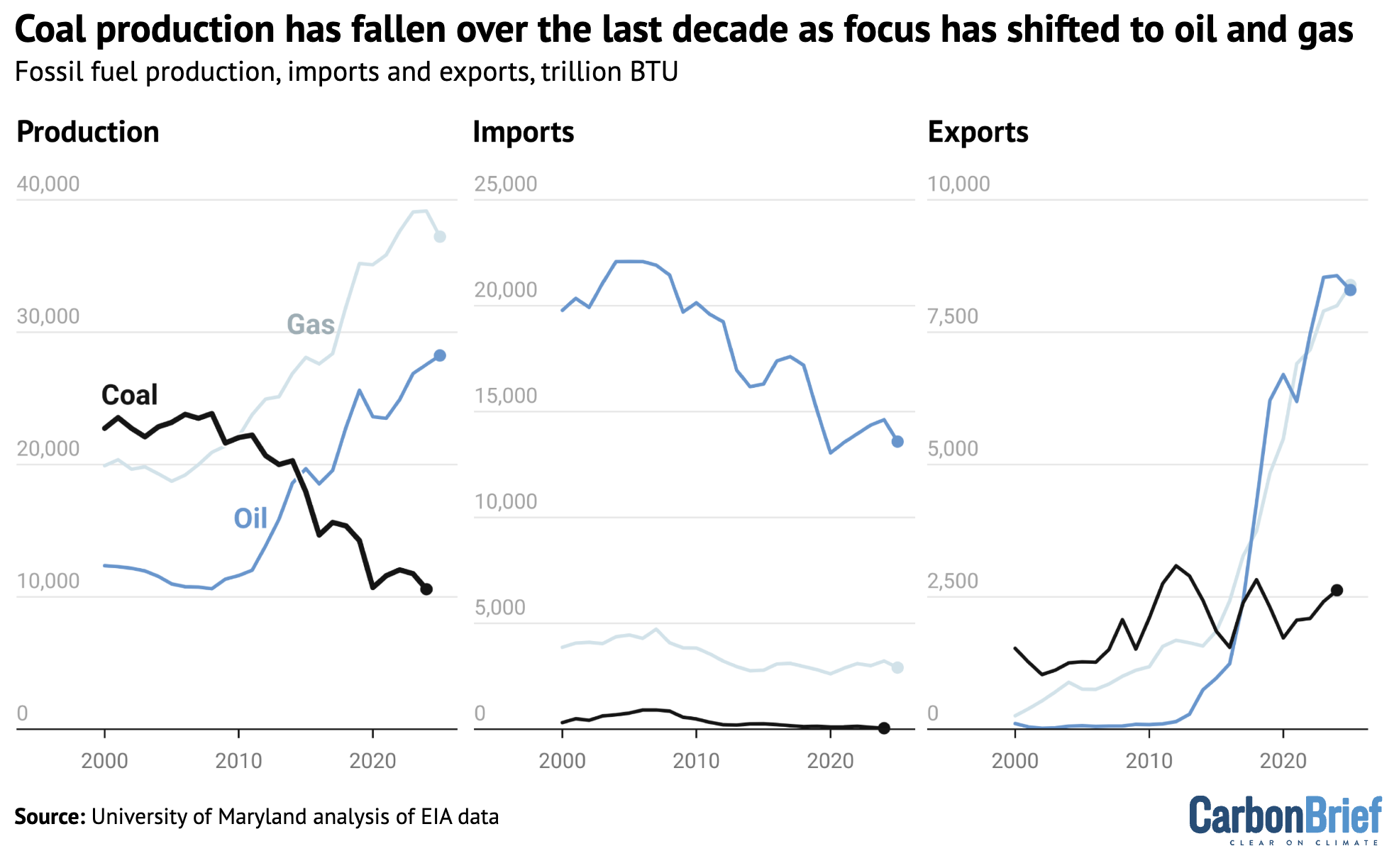
However, recent upheavals in the Middle East have underscored the country’s continued exposure to global fossil- energy markets.
Our research shows that renewable energy deployment in the US today is rooted in its practicality and cost-effectiveness. These advantages are allowing it to outcompete fossil-fuel technologies in terms of electricity capacity expansion, even across varying political landscapes.
Nevertheless, policy continues to influence the sector.
Coupled with parallel strategies for vehicle transport electrification, renewable deployment would offer lowered risks to consumers and businesses from fossil-fuel price volatility.



The post Guest post: How US renewable-energy growth persists despite federal policy uncertainty appeared first on Carbon Brief.
Guest post: How US renewable-energy growth persists despite federal policy uncertainty
Dozens of governments led by the EU and the UK have pledged to throw their political weight behind a rapid electrification of the world’s economy, billed as a “powerful weapon” for cutting reliance on planet-heating fossil fuels.
At a high-level summit in London’s Mansion House on Tuesday, energy ministers and business leaders were joined by UN secretary-general António Guterres in calling for faster action to curb demand for oil, coal and gas by powering homes, industry and transport with clean electricity.
Electrification – which spans measures such as switching from petrol cars to electric vehicles – has emerged as a key priority in climate and energy policy circles this year.
COP31 co-hosts Türkiye and Australia have made a global target for electricity to meet 35% of final energy demand by 2035, up from around 20% today, the main plank of this year’s action agenda for the UN summit. Reaching that level is necessary to keep the 1.5C warming limit within reach, according to the International Renewable Energy Agency (IRENA).
Turkish COP31 President-Designate Murat Kurum said earlier this month that the host nation would work to forge “a strong global coalition that is ready and determined to act” and promised to facilitate access to technical assistance.
-
Did Colombia’s energy transition just come to a halt?
With promises to lift a ban on oil and gas exploration and scale back renewables support, Colombia’s new Tiger President could threaten the country’s clean energy shift -
COP31 presidency ‘open’ to reflecting Santa Marta in UN climate process, ministers say
The two co-hosts want the gathering of over 60 governments in Colombia to be reflected in the official UNFCCC climate process -
UN asks AI companies to reveal full environmental impacts
UN chief António Guterres says big AI firms should disclose the emissions, water and energy use of their data centres amid community opposition


Rallying support for electrification
Five months before countries are due to sign on to the pledge, efforts to rally support gathered momentum at London Climate Action Week, as a record-breaking heatwave baking the capital underscored the urgency of weaning the world off fossil fuels.
Guterres said the world faces an “historic opportunity” to turn the page on its dependence on fossil fuels and fully embrace clean electrification powered by renewables.
“The age of clean electrification is here,” he added. “The question is whether we can build the grids and storage, mobilize the investment, and deliver the infrastructure at the speed and scale required”.
Without investment and government policies supporting upgrades in infrastructure, ageing power grids are often unable to handle the growing influx of renewable energy, creating bottlenecks and slowing the energy transition, according to the International Energy Agency (IEA).
Meanwhile, the high upfront costs of buying electric vehicles, heat pumps and industrial equipment remains a challenge to switch households and businesses away from using fossil fuels across the world, according IEA analysts, despite these technologies being cheaper over their whole lifecycle.
Global coordination platform
In a bid to overcome these hurdles, the European Commission and the UK government on Tuesday launched a new platform to coordinate global progress on electrification.
EU energy commissioner Dan Jorgensen said the goal was to build coalitions, draw up policy recommendations, share best practice and secure new funding to speed up the electrification of homes, industry and transport.
Brazil’s COP30 presidency, the joint Australia-Türkiye COP31 presidency, Ethiopia’s incoming COP32 presidency, Canada, the Philippines and South Korea joined the initiative at launch.
Jorgensen urged governments worldwide to “choose transformation over turbulence” and switch to clean electricity to make economies and societies more resilient and shield them from future shocks driven by volatile fossil fuels.
COP31 leaders unveil global targets, with spotlight on electrification
For many countries, especially those heavily reliant on imported fossil fuels, the oil and gas crisis triggered by the US and Israeli attacks on Iran and the ensuing blockade of the Strait of Hormuz has driven home the urgency of the clean energy transition.
The UK’s energy secretary Ed Miliband said on Tuesday that, unlike previous fossil fuel shocks, clean electrification now offers the world a clear alternative.
“An alternative that cannot be disrupted by foreign wars, that isn’t subject to global shocks because it is locked in stable prices at home, and that can create good jobs and drive growth,” he added, “an alternative that can deliver national security, energy security and indeed climate security.”
At the recent conference on transitioning away from fossil fuels in Santa Marta, a group of 60 governments led by the Netherlands and Colombia said electrification is one of the areas where they can align work with the UN climate talks.
Financial reforms needed
Achieving the electrification target – dubbed the “35 by 35” goal – will require significant financial resources. Investments in power grids alone need to double from their current rate to around $1 trillion each year in the next decade, according to IRENA.
But Guterres said that developing countries are still “starved from investment” in their clean energy sector. He urged deeper reforms of the global financial architecture by reducing lending risk, lowering the cost of capital and attracting more private investment.
Surangel Whipps Jr., president of the low-lying Pacific island state of Palau, said faster progress in electrification is a “powerful weapon in our arsenal”. But he warned that the energy transition would stall without “fit for purpose investment that is fast, predictable and accessible”.
The post EU, UK lead push for electrification as “powerful weapon” against fossil fuels appeared first on Climate Home News.
EU, UK lead push for electrification as “powerful weapon” against fossil fuels



-
Greenhouse Gases11 months ago
Guest post: Why China is still building new coal – and when it might stop
-
Climate Change11 months ago
Guest post: Why China is still building new coal – and when it might stop
-

 Greenhouse Gases2 years ago
嘉宾来稿:满足中国增长的用电需求 光伏加储能“比新建煤电更实惠”
-

 Renewable Energy8 months ago
Sending Progressive Philanthropist George Soros to Prison?
-
Climate Change2 years ago
Bill Discounting Climate Change in Florida’s Energy Policy Awaits DeSantis’ Approval
-

 Carbon Footprint2 years ago
US SEC’s Climate Disclosure Rules Spur Renewed Interest in Carbon Credits
-
Greenhouse Gases12 months ago
嘉宾来稿:探究火山喷发如何影响气候预测
-

 Climate Change2 years ago
Analysis: China’s CO2 falls 1% in Q2 2024 in first quarterly drop since Covid-19