Connect with us

Published

on

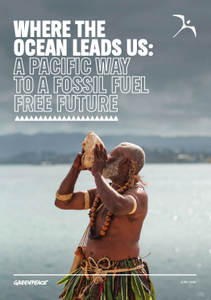
A new report from Greenpeace Australia Pacific advocates for a Pasifika-led transition toward a future free from coal, oil, and gas. It emphasises that while Pacific island nations contribute minimally to global emissions, they face existential threats from rising sea levels and coral reef destruction.

Leadership from the frontlines

Three decades ago, the world united to confront the greatest challenge of our age: climate change and transitioning away from fossil fuels.

The Pacific has been there at every step, playing a central role in shaping the global climate regime. We have defended science, been a voice for ambition and justice, and delivered successive breakthroughs — from securing the 1.5°C goal in the Paris Agreement to taking the world’s biggest problem to the world’s highest court. Today, we are spearheading efforts — both inside and outside the formal process of UN climate negotiations — towards a just and equitable transition away from fossil fuels.

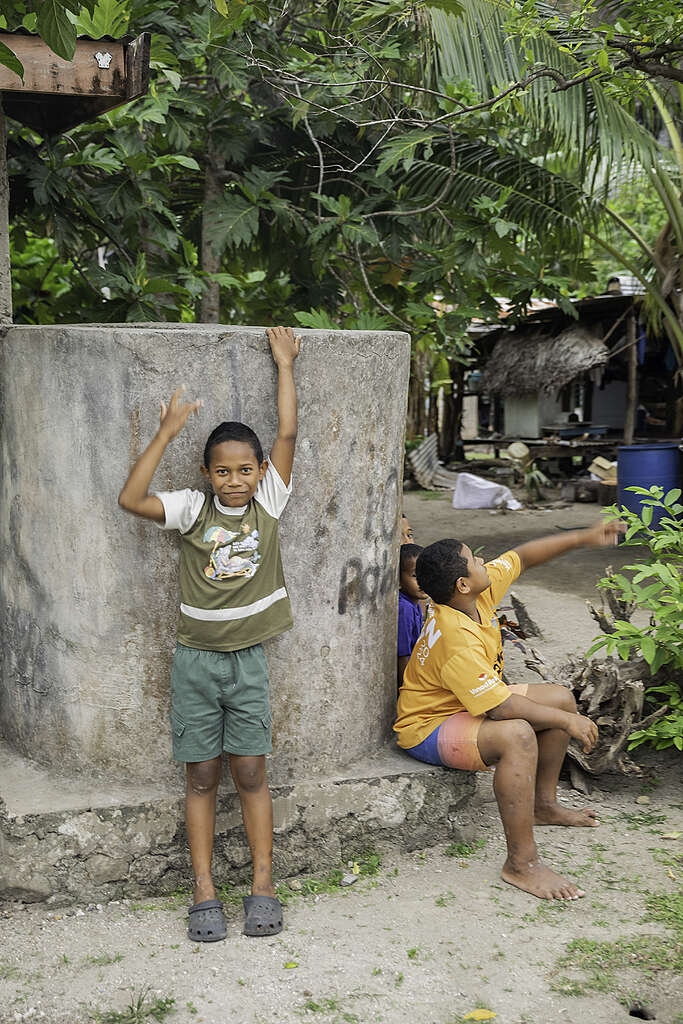
In Vanuatu, Risu and other young girls from her village, have been working to rehabilitate and protect their local reefs.

Timeline

1980s Pacific island countries first warn of the threats to physical and cultural survival from climate change.
1990 Together with island nations of the Caribbean and the Indian Ocean, the Pacific forms the Alliance of Small Island States (AOSIS).
1991 Vanuatu makes the first proposal for what we now call loss and damage finance.
1994 Nauru puts forward the first draft of what became the Kyoto Protocol.
2009 Pacific island countries press for a binding agreement that would limit warming to 1.5°C, with Tuvalu and AOSIS offering text for a new legal protocol.
2015 The Pacific plays a pivotal role in securing the Paris Agreement — including the all-important goal of limiting warming to 1.5°C, and a stand-alone article on addressing loss and damage from climate change.
2022 Vanuatu is the first country in the world to support a Fossil Fuel Treaty, followed shortly by Tuvalu.
2023 Pacific island countries help secure the first ever reference to fossil fuels in a UN climate decision, with COP28 calling on countries to “transition away from fossil fuels”. The Fund for Responding to Loss and Damage becomes operational.
2024 Following a request by Pacific and Caribbean island countries, the International Tribunal for the Law of the Sea clarified states’ obligations to protect the world’s oceans from the impacts of climate change.
2025 Following a campaign led by Pacific island students, a historic ruling from the International Court of Justice affirms that countries are legally obliged to limit warming to 1.5°C, and that continuing down the path of fossil fuels may be an internationally wrongful act.
2026 Pacific Ministers and civil society gather in Vanuatu to set the ongoing course of Pacific leadership towards a fossil fuel free future. The Tassiriki Call reaffirms the vision of a Fossil Fuel Free Pacific and agrees to establish an Inter-Governmental Taskforce.
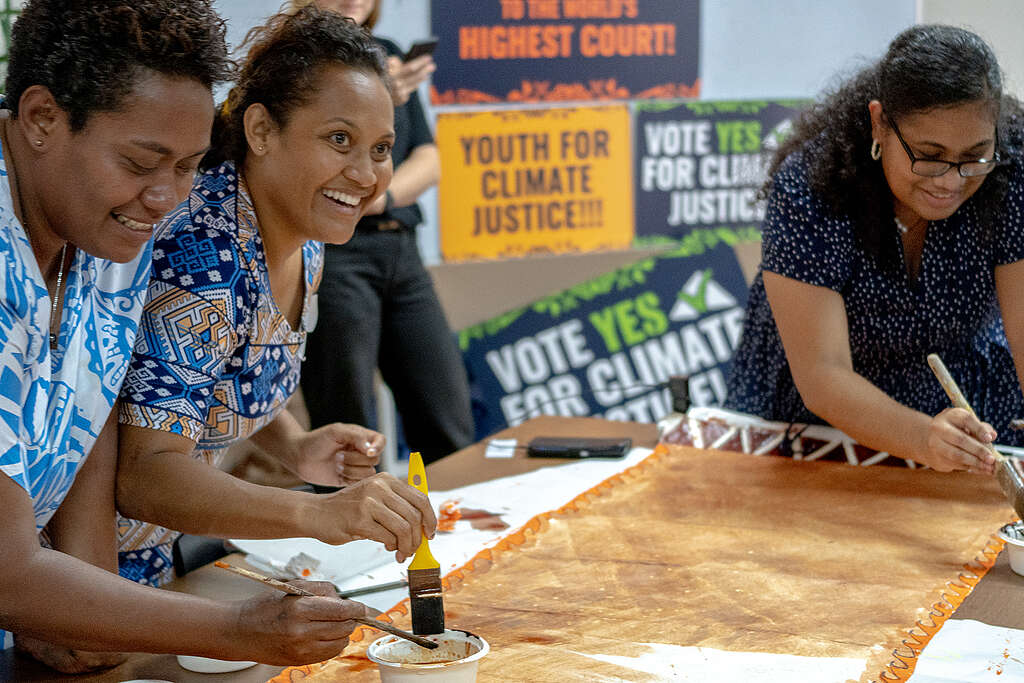
Activists use paint created from dried mangrove flowers to write climate justice messaging and design traditional tapa/masi cloth with motifs from various cultural influences of Fiji.

1.5°C and the transition away from fossil fuels

By the 2000s, it was clear that warming beyond 1.5°C posed a profound threat to communities in the Pacific and worldwide.

Rising seas, destructive storms, extreme heat, shifting rainfall patterns, ocean acidification… no level of warming is ‘safe’. Every fraction of a degree increases the risks to our food and water supply, our physical and mental wellbeing, our cultures, and our sovereignty.
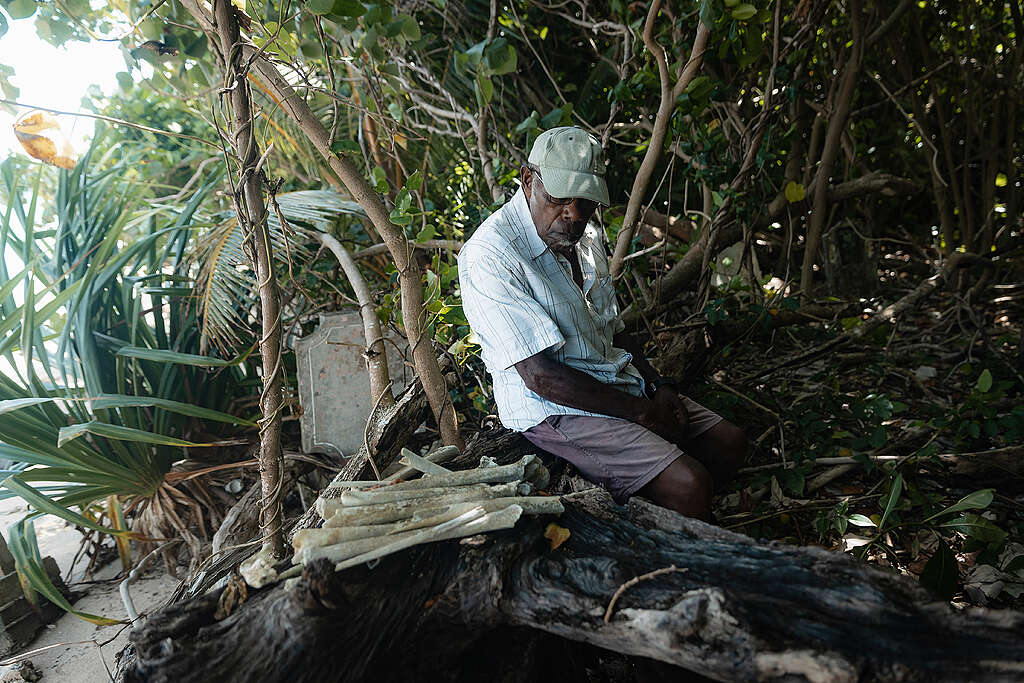
A man observes the community graveyard impacted by coastal erosion on Pele Island in Vanuatu.

Only when you have seen sacred land swallowed by the rising ocean and the graves of your ancestors washed out to sea, cared for elders suffering through extreme heat, watched the familiar rhythm of the seasons change before your eyes, or lied awake at night worried whether your children will still have a nation to call home, do you truly understand what is at stake. For some people and communities, 1.5°C is a point of no return.


In Paris, we held the line, and refused to negotiate away our futures. The result — a universal agreement to strive to limit warming to 1.5°C — became a lifeline for Pacific communities, and a gift to the entire world.
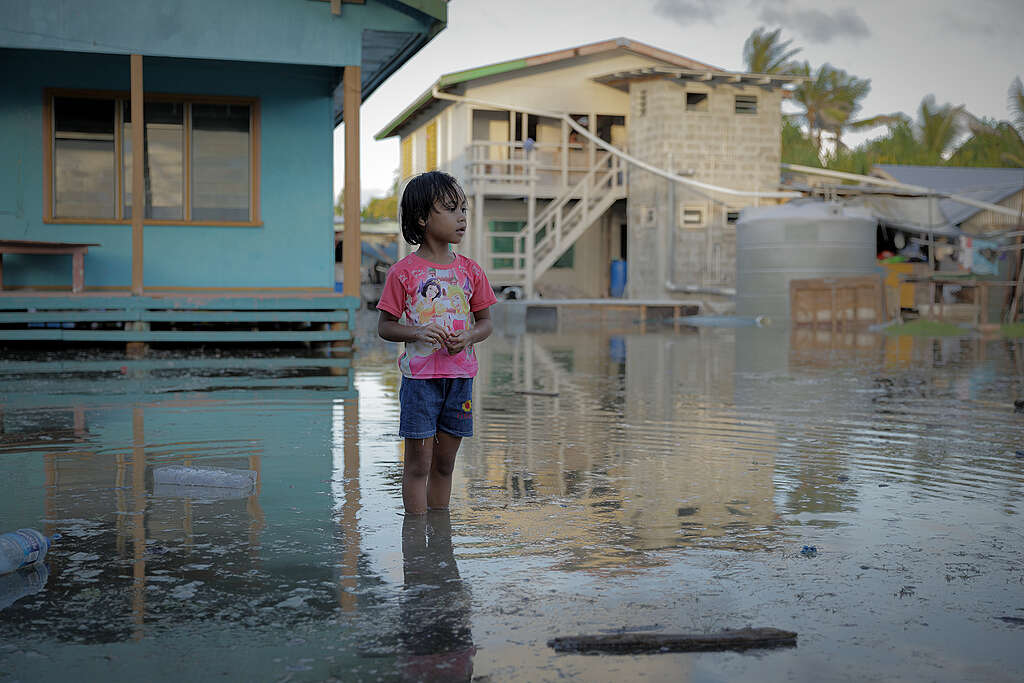
A young Tuvaluan child looking at the after effects of the king tide that hit Funafuti, Tuvalu in February 2023.

In the decade since Paris, the case for limiting warming to 1.5°C has only grown stronger. Beyond 1.5°C, the risks grow from highly destructive to truly existential. How? The impacts of climate change do not merely increase in a linear fashion as the global temperature climbs. At a certain point we start to trigger far more severe and abrupt changes — such as the destabilisation of polar ice sheets, committing the world to much faster sea level rise, or the mass death of critical ecosystems we depend on for our sustenance.

Cross these ‘tipping points’ and we will set in motion changes at a pace to which it may be impossible to adapt, and which will continue to play out for millenia. We will have left behind the relatively stable climate of the last 11,000 years, in which today’s modern civilisations evolved, and which is the only Earth they have known. We will have tipped our Earth into a far more chaotic state, and our survival as a species will be by no means assured.

“The salt spray of the Pacific Ocean is in my blood; I grew up watching the tides shape the shores of the islands of Tuvalu. But now, those tides are rising relentlessly, eroding lands, swallowing homes, decimating livelihoods and washing away the futures of communities.

— Dr Maina Talia, Minister for Home Affairs, Climate Change and Environment, Tuvalu

We now know that even at today’s level of global warming, of just below 1.5°C, we may have crossed tipping points for the tropical coral reefs upon which millions of people in the Pacific and worldwide depend for their food and livelihoods, and for some of the world’s major ice sheets. At warming of beyond 1.5°C, crossing these and many other tipping points becomes not merely possible but a greater and greater certainty.

Let us make this urgent reality even clearer by speaking more about the ocean — the big blue beating heart of our planet. Like the blood in our veins, ocean currents distribute nutrients, oxygen and heat around the planet. Without this planetary pulse, life simply would not exist. As the world warms, these ocean currents are slowing. The planet’s pulse is becoming fainter. Ignore these planetary health warnings, and push our ocean currents beyond a tipping point, and that pulse may stop — unable to be resuscitated — with consequences for all life connected to the ocean, including our own. The ocean that raised us is now carrying a stark warning.

We are already deep in the danger zone, and it is going to take all of us pulling in the same canoe to get back to safer shores.

Course correction

Our world is changing rapidly. Around the globe, solar panels now adorn millions of roofs and windfarms dot the landscape. Growth in renewable energy has outstripped all projections.

But here’s the rub: despite remarkable progress with renewable energy, we have seen no slowdown in the burning of coal, oil and gas. Globally, our hunger for energy has been growing fast, and with it our consumption of fossil fuels, even as renewable energy has grown alongside. We are on track to be producing double the amount of fossil fuels in 2030 than would be consistent with limiting warming to 1.5°C.

The lesson? We need, as a global community, to be far more proactive about transitioning away from fossil fuels. Merely betting on growing renewable energy is not going to save us. It is like trying to mop up a flooded floor while leaving the tap running — unless we turn down fossil fuel production, the flood only rises. In the decade since Paris, and in the three years since the world agreed explicitly to transition away from fossil fuels, consumption has reached dangerous new highs, bringing us to the brink of all-out climate catastrophe.

We need roadmaps that help us remove the barriers to action, overcome technical obstacles, and help us finally break away from fossil fuels.

But we must also ask ourselves what we truly value. Today, so much growth in energy demand is coming not from meeting our basic needs, but from material excesses and overconsumption of energy among wealthy nations and corporations, or powering artificial intelligence and technologies that only separate us further from each other and the land and oceans that sustain us. Is this really the world we want?

The Pacific has much to remind the world about what truly matters — family, connection, reciprocity, and living in harmony with our shared home.

Expert navigator, Alson Kelen, holds a model of a traditional Marshallese caanoe.

The course ahead

The Paris Agreement, its underlying Convention, and the ongoing process of negotiations on its implementation, provide legitimacy, universality and accountability. They offer the only forums where every country has a seat at the table. They provide the legally binding framework for our common but differentiated responsibilities, and the obligation of advanced economies, whose wealth was built off the back of fossil fuels, to support the majority world in transitioning to renewable energy, adapting to the impacts of climate change, and addressing loss and damage from climate change.

But we now know that this is not enough. The greatest strength of this all-in process is also its weakness. The process of consensus decision-making provides legitimacy and durability, but also puts a brake on ambition. At best, it offers the lowest common denominator. At worst, it allows the process to be held hostage by one or more regressive forces.
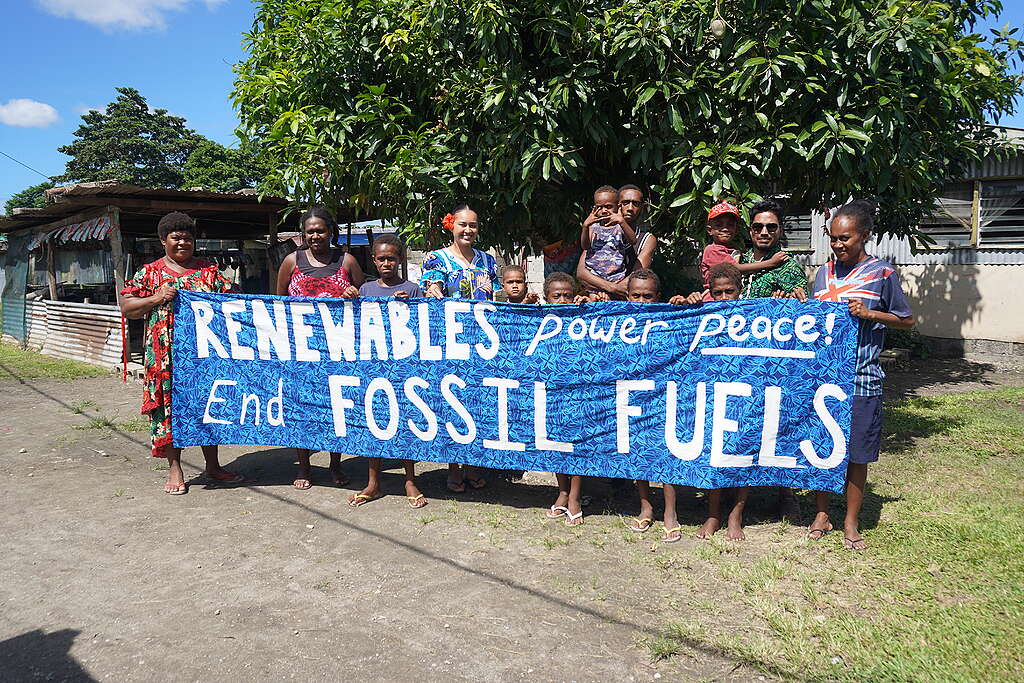
Greenpeace Australia Pacific staff meet community members in Vanuatu, calling to ‘End Fossil Fuels’.

Alongside the formal process of UN climate negotiations, we must continue to grow and strengthen the coalition of committed nations already getting on with the work of building a vibrant future beyond fossil fuels. We must carry forward the momentum generated by the landmark conference on transitioning away from fossil fuels in Santa Marta, as we voyage towards the second conference in Tuvalu next year. We will build a fossil fuel free Pacific, shaped by Pacific values. We will continue to be a voice of science, ambition and conscience, and we will seek justice and accountability through the full implementation of the historic ruling from the International Court of Justice.

Recommendations

1.5°C as our guiding star

The transition away from fossil fuels must be anchored to the fundamental scientific, moral and legal imperative of limiting warming to 1.5°C. This means timelines, targets and trajectories that minimise the duration and extent of any overshoot, and return the long-term average temperature rise to 1.5°C as soon as possible.

Strengthening global cooperation

The COP31 Presidency of Negotiations, to be held by Australia, must be a meaningful partnership with the Pacific. This means elevating the voices of our leaders, backing Pacific-led solutions, and maximising the opportunity of the Pacific pre-COP to ensure the 1.5°C imperative and the transition away from fossil fuels are central to the agenda at COP31 in Antalya.

COP31 must operationalise and accelerate the commitment to transition away from fossil fuels, building on the momentum from COP30 and the Santa Marta conference.

Alongside and complementary to the UN climate negotiations, willing countries should work to accelerate implementation through parallel initiatives such as the Brazilian COP30 Presidency-led roadmap, the follow-up to the Santa Marta conference, bilateral and regional collaborations, and implementation of the advisory opinion from the International Court of Justice.

National roadmaps that promote justice

All governments should develop national roadmaps for a just transition away from fossil fuels, aligned with their fair share of the global action needed to limit warming to 1.5°C, and identify needs for international support.

National roadmaps should include an immediate commitment to no new fossil fuel expansion, rule out false solutions, set timelines to phase out production and consumption — with developed countries moving fastest — and maximising the opportunities for increasing energy sovereignty, access and security.

From extraction to regeneration

The transition away from fossil fuels must also aim to reduce future energy use and demand for transition minerals. This means focussing on energy efficiency, a return to regenerative approaches, and reorienting our energy, transport, food systems and built environments away from material excesses and over-consumption, aligning instead with the values, wellbeing and long-term interests of our communities.

The transition must not lead to new industries that harm our environment and communities, and that repeat and compound the injustices of past extractive models. In particular, governments should put a permanent ban on deep sea mining.

Funding

Developed countries must provide adequate and accessible finance for transitioning away from fossil fuels, adapting to the impacts of climate change, and addressing loss and damage. This should include an increase in grants and direct budget support, be accompanied by debt relief, and be enabled through taxing polluters and ending fossil fuel subsidies.

Authored by the Pacific team at Greenpeace Australia Pacific. Words by Simon Bradshaw, Shiva Gounden, Moemoana Schwenke. Edited by Kate O’Callaghan.

Photos curated by Olivia Louella.

REPORT: Where the Ocean leads us, A Pacific way to a fossil fuel free future

Continue Reading

Climate Change

UK withdraws millions in funding from world’s second-largest rainforest in Congo 

Published

on

The UK has abandoned projects worth tens of millions of pounds that were meant to help protect Congo rainforests and support local people.

Together, these initiatives would have made up around half of the £200m that the UK pledged to support conservation in the Congo basin – the world’s second-largest rainforest.

When it hosted COP26 in Glasgow, the UK led a new initiative to end forest loss, which included a collective pledge by 12 donors of “at least” $1.5bn (£1.1bn) for Congo rainforest nations by 2025.

Development minister Jenny Chapman revealed last week that, as of 2024, the UK had only provided £39.8m towards this goal.

Alongside the US and much of Europe, the UK has significantly cut its aid budget in recent years, leading to much of its Congo rainforest spending being cancelled or reappraised.

The government says it still plans to “prioritise” rainforest regions, including the Congo basin, but civil society groups and MPs are concerned about the lack of “ring-fenced” forest funding in the UK’s new aid strategy.

COP pledge

At COP26, the UK – led by then prime minister Boris Johnson – launched the “Glasgow leaders’ declaration”, with a goal to “halt and reverse forest loss” by 2030. This was backed by more than 140 nations.

The UK also made various funding pledges, including £200m to protect the Congo basin, £350m for tropical forests in Indonesia and “up to £300m” for the Amazon.

These commitments target the world’s three largest rainforests, all of which face major forest loss due to threats such as agriculture, logging and climate change.

The Congo basin is the planet’s largest forested carbon sink. Yet, its six host nations are among the poorest in the world and face significant funding barriers.

This has global ramifications. An official UK assessment warned that “degradation or collapse” of the Amazon or Congo rainforests “threaten UK national security and prosperity”.

Forest cuts

Following successive aid cuts introduced by both the Conservative and then Labour governments – tracking a global trend – the UK’s Congo funding is under threat.

The Congo basin forest action programme (CBFA) was launched by the UK at COP27. It was explicitly set up to provide “roughly half” of the UK’s £200m Congo pledge.

CBFA set out to “empower central African nations”, such as the Democratic Republic of the Congo (DRC), with support for “community forests” and other measures to curb forest loss.

Now, after reporting delays, the UK has slashed the CBFA as part of the Labour government’s recent aid cuts, intended to free up money for defence spending.

Its original £90m budget has now been reduced to £18.8m. Government data shows that £15m of this has already been spent.

This is not the only Congo project that has been dropped due to this latest round of aid cuts.

The Congo part of the biodiverse landscapes fundchampioned by the previous government and worth at least £12.3m – has been closed, just two years into its seven-year schedule.

Government documents reveal more Congo forest funding is at risk as the UK scales back its aid budget, including the UK’s two largest remaining projects in the region.

One initiative, intended to “incubate forest-friendly enterprises” in DRC, faces “reduc[ed] budgets”. Officials working on the other, while more optimistic, reported that the project may be forced to operate in fewer countries as the cuts set in.

Documents also reveal the difficulties that come when operating in the Congo, including “complex political economies and, in Gabon, a military coup – which “complicated matters”.

‘Breaking promises’

Damian Fleming, a senior director of forests at WWF International tells Carbon Brief:

“Tropical forest countries are making long-term policy and development choices in expectation that international partners will honour their commitments.”

In a series of recent parliamentary responses, Chapman revealed that the UK had only spent £39.8m on Congo forest finance, as of 2024. (She declined to provide any information on the Indonesia and Amazon regional goals.)

Despite being presented as the UK’s “contribution” to the £1.1bn-by-2025 global goal agreed at COP26, the £200m target has a deadline of 2029.

Therefore, while the collective goal has been met, the UK’s contribution so far has been relatively small.

Zac Goldsmith, a former Conservative minister who oversaw the forest targets at COP26, tells Carbon Brief that, in his view, the UK has “discarded” its regional pledges:

“We have gone from being perhaps the leader on protecting nature internationally to breaking promises to countries around the world for whom the environment is an existential issue.”

Future targets

The Labour government says it has met the five-year “climate finance” target of £11.6bn that expires this year.

Ministers also say the government has met “and exceeded” the £3bn and £1.5bn sub-goals for “preserving nature” and forests, respectively, within the £11.6bn. These are the funding streams that include support for the Congo basin and other rainforests.

The UK has funded a variety of projects in line with its forest goals, including mangrove restoration in Indonesia, support for carbon-offsetting projects in Brazil and promoting “forest stewardship” among farmers in Cameroon.

Chapman has stated that the UK will continue to “prioritise” the Congo rainforest, in line with its new plan for aid spending in Africa. The UK even helped to launch a new “call to action” for Congo basin funding at COP30 last year.

The UK government also says it supported the creation of Brazil’s flagshipTropical Forest Forever Facility” (TFFF). However, so far it has not provided any funding for the facility.

When the government announced a new climate finance pledge for 2026 onwards, it stressed that nature would still be a “focus” and said it would also generate billions in “climate and nature positive investments”. Nevertheless, it dropped the “ring-fenced” amounts for nature and forests that had appeared in its previous pledge.

The UK, alongside other developed countries, has pledged to provide biodiversity finance to developing countries, under the Kunming-Montreal Global Biodiversity Framework (GBF) – a non-binding global pact to halt and reverse nature loss by 2030.

Sarah Champion, chair of the international development committee of MPs, says “sub-pledges” for nature and forests are a “cost-effective and impactful” way to ensure this finance is provided, alongside climate finance. She tells Carbon Brief that she was “concerned” about the move away from this approach:

“When the minister recently appeared before the international development committee, I was concerned to hear her characterise this shift as a ‘gamble’.”

A government spokesperson tells Carbon Brief:

“We remain committed to providing finance for forests, including in the Congo basin, as a core element of our overall climate funding.”

A shorter version of this article was first published in Cropped, Carbon Brief’s fortnightly newsletter that provides a digest of food, land and nature news, on 15 July 2026. Subscribe for free.

The post UK withdraws millions in funding from world’s second-largest rainforest in Congo  appeared first on Carbon Brief.

UK withdraws millions in funding from world’s second-largest rainforest in Congo 

Continue Reading

Climate Change

Cropped 15 July 2026: Uganda starves | Trump opens endangered habitats | UK cuts rainforest aid

Published

on

We handpick and explain the most important stories at the intersection of climate, land, food and nature over the past fortnight.

This is an online version of Carbon Brief’s fortnightly Cropped email newsletter.
Subscribe for free here.

Key developments

Global drought and heat

DRY THEN WET: A recent heatwave and months of low rainfall has led to a prolonged drought for Uganda, resulting in at least 16 deaths from hunger and significant crop losses, reported BBC News. Bastille Post Global suggested that “a developing El Niño later this year could bring heavier rainfall to parts of the region, raising the risk of flooding in areas now struggling with drought”.

FUNDING FOOD: The UN Food and Agriculture Organization (FAO) and the World Food Programme (WFP) have appealed for $200m in funding to help African nations deal with the impact of El Niño, stated Deutsche Welle. This would target 22 high-risk countries with measures, including “cash transfers, climate-resilient seeds, livestock protection and flood control.” The Guardian explained how El Niño could still “cause a severe shock to global food prices lasting into 2028”.

FARMING FEARS: Extreme weather has devastated agriculture across the world. India saw its driest June in 12 years, reported BBC News, and France has had a “double-digit production” decline, according to Le Monde. The Financial Times reported that farmers in the UK are mitigating the impacts of extreme heat by eliminating “chemicals and intensive ploughing to improve soil quality so it retains water”.

EURO FIRES: Wildfires have spread across Europe, with Spain reporting at least 12 deaths so far, according to the Guardian, and France experiencing road closures, said Reuters. Wildfire Today reported that the most extreme conditions are “across France, Spain and northern Portugal, the Alpine arc extending into northern Italy, the south of the UK and south-east Ireland”. CNN explained how “the climate crisis is driving hotter, drier weather, which is setting the stage for fiercer fire seasons”.

Endangering species

REDEFINING HARM: The Trump administration “reversed decades of longstanding environmental law protecting endangered species…opening up sensitive habitats…to drilling, mining, farming and real estate development”, reported CNN. According to the story, the change “redefines what constitutes ‘harm’” to endangered species, which historically prohibited habitat modification or degradation. Agence France-Presse reported that US environmental groups sued the Trump government over the move, arguing that it had violated “common sense, biological science and federal law”.

OPEN SEASON: Reuters reported that the change “limits the reach of the 50-year-old Endangered Species Act” (ESA), which is a “key regulatory consideration” when granting permits for “oil and gas, mining, electric transmission and ​other operations on federal lands and water”. Legal scholars told the New York Times the US government “was acting without conducting scientific research into the impact” of the change, while the National Mining Association “applauded the announcement”.

News and views

  • INTERNATIONAL WATERS: After a significant delay, the UK ratified the Biodiversity Beyond National Jurisdiction Agreement (BBNJ), also known as the High Seas Treaty. Oceanographic detailed how this will allow for “marine protected areas across international waters for the first time”, but also stressed that the “hard part” starts now. 
  • SCOPE-FREE: The world’s largest meat supplier JBS “scrapped a key climate goal” in its net-zero plan that accounts for its suppliers’ emissions, “which make up the vast bulk of the company’s environmental footprint”, reported the Financial Times. The company told the paper it was difficult to control these “indirect” emissions.
  • DEEP TROUBLE: Pacific gray whales are facing a “catastrophic die-off” as sea-ice loss threatens their food sources, said the Guardian. Separately, conservationists warned that more than half of all molluscs that “cluster around underwater vents” could face extinction from deep-sea mining, reported Reuters.
  • ETHANOL PUSHBACK: India’s new rules to promote 100% ethanol fuel and make ethanol-blended fuel mandatory at pumps “triggered a political row”, reported the Times of India. While the Indian government defended the push to automobile owners, a Hindu editorial and an Indian Express comment warned against incentivising fuels made from “water-intensive” sugarcane and rice. 
  • AMAZON ACTION: Deforestation in the Brazilian Amazon fell to its lowest level in a decade, but president Lula’s plans to “end illegal deforestation by 2030” could be hampered if he is not re-elected, reported Al Jazeera. Meanwhile, Colombia’s outgoing environment minister warned of greater environmental and climate risk under the incoming government, said the Associated Press
  • WAR WORRIES: The International Energy Agency (IEA) warned of the impact of the Iran war on Africa’s clean cooking efforts as disruption in the strait of Hormuz has stunted supplies and increased prices of liquefied petroleum gas (LPG), explained Climate Home News

Spotlight

UK ‘discards’ Congo rainforest funding

Amid worldwide cuts to aid spending, Carbon Brief explores how the UK is backtracking on funding for the Congo basin – the world’s second-largest rainforest.

The UK has abandoned projects worth tens of millions of pounds that were meant to help protect Congo rainforests and support local people.

Together, these initiatives would have made up half of the £200m that the UK pledged to support forest conservation in the Congo basin.

When it hosted COP26 in Glasgow, the UK led a new initiative to end forest loss, which included a collective pledge of “at least” $1.5bn (£1.1bn) for Congo rainforest nations by 2025.

Development minister Jenny Chapman revealed last week that, as of 2024, the UK had only provided £39.8m towards this goal.

COP pledge

At COP26, the UK – led by then prime minister Boris Johnson – launched the “Glasgow leaders’ declaration”, with a goal to “halt and reverse forest loss” by 2030.

The UK also made various regional funding pledges, including £200m for the Congo basin, £350m for tropical forests in Indonesia and “up to £300m” for the Amazon.

All of these rainforests face major forest loss. The Congo basin is the planet’s largest forested carbon sink, but its six host nations are among the poorest in the world and face significant funding barriers.

This has global ramifications. An official UK assessment warned that “degradation or collapse” of the Amazon or Congo rainforests “threaten UK national security and prosperity”.

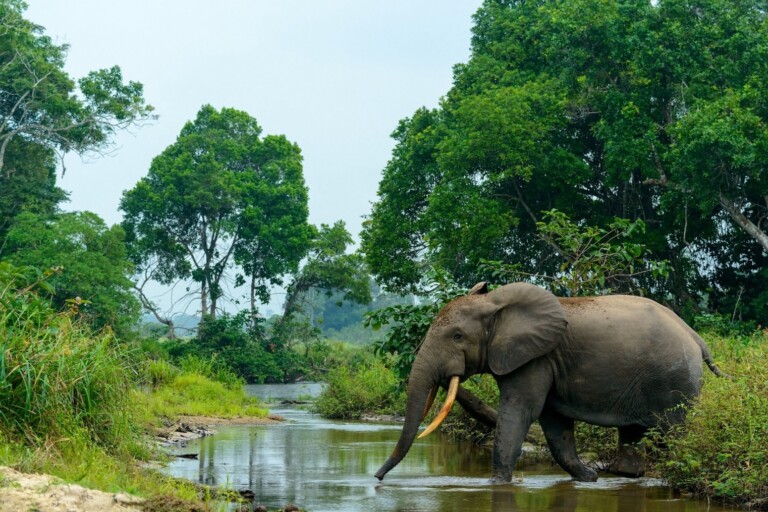
African elephant pictured in Congo.
African elephant pictured in Congo. Credit: BIOSPHOTO / Alamy Stock Photo

Forest cuts

Following successive aid cuts introduced by both Conservative and Labour governments – tracking a global trend – the UK’s Congo funding is under threat.

The Congo basin forest action programme (CBFA) was explicitly set up to provide “roughly half” of the UK’s £200m Congo pledge.

Now, after reporting delays, the UK has slashed the CBFA as part of the Labour government’s aid cuts. Its £90m budget has been “quietly reduced by 79% to £18.8m”, according to the Times.

This is not the only Congo project that has been dropped due to aid cuts. The Congo part of the biodiverse landscapes fund – worth at least £12.3m – has closed five years early.

Official documents reveal more Congo forest funding is at risk, including the UK’s two largest remaining projects in the region. One initiative, intended to “incubate forest-friendly enterprises” in DRC, faces “reduc[ed] budgets”.

Documents also show the difficulties operating in the Congo, including “complex political economies and, in Gabon, a military coup – which “complicated matters”.

‘Breaking promises’

Damian Fleming, a senior forests director at WWF International told Carbon Brief:

“Tropical forest countries are making long-term policy and development choices in expectation that international partners will honour their commitments.”

In a parliamentary response, Chapman said that the UK had spent £39.8m towards its £200m Congo target, as of 2024.

Despite being described as the UK’s contribution to the £1.1bn-by-2025 global goal agreed at COP26, the £200m target has a deadline of 2029. Therefore, while the collective goal has been met, the UK’s contribution was relatively small.

Zac Goldsmith, a former Conservative minister who oversaw the forest targets at COP26, told Carbon Brief that, in his view, the UK has “discarded” its regional pledges:

“We have gone from being perhaps the leader on protecting nature internationally to breaking promises to countries around the world.”

The Labour government says it has met its overarching “climate finance” goals and still intends to “prioritise” the Congo rainforest.

However, civil society groups and MPs are concerned about the lack of “ring-fenced” forest funding in the UK’s new aid strategy.

Watch, read, listen

TOXIC TROUBLES: DeSmog unpacked a new report that said Northern Ireland is being turned into a “toxic” pig and poultry farming “sacrifice zone” to satiate the UK’s meat appetite.

NEED TO NOAA: Laid-off scientists from the US’s National Oceanic and Atmospheric Administration (NOAA) launched Climate.Us – an independent, public-backed version of the climate information website shut down by Trump last year.

DRY FRUIT: A Dialogue Earth long read looked at how climate change is impacting apricot harvests in the “stark, high-altitude desert” region of Ladakh, India.

READING ALOUD: A London Review of Books podcast discussed Robin Wall Kimmerer’s influential book “Braiding Sweetgrass”, weighing its compelling themes and where it veers into “scientific overreach”.

New science

  • Climate change could cause Indigenous peoples in the Amazon to lose 28-34% of their plant species and 18-23% of their associated services | Nature
  • Biodiversity in forests can act as a “buffer” against compound extreme weather events | Nature Communications
  • Zero-deforestation commitments in Indonesia’s palm oil sector have had “no additional impacts” on reducing forest loss | Proceedings of the National Academy of Sciences

In the diary

This edition of Cropped was written by Jess Milligan, Josh Gabbatiss and Aruna Chandrasekhar. Cropped is edited by Dr Giuliana Viglione. This edition was edited by Daisy Dunne. Please send tips and feedback to cropped@carbonbrief.org.

The post Cropped 15 July 2026: Uganda starves | Trump opens endangered habitats | UK cuts rainforest aid appeared first on Carbon Brief.

Cropped 15 July 2026: Uganda starves | Trump opens endangered habitats | UK cuts rainforest aid

Continue Reading

Climate Change

Campaigners oppose Dangote’s planned Kenya refinery over climate and ecological risks

Published

on

Climate and environment campaigners have urged the Kenyan government to halt plans for a proposed 700,000-barrel-per-day oil refinery backed by Africa’s richest man, Aliko Dangote, warning the project threatens one of East Africa’s most ecologically sensitive coastlines. 

The refinery, which is planned to be situated in Lamu County on Kenya’s northern coast, will be East Africa’s largest refining project and is expected to take up to three years to build. Once finished, it would supply refined petroleum products to Kenya, Uganda, Tanzania and Rwanda, among others, helping to reduce the region’s dependence on imported fuels.

Campaigners are questioning the viability of such a large refinery at a time when renewable energy and electric transportation are expanding rapidly.

Mohamed Adow, director of a Kenya-based climate and energy think-tank Power Shift Africa, said the decision to give Dangote the green light for the refinery is “an extraordinary act of environmental recklessness and economic short-sightedness”, arguing it would tie Kenya to “yesterday’s energy system” just as global demand for petroleum products faces increasing uncertainty. 

    Campaigners argue the refinery risks coming online just as transport – the largest market for petrol and diesel – is beginning to electrify across the continent.

    Kenya launched a National Electric Mobility Policy earlier this year to speed up the uptake of electric vehicles (EVs) and reduce the country’s roughly $5 billion annual fuel import bill. Ethiopia has already banned imports of non-electric vehicles and now has more than 100,000 EVs on its roads, while Rwanda is expanding its electric mobility programme with plans to convert its fleet of around 100,000 motorcycles to electric.

    Adow said the project risks billions of dollars in investment in infrastructure that could become obsolete as the world moves away from oil.

    “Building a refinery today assumes decades of robust demand for fuels that much of the world is actively trying to phase out,” he said in a statement. 

    Ecological concerns

    Lamu – the proposed site for the project – is home to the UNESCO World Heritage-listed Lamu Old Town and an archipelago containing extensive mangrove forests, coral reefs and seagrass beds that support fisheries, tourism and coastal livelihoods.

    Locating the refinery in Lamu would “place one of Africa’s largest fossil fuel developments in one of the continent’s most ecologically sensitive and culturally significant coastal regions,” Power Shift Africa said.

    Major emitting countries knew of climate risks decades earlier than claimed

    Sherelee Odayar, oil and gas campaigner at Greenpeace Africa, warned that a refinery of this scale could increase the risk of habitat destruction, marine pollution, oil spills and air pollution in one of East Africa’s most fragile coastal ecosystems.

    She said the risks stem not only from the refinery itself – including storage tanks, pipelines and fuel handling facilities – but also from the large volumes of crude oil that would need to be shipped into Lamu and refined products exported by sea. Increased tanker traffic and fuel transfers, she said, would raise the likelihood of accidents in ecologically sensitive coastal waters.

    Odayar added that Lamu’s low-lying, flood-prone coastline could compound those risks by damaging infrastructure and carrying contaminants from storage facilities into nearby fishing grounds and marine ecosystems.

    “Lamu’s mangroves, coral reefs and seagrass beds are not expendable; they support fisheries, livelihoods and coastal protection,” Odayar added.

    She said Kenyan authorities should suspend any approvals until an independent environmental and social impact assessment is completed, with genuine public participation and transparent scrutiny of the long-term economic, health and ecological risks.

    “Any review must assess cumulative impacts on Lamu’s mangroves, coral reefs, seagrass beds and fishing livelihoods, alongside the wider economic risk of locking Kenya into costly fossil fuel infrastructure as the global energy transition accelerates”.

    Dangote Group declined to answer questions from Climate Home News when contacted by phone.

    Technological change threaten project’s future

    The Kenya refinery would replicate Dangote’s 650,000-barrel-per-day refinery in Lagos, currently Africa’s largest, which has plans to more than double capacity to 1.4 million barrels per day by 2028.

    Adow of Power Shift Africa said projects like this represent “a breathtaking failure to recognise where the global economy is heading”, pointing out that the East African refinery risks arriving when Africa is experiencing an unprecedented clean energy boom. 

    Referencing Africa’s solar boom, global electric vehicles uptake and the International Energy Agency’s projection that global oil demand is set to enter a decline later this decade, the think-tank founder said African governments risk anchoring the continent’s future to an industry facing mounting economic uncertainty.

    Loss and damage fund delays first project approvals as needs dwarf resources

    The organisation said the project faces a bigger threat aside from environmental opposition and that is technological change. “The danger is not simply that the refinery will pollute, it is that it will become obsolete long before it has paid for itself,” he added.

    Kenyan President William Ruto said the project will create about 60,000 jobs for Kenyans and supply refined fuel to eight East and Central African countries.

    GreenPeace Africa’s Odayar said the promise of ‘thousands of jobs’ cannot be used to hide the true cost of the investment which is that large fossil fuel projects often create temporary jobs while undermining existing livelihoods in fishing, tourism and small-scale local economies.

    “The enormous capital required for a project of this scale could instead help accelerate Kenya’s renewable energy future through solar, wind, geothermal, storage and better energy access,” she added.

    The post Campaigners oppose Dangote’s planned Kenya refinery over climate and ecological risks appeared first on Climate Home News.

    Campaigners oppose Dangote’s planned Kenya refinery over climate and ecological risks

    Continue Reading

    Trending

    Copyright © 2022 BreakingClimateChange.com