

In early July at Kerteminde, most of the individuals I observed were longer than 10 cm, including one close to 15 cm. Their size, and their timing, deserve immediate attention.
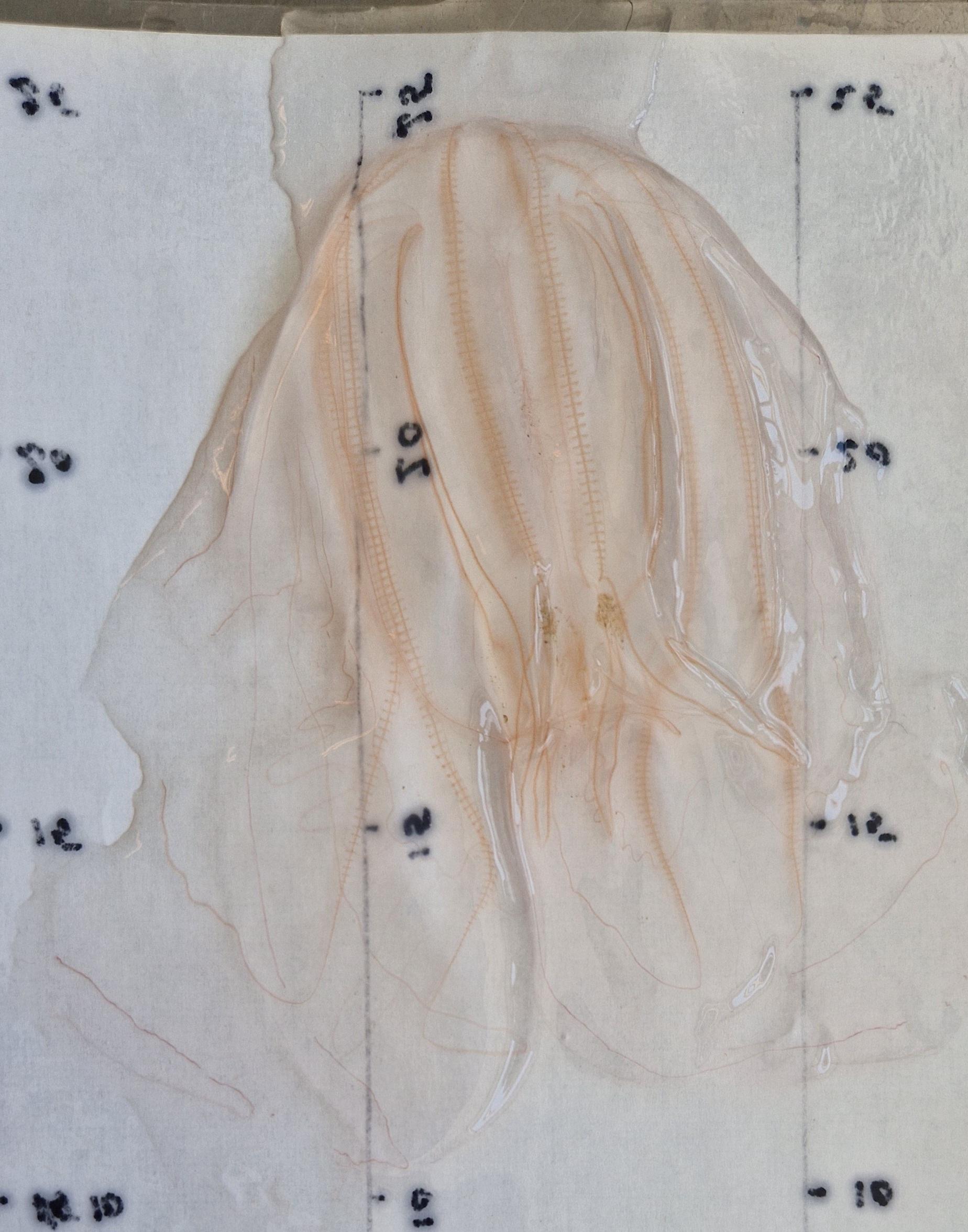
 One out of many large speciments I got from Kerteminde (Javidpour, July 2026)
It does not matter whether you call it ribbegople in Danish, Rippenqualle in German or comb jelly in English. The species is the same: Mnemiopsis leidyi. And what I have observed in Kerteminde this summer should concern us. During our current summer field course at the Marine Research Centre, I have repeatedly seen unusually large individuals of M. leidyi around the pier. Most of the animals I observed were longer than 10 cm, even bigger than the one I photographed.
Yes, yes, a pier observation is not a formal population survey….I know. We still need systematic sampling to determine the abundance, distribution and size structure of the population. Nevertheless, the observation is striking because both the size of the animals and the timing of their appearance are unusual, said by someone who is studying this species for the last 20 years.
This is happening earlier than expected
In previous years, the maximum population size of M. leidyi generally occurred several weeks later, mainly during August and early September. Our previous research, including work based on daily sampling, showed a clear seasonal development of the population. The timing varies among years and is influenced by environmental conditions, including winter temperature. Temperature is particularly important because it strongly affects the metabolism of M. leidyi. At warmer temperatures, individuals use their carbon reserves much faster and therefore require more food to maintain themselves and grow. This year, however, the pattern appears to be different. We are seeing very large individuals already in early July. We do not yet know whether this is a local aggregation, an unusually early bloom, transport from another area, particularly favourable feeding conditions or a combination of these factors. But it is a signal that deserves attention.
What does it take to grow by one centimetre?
It is tempting to ask how much energy an individual needs to add one centimetre to its body. The answer is not straightforward because one centimetre of length is not a fixed amount of biomass. Growing from 5 to 6 cm is not the same as growing from 14 to 15 cm…OK? However, we can make a rough carbon-budget calculation using a published relationship between the length and body-carbon content of M. leidyi:
Body carbon in milligrams = 0.0017 × body length in millimetres²·⁰¹³⁸
According to this relationship, an individual measuring 10 cm contains approximately 18.1 mg of carbon. At 11 cm, it contains about 21.9 mg. Adding this single centimetre therefore represents an increase of approximately 3.8 mg of body carbon. If we assume that the animal assimilates approximately 40% of the carbon it consumes, it would need to ingest at least ~10 mg of prey carbon to produce this additional tissue. Using an approximate value of 1 micrograms of carbon for a small copepod, this would correspond to more than 10,000 copepods.
For an already large individual growing from 14 to 15 cm, the estimated increase is approximately 5.3 mg of body carbon. At the same assimilation efficiency, that would require at least 13.3 mg of prey carbon: the equivalent of roughly 15,000 small copepods.
These calculations are only rough, conservative estimates. They are not complete energy budgets. They do not include the food needed for respiration, movement, reproduction, mucus production, excretion or unsuccessful feeding. The real prey requirement would therefore be considerably higher. The important point is that an individual measuring 15 cm represents a substantial transfer of material from the surrounding planktonic food web into gelatinous biomass. One additional centimetre is not “just” one centimetre.
Our students are tracing the food web
The timing of these observations coincides with our summer field course. The students are now collecting M. leidyi, fish, other gelatinous organisms and potential prey for stable-isotope analysis. By comparing carbon and nitrogen isotope values, we hope to obtain a rough picture of the relationships within the local food web. Carbon isotopes can help us trace the original sources of the material entering the food web, while nitrogen isotopes can provide information about relative trophic position.
This will not give us a direct photograph of one organism eating another. Stable-isotope values represent assimilated food over time, and their interpretation depends on appropriate baselines and turnover rates. Nevertheless, combined with information about size, abundance, prey availability and experimental feeding, they can help us understand where M. leidyi is obtaining its biomass and which organisms may be affected. …In simple terms, we are trying to determine who might be eating whom, and where this unusually large population fits into the food web.
Competition with fish is only part of the problem
The concern is not limited to competition for zooplankton. Mnemiopsis leidyi consumes copepods and other small planktonic animals that are also important food for pelagic fish. When the ctenophores are abundant, they can therefore compete directly with fish for prey. Our experiments have also demonstrated that M. leidyi can potentially feed directly on the early life stages of fish. In the study by my previous PhD student, the ctenophores captured and digested Baltic herring yolk-sac larvae. Predation was related to ctenophore size and was not simply eliminated when alternative copepod prey were available. This means that M. leidyi may/can affect fish populations in two ways: by consuming the food needed by fish and by consuming fish eggs or larvae directly.
A recent study by Lucila Sobrero and colleagues in Argentina, within the native range of M. leidyi, found a similar pattern. Their experiments showed size-dependent predation on fish eggs and larvae. Larger ctenophores consumed more eggs. Some eggs were later regurgitated, but many were no longer viable, while fish larvae were retained and digested. These findings are particularly relevant to what we are observing in Kerteminde. The size of an individual is not merely an interesting measurement. It can influence what that individual is capable of capturing and how strongly it affects the surrounding ecosystem. A population consisting of fewer but much larger individuals may still exert substantial pressure on zooplankton, fish eggs and fish larvae.
We need to investigate use, not only control
For several years, I have tried to obtain funding to investigate innovative approaches to this invasive species.
Once M. leidyi is well established, we may not be able to control its regional spread or completely prevent its blooms. But that does not mean that we have no options. We should investigate whether at least part of this recurring biomass can be collected and converted into something useful.
This is not a proposal for a miracle solution. Any utilisation strategy would have to be tested carefully. It must not encourage the further spread of the species, create damaging bycatch or provide an economic incentive to maintain an invasive population. We also need to understand the environmental costs of collection, transport and processing.
But these are exactly the questions that research funding should allow us to answer.
So far, my attempts to secure support for this work have been unsuccessful. Funding agencies do not seem to sense the urgency of studying approaches whose benefits may not be immediate or easily visible. and EPAs do not have any resource to invest in this part. The contrast with events on land is striking. This week, the oak processionary moth, the so-called “larva from hell”, has attracted considerable attention in Odense. Its microscopic hairs can cause rashes and allergic reactions, residents have reported serious discomfort, and a kindergarten has reportedly had to close temporarily. Those concerns are real and deserve a response.
But the case also illustrates how differently we react to environmental threats.
When the impact appears visibly on human skin, the urgency is immediately understood. When ecological damage develops below the surface of the sea, in the form of disappearing zooplankton, altered food webs, consumed fish eggs or reduced larval survival, it is much easier to overlook.
Marine ecosystem changes are often gradual, underwater and largely invisible to the public. By the time their consequences become obvious, the opportunity for early and relatively inexpensive action may already have passed.
Concern does not mean panic
One photograph and a series of observations from one pier do not prove that an ecological crisis is underway. I am not suggesting that they do. But science should not have to wait for undeniable damage before investigation becomes urgent.
The unusually large M. leidyi appearing in Kerteminde this July give us an opportunity to act early. We need systematic monitoring of their abundance and size distribution. We need to measure the available prey field. We need to determine their trophic position and investigate possible consequences for fish recruitment. And we need to explore whether biomass that we may be unable to prevent could be collected and used responsibly.
Whatever language we use and whatever name we give it, the message is the same:
We should measure early, investigate early and support innovative solutions while the warning is still only a warning, not after it has become a crisis.
Relevant publications
Javidpour, J. et al. (2009). “Seasonal changes and population dynamics of the ctenophore Mnemiopsis leidyi after its first year of invasion in the Kiel Fjord, Western Baltic Sea.” Biological Invasions.
Javidpour, J. et al. (2020). “Cannibalism makes invasive comb jelly, Mnemiopsis leidyi, resilient to unfavourable conditions.” Communications Biology.
Stoltenberg, I. et al. (2024). “Predation on Baltic Sea yolk-sac herring larvae (Clupea harengus) by the invasive ctenophore Mnemiopsis leidyi.” Fisheries Research.
Sobrero, L. et al. (2025). “Predatory impact on ichthyoplankton by Mnemiopsis leidyi is size-dependent: an experimental approach.” Marine Ecology Progress Series.
Ribbegople, Rippenqualle or Comb Jelly: Whatever You Call Mnemiopsis leidyi, You Should Be Concerned

This fall, Ocean Conservancy is celebrating its 41st annual International Coastal Cleanup® (ICC), once again bringing together volunteers to protect the beaches and waterways we all love. Ocean Conservancy recently hosted flagship events in Long Beach and Washington, D.C. that celebrated this global movement close to home.
Over the past four decades, nearly 20 million volunteers have rolled up their sleeves to remove more than 405 million pounds of trash from beaches and waterways around the world. And their impact extends far beyond what they collect. ICC volunteers have documented nearly 440 million individual items, creating the world’s largest marine debris database and providing invaluable information that helps Ocean Conservancy and others better understand—and tackle—ocean plastic pollution.
This year’s celebration continued that incredible legacy. At Alamitos Beach in Southern California, more than 150 volunteers gathered on September 19 and removed 1,109 pounds of trash, alongside members of Team USA Artistic Swimming and Olympic and Paralympic athletes. In Washington, D.C., 439 volunteers gathered on September 26 to remove 2,182 pounds of trash from Anacostia Park along the Anacostia River.


“I am so grateful to all of the volunteers who came out today for our ocean—and every volunteer who has made the last 41 years of impact possible,” said Ocean Conservancy’s Senior Director of Conservation Cleanups, Allison Schutes. “Every piece of plastic collected helps protect marine animals and habitats and contributes to research and advocacy.”
And the impact doesn’t stop when the cleanup ends. During International Coastal Cleanup events, volunteers do more than remove trash: They document what they find, helping build a clearer picture of the plastic pollution threatening our waterways and wildlife. Through the Clean Swell® app or paper data sheets, ICC volunteers contribute to Ocean Conservancy’s online, open-access database, the world’s largest repository of marine debris data. These records help scientists, conservation groups and governments understand pollution trends and identify solutions.
That data can also drive meaningful policy change. ICC data were recently used in a peer-reviewed study showing that plastic bag bans lead to reduced plastic bag pollution. The data have also helped advance policies ranging from California’s SB 54 to Florida’s balloon release ban and the federal Farewell to Foam Act. From a neighborhood cleanup to statewide action, every piece of documented trash helps build the evidence needed to tackle plastic pollution at its source.
Get Ocean Updates in Your Inbox
Sign up with your email and never miss an update.
Want to get involved?
Whether you join a local cleanup, record the trash you find using the Clean Swell app, or take action to reduce plastic pollution, you can be part of this incredible collective effort to protect our ocean. Here are a few ways to make an impact:
- Find a cleanup near you.
- Download our Clean Swell app to easily record the trash you collect.
- Take action to reduce plastic pollution.
- Explore our Wildlife Impact Calculator to estimate the potential benefits of your cleanup for marine wildlife.
- Donate today to Ocean Conservancy to help us fight plastic pollution for years to come!
The post Celebrating 41 Years of the International Coastal Cleanup® appeared first on Ocean Conservancy.
For generations, stories of people being swallowed by enormous sea creatures have painted awe-inspiring tales of human survival and perseverance. From the biblical account of Jonah to the legendary battle of Hercules and Cetus to the timeless story of Pinocchio, these legendary tales have captivated people since time immemorial.
But all these stories raise the question: Could someone really be swallowed by a whale? With the premiere of the film Whalefall on October 16, 2026, you may find yourself in conversations about this very situation. Based on the bestselling 2023 thriller authored by Daniel Kraus, the film tells the story of a scuba diver who is accidentally gobbled up by a sperm whale while searching for the remains of his late father. With only an hour of oxygen left in his tank, the diver must fight to escape the whale’s gut before time runs out.
The answer to whether it’s anatomically possible for a whale to swallow a person is actually a bit more complicated than you might think.