


- What are the benefits and challenges of using AI in weather and climate forecasting?
- What are some other current uses of AI in climate science research?
- How is AI being used to advance climate policy and action?
- How could AI be used in climate research over the coming years?
- Are there any misconceptions about the use of AI in climate science?
- Could AI improve or exacerbate inequalities in climate research?
- What are some other risks and challenges of AI in climate change research?

Warming driven by deforestation caused an extra 28,000 heat-related deaths per year across Africa, South America and Asia over 2001-20, new research finds.
The study, published in Nature Climate Change, is the first to look at human health impacts of warming caused specifically by tropical deforestation, as opposed to the burning of fossil fuels, its lead author tells Carbon Brief.
The authors find that deforestation alone drove, on average, 0.45C of warming in the tropics over 2001-20, accounting for 64% of the total warming in regions with tropical forest loss.
They also find that tropical deforestation over 2001-20 exposed 345 million people to “local warming”, in addition to the warming they were already facing due to global warming.
Six out of every 100,000 people living in deforested areas died as a result of deforestation-induced warming during this time, they warn.
This number is higher in south-east Asia, with Vietnam setting a record of, on average, 29 deaths per 100,000 people.
A researcher who was not involved with the study tells Carbon Brief that the “sobering” paper “reframes tropical deforestation as not only a carbon emissions and ecological issue, but also a critical public health concern”.
Tropical deforestation
Tropical forests, mainly distributed across South America, Africa and Asia, account for 45% of global forest cover.
These regions are well-known for their high biodiversity and the crucial ecosystem services that they provide, such as carbon storage.
However, tropical forest loss is on the rise.
A record 6.7m hectares of previously intact tropical forest was lost last year, mainly due to fires and land clearing for agriculture. As the planet warms, worsening heat and drought extremes are also causing trees to become less resilient to change, resulting in forest degradation.
The new study uses data from the Global Land Analysis and Discovery laboratory at the University of Maryland to assess how tropical forest cover has changed year on year. The authors find that over 2001-20, a total of 1.6m square kilometres (160m hectares) of tropical forest was lost globally. This is shown on the map below, where blue indicates high forest loss and yellow indicates low loss.
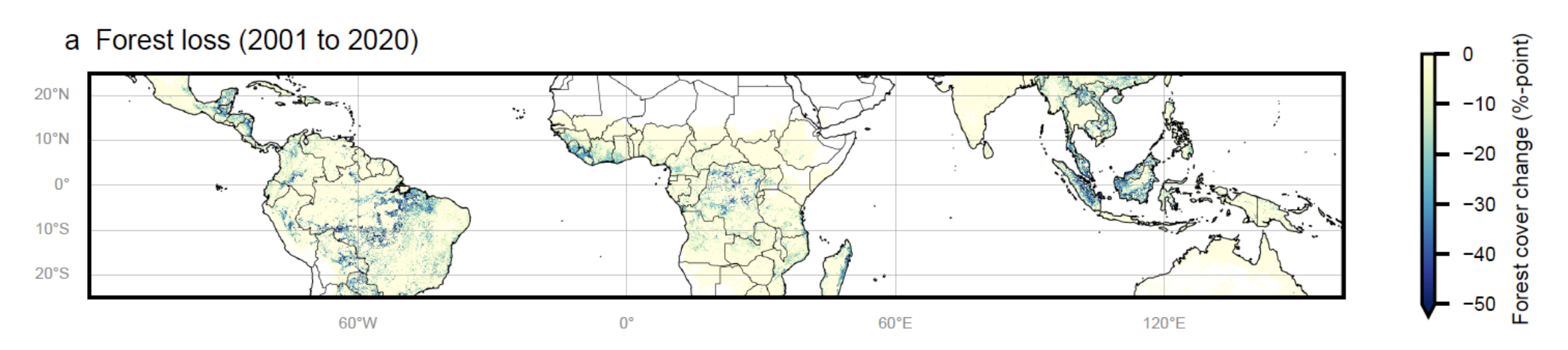
The authors find the largest forest loss was in central and South America, but also highlight “extensive” loss in south-east Asia and tropical Africa.
Forest warming
Tropical deforestation has a wide range of negative consequences, including decreasing biodiversity, releasing carbon into the atmosphere and threatening the safety of Indigenous communities.
Loss of tree cover can also affect local temperatures by influencing the water cycle.
Water is constantly moving from the surface of the land into the atmosphere through a process called evapotranspiration. Plants play a crucial part in this process by moving water from the soil up through their roots and into their leaves, where it evaporates, cooling the air above. When trees are cut down, this cooling effect is reduced.
The authors use data of land surface temperatures from the NASA MODIS satellite to map warming in tropical regions over 2001-20. These results are shown in the map below, where red indicates warming and blue indicates cooling.

The authors find that between 2001-03 and 2018-20, surface temperatures increased by 0.34C in tropical central and South America, 0.1C in tropical Africa and 0.72C in south-east Asia. They add that “areas of forest loss coincide with areas of strong positive change in temperature across many regions of the tropics”.
By comparing their deforestation and surface warming maps, the authors find that deforested regions of the tropics saw an average of 0.7C warming over 2001-20, while areas that “maintained forest cover” saw an increase of only 0.2C.
By comparing the change in temperature in deforested regions with that in neighbouring locations without forest loss, they find that deforestation alone caused 0.45C of warming in the tropics over 2001-20 – accounting for 64% of total warming experienced over those regions.
Heat exposure
High temperatures can be deadly.
During periods of extreme heat, people can suffer from heat stroke and exhaustion – and even die. Those with underlying health conditions are at higher risk of fatal complications.
The authors use data from Oak Ridge National Laboratory’s LandScan to map where people live in the tropics. They estimate that 425 million people live in regions that were exposed to tropical deforestation over 2001-20, and just over three-quarters of them were exposed to warming as a result of the loss of forest cover.
Finally, the authors estimated “heat-related excess mortality” due to nearby tropical deforestation.
Using data from the 2019 Global Burden of Disease study, they determine the number of “non-accidental” deaths in each deforested tropical area. This excludes deaths from “external” causes, such as accidents and suicides, but includes “internal” causes, such as disease.
The researchers then used previously published “temperature-mortality” relationships for different countries. These relationships show the link between temperature and excess mortality rate, indicating the percentage increase in mortality for every degree of warming.
These relationships vary between countries, as people in hotter regions are generally better adapted to extreme heat.
By combining the data on local warming due to deforestation, temperature-mortality relationships and the non-accidental mortality data, the authors calculated how many non-accidental deaths would have been expected in deforested regions if they had not warmed due to the loss of forest cover.
By comparing the real and counterfactual mortality rates, the authors were able to calculate the total mortality burden due to tropical deforestation-induced warming.
Overall, the authors find that tropical deforestation drove an additional 28,300 deaths every year over 2001-20, accounting for 39% of the total heat-related mortality from global climate change and deforestation combined over locations of forest loss.
The study finds that, on average, six out of every 100,000 people living in deforested areas died as a result of deforestation-induced warming. However, these numbers vary by country.
The chart below shows the average annual deaths due to deforestation-induced heat per 100,000 people living in areas of forest loss.

Dr Carly Reddington is a research fellow at the University of Leeds and lead author of the study. She tells Carbon Brief that it is the “first study to look at human health impacts of tropical deforestation-induced warming”.
Dr Nicholas Wolff, a climate change scientist at the Nature Conservancy who was not involved with the study, tells Carbon Brief that the paper is “sobering”. He adds that it “reframes tropical deforestation as not only a carbon emissions and ecological issue, but also a critical public health concern”.
Data-scarce
The authors note that there are no country-specific heat vulnerability indices available for African countries. To develop their data for African countries, they used the average heat vulnerability index for South America.
Reddington tells Carbon Brief that Africa is the most “uncertain region” in the study and tells Carbon Brief that “more data is really crucial” to develop more accurate estimates.
Wolff tells Carbon Brief that extrapolating heat-mortality relationships “from data-rich regions to data-poor ones” is a “common practice in global-scale climate-health research”.
He praises the overall methodology as “innovative, transparent and scientifically sound, with appropriate caveats”.
Dr Luke Parsons, a climate modelling scientist at the Nature Conservancy, tells Carbon Brief that the conclusions are “robust”. However, he notes some “methodological issues” with the paper, such as the fact that all results are modelled, rather than measured.
He tells Carbon Brief that future work could assess “near-surface air temperature and humidity changes associated with deforestation, as well as study regional air temperature changes beyond deforested areas”.
While the new study focuses on warming within one square kilometre of forest loss, Reddington tells Carbon Brief that “deforestation is associated with warming up to 100km away”.
Furthermore, the study notes that the increase in deaths due to excess heat is likely to affect the most vulnerable members of society the most. It says:
“Vulnerable populations, particularly traditional and Indigenous communities, often live near deforested areas and face limited access to resources and infrastructure needed to cope with the combination of rising temperatures and environmental changes caused by deforestation and climate change.”
Wolff also stresses this disparity, adding that “many of these communities depend on forest clearing for agriculture, income and survival, and are forced to make difficult choices between short-term economic needs and long-term health and environmental stability”.
The authors also note that deforestation can drive a range of other interacting health problems, which were not considered in this study. For example, deforestation is linked to a rise in zoonotic diseases, such as malaria.
Dr Vikki Thompson, a climate scientist at the Royal Netherlands Meteorological Institute who was not involved in the study, says that the findings of the paper are “relevant to everyone”. She continues:
“We can reduce impacts of extreme heat by planting more trees and reducing deforestation everywhere, on both local and international scales.”
The post Warming due to tropical deforestation linked to 28,000 ‘excess’ deaths per year appeared first on Carbon Brief.
Warming due to tropical deforestation linked to 28,000 ‘excess’ deaths per year
Continue Reading
Artificial intelligence (AI) is developing at a rapid pace and is increasingly being used by scientists to better understand climate change.
AI is perhaps best-known for its use in “large language models”, such as ChatGPT, Claude and Gemini.
However, the field is vast.
From weather forecasting to analysing satellite images, climate scientists are using various types of AI to develop faster and more efficient ways to study the warming planet.
However, the technology comes with no shortage of risks and challenges, including overreliance on unverified results, intensive energy use and exacerbating existing inequalities in climate science.
Carbon Brief spoke to 10 experts working across a range of climate-related fields – from developing climate forecasts to analysing changes in the energy grid – about how AI is being used.
Their answers are set out below, grouped by theme.
- What are the benefits and challenges of using AI in weather and climate forecasting?
- What are some other current uses of AI in climate science research?
- How is AI being used to advance climate policy and action?
- How could AI be used in climate research over the coming years?
- Are there any misconceptions about the use of AI in climate science?
- Could AI improve or exacerbate inequalities in climate research?
- What are some other risks and challenges of AI in climate change research?
What are the benefits and challenges of using AI in weather and climate forecasting?
Dr Doug McNeall, science lead in data-driven climate modelling at the UK Met Office:
One of the most significant recent developments has been the success of AI weather-prediction models, which learn from large volumes of weather data to predict the next few hours ahead and then repeatedly feed those predictions back into themselves to generate forecasts up to two weeks into the future.
These models have demonstrated that AI can provide accurate predictions while requiring far less computing power than existing numerical models [which rely on mathematical equations to simulate the climate].
One of the main challenges is that AI weather-prediction models have been developed for relatively short timescales, where large amounts of observational data [for example, temperature, rainfall or sea ice extent data] is available and model performance can be evaluated quickly and rigorously.
Climate prediction is fundamentally different. To provide useful climate information, we need to make projections for future climates that lie outside the observational record.
One promising route forward is, therefore, to use AI to emulate or accelerate these existing models, rather than relying solely on purely data-driven approaches. This blended approach could make climate risk information far more accessible and affordable to produce, while retaining the physical understanding [based on mathematical and scientific principles] that underpins confidence in climate projections.
Prof William Collins, professor of AI for climate science at the University of East Anglia:
We’re seeing a really exciting renaissance in both weather and climate science…Machine learning [a subset of AI that uses algorithms to let computers learn from data and make predictions without being explicitly programmed] has had an enormous impact on numerical weather prediction.
So, for example, the European Center for Mid-Range Weather Forecasts is now deploying an AI forecast system as part of their official communication of weather predictions to the European community, alongside the traditional forecast system. AI systems have become good enough that they’re absolutely competitive with the world’s leading numerical weather prediction…So that’s been quite remarkable.
Much of machine learning and AI involves learning from data and climate represents a future for which we do not have data. We’re literally trying to predict the future. We don’t have observations of it. So, where does the data come from to inform the models? That is, at the moment, the central challenge that the climate community is attempting to overcome.
Dr Amirpasha Mozaffari, researcher in Earth artificial intelligence at the Barcelona Supercomputing Centre:
AI forecast models do well on typical weather, but underperform physics-based models on record-breaking and unprecedented extremes – precisely the events that matter most for adaptation [to climate change].
Solving that – whether through hybrid models [which combine AI with traditional models], physical constraints [in which rules are implemented based on the laws of physics to help the models make realistic forecasts] or new ways of evaluating models on what they have not seen – is the central open problem for the field.
What are some other current uses of AI in climate science research?
Dr Stefano Materia, researcher in climate variability and change at the Barcelona Supercomputing Centre:
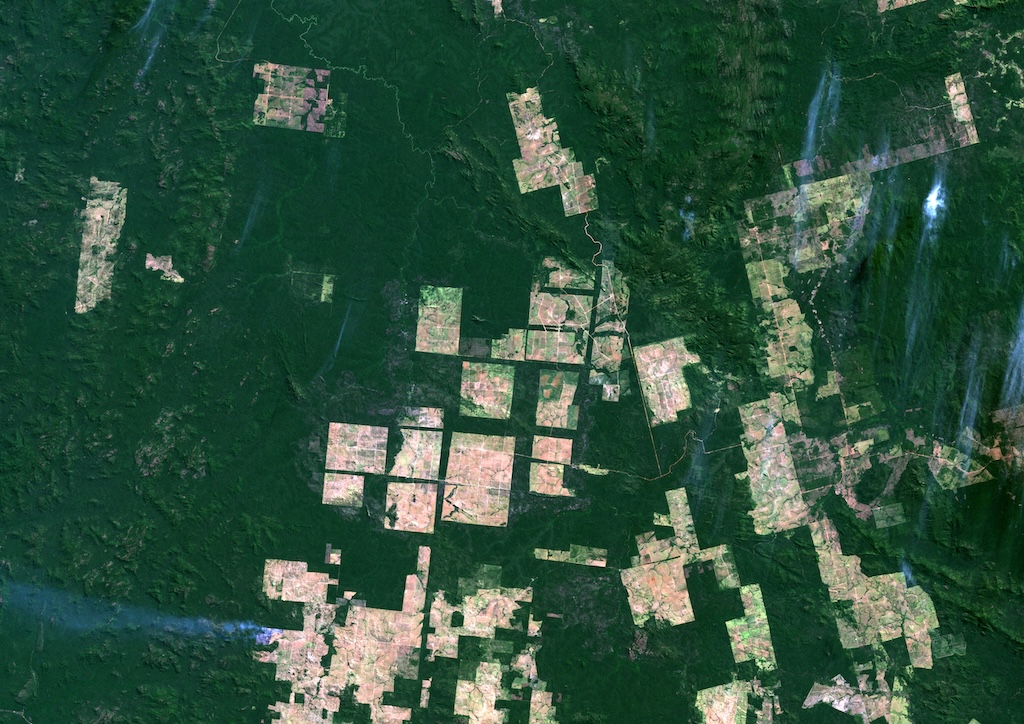
Besides the climate modelling and prediction framework, the proliferation of Earth-observation satellites has created a massive influx of geospatial data (for example, images showing deforestation or sea ice melt). AI is used to translate raw pixel data into actionable climate intelligence.
Methane tracking and ecosystem monitoring are two examples of this kind of application. Methane is a potent greenhouse gas, but leaks are largely invisible and hard to track. AI algorithms now automatically scan hyperspectral imagery [which uses data from across the electromagnetic spectrum] from satellites to pinpoint specific industrial methane leaks globally, alerting operators in near real-time.
At the same time, machine-learning models process thousands of satellite images daily to detect illegal logging, track land-use changes and monitor glacier retreat long before humans could manually review the footage.
Dr Clare Eayrs, polar research scientist at the Environmental Fluid Dynamics Lab at New York University:
In sea ice research, machine learning is now used across the sea ice modelling workflow…The most mature application is extracting more information from observations, for example, mapping fine-scale sea ice deformation from ship radar and classifying snow layers in micropenetrometer profiles [which measure the hardness or softness of different layers of snow].
Forecasting is the most visible application in this field. Ice Net [a sea ice forecasting system] was an early demonstration that a deep-learning system [which uses models inspired by the layers of a human brain to process information] could outperform a leading physical model in seasonal Arctic forecasts. Machine-learning systems are now used to predict [climate] variables such as sea ice concentration, thickness and drift.
Prof Cristiana Stan, vice-chair of the World Climate Research Programme (WCRP):
AI now appears across all major parts of the WCRP. [For example,]…the ”weather prediction model intercomparison project” [an initiative to create a centralised database of physics- based, machine-learning and hybrid model forecasts] includes physics-based numerical weather prediction models, hybrid [models] and AI weather prediction models. Because it is focused on operational models, the project offers a direct comparison between state-of-the art systems. [It] is intended to accelerate the deployment of the next generation of operational models and contributes to development of metrics needed to assess relative strengths and weaknesses of models.
Downscaling is another area that is harnessing AI power to refine the coarse-resolution model output into high-resolution.
Dr William Collins:
The Intergovernmental Panel on Climate Change (IPCC) is performing its seventh assessment report (AR7)…This time, for the very first time, there’s a model intercomparison project just for models using AI [for weather and climate forecasting]. So that is a real milestone…It’s a very exciting proof of principle or proof of concept and, I think, the harbinger of many more developments of this kind to come.
[For more on how model intercomparison will inform IPCC AR7, see Carbon Brief’s recent guest post.]
Dr Amirpasha Mozaffari:
A few years ago, it took two or three years for a new architecture to make its way from the machine-learning community into weather and climate work. Today it is a matter of months: diffusion models, foundation models and generative ensembles have all arrived in our field almost as soon as they appeared elsewhere. That speed opens up things that were previously out of reach.
And the cost of running a global forecast has dropped by orders of magnitude…which,