

Most Ugandans whose land and livelihoods were affected by the construction of the East African Crude Oil Pipeline (EACOP) are dissatisfied with training programmes provided by developers which were designed to stop them being left worse off, a survey has found.
The Africa Institute for Energy Governance (AFIEGO) asked 246 people in seven communities affected by the project for their views on the developers Resettlement Action Plan (RAP).
It found that while most affected households have received some form of support, most were dissatisfied with the quality of food security programmes and training on alternative vocations and financial literacy.
Dickens Kamugisha, AFIEGO’s CEO, said that while the Ugandan government claims it is developing the oil sector to create lasting value for everyone, this study shows that this is not the case especially for the people that were displaced for the project.
“They lost their land, were under-compensated and now an inadequate livelihood restoration programme is being implemented. Instead of creating lasting value for the project-affected people, the government and the EACOP company could create lasting poverty for the people”, he added.
-
Where East African oil pipeline meets sea, displaced farmers bemoan “bad deal” on compensation
The oil export project has pushed up the price of land, so compensation is too low to maintain affected villagers’ standard of living -
As Louisiana bets big on ‘blue ammonia’, communities brace for air pollution
Carbon capture hasn’t delivered major climate benefits — and the plants would still emit thousands of tons of pollution.


EACOP is being built by a coalition led by the French company Total, along with China’s National Offshore Oil Corporation and Uganda and Tanzania’s state-owned oil companies.
The 1,400 km pipeline will take oil from Uganda’s Tilenga and Kingfisher oil fields through Tanzania to the East African coast, where the oil can be put on ships and exported.
Inadequate training
Nearly four-in-five of those surveyed described vocational training programmes, designed to give displaced people new professions like bakers, welders and soap makers, as inadequate. They cited short training periods, absentee trainers and limited hands-on learning.
One participant said he was trained in catering for four months in 2024. “I did not understand what I was taught. We were not learning most of the time”, he said.
The young man said that he only cooked once in the four months and that trainers told them that they would be sent home if they complained.
The financial literacy programme, aimed at training people to use their compensation wisely, was also described as inadequate by nearly four-fifths.
They said the training was only one day and was conducted by a commercial bank, which pushed them to open bank accounts rather than improving their money management practices.
“They were interested in business, and not in people learning”, one woman said, “no wonder when people got money, some married more women. The compensation was also too little!”

Not enough food
Those who were physically displaced by the pipeline or who lost more than a fifth of their land to it were supposed to be entitled to food assistance for up to a year or more.
While three-quarters of respondents received some food assistance, just a third said it was adequate. They complained that they did not understand why some people were getting food and others not.
There were also complaints about the quantity of beans, rice, cooking oil and salt provided, particularly from those with big families. One woman said her family of 30 used up the 4 kg of rice and beans in one meal.
-
Tanzania pushed African nations to oppose fossil fuel transition at COP30
While chairing the African group at the summit, the gas-dependent nation advised the continent’s ministers to block language on transitioning away from fossil fuels -
African banks back oil export pipeline despite climate commitments
Lenders including Afreximbank are backing Uganda’s EACOP project, while publicly talking up their support for a just energy transition.


An agricultural recovery programme aimed to help people transition but, while many confirmed receiving seeds, seedlings or fertilisers, they complained that the seeds were poor quality and distributed too late – after the rains – for crops to grow.
In Kyotera District, one participant recounted receiving 70 coffee seedlings, of which only 20 survived. “We were given very young coffee seedlings. They were also poor quality with some having no roots,” the participant said. “I watered those coffee seedlings, but they did not grow. They were poor quality!”
Some of the affected communities also complained about not getting the livelihood options they wanted, adding that those who wanted livestock were given seeds instead because they did not have a building to house the livestock.
On the other hand, the survey found that about two-thirds of affected people were satisfied with the distance between their homes and the pipeline. The third who were not satisfied said they feared accidents like oil spills and noise and dust pollution as the pipeline is built.
“I fear for my life,” said one man in Hoima, “the pipeline can burst, spill and affect us. We have also been told that the pipeline will be heated. The heat from the pipeline could affect our soils”.
The post Ugandans living near new oil pipeline let down by compensation programmes appeared first on Climate Home News.
Ugandans living near new oil pipeline let down by compensation programmes

Governments are still at loggerheads over the timeline for publishing the Intergovernmental Panel on Climate Change’s (IPCC) next three-part report, after countries doubled down on existing positions at a meeting in Bangkok.
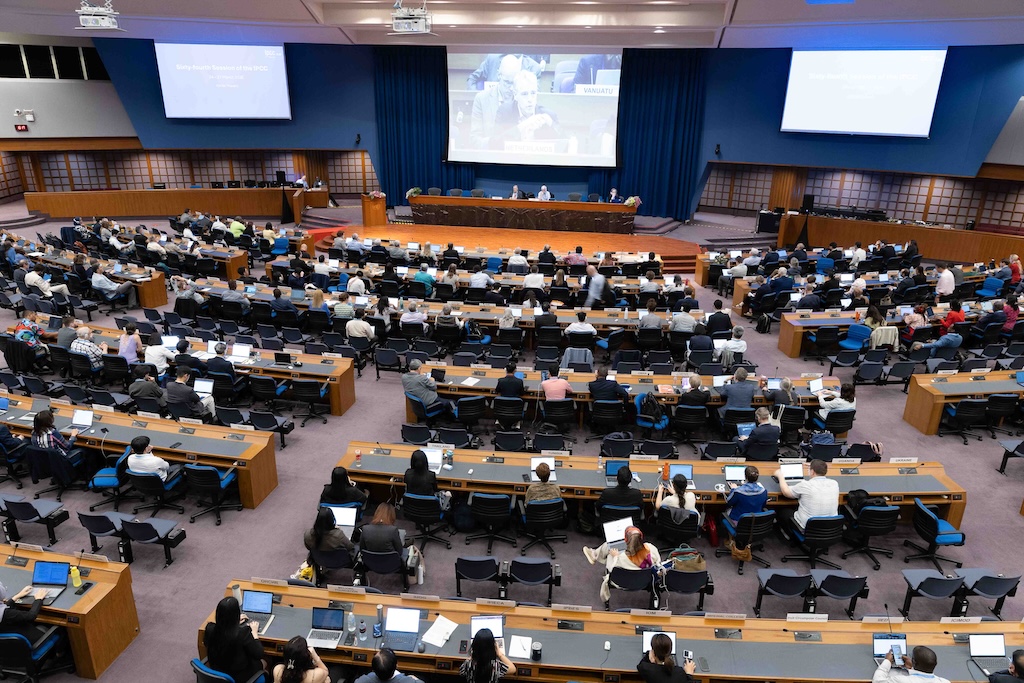
Last week, around 330 delegates from more than 100 countries met in Thailand for the 64th session (IPCC-64) of the UN’s climate science body.
The meeting, set against the backdrop of a global energy shock triggered by war in the Middle East, comes more than two-and-a-half years into the IPCC’s seventh assessment cycle (AR7).
There was disagreement on a range of issues, including the workplan for the cycle’s “working group” reports.
For five consecutive meetings, countries have failed to agree on whether the reports should be completed before, or after, the second “global stocktake” process under the UN Framework Convention on Climate Change (UNFCCC), due to culminate in 2028.
IPCC chair Prof Jim Skea tells Carbon Brief the “frustrating and disappointing” meeting delivered “minimal outcomes”.
“We made some formal decisions by consensus, but I would say they were more to postpone the decision making than they were to take decisions,” he says.
AR7 report timeline
As is typical for an IPCC assessment report cycle, AR7 will include three “working group” reports – on the physical science of climate change, impacts and adaptation, and mitigation. These will be summarised in a synthesis report.
Work is already underway on the three headline reports, as well as a special report on cities and climate change and methodology reports on carbon dioxide removal technologies and inventories for short-lived climate forcers.
However, countries are yet to reach an agreement as to when the three headline reports will be published, after deadlocked negotiations at meetings at Lima, Hangzhou, Sofia and Istanbul.
A coalition of developing and developed countries have backed a plan – proposed by the IPCC’s co-chairs – that would see the three reports published in 2028. This would enable their findings to feed into the second global stocktake, due to conclude that year at the COP33 conference.
The global stocktake is a five-yearly appraisal of global progress on tackling climate change that is designed to inform the national climate goals countries must submit to the UN under the Paris Agreement.
A separate group of countries, including China, India, Kenya, Russia and Saudi Arabia, have argued for a longer timeline on the grounds that developing nations need more time to review and approve the reports, according to reports from inside the meeting. This would mean some of the working group reports would be published after the second global stocktake is completed.
Dr Bill Hare, CEO and senior scientist at Climate Analytics, tells Carbon Brief that “the majority of countries, across geographies and levels of development, including least developed countries and small island developing states” support a timeline where the AR7 reports align with the stocktake.
Speaking during the opening session of IPCC-64, UNFCCC executive secretary Simon Steill said that 194 nations who attended COP30 in Belem last year had “emphasised the critical importance of the IPCC’s work in ensuring that the best available science feeds into the global stocktake”.
The timeline of the AR7 reports was not on a provisional agenda released ahead of the meeting.
However, the contentious issue was belatedly added to the agenda on the meeting’s first day, according to the Earth Negotiation Bulletin (ENB) reporting from inside the meeting.
This came after objections about the omission from a raft of countries, including Algeria, China, Egypt, Kenya, India, Russia, Saudi Arabia, South Africa and Venezuela.
According to the ENB, Saudi Arabia “insisted” the issue be included on the agenda and warned that deferring it to the next meeting “risked a scenario in which the budget would not be approved and further work would be delayed”.
In response to calls for clarification on why there was no formal agenda item on report timelines, IPCC AR7 chair Prof Jim Skea said the secretariat had “not detected the flexibility” among governments that could lead to its resolution, according to the ENB.
Skea thus proposed that “informal consultations” would be held in order to “identify the basis for any flexibility”. He also suggested the subject be discussed in a session earmarked for “any other business”.
This proposal was rejected by some delegations, who argued the issue required more formal treatment and said informal consultations might not be inclusive, the ENB says.
In the end, the IPCC agreed to add the item to the agenda and establish a contact group, co-chaired by Brazil and Canada, tasked with advising the IPCC on how to make progress.
Speaking to Carbon Brief, Skea explains that the secretariat did not put the issue on the agenda because it had “very low expectations about the success of such a discussion” and felt that more preparation was needed “to build the foundations for a decision” at a future meeting.
The last-minute addition of AR7 timelines to the agenda prompted some delegations to question the inclusivity of discussions. They noted that some countries had come without permission from their governments to discuss the issue, the ENB reports, whereas others with “limited resources” had decided to skip the meeting altogether.
This position was articulated at different stages of negotiations by Antigua and Barbuda, the Netherlands and Singapore in interventions supported by Canada, China, Cuba, Mexico, South Korea and Tanzania.
Climate Analytics’ Hare explains:
“The agenda item ‘progress with the timeline of AR7’ was added at the last minute upon pressure by countries including India and Saudi Arabia, in an attempt to introduce their own timelines into the process, which would push both WG2 and WG3 to 2029.
“As the AR7 timeline was not on the provisional agenda, many developing countries with resource and capacity constraints across the continent did not attend the session.”
One observer to the talks tells Carbon Brief that logistical issues prompted by the war in Iran had contributed to some countries’ decision not to attend.
‘Heated and polarised’
Discussions about the AR7 report timeline were focused on how to reach agreement by the IPCC’s next session.
A number of solutions were proposed, including for the IPCC secretariat to hold “informal conversations” between sessions to the creation of an “options paper” based on country submissions that would be presented at IPCC-65. Ultimately, all options ultimately failed to get the consensus required to be officially ratified by the IPCC.
On Thursday, the co-chairs of a contact group tasked with advising on how to progress with the timeline issue reported that “no consensus had been reached” and said there was a need for a “further exchange of views”, according to ENB.
Singapore subsequently suggested a plan for countries to formally submit views on the topic to the IPCC secretariat, which would then summarise submissions and present an “options report” for discussion at IPCC-65, says ENB. This would allow countries that were not prepared or not present at IPCC-64 to contribute, the country delegation said.
On the other hand, the Cook Islands said that “time is of the essence and further submissions from members should not be invited”, reports ENB. The country delegation also said the report timeline presented by co-chairs in Lima provided “sufficient time” for report reviews. This intervention was supported by Australia, Belize, Chile, Dominican Republic, Finland, Italy, Luxembourg, New Zealand, Norway, Palau, Panama, Samoa and Vanuatu.
Saudi Arabia repeated objections raised at previous meetings and said there was a need to address issues relating to overlaps in report scheduling, back-to-back reviews, inclusivity and capacity, as well as how the IPCC aligns with the UNFCCC processes, reports the ENB.
Instead, Saudi Arabia suggested that a later publication of working group reports in 2028 and 2029 would “provide sufficient intervals between IPCC sessions, time for developing countries to undertake their reviews and inclusive engagement”. This intervention was backed by Bahrain, Belarus, Kenya, Russia and Yemen, according to ENB.
As in previous IPCC sessions, there were diverging opinions around whether the IPCC needed to align report production with the global stocktake.
Some countries – including Bangladesh, Panama and South Korea, emphasised the need for the reports to align with the UNFCCC process.
The Netherlands, backing the plan for countries to submit their views ahead of IPCC-65, said delivery of AR7 reports after the global stocktake would “significantly lower” their policy relevance. The delegation noted that “never before” had the timeline given rise to such “heated and polarised debate”, according to the ENB.
Others – including Saudi Arabia, China and Russia – minimised the role of IPCC reports as an input into the stocktake, reports ENB.
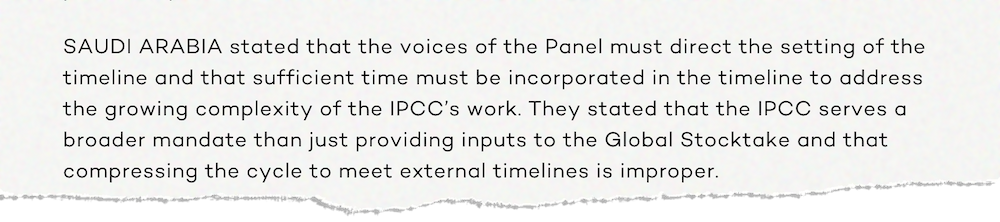


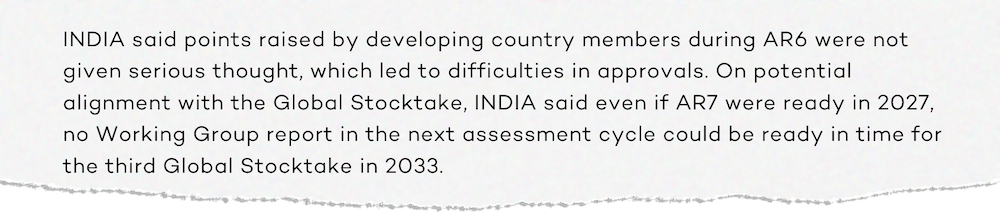
A selection of interventions by country delegations at the IPCC’s Bangkok meeting, as reported in the ENB’s meeting summary. ENB (2026).
A number of countries, including France, Haiti and Panama, stressed that the absence of several delegations from the Bangkok meeting, including many small-island states, made the discussions about the timeline less inclusive, according to ENB.
Skea tells Carbon Brief that none of the talking points raised by countries around AR7 reports were new:
“I didn’t hear any new arguments offered at this meeting.”
No decision
By close of play on Thursday, Skea presented a draft decision text which proposed that governments entrust the IPCC secretariat to develop an “options paper” that would be circulated ahead of IPCC-65, with a view to making a decision at the meeting.
India, Russia and Saudi Arabia said that they would prefer the creation of a “task group” that would produce a “compilation of views and proposals” on options for the timeline, according to the ENB. This would provide the “basis for further discussion” at IPCC-65.
Skea subsequently advised IPCC vice-chair Ladislaus Chang’a to form a huddle to find a middle ground between these two approaches.
On Friday, Chang’a presented a compromise solution where the IPCC chair and secretariat would “facilitate an exchange on the timeline with a view to reaching a decision at IPCC-65”, according to ENB. This would include overseeing a “task group” that would work between now and the next session.
This “draft decision” was backed by Brazil, China, India, Kenya, Russia and Saudi Arabia.
However, Belgium, Chile, Colombia, the Cook Islands, France, Italy, the Netherlands, Norway, Panama, Sweden and Switzerland said they could not support it, ENB says.
Antigua and Barbuda, the Cook Islands and a coalition of European nations instead suggested the chair hold “informal conversations” with governments over the coming months, with a view to coming to a timeline agreement at IPCC-65, says the ENB.
Skea subsequently proposed eliminating the reference to the task group in the decision text and to postpone all further deliberations on the timeline to IPCC-65.
This proposal faced opposition from a swathe of developing and emerging-economy countries, including Algeria, Angola, Azerbaijan, Bahrain, Botswana, Burundi, Cuba, Guinea, India, Iraq, Kenya, Libya, Libya, Russia, Tanzania, Tunisia, Turkmenistan and Venezuela.
At this juncture, a growing number of countries supported pressing ahead without a decision text, citing lack of consensus as the meeting clock was running down, notes ENB.
Among these countries was Canada. Its delegation noted there was little time left in the session – and that countries had heard “basically nothing” about the scientific work of the IPCC at the meeting, reports ENB.
Despite some last-hour calls from India and South Africa for previous proposals to be revisited, no agreement was reached and no decision issued.
Review of IPCC principles and procedures
Another issue discussed in Bangkok was a review of the IPCC’s principles and procedures, which inform how the panel goes about putting together its reports.
The principles and procedures came into force in 1998 and are meant to be reviewed every five years. However, the last review was delayed due to the Covid pandemic.
Opening the agenda item on the IPCC’s principles and procedures towards the beginning of the talks on Tuesday, IPCC officials laid out 12 topics that the IPCC bureau had prioritised for review, according to the ENB. These included:
- Author selection criteria
- Responsibility for author selection
- Chapter scientists
- Scope of literature/Indigenous knowledge and local knowledge. (See Carbon Brief’s recent report on considering Indigenous knowledge within the IPCC.)
- Selection criteria and responsibilities for review editors
- Terms of reference for the chair, vice chairs and working group co-chairs
- Terms of reference for technical support units
- Developing country engagement and broader finance concerns
- Carbon footprint and inclusivity
- Artificial intelligence
- Copyright
- Timing and guidance on conflict of interest
Skea told countries that, while the bureau’s input was meant to inform discussions, it was for them to decide if a review of the principles and procedures was needed and what topics should be covered.
In discussions that followed, some countries called for the review to focus on the inclusivity of global south countries, while others said the review should be “targeted”, “focused” and “completed within a set time frame” to allow the IPCC to make swift progress.
Noting countries’ differing views, Skea proposed a huddle to discuss whether a task force on the review should be created.
On Wednesday, countries once again set out their priorities for the review.
According to the ENB, many countries “prioritised copyright, conflict of interest procedures, AI, and ensuring inclusivity by supporting the participation of developing and least developed countries and incorporating Indigenous knowledge and local knowledge”.
Many also said the “principles and procedures are working well and supported a limited review that could be completed by IPCC-65, ahead of the report approval sessions starting in 2027”, the ENB says.
A small number of countries, including Saudi Arabia, India and Russia, called for the procedures to dictate that the timing of IPCC reports should be unaffected by “external factors”.
This could be interpreted as a reference to the push for the next IPCC assessment report to coincide with the next global stocktake – something that Saudi Arabia, India and Russia oppose.
Skea proposed the establishment of a contact group to try to take discussions forward, appointing Egypt and Ireland as co-chairs.
On Friday, the contact group co-chairs told the talks that they had found no agreement on whether to complete a review of the principles and procedures at these talks or at a future session.
Skea then presented a draft decision produced by the contact group co-chairs, which stated that the “IPCC’s principles and procedures are robust and have worked well” and expressed thanks to the bureau “for their work in preparing for a review of the principles and procedures”.
In response, Saudi Arabia said the draft “lacked a clear process and could be misleading”, with India adding that the “group had not reached agreement”, according to the ENB.
Colombia suggested “specifying that the review of principles and procedures had ended and would be considered again in 2031”, it continues.
This idea was opposed by Saudi Arabia, who said the “review has just begun”.
India, Kenya and Saudi Arabia also opposed language indicating the principles and procedures “have worked well and are robust”.
Norway “observed that lack of consensus could be interpreted to mean that no amendments of the principles and procedures were appropriate and the panel could consider the review complete”, according to the ENB.
Skea presented a slightly revised text for adoption, which was adopted without further discussion.
The text notes the “diversity of views expressed at the session” and “decides to consider the review of the IPCC principles and procedures at future sessions, as appropriate”.
The ENB notes that this outcome left countries confused, saying:
“Some countries saw lack of consensus as an indication that discussions on the issue are now complete, while others believe the review process has just begun.”
Approval of meeting summaries
In what could be viewed as a signifier of the high levels of disagreement between countries, the talks failed to approve the meeting reports from its past three sessions in Peru, China and Bulgaria.
(The approval of the reports from China and Bulgaria had already been shifted to this meeting after countries failed to agree to them at previous sessions.)
During discussions on Wednesday, many European countries, along with Panama, complained about a “lack of transparency” in the reports, according to the ENB.
They suggested that countries making interventions should be named in the reports and that the number of speakers showing their support or opposition to an issue should be included.
This idea was opposed by Saudi Arabia.
In response, Skea called for a huddle to convene to discuss the matter further.
On Friday, Skea noted that some countries had suggested that the “quality” of the report from the most recent meeting in Peru was higher than those from China and Bulgaria and suggested that countries adopt it.
Germany opposed this, expressing “openness” to further revisions of the report, in light of “diverging views” and a “lack of consensus in the room”, according to the ENB.
France requested that “past and future reports include everything that has been said by all delegates”, a view that was described as “unacceptable” by Saudi Arabia.
Skea said the lack of consensus from countries meant the issue would be deferred to the next IPCC meeting. This was reflected in a text adopted at the meeting.
Funding crunch
The IPCC receives funding from its parent organisations, the World Meteorological Organization (WMO) and UN Environment Programme (UNEP), in addition to voluntary contributions from its member governments and the UNFCCC. This money is held in a “trust fund”.
According to the IPCC, the trust fund “supports IPCC activities, in particular the participation of developing country experts in the IPCC, the organisation of meetings as well as publication and translation of IPCC reports”.
However, in her opening remarks at last week’s meeting, UNEP executive director Inger Andersen warned that “expenditures from the IPCC trust fund have exceeded contributions over the last few years”, according to the ENB. She added:
“If this continues, the trust fund’s cash balance will be depleted before the end of the seventh cycle, impacting both this cycle and the transition to the next.”
The IPCC secretariat presented nine different IPCC funding scenarios for 2026-29 to the delegates. These scenarios include three different future expenditure levels, ranging from a “business as usual” scenario to a “severe spending cuts” scenario, which would see “fully virtual operations with suspension of multiple activities”.
They combine these expenditure scenarios with three different contribution scenarios, including a scenario in which annual contributions match annual expenditure and another that is equivalent to 2025 expenditure.
These scenarios highlighted that the IPCC trust fund is “likely to be depleted soon without new and larger financial contributions, expenditure cuts, or both,, the ENB says. It continues:
“The message was clear: if contributions do not increase, significant cuts in operations and more efficient meeting formats will need to be implemented. Possible ways forward include reduced activities and the greater use of virtual meetings, which run counter to the needs voiced by many countries for inclusivity, equity and capacity.”
The ENB adds that “the timing of this situation is particularly difficult”, because the IPCC is moving into its “busiest and most difficult part” of the assessment cycle, when the initial draft of reports are being written and reviewed.
According to the ENB, “the pattern of contentious meetings may also increase costs, especially if the panel requires late night sessions or extended days to conclude its work”.
Skea tells Carbon Brief that he is “more confident” about the budget than the “mood music that came out of some of the reporting”. He notes:
“It is really only in the worst-case scenarios where you combine low levels of contributions with high levels of spend that you run into real difficulties during the [AR7] cycle.
“During the first Trump administration, other countries stepped in [with funds] and we are now seeing these signs as well.”
The ENB reports that “Sweden has committed to increasing its contribution by 150% and encouraged all countries to contribute financially or host plenary sessions”.
The IPCC did not publish an updated budget in the documents for the IPCC-64 meeting.
Working group updates
The co-chairs of the three AR7 working group reports (WG1, WG2 and WG3) also presented updates on progress.
All three working group reports highlight the first joint lead author meeting, which was held in Paris in December. The meeting brought together lead authors from all three working groups and saw a total of 650 attendees.
All working groups have also submitted “zero order drafts” – an initial draft text – of their reports to their respective technical support units.
Meanwhile, the World Climate Research Programme and IPCC co-sponsored a workshop on high-impact events and Earth system tipping points in Paris in November 2025.
Separately, the IPCC undertook an expert review of the first order draft of the “special report on climate change and cities” between October and December 2025.
The agenda for the Bangkok meeting also included a range of other items.
IPCC legal officer Jennifer Lew Schneider reported that there are currently 263 organisations with “observer status” to the IPCC, alongside 20 new applications.
IPCC vice-chair Diana Ürge-Vorsatz presented a progress report on an expert meeting on “gender, diversity, equity and Inclusivity”, which was held in September 2025.
The UNFCCC’s Annett Möhner presented a review of collaborations between the IPCC and UNFCCC. In its summary of the meeting, the ENB says:
“She described activities and outcomes from UNFCCC COP30 including decisions on the global mutirão, procedural and logistical elements of the global stocktake process, and the Belém gender action plan, as well as conclusions on research and systematic observation.”
Similarly, Simone Schiele – programme officer at the IPBES secretariat – noted outcomes of the IPBES-12 meeting held in February 2026, as well as ongoing IPBES work.
‘Frustrating and disappointing’
IPCC chair Skea tells Carbon Brief that, overall, the meeting delivered “minimal outcomes”. He says:
“It was a frustrating and disappointing meeting. It was only a business meeting – there was no science involved in it. The lack of progress was a frustration to me, sitting there, chairing it.”
The next meeting – IPCC-65 – will take place in Addis Ababa, Ethiopia, during the second week of October 2026.
During this session, delegates hope to finalise the timeline for the AR7 reports and approve the draft reports of the IPCC’s 61st, 62nd and 63rd sessions.
As such, the ENB notes that “intersessional work” will play an important role in preparing panel members for meetings at IPCC-65. This, it says, includes the “submission of proposals on the AR7 timeline and informal consultations with the chair to identify points of convergence and possible flexibility”.
Skea says the secretariat will be working between sessions “to figure out the process that will move [things] in the right direction”. He continues:
“One of the issues that we have to consider is that there has been, in my view, quite a loss of trust between different groups of countries. We do need to address the trust issue, as well as the technicalities of how the timeline is constructed.”

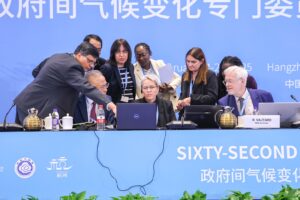
The post IPCC: ‘Frustrating and disappointing’ meeting leaves AR7 timeline in deadlock appeared first on Carbon Brief.
IPCC: ‘Frustrating and disappointing’ meeting leaves AR7 timeline in deadlock
A lack of money is hampering the work of the Intergovernmental Panel on Climate Change (IPCC) and a substantial funding boost is needed to ensure its scientists can complete their next set of flagship reports, the chair of the UN body has warned.
Funding from governments fell in 2024 and 2025 and the organisation could run out of money by 2028 unless it receives fresh funds or implements spending cuts, chair Jim Skea told an official meeting of IPCC scientists in Bangkok last week, according to the Earth Negotiations Bulletin (ENB), which provides coverage of UN negotiations.
Skea told the IPCC’s 64th session that without a substantial increase in contributions, the completion of the next set of reports, known as AR7, would be jeopardised.
To deal with this crisis, the IPCC is now considering cutting costs by holding meetings virtually, reducing staff travel, media training, recruitment, pay and website upgrades and cutting down on the editing, translating and printing of its reports, according to scenarios prepared by the IPCC secretariat.
-
Countries fail again to decide timing of key IPCC climate science reports
China, Saudi Arabia and India pushed back against a proposal to align the IPCC flagship reports with the timeline of the global stocktake of climate action -
Green Climate Fund picks locations for five developing country hubs
The UN’s climate fund says new offices will boost developing nations’ access to climate finance as board accredits first Palestinian entity for direct access to funds -
Major oil producers among 46 nations joining fossil fuel phase-out summit
Canada, Australia, Brazil and Norway are set to attend the Santa Marta summit, but the world’s biggest fossil fuel producers are missing from the list


Nepal’s representative Manjeet Dhakal told Climate Home News he was concerned about the situation, while the ENB report said Japan’s government had called the funding crunch alarming.
While South Korea and Sweden announced increased funding, the European Union – a major funder – cautioned against assuming past contributors will continue to give the same amounts, ENB reported.
No end to row over reports’ timing
The five AR7 reports, which will assess how the climate is changing, how to adapt, how to cut emissions, a synthesis report and a special report on climate change and cities – are further threatened by a long-running disagreement over when they should be completed.
While some countries want them finished by 2028, so they can feed into the UN climate process’s five-yearly global stocktake, others say this is too rushed and want to stick to the IPCC’s usual seven-year cycle, meaning reports would be finished by 2030.
Despite not being on the initial agenda, this issue dominated much of the scientists’ time in Bangkok. With time running out as delegates flew home, the meeting was unable to agree even on a plan to reach agreement by the next meeting in October 2026, ENB said.
Delegates also failed to agree to approve reports of previous meetings, after arguing over transparency, and were divided on how to respond to a scientific conference on climate tipping points.
Funding cuts
To fund its work, the IPCC relies on voluntary funding from governments. Most of the money is spent funding the participation of scientists from developing countries, the IPCC says.
But a report prepared by the IPCC secretariat for the Bangkok meeting said that “in recent years, the IPCC’s financial situation has come under strain, including amid current geopolitical challenges”.
It did not mention any governments, but reduced US funding has had a major impact, the IPCC’s financial documents show.
During Joe Biden’s presidency, the US gave the IPCC an average of $1.7 million a year, but President Donald Trump announced he would end US support and the latest data shows the US contributed no money in the first half of 2025.
The IPCC spent more money than it received in 2024 and the shortfall grew in 2025, prompting the raft of cost-cutting proposals – from switching to online meetings to cutting budgets for translating reports.
Further cost savings could be achieved, the IPCC said, by suspending IPCC travel to outreach events, freezing non-essential updates to the IPCC’s website, not creating any new staff positions until at least 2029 and no longer providing media training for the IPCC’s scientists.
Richard Klein, a scientist who has been involved in the IPCC since 1994, told Climate Home News there was “a growing discrepancy between the ambition of the IPCC and what is feasible given the budget”.
“In the end it means more pressure on authors who are already volunteering their time, and quite possibly less inclusivity of experts from developing countries,” he said.
Nepal’s Dhakal, who advises the Least Developed Countries group, called on governments to give more money to the IPCC and for the IPCC secretariat to “explore options to reduce costs without compromising inclusivity, particularly for small delegations and those with limited capacity to engage”.
Bitter divides on timeline
Since January 2024, delegates to IPCC meetings have been arguing over when the deadline for the AR7 reports should be. Delegations including Saudi Arabia and India have opposed attempts to ensure that the reports are published by 2028, in time to inform the second global stocktake.
The issue was not included on the Bangkok meeting’s formal draft agenda, with ENB reporting that Skea said this was because he did not think delegations had shown enough flexibility to be able to resolve it.
After pressure from Saudi Arabia, India and several others, the issue was added to the agenda despite delegations complaining that their governments had not authorised them to discuss it and that many countries were not represented at the meeting.
But, after four days, delegates were unable to even agree on a plan on how to reach agreement by the next meeting in October. Nepal’s Dhakal said he was “concerned with the lack of agreement on delivering the full AR7 package by 2028 to inform the second global stocktake”.

France’s Environment Ministry said in a statement that it had “deep concern at attempts to slow down and arbitrarily delay the publication schedule for the reports”.
Klein said that, while scientists are continuing their work on these reports, the likelihood of them being finalised before the second global stocktake “diminishes with every delay in making a decision”.
Transparency and tipping points
Delegates were also divided on the usually-routine issue of approving the summaries, prepared by the IPCC secretariat, of previous meetings.
According to ENB, France, Germany and Belgium wanted reports to specify speakers’ names. While France said reports should include everything that has been said by all delegates, Saudi Arabia responded that this would be unacceptable. The issue was deferred to the next meeting in October.
Saudi Arabia and India also objected to a reference in a report to a workshop that took place at Paris’s Sorbonne University in November on “tipping points and their consequences”. They argued that the concept of tipping points, which are thresholds beyond which the Earth’s climate changes suddenly, was contentious at the IPCC, ENB reported.
While journalists are not allowed to observe IPCC sessions, staff from ENB – which is an arm of the IISD think tank – are allowed to watch sessions and report on what is said.
The post Funding gap threatens next round of IPCC climate science reports, chair warns appeared first on Climate Home News.
Funding gap threatens next round of IPCC climate science reports, chair warns
Business has never been as brisk for Nigerian solar panel retailer Samuel Okechukwu and his team of installation technicians, who are struggling to keep up with orders since the Iran war caused local fuel prices to double.
“There’s too much work, I’m even having to outsource some services to keep up with the work rate,” Okechukwu told Climate Home News, as he installed solar panels on the roof of an apartment building in the southern city of Port Harcourt.
Before the war, he had installations once or twice a week, but is now busy almost every day.
Okechukwu’s surge in orders in recent weeks suggests that more Nigerians are buying solar systems due to soaring fuel prices caused by the conflict in the Middle East, which has effectively blocked the Strait of Hormuz through which a fifth of the world’s oil and liquefied natural gas previously flowed.
-
Africa records fastest-ever solar growth, as installations jump in 2025
Africa’s solar power installations have increased sharply, driven by utility-scale projects and privately financed rooftop and commercial systems -
Boom in solar panel imports boosts hopes for clean energy take-off in Africa
Africa’s solar imports from China jumped 60% in the 12 months to June 2025, reaching an all-time high -
Ugandan farmers use British court to try to stop East Africa oil pipeline
The farmers and their lawyers will argue that a UK-based entity linked to the East African Crude Oil Pipeline has breached Ugandan law and construction should halt


Plagued by frequent failures on Nigeria’s national grid, many homes and businesses buy diesel and petrol to supply generators to keep the lights on and equipment operating.
Even before the latest fuel price shock, solar installations had been increasing in Nigeria in recent years as an alternative to generators among those able to afford the initial outlay.
It costs about 600,000 naira ($450) to buy just one inverter battery and two 300-watt solar panels to charge it – roughly 10 times the minimum monthly wage – and eyebrows were raised when the government announced last year that the presidential villa was being kitted out with a $6 million solar mini-grid.
Power plants hit by gas shortages
Nigeria’s erratic power supplies have become even more unreliable in recent weeks as gas shortages constrain already fragile power generation. Most of Nigeria’s electricity supply comes from gas-fired plants.

Last month, the Nigerian Independent System Operator said several of the oil- and gas-producing nation’s thermal power plants were being affected by “persistent gas supply constraints” that were causing a decline in electricity generation.
While Nigeria has abundant gas reserves, the shortages are largely driven by structural issues, including mounting government debts owed to gas suppliers and pipeline constraints. Power Minister Adebayo Adelabu said last week that gas suppliers are prioritising export markets which have become more attractive and offer better returns over domestic markets.
This week, the Nigerian government increased gas prices for power generation companies, a move likely to deepen cost pressures in the electricity sector already struggling with debt and supply shortages.
At the same time, Okechukwu said rising temperatures in recent years were also increasing demand for an affordable source of electricity to power air conditioners.
Global oil shock makes case for renewables
Installations of solar power in Africa jumped 54% in 2025, according to a report by the Global Solar Council (GSC), marking the fastest annual growth on record.
The continent’s solar power capacity still represents only about 1% of the world’s total, though industry experts say the continent may have significantly more than official data reflects, with many rooftop installations going uncounted.
Precarious power supplies are already a key driver of solar adoption in many African nations, propelling fast growth rates in countries including Nigeria, which was Africa’s second-largest solar installer last year, installing more than 800 MW of capacity, according to the GSC, a nonprofit trade body.

Surging energy costs due to the Iran war could give further momentum to growth, the GSC’s CEO Sonia Dunlop told Climate Home News.
“It’s clear the people of Nigeria saw the writing on the wall … and have gone all in on rooftop solar as a result,” Dunlop said.
The increase in energy prices since the conflict began have cost consumers and businesses around the world more than $100 billion, according to a March 2026 analysis by 350.org, a non-profit organisation.
It said that would be enough to build sufficient solar capacity to supply about 150 million people in lower-consumption countries, for example in Africa, adding that investing in renewables was the best way to stabilise prices and strengthen energy security.
Anne Jellema, 350.org’s CEO, urged governments meeting in Colombia next month to discuss the transition away from oil and gas to “seize this moment to adopt binding targets to phase out fossil fuels and ramp up investment in a clean, safe energy future”.
Africa records fastest-ever solar growth, as installations jump in 2025
The global energy shock unleashed by the U.S.-Israeli war “definitely supports the case for longer-term mitigation, not being reliant on imported oil”, said Karl Boyce, CEO of ARC Power, a mini-grid developer operating in Africa, adding that securing sufficient investment would be crucial to realising Africa’s renewables potential.
“It’s so reliant on really heavy investment,” Boyce said. “So globally, there should be a focus on seeing how more investment can go into that sector just to give more stability in the longer term.”

“Forget about buying petrol”
In Port Harcourt, another solar trader, Sunday Onuchukwu, said his business has been “moving faster than before” as people get tired of power cuts and rising fuel costs that make investing in panels seem a better bet.
Located in a solar panels retail market, Onuchukwu’s shop was busy with customers, but the market itself was unusually quiet – without the usual whirr of generators thanks to the solar panels on the roof.
“Most of my customers complain that the fuel issue is one reason why they have decided to go solar. I have clients who transition both their offices and homes at the same time and move away from the bad power supply,” Onuchukwu told Climate Home News.
He said many businesses spend more than 20,000 naira ($15) per day on petrol to power generators.
Green Climate Fund picks locations for five developing country hubs
“With that money, calculated over a one-year period, you can install solar and forget about ever buying petrol,” he said, adding that some lower-cost solar products were now becoming available such as a 50,000-naira ($36) kit that provides enough power to light a single bulb and charge a mobile phone.

Lifting two heavy panels onto his head in Onuchukwu’s shop, one customer said ensuring a steady supply of power – after months without mains supplies – was vital for his barber shop and would also help his wife’s small business.
“This is what I am using to run my business and ensure electricity,” the man said, giving his family name as Amadi.
“With these two panels, I can also power my wife’s inverter freezer for her to be selling frozen foods.”
The post Nigerians bet on solar as global oil shock hits wallets and power supplies appeared first on Climate Home News.
Nigerians bet on solar as global oil shock hits wallets and power supplies


IPCC: ‘Frustrating and disappointing’ meeting leaves AR7 timeline in deadlock
Texas-Based EnergyX’s Project Lonestar™ Signals a Turning Point for U.S. Lithium Supply
Canada Doles Out Almost C$29M for CCUS and Renewables as Clean Energy Market Surges
-
Climate Change8 months ago
Guest post: Why China is still building new coal – and when it might stop
-
Greenhouse Gases8 months ago
Guest post: Why China is still building new coal – and when it might stop
-

 Greenhouse Gases2 years ago
嘉宾来稿:满足中国增长的用电需求 光伏加储能“比新建煤电更实惠”
-
Climate Change2 years ago
Bill Discounting Climate Change in Florida’s Energy Policy Awaits DeSantis’ Approval
-

 Climate Change2 years ago
嘉宾来稿:满足中国增长的用电需求 光伏加储能“比新建煤电更实惠”
-
Climate Change Videos2 years ago
The toxic gas flares fuelling Nigeria’s climate change – BBC News
-

 Renewable Energy5 months ago
Sending Progressive Philanthropist George Soros to Prison?
-

 Carbon Footprint2 years ago
US SEC’s Climate Disclosure Rules Spur Renewed Interest in Carbon Credits