Connect with us

Published

on

AI

In January, President Donald Trump signed an executive order titled “Removing Barriers to American Leadership in Artificial Intelligence.” The goal was to maintain and expand America’s edge in AI technology to enhance national security, economic power, and human development.

Following up on that directive, the White House released “Winning the AI Race: America’s AI Action Plan” on July 23. The strategy aims to place the U.S. at the forefront of global AI development by fast-tracking infrastructure, encouraging innovation, and promoting international cooperation. Officials called it a transformative roadmap to power a new era of American technological dominance.

Key Highlights of America’s AI Action Plan

The plan outlines over 90 policy actions centered around three core areas:

  1. Accelerating innovation
  2. Building strong AI infrastructure
  3. Leading global AI diplomacy and security

White House Science and Technology Policy Director Michael Kratsios said,

 “America’s AI Action Plan charts a decisive course to cement U.S. dominance in artificial intelligence. President Trump has prioritized AI as a cornerstone of American innovation, powering a new age of American leadership in science, technology, and global influence. This plan galvanizes Federal efforts to turbocharge our innovation capacity, build cutting-edge infrastructure, and lead globally, ensuring that American workers and families thrive in the AI era. We are moving with urgency to make this vision a reality.” 

Several major actions were outlined in the strategy:

  • Exporting AI Technology: The U.S. Commerce and State Departments will work with industry leaders to export complete AI solutions—including hardware, software, and standards—to trusted allies.
  • Faster Buildout of Data Centers: The government plans to speed up the permit process for building data centers and chip factories. It will also support workforce development in trades like electrical and HVAC services.
  • Regulatory Reform: The administration will eliminate or ease federal rules that slow AI progress. Businesses will be asked to share feedback on outdated regulations that should be scrapped.
  • Safeguarding Free Speech: New guidelines for government AI contracts will require that language models are free from political bias and allow open discourse.

Relaxed Environmental Rules Raise Red Flags

The plan includes fast-tracking environmental permits under the National Environmental Policy Act to ease the construction of large data centers. This also involves rolling back rules from the Clean Air Act and Clean Water Act. In return, data centers must promise to invest at least $500 million per site.

Federal agencies have also been asked to offer up government-owned land for building both data centers and their supporting energy infrastructure. These moves aim to speed up construction but have raised concerns about environmental oversight.

The Department of Energy announced four government sites where private companies will partner to build new AI data centers and power facilities. Energy Secretary Chris Wright called it “a bold step” and compared it to launching a new Manhattan Project.

Global Data Center Energy Use Set to Soar

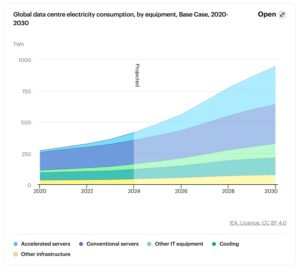
AI needs a lot of electricity to power advanced servers, cooling systems, and data management. The International Energy Agency (IEA) warned that global electricity use from data centers could double by 2030, reaching more than Japan’s current energy demand.

By 2030, it could reach about 945 TWh, which is nearly 3% of total global demand.

  • From 2024 to 2030, data center electricity use is projected to grow 15% each year—four times faster than other sectors.

Notably, all data center types, enterprise, colocation, and hyperscale, contribute to this rise.
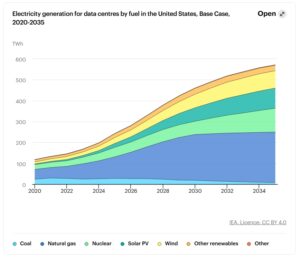
U.S. data center demand

The U.S. AI Infrastructure Demands Massive Power

Talking about the U.S., a report revealed that data centers and AI platforms used 4% of the nation’s electricity in 2023. The electricity use has remained steady for 20 years, but the rise of AI will likely push total demand up by 9% by 2028 and 20% by 2033.

Much of this power may come from fossil fuels like coal and natural gas, which release greenhouse gases such as carbon dioxide and methane. This could worsen global warming and increase extreme weather events.

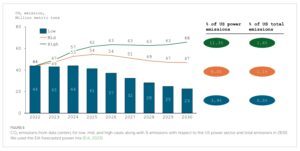
  • This surge in electricity use could lead to greenhouse gas emissions equal to 40% of the U.S.’s current annual emissions. This amount is the same as emissions coming from 540 million gasoline-powered cars.
us data center emissions
Source: IEA

Chart: CO2 emissions from data centers for low, mid, and high cases, along with % emissions concerning the US power sector and total emissions in 2030.
US Data center emissions
Source: Frontiers

Additionally, AI data centers require large amounts of water for cooling, putting stress on water supplies in already dry regions.

Why is AI so energy-hungry?

GPUs used in AI are much more power-intensive than standard chips. Even a single ChatGPT query uses nearly 10 times the power of a Google search. Creating AI-generated images takes thousands of times more electricity than generating text.

  • In 2024, ChatGPT alone used over 500,000 kilowatt-hours of electricity daily, which is equal to the power used by 180,000 U.S. homes.
  • A single Meta data center consumes as much power as 7 million laptops running eight hours a day.
  • In Santa Clara, California, 50 data centers use 60% of the city’s electricity, often paying lower rates than residents.
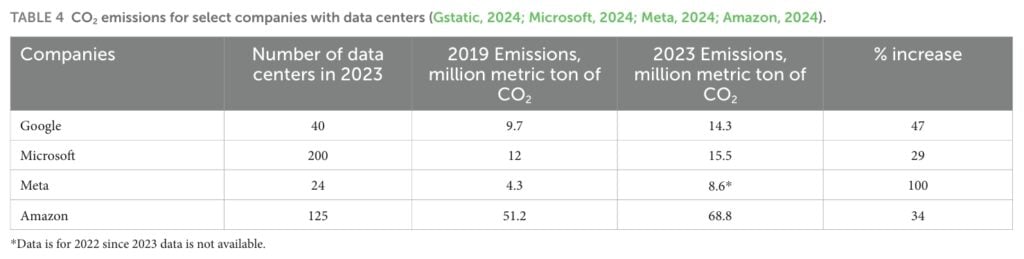
big tech AI emission
Source: Frontiers

How Big Techs Are Responding to Trump’s AI Policy?

To keep up with rising energy demands, many tech companies are relying on existing power plants. In the U.S., most of these still use fossil fuels, especially natural gas. While some areas are adding renewables and battery storage, nuclear energy is gaining attention as a cleaner, steadier power source.

To begin with, Nvidia CEO Jensen Huang said,

 “America’s unique advantage that no country could possibly have is President Trump.”

Meanwhile, OpenAI and Oracle announced progress on their massive “Stargate” project. The $500 billion effort aims to create a national AI infrastructure network. The companies revealed they are developing 4.5 gigawatts of new data center capacity, more than twice the power used in San Francisco. While specific energy sources weren’t mentioned, one site in Abilene, Texas, is already up and running. The rest of the project will be rolled out in phases over the next four years.

With demand from AI and cloud services growing fast, nuclear energy is becoming a key part of the tech industry’s strategy to ensure reliable, low-carbon power.

AI Is the New Arsenal—And America Must Win

Even though critics stress the need for updated energy policies and better efficiency standards, Trump stays undeterred. He is clean on his stance. America has to dominate the artificial intelligence space.

And Secretary of State and Acting National Security Advisor, Marco Rubio, also vouches for this vision. He noted,

“Winning the AI Race is non-negotiable. America must continue to be the dominant force in artificial intelligence to promote prosperity and protect our economic and national security. President Trump recognized this at the beginning of his administration and took decisive action by commissioning this AI Action Plan. These clear-cut policy goals set expectations for the Federal Government to ensure America sets the technological gold standard worldwide, and that the world continues to run on American technology.”

The post Trump’s Most Ambitious AI Plan to Lead America in the Global Data Center Race appeared first on Carbon Credits.

Continue Reading

Carbon Footprint

Climate-Linked Supply Chain Risk Is Already in Your P&L

Published

on

The earnings calls that quietly reframed climate from sustainability question to operating risk.

Three earnings calls in the last 18 months tell the story without any help from a press release.

Hershey, May 2024: cocoa price exposure compresses margin, and the company attributes part of the cost shock to West African weather. Olam, July 2024: coffee climate exposure quantified in the annual report. JBS, January 2025: supply chain climate disclosures expanded materially in response to investor pressure and regulatory expectation. None of these companies issued the announcement as climate news. They issued it as financial news. The climate-linked supply chain risk did not arrive with a sustainability framing; it arrived as a P&L line.

You are probably reading this article because you suspect the same thing is happening to your business. This piece walks through what is showing up on which earnings calls, how procurement and finance leaders are quantifying the exposure, and what serious corporates are doing about it before the regulator asks.

Where climate risk has already appeared in earnings

The pattern is consistent across resource-intensive sectors. A weather event compresses supply, the price spikes, the cost flows through the income statement, and the analyst on the call asks whether the event is anomalous or structural. Increasingly, the honest answer is the second one.

Cocoa is the cleanest example. The 2023 to 2024 West African harvest fell sharply on the back of erratic rainfall and disease. Cocoa futures more than tripled. Companies with concentrated West African sourcing absorbed the cost; companies with diversified sourcing absorbed less. The exposure was not climate as ESG topic. It was climate as cost of goods.

Coffee follows the same pattern. Brazilian and Vietnamese harvests have moved on weather more sharply across the last several seasons. Roasters with long-tenor supplier relationships and origin diversification have managed the volatility; roasters with spot-market exposure have not. Wheat, sugar, palm oil, beef: the same dynamic in different commodities, a pattern the IPCC AR6 Working Group II report projects will intensify across agricultural systems through mid-century.

What this means: climate risk is no longer a footnote in the 10-K. It is a line item the CFO has to explain on the call.

The three commodity exposures that hit margin first

For most companies with material Scope 3 exposure, three exposures dominate the near-term P&L risk.

  • Concentrated single-origin sourcing in a climate-vulnerable region. If your tier-one supply for any material commodity sits in one geography, you have a concentration risk that climate amplifies. Diversification across origins is the obvious hedge, but it takes years to build and requires relationships you cannot acquire by tender.
  • Supplier financial fragility under climate stress. Smallholder farmers, who supply a large share of the global cocoa, coffee, and palm oil market, do not carry the balance sheets to absorb yield shocks. When yields collapse, they exit. When they exit, your supply base shrinks, and the surviving suppliers raise prices. The risk is structural, not cyclical.
  • Logistics and storage exposure to extreme weather. Hurricane disruptions to Gulf shipping, drought-driven Panama Canal restrictions, flooding in European inland waterways: each of these has moved input costs in the last three years, a pattern documented in Munich Re’s natural catastrophe data. The exposure shows up as a one-quarter event in the financial press but accumulates over time on the cost line.

TCFD and ISSB disclosure changes

The disclosure architecture has now caught up with the risk. The Task Force on Climate-related Financial Disclosures, whose recommendations are now embedded in the ISSB’s IFRS S2 climate standard, requires companies to disclose climate-related risks across physical and transition categories, with quantification where possible.

For physical risk specifically (the climate-linked supply chain risk you are reading about), the disclosure must address both acute exposures (extreme weather events) and chronic exposures (gradual changes in temperature, precipitation, and growing seasons). The disclosure must address the time horizon over which the risk is material, the parts of the value chain exposed, and the financial impact under different scenarios.

The CSRD imposes similar requirements under European law, with double materiality (both financial and impact materiality) embedded in the assessment. The practical effect: your auditors and your investor relations team now need a defensible answer to the climate-linked supply chain risk question, and the answer needs to be quantified.

What procurement and finance can do now

Three actions matter near-term.

Map your exposure. Most companies do not have a clear view of which tier-one and tier-two suppliers sit in which climate-vulnerable geographies. Without the map, you cannot quantify the risk, and without the quantification, you cannot disclose it credibly. The map is the foundation, and World Resources Institute climate risk research provides useful public tooling to start.

Diversify and deepen, in that order. Diversification across origins reduces concentration risk, but the deeper move is to invest in the resilience of the suppliers you already have. Regenerative practices, agroforestry, soil health interventions: these reduce yield volatility under climate stress and protect your input cost trajectory.

Embed the climate spend inside procurement, not outside it. Treating climate risk as a sustainability cost line subordinates it to the ESG budget. Treating it as a procurement and resilience investment puts it in the budget that matters, which is the cost-of-goods budget that the CFO defends quarterly.

Nature-based supply chain investments are the asset class designed for exactly this purpose. They sit inside the value chain, they reduce climate-linked supply risk, they generate verifiable Scope 3 reductions, and they produce the documentation an auditor and a regulator can both test.

If you are quantifying climate-linked supply chain risk in advance of the next earnings cycle or the next disclosure period, the carbon and sustainability experts at Carbon Credit Capital can help you map your exposure and structure a Dual-Value Model response that addresses reduction, resilience, and disclosure-readiness in a single program. Schedule a consultation.

Continue Reading

Carbon Footprint

Where should an SME start with a carbon action plan?

Published

on

More and more small and medium-sized businesses are hearing the same question from their larger customers: What is your carbon footprint? That question now travels down entire supply chains, and it arrives next to tender requirements, certification criteria, and rising customer expectations.

Continue Reading

Carbon Footprint

Insetting vs Offsetting: Which Actually Counts Toward Your Scope 3 Targets

Published

on

The accounting differences that decide whether your nature investment shows up in inventory, in BVCM, or nowhere at all.

The question reaches a procurement team about three weeks before the next sustainability committee meeting. Someone has read about insetting. Someone else has just signed off on an offset purchase. The CSO wants to know if the two are interchangeable. The answer is no, and the GHG Protocol Land Sector and Removals Standard is the reason why.

This article walks through what each term means at audit-grade specificity, what the standards actually say about how each gets counted, and how to decide which tool fits which target. The insetting vs offsetting question is one of the most-searched in corporate climate strategy, and one of the most poorly answered. By the end of this piece, you should be able to brief a committee on the difference without notes.

The two definitions, in plain English

Offsetting means buying carbon credits generated outside your value chain and retiring them against your residual emissions. The reduction happens somewhere else, financed by you, and the credit is the receipt.

Insetting means investing in emission reductions or removals inside your own value chain, typically with suppliers, where the reduction is directly linked to the products and services you buy. The reduction happens inside the boundary of your Scope 3 inventory, and the accounting treatment is fundamentally different.

The shorthand from the University of Oxford’s Nature-based Insetting Initiative is useful: insetting is what you do with the supply chain you have; offsetting is what you do with the supply chain you do not have.

What the GHG Protocol Land Sector Standard actually says

The GHG Protocol Land Sector and Removals Standard, finalised in 2024 after a multi-year pilot, sets the rules for how land-based emission reductions and removals enter corporate inventories. The Standard distinguishes between inventory accounting (Scope 1, 2, and 3) and project or intervention accounting (a separate methodology for crediting).

For insetting, the practical implication is that supplier-level interventions, when properly measured and attributed, can reduce your Scope 3 category 1 (purchased goods and services) emissions in your inventory. The reduction is not a credit retired against the inventory; it is a lower inventory number, period.

For offsetting, the credit is retired separately. It can be reported as a contribution toward a net-zero claim under the SBTi Beyond Value Chain Mitigation framework or as part of a VCMI Carbon Integrity claim, but it does not lower the inventory number.

A practical consequence: if your Science Based Target requires a 50% absolute reduction in Scope 3 emissions by 2030, insetting moves you toward the target. Offsetting does not. This single point of difference reshapes the procurement decision.

When insetting counts toward Scope 3 (and when it does not)

Insetting counts toward Scope 3 only when several conditions are met:

  • The intervention must occur with an entity in your value chain.
  • The emissions reduction or removal must be measured against a defensible baseline.
  • The reduction must be attributed to your share of that supplier’s output, not double-counted with other buyers.
  • It must follow the inventory accounting rules in the GHG Protocol Land Sector Standard, not the project accounting rules used to generate credits.

The most common failure mode is double counting. If your supplier sells the same reduction as a credit on the voluntary market and also reports it to you as a Scope 3 reduction, the math breaks. The Standard requires you to address this risk, typically by purchasing and retiring the supplier-issued credit as part of your inventory or by contractual provisions that prevent the supplier from selling the reduction twice.

When insetting does not count toward Scope 3: when the intervention sits with a supplier you do not buy from, when the baseline is not defensible, when the attribution is unclear, or when the documentation does not survive audit. Those cases default to Beyond Value Chain Mitigation, which is still useful but operates on a different ledger.

The procurement and supplier engagement question

Insetting is harder than offsetting. That is the unfashionable truth most buyers eventually confront. Offsetting is a transaction; insetting is a relationship.

To run an insetting program, you need supplier mapping precise enough to know which farms or facilities sit at which Scope 3 boundary. You need an engagement model that gets suppliers to participate, which usually requires multi-year commitments and shared economics. You need an MRV architecture that measures the right things and produces audit-ready documentation. And you need a contractual structure that prevents double counting and protects both sides.

The trade-off you receive in return is significant. Reductions count against your inventory rather than your residual. Supplier relationships deepen, which protects sourcing continuity. Yield and quality improvements often follow regenerative interventions, which reduces your input cost over time. And the regulatory file, under CSRD, CSDDD, EUDR, and the SBTi FLAG Guidance, is materially stronger.

Choosing the right tool for the right target

A practical decision rule. If your target is a science-based Scope 3 reduction and you operate in a FLAG sector or source FLAG commodities, insetting is the structurally correct tool. If your target is a net-zero claim that includes neutralising hard-to-abate residual emissions outside your value chain, BVCM via high-integrity offsets is the structurally correct tool. Most companies with material Scope 3 exposure need both, in different proportions, sequenced over time.

The sequencing matters. Insetting takes longer to stand up but produces a permanent reduction in the inventory. Offsetting can be transacted faster but does not change the inventory and now sits under tighter claim restrictions. Treat them as complementary tools with different jobs, not as substitutes. The Accountability Framework Initiative and the IUCN Global Standard for Nature-based Solutions both provide useful guardrails for the insetting side, with biodiversity, human rights, and benefit-sharing requirements that go beyond carbon math.

If you are mapping a Scope 3 reduction roadmap and need to scope which interventions count toward your inventory versus which sit in Beyond Value Chain Mitigation, the carbon and sustainability experts at Carbon Credit Capital can help you structure a nature-based supply chain investment program that fits your FLAG exposure, your target architecture, and your audit horizon. Schedule a consultation.

Continue Reading

Trending

Copyright © 2022 BreakingClimateChange.com

