Connect with us

Published

on

President Donald Trump’s move on Thursday to kickstart deep-sea mining could be a lifeline for the Canadian company that is pushing to be the first to supply strategic minerals from the ocean floor.

The firm signalled its intention weeks ago to seek permits from the US administration for the activity in a challenge to UN governance, but whether the gambit pays off remains to be seen. The plan faces strong opposition from many countries and scientists who fear the industry could have catastrophic effects on the ocean ecosystem.

Years of deadlock in global efforts to agree rules for commercial mining of the ocean floor had been straining the finances and patience of the Vancouver-based The Metals Company (TMC) – one of the most prominent among a clutch of aspiring deep-sea mining companies.

Then, in an abrupt shift in company policy, TMC Chief Executive Gerard Barron said in a statement at the end of March that it was time to bypass the International Seabed Authority (ISA) – the little-known UN body created by the United Nations Convention on the Law of the Sea (UNCLOS).

“What we need is a fair hearing and a regulator willing to engage,” said Barron, going on to accuse various actors at the ISA of acting in “bad faith” by obstructing the completion of a mining code.

“Looking back at our 16-year experience of the ISA brand of multilateralism, we believe the United States made the right decision when they chose not to ratify UNCLOS,” Barron said.

Trump tries to upend international order

The company’s share price – which has struggled since it listed in 2021 – jumped this week after Trump signed an executive order calling for deep-sea mining, including beyond US territorial waters, in a bid to secure critical minerals like nickel, cobalt and copper and counter China’s dominance in the sector.

“Vast offshore seabed areas hold critical minerals and energy resources,” Trump said in the order. “These resources are key to strengthening our economy, securing our energy future, and reducing dependence on foreign suppliers for critical minerals.”

Xi commits China to full climate plan but emissions-cutting ambition still unclear

He directed his administration to expedite the issue of mining permits under the Deep Seabed Hard Mineral Resource Act (DSHMRA), a piece of largely untested legislation dating back to 1980 before UNCLOS existed.

Following Trump’s announcement, TMC’s Barron said that “with a stable, transparent, and enforceable regulatory pathway available under existing US law, we look forward to delivering the world’s first commercial nodule project – responsibly and economically”.

Financial lifeline

Crucially, the step could give TMC some financial breathing space.

“They have had very little money, and a lot of debt, for a long time,” Bobbi-Jo Dobush, a US.-based environmental attorney, told Climate Home before Trump’s order was signed on Thursday.

TMC made a net loss of over $81 million last year, with a total deficit of $631 million piled up since it began operating. According to its latest annual accounts, the company had only $3.5 million in the bank at the end of 2024 and access to a potential $41.5 million loan offered by its main investors, Silicon Valley financier Andrei Karkar and Gerard Barron himself.

A company spokesperson declined to comment on its financial position.

The wider deep-sea mining industry has been in choppy financial waters due to persistent uncertainty over its viability. Norwegian company Loke Marine Minerals filed for bankruptcy earlier this month after a long search for additional capital from investors proved unsuccessful, its CEO Walter Sognnes was quoted as telling Norwegian newspaper DN.

International backlash

The ISA has under its supervision huge swathes of the Pacific Ocean beyond national jurisdictions that hold the world’s largest reserves of polymetallic nodules – potato-sized rocks packed with minerals that have a multitude of industrial uses – from weapons to clean energy technology.
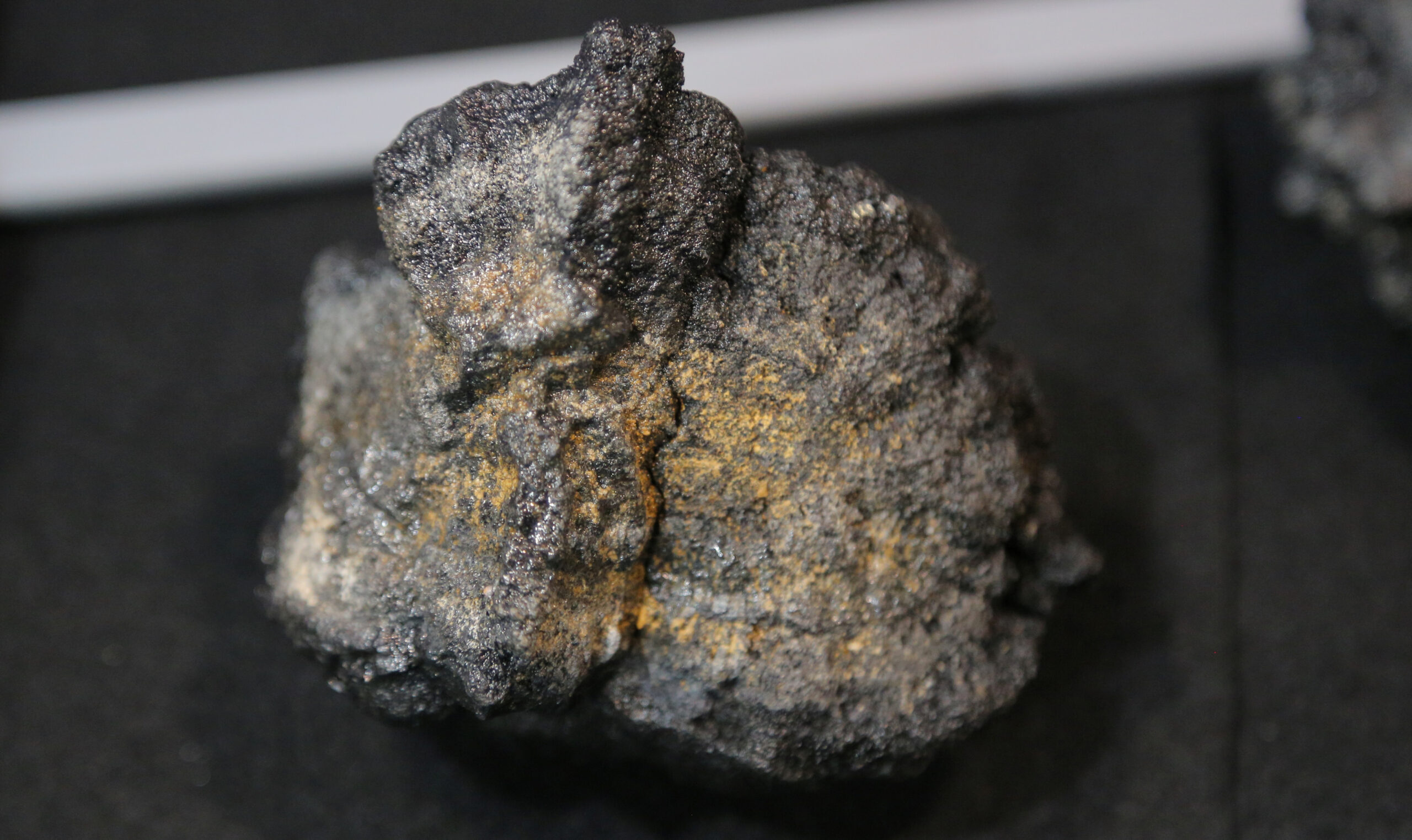
A polymetallic, or manganese, nodule is displayed the the booth of DeepGreen Resources in Toronto, Ontario, Canada March 4, 2019. REUTERS/Chris Helgren

A polymetallic, or manganese, nodule is displayed the the booth of DeepGreen Resources in Toronto, Ontario, Canada March 4, 2019. REUTERS/Chris Helgren

For years, diplomats at the ISA have been trying to hash out deep-sea mining standards but deep divisions persist and much work remains to be done. Thirty-two countries, including France, Germany and Canada, have also called for either a full ban or a precautionary pause in deep-sea mining activities.

That means Trump’s unilateral decision to expedite licences in both US and international waters is likely to spark a backlash from the international community.

“Any unilateral action would constitute a violation of international law and directly undermine the fundamental principles of multilateralism, the peaceful use of the oceans and the collective governance framework,” said Leticia Carvalho, the secretary general of the ISA, when TMC unveiled its plans in March. Dozens of nations, both in the Global North and South, echoed her opposition.

China’s Foreign Ministry spokesperson Guo Jiakan said on Friday the US move “violates international law and harms the collective interests of the international community”. China holds the largest number of exploration permits in the Pacific Ocean under the ISA, but it has been waiting for the mining rulebook’s completion before conducting any commercial extraction activity.

‘Rip up the deep sea for profit’

Trump’s executive order also drew immediate condemnation from environmentalists who say deep-sea mining would cause irreversible damage to the ocean ecosystem while being financially prohibitive and unnecessary because land-based mineral resources and recycling could cover demand.

“Authorizing deep-sea mining outside international law is like lighting a match in a room full of dynamite – it threatens ecosystems, global cooperation, and US credibility all at once,” said Arlo Hemphill of Greenpeace.

“The United States government has no right to unilaterally allow an industry to destroy the common heritage of humankind, and rip up the deep sea for the profit of a few corporations,” he added.
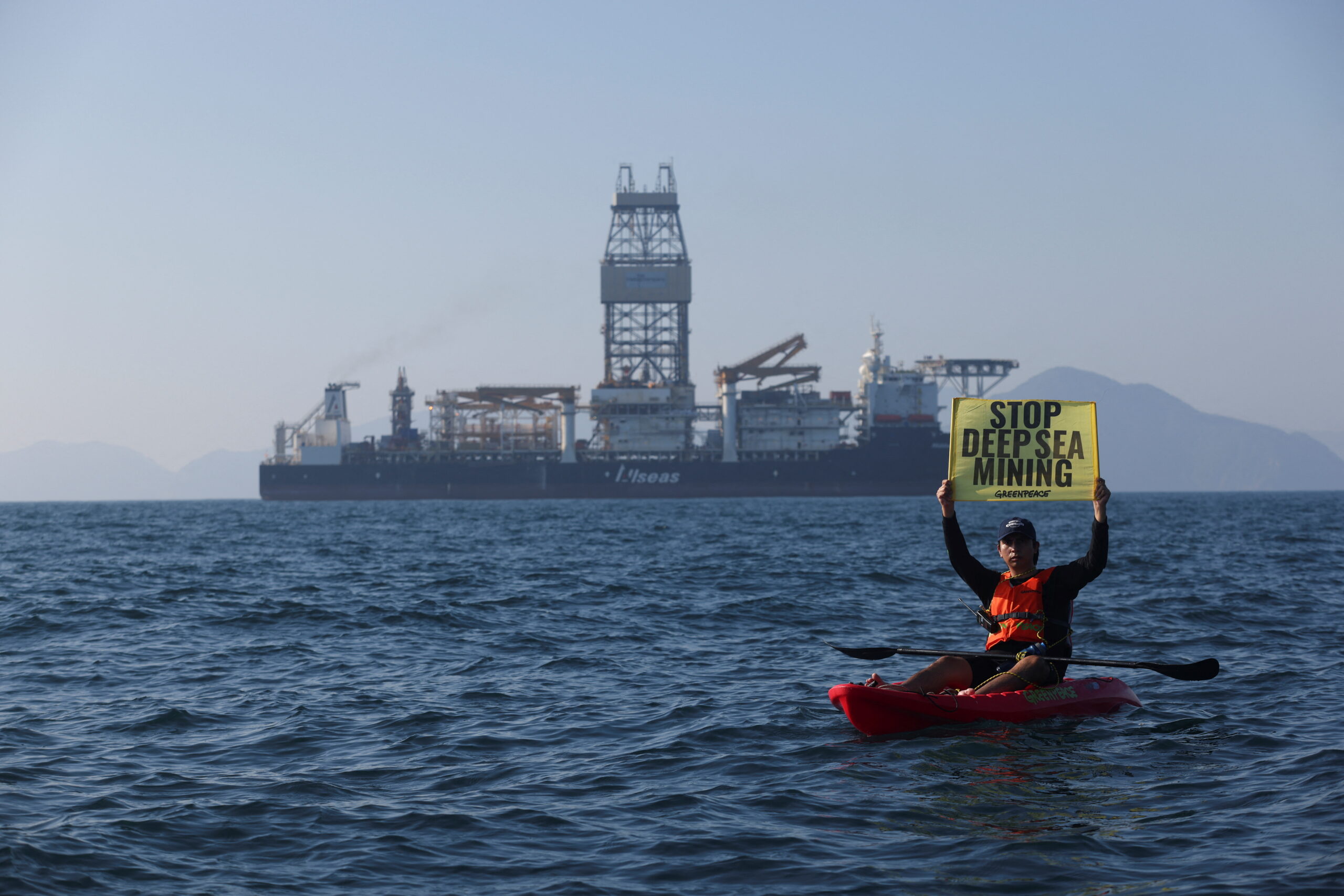
A Greenpeace activist holds a sign as he confronts the deep sea mining vessel Hidden Gem, commissioned by Canadian miner The Metals Company, as it returned to port from eight weeks of test mining in the Clarion-Clipperton Zone between Mexico and Hawaii, off the coast of Manzanillo, Mexico November 16, 2022. REUTERS/Gustavo Graf

A Greenpeace activist holds a sign as he confronts the deep sea mining vessel Hidden Gem, commissioned by Canadian miner The Metals Company, as it returned to port from eight weeks of test mining in the Clarion-Clipperton Zone between Mexico and Hawaii, off the coast of Manzanillo, Mexico November 16, 2022. REUTERS/Gustavo Graf

TMC is one of the companies with the most to potentially gain.

In a call with analysts in late March, an executive from the Vancouver-based firm indicated that the US backing could be a much-needed spur to attract external investment.

“If we get to the point where regulatory uncertainty is no longer there and, you know, things are moving along at a very fast clip, let’s say through the US process, well that may put us in a different financial position,” said Craig Shesky, the company’s CFO.

TMC’s rapid pivot

As recently as a few months ago, the company was still lobbying US lawmakers to get behind new legislation calling on the US government to support international governance of seafloor resource exploration.

TMC spent $312,000 on US lobbying activities in 2024, according to lobbying disclosure records.

It is unclear why TMC’s longstanding policy position changed, but during a presentation with analysts, company executives name-checked Steven Groves, a former White House staffer during Trump’s first term.

At energy security talks, US pushes gas and derides renewables

Groves is a policy director at the Heritage Foundation, a fossil-fuel funded think-tank that routinely opposes climate policies and casts doubts on universally accepted climate science. He also co-edited ‘Project 2025’, the controversial 900-page conservative policy blueprint for reshaping the federal government.

TMC’s Shesky said Groves agreed that applying for a mining licence under DSHMRA would be “a viable path based on robust and well thought out regulations”.

Choppy waters ahead

But other experts vehemently disagree. Dobush told Climate Home it is “very ironic and highly likely untrue” that going through the United States provides regulatory certainty when the national legislation has never been used for exploitation.

In 2022, weapons maker Lockheed Martin – the only existing holder of DSHMRA exploration permits – said that activities had been delayed as a result of a lack of international recognition of the US licences.

Duncan Currie, legal advisor at the Deep Sea Conservation Coalition, said he expected plenty of potential legal issues down the line for TMC before any mining takes place.

For instance, countries like Canada, Switzerland and the Netherlands – where TMC and its partner Allseas are respectively based – could risk breaching the terms of the UNCLOS if they fail to prevent the companies from acting unilaterally, he said.

Nations that rely on the UNCLOS to protect their freedom of navigation or fisheries rights may also be motivated to prevent the US government from setting a precedent in sidestepping international governance.

“Island states and seafaring nations place a great deal of importance on UNCLOS,” added Currie. “I would imagine that those countries will be working to ensure that this doesn’t happen.”

The post Trump throws lifeline to Canadian deep-sea miner, setting scene for international clash appeared first on Climate Home News.

Trump throws lifeline to Canadian deep-sea miner, setting scene for international clash

Continue Reading

Climate Change

DeBriefed 27 February 2026: Trump’s fossil-fuel talk | Modi-Lula rare-earth pact | Is there a UK ‘greenlash’? 

Published

on

Welcome to Carbon Brief’s DeBriefed.
An essential guide to the week’s key developments relating to climate change.

This week

Absolute State of the Union

‘DRILL, BABY’: US president Donald Trump “doubled down on his ‘drill, baby, drill’ agenda” in his State of the Union (SOTU) address, said the Los Angeles Times. He “tout[ed] his support of the fossil-fuel industry and renew[ed] his focus on electricity affordability”, reported the Financial Times. Trump also attacked the “green new scam”, noted Carbon Brief’s SOTU tracker.

COAL REPRIEVE: Earlier in the week, the Trump administration had watered down limits on mercury pollution from coal-fired power plants, reported the Financial Times. It remains “unclear” if this will be enough to prevent the decline of coal power, said Bloomberg, in the face of lower-cost gas and renewables. Reuters noted that US coal plants are “ageing”.

OIL STAY: The US Supreme Court agreed to hear arguments brought by the oil industry in a “major lawsuit”, reported the New York Times. The newspaper said the firms are attempting to head off dozens of other lawsuits at state level, relating to their role in global warming.

SHIP-SHILLING: The Trump administration is working to “kill” a global carbon levy on shipping “permanently”, reported Politico, after succeeding in delaying the measure late last year. The Guardian said US “bullying” could be “paying off”, after Panama signalled it was reversing its support for the levy in a proposal submitted to the UN shipping body.

Around the world

  • RARE EARTHS: The governments of Brazil and India signed a deal on rare earths, said the Times of India, as well as agreeing to collaborate on renewable energy.
  • HEAT ROLLBACK: German homes will be allowed to continue installing gas and oil heating, under watered-down government plans covered by Clean Energy Wire.
  • BRAZIL FLOODS: At least 53 people died in floods in the state of Minas Gerais, after some areas saw 170mm of rain in a few hours, reported CNN Brasil.
  • ITALY’S ATTACK: Italy is calling for the EU to “suspend” its emissions trading system (ETS) ahead of a review later this year, said Politico.
  • COOKSTOVE CREDITS: The first-ever carbon credits under the Paris Agreement have been issued to a cookstove project in Myanmar, said Climate Home News.
  • SAUDI SOLAR: Turkey has signed a “major” solar deal that will see Saudi firm ACWA building 2 gigawatts in the country, according to Agence France-Presse.

$467 billion

The profits made by five major oil firms since prices spiked following Russia’s invasion of Ukraine four years ago, according to a report by Global Witness covered by BusinessGreen.


Latest climate research

  • Claims about the “fingerprint” of human-caused climate change, made in a recent US Department of Energy report, are “factually incorrect” | AGU Advances
  • Large lakes in the Congo Basin are releasing carbon dioxide into the atmosphere from “immense ancient stores” | Nature Geoscience
  • Shared Socioeconomic Pathways – scenarios used regularly in climate modelling – underrepresent “narratives explicitly centring on democratic principles such as participation, accountability and justice” | npj Climate Action

(For more, see Carbon Brief’s in-depth daily summaries of the top climate news stories on Monday, Tuesday, Wednesday, Thursday and Friday.)

Captured

The constituency of Richard Tice MP, the climate-sceptic deputy leader of Reform UK, is the second-largest recipient of flood defence spending in England, according to new Carbon Brief analysis. Overall, the funding is disproportionately targeted at coastal and urban areas, many of which have Conservative or Liberal Democrat MPs.

Spotlight

Is there really a UK ‘greenlash’?

This week, after a historic Green Party byelection win, Carbon Brief looks at whether there really is a “greenlash” against climate policy in the UK.

Over the past year, the UK’s political consensus on climate change has been shattered.

Yet despite a sharp turn against climate action among right-wing politicians and right-leaning media outlets, UK public support for climate action remains strong.

Prof Federica Genovese, who studies climate politics at the University of Oxford, told Carbon Brief:

“The current ‘war’ on green policy is mostly driven by media and political elites, not by the public.”

Indeed, there is still a greater than two-to-one majority among the UK public in favour of the country’s legally binding target to reach net-zero emissions by 2050, as shown below.

Steve Akehurst, director of public-opinion research initiative Persuasion UK, also noted the growing divide between the public and “elites”. He told Carbon Brief:

“The biggest movement is, without doubt, in media and elite opinion. There is a bit more polarisation and opposition [to climate action] among voters, but it’s typically no more than 20-25% and mostly confined within core Reform voters.”

Conservative gear shift

For decades, the UK had enjoyed strong, cross-party political support for climate action.

Lord Deben, the Conservative peer and former chair of the Climate Change Committee, told Carbon Brief that the UK’s landmark 2008 Climate Change Act had been born of this cross-party consensus, saying “all parties supported it”.

Since their landslide loss at the 2024 election, however, the Conservatives have turned against the UK’s target of net-zero emissions by 2050, which they legislated for in 2019.

Curiously, while opposition to net-zero has surged among Conservative MPs, there is majority support for the target among those that plan to vote for the party, as shown below.

Dr Adam Corner, advisor to the Climate Barometer initiative that tracks public opinion on climate change, told Carbon Brief that those who currently plan to vote Reform are the only segment who “tend to be more opposed to net-zero goals”. He said:

“Despite the rise in hostile media coverage and the collapse of the political consensus, we find that public support for the net-zero by 2050 target is plateauing – not plummeting.”

Reform, which rejects the scientific evidence on global warming and campaigns against net-zero, has been leading the polls for a year. (However, it was comfortably beaten by the Greens in yesterday’s Gorton and Denton byelection.)

Corner acknowledged that “some of the anti-net zero noise…[is] showing up in our data”, adding:

“We see rising concerns about the near-term costs of policies and an uptick in people [falsely] attributing high energy bills to climate initiatives.”

But Akehurst said that, rather than a big fall in public support, there had been a drop in the “salience” of climate action:

“So many other issues [are] competing for their attention.”

UK newspapers published more editorials opposing climate action than supporting it for the first time on record in 2025, according to Carbon Brief analysis.

Global ‘greenlash’?

All of this sits against a challenging global backdrop, in which US president Donald Trump has been repeating climate-sceptic talking points and rolling back related policy.

At the same time, prominent figures have been calling for a change in climate strategy, sold variously as a “reset”, a “pivot”, as “realism”, or as “pragmatism”.

Genovese said that “far-right leaders have succeeded in the past 10 years in capturing net-zero as a poster child of things they are ‘fighting against’”.

She added that “much of this is fodder for conservative media and this whole ecosystem is essentially driving what we call the ‘greenlash’”.

Corner said the “disconnect” between elite views and the wider public “can create problems” – for example, “MPs consistently underestimate support for renewables”. He added:

“There is clearly a risk that the public starts to disengage too, if not enough positive voices are countering the negative ones.”

Watch, read, listen

TRUMP’S ‘PETROSTATE’: The US is becoming a “petrostate” that will be “sicker and poorer”, wrote Financial Times associate editor Rana Forohaar.

RHETORIC VS REALITY: Despite a “political mood [that] has darkened”, there is “more green stuff being installed than ever”, said New York Times columnist David Wallace-Wells.
CHINA’S ‘REVOLUTION’: The BBC’s Climate Question podcast reported from China on the “green energy revolution” taking place in the country.

Coming up

Pick of the jobs

DeBriefed is edited by Daisy Dunne. Please send any tips or feedback to debriefed@carbonbrief.org.

This is an online version of Carbon Brief’s weekly DeBriefed email newsletter. Subscribe for free here.

The post DeBriefed 27 February 2026: Trump’s fossil-fuel talk | Modi-Lula rare-earth pact | Is there a UK ‘greenlash’?  appeared first on Carbon Brief.

DeBriefed 27 February 2026: Trump’s fossil-fuel talk | Modi-Lula rare-earth pact | Is there a UK ‘greenlash’? 

Continue Reading

Climate Change

Pacific nations want higher emissions charges if shipping talks reopen

Published

on

Seven Pacific island nations say they will demand heftier levies on global shipping emissions if opponents of a green deal for the industry succeed in reopening negotiations on the stalled accord.

The United States and Saudi Arabia persuaded countries not to grant final approval to the International Maritime Organization’s Net-Zero Framework (NZF) in October and they are now leading a drive for changes to the deal.

In a joint submission seen by Climate Home News, the seven climate-vulnerable Pacific countries said the framework was already a “fragile compromise”, and vowed to push for a universal levy on all ship emissions, as well as higher fees . The deal currently stipulates that fees will be charged when a vessel’s emissions exceed a certain level.

“For many countries, the NZF represents the absolute limit of what they can accept,” said the unpublished submission by Fiji, Kiribati, Vanuatu, Nauru, Palau, Tuvalu and the Solomon Islands.

The countries said a universal levy and higher charges on shipping would raise more funds to enable a “just and equitable transition leaving no country behind”. They added, however, that “despite its many shortcomings”, the framework should be adopted later this year.

US allies want exemption for ‘transition fuels’

The previous attempt to adopt the framework failed after governments narrowly voted to postpone it by a year. Ahead of the vote, the US threatened governments and their officials with sanctions, tariffs and visa restrictions – and President Donald Trump called the framework a “Green New Scam Tax on Shipping”.

Since then, Liberia – an African nation with a major low-tax shipping registry headquartered in the US state of Virginia – has proposed a new measure under which, rather than staying fixed under the NZF, ships’ emissions intensity targets change depending on “demonstrated uptake” of both “low-carbon and zero-carbon fuels”.

The proposal places stringent conditions on what fuels are taken into consideration when setting these targets, stressing that the low- and zero-carbon fuels should be “scalable”, not cost more than 15% more than standard marine fuels and should be available at “sufficient ports worldwide”.

This proposal would not “penalise transitional fuels” like natural gas and biofuels, they said. In the last decade, the US has built a host of large liquefied natural gas (LNG) export terminals, which the Trump administration is lobbying other countries to purchase from.

The draft motion, seen by Climate Home News, was co-sponsored by US ally Argentina and also by Panama, a shipping hub whose canal the US has threatened to annex. Both countries voted with the US to postpone the last vote on adopting the framework.

    The IMO’s Panamanian head Arsenio Dominguez told reporters in January that changes to the framework were now possible.

    “It is clear from what happened last year that we need to look into the concerns that have been expressed [and] … make sure that they are somehow addressed within the framework,” he said.

    Patchwork of levies

    While the European Union pushed firmly for the framework’s adoption, two of its shipping-reliant member states – Greece and Cyprus – abstained in October’s vote.

    After a meeting between the Greek shipping minister and Saudi Arabia’s energy minister in January, Greece said a “common position” united Greece, Saudi Arabia and the US on the framework.

    If the NZF or a similar instrument is not adopted, the IMO has warned that there will be a patchwork of differing regional levies on pollution – like the EU’s emissions trading system for ships visiting its ports – which will be complicated and expensive to comply with.

    This would mean that only countries with their own levies and with lots of ships visiting their ports would raise funds, making it harder for other nations to fund green investments in their ports, seafarers and shipping companies. In contrast, under the NZF, revenues would be disbursed by the IMO to all nations based on set criteria.

    Anais Rios, shipping policy officer from green campaign group Seas At Risk, told Climate Home News the proposal by the Pacific nations for a levy on all shipping emissions – not just those above a certain threshold – was “the most credible way to meet the IMO’s climate goals”.

    “With geopolitics reframing climate policy, asking the IMO to reopen the discussion on the universal levy is the only way to decarbonise shipping whilst bringing revenue to manage impacts fairly,” Rios said.

    “It is […] far stronger than the Net-Zero Framework that is currently on offer.”

    The post Pacific nations want higher emissions charges if shipping talks reopen appeared first on Climate Home News.

    Pacific nations want higher emissions charges if shipping talks reopen

    Continue Reading

    Climate Change

    Doubts over European SAF rules threaten cleaner aviation hopes, investors warn

    Published

    on

    Doubts over whether governments will maintain ambitious targets on boosting the use of sustainable aviation fuel (SAF) are a threat to the industry’s growth and play into the hands of fossil fuel companies, investors warned this week.

    Several executives from airlines and oil firms have forecast recently that SAF requirements in the European Union, United Kingdom and elsewhere will be eased or scrapped altogether, potentially upending the aviation industry’s main policy to shrink air travel’s growing carbon footprint.

    Such speculation poses a “fundamental threat” to the SAF industry, which mainly produces an alternative to traditional kerosene jet fuel using organic feedstocks such as used cooking oil (UCO), Thomas Engelmann, head of energy transition at German investment manager KGAL, told the Sustainable Aviation Fuel Investor conference in London.

    He said fossil fuel firms would be the only winners from questions about compulsory SAF blending requirements.

    What is Sustainable Aviation Fuel (SAF)?

    The EU and the UK introduced the world’s first SAF mandates in January 2025, requiring fuel suppliers to blend at least 2% SAF with fossil fuel kerosene. The blending requirement will gradually increase to reach 32% in the EU and 22% in the UK by 2040.

    Another case of diluted green rules?

    Speaking at the World Economic Forum in Davos in January, CEO of French oil and gas company TotalEnergies Patrick Pouyanné said he would bet “that what happened to the car regulation will happen to the SAF regulation in Europe”. 

    The EU watered down green rules for car-makers in March 2025 after lobbying from car companies, Germany and Italy.

    “You will see. Today all the airline companies are fighting [against the EU’s 2030 SAF target of 6%],” Pouyanne said, even though it’s “easy to reach to be honest”.

    While most European airline lobbies publicly support the mandates, Ryanair Group CEO Michael O’Leary said last year that the SAF is “nonsense” and is “gradually dying a death, which is what it deserves to do”.

    EU and UK stand by SAF targets

    But the EU and the British government have disputed that. EU transport commissioner Apostolos Tzitzikostas said in November that the EU’s targets are “stable”, warning that “investment decisions and construction must start by 2027, or we will miss the 2030 targets”.

    UK aviation minister Keir Mather told this week’s investor event that meeting the country’s SAF blending requirement of 10% by 2030 was “ambitious but, with the right investment, the right innovation and the right outlook, it is absolutely within our reach”.

    “We need to go further and we need to go faster,” Mather said.

    UK aviation minister Keir Mather speaks at the SAF Investor conference in London on February 24, 2026. (Photo: SAF Investor)

    SAF investors and developers said such certainty on SAF mandates from policymakers was key to drawing the necessary investment to ramp up production of the greener fuel, which needs to scale up in order to bring down high production costs. Currently, SAF is between two and seven times more expensive than traditional jet fuel. 

    Urbano Perez, global clean molecules lead at Spanish bank Santander, said banks will not invest if there is a perceived regulatory risk.

    David Scott, chair of Australian SAF producer Jet Zero Australia, said developing SAF was already challenging due to the risks of “pretty new” technology requiring high capital expenditure.

    “That’s a scary model with a volatile political environment, so mandate questioning creates this problem on steroids”, Scott said.

    Others played down the risk. Glenn Morgan, partner at investment and advisory firm SkiesFifty, said “policy is always a risk”, adding that traditional oil-based jet fuel could also lose subsidies.

    A fuel truck fills up the Emirates Airlines Boeing 777-300ER with Sustainable Aviation Fuel (SAF), during a milestone demonstration flight while running one of its engines on 100% (SAF) at Dubai airport, in Dubai, United Arab Emirates, January 30, 2023. REUTERS/Rula Rouhana

    A fuel truck fills up the Emirates Airlines Boeing 777-300ER with Sustainable Aviation Fuel (SAF), during a milestone demonstration flight while running one of its engines on 100% (SAF) at Dubai airport, in Dubai, United Arab Emirates, January 30, 2023. REUTERS/Rula Rouhana

    Asian countries join SAF mandate adopters

    In Asia, Singapore, South Korea, Thailand and Japan have recently adopted SAF mandates, and Matti Lievonen, CEO of Asia-based SAF producer EcoCeres, predicted that China, Indonesia and Hong Kong would follow suit.

    David Fisken, investment director at the Australian Trade and Investment Commission, said the Australian government, which does not have a mandate, was watching to see how the EU and UK’s requirements played out.

    The US does not have a SAF mandate and under President Donald Trump the government has slashed tax credits available for SAF producers from $1.75 a gallon to $1.

    Is the world’s big idea for greener air travel a flight of fancy?

    SAF and energy security

    SAF’s potential role in boosting energy security was a major theme of this week’s discussions as geopolitical tensions push the issue to the fore.

    Marcella Franchi, chief commercial officer for SAF at France’s Haffner Energy, said the Canadian government, which has “very unsettling neighbours at the moment”, was looking to produce SAF to protect its energy security, especially as it has ample supplies of biomass to use as potential feedstock.

    Similarly, German weapons manufacturer Rheinmetall said last year it was working on plans that would enable European armed forces to produce their own synthetic, carbon-neutral fuel “locally and independently of global fossil fuel supply chain”.

    Scott said Australia needs SAF to improve its fuel security, as it imports almost 99% of its liquid fuels.

    He added that support for Australian SAF production is bipartisan, in part because it appeals to those more concerned about energy security than tackling climate change.

    The post Doubts over European SAF rules threaten cleaner aviation hopes, investors warn appeared first on Climate Home News.

    Doubts over European SAF rules threaten cleaner aviation hopes, investors warn

    Continue Reading

    Trending

    Copyright © 2022 BreakingClimateChange.com

