

Weather Guard Lightning Tech
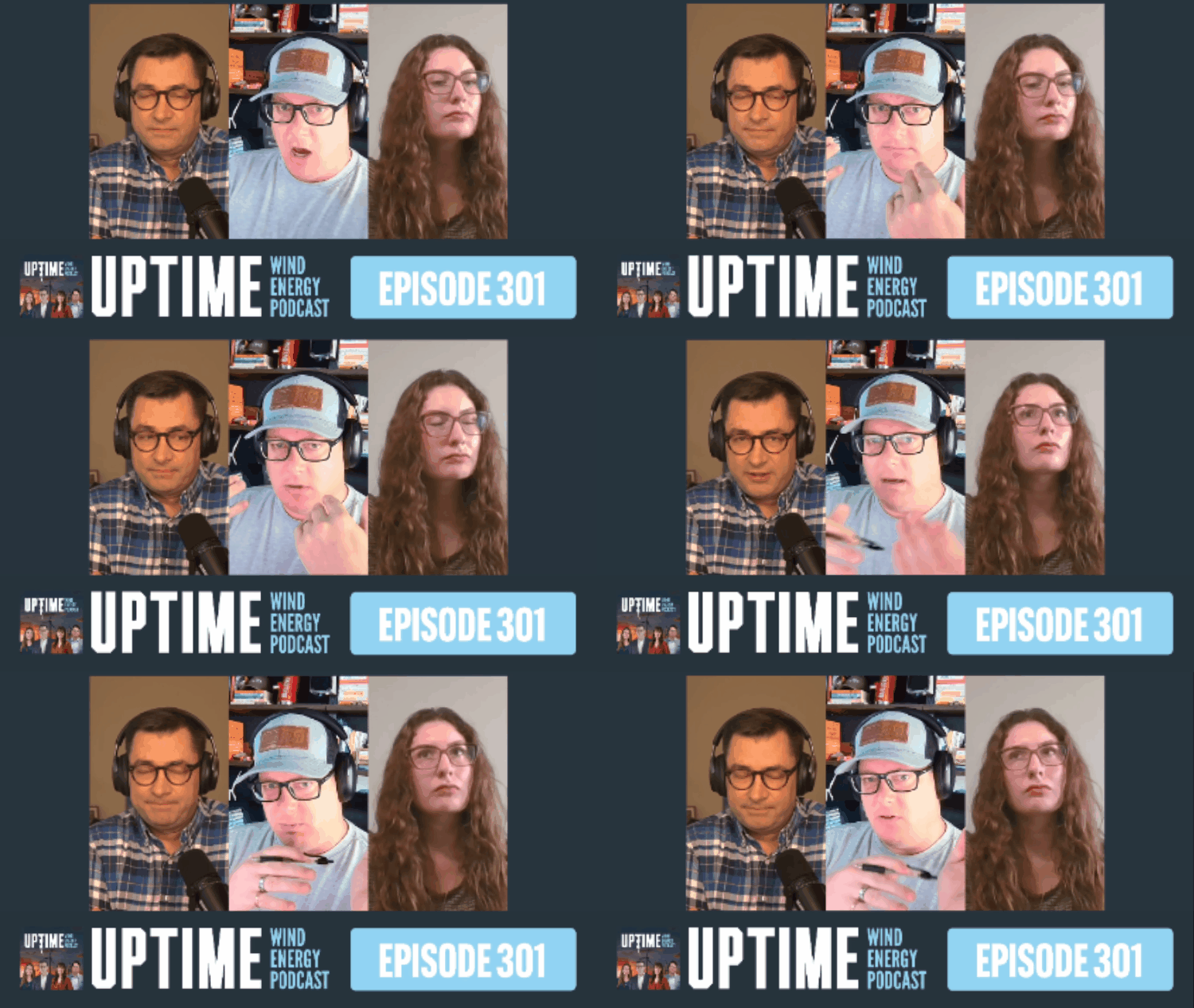
TPI Composites Bankruptcy, Vestas Buys Mexico Factories
Allen, Joel, and Yolanda examine TPI Composites’ Chapter 11 proceedings, including the Oaktree Capital secured debt controversy and Vestas’ acquisition of two Mexican factories. With remaining assets heading to auction in January, they discuss what operators should consider as blade supply uncertainty grows.
Sign up now for Uptime Tech News, our weekly email update on all things wind technology. This episode is sponsored by Weather Guard Lightning Tech. Learn more about Weather Guard’s StrikeTape Wind Turbine LPS retrofit. Follow the show on Facebook, YouTube, Twitter, Linkedin and visit Weather Guard on the web. And subscribe to Rosemary Barnes’ YouTube channel here. Have a question we can answer on the show? Email us!
The Uptime Wind Energy Podcast brought to you by Strike Tape, protecting thousands of wind turbines from lightning damage worldwide. Visit strike tape.com. And now your hosts, Allen Hall, Rosemary Barnes, Joel Saxum and Yolanda Padron. Welcome to the Uptime Wind Energy
Allen Hall: Podcast. I’m your host, Allen Hall. I’m here with Yolanda Padron and Joel Saxum.
Rosemary Barnes is on holiday. We’re here to talk about the TPI composites, uh, bankruptcy hearings, and there’s been so much happening there behind the scenes. It’s hard to keep track of, but we’ve done a deep dive and wanted to give everybody at least a highlight of what has happened over the last couple of months.
So, uh, if you do own vessels or GE turbines, you understand what the situation is. As we all know, TPI composites, gee, was the world’s largest independent of wind blade manufacturing. Uh, they [00:01:00] were, it, they built blades for renova, Vestas, Nordex. They built blades for almost everybody, uh, names that basically power the global energy transition.
And then, uh, if, and a lot of people don’t know this, but back in December of 2023, uh, TPI struck a deal that is drawing some fire. Right now, TPI swapped $436 million in preferred stock for. $393 million in secure debt held by Oak Tree Capital and by August of last year, just a couple of months ago, TPI filed for Chapter 11.
Now the Blade Makers assets are being carved up and sold, and two of wind energy’s biggest players are stepping in to keep production running while the bankruptcy plays out. Now, Joel and Yolanda, I, I think the bankruptcy of. TPI sort of came to the industry as a little bit of a shock. Obviously [00:02:00] the, the price had fallen quite a bit.
Uh, if you’ve watched the stock price of TPI composites had been dropping for a while and didn’t have a lot of of market value. However, uh, GE and Vestas both have manufacturing facilities basically with uh, TPI composites and, and needs them to produce those blades. So the filing of the bankruptcy, I’m sure was a nervous point for Vestus and GE being really the, the two main ones.
Joel Saxum: Well, I think we talked about this a little bit off air. Is it, it shouldn’t just be Vestus and GE nervous about this now. It should be every operator that’s in either in development or still has blades under warranty. Uh, so, and this is a not a US problem, this is a global problem. ’cause TPI is a global company that serves, uh, global industry all over the place, right?
We know that a large percentage of their throughput was GE and Vestas, but also Siemens ESAs in there, you name it, right? The, any major operator’s gonna have some blades built [00:03:00] by TPI or op major, OEM. So. There isn’t gonna be much of a, uh, dark corner of the wind industry that this issue doesn’t touch. So I think they, the, one of the issues here is, um, we’ve, we’ve, we’ve heard about some issues going on with TPI, but it was almost like a, ah, they’re not, they’ll, they’ll be okay.
They, so, so something will happen. I mean, Yolanda, you had said. What was it that you said ear earlier? Like, uh, the kind of the, the, the feeling about it.
Yolanda Padron: They’ll take care of it. You know, OEMs will take care of it and we’ll be fine.
Joel Saxum: Someone’s gonna support this thing.
Yolanda Padron: Yeah. I, I think teams, you’re, you’re definitely right.
Teams really do need to at least think of a, of a plan B or a plan C to have when the dust settles so you’re not scrambling.
Allen Hall: Yeah. And it hasn’t really played out that way. Uh, Vestas has stepped in a little bit and GE has stepped in. Not in terms of acquiring any of the major assets, but I think the first question is what is Oaktree Capital’s, [00:04:00] uh, role in all this?
And that is being played out right now in front of the bankruptcy court. Uh, so when you go to bankruptcy, there’s obviously a lot of oversight that happens there, uh, and. When TPI composites entered bankruptcy, the accreditors committee had a bunch of questions about that transaction. Uh, they pointed to a December, 2023 refin refinancing deal with Oaktree and in which creditors were really suspicious of basically saying that TPI was already insolvent in 2023 and Oaktree exchanged equity for secure debt jumping ahead of everybody else in line to get paid.
So because they Oaktree has secured debt, they’re first in line to get paid. If, uh, weather Guard was involved selling parts to TPI, which thank goodness we weren’t, we would be unsecured. They wouldn’t have to pay us. So Oaktree would get paid first and everybody else is unsecured, gets paid [00:05:00] later. Uh, that’s okay.
I mean, that’s the way they, uh, they structured it. But this has led to a problem, right? So that oak tree. Uh, was supposed to release about $20 million in funding to keep the factories open, and that, that happened just a couple of weeks ago, and Oaktree refused to do it. So the amount of cash flow to keep the factories open was a real issue.
TPI was in front of the court saying, we’re in trouble. We’re gonna become insolvent. We don’t have cash flow to keep the doors open. So the blade factories nearly shut down a couple of weeks ago. However, there was a, the settlement, uh, just after that, uh, in regards to Oaktree about when the payouts happen, what Oaktree will receive, and which basically it’s, most of whatever’s gonna happen here.
So whatever, uh, TPI decides to sell or can sell, Oaktree is gonna be the recipient of those funds for most of it. I think the
Joel Saxum: difficult thing here for. The [00:06:00] general listener, me included, is understanding that this is a very complicated legal process that’s governed and it’s global, right? So it’s governed in certain court systems in different places.
And because there is also the idea of like say in the, in the United States, the SEC Securities Exchanges Commission, that kind of regulates these. Publicly traded companies. There’s a lot of lights and there’s a lot of lawyers and there’s a lot of jargon involved in this thing. And, but basically what what we’re saying is, is the way the process works when you have a, uh, a bankruptcy and insolvency, if a company has debt to certain people, there may be a list of a hundred people.
There may be a list of two, doesn’t matter. There’s certain classes of debt, right? And Oaktree has secured debt, which means. If they get paid first, if there’s anything, right? If this bankruptcy goes and, and gets, sell this, sell that, sell this, whatever’s left, goes to the secured debt and then it goes to unsecured debt.
And [00:07:00] there’s sometimes there can be different classes of unsecured debt as well. And, but if there’s not, some of it just goes by like date or value or everybody gets a percentage, it just kind of all depends on how it works out in the specific court system that the stuff takes care of. But that person.
That is the top. Um, in this case, Oaktree Capital, right? Based out of la but offices all over the world, they got about $200 billion in real estate equity and debt assets or, uh, I guess valuation. I wouldn’t say assets. Um, they are the debtor in possession, so they’re the one that’s kind of like top of the heap.
They’re kind of controlling how the. The restructuring and or sale goes alongside the court system.
Allen Hall: And the trouble is, is that when you have unsecured and secured debt, everybody that’s unsecured wants to get paid. So any material supplier that has been for in selling product to TPI over the years [00:08:00] usually has a 30, 60, 90, maybe 120 days of, of after they deliver the product to they get paid.
In that timeframe, if bankruptcy happens, all that product that’s sitting on the floor at TPI, you sort of lost it. You know, you can’t get it back and you’re not gonna get paid for it for if, if, if ever, what do you do? And so you start, you know, you start filing claims, but those, those claims most likely will never get paid.
Or if they will, they’re going to get pennies on the dollar.
Joel Saxum: Yeah. And I would imagine like, so, you know, when we, when we sit here and say from the weather guard hat, right? We put a. They go to a client, net 15, net 30, we expect to get paid in that amount of time. That’s kind of how our, basically US forwarding credit to someone else.
That’s how it works. And if you work within the wind industry, you know that the OEMs, because they are the OEMs, they have a heavier hand. Sometimes they’re net 90, net one 20. Um, once they, once they’re cool with your invoice. So you could see that some of these people that have, [00:09:00] uh, and TPI falls within that OEM category, right?
Um, you can see that they more than likely will have had longer, more favorable terms for themselves with some of these sub-suppliers. And the sub-suppliers are, think about TPI blades. It is composites, it is fabric, it’s resins, it’s all of those supply companies. Um, and you know, there may be, uh, some other.
Dead in there that you’re not, we’re not sure of. We saw some stuff with some OEMs, maybe they have some exchange agreements you paid up front for some blades or something of that sort. You didn’t get ’em. I don’t know. But there is also, and this is the one that kind of hits home to some of our listeners, um, not only some of our listeners are those supply chain companies that support them, um, but a lot of them are ISPs.
Right? So we were just talking to someone who, you know, just a couple weeks ago that had done some inspection work, uh, for, for TPI that. They’re not gonna get paid for it. Um, we have seen on the creditors list of some ISPs that we know they’re not gonna get paid, and those are people out [00:10:00] doing warranty repairs and those kind of things over a course of time.
And they may have had a net 30, net 60, net 90 days payment, but I’m sure that stuff is well and long gone. They probably have invoices due for a year now. Uh, but it, this, the, the, this downfall of TPI, what’s going on with them, it affects a lot of people in the wind industry. Um. Be being, having been on the short end once in my career of an unsecured debt, uh, when a, when the client or the, uh, um, purchaser of services, but went into bankruptcy and losing a whole bunch of cash, and there’s nothing you can do about it, um, except for.
Be mad and stew over it and learn from your mistakes. Uh, that’s a tough place to be.
Speaker 5: Australia’s wind farms are growing fast, but are your operations keeping up? Join us February 17th and 18th at Melbourne’s Poolman on the park for Wind energy o and m Australia [00:11:00] 2026, where you’ll connect with the experts solving real problems in maintenance asset management. And OEM relations. Walk away with practical strategies to cut costs and boost uptime that you can use the moment you’re back on site.
Register now at W OM a 2020 six.com. Wind Energy o and m Australia is created by wind professionals for wind professionals because this industry needs solutions, not speeches,
Allen Hall: the problem. With TPI has been keeping the doors open and they went in front of the court and said, we have a liquidity problem.
Uh, Vestus bought those two factories, those two LLCs for $10 million each. That was the agreement During that transaction, TPI asked for another $55 million, uh, and it’s in the transcripts. You can go listen to this dental, listen to it, but obviously the vest representatives were. No [00:12:00] way. We’re not doing that.
We are in good faith. De decided to buy, uh, these two pieces. So 10 million bucks a, a factory is. Pretty decent price, but they are still in a liquidity challenge. So GE Renova and Vestus, uh, don’t want the Blades manufacturing to stop. They have customers who need blades and so they need these TPI factories to keep running.
GE Renova is providing emergency financing. Uh, through what the court calls, uh, Erna, G-E-R-N-A, it’s a liquidity agreement. Uh, they also signed a long lead materials agreement to keep raw materials moving into the plants. Vestas provided cash advances to keep production going at the Mexico facilities also.
So for now, everything continues to be running, but essentially GE and Vestas are pro paying for the materials. To keep the production line going and there’s this, there’s on the back end of this TPI is essentially. Gonna charge, um, [00:13:00] GE vest less for the blades when they roll off the line because they advanced some those funds.
So, TPI as an organization is still trying to continue to produce blades and trying to honor their commitments as much as they can, but they need cash and the, the place they’re going to go get it or have been getting it from as Vestas in GE Renova. So you
Joel Saxum: one would expect that either Vestas or GE Renova would eventually just say like, we’ve got to buy you.
Is that a reality? Because it doesn’t seem like it from the court documents and stuff. It seems like they’re, they’re kind of, they don’t want to get their hands into back or back into, in GEs case, this blade manufacturing, uh, faculties, right? They’re okay right now providing cash for you guys to keep your operation running and providing us with the things we need.
But we don’t actually want to take it over. That’s what it feels
Allen Hall: like. Uh, well, Vestus did, right? So Vestus took over two factories in Mexico. GE has not done [00:14:00] that yet, and there’s no indication from the proceedings that I read on all the documents that GE has made any move to do that. Vestus definitely stepped in and wants to keep the two factories running, uh, with the issues with ge, Renova and LM at the minute, and there was a lot of layoffs at LM just before the new year.
It’s a question of what GE will do, and it doesn’t seem like as of right now, GE is going to buy factories. Now that being said, uh, TPI composites has deadlines to meet and some auctions to run. Uh, the remaining assets, the non vestus. Portion and the, the Turkish operations, which were sold way earlier, uh, all of the remaining assets go up for bid on January 26th.
And if no outside buyer steps in, which is very possible, Oak Tree Capital can use its debt as currency to take ownership of from what is called a credit bid. [00:15:00] From there, uh, the secure lender could convert that debt into equity and, and so basically what happens is Oak Tree Capital. Would be the holder of the company for whatever remains.
But you would think that GE Viva, uh, would want to have some piece of this to keep the blade factories running, but there’s no indication of that. No one from GE has said anything. None of the filings indicate that GE wants to go ahead and or ge. Viva wants to go ahead and buy the factories. Nothing like that has happened.
So there may be, uh, some more financial transactions at play here, but as of right now, everything that remains for TPI composites is gonna be in the auction block. Someone could walk up and for several million dollars, obviously, uh, acquire it and
Joel Saxum: in theory run it. So, I mean, Alan, you and I talked about this this morning a little bit.
We have seen more [00:16:00] layoffs at lm. Right. We saw more people depart and it sounds like that building is basically a ghost town over in Denmark. GE is basically scuttling LM down to nothing, and they will more than likely either sell off whatever LM has or discontinue whatever that business model is, if that’s where they’re going, blade wise, wind wise.
At the same time, they’ve also said, we’re not building any more g offshore turbines.
Allen Hall: What are they
Joel Saxum: doing? I don’t see them having the, the, the, the thirst to go scoop up or put any money into TPI, but it’s like a catch 22. ’cause they need them to fulfill the orders and stuff that they have. Right now what we’re staring at is basically oak tree composites.
Allen Hall: There’s no chance of that. The oak tree doesn’t know how to run that business. They’re gonna have to hire somebody to go do that. Even if they did, you still got factories in Iowa, a bunch in Mexico, other [00:17:00] places. You have all these assets kind of spread all over the place. It’s not like running an automotive dealership on the corner, you’re, you’re running a major operation with thousands of employees and producing these massively complex blades.
There’s only a handful of companies that would be even possible that we could acquire that and run it with any competency at all right now.
Joel Saxum: So does oak tree being, being that oak tree is the debtor in possession and if, if possible with, or if possible, if it, if it rolls this way with the plan toggle, right.
Where they would basically, the cell would convert them into equity holdings and they would own it. Are they the gatekeepers to who can bid? Like do they control ge? You can bid vest as you can bid? Or does the court control that?
Allen Hall: The court controls all of that. So it’s all part of the chapter 11 proceedings.
Anybody can walk up and put a bid in. And now whether it qualifies or not is, is a good question, but anybody can walk up and, [00:18:00] and make a claim for what remains. There’s, there is a process that will happen there, but who else would it be? Nordex? I don’t think so. Is is Vesta gonna buy more? I don’t think so.
So the concern is obviously for TPI, what is it gonna look like going forward? If you have purchased Vestus turbines or GE Renova turbines, are you gonna have the blades that you have purchased in time? Great questions to ask. I think on the other side is if you do own GE Renova or Vestus turbines and they’re made by TPI, where the technical aspects lie, what do you do where, what should you be thinking about if you’re a large operator of some of these turbines?
How I should be planning for the future here? What are you thinking about?
Joel Saxum: So let’s divide it into two categories. One of them is turbine blades on order supply chain, supply [00:19:00] chain, and the other one’s being turbine blades already in production or received order.
Yolanda Padron: I’m not sure that we can fully look at them separately though, right?
Because if you have them, if, if they’re yours and they’re under a service agreement or something. Eventually you might be in the queue for a replacement that you need, right? That your OEM would be on the hook for.
Joel Saxum: That raises another question there then does. I don’t, ’cause I don’t know this. Maybe you do.
Alan does a bankruptcy qualify as a force majeure event?
Allen Hall: Not in terms of like lightning would be, but, but in terms, yeah, sure.
Joel Saxum: Yeah. But can they claim force majeure and be like, uh, out of our control? So now the turbine supply agreements are, you know, basically have to be rewritten. Timelines have to be rewritten.
Yolanda, to your point, if we have a blade that we need for production, am I not responsible for LDS anymore because the blade manufacturer went into, uh, bankruptcy?
Yolanda Padron: I think it’d be more of [00:20:00] either Now you’re not just. In the queue for TPI Blades. But you’re in the queue for whatever we can retrofit there, right?
That they could put in.
Joel Saxum: Yeah. The alternative is you need a whole set though, right? So if we say like, I need a blade from TPI, or I need an entire set of LM blades, now you’re triple the cost. Who has to pay for that?
Yolanda Padron: I really would hope that it, they wouldn’t go this route, but I think some OEMs would just hit liquidated damages.
And stop.
Allen Hall: That’s what I think too. I mean, we’ve seen that happen with some of the OEMs. Is that the, uh, LDS and that’s it. There is nothing going forward. They’re, they’re fine doing that. That’s the only play that they have. I, I am deeply concerned what GE Renova is about to do in the wind business because of their gas turbine and everything else are so profitable.
And they just announced that the wind business in 2026 is not likely to make any. Positive cash flow. [00:21:00] It, the, the discussion inside of GE Renova, at least at the sort of the boardroom level, must be really tense because in, in theory, they could buy TPIs assets in the factories and run them, but they just went through essentially a liquidation process with lm.
Do they want to run another company, especially when they’re bleeding cash in that particular business? I think the answer GE historically has been no. If we’re not number one or number two, we’re getting the heck outta that business. That was the Jack Welsh of running ge, and anybody that worked for GE knew that loud and clear because they said it all the time.
Those same people that grew up in that GE culture are now in the boardroom, and what are they likely to do? They’re likely to follow that advice. Because it’s just what they know. It’s, it’s, it’s, it’s the school they went to. Are they gonna change their mind and say, A longer term play is wind [00:22:00] and we wanna stay in it and we’re willing to lose a couple hundred million dollars a year for the next couple of years, and now we’re gonna run a Blade Factory with several thousand employees down in Mexico.
I just don’t see it. Uh, not that I could be totally wrong about that. Probably am. Uh, today, sitting at the beginning of January of 2026, I don’t think GE Renova wants to be in the blade manufacturing business if they can at all avoid it.
Yolanda Padron: I think it’s important for owners to start thinking a lot more about educating their internal teams on what they can.
So if it’s through, if you know people within your OEM that you can trust and that can help you. Learn how to self-service some of your blades. That would be great if it’s through ISPs that you can trust. If it’s a hodgepodge of items. I think it’s really important for owners right now to start building that up because it will take a while.
I. And, and the risk [00:23:00] is there.
Allen Hall: That wraps up another episode of the Uptime Wind Energy Podcast, and if today’s discussion sparked any questions or ideas, we’d love to hear from you. Reach out to us on LinkedIn and don’t forget to subscribe so you never miss an episode. And if you found value in today’s conversation, please leave us overview.
It really helps other wind energy professionals discover the show. And we will catch you here next week on the Uptime Wind Energy Podcast.

 Did Jennifer Lawrence really say this? I hope not, because it’s complete stupidity.
People who didn’t criticize Hitler, Mussolini, or the dozens of other fascist dictators as they were rising to power merely ushered them into a position in which they could destroy the lives of millions of innocent lives.
 The author of the meme at left writes, “We’re the only ones.”
This is completely incorrect, not that you care about facts and truth. Over 30 countries, primarily in the Americas, offer unconditional birthright citizenship, granting citizenship to almost anyone born within their territory, regardless of their parents’ status.
 For those who struggle with elementary school arithmetic, Trump won the election (50%+ approval) out of more than 150 million votes cast, and now his approval rating is in the low 30s.
That’s ~30 million voters who regret their choices, out of the common American.
Add in the Tucker Carlsons of the world.


-
Climate Change8 months ago
Guest post: Why China is still building new coal – and when it might stop
-
Greenhouse Gases8 months ago
Guest post: Why China is still building new coal – and when it might stop
-

 Greenhouse Gases2 years ago
嘉宾来稿:满足中国增长的用电需求 光伏加储能“比新建煤电更实惠”
-
Climate Change2 years ago
Bill Discounting Climate Change in Florida’s Energy Policy Awaits DeSantis’ Approval
-

 Climate Change2 years ago
嘉宾来稿:满足中国增长的用电需求 光伏加储能“比新建煤电更实惠”
-
Climate Change Videos2 years ago
The toxic gas flares fuelling Nigeria’s climate change – BBC News
-

 Renewable Energy6 months ago
Sending Progressive Philanthropist George Soros to Prison?
-

 Carbon Footprint2 years ago
US SEC’s Climate Disclosure Rules Spur Renewed Interest in Carbon Credits