

A new Greenpeace International report, Toxic Skies: How Agribusiness is Choking the Amazon, reveals how fires linked to industrial agriculture are turning the forest’s air toxic during the dry season. The findings are a stark warning that the Amazon’s crisis is not only about trees. It is about the air millions of people breathe, and the health of our shared planet.
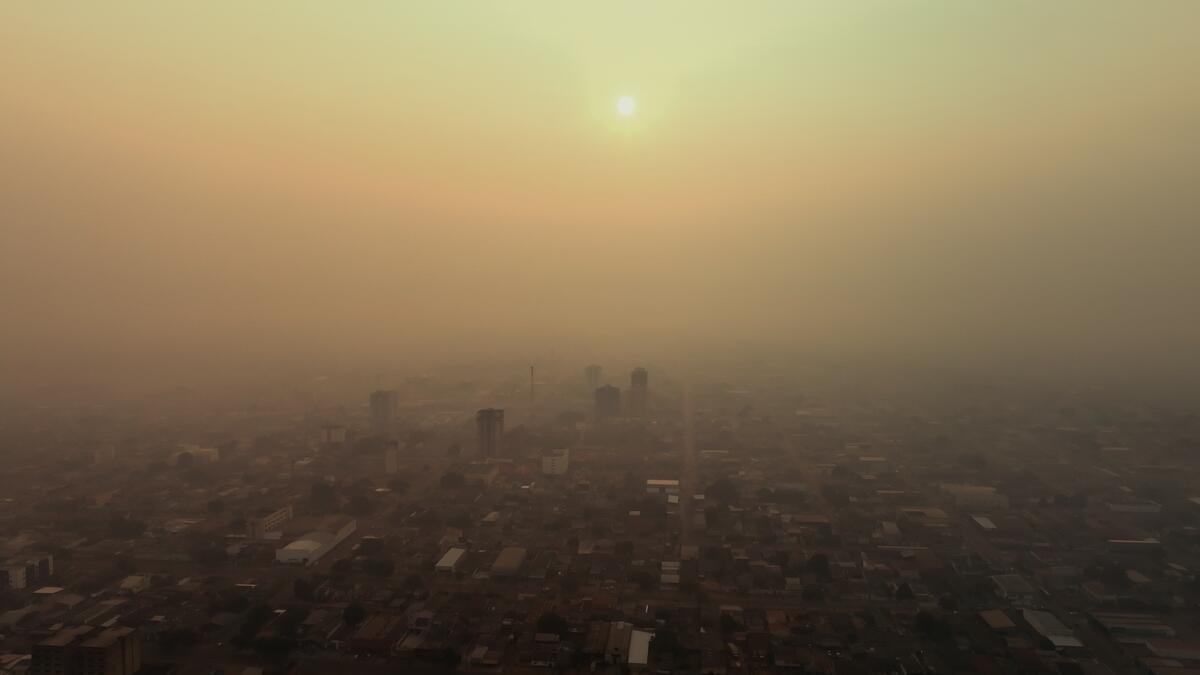
When the sun rises over Porto Velho, on the edge of the Brazilian Amazon, it does not pierce through the mist. It struggles through the smoke. For months each year, the air fills with the haze of fires deliberately set to clear forests for cattle or to renew pasturelands. What was once the world’s greenest ecosystem often breathes air contaminated with higher levels of toxic particles than Beijing, São Paulo or Santiago, according to the report.
What the study found
Researchers monitored air quality in two Amazonian cities, Porto Velho (Rondônia) and Lábrea (Amazonas), combining satellite and ground-based data. The results are alarming:
- During the record-breaking fire season of 2024, levels of fine particulate matter (PM2.5) exceeded WHO daily health guidelines by more than 20 times.
- Even in 2025, a year with far fewer fires, the air still exceeded the guidelines by over six times.
- Between 2019 and 2024, the annual average pollution in Porto Velho was higher than in major global megacities, largely driven by sharp increases in PM2.5 levels during the fire season.
- Around 75% of burned areas around Porto Velho in 2024 are used as pasture for cattle production, showing that most fires are linked to grazing land use.
- More than half of the total burned area in 2024 in the Amazon biome falls within a 360km radius around the facilities of Brazil’s largest meatpacker, JBS. Meatpackers such as JBS do not effectively prohibit and monitor the deliberate use of fire in their supply chains – leaving meatpackers exposed to the risk of indirect or direct supply chain links, including through maintaining business relations, with farms in burned areas.
This is not a natural disaster. It is a business model that profits from destruction and public suffering.
Breathing in the crisis

The Amazon’s fires are not acts of nature. They are deliberately lit to clear forest or renew pastures for cattle. And, behind every statistic are human stories. Hilda Barabadá Karitiana, from the Karitiana Indigenous Territory near Porto Velho, describes how her community lives with the smoke:
During the dry season, the air becomes thick with smoke. Even when the fire is far away, we feel it. Sore throats, constant coughing, and irritated eyes. It affects everyone.– Hilda Barabadá Karitiana
For people like Hilda, the smoke is not just a seasonal nuisance. It is a public health emergency. Exposure to high levels of PM2.5 causes respiratory infections, heart disease and asthma, especially among children and older adults. The air itself has become an agent of crisis.
Debunking Myths
✘ Fires in the Amazon region occur naturally and are beneficial for the ecosystem.
 Fires in the Amazon region are caused by human activity and are highly destructive to the rainforest ecosystem.
✘ Fires in the Amazon happen because of logging.
Vast areas of the Amazon biome are set on fire to make way for cattle ranching.
A turning point before COP30
This year’s COP30, hosted in Belém, on the edge of the Amazon, will be the first UN Climate Summit held inside a tropical forest. It is an opportunity to put Amazonian voices and air quality at the centre of global climate negotiations and to demand that governments and corporations act.
Chief Zé Bajaga, from the Caititu Indigenous Territory, says:
Here in the Amazon, we face invasion, fires and pollution from companies that profit while our land burns. Those who destroy for money must be held accountable.– Chief Zé Bajaga
What needs to happen now

World leaders need to step up and:
- COP30 should deliver an action plan to implement the UNFCCC’s 2030 target to halt and reverse deforestation and forest degradation of the world’s forests. It’s time to turn commitments into action.
- Governments must urgently regulate the agricultural and financial sectors to ensure their alignment with the Paris Agreement, the Global Biodiversity Framework, and the UN Sustainable Development Goals.
- Governments must ensure the transition to truly ecological and just food systems, an end to deforestation, and the reduction of emissions associated with agriculture, including methane.
- World leaders must ensure funding for real solutions to protect and restore forests by providing finance directly accessible to Indigenous Peoples and Local Communities.
The Amazon’s toxic skies are not inevitable. They are the product of political choices and economic greed. As world leaders prepare for COP30, this is the moment to act.
Lis Cunha is a campaigner with Greenpeace International’s Respect the Amazon campaign.
Toxic Skies: The Amazon is now breathing dirtier air than the world’s biggest cities



Climate Change
Greenpeace delivers 47 metre-long petition with half a million signatures to Woodside HQ following major gas protest
Greenpeace delivers 47 metre-long petition with half a million signatures to Woodside HQ following major gas protest
PERTH, Monday 19 October 2026 — Dozens of Perth community members delivered a giant petition, signed by almost half a million people, to Woodside’s corporate headquarters this morning, calling on the government to save Scott Reef from Woodside’s reckless Browse gas proposal.
Dressed in sea creature costumes and hats, supporters carried one of Australia’s biggest environmental petitions to Woodside’s headquarters, and a local choir performed a ‘Scott Reef’ rendition of Angie McMahon’s iconic cover of ‘Reckless’ by Australian Crawl.
On the sidelines of the Perth Global Citizen Now event, it comes following a two day-long protest at Woodside’s Scarborough gas platform that saw activists scale and occupy the Floating Production Unit calling to “Stop Woodside’s Dirty Gas” and “Save Scott Reef”. The activists were taken from the platform by police helicopter on Sunday afternoon.
David Ritter, CEO at Greenpeace Australia Pacific, said: “Less than a day after two Greenpeace Australia Pacific activists were arrested for their peaceful protest at Woodside’s Scarborough gas platform to save Scott Reef, we are here again with another message to Woodside: half a million of us do not want your dirty gas at Scott Reef.
“Community pressure on Woodside is rising. Today we are here to show Woodside that they can’t ignore half a million people who want Scott Reef protected, not turned into an industrialised gas zone.
“Woodside can’t be trusted with our oceans. Woodside’s plans to drill up to 57 toxic wells at Scott Reef, Australia’s largest oceanic reef, putting endangered pygmy blue whales at risk, and jeopardising a nesting ground for unique green sea turtles.
“We Australians love our oceans and this is an opportunity for our governments to do the right thing, to reject Woodside’s reckless drilling plans, and save Scott Reef.”
-ENDS-
Media contact
Kate O’Callaghan on +61 406 231 892 or Emma Sangalli on +61 431 513 465
Climate Change
Greenpeace Australia Pacific activists in police custody after two-day protest against Woodside’s Browse gas project at Scott Reef
PERTH, Sunday 18 October 2026 — Two Greenpeace Australia Pacific activists are in police custody after occupying a gas platform at Woodside’s Scarborough gas project, in peaceful protest of the fossil fuel corporation’s plans to drill for oil and gas at Scott Reef.
NEW footage and photos of the peaceful protest available here and on Instagram
The activists used specialised climbing equipment to scale and attach themselves to a Floating Production Unit (FPU), a key piece of gas processing infrastructure at the Scarborough gas field over 200km off the coast of Exmouth, at around 05:45am AWST on Saturday and proceeded to occupy the platform for two days, displaying banners reading “Stop Woodside’s Dirty Gas. Save Scott Reef.”
Special police forces landed a helicopter on the FPU at around 11:30am AWST. The activists safely removed themselves from their equipment before being taken into police custody around 1:00pm AWST. At the time of writing, no charges have been laid.
David Ritter, CEO at Greenpeace Australia Pacific, said: “It takes guts and conviction to do what our activists have done, peacefully protesting Woodside’s reckless gas plans at Scott Reef.
“Woodside’s plans to drill up to 57 toxic wells at Scott Reef are outrageous. If allowed to go ahead Woodside would turn Scott Reef, Australia’s largest oceanic reef, home to nesting green sea turtles and elusive pygmy blue whales, into an industrial gas zone. Around half a million people have called on our governments to stop Woodside and to save Scott Reef.
“Our activists are highly trained and experienced in these activities. West Australia has a proud history of peaceful, democratic protest at sea, to protect our oceans from environmental threats. From whaling in Albany in the seventies, to Woodside’s threat to Scott Reef today, there’s more than fifty years of history, of Greenpeace taking action off WA’s coast to protect the places we love.
“Peaceful protest has long been part of what has given us so many of the things that are great about Australia and is part of the fabric of our democracy and our national identity.”
“The right to peaceful protest is fundamental to a healthy democracy. From Australia to the Arctic and the Amazon, Greenpeace has been peacefully protesting for more than 50 years to expose the biggest environmental threats around the world. We will not be silenced by corporations like Woodside who actively try to stop everyday people from speaking out against their reckless plans.
“Woodside’s reckless proposal to drill at Scott Reef is an unacceptable risk to Scott Reef and to the climate, which our government should emphatically reject.”
Speaking from the Rainbow Warrior, Captain of the Rainbow Warrior Hettie Geenen, said:
“It felt powerful watching from the Rainbow Warrior as these brave activists scaled Woodside’s enormous and imposing gas infrastructure, which has no place at Scott Reef. We are all out here because we feel an urge to act, in the face of Woodside’s grave threat to Scott Reef and to our climate. Now we ask for the Australian government to act too, and reject Woodside’s reckless Browse project.
“Just before this peaceful protest, the Rainbow Warrior sailed to Scott Reef, where our whole crew got to witness the magic of an untouched, healthy reef ecosystem full of marine life. It was my second time visiting Scott Reef with the Rainbow Warrior. When you see Scott Reef up close and witness its magic first hand, it is impossible not to feel driven to try and protect it.”
The activists sailed to Scarborough on the Rainbow Warrior, Greenpeace’s flagship vessel, which is in the region campaigning to protect Australia’s oceans, including Scott Reef.
-ENDS-
Media contact
Greenpeace Australia Pacific media team in Perth on +61 406 231 892 or +61 407 581 404 or email media.au@greenpeace.org
Climate Change
GREENPEACE GAS PROTEST DAY TWO: Activists spend first night on Woodside’s Scarborough gas platform, “in this for the long haul”
- NEW footage and photos available here and on Instagram – more being uploaded today.
- Interviews available with campaigners on board the Rainbow Warrior on request.
Greenpeace Australia Pacific activists have slept overnight on Woodside’s Floating Production Unit and dropped a massive 12×14-metre banner reading “Stop Woodside’s Dirty Gas. Save Scott Reef”.
Two activists have set up temporary hanging tents on the South East pillar, while the other two returned to the Rainbow Warrior late yesterday afternoon, after fulfilling their initial role. The activists will occupy the platform for as long as possible.
The environmental advocacy group is peacefully protesting Woodside’s plans to drill for oil and gas at Scott Reef as part of its Browse proposal.
Sakyo Noda, one of the Greenpeace Australia Pacific activists, said: “As a Japanese person living in Australia, I feel incredibly passionate about stopping Australia’s gas exports to Asia.
“Despite what the gas industry tells us, Australia’s gas is not helping to decarbonise Asia. It is simply not true. We shouldn’t be allowing fossil fuel companies like Woodside to extract new fossil fuels, let alone at extraordinary places like Scott Reef”.
Aboard the Rainbow Warrior, Geoff Bice, WA Campaign Lead at Greenpeace Australia Pacific, added, “Everyone is in good spirits. We’re in it for the long haul.”
Links:
Photos and video of Scott Reef here
Audio and footage of yesterday’s press conference here
Content and live updates will be uploaded to a live blog and Instagram
In-person interviews in Perth with David Ritter, CEO of Greenpeace Australia Pacific, can be organised. Dial-in, SimSat and Zoom interviews with Geoff Bice, WA Campaign Lead at Greenpeace Australia Pacific, currently aboard the Rainbow Warrior, can be organised.

Greenpeace delivers 47 metre-long petition with half a million signatures to Woodside HQ following major gas protest

Dictators
Greenpeace Australia Pacific activists in police custody after two-day protest against Woodside’s Browse gas project at Scott Reef
-
Climate Change1 year ago
Guest post: Why China is still building new coal – and when it might stop
-

 Greenhouse Gases2 years ago
嘉宾来稿:满足中国增长的用电需求 光伏加储能“比新建煤电更实惠”
-
Greenhouse Gases1 year ago
Guest post: Why China is still building new coal – and when it might stop
-

 Climate Change2 years ago
嘉宾来稿:满足中国增长的用电需求 光伏加储能“比新建煤电更实惠”
-

 Renewable Energy12 months ago
Sending Progressive Philanthropist George Soros to Prison?
-
Climate Change2 years ago
Bill Discounting Climate Change in Florida’s Energy Policy Awaits DeSantis’ Approval
-
Greenhouse Gases1 year ago
嘉宾来稿:探究火山喷发如何影响气候预测
-

