

In April 2021, global banks and smaller lenders banded together in the world’s biggest climate finance coalition convened by the UK as host of the COP26 climate summit. A few short years later, a growing number have run for the exit, leaving the alliance in turmoil.
Members of the Net Zero Banking Alliance (NZBA) promised to progressively shift their investment dollars away from polluting industries and towards climate solutions such as renewable energy. They also pledged to set “science-based” goals for their businesses to reach net zero emissions no later than 2050.
UN special envoy and former central banker Mark Carney hailed the initiative – and its wider umbrella group called the Glasgow Financial Alliance for Net Zero – as the “breakthrough” in climate finance that the world needed to mobilise trillions of dollars in support of a low-carbon economy.
But, nearly four years on, with climate change-sceptic Donald Trump back in the White House, Wall Street banking giants have led an exodus from the coalition, emboldening some Canadian and Australian peers to follow suit.
Ending poverty and gangs: How Zambia seeks to cash in on the global drive for EVs
The flight of some of the NZBA’s most influential members risks further damaging the relevance of an initiative that has been facing questions over its real-world climate credentials for some time.
Planet-heating fossil fuels continue to attract close to $700 billion a year from global banks. A first large-scale assessment, published by the European Central Bank (ECB), last year showed that being a signatory to the voluntary alliance – and others like it – had made a negligible difference in advancing climate goals.
Today, with the NZBA facing a reputational crisis, its remaining 135 members and watchers of ESG efforts are sparring over its purpose and where it should head next.
“It is a matter of survival for the coalition,” Quentin Aubineau, a policy analyst at BankTrack, an NGO that monitors commercial banks’ activities, told Climate Home.
Trump effect
Last December, exactly one month after Trump’s election win, Goldman Sachs quit the Net Zero Banking Alliance, opening the floodgates. The other top five US banks – JPMorgan, Citigroup, Bank of America, Citigroup and Morgan Stanley – all left over the next month. Canada’s biggest lenders followed soon after, with Australia’s Macquarie being the latest out of the door.
While none of the banks gave an official reason for exiting the alliance, observers believe the move came in reaction to political pressure from Republican officials in the US – which is widely expected to ramp up under the new pro-fossil fuel administration.
In 2022, attorneys-general from 19 Republican-led states launched an investigation into whether leading US banks were colluding under the NZBA to “starve companies engaged in fossil fuel-related activities of credit”.
South Africa’s G20 push for local processing of transition minerals faces barriers
The campaign spread to Washington and, last December, a House committee dominated by Republicans said it had found “substantial evidence of collusion and anticompetitive behavior” by the financial industry to “impose radical ESG goals” on US companies.
“They [the banks] joined in a political context, and they are withdrawing in a political context,” said Brian O’Hanlon, managing director of the climate finance programme at RMI, a US-based think-tank that supports clean energy. RMI’s Center for Climate-Aligned Finance is a collaborating partner of the NZBA.
He added that in 2021, when the alliance was formed, the new administration under former President Joe Biden, a Democrat, put pressure on Wall Street institutions that were lagging behind their European peers on sustainability disclosures and climate finance.
The vicious cycle pushing Bangladeshi climate migrants into modern slavery
Under the NZBA, lenders voluntarily commit to aligning their operations with the global aim of reaching net-zero emissions by 2050, setting targets to help achieve the goal and documenting their progress every year.
O’Hanlon said most banks saw the coalition primarily as an avenue to agree on standardised guidelines for drafting net zero policies and now, having built their internal capacity, some see more risk than benefit in being part of the club.
The banks that quit the NZBA have so far kept their net zero targets, but their track record raises questions about their commitment to reducing emissions.
Limited real-world impact
Big US and Canadian banks remain the world’s largest financial supporters of fossil fuels, according to a report by green groups called “Banking on Climate Chaos”. Some like Goldman Sachs and Bank of America even increased their fossil-fuel deals after joining the coalition, Bloomberg reported.
“NZBA was mostly an excuse for these banks because they haven’t done anything concrete to switch their business towards low-carbon except setting targets but without adopting clear policies,” said Aubineau of BankTrack, which contributed to the report.
North American lenders are not alone in this. While the NZBA includes some progressive signatories that do explicitly rule out support for climate-polluting businesses, member banks featured in the “Banking on Climate Chaos” assessment provided around $253 billion to companies expanding fossil fuels in 2023.
Meanwhile, for the ECB study, economists carried out a large-scale assessment of the lending behaviour of European banks and found virtually no difference between banks inside or outside of the coalition.
While European banks reduced their exposure to fossil fuels overall, NZBA members had neither divested from polluting companies nor engaged with them to push for emission-cutting measures any more than those without a climate commitment, according to the study.

“[The evidence] suggests that voluntary private-sector initiatives may have relatively little impact on decarbonization,” the authors concluded, calling on governments to improve the credibility of net zero promises in the private sector.
Expectation vs reality
The NZBA has been criticised repeatedly for a perceived failure to live up to its promise of fast-tracking a climate shift in finance.
BankTrack’s Aubineau said the NZBA leaves banks “a lot of room for manoeuvre” in how they set targets and communicate their actions, meaning “they can basically do whatever they want” with no accountability mechanism.
RMI’s O’Hanlon said the criticism is partly a consequence of the “inflated claims” made at the outset by the alliance which “raised expectations and obscured its meaning”.
“What GFANZ was doing in the first years was training for a race, but the rhetoric was that it was running the race and doing so with thoroughbred athletes,” he added.
Battle over NZBA’s future
Some of the NZBA’s remaining members, however, want to lead the pack and set a higher pace for transition. The Netherlands’ Triodos Bank and the UK’s Ecology Building Society threatened to quit the alliance in late 2023 over what they viewed as lax emissions reduction requirements.
But they eventually decided to stay, hoping to change the NZBA from the inside.
“By merely ‘encouraging’ disclosure of policies for the highest-emitting sectors, rather than requiring it, the [NZBA] guidelines undermine the transparency and action necessary to ensure safer climate outcomes,” they said in a letter written with the US-based Amalgamated Bank.
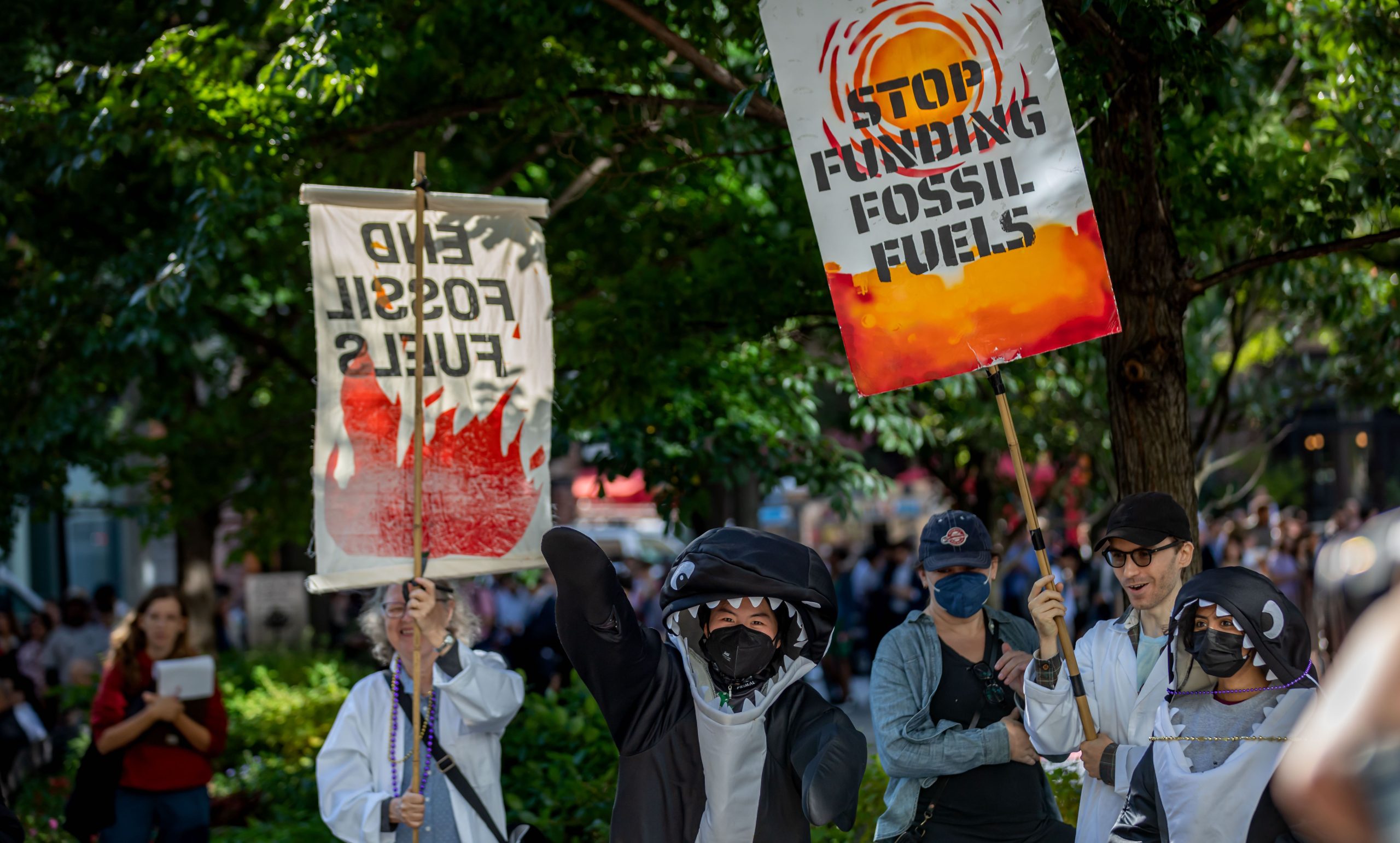
Following the US banks’ departure, the weight and make-up of the coalition have changed significantly. At its peak, the NZBA members had assets worth a combined $74 trillion – that is now down by a quarter. Meanwhile, European banks – which have so far stayed put – have gained greater influence.
Wall Street’s faltering on climate action opens up opportunity for European banks
Aubineau told Climate Home the internal debate over the future direction of the coalition is now picking up pace.
“The NZBA is trying to choose between two options: lower the ambition again and try to keep as many banks as possible or try to strengthen the guidance and move forward with those that are really committed,” he said.
While the departure of the US banks should be “a key opportunity” to turn a page and bolster commitments, “unfortunately, I think the NZBA might be considering the first option”, he warned.
HSBC – a founding member of the NZBA – ditched on Wednesday a target of reaching net-zero carbon emissions across its business by 2030 citing slow change in the real economy.
A decision over the direction of travel is expected in the next few months by the steering group, which includes both progressive lenders, including Amalgamated Bank, and some of the world’s top fossil fuel financiers, like Japan’s MUFG and Spain’s BBVA.
RMI’s O’Hanlon said that, while NZBA members should work out what the coalition is trying to achieve, climate regulations and government economic policy provide stronger transition levers than a voluntary framework.
“Incentives have always shaped the economic case for these financial institutions,” he added. “If the government tilts the market and the playing field to disadvantage certain technologies that are lower carbon, you will see a knock-on effect,” he added.
The post The world’s biggest climate finance coalition is in crisis. Is it worth saving? appeared first on Climate Home News.
The world’s biggest climate finance coalition is in crisis. Is it worth saving?

Mae Buenaventura is the manager of the debt justice programme of the Asian Peoples’ Movement on Debt and Development, a regional alliance of peoples’ movements, community organizations, coalitions, NGOs and networks
A potentially historic shift in public debt governance is set to unfold in Washington DC this week as Global South governments take a collective stand to stop a “silent killer” of development financing.
The first-ever UN-hosted borrowers’ forum will officially be launched on April 15 on the sidelines of the 2026 Spring Meetings of the International Monetary Fund (IMF) and the World Bank. Led by five convening countries – Zambia, Egypt, Nepal, the Maldives and Pakistan – the initiative is one of the key wins of last year’s 4th Financing for Development Conference (FFD4) in Sevilla, Spain.
The forum’s mandate is to establish a platform for borrower countries, supported by a UN secretariat, “to discuss technical issues, share information and experiences in addressing debt challenges, increase access to technical assistance and capacity-building in debt management, coordinate approaches and strengthen borrower countries’ voices in the global debt architecture”.
Instead of facing lenders alone, these countries will now use a UN-backed platform to share technical expertise and coordinate their approach to a global debt system that is fundamentally broken.
Debt grips climate-vulnerable nations
The human cost of the current debt architecture is staggering. According to the UN trade and development agency, UNCTAD, more than 40% of the global population – roughly 3.4 billion people – live in countries where the government is forced to spend more on debt payments than on the health, education and social protection of its citizens.
In so-called low-income countries, governments spend an average of 7.5% of their total budgets on debt service, with interest payments consuming up to 20% of total government revenue in these regions.
The Philippines is a case study in this financial stranglehold. It is part of a global majority forced to watch its public services crumble and infrastructure lag while its wealth is siphoned off to satisfy foreign lenders.
The policy of automatic appropriations – a legacy of the rule of late former President Ferdinand Marcos Sr. – mandates that debt servicing takes precedence over any other public expenditure, effectively placing the demands of lenders above the needs of the Filipino people. Even as it faces a $1.5 trillion regional financing gap to achieve the Sustainable Development Goals (SDGs) by 2030, its hands remain tied by a legal framework that values credit ratings over human lives.
-
GEF raises $3.9bn ahead of funding deadline, $1bn below previous budget
Amid aid cuts, donor governments pledge less nature and climate funding to the Global Environment Facility (GEF), with the four-year package to be finalised in late May -
Charging worries, high prices put brakes on EV growth in Bangladesh
Sales of e-bikes and rickshaws are up amid queues at fuel stations, but a lack of charging infrastructure and high prices still deter many Bangladeshis from going electric


As a “middle-income country” (MIC), the Philippines is stuck in a frustrating purgatory. It is often deemed “too wealthy” for the G20’s debt-relief framework, yet too poor to absorb global economic shocks. Last year, Finance Undersecretary Joven Balbosa hit the nail on the head when he called for support that goes “beyond the simplistic income categorization” that ignores a country’s actual vulnerabilities.
Without an inclusive and equitable global debt architecture, nations including the Philippines are left to navigate catastrophic climate risks and economic shocks with zero fiscal breathing space.
No respite during climate disasters
The regional evidence of this systemic failure is everywhere. Take Pakistan, which in 2022 was hit by catastrophic flooding that submerged a third of the country and caused billions in losses. Despite this climate-driven disaster, World Bank data shows that Pakistan made payments in 2023 of $11.8 billion for public and publicly guaranteed (PPG) external debt, while its PPG external debt reached $93 billion that same year, surpassing pre-pandemic debt of $87 billion (2020).
Sri Lanka followed IMF prescriptions throughout 16 lending programs since 1991, only to become the first Asian country this century to default. Its MIC status prevents application for debt relief and restructuring measures. Today, the Sri Lankan people bear the brunt of harsh conditionalities, including raising VAT from 8% to 15%, slashing food and fuel subsidies, and the erosion of hard-earned worker pensions.

Currently, the global rules of lending and borrowing are set by a “creditors’ club” composed of the IMF, the World Bank and the Global Sovereign Debt Roundtable it set up, and the Paris Club.
These institutions measure “debt sustainability” through a narrow lens of a country’s capacity to make timely repayments. They largely ignore internal economic inequalities, gender disparities and the existential threat of climate change.
Crises should trigger debt service cancellation
By organising the new borrowers’ forum, the Global South is signalling that the era of passive “standard-setting” by lenders is over.
The ultimate goal for global civil society and debt justice movements is the establishment of a UN Debt Convention; a democratic, binding and inclusive framework that governs both lenders and borrowers. This mechanism would ensure that debt restructuring and cancellation are sufficient to allow countries to fulfill their international human rights obligations and implement necessary climate actions.
Green Climate Fund picks locations for five developing country hubs
To be truly transformative, debt sustainability analyses must align with human rights and sustainable development needs. This means conducting impact assessments – both before and after loans are issued – to identify “illegitimate” debts that do not benefit the public.
Crucially, we need an automatic debt service cancellation mechanism that triggers during extreme climatic, environmental or health shocks. We also need a binding global debt registry to ensure that every loan is transparent and subject to public scrutiny.
Whether the borrowers’ forum becomes a true milestone depends on its courage to challenge the status quo. We can no longer allow debt to act as a “silent killer” of our future. It is time to demand a financial system that serves humanity, not just the balance sheets of the powerful.
The post Broken debt system must be fixed to confront future climate shocks appeared first on Climate Home News.
Broken debt system must be fixed to confront future climate shocks
Greenpeace and allies will be protesting outside Woodside’s Annual General Meeting to show the WA and federal governments strong community opposition to Woodside’s proposal to drill for gas at Scott Reef.
What: Protest outside Woodside Energy’s Annual General Meeting
When: 8am Thursday 23rd April 2026Where: Kagoshima Park (on the corner of Great Eastern Highway and Bolton Avenue)
What’s at stake
Scott Reef is a pristine ocean ecosystem off the north-west coast of Australia.
It is home to endangered and endemic species, including pygmy blue whales and the dusky sea snake, and a nesting ground for green sea turtles. Scott Reef is a place of extraordinary natural beauty, and a vital marine environment that supports a wide range of marine life.
What Woodside is proposing
Dirty fossil fuel corporation, Woodside Energy, is seeking approval to drill more than 50 gas wells underneath and around Scott Reef as part of its Browse project.
The gas would be extracted and transported to the Burrup Hub, the most polluting fossil fuel project in Australia. This proposal would industrialise the doorstep of Australia’s largest freestanding oceanic reef system – threatening the marine life that relies on it and the climate.
Why this can’t go ahead
The WA Environmental Protection Authority has already identified the risks of this project as “unacceptable”, issuing a preliminary rejection.
Serious concerns include:
- The risk of an oil spill
- Impacts on pygmy blue whales
- Damage to green sea turtle nesting grounds
These risks are severe, and potentially irreversible. But the decision hasn’t been made yet. The project is still being assessed.
The Federal Environment Minister is approaching a decision that will determine whether Scott Reef is protected – or vulnerable to decades of industrial gas destruction.
This is a defining moment.
Make opposition visible
Across Australia, people are speaking out to protect Scott Reef and oppose Woodside’s Browse project.
Showing that opposition is visible, coordinated and growing helps increase pressure on decision-makers ahead of this critical decision.
Join the protest
A protest outside Woodside’s AGM is a key public moment to demonstrate opposition and help protect Scott Reef.
Kagoshima Park (on the corner of Great Eastern Highway and Bolton Avenue) 8am, Thursday 23rd April 2026
Join the protest and help show how many people support protecting Scott Reef before the government makes its decision.
Join Greenpeace to save Scott Reef from Woodside’s dirty gas
As demand for whale meat declines at home, Norway exports it to Japan, markets it to tourists and sells it online as dog food.
Norway reopened its annual whale hunting season earlier this month, continuing a practice most countries abandoned decades ago.
Norway Reopens Annual Whale Hunt Despite Pressure to End Commercial Whaling



-
Climate Change8 months ago
Guest post: Why China is still building new coal – and when it might stop
-
Greenhouse Gases8 months ago
Guest post: Why China is still building new coal – and when it might stop
-

 Greenhouse Gases2 years ago
嘉宾来稿:满足中国增长的用电需求 光伏加储能“比新建煤电更实惠”
-
Climate Change2 years ago
Bill Discounting Climate Change in Florida’s Energy Policy Awaits DeSantis’ Approval
-

 Climate Change2 years ago
嘉宾来稿:满足中国增长的用电需求 光伏加储能“比新建煤电更实惠”
-
Climate Change Videos2 years ago
The toxic gas flares fuelling Nigeria’s climate change – BBC News
-

 Renewable Energy6 months ago
Sending Progressive Philanthropist George Soros to Prison?
-

 Carbon Footprint2 years ago
US SEC’s Climate Disclosure Rules Spur Renewed Interest in Carbon Credits