

Freshwater, essential for ecosystems and human well-being, is becoming increasingly scarce.
Population growth, urbanisation and socioeconomic development are all driving greater demand for the world’s finite water resources. At the same time, climate change is altering precipitation patterns and affecting water availability.
Currently, approximately four billion people experience water scarcity for at least one month each year.
Irrigated agriculture – which accounts for nearly 90% of the world’s water consumption – is a major driver of this scarcity.
Without substantial reductions in greenhouse gas emissions, global temperatures could rise by 3C by the end of the century, exacerbating water shortages and impacting an additional 0.8 to 2.2 billion people.
In our new study, published in Nature Communications, we quantify and map current “water gaps” – shortfalls where water demand exceeds supply – around the world, and project how 1.5C and 3C of warming will impact water availability.
We find that under 1.5C of warming, the global water gap will increase by nearly 6%. But under 3C of warming, the gap will grow by almost 15%.
Our work shows that mitigating climate change can help lessen future water shortfalls, but robust adaptation methods will also be necessary to secure water security in a warmer world.
‘Water gaps’
Traditionally, scientists have quantified water scarcity with a variety of indicators, which help assess water availability relative to demand.
For example, the Falkenmark Indicator, or water stress index, is a simple indicator, measuring the per-capita water availability. However, this approach says nothing about the quality of the water, the soil moisture (which is critical for agriculture) or the environmental flows. Other indicators include the water use-to-availability ratio and the water poverty index.
These indicators have been instrumental in highlighting resource limitations, but they are no longer sufficient for modern water management needs because they do not provide a quantitative assessment of the water volumes overused by humans.
In our study, we introduce the concept of “water gaps”, defined as the difference in water volume when demand exceeds supply.
We used historical water use data and water availability from a water-resources model to map the average global water gap between 2001 and 2010.
This approach has some advantages over traditional indicators.
By actually quantifying the volumes of water needed to solve water scarcity in a given location, decisionmakers can be better informed when designing solutions to solve it. For example, given a certain water gap, they can figure out how much desalination would be needed to solve water scarcity.
Water gaps represent the difference between the availability of “renewable” water resources and water consumption within a specific region and timeframe – where renewable water is that which can be replenished naturally through the water cycle.
When water availability falls below consumption, it signals a critical shortage and leads to unsustainable water use. These shortages threaten human needs, agriculture, industry, energy production and ecosystems – potentially leading to severe social, economic and environmental consequences.
We found that the current global water gap is approximately 458 cubic kilometres (km3) per year. (One cubic kilometre is equivalent to 1bn cubic metres.) The countries with the largest individual gaps are India, the US, Pakistan, Iran and China, but water gaps exist on every continent.
The map below shows the baseline average water gap, with lighter colours representing smaller gaps and darker colours representing larger ones. Light blue areas are areas where there is no water gap, and white areas show regions without human water consumption.

In areas with water gaps, humans must make up the shortfall by depleting groundwater, rivers, lakes and aquatic ecosystems.
Future shortfalls
We also look forward, projecting how water gaps might grow under future climate change.
We use five climate models from the sixth Coupled Model Intercomparison Project (CMIP6) to obtain projections of climatic conditions, such as rainfall and temperature.We focus on two levels of warming: 1.5C, part of the long-term goal under the Paris Agreement, and 3C, which is a realistic level of warming for the end of the century under current climate policies.
Then, we use those climate outputs into a hydrological model to determine the availability of renewable water under each warming scenario.
Under 1.5C of warming, the global water gap is projected to increase by around 26.5km3 per year – an increase of 5.8% from the current baseline. A 3C warming scenario would see a more severe rise of 67.4km3 per year, or 14.7%.
The difference in the size of the water gap under these two warming scenarios underscores the critical need for ongoing climate change mitigation to minimise its impact on water resources.
Regional patterns
The regional variability in water gaps highlights the uneven impacts of climate change, with some countries and river basins facing significant vulnerabilities.
India, which has the largest baseline water gap of 124.3km3 per year, is also expected to see the most significant increase in water gaps. Other countries experiencing notable increases include China, Pakistan, the US, Spain and Turkey.
Substantial water gaps can currently be found in the Ganges-Brahmaputra basin in India and Bangladesh, the Sabarmati basin in India and the Tigris-Euphrates basin, which covers much of the Middle East. Under both warming scenarios, notable increases in water gaps are expected in the Ganges-Brahmaputra basin and the Mississippi-Missouri basin in the US.
While the climate models we used agree on worsening water gaps in most regions, some countries, such as Nigeria, Niger, Chad, Sudan, Ethiopia, Vietnam and the Philippines, are projected to see modest reductions in water gaps. Modest decreases are anticipated in the Sabarmati and Nile river basins.
The maps below show the projected changes in global water gaps under 1.5C (top) and 3C (bottom) of warming. Areas in blue are projected to have a decreased water gap in the future, while areas in red are projected to have an increased one.

No single solution can ensure global water security – effective solutions require both reducing water consumption and increasing water availability.
Reducing consumption can involve switching to less water-intensive crops, minimising food waste and enhancing irrigation efficiency. On the supply side, expanding water storage infrastructure, investing in seawater desalination technologies, and reusing treated wastewater can help augment freshwater resources.
A combination of these approaches, tailored to local needs, is essential for tackling water scarcity and ensuring long-term water security.
Our findings underscore the urgent need for robust adaptation and mitigation strategies to manage escalating water scarcity. By quantifying these future water gaps, decisionmakers can better understand regional vulnerabilities and develop targeted interventions.


The post Guest post: How the global ‘water gap’ will grow under climate change appeared first on Carbon Brief.
Guest post: How the global ‘water gap’ will grow under climate change

Three countries have been named by the Paris Agreement’s compliance committee for failing to submit a nationally determined contribution (NDC) and repeatedly snubbing offers of help with their climate plans.
After months of internal debate over whether to identify serial non-responders, the Paris Agreement’s Implementation and Compliance Committee (PAICC) named the three countries which have failed to engage with it over their NDCs on Friday.
It named Democratic Republic of Congo, Senegal and North Korea in a footnote of its annual report, adding that it decided to name them “with a view to facilitating engagement”, adding that representatives of the three nations had been invited to its meeting in early 2027 “with the purpose of identifying any challenges and constraints”.
“The Committee noted the importance of Parties engaging with the Committee in a timely manner, while noting that some delays may be due to the national capabilities and circumstances of the Parties”, the report said.
-
Under US pressure, World Bank says it will back gas “where appropriate”
The US wants the World Bank to expand its gas support while climate campaigners are pushing for it to end – its head spoke this week of limited backing for the fossil fuel -
IPCC scientists vow to press on with climate reports despite political deadlock
After governments again failed to agree a timeline, nearly 120 IPCC authors pledged to complete their assessment on time and with full scientific rigour -
Paris Agreement committee snubbed over missing NDC climate plans
Many governments have still not submitted a nationally determined contribution to the UN, breaching a key requirement of the Paris Agreement

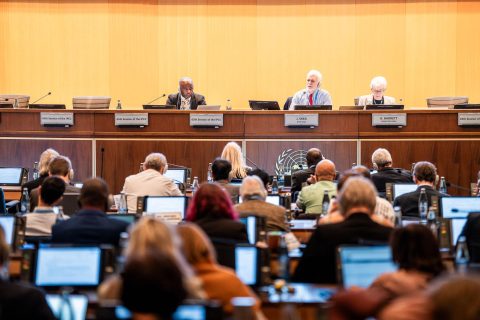

In July, PAICC said 12 countries had ignored its repeated attempts to discuss why they had not published an NDC as required every five years under the 2015 Paris accord.
Members of the committee had been divided over whether to name them, but at a September meeting decided to do so in their annual report to the annual climate COP summit.
By the time the report was published on Friday, only Congo, Senegal and North Korea “had not communicated an NDC or submitted a [Biennial Transparency Report] and had not yet responded to any of the Committee’s notifications, despite several reminders issued by the Committee in this regard”.
Rainforest and renewable energy ambitions
The silence from Congo and Senegal is notable because the former is home to much of the Congo Basin rainforest while the latter has sought billions of dollars in climate finance to support its renewable energy ambitions.
After Brazil, Congo has more rainforest than any country in the world. This forest, and the country’s peatlands, absorb huge amounts of greenhouse gas but are fast being lost to expanding farmland, charcoal production, logging and mining.
Senegal signed a Just Energy Transition Partnership with Canada and wealthy European nations in 2023, to help it meet its renewable energy targets under the-then government of Macky Sall. It was chair of the Least Developed Countries group between January 2022 and December 2023.

Tejas Rao, who is researching the PAICC as part of a doctoral thesis at Cambridge University, said the governments of the three countries should engage with the committee.
“Engagement costs these governments very little and the committee has shown it will listen,” he said.
“Silence leaves the committee with no basis to help, and it leaves the [governments] exposed to the narrative that they are simply disengaged,” he told Climate Home News.
Paris Agreement requirement
The 2015 Paris Agreement requires all parties to publish an NDC every five years outlining their emissions reduction targets, with each plan meant to be more ambitious than the country’s last NDC.
The latest set – the third round of plans, with new targets for 2035 – was due in February 2025. While most countries missed this deadline, all but around 30 – mostly small emitters but including Egypt, Vietnam and Argentina – have now submitted them.
Over the year, the PAICC – which is made up of government climate officials from developed and developing countries – has been communicating with governments that have not submitted NDCs and trying to overcome barriers to them doing so.
Some nations have cited exceptional circumstances as the reason for not submitting an NDC, a process that requires a significant amount of work in tracking emissions and consulting on how to curb them across the economy. For example, a letter from a Sudanese official to the PAICC, seen by Climate Home News, said that the country’s civil war had led to the suspension of its NDC preparation.
-
IPCC scientists vow to press on with climate reports despite political deadlock
After governments again failed to agree a timeline, nearly 120 IPCC authors pledged to complete their assessment on time and with full scientific rigour -
Under US pressure, World Bank says it will back gas “where appropriate”
The US wants the World Bank to expand its gas support while climate campaigners are pushing for it to end – its head spoke this week of limited backing for the fossil fuel -
Who shapes climate science? The equity question facing the IPCC
Early completion of the next global climate science assessment reports risks excluding research from the Global South, which is key to ensuring the findings are fair
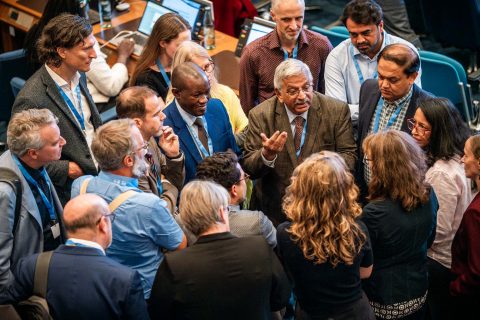
The US and Iran are not signed up to the Paris Agreement and so do not have active NDCs, nor does Taiwan, which is not a UN member state.
Rao said that because the PAICC is “facilitative and non-punitive”, naming the countries “is meant to open a door, not close one – the invited consultation is the point”.
“In recent months, governments that explained their constraints, whether capacity, finance or domestic process, have been met with follow-up and support rather than sanction, and the number of silent governments has fallen sharply,” Rao said.
The post Paris Agreement committee names three countries snubbing it over NDCs appeared first on Climate Home News.
Paris Agreement committee names three countries snubbing it over NDCs