

Founded in 1947 by J.I. Rodale, Rodale Institute is a nonprofit dedicated to helping the regenerative organic agriculture movement grow through research, education and farmer training.
In his study of regenerative organic farming, Rodale — who came up with the term “organic” — studied Indigenous agricultural practices, including those of communities like the long-lived Hunza Peoples of Northern Pakistan.
“A lot of people credit him really with being the preeminent thinker and leader in this modern day organic movement. J.I. Rodale coined the term ‘organic’ as it’s used today. He started a nonprofit in 1947 and ironically the original name for our organization was the Soil and Health Foundation, which I find to be so profound that this man had the vision to connect soil health with human health,” CEO of Rodale Institute Jeff Tkach told EcoWatch in an interview. “Fast forward to today — 77 years later — I think we all know that there is a fundamental disconnect in our society that human beings are divorced and disconnected from their food system, from nature. And I think it’s what’s leading to a chronic health epidemic. I think that we all are recognizing that our health begins in the soil, and how we farm matters. And so J.I. Rodale was way out in front, you know, doing that work.”

Before founding the institute, Rodale was an entrepreneur who started a company with his brother in New York City.
“He came from poverty, but one of the challenges in his life was his health. He came from a lineage where his father and his uncles didn’t live past the age of 57. And when he and his brother began to accumulate enough wealth, they decided to move their business out of New York City to rural Pennsylvania and he bought a farm,” Tkach told EcoWatch. “He had never farmed a day in his life. And he just had this sense that if he could control his food and where his food came from and how his food was produced that it would have an impact on his longevity. So he bought a 40-acre farm in Lehigh County, Pennsylvania, outside of Allentown, and started talking to all the experts in farming.”

J.I. Rodale. Photo courtesy of the Rodale family
After starting his farm in Pennsylvania, Rodale became curious about how the chemicals that were being used in agriculture after World War II were impacting the food people were eating.
“The representatives at the land grant universities like Penn State and Rutgers and Cornell… were all telling him about this amazing innovation in farming called chemical agriculture, [but] no one could really sufficiently answer his question around how those chemicals could yield healthy food. So he started looking to Indigenous populations,” Tkach told EcoWatch. “He was very concerned around where agriculture was headed if we stopped considering the power of nature… I think that was really his concern, that we were going to lose sight of the miracle of nature to heal us, to feed us, to nourish us in the name of innovation.”
Rodale Institute offers science programs and direct farmer support to facilitate change in food production and farming globally.
“As the birthplace of the modern Organic movement, Rodale Institute is filling the massive void of American land-grant institutions by revolutionizing farming and aiming to fix what is broken in our food system,” a press release from the institute said.
Rodale Institute co-founded the “regenerative organic” certification, which is the food industry’s highest standard. For 40 years, the institute’s farming educational and consulting programs — Farming Systems Trial — have been equipping thousands of farmers in the United States with the resources and knowledge they need to adopt regenerative organic agricultural practices.
U.S. consumer demand for certified organic products currently exceeds supply, which makes organic farming a potentially economically viable option for small and large farms.
Rodale Institute is planning to transition a million acres of farmland to regenerative organic agriculture in the next decade.
“We’ve just contracted with Organic Valley, and we’re working with a select number of their farmers to help them adopt organic practices and to do it more effectively, as well as to be able to help connect those farmers with more lucrative markets, so that they have a place to sell their crops at the highest value,” Tkach told EcoWatch.
Tkach said one of the roles Rodale Institute plays is assisting farmers with the barriers they face when transitioning to organic.
“‘Where am I going to sell my crop? How am I going to effectively embrace organic practices? How am I going to overcome pressures like weeds and pests?’ All these things that you and I don’t think about, but that farmers face every day,” Tkach said. “So Rodale is stepping in to help farmers. And in a lot of ways we’re acting as a land grant on a national scale for farmers, because our land grant system does not currently serve organic farmers. So the same challenge that J.I. Rodale faced 77 years ago, many of America’s farmers still face today.”
Rodale Institute’s philosophy is to always keep moving things forward through research and innovation.
“We pride ourselves in being an innovative organization, and even though we’re 77 years old, it feels like we’re a 77 year old startup right now because the world has finally embraced what Rodale has been espousing for a very long time,” Tkach told EcoWatch. “We see agriculture as a continuum, and we’re trying to help move farmers from conventional chemical farming down a path towards embracing better and better, healthier agricultural practices.”
Tkach said Rodale Institute helps farmers make the transition “by doing long-term science.”
“So I’m sitting today in my office, but my office is on a 400-acre farm. And when I walk out of my office, there’s research happening all over our farm,” Tkach said. “One study in particular is a 44-year study that is the longest running trial of its kind in the world, where we’re studying organic and conventional grain cropping systems, and we’re able to look at how these two ways of farming are very different and what their long-term implications are… I think the science is what sets us apart, because there’s really no other entity in North America that’s doing long-term research on organic agriculture.”
Tkach said the researchers are able to demonstrate that organic farming is not only “more ecologically sound” and better for the environment, but more profitable as well.

The Rodale Institute’s research team studies various weed management practices in their fields and in partnership with farmers. Photo courtesy of Rodale Institute
“If you want to heal the rural and the urban divide and begin investing in rural economies, our farmers are struggling in this country, they need to improve their bottom line. And organic agriculture is driving between three and six times more profits for farmers,” Tkach told EcoWatch. “Our science has proven that.”
Tkach said regenerative organic farming is not just for smaller family-owned farms, as larger farms are embracing the practices as well.
“Rodale has proven that organic regenerative organic agriculture can be scaled… Today, our national network of consultants that are Rodale employees have been called upon by some of the biggest food companies in the world,” Tkach said. “One example is General Mills. General Mills has recently hired Rodale Institute as a nonprofit to go out and work with 70 farmers in the upper Midwest that are producing oats and wheat — two of the biggest ingredients that General Mills grows.”
Tkach said the country’s need for certified organic products is outpacing its supply.
“So right now there is a greater demand for certified organic products in the United States than we can supply domestically. The U.S. is a net importer of organic food,” Tkach explained. “During this new administration I actually was in DC five weeks ago meeting with House and Senate leaders of the Ag Committee and, frankly, I received support from both sides of the aisle… So I always say that organic agriculture is for all of us. We all eat. We all want to live on a healthy planet. We all want to be healthy. And in order to do that, we need to come to grips that our current farming system is fundamentally broken. We have to transform agriculture in this country.”
“There’s something in organic that every one of us can be excited about. If you want to talk about onshoring our food system and creating a regional resilient food system, that’s what organic agriculture can do for us. If you want to talk about lowering our healthcare costs, well, it starts with what we’re eating. Food is medicine. And Rodale is saying that healthy food starts in healthy soil. And healthy soil is birthed on organic farms,” Tkach added.
Tkach said Rodale science has demonstrated that much of the world’s carbon emissions can be sequestered in the soil on organic farms.
“How we farm can actually become a carbon sink in agriculture,” Tkach said.
Rodale Institute was recently named one of the most innovative companies in the world for 2025 by the magazine Fast Company.
“I’ve actually been a reader of Fast Company for most of my adult life… It’s a magazine about innovation,” Tkach told EcoWatch. “My life was deeply touched by their content over the years… It was a huge honor… It’s kind of hilarious that a 77-year-old company is being named to that list, but it’s a testament to where we are in the world and how the innovation that we’ve been leading is finally getting recognized.”
Rodale is co-hosting the first Good Farmer Award in recognition and support of farmers who have been using organic practices for a decade or less.
“We are going to be co-hosting an award called the Good Farmer Award in partnership with our brand partner Davines… recognizing farmers that are at the early part of their journey and that are looking for some financial support,” Tkach told EcoWatch. “Some of the biggest barriers for young farmers is capital. Farming is a very capital-intensive business, and Rodale is going to be looking to honor and celebrate beginning farmers who are using organic and responsible practices, and we’re going to try to award them with some funding to help get them get their business off the ground. So we’re really excited about that.”
The first recipient of the award is Clarenda “Farmer Cee” Stanley.
“The award recognizes outstanding farmers making positive environmental and social contributions to agriculture through regenerative organic practices,” a press release from Rodale Institute and Davines Group said. “Clarenda Stanley, founder and CEO of Green Heffa Farms in North Carolina, stood out for her commitment to economic empowerment, education, equity, and ecological stewardship.”
I asked Tkach what individuals can do to support regenerative organic farming in the U.S.
“Right now, the word regenerative is being co-opted and greenwashed by the biggest food companies in the world. When we talk about regenerative farming in and of itself, that means everything and nothing,” Tkach told EcoWatch. “But Rodale helped to co-found the newest and highest bar certification in the food industry: regenorganic.org. That is what all consumers should be supporting. They should be looking for foods that have both the USDA organic and regenerative organic label on them, and supporting those farmers and those brands, because that’s the kind of food system we’re trying to usher in.”
“Robert Rodale, the founder of the Rodale Institute’s son, actually coined the term regenerative farming in the 1970s. And he believed that we regenerate when we begin to farm in a regenerative way. We start by healing the soil, but everything else in that system improves over time,” Tkach said. “And so we’re asking consumers to participate in a better food system.”
Tkach recommended that, in addition to supporting the certifications and brands, every consumer should “get to know a farmer.”
“We all should have a relationship with someone in our community that is growing healthy food and we should support them,” Tkach said. “If you’re even more courageous and adventurous, I always tell people they should try to plant something, you know, just grow one thing, whether it’s a potted plant on your windowsill or a raised bed garden… we all should become farmers and stewards of the earth.”
“The rhythm of nature changes you. It deepens your human experience, and it makes you a better human. And I think it starts with food,” he said.
Educational materials and resources on organic farming — including free webinars and courses — are available on Rodale Institute’s website.
“If we’re talking about a win that everyone can get behind, it’s organic farming. And it’s not a polarizing topic. It’s something that we can all agree on,” Tkach said.
The post ‘The Science Is What Sets Us Apart’: How the Rodale Institute Has Spent 77 Years Innovating Regenerative Organic Agriculture appeared first on EcoWatch.
https://www.ecowatch.com/rodale-institute-organic-agriculture-ecowatch.html

Just like fashion has been overrun by fast fashion, home goods and furniture have similarly seen a rapid decline in quality. Rugs are no exception.
And similar to fashion, these cheap goods come at a high cost — namely, to the planet and to people. In fact carpet and rug production is rampant with exploitation.
On the other hand, fair trade rugs present the best of what a rug can bring to your home: artistry, craftsmanship, and heritage.
The brands featured in this guide are partnering with (and fairly paying!) skilled artisans who are using generations-old — and sometimes even centuries-old — techniques. These artisans are sustaining long lines of crafts, preserving their cultural diversity, and celebrating the richness of their time-honored crafts.
There’s simply no replacement for a timeless, quality artisan-made rug — they’re like pieces of art you can lay out on your floor or hang on your walls.
So, enjoy browsing through this guide to sustainable rug brands listed out below and best of luck on your search for the right fair trade rug!
Where to Find Ethical and Fair Trade Rugs
Note that this guide includes affiliates and partners. As always, brands must meet high standards for ethics and sustainability to be featured and all opinions are my own.
1. Obakki
Best for: warm-hued handwoven wool rugs
Categories: Area Rugs, Runners, Accent Rugs
Obakki partners with artisan weavers primarily in Oaxaca, Mexico — including individual makers like José — who hand-dyes and weaves rugs on a traditional pedal loom using locally sourced sheep’s wool and natural dyes derived from native plants. The brand also works with Rrres Design Studio, a Latin American studio dedicated to preserving traditional Oaxacan weaving techniques, and sources handwoven textiles from artisan communities beyond Mexico as well, including Morocco.
Each rug is made from 100% wool with no synthetic dyes or backing. Most pieces are made-to-order with a 4-8 week production window, shipped directly from the artisan partners.
Price Range: $460 – $4,159
Conscious Qualities: Natural Fibers, Natural Dyes, Craft Preservation

2. Kiliim
Best for: modern wool kilim rugs
Categories: Area Rugs, Accent Rugs
If you’re well-versed in rug terminology, you may recognize that this brand’s name looks similar to the word kilim.
Kiliim’s rug are made using authentic kilim rug craftsmanship by artisans in Egypt coming from generations of kilim artisans. To ensure ethical production and to support the preservation of this heritage craft, Kiliim pays living wages to all artisans.
Price Range: $95 – $4,812
Conscious Qualities: Ethical Production, Heritage Craft Preservation, Natural Fibers
3. Urban Natural
Best for: browsing fair trade rugs in lots of styles and sizes
Categories: Outdoor, Area Rugs, and Accent Rugs
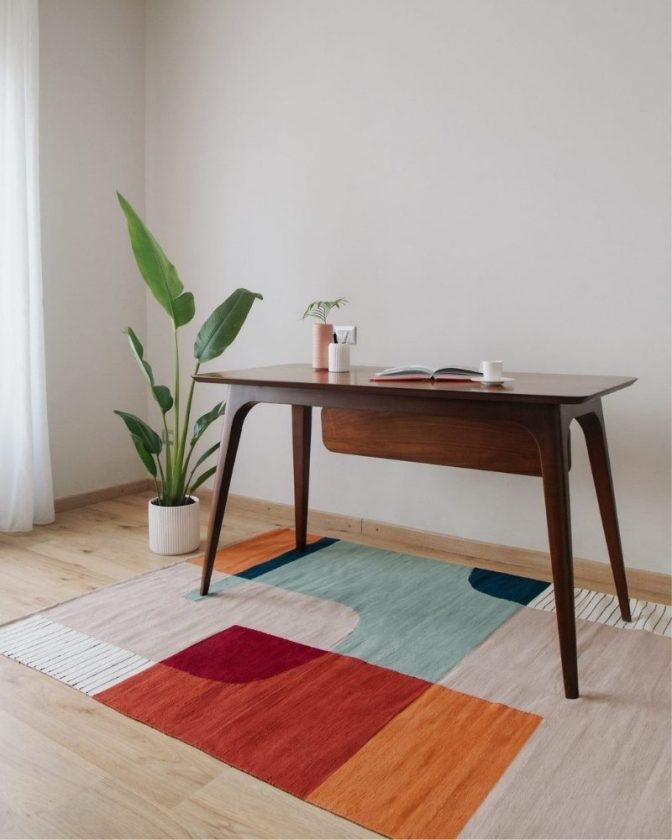
This natural home and lifestyle retailer has a beautifully curated selection of sustainably-made rugs crafted with materials like jute, sisal, wool, and cotton.
Several brands on Urban Natural are also ethically hand-loomed or hand-knotted, such as Loloi — a GoodWeave partner — and Jaipur Living — a brand that partners with thousands of local artisans to sustain heritage crafts.
Price Range: $259 – $9,755
Conscious Qualities: Eco-Conscious Materials

4. LOOMY
Best for: pet-friendly and performance rugs
Categories: Area Rugs, Accent Rugs, Runners, Outdoor Rugs
Founded by a weaver, LOOMY is dedicated to crafting beautiful artisan-made rugs that will last for decades to come.
LOOMY partners with highly-skilled artisan weavers who craft quality rugs made from eco-minded materials like banana silk, jute, and recycled cotton, plus performance options made from 100% recycled polyester built to withstand whatever life brings you.
Price Range: $298 – $8,298
Conscious Qualities: Natural Fibers, Craft Preservation, Vintage Options