

Weather Guard Lightning Tech
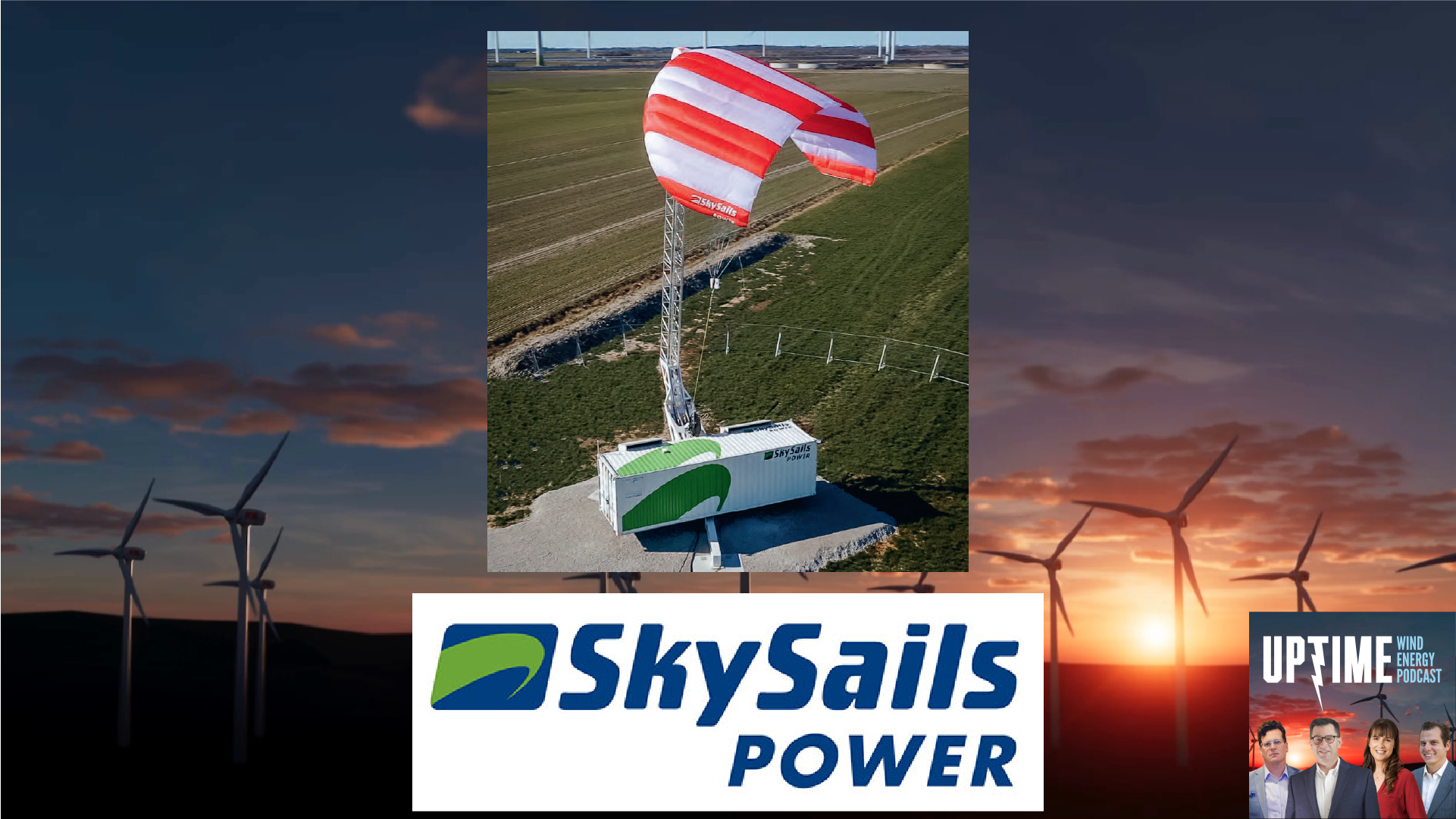
SkySails Power’s Innovative Airborne Wind Systems
Mark Hoppe, VP of Public Affairs & Business Development at SkySails Power, discusses their containerized airborne wind energy system. The innovative technology captures high-altitude winds with kite-based systems, producing up to 50% more yield than traditional turbines. Mark delves into the operational mechanics, deployment in remote and island nations, and future market expansion.
Sign up now for Uptime Tech News, our weekly email update on all things wind technology. This episode is sponsored by Weather Guard Lightning Tech. Learn more about Weather Guard’s StrikeTape Wind Turbine LPS retrofit. Follow the show on Facebook, YouTube, Twitter, Linkedin and visit Weather Guard on the web. And subscribe to Rosemary Barnes’ YouTube channel here. Have a question we can answer on the show? Email us!
Allen Hall: With traditional wind turbines, limited by location and high material costs, the industry needs innovative solutions for clean energy in remote areas. This week we speak with Mark Hoppe at SkySails Power. SkySails has developed a containerized airborne wind energy system that captures high altitude winds with unique kite technology producing up to 50% more yield than conventional turbines while being deployable nearly anywhere on the planet.
Stay tuned.
Welcome to Uptime Spotlight, shining Light on Wind. Energy’s brightest innovators. This is the Progress Powering tomorrow.
Allen Hall: Mark, welcome to the podcast.
Mark Hoppe: Yeah, thanks, man. Nice to be here.
Allen Hall: I’ve been looking to talk to you for. Ooh, going on at least two years because I saw SkySails in Hamburg at the Hamburg Wind Energy Show, and I thought, wow, this is really cool. And then, and the display was [00:01:00] good and the information was good.
I just didn’t know how much effort had gone into it at that point. And, and we’re two years further along, obviously. The SkySails technology and the problem you’re solving is really fascinating because there’s a lot of places on the planet that could use wind energy, but a standard horizontal axis wind turbine is probably the not the right approach, and diesel ends up being the winner on a lot of these places.
Mark Hoppe: That’s a problem. Definitely, definitely. So yeah, our technology solves a lot of these problems, but of course our technology is not just meant for these kind of places. So this is the entry point where we go in as, these places, they’ve faced a lot of issues when it comes to logistics, prices of the diesel because of the transport costs.
That also includes in, in the diesel prices, which then makes the diesel even, even pricier. So, and due to, they have to spend a lot, a lot of money on the diesel. Then they have the issue that they don’t have [00:02:00] the money for social development, for example. ‘Cause they have to subsidize their power prices and all this comes along.
So what we have as a solution for that problem is that we have a containerized wind power system. It’s so-called airborne wind energy system which uses the high altitude wind, which is more powerful. So we fly in heights between two and 400 meters, sometimes even higher. It depends on the width direction and everything.
And due to that we can use the higher wind and then produce 50% more yield than the typical wind turbine at the same size. So that’s crazy.
Allen Hall: Yes, that’s, that’s really good. I think the technology and the approach is innovative. So the, the solution to get rid of all the dependence on diesel and some of these electric grids that are very unreliable is to put in basically electric [00:03:00] generation through a, a kite in the sense the technology seems.
Relatively simple, but I’ve looked at this up close. There’s actually a lot of technology here because the system itself is really containerized. It’s like dropping a diesel generator on site somewhere, but except it’s a kite. Instead, you wanna explain basically how the system operates and what someone would see if they’re watching it work?
Mark Hoppe: Yeah, sure, sure, sure. So basically we, we always divide it into two subsystems more or less. So we have the ground station, which is a container. It’s a 30 feet container, so you can ship everywhere and just need one truck to to, to actually transport it somewhere. So this is really easy. And then you have the flying system. And the flying system at the ground station,
they’re connected via the start and landing mass. And the start and landing mast, so in, in the front of the start and landing mast, you have the kites. So when the start and landing mast goes up, [00:04:00] the in floating wind unfolds the kite and then the, the, the wind takes the kite upwards. And underneath the kite you have a robota, you can call it, we call it the control po.
It’s, you can compare it to a paraglide pilot more or less. And there you have an autopilot who steers to the whole system. Then what does is, I don’t know, have you, have you ever been kite surfing before?
Allen Hall: Yeah, I’ve seen it, yes.
Mark Hoppe: Yeah, so, so when you have kite surfing, you, you try to fly your kite in, in the so-called power zone, ’cause you have the wind window, so in the middle of it you have the power zone there, you have the most force and the autopilot does the same.
So it actually tries to fly inside the power zone all the time. So you have a lot of force on the, on the tether. And when the tether is unwind from the, from the winch inside the ground station, the rotational energy is converted into electricity, [00:05:00] and then you have 800 meter long tether on the drum.
And then when, when the 800 meters gone all the way out, the autopilot takes back the kite in nose dive, so it actually pitches the kite and then it falls down from the sky, and then it has, yeah, nearly no force. Then the generator X as a motor wheels in the, the tether again. And then when the autopilot is at a hundred meter, it starts all over.
So you can compare it to a yo-yo, you know.
Allen Hall: That’s a very good analogy. So the kite deploys out several hundred meters, 800 meters. Providing energy because of that pull force, turning a generator. And then in, when it reaches this extended length, it basically simplifies itself, lowers the drag, comes back in and repeats it.
So does, does that create continuous power then, or how does it handle the, the inward time in terms of. Power production? Is there a battery involved? What does that [00:06:00] look like?
Mark Hoppe: Yeah, so we always deliver our system in different configurations. So a little bit depends on this site conditions. So of course you can use it off-grid.
So what we would do then is we always deliver. So our system comes in a 30 feet container, and then you have another smaller container where you have a grid converter or a battery pack inside. And then so what we do with this solution is that we can always comply to the grid code but also of course can deliver an off grid system.
So you can either store the energy produced or use it direct or grid connect the whole system and then feed it into the grid. So that’s, that’s up to our customers on this side.
Joel Saxum: I think that one of the important things here to think about, like in the beginning of this conversation of how this thing looks, how it operates in the field, is that it [00:07:00] is modularized, right?
Like you’ve guys have taken the smart approach of putting this in a container because a lot of the places that this technology can be used can be on demand. Hey, I, in my mind, I’m thinking disaster response. I’m thinking military uses, remote microgrids. Like we have, we’ve had on the podcast before Hatch. Hatch works with a lot of First Nations up in Canada where they’re in these really remote places.
It’s hard to get infrastructure in there, but if you can bring this in on a truck, great. Right, so there’s a lot of places around the world, and I know this is, that’s just one use case, right? These remote, these Caribbean islands, like Allen was saying. Diesel generators, but they’re paying exorbitant amounts of cost for fuel.
So this thing, this and, and the fact that you can switch over to different grids right. So different her hertz ratings and voltages coming out. Really important. So where have you guys been able to deploy the system so far?
Mark Hoppe: So, so [00:08:00] far, and, and so far we have been installing systems. So we have one system in, in northern Germany, which is our research development side also.
And that one has also been grid connected now for five years. More or less and also been operating since then, but we use it for short durations in our the research development cycle. Then we have another system which has been installed Mauritius for now, also two and a half, three years, something.
Also grid connection, which has been operated all the time because of duration tests. So we actually get some figures about, okay, how last. How lasting are materials and what do we need to do to make them even last longer? So we learned a lot in the, in the past years on that.
And now we take all this into our product development cycles, and now we have another two systems [00:09:00] which are now being delivered to Taiwan. So the next installations will be in Taiwan, and then. We have some projects going on in the Philippines, Cape Words Hawaii. So all, all of these like island states and island nations, they, they, we were really active in these spaces right now.
French Polynesia is also really interesting so far remote places. And all these island states, they have a bigger issue. They have a really big issue ’cause they’re feeling the, the climate crisis first. So they need to solve it. And also, and, and also what, what we are look also looking into, which is a really interesting market, is the Caribbean.
Because there you have the same issues. You have hurricane region. So what they have to do is that they have to rebuild more or less the whole infrastructure every five to 10 years because everything has been destroyed. So they can’t even install any wind turbines because they’ve just been blown away.
And [00:10:00] in Mauritius we have proven that our system actually is feasible to withstand a typhoon many times.
Joel Saxum: Well, and these are good places to do installs too, I suppose from a business perspective. You get to go to the Caribbean, French Polynesia, like that. That sounds amazing. So one, one of the questions I’d ask you is kind of reviewing your technology here.
Do you, do you have a special kind of parachute material and a tether material that you guys use because it’s, you know, it’s long duration. In my mind, I think a parachute is, you know, down, repack put away. But this thing is gonna be out there for a long time. So throughout these great that you guys have had five year tests and it, you know, a two, three year test, have you developed those…or how have those technologies developed?
Mark Hoppe: So well, it has developed a lot and, and there’s still a lot to do. So because we still do a lot of material tests and now we extend them by far what we have done [00:11:00] before. So when you look at the materials, what we use now is for the tether we use Dyneema which is even used in, in, in shooting rests, I think.
And, and it’s like it’s. It’s, it’s better than steel. So it, it’s makes you made for a lot of force. And, and so you can think of, so we, we use a 40 millimeter tether. diameter 40 millimeter. And it, it, it withdraw. It’s, it’s made for I think six tons design load. And and yeah, so, so it withstands a lot.
Then what we use for the kites it’s actually the same kind of materials which we use in sailing, nowadays. And also what they do in development. When you look at the, the sales nowadays also, especially for the performance sail, you know, for the races, what they use there. This is these kind of materials we also [00:12:00] kind of use and also will extend because they are made to last for a lot of force, but they’re in light and all what we need.
And then for example, what we have done now, so we just bought the biggest tether bending machine in the world to actually do the tether testing and to extend all this knowledge, you know, because this is really important, you know, it’s also for the safetyness of our system because everything is built around the tether.
Well,
Allen Hall: Dyneema is the right choice there. That material has been proven over and over and over again in aerospace and in sailing. It is an extremely tough material. Yeah, and you’re only using the, a line that’s about a 10th of an inch wide diameter. That’s actually really small, but it does make sense because that’s the right choice.
Now, in terms of operational aspects one of the things I get ask about SkySails, well, how many hours a day [00:13:00] does it operate? Is it up there 24 hours a day? Is it up there five hours a day? What do you typically see in some of these installations?
Mark Hoppe: Our systems, they, so. Like looking over a year. I think it, it, it’s, it’s good to compare also the different technologies when you look at how many operational hours you have over one year.
And there you always call it full-load hours that you can have over one year. So if you have installed one megawatt then you have 5,000 full-load hours, and then you have 5,000 megawatt hours a yield per year. It’s pretty easy. So, and one year has 8,700 something hours, I think. So and our system has up to 5,000, full-load hours, depending on the size.
Allen Hall: That’s a lot.
Joel Saxum: That’s a, that’s a high capacity factor. Yeah. That’s higher than a, like a horizontal access. Yeah.
Mark Hoppe: Yeah. So if you, for example, compare a coal-fire plan t they have [00:14:00] coal power, power plant, they have ’cause of the service cycles and everything like this.
You have 4,500 full-load hours if you have a offshore winter turbine buying Europe. Depending on the site, 4,000 full-load hours. So what we do is we have offshore wind on onshore sites.
Joel Saxum: And, and what’s the output?
Mark Hoppe: Yeah, so for now now the systems is really small because also because of the sites we want to go into.
So they now have a, we call it cycle power because this is it’s not like what we know from conventional wind turbines. We, we call, we, we always talk about installed power. But we, in our industry, talk about cycle power. So what’s you have in a one power cycle? Yeah. And this is a 200 kilowatt system that we have now in the market.
Allen Hall: Okay. That’s a lot larger than I thought you were at right now. So that a 200 kilowatt sheen can help a lot of people, particularly in rural communities or whether it’s been through a hurricane. Just getting back up [00:15:00] and running is huge because the, the, the load is really simplistic. Lights, maybe cooking those kind of things, air conditioning.
Mark Hoppe: Yes. So the year would be 780 megawatt hours a year depending on the site, of course again. But that would be enough power for I think so just talking in German households. ‘Cause I have the number in my mind. So that would be something between two and 400 households. For one with one transmission..
Allen Hall: Yeah. It seems like a, the proper solution in, in a lot of cases. So what’s the deployment plan then? If you have a larger community, would you deploy two SkySails systems? Would you install a larger system? What does that look like in terms of the, the right approach and the units and to the community?
Mark Hoppe: So what can see now, so looking at our, how, how we go into the market now. So now we have this 200 kilowatt system which is actually meant for like all these [00:16:00] remote places where we have diesel hybridization with PV hybridization. All these places like remote off-grid solutions mostly and mini grids, micro grids. And then next step would be, and this what we are already have the pipeline is to develop the next bigger system.
Which is then also meant for more developed countries because you have a different load so which you can match. Then of course you match better the needs of, of these specific markets. And then also already planned is next step after that one. So first step would be now something between four and 500 kilowatt, and then the next step is already megawatt system.
And this is already planned to do. So this is already in project plans and everything.
Allen Hall: So what does a megawatt system look like in terms of the kite size? Does it expand? I, I don’t know what the math is. There is by, is it square function? How, how big does kite get versus a 200 kilowatt system to a [00:17:00] megawatt?
Mark Hoppe: Yes. So the 200 kilowatt system uses kites up to 180 square meters. Also depending on the wind distribution. So if you have a high wind site, you use a smaller kite. If you have a low wind site you use a bigger kite. So you can use the same system, but you just exchange kite, which is also really great.
When it comes to material intensity. Then if you look into the megawatt system. The kite size would probably be something between 700 square meter up to a thousand.
Joel Saxum: How do you, okay, so I’m thinking, I’m thinking in my this is my traditional mind thinking about wind, wind farm, siting and these other things.
So of course, like if you, Hey, we’re gonna build a wind farm here. You know, a year before that we put a mast tower out there. We measure the wind resource. We have a general idea of what it looks like at 10 meters above the surface and sometimes, you know, 50 or a hundred. How do you measure the [00:18:00] wind resource at 400 meters of, of height?
Like what does that look like? Because I don’t, I’ve, I don’t think I’ve ever seen a map that says, here’s the wind resource at 400 meters.
Mark Hoppe: So actually there is no, so this is why you’ve never seen one probably. Yeah, and this is a really interesting question actually, because, yeah. How do you measure the wind?
So nowadays we have what we do, we do kind of the same. So when we do project development so what we do is first, okay, our customers come to us and they, okay, we have an idea of a site which would work for us. And then what we do, we, we have, internal developed tool chain, which we use then do a small, like, like a really fast site scouting to get an idea of, okay, if this is this site actually feasible. With weather data, which we can just get from databases, everything is calculated.
Like is there a business case? Like pretty, pretty, pretty easy stuff. And then after that next step would be that we go there [00:19:00] and then we actually put a lidar on, on the site. And then we do a lidar measurement campaign. So also wind measurement campaign, but by, by using a lidar we can use we can measure the wind power up
far higher. And that’s, that’s it.
Allen Hall: All right. So this sounds really doable. I just did a quick Google search to see what the square meter area of an Airbus A380 is. It, it’s about, it’s about 850 square meters. So you’re talking about a kite that has the wingspan roughly as an Airbus A380, which is, it’s big, but doable. I mean, obviously those airplanes are flying around, so it is not particularly hard to, to make something of that size, particularly in, in a kite form. So this seems relatively straightforward. Once you cross that megawatt threshold, then your market expands dramatically. Correct?
Mark Hoppe: Yeah, it expands dramatically.
And then and, and, [00:20:00] and even for what, what, what then is the steps do is actually to put them offshore. To put them on the floor because then it expands even wider because what, what we, what we can do with this technology compared also to conventional technologies, which we have on the market nowadays.
Is that also there the floater can be much, much smaller because if you compare it to wind turbine. So the, the wind turbine has all the weight up in the sky and what does it do with the float? So the float must be really big because. Take care of the binding moments up in the ocean. And if you not have these binding moments, you don’t even need a floor, which is that big because if you look at our system, all the weight is on the ground.
So the only thing you need is actually an anchor, so it doesn’t swim away because of the kite.
Allen Hall: Alright, so let’s, let’s walk through the, the math of that for a second. So instead of putting out a 15 megawatt turbine and all the, [00:21:00] as Joel has pointed out on the podcast numerous times, the complexities of doing that, the ships, the pounding, the monopile, all the regulatory aspects.
Mark Hoppe: The material intensity.
Joel Saxum: Pure cost. Yeah.
Allen Hall: Pure cost, right? So you’re cutting out all the steel. Pretty much out of a wind turbine.
Mark Hoppe: Even the rare earth, because like if you, if you look at the wind turbines because they need to take care of the weight they need the rare earth is because otherwise the generator and, and, and the mag magnet inside for the, for the gear would be too to, to, to, would, would have too much weight, you know?
And since we don’t have that issue, we can use other materials like yeah, other materials, which is, which are not that easy, which are much more easy to get, you know. So because we don’t have the weight issue.
Allen Hall: Okay, so the cost would come way down. The simplicity would be there, the deployment would be easier. Are you seeing [00:22:00] interest in this and on offshore applications? I’m thinking Joel, I’m thinking California.
Joel Saxum: I’m thinking Gulf of Mexico. Because now, now you’ve, now you’ve solved the hurricane problem. Hurricane’s coming, wheel ’em in, shut ’em down for a second. Hurricane blows through, put ’em back up. So you remove that blade problem that we have in the Gulf of Mexico.
Mark Hoppe: That would be, that would be great. That would be a great site to actually, to, to develop such systems. And then yeah, and even though, even, even even sites like the, the coast of Japan, because in Japan you have the deep sea really deep sea coast, which means that it’s really hard to install any other wind turbines ’cause it’s deep, you know.
Allen Hall: As this technology develops over the, the next roughly year or so, you must be ramping up on the factories and the scale and to be able to produce these units. But that does seem like. There’s a lot of advantage here, particularly on the cost side. Man, even in like UAE, saudi Arabia, places like that, where there, there is wind, [00:23:00] just deploy it, boom, boom, boom.
Right? So what does that look like? Are you scaling up at the minute to, to take some of these orders because the math works out it looks like.
Mark Hoppe: Yeah, so actually we talk in the right moment. So what we do now is actually, so. We have, we have taken the step to develop the technology and we have proven the technology also by having the first, also being the first company in our industry to have a verified power curve last year.
So we, we made the proof for the technology that it actually works and produces power. And this year’s all about to go into the market. And we do this making big steps forward. So as we have a lot of customer inquiries and we’ve not done any. Any outreach from our side, so it’s all inbound.
Which is great. But now, so, so now we say now our customers are actually [00:24:00] ready to reserve their production slots. This is what we do now. So they can reserve the production slots and then we will deliver the system when they need them.
Allen Hall: So where can they see a system today? Like if, if I wanted to see a system in action, would I, would I just go to YouTube?
Would I, would I travel over to Germany? I. Where would, where I go to Mauritius, where would, where would I go to go see this live?
Mark Hoppe: So to see them live, of course it’s always good to go to Northern Germany or to Mauritius. But then of course in the near future, where you will see some flying in Taiwan.
And then we will extend to the Philippines. And then probably will be next or French, we will see, which is faster. And hopefully also Hawaii.
Allen Hall: I love Hawaii.
Joel Saxum: There we go. That’s where we want to go.
Mark Hoppe: Yeah, yeah, of course. I, I’m happy to invite you when, when you, when you’re ready to, to, to run, we take another podcast there I would say.
Allen Hall: That would be terrific.
Mark Hoppe: Yeah. We, so we actually, we are just ramping up, huh? We just ramping up this [00:25:00] whole, this whole market and, and this is really exciting to us.
Joel Saxum: Every country is different with airspace laws. Now there’s some, there’s some global stuff, general guidelines, right? But there’s every country’s different.
Like there’s these, you can’t fly a kite over 500 feet in the United States. Then you run into airspace and you have issues. How have you guys circumvented or dealt with some of those local airspace regulations?
Mark Hoppe: In our industry. There are different approaches right now. Because some of them, if you, if you compare the technologies they’re two different concepts.
So the one we use is the textile kit, and then you have other companies which uses rigid wing which, okay, we have our, why we use textile kite. We have a lot of yeah, issues why we do that and not do the other approach. But if you compare them, then the rigid wing companies, they claim that they’re kind of a drone [00:26:00] because of course they kind of look like a drone, a tether drone, more or less.
It looks like an airplane like a small airplane. But if you compare our kites with them then our kite is not an airplane.. Sorry. It, it’s not as immovable. And it so what we classify as is an obstacle.
Joel Saxum: Like a tower.
Mark Hoppe: Yeah, like a tower. Yeah. Like a structure. And then because of that we of course we need some marking, which means we now also have developed an integration concept, which comes with different kind of
yeah, safety measures. So, ’cause what we always have to take care of in, in using the airspace is that you have to take care about the safeness, of course. So all the other airspace users, they need to be aware of what you’re using as an airspace. Which means that you need marking. And the marking could [00:27:00] be that you have lighting.
It’s like a wind turbine. You have every 50 meters. You have some, some lighting on the tower flashing. And then, then, and what we use, we use kind of the same. So we have a lighting on the ground station, on the, on the mass, and then at the controlled part. And then the kite is also a white and red color.
And then what we also want to implement is a a map mark for the for the aerospace maps. For like a symbol for, for, so, so that, you know, okay, there’s an obstacle. And then you of course need some awareness campaigns to to, to make all them aware of the technology. And like, this also comes with more installations, of course.
And then for now, what we, what we try to get is a solution where we use EDDs danger zones. So like they, all the pilots are aware of, okay, there’s something, [00:28:00] but you can fly in, you can fly through. So it’s not a restricted zone, but it’s like a danger zone. So they even use these danger zones for, in Europe, they use them also in other countries for drones, for example for drone use spaces and stuff.
So yeah, that’s the way to go now.
Joel Saxum: In the States, it would be covered under a. I think right, Allen? A certificate of authorization for use, then that’s filed. Filed with the FAA, then they can go from there but.
Allen Hall: ‘Cause there are buildings that are operate, that exist, that are taller than what you’re flying at today in the world.
So you’re, you’re not the tallest object on the planet at the minute. And obviously there’s hills and mountains and things that are much taller. So I, this makes a ton of sense. So anybody who wants to find out about SkySails, you need to go to the website because there’s a ton of great information. They, yeah.
And the website is skysails-power.com. but they’re also on LinkedIn. You can see a lot of SkySails information there and their [00:29:00] YouTube channel. Yeah, YouTube is, the YouTube channel is really good. And, and check it out there. Mark, how do people get ahold of you if they want to acquire one of your systems or see a demo?
How do they do that?
Mark Hoppe: So it’s actually the easiest way would be just to visit our website and, and file us an inquiry. Or you can just send us a yeah a message on LinkedIn.
Allen Hall: Great technology. Fascinating. And the, the growth of this technology is astounding. One megawatt kites or sails does seem like a way to make more wind energy pretty slick. So check out skysails-power.com. Mark, thank you so much for being on the podcast and keep us up to date as things progress, especially if you go to Hawaii.
Mark Hoppe: Yeah, we will do that. Thank you Joel and thank you Allen
https://weatherguardwind.com/skysails-airborne-wind-system/

 For those who struggle with elementary school arithmetic, Trump won the election (50%+ approval) out of more than 150 million votes cast, and now his approval rating is in the low 30s.
That’s ~30 million voters who regret their choices, out of the common American.
Add in the Tucker Carlsons of the world.
Absolutely.
It must be done, because our country is home to some hateful morons who want to see honest, hardworking, taxpaying people with brown skin deported, and their families torn apart.
It wasn’t the American way until recently, but it sure is now.
 As shown at left, the United States is loaded with people who twist the facts to their liking.



-
Climate Change8 months ago
Guest post: Why China is still building new coal – and when it might stop
-
Greenhouse Gases8 months ago
Guest post: Why China is still building new coal – and when it might stop
-

 Greenhouse Gases2 years ago
嘉宾来稿:满足中国增长的用电需求 光伏加储能“比新建煤电更实惠”
-
Climate Change2 years ago
Bill Discounting Climate Change in Florida’s Energy Policy Awaits DeSantis’ Approval
-

 Climate Change2 years ago
嘉宾来稿:满足中国增长的用电需求 光伏加储能“比新建煤电更实惠”
-
Climate Change Videos2 years ago
The toxic gas flares fuelling Nigeria’s climate change – BBC News
-

 Renewable Energy6 months ago
Sending Progressive Philanthropist George Soros to Prison?
-

 Carbon Footprint2 years ago
US SEC’s Climate Disclosure Rules Spur Renewed Interest in Carbon Credits