

As oil prices spike due to the Iran war, a new diplomatic process launched in Colombia will support a group of 57 countries – among them large fossil-fuel producers – interested in designing national roadmaps and a new financial architecture to wean their economies off coal, oil and gas, as well as building a trade system that favours clean energy.
The first global conference on transitioning away from fossil fuels wrapped up on Wednesday in the coal-port city of Santa Marta after several days of discussions bringing together ministers, academics, Indigenous and Afro-descendant peoples, green groups, trade unions and business representatives.
It offered a space for governments frustrated by last year’s failed attempt at COP30 to develop a global roadmap away from fossil fuels to make progress on how to reduce their reliance on hydrocarbons in a fair and carefully planned way, in line with a commitment made at COP28 in Dubai. Large fossil fuel-producing countries have since blocked concrete advances at the UN talks on putting that into practice.
The Santa Marta outcomes will feed into a voluntary roadmap being crafted by COP30 hosts Brazil based on inputs from countries and civil society.
Santa Marta: Ministers grapple with practicalities of fossil fuel phase-out
At Wednesday’s closing plenary, Colombian environment minister Irene Vélez Torres announced that a second conference will be held early next year in the Pacific island nation of Tuvalu, co-chaired by Ireland, marking the start of a new policy-making process to run alongside the slower-paced climate COPs.
“For the first time, it demonstrates that it is possible to make a different type of environmental democracy,” Vélez Torres said, adding that improvements can be made to the methodology.
Colombia and the Netherlands, which jointly hosted the Santa Marta conference, said three workstreams had been set up to identify concrete ways to reduce fossil fuel dependence and strengthen co-operation between countries.
These workstreams are focused on designing national and regional roadmaps away from fossil fuels including coordinating support for implementation; reforming economic and financial architecture by reducing fossil fuel subsidies, unlocking investment and managing debt constraints; and connecting fossil fuel-producing and consuming nations to reshape the international trade system towards decarbonisation and green commerce.
A summary report of the conference said governments would receive policy support from a new panel of top scientists specialised in the energy transition, which will help countries develop roadmaps and align them with their national climate action plans (NDCs).
During two days of ministerial meetings, France was the first country to announce its own roadmap, which includes targets to end the consumption of coal by 2030, oil by 2045 and fossil gas by 2050 for energy purposes.
Dutch climate minister Stientje van Veldhoven said that, while “nobody is gonna force” governments to implement the anticipated roadmaps, “these countries came together because they want to transition to a different economy”, adding that the conference provides “safe space for dialogue”.
“The fact that we don’t have negotiations here gave us such different dynamics, so the psychology of the Santa Marta conference is something that we will definitely make sure to carry forward,” she told the plenary. Later she said at a press conference that the key was not to negotiate but to “collaborate”.
Call for a fossil fuel treaty
Countries gave mostly positive reactions to the conference proceedings and said the general mood had been uplifting. One government delegate from the Dominican Republic even had to fight back tears in the plenary as she thanked the hosts for inspiring the group of assembled countries.
While supportive of the Santa Marta discussions, oil-rich Nigeria advocated strongly for a “managed, just, orderly and equitable” transition away from fossil fuels, warning against any “sudden closures”. This stance was reflected in the summary report which notes that fossil fuels should “decline in a managed, fair, and politically viable way”.
-
Why the transition beyond fossil fuels depends on cities and collective action
Cities will help identify concrete pathways for an equitable shift to clean energy at the Santa Marta conference, with C40 members aiming to halve their fossil fuel use by 2030

Ghana, another fossil fuel-producing country, said oil and gas remain deeply tied to government revenues which fund public services. Nonetheless, the West African country urged others to join an initiative to negotiate a global “Fossil Fuel Treaty”, which a group of 18 nations called on the conference to endorse. The effort was not included in the Santa Marta workstreams.
Felix Wertli, Switzerland’s ambassador for the environment, said countries had found potential areas for collaboration around improving electricity grids, energy storage and green investments ahead of this year’s COP31 UN climate summit in Türkiye. “We are confident that this COP could support such a call,” he added.
“Groundbreaking” talks
Delegates said Santa Marta had offered a “more relaxed” and inclusive process than UN negotiations. Government officials met face-to-face in hours-long conversations and interacted with representatives of different social sectors, including Indigenous peoples, cities and academics in closed-door breakout sessions.
Panama’s climate envoy, Juan Carlos Monterrey, told Climate Home News that, while he had been sceptical of the process at first, it allowed for discussions to “flow” in a way that COPs do not. “That is groundbreaking – it is a massive change in how we deal with environmental diplomacy,” he said.
EU climate chief Wopke Hoekstra told journalists that the fact that the conference had happened at all just a few months after a tense COP30 was an achievement in itself. UK climate envoy Rachel Kyte also noted that the Santa Marta dialogue “is a proof of point that we can talk maturely about a really difficult issue”.
Comment: Santa Marta marks a new chapter in climate diplomacy
Observers also largely praised the conference. Catherine Abreu, director of the International Climate Politics Hub, called it a “productive space” for discussing the “stickiest issues” in the energy transition. WWF’s Manuel Pulgar Vidal, also a former COP president for Peru, said Santa Marta made “hope swell into momentum”, adding that its urgency must be sustained beyond this one summit.
Patricia Suárez, from the Organization of Indigenous Peoples of the Colombian Amazon (OPIAC), said Indigenous peoples were optimistic that the conference had placed “the urgency of moving away from fossil fuels on the table”. But more concrete measures must follow, she noted, including declaring key rainforest ecosystems as “fossil fuel exclusion zones”.
One area the conference was criticised for overlooking was the health harms caused by fossil fuels through air pollution, extreme heat and other impacts. Jeni Miller, executive director of the Global Climate and Health Alliance, which unites 250 health organisations, said leaders in Santa Marta “did not address the importance of protecting people’s health”, which should be put at the centre of the conversation.
Influencing UN negotiations
Most government officials at the conference recognised the need to grow the “coalition of the willing” cemented in Santa Marta into a larger network that can influence other spaces such as UN climate negotiations – and its organisers reiterated that the door is open for others countries to join.
Dutch minister van Veldhoven told the final plenary that while “we are here with an immense group in Santa Marta, it is still too small” to fully disentangle the world from fossil fuels. Colombia and the Netherlands did not invite some powerful fossil fuel-producing countries like Russia and the US to the gathering because of their “openly extractivist” views, and major players in the clean energy sector like China were also left off the list.
Comment: Six nations at Santa Marta could shape fossil fuel futures
Tuvalu’s climate minister, Maina Vakafua Talia, told Climate Home News that big actors like China should be at the table, saying the criteria for invitations could change for the second fossil fuel phase-out conference his country will organise in April 2027.
“If we are missing out the main players in the discussion, then we are moving in a loop,” he said. “We need to find somehow how we can engage with [them] because there is no point in talking to ourselves.”
Claudio Angelo, head of international politics at Brazilian NGO Observatório do Clima, said countries could decide to keep the ball rolling within the UN climate negotiations by presenting formal agenda items on roadmaps away from fossil fuels at the annual Bonn talks in June which set the scene for COPs.
Tina Stege, climate envoy from the Marshall Islands, argued “there is a strong recognition that what we’re doing here can complement the COP process and needs to inform that process” – a view backed by other Pacific islands.
The post Santa Marta summit kick-starts work on key steps for fossil fuel transition appeared first on Climate Home News.
Santa Marta summit kick-starts work on key steps for fossil fuel transition

Climate Change
After a week of plenty of activity and drama for Greenpeace at sea, I felt like writing to you on a much quieter theme…
Do you have a favourite book, poem or story about the ocean?
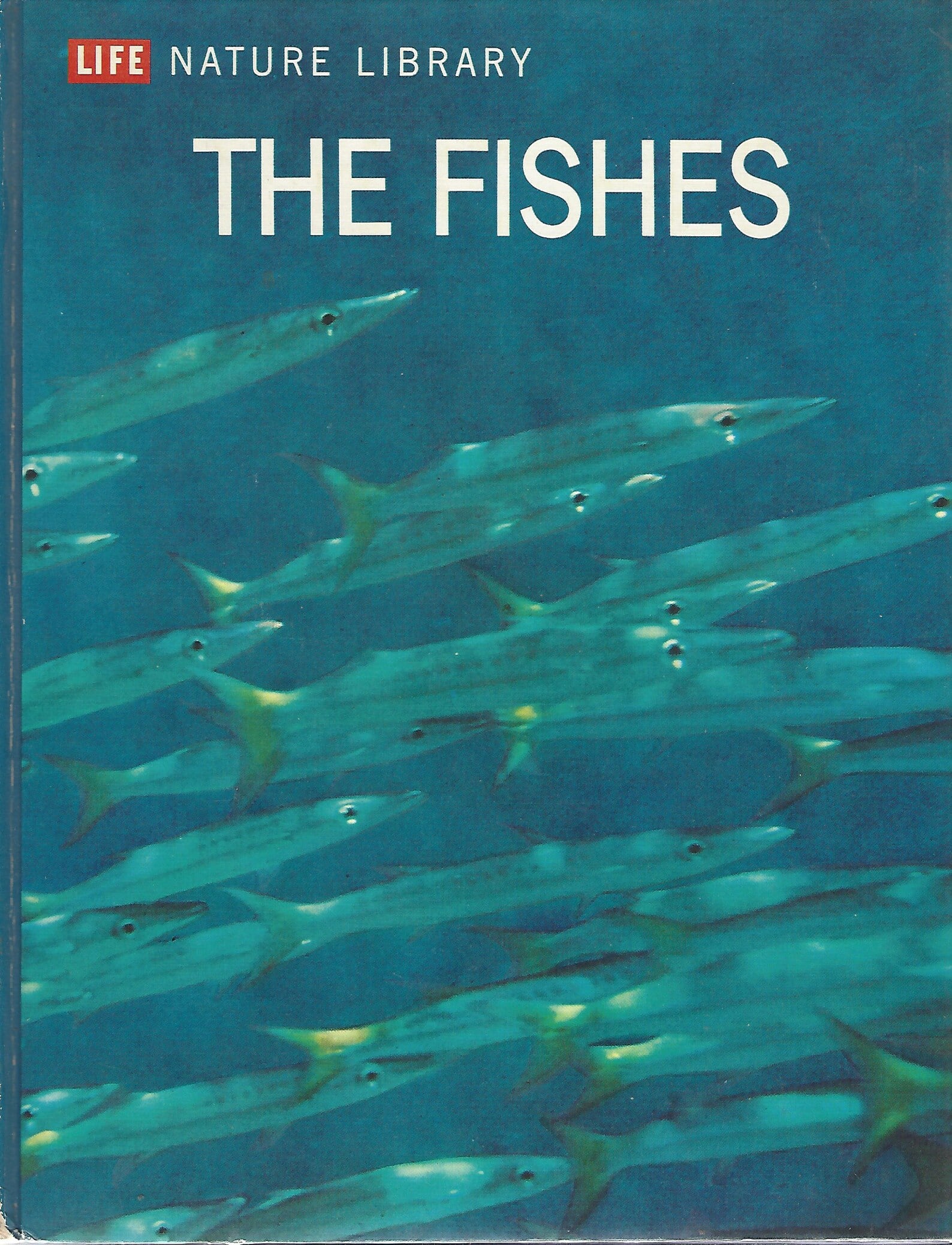
When I was very small, it was the TimeLife book of The Fishes, by F. D. Ommanney, which I remember endlessly poring over, my child’s mind gripped, in total fascination. The cover illustration showed a shoal of barracuda, mid-water and heading upwards, lit up as an iridescent blue by a column of sunlight. Oddly, it is only the cover and the illustrations of the deep sea creatures which I now remember—but I loved that book, as the weakened spine, blunted pages and dog-eared corners attested.
The Fishes has been on my mind recently, because I’ve been working with some dear friends on our own illustrated oceans book, to be published by Upswell Publishing. The book is called Scott Reef: Like Nowhere Else on Earth, and I want to share with you a bit of the story behind its creation.
Scott Reef is absolutely magnificent: Australia’s largest freestanding oceanic reef, brimming with life, including rare and threatened species such as a genetically distinct population of green sea turtles, pygmy blue whales and the wonderfully elegant dusky sea snake. But Scott Reef isn’t near our capital cities; it is way off the north-west coast of WA. And it is threatened with devastation by Woodside, which wants to drill up to 57 toxic wells at the Reef for its vast, dirty Browse gas project.
One of the main challenges in the fight to save Scott Reef from being turned into an industrialised gas zone by Woodside is bringing this incredible location to life for people who haven’t actually experienced it first hand. Because despite its ecological significance and dazzling beauty, ‘Scott Reef’ is also—at least not yet—exactly a household name.
To help get over this barrier, Greenpeace has enabled a number of photographers to travel to Scott Reef by boat (including the Rainbow Warrior) to document its astonishing diversity of colour and life. We then brought these images together in a remarkable photobook, produced by our talented in-house team, which we’ve been putting into the hands of as many leaders as possible—including the MPs whose decisions can determine the Reef’s future.
Back in June this year, I was sharing a copy of our in-house book at a business gathering in Perth when someone pulled me aside. Had we thought about publishing the book commercially? Apart from anything else, he wanted to buy a copy himself! He had a point. We were proud of what we’d created, but a commercially published version could reach a much wider audience and have even greater campaign impact. I immediately turned to my dear friend, Terri-ann White, who runs Upswell Publishing in WA, for advice.
Terri-ann has a huge heart and terrific vision. So many wonderful things in WA owe their existence to her doings, and, true to form, she was immediately encouraging and enthusiastic. “But,” she said, “it would add a whole new dimension if we had some words to accompany the incredible pictures.”
Fair enough, I thought. I could ask a few authors.
“And when would you like it published?” she asked.
“Ideally November,” I answered sheepishly.
Now, in publishing terms, nobody goes from idea to finished work, beautifully produced by a commercial publisher, in just four months. It. Just. Doesn’t. Happen. A book of this scale would ordinarily take nine months, I was told. But Terri-ann was undeterred. “If you can get a rapid turnaround on the writing, I will give it a shot.”
Over the following few days, I sent out 24 emails to prospective writers. To my joy and surprise 23 of them responded almost immediately with an enthusiastic yes!
Terri-ann was somewhat alarmed and perplexed when I told her the good news… we’d discussed a few authors, not more than twenty! “Impossible,” she texted. “Editing is important and you are talking about thousands of words!” But I also know Terri-ann. She does the impossible. And so, here we are… Terri-ann is going to hit that improbable deadline. Scott Reef: Like Nowhere Else on Earth will be on shelves in November.
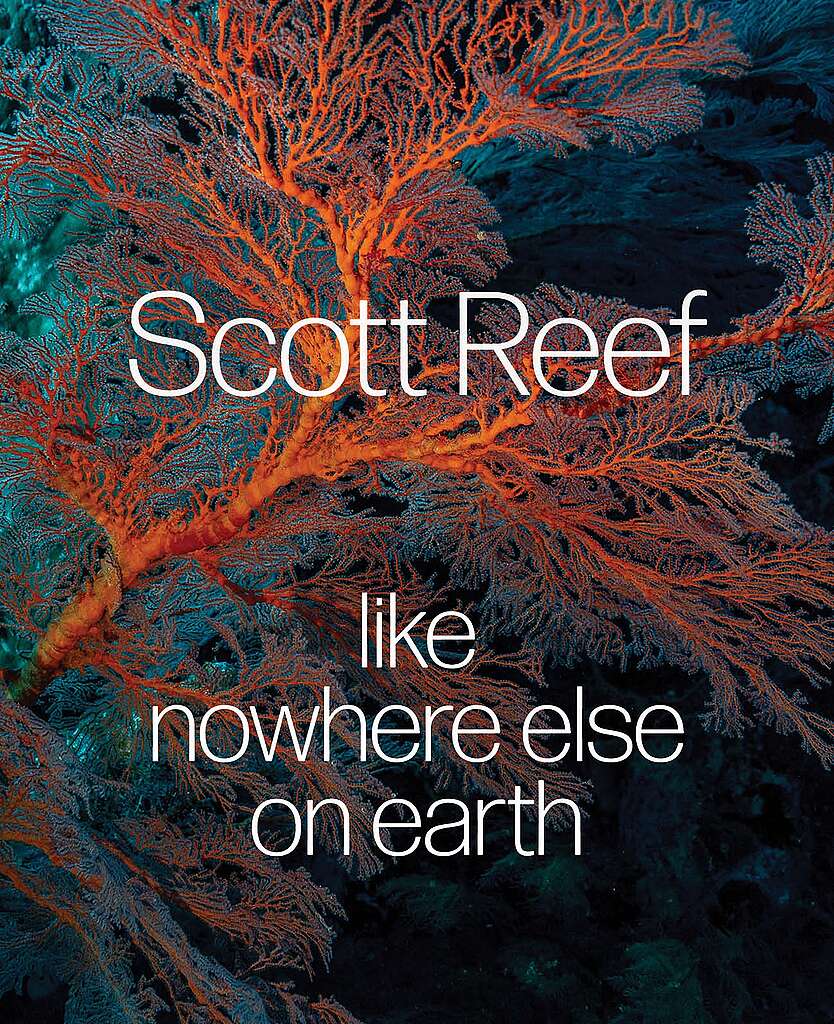
The contributors are a wonderfully diverse bunch, united by their enthusiasm for Scott Reef — and their extraordinary speed!
It’s a brilliant mix. The book brings together national icons like Peter Garrett, Tim Winton, Mick Dodson, Janet Holmes à Court and Fiona Stanley; the intellectual heft of professors Frank Bongiorno, Jessica Meeuwig, Rick Steiner and Samantha Hepburn; the poetic vision of Prema Arasu, Berndt Sellheim and Saadiah Freeman; the field expertise and passionate first hand witnessing of Imogen Zethoven, Tooni Mahto, Ben Fitzpatrick, Geoff Bice, Olaf Meynecke, Paul Gamblin, Sarah Gittoes and Hayley Baillie; and the determination of emerging activist voices Jackson Reid and Emma Sangalli.
Their elegant words wrap themselves around the sheer wonder of the underwater world, brought to life by the work of the photographers — of whom one, Wendy Mitchell, has also contributed a wonderful essay.
Terri-ann showed me the full physical proofs this week and they are breathtaking. This book contains some of my absolute favourite images of wildlife beneath the waves -– and believe me, after almost 20 years at Greenpeace, I’ve been privileged enough to see some remarkable shots! The essays bring a whole new depth and richness to the story of Scott Reef.
If I am being honest, and maybe a bit sentimental, I hope that a four or five-year-old child somewhere in Australia will spend part of their summer holidays turning the pages of this book, wide-eyed with curiosity and awe at the beauty and strangeness of the creatures that call our oceans home.
Our shared commitment is to make sure that, as those children grow up, the wonders of Scott Reef will exist not just in the pages of the book, but out there in the wild waters off north-western Australia—alive, thriving, and every bit as extraordinary as they are today; a living wonder beneath the waves.
Pre-orders of Scott Reef: Like Nowhere Else on Earth are available here.


Q & A
Sometimes you get asked a question so often that you decide to produce a report to answer it!
We know there is strong public opposition to voter opposition to gas drilling at Scott Reef and fracking in the Kimberley in Western Australia. But I am frequently asked whether, even if people don’t want it, more gas drilling is a necessary evil to sustain WA’s prosperity?
The short answer is an unequivocal ‘No’. The longer answer is our new report, From Gas to Green: Building Western Australia’s Future State, which makes the comprehensive case that Asia’s gas market is declining — while WA has an enormous untapped opportunity to become a global leader in green industries and exports, helping drive the region’s shift away from fossil fuels. The faster that WA embarks on a decisive shift away from gas—and that includes no fracking in the Kimberley, or drilling at Scott Reef — so much the better for the state’s people, ecology and economy.
For the first time, new-energy vehicles (NEVs) made up 67% of new car sales in China in September, according to the latest data from the China Passenger Car Association (CPCA).
The figures show that NEVs, which include battery electric cars and plug-in hybrids, captured a record share of sales, even though fewer were sold than last year.
This is because sales of combustion-engine cars are falling steeply, a trend that the CPCA has attributed to rising petrol prices following the start of the Hormuz crisis.
Indeed, sales of fuel-only cars were down 31% year-on-year in the first nine months of 2026, with plug-in hybrid sales down 26% – whereas battery EV sales were only down 4%.
One analyst tells Carbon Brief that China’s rapidly growing EV fleet has offset demand for 143m barrels of oil since the start of the Hormuz crisis.
Another says that the crisis is “reinforcing China’s electrification of road transport”.
Meanwhile, amid slowing domestic sales, Chinese carmakers’ exports of NEVs more than doubled [in 2026 to date / in September] from a year earlier.
NEV record
A record two out of every three cars sold in September in China were NEVs, according to CPCA data, as shown in the figure below.
(NEVs predominantly include battery electric vehicles – BEVs – and plug-in hybrids – PHEVs. BEVs only run on electricity, whereas PHEVs also have a combustion engine.)
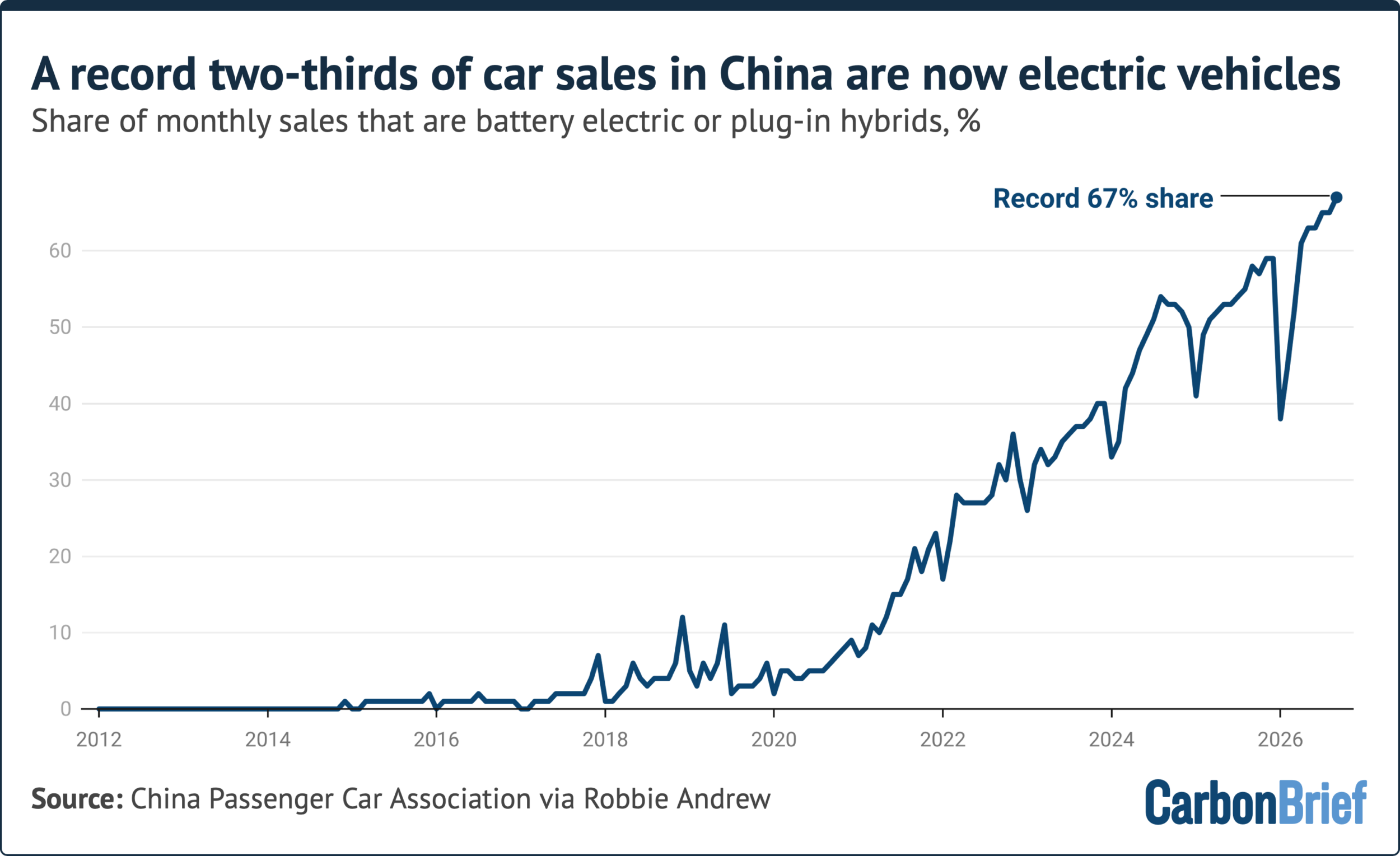
This marks a rapid rise for NEVs from just 6% of new car sales in 2020 up to 58% in 2026 to date – and a record 67% in the month of September.
This year, NEVs’ share of sales has also bounced back from a low of 39% in January, after the full purchase tax exemption that had been in place for more than a decade came to an end in December 2025.
The gain in NEV share in 2026 has come amid a slowdown across the wider domestic passenger-car market, which has hit sales of combustion-engine vehicles particularly hard.
This September, passenger-car retail sales across all categories declined, with overall sales volumes falling 28% year-on-year.
The contraction was led by combustion-engine vehicles, which saw sales fall 43% year-on-year in September and 31% in 2026 to date.
However, sales of PHEVs also fell by 36% year-on-year in September and by 26% in 2026 to date. By comparison, BEVs performed better, although sales still declined 8.5% from a year earlier in September and 4% in 2026 to date.
As a result, NEV sales overall fell by 17% in September and 13% in 2026 to date.
While the market changes in 2026 to date were particularly dramatic, they reflect a broad continuation of trends seen over the past decade.
Indeed, sales of combustion-engine cars in China peaked in 2017 and they have been declining ever since, shown in the figure below.