Connect with us

Published

on

Oscar Berglund is a senior lecturer in international public and social policy at the University of Bristol and Tie Franco Brotto is a PhD candidate at the University of Bristol’s School for Policy Studies.

Climate and environmental protest is being criminalised and repressed around the world. The criminalisation of such protest has received a lot of attention in certain countries, including the UK and Australia. But there have not been any attempts to capture the global trend – until now.

We recently published a report, with three University of Bristol colleagues, which shows this repression is indeed a global trend – and that it is becoming more difficult around the world to stand up for climate justice.

This criminalisation and repression spans the global north and south, and includes more and less democratic countries. It does, however, take different forms.

Our report distinguishes between climate and environmental protest. The latter are campaigns against specific environmentally destructive projects – most commonly oil and gas extraction and pipelines, deforestation, dam building and mining. They take place all around the world.

Climate protests are aimed at mitigating climate change by decreasing carbon emissions, and tend to make bigger policy or political demands (“cut global emissions now” rather than “don’t build this power plant”). They often take place in urban areas and are more common in the global north.

Four ways to repress activism

The intensifying criminalisation and repression is taking four main forms.

1. Anti-protest laws are introduced

Anti-protest laws may give the police more powers to stop protest, introduce new criminal offences, increase sentence lengths for existing offences, or give policy impunity when harming protesters. In the 14 countries we looked at, we found 22 such pieces of legislation introduced since 2019.

2. Protest is criminalised through prosecution and courts

This can mean using laws against climate and environmental activists that were designed to be used against terrorism or organised crime. In Germany, members of Letzte Generation (Last Generation), a direct action group in the mould of Just Stop Oil, were charged in May 2024 with “forming a criminal organisation”. This section of the law is typically used against mafia organisations and had never been applied to a non-violent group.

In the Philippines, anti-terrorism laws have been used against environmentalists who have found themselves unable to return to their home islands.

Criminalising protest can also mean lowering the threshold for prosecution, preventing climate activists from mentioning climate change in court, and changing other court processes to make guilty verdicts more likely. Another example is injunctions that can be taken out by corporations against activists who protest against them.

3. Harsher policing

This stretches from stopping and searching to surveillance, arrests, violence, infiltration and threatening activists. The policing of activists is carried out not just by state actors like police and armed forces, but also private actors including private security, organised crime and corporations.

In Germany, regional police have been accused of collaborating with an energy giant (and its private fire brigade) to evict coal mine protesters, while private security was used extensively in policing anti-mining activists in Peru.

4. Killings and disappearances

Lastly, in the most extreme cases, environmental activists are murdered. This is an extension of the trend for harsher policing, as it typically follows threats by the same range of actors. We used data from the NGO Global Witness to show this is increasingly common in countries including Brazil, Philippines, Peru and India. In Brazil, most murders are carried out by organised crime groups while in Peru, it is the police force.

Protests are increasing

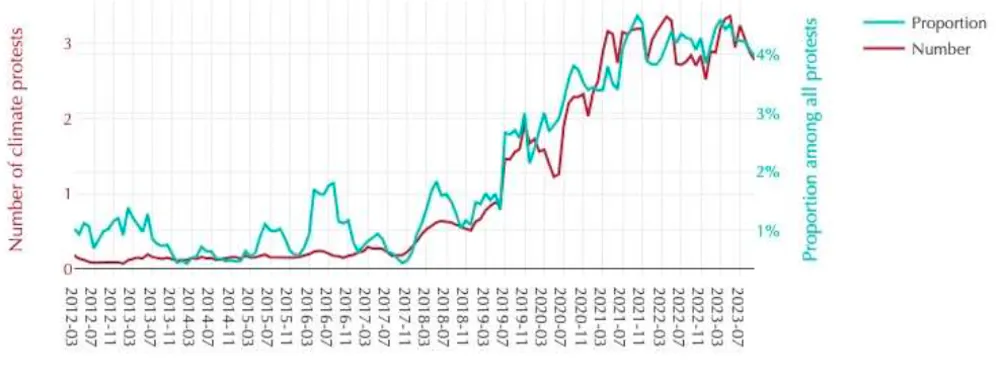
To look more closely at the global picture of climate and environmental protest – and the repression of it – we used the Armed Conflicts Location Event database. This showed us that climate protests increased dramatically in 2018-2019 and have not declined since. They make up on average about 4% of all protest in the 81 countries that had more than 1,000 protests recorded in the 2012-2023 period:
Graph
Climate protests increased sharply in the late 2010s in the 14 countries studied. (Data is smoothed over five months; number of protests is per country per month)
Berglund et al; Data: ACLED, CC BY-SA

This second graph shows that environmental protest has increased more gradually:

Graph
Environmental protests in the same 14 countries
Data: ACLED, CC BY-SA

We used this data to see what kind of repression activists face. By looking for keywords in the reporting of protest events, we found that on average 3% of climate and environmental protests face police violence, and 6.3% involve arrests. But behind these averages are large differences in the nature of protest and its policing.

A combination of the presence of protest groups like Extinction Rebellion, who often actively seek arrests, and police forces that are more likely to make arrests, mean countries such as Australia and the UK have very high levels of arrest. Some 20% of Australian climate and environmental protests involve arrests, against 17% in the UK – with the highest in the world being Canada on 27%.

Meanwhile, police violence is high in countries such as Peru (6.5%) and Uganda (4.4%). France stands out as a European country with relatively high levels of police violence (3.2%) and low levels of arrests (also 3.2%).

In summary, while criminalisation and repression does not look the same across the world, there are remarkable similarities. It is increasing in a lot of countries, it involves both state and corporate actors, and it takes many forms.

This repression is taking place in a context where states are not taking adequate action on climate change. By criminalising activists, states depoliticise them. This conceals the fact these activists are ultimately right about the state of the climate and environment – and the lack of positive government action in these areas.The Conversation

This article is republished from The Conversation under a Creative Commons license. Read the original article.

The post Repression of climate and environmental protest is intensifying across the world appeared first on Climate Home News.

Repression of climate and environmental protest is intensifying across the world

Continue Reading

Climate Change

European, island states seek clear future for global roadmap to cut fossil fuels

Published

on

The global roadmap on transitioning away from fossil fuels now being developed should be a “continuing conversation” which is part of UN climate talks, not just a one-off report, several governments told the Brazilian COP30 Presidency on Friday in Bonn.

During a 90-minute exchange of views at the annual mid-year climate talks in Germany, several European governments and the Marshall Islands said the roadmap that Brazil is due to finish by November should be incorporated into the official negotiations.

Any such push is likely to be resisted by nations whose economies are reliant on fossil fuel production. While Russia did not speak on Friday, it has said in earlier written submissions that the roadmap should not be referenced in any document approved by governments at UN climate talks.

At COP30 last year, Brazil tried to get governments to agree to produce a roadmap on how to transition away from fossil fuels but the proposal did not win consensus, with major nations like Saudi Arabia and Russia opposed.

Feedback in Bonn

To save the day, Brazil’s COP30 president André Aranha Corrêa do Lago promised at the closing plenary in Belem to draw up a voluntary roadmap in consultation with interested governments. Over 20 countries have officially submitted their opinions on this roadmap and, in Bonn on Friday, Corrêa do Lago sought their views – and those of civil society – in person after the presidency presented its findings so far.

The roadmap will also incorporate outcomes from the first global conference on transitioning away from fossil fuels held in Santa Marta, Colombia, in April and attended by around 60 countries.

A negotiator for the Marshall Islands told Friday’s meeting that at COP31 this year all governments should “welcome the collaborative effort behind the roadmap and the Santa Marta conference and for this work to be taken on to COP32 and beyond”.

    A spokesperson for Switzerland said on behalf of a group of nations which includes South Korea and Mexico that the roadmap must be a “sustained process, not a one-off report” and “we would welcome an ongoing platform for dialogue, for learning and cooperation including among fossil-fuel production countries”.

    “We expect more than a document, rather a process whereby we come together to develop concrete steps, recommendations and tools to prepare for the transitions,” she said, calling on the COP31 co-presidents Australia and Turkiye and COP32 host Ethiopia to “take up the leadership” for implementing the roadmap”.

    Global stocktake response

    France’s negotiator said the roadmap “is a process and we will need continuing discussions” as “implementation needs time”, while the UK called for a “continuing conversation, including as we head towards the second [global stocktake]”. 

    The global stocktake (GST) is an official five-yearly report into how the world’s governments are doing on their Paris Agreement goal to limit global warming to 1.5C above pre-industrial temperatures.

    The second stocktake will be published in 2028 and governments are likely to negotiate a response to it, which could include new commitments to reduce emissions, at COP33 that year. The response to the first global stocktake included the landmark COP28 commitment to transitioning away from fossil fuels in energy systems.

    Activists and Indigenous people take part in a Stop EACOP campaign protest against fossil fuels during the UN Climate Change Conference (COP30) in Belem, Brazil, November 13, 2025. REUTERS/Adriano Machado

    Activists and Indigenous people take part in a Stop EACOP campaign protest against fossil fuels during the UN Climate Change Conference (COP30) in Belem, Brazil, November 13, 2025. REUTERS/Adriano Machado

    “Even though it’s not a formal part of the negotiation agenda, the roadmap can be a key input for the entire information-gathering phase of the second GST,” Enrique Maurtua Konstantinidis, an independent climate policy consultant, explained to Climate Home News. 

    “The key is for countries not to focus the discussion on defending the roadmap itself, but rather on its content, which is what truly matters,” he added.

    At the Bonn event, civil society organisations also supported continuing the roadmap inside the formal climate process.

    Natalie Jones, policy adviser for the International Institute for Sustainable Development, told Climate Home News the roadmap should be “an ongoing dialogue where countries can exchange their experiences, best practices and continue implementing the [transitioning away from fossil fuels] consensus”.

    Russian resistance

    But economies reliant on fossil fuel production are likely to oppose incorporating the roadmap into negotiations in Bonn and at COP summits. Russia’s written submission to Brazil’s consultation says the roadmap was not agreed by governments at COP30.

    It says such work should therefore take place on the margins of the UNFCCC process, adding that “ the inclusion of any references to the “Roadmap” in the agenda or in official or informal documents” at Bonn or COP “would constitute a deviation from previously agreed consensus outcomes”.

    Other major oil and gas producers like Saudi Arabia have not made written or spoken submissions and the US, as it has left the Paris Agreement, is not involved in discussions. But countries other than Russia are likely to resist incorporating the roadmap into official talks.

    The UN climate process needs ambition – the law demands it

    The submission by Japan, which is not a major producer of fossil fuels but consumes them from overseas, suggests nervousness about the roadmap. It asks Brazil for clarity on how the roadmap is “envisaged to be utilised” and argues that as many countries continue to rely on fossil fuels for electricity, a full and fast shift to “full decarbonisation” is “challenging.

    After Friday’s event, Corrêa do Lago told Climate Home News that “the suggestions and the key milestones of the roadmap are not clear yet”. He added that the next step for the COP30 presidency will be to “sit down in July and August to really prepare” the content.

    The veteran Brazilian diplomat added that the roadmap will have a section on the challenges of the transition and another section on solutions.

    National fossil fuel roadmaps

    Brazil, as COP30 president, is drawing up the global roadmap but its leader Lula da Silva has also ordered his officials to draw up a national roadmap. 

    In April, France became the first and so far only nation to produce a roadmap, which amalgamated different existing energy and decarbonisation plans and targets. Colombia is reportedly drawing up a roadmap too, based on a draft document by academics.

    On Friday, a coalition of nearly 100 civil society organisations called on the COP31 co-presidents Australia and Türkiye to both come up with national roadmaps in order to “lead by example”. Türkiye produces about a third of its electricity from coal, while Australia is the world’s third-largest fossil fuel exporter, the NGOs said.

    But in the Brazil-led consultation meeting, a Norwegian negotiator downplayed the importance of separate national roadmaps for transitioning away from fossil fuels.

    While they can “have a supporting role”, the official said countries’ nationally determined contributions (NDCs) “must remain the primary vehicle for driving global climate transition.”

    NDCs are climate plans, usually containing emissions reduction targets, which the Paris Agreement states governments must update with higher ambition every five years. 

    The post European, island states seek clear future for global roadmap to cut fossil fuels appeared first on Climate Home News.

    https://www.climatechangenews.com/2026/06/12/european-island-states-seek-clear-future-for-global-roadmap-to-cut-fossil-fuels/

    Continue Reading

    Climate Change

    Hoover Dam Approaches a Hydropower Cliff

    Published

    on

    Big cuts in generating capacity are coming as the Colorado River struggles to meet demand.

    Some day in the next 12 months—maybe in late August, maybe not until next spring— Lake Mead will drop below the critical threshold of 1,035 feet above sea level.

    Hoover Dam Approaches a Hydropower Cliff

    Continue Reading

    Climate Change

    DeBriefed 12 June 2026: El Niño begins | COP31 hosts eye electrification | Atlantic current monitoring at risk

    Published

    on

    Welcome to Carbon Brief’s DeBriefed.
    An essential guide to the week’s key developments relating to climate change.

    This week

    El Niño begins

    ‘DOMINO WEATHER’: The natural weather phenomenon El Niño, which can raise global heat and “bring domino weather effects across the planet”, is now underway, the US National Oceanic and Atmospheric Administration (NOAA) declared on Thursday, reported the Washington Post. The Japanese Meteorological Administration also identified the start of El Niño on Wednesday, said Bloomberg. According to the Japanese weather agency, the event is “expected to intensify in the coming months and become very strong later in the year, persisting into at least December”, reported the outlet.

    ‘SUPER EVENT’: BBC News reported that “many forecasts suggest this could end up as a so-called ‘super’ El Niño” and be “among the strongest ever recorded”. It added: “Coming on top of decades of human-caused warming, it could bring another record-hot year – most likely in 2027 – with disruption to weather, food supplies and economies running well into that year.”

    COP31 hosts eye electrification

    ‘35 BY 35’: COP31 hosts Turkey and Australia have called for countries to support a target of electrifying 35% of global energy use by 2035, reported Politico. Speaking at climate talks in Bonn, Germany, Turkish minister Murat Kurum said that electrification would be a “flagship priority” at the COP31 summit, noted the publication. Kurum added that “electrifying daily life, from transport to buildings and industry” could “protect families and businesses from volatile energy markets”, said the outlet.

    WASTE AND BUILDINGS: Climate Home News reported that electrification was one of three priorities unveiled by the COP31 hosts, with the other two being waste and buildings. On buildings, the COP31 hosts “quietly overhauled [their] goal”, Climate Home News said. It reported: “An initial press statement on Monday set out a target ‘to achieve at least a 25% increase in energy efficiency in buildings by 2035’. But…on Tuesday, that was replaced with a different goal to ‘reduce energy consumption intensity in the building sector by at least 25% by 2035’.”

    ‘HARDEST’ CHALLENGE: Elsewhere in Bonn, UN climate chief Simon Stiell said “governments must stop revisiting climate commitments and start delivering on them”, South Africa’s Mail and Guardian reported. It quoted Stiell as saying: “Tackling the global climate crisis is the hardest but most important thing humanity has ever tried to do together…We are not yet where we need to be. But we are somewhere we have never been before.”

    Around the world

    • ETS EXTRA: The EU has agreed “stronger” price controls on “ETS2”, its planned trading system for heating and transport emissions, according to Reuters.
    • OCEAN STRESS: The rate of sea level rise has doubled in 10 years amid “severe and accelerating” pressures on oceans, said a UN report covered by Time.
    • CLIMATE MIGRANTS: Donald Trump’s “immigration crackdown is largely targeting people from the countries most vulnerable to displacement from climate-driven disasters”, according to Guardian analysis.
    • ULTRA-RICH: Investments by the world’s ultra-rich in 2022 are linked to nearly $1tn in climate damages, according to a Greenpeace Africa analysis covered by BusinessGreen.

    Two

    The number of bidders for Trump’s auction for drilling rights in an Arctic wildlife refuge, with big oil companies “sitting out the sale”, reported Bloomberg.


    Latest climate research

    • As the Arctic warms, increased iceberg activity could “reshape” deep-sea habitats and “elevate” navigational hazards as maritime traffic expands | Nature
    • Around 11% of the population of the world’s “rarest great ape”, the Tapanuli orangutan, is estimated to have perished in an extreme rainfall event in Indonesia in 2025 | Current Biology
    • Canada’s forests are shifting from a carbon sink to a carbon source, due to “wildfires disturbances” | Global Change Biology

    (For more, see Carbon Brief’s in-depth daily summaries of the top climate news stories on Monday, Tuesday, Wednesday, Thursday and Friday.)

    Captured

    Solar power has overtaken gas in Asia to become the region’s third largest electricity source behind coal and hydropower, according to Carbon Brief analysis of data from the thinktank Ember. Solar became the third largest electricity source for Asia on an annual basis in April 2026, according to the analysis. In the year to April 2026, solar generated 1,727 terawatt hours (TWh), while gas generated 1,711TWh, it added.

    Spotlight

    Atlantic current monitoring at risk

    This week, Carbon Brief reports on how Trump plans could disrupt efforts to track a major ocean current.

    The Irminger Sea, a patch of frigid ocean east of Greenland, plays an outsized role in the Earth’s climate.

    Here, surface water that has travelled thousands of kilometres from the tropics grows cold and dense enough to sink to the ocean’s depths – a transformation that must occur for the water to begin a long journey back to the southern hemisphere.

    This makes the Irminger Sea an “action centre” for the mighty Atlantic Meridional Overturning Circulation (AMOC), the vast system of ocean currents that keeps temperatures in Europe mild.

    Last week, the US government announced plans to dismantle ocean moorings installed in the Irminger Sea which, among other things, collect data on the health of the AMOC.

    This came as part of a programme to “descope” the Ocean Observatories Initiative, a $368m network of ocean sensors installed in the Pacific and Atlantic oceans.

    Two of the moorings earmarked for removal in the Irminger Sea form part of an internationally funded, trans-Atlantic AMOC monitoring array, known as OSNAP, that stretches from Canada to Scotland.

    Experts told Carbon Brief the move by the Trump administration highlights the vulnerability of AMOC observation systems around the world. These deep-sea moorings – scattered across the Atlantic – collect real-time data on, among other things, ocean current, temperature, pressure and biochemistry.

    Prof Penny Holliday, chief scientific officer of the UK National Oceanography Centre, told Carbon Brief that the OSNAP array, as well as the RAPID array at 26N, are “entirely dependent” on research grants that have to be “continually reapplied for”.

    “Funding is perilous all the time,” she said.

    A report prepared last month by scientists for Nordic ministers exploring the security of funding for AMOC observing systems warned that RAPID and OSNAP were in “critical condition” and faced “material exposure over an 18-month horizon”. Meanwhile, other key basin-wide and global components of the global AMOC observing system were rated as “at risk”.

    It is not just US funding that is uncertain. The report notes, for example, that the five-yearly funding the UK provides to RAPID and OSNAP is “at risk from 2027 due to year-on-year budget reductions” at the Natural Environmental Research Council.

    (RAPID is funded by the US and UK, whereas OSNAP is backed by five different countries, with the US contributing half of the total financial support.)

    Report co-author Dr Femke de Jong from the Royal Netherlands Institute for Sea Research told Carbon Brief that “continued AMOC observations” are under pressure in “multiple countries”. She said:

    “While the risk of a declining AMOC to society is starting to be recognised, there is not yet a system or institution in place to guarantee a way to monitor it.”

    AMOC monitoring arrays are still in their infancy – RAPID, the oldest, was launched in 2004. Two decades of data captured so far shows that the AMOC is slowing down. However, scientists will need many more years of data to be able to confidently link the decline to climate change, rather than natural variability in the ocean.

    NOC’s Holliday points to the disconnect between scientific and funder timelines:

    “The timescale of observations needed in order to be able to detect a climate change signal from the very naturally variable ocean is around 40-60 years…. [And yet], in the Netherlands, they have to apply for a new grant for their ocean moorings every two years. They are going to have to do that for 40 years.

    “This is a very inefficient way of getting funding for what should be critical infrastructure.”

    This spotlight first appeared in Cited, Carbon Brief’s new fortnightly newsletter focused on climate research. Sign up for free.

    Watch, read, listen

    ‘BEYOND GROWTH’: A group of economists set out a “roadmap for eradicating poverty beyond growth” in the Guardian.

    OIL CAMPAIGN: Politico reported on how “oil industry allies” are campaigning against attribution science, including by working to discredit a US National Academies report that “will examine research into the ways corporate climate pollution is intensifying natural disasters”.

    ‘FIGHT BACK’: For the Apocalyptic Optimist podcast, Dr Dana Fisher spoke to historian and author Dr Naomi Oreskes about how to “fight back” against climate misinformation.

    Coming up

    Pick of the jobs

    DeBriefed is edited by Daisy Dunne. Please send any tips or feedback to debriefed@carbonbrief.org.

    This is an online version of Carbon Brief’s weekly DeBriefed email newsletter. Subscribe for free here.

    The post DeBriefed 12 June 2026: El Niño begins | COP31 hosts eye electrification | Atlantic current monitoring at risk appeared first on Carbon Brief.

    DeBriefed 12 June 2026: El Niño begins | COP31 hosts eye electrification | Atlantic current monitoring at risk

    Continue Reading

    Trending

    Copyright © 2022 BreakingClimateChange.com