Connect with us

Published

on

Renewables 2025: How China, the US, Europe, and India Are Leading the World’s Clean Energy Growth

The world’s renewable energy sector has entered a new phase of record growth. According to the International Energy Agency’s Renewables 2025 report, global renewable power capacity grew by more than 510 gigawatts (GW) in 2024 — the fastest increase ever recorded. Another 520 GW is expected to be added in 2025, pushing renewables to account for over 90% of all new global power capacity.

Solar and wind dominate this growth. By 2025, solar will account for nearly three-quarters of new installations. This growth comes from cheaper technology, improved grid integration, and supportive policies. Wind power is also recovering after a slowdown in 2022–2023, supported by new offshore projects in Europe, China, and the United States.

The IEA says the world’s total renewable capacity will reach nearly 5,800 GW by 2025, up from around 4,200 GW in 2023. That means renewables now generate about 30% of global electricity and are on track to reach 42–45% by 2030.
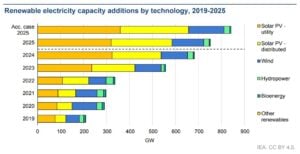
Renewable electricity capacity additions by technology

Four regions — China, Europe, the United States, and India — are responsible for almost 90% of this global expansion. Each is moving at a different pace, but together they are transforming how the world produces and consumes energy.
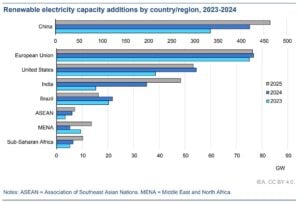
Renewable electricity capacity additions by country

Europe: Accelerating the Energy Transition

Europe continues to lead in energy policy and innovation. In 2024, the European Union added more than 70 GW of new renewable capacity, driven mainly by solar. This is a record year. It shows the bloc’s goal to cut reliance on imported fossil fuels. They aim to meet their Green Deal target of a 55% emissions reduction by 2030.

Solar capacity across the EU doubled between 2020 and 2024, reaching over 300 GW, while wind capacity passed 220 GW. The IEA predicts that Europe will add 450 GW of renewables from 2025 to 2030. This will raise the total capacity to almost 870 GW by the end of the decade.
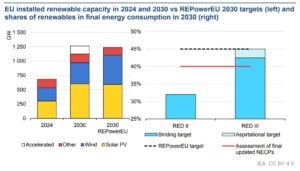
EU installed renewable capacity in 2024 and 2030

Much of this growth is tied to the REPowerEU plan, which aims to speed up permitting and expand rooftop solar. Offshore wind is gaining popularity. Countries like Germany, Denmark, and the Netherlands are investing in North Sea projects.

Despite progress, Europe faces challenges. Delays in grid expansion and limited local manufacturing capacity for wind turbines have created supply bottlenecks. Even so, strong policy support and high carbon prices still make renewables the best choice for power generation.

United States: Policy Support and Private Investment Drive Expansion

The United States is entering a period of major renewable growth, supported by the Inflation Reduction Act (IRA) and record private investment. The IEA expects the U.S. to add around 400 GW of new renewable capacity by 2030, effectively doubling its current base.

In 2024, U.S. solar installations rose by nearly 40%, reaching 45 GW for the year. Solar now accounts for the largest share of new capacity additions. Wind power also recovered, with onshore and offshore projects expanding in Texas, California, and along the East Coast.
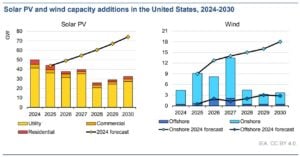
Solar PV and wind capacity additions in US

Renewables currently generate about 26% of U.S. electricity, up from 22% in 2022. The IEA projects this share will climb to over 40% by 2030, driven by federal tax incentives and falling technology costs.

Battery storage is another fast-growing sector. Storage capacity doubled between 2023 and 2024, helping stabilize variable solar and wind output. The IRA’s clean energy credits could draw over $400 billion in investments by 2032. This boost will help generate energy and support U.S. manufacturing of solar panels and turbines.

Challenges remain. The U.S. needs to modernize its grid and streamline permitting for transmission lines to connect renewable projects to demand centers. But the direction is clear — renewables are becoming the backbone of America’s energy system.

China: The Global Powerhouse of Renewables

China remains the undisputed leader in renewable energy growth. The IEA projects that China will account for about 60% of all new renewable capacity added worldwide by 2030.

In 2024 alone, China installed more than 260 GW of new renewables — more than the rest of the world combined. Solar made up the majority of this, with over 190 GW of solar capacity added during the year.

Wind power grew by 60 GW. China kept building big onshore and offshore projects in Inner Mongolia, coastal areas, and deserts.
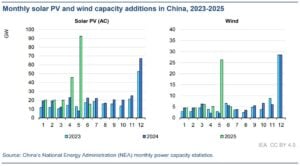
Monthly solar PV and wind capacity additions in China

China now has an estimated 1,400 GW of total renewable capacity, representing about half of the global total. Renewables already supply more than 35% of China’s electricity, up from 27% in 2020.

Government policy is the key driver. China aims to reach 1,200 GW of combined solar and wind capacity by 2030, a target it is likely to achieve five years early. The country’s large manufacturing base keeps equipment prices low globally. This helps other regions grow their clean energy fleets.

Still, integration challenges persist. Some provinces face grid congestion and curtailment — when renewable power can’t be used due to transmission limits. The IEA recommends that China continue to invest in grid upgrades and flexible storage systems to handle its rapid growth.

India: The Fastest-Growing Emerging Market for Renewables

India is now the fastest-growing renewable energy market among developing economies. The IEA expects India’s renewable capacity to nearly double between 2023 and 2030, expanding from around 190 GW to 360–380 GW.
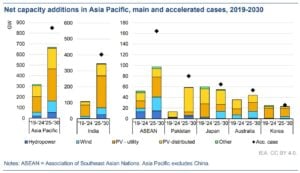
renewable net capacity additions India

Solar energy is leading the charge. In 2024, India added more than 17 GW of solar capacity, supported by large auctions and declining costs. Wind capacity also grew modestly, and new hybrid projects combining solar and wind are improving reliability.

The government’s goal is ambitious: 500 GW of non-fossil capacity by 2030, which would cover about 50% of total power demand. India is also expanding its domestic solar manufacturing base to reduce dependence on imports.

Hydropower and bioenergy continue to play supporting roles, particularly in rural electrification. The IEA reports that renewable energy in India cuts over 250 million tonnes of CO₂ emissions each year. This makes India a major player in global emission reductions, second only to China.

However, financing and grid infrastructure remain key hurdles. The report notes that India needs annual clean energy investments of about $60–70 billion through 2030 to meet its targets.

The chart below compares renewable energy capacity in 2024 vs. 2030 projections for the four key regions, based on the IEA Renewables 2025 report.
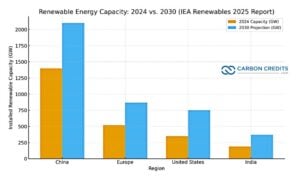
renewable energy capacity by region IEA report
Data source: IEA Report

It clearly shows China’s dominant position, followed by steady growth in Europe and the U.S., and rapid expansion in India’s renewable capacity by the end of the decade.

The Decade of Clean Power: A Turning Point for Global Energy

The combined momentum of China, Europe, the United States, and India is reshaping global energy markets. Together, these four regions will account for almost 90% of all renewable capacity growth by 2030.

The pie chart shows each region’s share of total global renewable capacity additions from 2024 to 2030, based on the IEA forecast. It also shows how dominant China remains in driving renewable expansion, while Europe, the U.S., and India together account for about one-third of the world’s clean-energy growth.
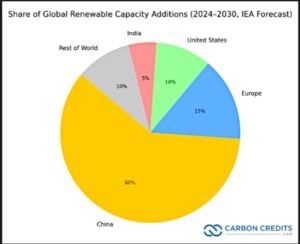
share of global renewable capacity additions 2030 IEA 2025 report
Data source: IEA Report

Global renewable electricity capacity is expected to surpass 6,200 GW in 2025 and reach 8,300 GW by 2030 — roughly triple the total in 2015. Solar will remain the dominant source, followed by wind and hydropower.

Yet challenges persist. The IEA warns that grid constraints, permitting delays, and uneven financing could slow progress in developing economies. To stay on track for the net-zero pathway, annual renewable additions must rise to around 800 GW per year by 2030.

Still, the direction is clear. The world is entering a decade where clean power becomes the main driver of growth, investment, and energy security. The actions of these four key players will determine how fast the transition happens and how close we come to a truly sustainable global energy system.

The post Renewables 2025: How China, the US, Europe, and India Are Leading the World’s Clean Energy Growth appeared first on Carbon Credits.

Continue Reading

Carbon Footprint

Europe Unveils $108B Clean Fuel Plan to Decarbonize Aviation and Shipping by 2035

Published

on

Europe Unveils $108B Clean Fuel Plan to Decarbonize Aviation and Shipping by 2035

The European Union (EU) has announced a new $108 billion (about €100 billion) investment plan to speed up the production and use of cleaner fuels for aviation and shipping. The plan, called the Sustainable Transport Investment Plan or STIP, will run until 2035.

It is one of the largest efforts in Europe to cut emissions from two of the hardest sectors to decarbonize—aviation and maritime transport. The EU hopes the program will help meet its climate targets and strengthen Europe’s leadership in clean energy technology.

The plan aims to boost the economy. It will create jobs, attract private investors, and build new industries centered on sustainable fuels.

Why Planes and Ships Should Go Green

Airplanes and ships play a vital role in global trade and travel. However, they release a lot of carbon dioxide and other greenhouse gases. The aviation sector alone is responsible for about 3% of global emissions, and that number is rising as air travel grows.

Unlike cars or trains, airplanes and large ships cannot easily switch to battery power. That is why sustainable aviation fuels (SAFs) and synthetic e-fuels are key to cutting emissions in these sectors. These fuels can be made from renewable sources such as used cooking oil, waste, or captured carbon, and can often be used in existing engines.

However, cleaner fuels are still much more expensive to produce than traditional jet fuel. The new EU plan aims to close this price gap by providing investment support, policy certainty, and funding for research and infrastructure.

EU investment needs for aviation and maritime transport
Source: EC

Key Goals of the $108B Investment Plan

The Sustainable Transport Investment Plan brings together funding, regulation, and private partnerships to scale up clean fuel production across Europe. Its main targets include:

  • 20 million tonnes of sustainable fuels will be produced each year by 2035.
  • Around 13 million tonnes of biofuels and 7 million tonnes of e-fuels.
  • Deployment of clean fuel technology in both aviation and maritime transport.
  • Greater energy independence and industrial competitiveness for Europe.

The EU expects to mobilize at least €2.9 billion by 2027 as a first step. Part of the money will come from existing EU programs such as InvestEU, the European Hydrogen Bank, the Innovation Fund, and Horizon Europe. These programs will help finance new fuel plants, research projects, and pilot facilities.

For example, more than €300 million will support hydrogen-based fuels for planes and ships. €150 million will support synthetic fuel projects. Additionally, €130 million will fund research on new clean fuel technologies.

EU STIP investment actions
Source: EC

The plan promotes partnerships among governments, energy companies, and airlines. This helps ensure that supply and demand increase together.

Building a Market for Sustainable Aviation Fuels

Today, sustainable aviation fuels make up less than 1% of Europe’s total jet fuel supply. The new investment plan aims to change that by building a large and stable market for cleaner fuels.

Under new EU rules, ReFuelEU Aviation and FuelEU Maritime, airlines and shipping companies must slowly boost their use of renewable fuels. The rules require at least 2% SAF by 2025, 6% by 2030, and 70% by 2050 for aviation.

EU clean fuel target for aviation

To meet these targets, Europe needs dozens of new refineries and production plants. The investment plan offers developers more financial certainty. This should help attract private capital. Many companies have been hesitant to invest in SAF plants because of high costs and uncertain returns.

By combining regulation with financial incentives, the EU hopes to lower these risks and attract long-term investors.

The plan also promotes the creation of fuel offtake agreements, where airlines commit to buying a set amount of SAF each year. This helps producers secure financing, knowing there will be demand for their product once it is ready.

Experts expect global production of SAF to rise substantially by 2030. The International Civil Aviation Organization (ICAO) says that in a “high +” policy scenario, production might hit about 16.97 million tonnes by 2030. This would meet around 5% of the expected aviation fuel demand.

Other reports suggest figures such as 6.1 to 8.2 billion gallons (~23–31 million tonnes) by 2030 based on announced projects and capacity. Most analyses say that, despite this growth, the industry needs more support. This includes policy help, feedstock expansion, and better technology. These steps are crucial to meet even modest blend targets.

global SAF capacity 2030

Economic and Environmental Impact

The EU estimates that scaling up SAF and e-fuels could create tens of thousands of new jobs across Europe. These jobs would come from building new plants, upgrading infrastructure, and managing supply chains for renewable fuels.

Economic benefits also include:

  • More investment in rural areas where biofuel feedstocks are grown.
  • Strengthened local industries producing renewable hydrogen and carbon-capture systems.
  • Reduced dependence on imported oil and gas.

Sustainable aviation fuels can cut lifecycle carbon emissions by 70–90%. This reduction depends on how they are made, compared to fossil-based jet fuel. E-fuels made from green hydrogen and captured carbon can potentially be near-zero emission.

If Europe achieves its production targets, the total fuel savings could cut up to 200 million tonnes of CO₂ by 2035. That would be a major step toward meeting the EU’s 2050 climate neutrality goal.

What are the Challenges to Overcome?

While the EU plan is ambitious, experts warn that several obstacles remain, including:

  1. Feedstock supply: Europe needs to secure enough sustainable raw materials, like waste oils and residues. This must happen without harming food production or ecosystems.
  2. Cost gap: SAFs currently cost 2x to 5x times more than traditional jet fuel. Subsidies and long-term contracts will be needed to make them affordable for airlines.
  3. Infrastructure: Airports and ports will need to upgrade storage and refueling systems to handle new fuel types safely.
  4. Permitting and construction: Building new fuel plants can take years, and delays in approvals could slow progress.
  5. Global competition: The U.S. and Asia are also investing heavily in clean-fuel production. Europe must remain competitive while keeping its sustainability standards high.

Despite these challenges, many in the aviation industry see the plan as a turning point. Airlines, manufacturers, and energy companies are working together to pilot new fuel technologies and increase production capacity.

Next Steps for Cleaner Skies

Over the next two years, the EU will focus on building early projects and securing private investment. The first wave of large-scale SAF facilities could begin operations by 2027.

The European Commission will also monitor fuel availability, costs, and emissions reductions. Annual progress reports will help track whether Europe is on pace to meet its 2030 and 2035 milestones.

If successful, the plan could become a model for other regions looking to decarbonize aviation. Similar programs are under discussion in the United States, the United Kingdom, and Japan. As the world races toward net zero, the success of this plan could help define how fast aviation and shipping can truly go green.

The post Europe Unveils $108B Clean Fuel Plan to Decarbonize Aviation and Shipping by 2035 appeared first on Carbon Credits.

Continue Reading

Carbon Footprint

COP30 Begins with a Call for Delivery, with Carbon Credit Rules Taking Shape

Published

on

COP30 Begins with a Call for Delivery, with Carbon Credit Rules Taking Shape

The 30th United Nations Climate Change Conference (COP30) opened yesterday in Belém, Brazil. From the start, the message was clear: climate change is happening now, and solutions must follow. Nearly 200 countries gathered to turn promises into results. The formal agenda was adopted quickly, which signals a move away from long debates and toward implementation.

President Lula remarked during the summit’s opening:

“We are moving in the right direction, but at the wrong speed…This COP must be remembered as the COP of Action — a conference that turns commitments into results. It is time to integrate climate, economy, and development, creating jobs, reducing inequalities, and strengthening trust among nations.”

Adaptation and Resilience: Real Stories, Real Need

On the first day, adaptation and resilience took center stage. Many communities around the world are already dealing with floods, heat waves, droughts, and storms. At COP30, developing nations stressed they can’t wait for future help. They need infrastructure, early warning systems, and solid support now.

For example, Brazil is using the summit to elevate adaptation as an investor-ready field. A report shows that every dollar spent on resilience can produce up to four dollars in benefits.

The summit’s agenda includes projects such as climate-smart agriculture, restoring mangroves, and strengthening infrastructure. These are not just ideas—they are proven “best buys” in food, water, health, nature, and infrastructure.

RAIZ is a global program aimed at restoring degraded farmland. It also helps strengthen agriculture in vulnerable areas. The aim is to turn land that once produced little into productive, climate-resilient farmland. Such a project tackles food security, livelihoods, and climate risk all at once.

These stories show that adaptation is urgent. The challenge will be making sure the promised funds arrive and that they reach the people and communities who need them most.

Innovation and Technology: Tools for Change

Technology and innovation were also prominent on Day 1. Countries and organizations discussed digital platforms, AI tools, satellite monitoring, and data systems. They aim to measure and track climate action better.

During a showcase at COP30, an agricultural innovation package was launched to help millions of farmers. The package includes an open-source AI model to support farmers in vulnerable regions. This shows how technology can empower local communities—not just big cities or corporations.

These tools matter for carbon credit markets, too. Accurate tracking, measurement, and verification of emissions reductions depend on strong data systems. For companies and project developers in carbon markets, good tech means more confidence that credits represent real change.

The $1.3 Trillion Question: Who Pays for Climate Action?

Financing remains one of the biggest obstacles. On this first day, many developing nations made it clear: they need more money to adapt and reduce emissions. But the structure of responsibilities came into the spotlight as well.

Major emitters such as the United States, China, and India sent lower‐level representation to COP30. These three countries together account for nearly half of global emissions. Fewer resources mean climate finance might weigh more on other areas, especially Europe and vulnerable nations.

Before COP30, Brazil and finance ministers suggested a plan. This roadmap aims to boost global climate finance to about US$1.3 trillion each year. This is a huge sum compared to current flows. It aims to mobilize grants, private capital, bank reform, and new financing models. The question now is: will the money show up at scale and quickly?

global climate finance vs COP30 target

For the carbon markets and ESG community, finance connects directly to credibility. Without enough money for adaptation projects, carbon credit systems, and technology, strong markets may not succeed.

Carbon Markets Under Pressure: A Vital Story

A central thread for ESG and carbon market watchers at COP30 is the state of the carbon crediting mechanism under the Paris Agreement (Article 6.4). This mechanism allows projects to generate credits for verified emissions reductions, which countries or companies can use. But the system faces headwinds.

Here are the key facts:

  • The Supervisory Body reported a funding shortfall of around US$13 million this year.
  • Rules on the following are in place—but the supply pipeline remains uncertain.
    • Baseline: What was the starting point?
    • Additionality: Did the project occur because of the credit?
    • Leakage: Did emissions just shift elsewhere?
    • Permanence: Will the reduction last?) 
  • Because major emitters have not fully committed to using such credits yet, demand and clarity are still developing.
article 6.4 PACM
Source: UNFCCC

In Brazil’s home terrain, big tech and carbon credit developers are already active. For example, a Brazilian startup working on reforestation is supplying credits to major tech firms. Buyers are willing to pay higher prices for what they believe are higher-quality credits. But they warn that there are still many projects of ambiguous quality.

For companies using carbon credits as part of their ESG strategy, these issues matter. If credit supply is slow or credibility is questioned, companies may find fewer, higher-cost options. Investors and project developers will watch for who steps in to fill the funding gap, how supply scales, and whether credible markets emerge.

Missing Voices, Shifting Power 

Day  1 also highlighted a significant challenge: participation gaps. When countries responsible for large shares of global emissions send lower-level delegations, it raises questions about global cooperation and the scale of the response.

For example, the U.S., China, and India—the biggest three—sent less senior representation to COP30. Observers say this leaves a leadership vacuum and puts more burden on others to carry the financing, negotiation, and implementation load. One commentator said COP30 may risk becoming “a global ATM” for climate finance if coordination doesn’t improve.

For carbon markets, the risk is fragmentation. If different regions adopt different rules, or if major emitters operate outside emerging frameworks, companies may face divergent standards, higher costs, or regulatory risks.

A unified market helps lower transaction costs, boosts liquidity, and builds trust. Day 1 showed that building that unity is still a work in progress.

What to Watch in the Days Ahead

As COP30 unfolds, several signals will matter for ESG, carbon markets, and climate action:

  • Will there be concrete pledges to fill the funding gap for the Article 6.4 mechanism? Will donors and countries commit more funds so credit supply can scale?
  • Will major emitters increase their engagement, or remain at arm’s length? The level of their participation will shape both cooperation and market confidence.
  • Will adaptation finance be connected with market-based solutions (for example, nature-based carbon credits, forest protection, regenerative agriculture)? A good sign would be projects where adaptation, resilience, and mitigation align.
  • Will new platforms or coalitions for linked carbon markets emerge? For example, proposals from Brazil talk about connecting national carbon systems into a global “Open Coalition for Carbon Market Integration.” If that gains traction, it could boost market scale.
  • Will technology and data systems be scaled across developing countries so they can participate in carbon markets, track progress, and report credibly? Without that, the markets remain narrow and less credible.

Day 1 of COP30 in Belém brought strong signals. The world is shifting from talk toward implementation. Adaptation, resilience, technology, finance, and carbon markets all featured prominently. 

Yet, the challenges remain. Participation gaps, funding shortfalls, market uncertainty, and divergent standards all pose risks. For ESG professionals, project developers, and investors, the message is clear: the summit’s value will be judged by whether systems, markets, and finance begin to deliver, not just whether pledges are made.

COP30 may mark a turning point, but it will succeed only if what is announced today becomes action tomorrow.

The post COP30 Begins with a Call for Delivery, with Carbon Credit Rules Taking Shape appeared first on Carbon Credits.

Continue Reading

Carbon Footprint

Gevo’s Q3 2025 Earnings Fuel Optimism for Its SAF and Carbon Credit Growth Strategy

Published

on

Gevo, Inc. (NASDAQ: GEVO) delivered a major earnings surprise for the third quarter of 2025, posting results that exceeded Wall Street expectations and highlighted a sharp turnaround in its financial performance.

Record Revenue Growth and Strong Financial Recovery

For Q3 2025, Gevo reported revenues of $43.6 million, far above analyst forecasts of $37.03 million, and a dramatic increase from about $2 million during the same period last year. The company’s earnings per share (EPS) came in at a loss of $0.03, beating the expected loss of $0.04.

Most notably, Gevo achieved a positive adjusted EBITDA of $6.7 million, marking its second consecutive quarter of profitability. This was a major improvement compared to a loss of $16.7 million a year ago, reflecting improving operational efficiency and higher cash flow from its facilities.

The company ended the quarter with $108 million in cash, ensuring a strong liquidity position as it continues investing in growth projects.

gevo earnings
Source: Gevo

North Dakota Facility Powers Carbon and Ethanol Gains

Gevo’s North Dakota operations were the cornerstone of its quarterly success, contributing $12.3 million in operational income. This performance was driven by efficient low-carbon ethanol production, carbon sequestration, and robust sales of clean fuel and voluntary carbon credits.

During the quarter, the site achieved several operational milestones:

  • Produced 17 million gallons of low-carbon ethanol
  • Generated 46,000 tons of protein and corn oil co-products
  • Sequestered 42,000 tons of carbon dioxide
  • Produced 92,000 MMBtu of renewable natural gas (RNG)

Gevo’s Carbon Capture and Sequestration (CCS) system has now stored over 560,000 metric tons of CO₂ since its launch in June 2022, making it the world’s first ethanol dry mill to achieve commercial-scale carbon storage.

The company also capitalized on Section 45Z Clean Fuel Production Credits (CFPCs), selling all its remaining 2025 credits worth $30 million, bringing total CFPC sales for the year to $52 million. This reflects Gevo’s ability to monetize carbon-linked incentives effectively.

Carbon Credit Expansion Strengthens Revenue Mix

Gevo is rapidly scaling its carbon revenue streams. In Q3 2025, the company signed a multi-year offtake agreement expected to generate around $26 million in Carbon Dioxide Removal (CDR) credit sales over five years, with the potential to increase volumes.

By the end of 2025, Gevo expects carbon co-product sales to grow to $3–5 million, up from $1 million in Q2. The company projects that long-term annual carbon revenues could exceed $30 million as it optimizes its carbon accounting and trading systems.

Gevo’s carbon credits are certified under the Puro.Earth standard, ensuring over 1,000 years of permanence, among the most durable forms of carbon removal on the market. Its customers include Nasdaq and Biorecro, signaling growing confidence from corporate buyers in Gevo’s durable carbon removal capabilities.

This dual-income approach, combining low-carbon fuel sales with carbon credit monetization, strengthens Gevo’s position in both the voluntary and compliance carbon markets.

gevo carbon credits
Source: Gevo

Strategic Focus on Sustainable Aviation Fuel (SAF)

Sustainable Aviation Fuel (SAF) is the main pillar of Gevo’s long-term strategy. Through its proprietary Alcohol-to-Jet (ATJ) technology, the company converts renewable ethanol into low-carbon jet fuel, helping airlines decarbonize air travel.

Gevo plans a Final Investment Decision (FID) by mid-2026 for its upcoming ATJ-30 plant, a project designed to scale synthetic SAF production at its North Dakota site. Once completed, the plant could play a central role in meeting the aviation sector’s growing SAF demand.

SAF Market Forecast

The global SAF market is expanding rapidly. In 2025, the market was valued at about $2.25 billion but is forecasted to soar to $134.57 billion by 2034, growing at a CAGR of over 57 percent, according to industry estimates. This surge is driven by regulatory mandates, green aviation goals, and policies like the U.S. Inflation Reduction Act and the EU’s ReFuelEU Aviation Initiative.

SAF market

Gevo’s integrated approach linking SAF production, ethanol output, and carbon monetization aligns perfectly with the industry’s transition toward net-zero aviation. As the company scales ethanol production to 75 million gallons annually, it expects a substantial boost in SAF output and carbon credit revenues.

Carbon Capture and Policy Incentives Drive Future Growth

The company capitalizes on the intersection of clean fuel policy, carbon markets, and technology innovation. By sequestering carbon at its ethanol facilities, the company captures and sells verified carbon credits while also producing renewable fuels that qualify for federal incentives.

With growing policy support and rising carbon prices, Gevo is positioned to benefit from both market-based carbon trading and tax credit monetization. The Section 45Z clean fuel credits, in particular, provide strong financial incentives that enhance the company’s margins and encourage further expansion.

As governments tighten emission standards and airlines commit to net-zero targets by 2050, the demand for SAF and durable carbon credits will continue to rise. Gevo’s technology and operations are built to meet this challenge while maintaining commercial viability.

Investor Confidence and Stock Performance

Following its strong Q3 2025 results, Gevo’s stock rose over 4 percent in after-hours trading, reflecting investor confidence in the company’s growth trajectory. The stock trades around $2.12 per share with a market capitalization of about $513 million.

Investors are increasingly viewing Gevo as a clean-energy growth stock, citing:

  • Consistent revenue growth and improving EBITDA margins
  • Clear strategic direction toward SAF and carbon capture
  • Effective monetization of clean fuel tax credits and carbon offsets

The company’s solid balance sheet, strong policy tailwinds, and successful operational execution position it favorably within the renewable hydrocarbon fuels market.

gevo stock
Source: Yahoo Finance

Gevo’s Role in the Green Aviation Future

The aviation sector targets a 65% reduction in emissions through SAF by 2050.  And companies like Gevo will play a critical role in meeting that goal. Its ATJ technology, carbon sequestration systems, and integration with carbon markets make it one of the few clean fuel developers with a fully circular carbon strategy.

Significantly, its North Dakota operations serve as a blueprint for carbon-negative fuel production, proving that decarbonization and profitability can coexist. With expansion plans for 2026 and beyond, the company is well-positioned to scale both its fuel and carbon businesses.

The post Gevo’s Q3 2025 Earnings Fuel Optimism for Its SAF and Carbon Credit Growth Strategy appeared first on Carbon Credits.

Continue Reading

Trending

Copyright © 2022 BreakingClimateChange.com

