

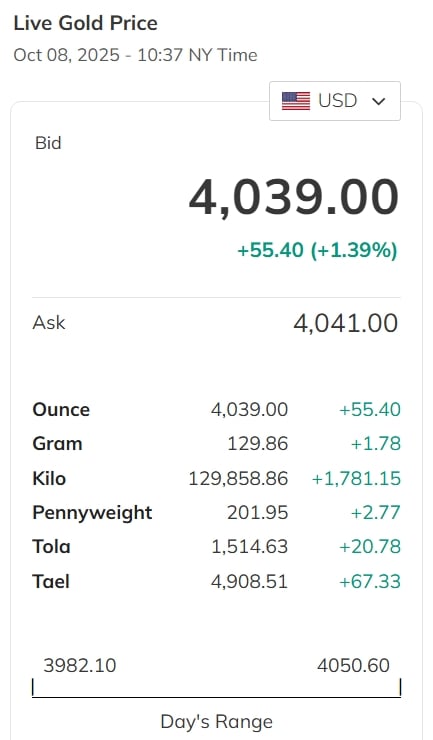
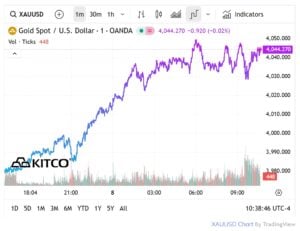
Gold prices climbed to new highs on Monday, with December futures reaching a record $4,014.60 per ounce. The yellow metal stayed strong as investors sought safety amid global uncertainty and a prolonged U.S. government shutdown.
Goldman Sachs raised its December 2026 gold price forecast from $4,300 to $4,900 per ounce, citing steady central bank purchases and renewed investor interest in gold-backed ETFs. Spot gold has surged 52% so far this year, supported by a weaker U.S. dollar and rising geopolitical tensions.
But first, let’s take a closer look at gold ETFs — what they are and why so many investors are turning to them.
What Are Gold ETFs and Why Are They Popular?
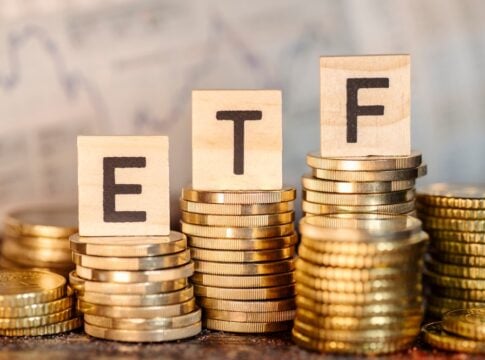
Gold Exchange-Traded Funds (ETFs) mirror the market price of physical gold without requiring investors to hold the metal themselves. Each ETF unit typically represents one gram of 99.5% pure gold, traded on stock exchanges just like shares.
Key features of gold ETFs include:
- Backed by physical gold stored in secure vaults
- Real-time pricing and easy trading through Demat accounts
- No storage or making charges
- Lower transaction costs and high liquidity
- Transparent pricing that tracks the spot gold rate
Central Banks and ETFs Fuel the Gold Price Rush
Reports say that China’s central bank has played a major role in driving gold demand. In September, the People’s Bank of China (PBOC) added to its gold reserves for the 11th month in a row, increasing holdings to 74.06 million troy ounces from 74.02 million in August. The value of these reserves also jumped to $283.29 billion, up from $253.84 billion the previous month.
Goldman Sachs expects central banks to keep buying gold, with around 80 tonnes forecast for 2025 and 70 tonnes for 2026, as emerging economies continue to diversify away from the U.S. dollar.
At the same time, strong inflows into gold ETFs are supporting the rally, giving investors an easier and safer way to gain exposure to rising gold prices.
Top Gold ETFs to Watch: IAU, GLD, and GDX
Gold ETFs provide a practical, cost-effective, and transparent way to invest in gold, avoiding the hassle of storage, insurance, and purity verification.
iShares Gold Trust (IAU)
IAU is one of the largest gold ETFs with around $72.7 billion in market capitalization. Each share represents roughly 0.01 ounces of gold, making it affordable for small investors. With a low expense ratio of 0.25%, IAU offers cost-effective access to physical gold.
However, it does not follow a specific ESG (Environmental, Social, and Governance) framework since it directly holds bullion. Any sustainability impact stems from the gold mining and refining practices behind the physical gold it stores.
SPDR Gold Shares (GLD)
GLD is the world’s largest gold ETF, managing about $129 billion in assets. Each share equals one-tenth of an ounce of gold, stored in vaults in London, New York, and Zurich, backed by custodians like JPMorgan Chase and HSBC. It is known for its high liquidity and tight spreads.
SPDR Gold Shares has removed many barriers to investing in gold, such as buying, storing, and insuring it. The fund provides direct exposure to physical gold, minus expenses, without relying on derivatives that carry extra credit risk.
It allows investors to easily access the gold market and include it in their portfolios, offering a strategic way to diversify risk due to gold’s low or negative correlation with other assets.
Like IAU, GLD does not integrate ESG criteria but depends on the ethical and environmental practices of gold suppliers and refiners.
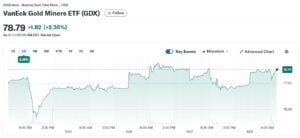
VanEck Gold Miners ETF (GDX)
GDX differs from IAU and GLD as it invests in leading gold mining companies instead of holding physical gold. Managing around $22.54 billion in assets, GDX tracks major miners such as Newmont and Barrick Gold.
The fund provides leveraged exposure to gold prices through miner performance. Since it involves mining operations, ESG factors play a more direct role covering carbon reduction, responsible sourcing, labor safety, and community development.
Sustainability Perspective: Physical Gold vs. Gold Miners
Physical gold ETFs like IAU and GLD mainly reflect the sustainability impact of gold mining through their bullion holdings. They don’t actively engage in ESG initiatives. In contrast, GDX connects investors directly to mining companies that can influence sustainability outcomes through operational decisions.
Investors focused on responsible investing should assess the ESG performance of individual mining companies within funds like GDX. This approach allows for more transparency and accountability in evaluating how sustainable practices affect returns and risk exposure.
Gold’s Shine Isn’t Fading Anytime Soon: A Smart Safe-Haven Investment
It’s now clear that the gold price is hitting record highs due to central banks buying more, strong ETF inflows, and ongoing global uncertainty. Because of this, ETFs like IAU, GLD, and GDX give investors different ways to invest in gold, depending on their needs for liquidity, cost, and even sustainability.
At the same time, the market is watching for possible Federal Reserve rate cuts and dealing with economic uncertainty. Gold’s appeal as a safe-haven asset remains strong. And Goldman Sachs’ higher forecast adds to investor confidence — the gold story is far from over.
Also, institutional investors are increasingly using gold ETFs to balance portfolios and protect against stock market swings. Experts recommend investing gradually and diversifying, especially after gold’s sharp price jump. Long-term investors like these ETFs because they are affordable, simple, and easy to manage.
Plus, rising interest in gold is encouraging some investors to explore other commodity ETFs, such as silver and industrial metals, to spread their risk.
In short, gold ETFs are a favorite in 2025 for their simplicity, transparency, and ability to protect against inflation and market ups and downs. Both retail and institutional investors see them as a safe and reliable way to invest in uncertain times.
- READ MORE: Gold Price Today Surges to All-Time High at $3,671 as Miners Push ESG and Carbon Reduction Goals
The post Top Gold ETFs to Watch Now as Gold Prices Break $4,000 — IAU, GLD, and GDX Lead the Pack appeared first on Carbon Credits.

EU carbon credit claims changed on 27 September 2026, the day the Directive (EU) 2024/825 began to apply across the European Union. The change is narrow. It changes how a company can talk about the credits it buys. A product can no longer be called neutral on the strength of compensation alone; however, every specific, evidenced statement about what a company measured, reduced, and funded stays fully available.

The post Promoting Improved Cooking Practices in Nigeria appeared first on Terrapass.



-
Climate Change1 year ago
Guest post: Why China is still building new coal – and when it might stop
-

 Greenhouse Gases2 years ago
嘉宾来稿:满足中国增长的用电需求 光伏加储能“比新建煤电更实惠”
-
Greenhouse Gases1 year ago
Guest post: Why China is still building new coal – and when it might stop
-

 Climate Change2 years ago
嘉宾来稿:满足中国增长的用电需求 光伏加储能“比新建煤电更实惠”
-

 Renewable Energy12 months ago
Sending Progressive Philanthropist George Soros to Prison?
-
Climate Change2 years ago
Bill Discounting Climate Change in Florida’s Energy Policy Awaits DeSantis’ Approval
-
Greenhouse Gases1 year ago
嘉宾来稿:探究火山喷发如何影响气候预测
-

 Climate Change2 years ago
Analysis: China’s CO2 falls 1% in Q2 2024 in first quarterly drop since Covid-19