Connect with us

Published

on

Renewable energy comes from different sources, such as solar and wind power. It’s often called “clean energy” because it produces little or no carbon emissions. It’s also called “green energy” because it comes from natural sources. 

With a focus on sustainability nowadays, new technologies are used to include renewable energy in sustainable building design. People can use clean energy at home by installing systems to produce electricity or using renewable sources to heat and cool water and spaces. 

Understanding Sustainable Building Design

Sustainable building design means creating buildings that are good for the environment and using resources wisely. These buildings are designed to use less energy and water, reduce waste, and minimize natural harm.  

Sustainable buildings also aim to be healthier for the people who live or work in them by using safe and environmentally friendly materials. They often use renewable energy, like solar power, and are built to last a long time with minimal environmental impact. 

The goal is to create structures that have a smaller impact on the environment and promote healthier living spaces for people. This means thinking carefully about how buildings are made, how they function, and how they affect their surroundings over time. 

Here are some primary factors that come with sustainable building design: 

Energy Efficiency: Sustainable buildings use less energy by incorporating better insulation, energy-efficient windows, and systems that control heating, cooling, and lighting. They also typically rely on renewable energy sources like solar panels or wind power. 

Water Conservation: These buildings are designed to use water wisely, with low-flow taps, rainwater collection systems, and efficient landscaping irrigation. 

Environmentally Friendly Materials: Sustainable buildings use non-toxic, recyclable materials with a low environmental impact. These materials can include recycled materials or those sourced from sustainable forests. 

Waste Reduction: Sustainable buildings aim to minimize waste during construction by using materials efficiently and recycling leftovers. Once built, they are designed to reduce ongoing waste by incorporating recycling systems and composting options. 

Healthy Living Environment: Sustainable design also focuses on creating a healthier indoor environment by improving air quality, using natural light, and avoiding materials that emit harmful chemicals. 

Long-Term Durability: These buildings are made to last, requiring less maintenance and repairs over time, reducing their environmental impact. 

Overall, sustainable building design involves smart choices that benefit people and the planet. It ensures that the building is eco-friendly, energy-efficient, and comfortable to live or work in.

Sustainable Building Design Strategies and Goals

sustainable

Using sustainable design has many advantages, such as saving money, improving comfort, and making buildings more enjoyable. 

Here are some common strategies used in sustainable buildings: 

  • Passive Sustainable Design: This includes natural light, good airflow, and using materials that store heat to make the building more energy-efficient. 
  • Active Sustainable Design: This involves using energy-efficient systems for heating, cooling, lighting, and plumbing. 
  • Renewable Energy: Sustainable buildings often use natural energy sources, like solar and wind, to power the building. 

The main goal of these strategies is to reduce the building’s impact on the environment while creating a functional and attractive space. Some specific goals for sustainable building design include: 

  • Net Zero Building: A building that generates as much energy as it uses over a year. 
  • Carbon Neutral Building: A building that doesn’t use fossil fuels or release greenhouse gases. 
  • Living Buildings: These buildings produce their energy, collect and clean water, use only non-toxic, renewable materials, and are designed to improve people’s well-being while supporting fairness and equality.  

Renewable Energy Integration for Sustainable Building Design| The Role of Renewable Energy in Sustainable Building Design

Incorporating renewable energy sources such as solar and wind into sustainable building design is a critical step toward green buildings and environmental preservation in an era when sustainability is a requirement rather than an option.  

Integrating solar, wind, and geothermal technologies into urban landscapes fosters a sustainable relationship with the environment.  

It propels the architectural industry toward a future where buildings serve as innovative and efficient ecosystems rather than mere physical structures.  

Solar Energy: Photovoltaics and Thermal| The Role of Solar Panels in Sustainable Architecture

Solar energy can be turned into electricity using silicon photovoltaic (PV) panels. These panels come in three main types: monocrystalline, polycrystalline, and thin film. They can be installed on the roofs or walls of buildings.  

In 2023, global solar energy capacity grew by nearly 50%, especially due to China’s rapid installation of solar panels. This shows how fast the technology advances and how easily it can be used in modern buildings. 

Renewable energy

Solar Thermal Energy:

Solar thermal systems use sunlight to produce heat, often to heat water. The system collects sunlight, concentrates it, and transfers the heat to a liquid, which can create steam.  

This steam drives a turbine connected to a generator, producing electricity. Solar thermal technology is especially useful for large-scale operations like factories and district heating systems, as it is very efficient for heating in big setups.  

Wind Energy| Integrating Wind Turbines into Building Design

Wind turbines turn the energy of moving air into electricity. The Bahrain World Trade Centre was the first skyscraper to use wind energy in its design.  

Modern advancements include vertical-axis turbines, which work well in cities because they don’t need to face the wind and can fit into smaller spaces.  

Large turbines can meet a significant part of a building’s energy needs, with some even providing power for thousands of homes yearly.  

By the end of 2023, global wind energy capacity had grown by 9%, reaching over 906 gigawatts, showing rapid advancements and increased use in rural and urban areas. 

Types of Wind Turbines:  

  • Horizontal-axis wind Turbines (HAWTs)  
  • Vertical-Axis Wind Turbines (VAWTs) 

Smaller wind turbines can be placed on rooftops or built into a building’s structure, providing a direct renewable energy source. This is effective in cities with limited space, but wind is available.  

In areas with enough wind, buildings can meet most of their energy needs with nearby freestanding turbines. These setups can range from small community wind projects to large wind farms that send power to the grid. 

Geothermal Energy| How to Integrate Geothermal Systems into Building Design?

Geothermal systems heat and cool using the stable temperature beneath the earth’s surface. Geothermal heat pumps (GHPs) transfer heat to and from the ground through a heat exchanger, making them very efficient and less affected by outdoor temperatures.  

These systems can be set up in different ways depending on land space and soil conditions, such as horizontal, vertical, or pond/lake setups.  

Types of Geothermal Systems: 

  • Horizontal Systems 
  • Vertical Systems 
  • Pond/Lake Systems 

Careful planning is needed to integrate geothermal systems into buildings.  

Here’s a simple process: 

Site Assessment: Before installation, the site must be evaluated. This includes checking the soil and rock type, groundwater presence, and land availability to decide if a horizontal, vertical, or pond/lake system will work best. 

Designing the Ground Heat Exchanger: The system uses a network of pipes underground (or in water) to transfer heat. The setup can be horizontal or vertical or placed in nearby water bodies. 

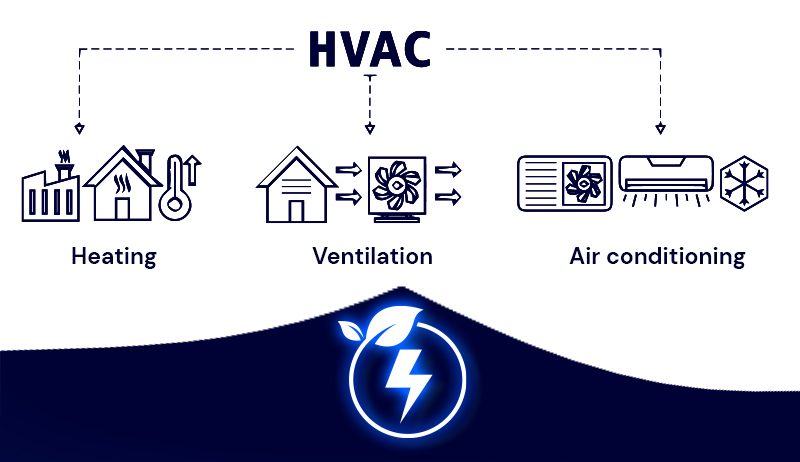
Connecting to Building Systems: The geothermal system must be connected to the building’s heating and cooling system (HVAC). It can distribute heated or cooled air or water through ductwork or radiant floors. 

Energy Management System (EMS) Integration: An EMS can control the geothermal system to run during low-energy times to save costs. It also monitors the system’s performance to ensure it operates efficiently.  

How to Construct Sustainable and Energy-efficient Buildings? Sustainable Building Design Principles

Due to climate change, building in an environmentally friendly and energy-efficient way is more important than ever.  

Here’s a simple guide on how to create sustainable buildings, from using renewable energy and sustainable materials to improving indoor air quality.

Energy Efficiency

Energy efficiency is key to reducing the energy a building needs and lowering its environmental impact.  

This can be achieved using energy-efficient appliances, lighting, and automated doors, which help save energy by minimizing heat loss or gain. These measures lower energy use and reduce operating costs. 

Renewable Energy

Adding renewable energy sources like solar panels and wind turbines helps reduce a building’s reliance on non-renewable energy and lowers its carbon footprint. This approach makes the building greener and more sustainable. 

Sustainable Materials

Using eco-friendly materials is a crucial part of sustainable construction. Materials like reclaimed wood, recycled steel, and natural insulation like hemp or cotton reduce the building’s environmental impact.  

These materials are better for the planet and cost-effective over time, as they often require less maintenance and reduce long-term expenses.  

Indoor Air Quality

Good indoor air quality is essential for the health of the people inside a building. Using low-VOC (volatile organic compounds) paints, sealants, and adhesives prevents harmful chemicals from polluting the air.  

Installing air purification systems further improves air quality by removing allergens and pollutants. Automatic doors can also help by controlling airflow, regulating temperature, and keeping outdoor pollutants out. 

Building sustainable, energy-efficient structures is a crucial way to combat climate change. A complete approach, covering everything from design and construction to operation and maintenance, is needed. 

Contact Cyanergy for more informative content like this. Or talk to an expert!

Your Solution Is Just a Click Away

The post Renewable Energy Guide to Sustainable Building Design appeared first on Cyanergy.

https://cyanergy.com.au/blog/renewable-energy-guide-to-sustainable-building-design/

Continue Reading

Renewable Energy

Raw Stupidity: Yet One More Reason that Trump Must Go

Published

on

From the Huffington Post:

A senior FBI officer struggled to answer basic questions about antifa, despite characterizing the organization as “the most immediate violent threat” the US faces.

At a House Committee on Homeland Security hearing on Thursday, Michael Glasheen, operations director of the national security branch of the FBI, said he agreed with President Donald Trump that antifa is one of the greatest national security threats to the country.

The answer, of course, is that “Antifa” is a concept, not an organization.  It refers to anyone who is against fascism. It has no headquarters, no leaders, and no members.

Now, it is true that people with these views can be violent.  When my father led a crew of his fellow anti-fascists, flying a B-17 bomber in World War 2, they completed 29 successful missions, destroying Nazi oil refineries.   Were Nazi soldiers killed in the process?  I never asked him that, and he probably didn’t know, as they were flying at 29,000 feet, but it seems extremely unlikely that no one died.

In peacetime, we antifa people are non-violent.  We may be marching for BLM, or encouraging the use of science in policymaking, or expressing our view that the United States should not have a king.

The FBI must understand this; they must be saying this purely to placate Trump.  No one can be that stupid.

Raw Stupidity: Yet One More Reason that Trump Must Go

Continue Reading

Renewable Energy

Hydrokinetics Gone Awry

Published

on

When I came across the meme at left, I was instantly reminded of a guy who called me from Baltimore, MD about 15 years ago, anxious for me to hunt up investors in an invention he had created.  I was having a hard time understanding the concept he was describing, and so he told me, “Think of it as a river in a box.”

“Ah! Now I get it. You have a box full of standing water. You add energy to it to get it moving, and then our extract energy from the moving water.  And you think that you can extract more energy than you put into it.”

“Yes!” he said excitedly.

I calmly told him that this violates the laws of physics, specifically the first and second laws of thermodynamics, but he wasn’t “having it.” I wished him a pleasant good night and asked him to let me know when he had built a working prototype.

I’m still hoping to hear from him again.

Hydrokinetics Gone Awry

Continue Reading

Renewable Energy

Benefits of Solar Power Solution in Manufacturing Facilities 

Published

on

In today’s dynamic manufacturing world, energy is more than just a utility; it’s the spark that keeps production running. Industrial facilities, powered by massive engines and heavy machinery, often operate 24/7, driving output but also consuming enormous amounts of electricity.

The issues? Soaring energy costs and a growing environmental footprint.

Sometimes it’s like a cycle that often feels impossible to break, but what if your facility could draw energy from a cleaner, more reliable, and cost-effective energy source?

Yes, you heard it right, and that’s where solar power comes in!

As electricity prices continue to rise and corporate sustainability goals become more pressing, manufacturers are rethinking how they power their commercial operations.

Therefore, solar energy is emerging as a game-changing solution, offering reliability, long-term savings, and a sustainable path forward for the Australian manufacturing industry.

In this blog, we’ll explore how manufacturers are successfully implementing solar power, featuring real-world case studies from Cyanergy that highlight both the business advantages and environmental impact.

So, let’s explore how solar energy can help your manufacturing facility reduce costs and enhance efficiency, achieving long-term sustainability.

Why Solar Energy Is Essential for Modern Manufacturing Facilities?

In Australia, manufacturing facilities typically have large roof or yard footprints, significant and relatively
stable electrical loads, including lighting, motors, HVAC, and other machinery. So, the energy used every day is
enormous.

By harnessing the sun’s energy, factories can significantly cut operating
costs
, reduce carbon emissions, and gain greater control over long-term energy stability.

Beyond the environmental benefits, solar power also strengthens a company’s competitive edge and brand reputation in
an increasingly eco-conscious market.

Here we’ve penned down the importance of solar power in the manufacturing industry:

  1. Energy cost mitigation 
  2. So, how solar energy reduces manufacturing costs in Australia?

    With electricity prices rising and energy market volatility increasing, incorporating solar energy offers a
    way to
    reduce grid dependency and lower utility costs in the long term.

  3. Ensure Operational Continuity & Resilience
  4. Solar panel systems, when paired
    with
    battery storage, can help smooth peak energy demand, reduce grid dependence, and improve functioning
    time.

  5. Promote Sustainability and Brand Value
  6. In larger industries, many manufacturers are under pressure from customers, regulators, investors, and
    internal
    stakeholders to reduce
    their carbon footprint
    .

    Solar helps them to achieve energy freedom, powering businesses with a sustainable energy source.

  7. Increase Asset value & ROI
  8. Solar systems, when sized appropriately and properly optimised, can deliver payback in a few years and
    continue to
    provide savings thereafter.

According to Cyanergy’s capability statement, we delivered a 490
kW system
that generated 752 MWh for a manufacturing client, with a 37-month payback period.

This shows that industrial-scale solar can deliver real, practical results for manufacturers.

Now, let’s examine solar power solutions for manufacturing facilities, case studies, and best practices to ensure a
clear understanding.

Case Studies from Cyanergy: Real-World Manufacturing Success in Australia!

In this part of the blog, we have selected three examples from Cyanergy to illustrate how manufacturing facilities are utilising solar energy.

These are not generic installations; these are production-oriented businesses taking real steps across different states of Australia.

1. Uniplas Mouldings International – Wetherill Park, NSW

Project Overview

  • System size: 490 kW solar system installed in staged phases
  • Investment: AUD $591,823.71.
  • Annual generation: 752 MWh
  • Yearly energy costs before solar: approximately $647,000.
  • After solar: $456K, which is approximately 55% of the previous
  • Payback period: 37 months

Why it matters

For Uniplas, a large industrial manufacturer, the solar system not only significantly reduces their operating energy
costs, but the payback of just over 3 years means that the return on investment is also attractive for the
business.

The staged approach also allowed them to access multiple subsidies and implement the project rapidly; for example,
the first stage of 200 kW was completed in four weeks.

This clearly shows how manufacturing operations can incorporate
solar
without any significant disruption.

2. AC Laser – Thomastown, VIC

Project Overview

  • System size: 99.45 kW
  • Annual generation: 141.75 MWh
  • Annual electricity cost before solar: $79,000.
  • After solar: $38,160, a reduction of more than 50%
  • Payback period: 26 months

Why it matters

This is a smaller-scale manufacturing facility compared to Uniplas, yet the results are impressive: a more than 50%
cost reduction and a shorter payback period.

This shows that not only large-scale commercial properties but also mid-sized manufacturing operations can benefit
from solar, not just large ones.

Insights Gained from the Case

  • Don’t wait until your business is huge, as size is scalable.
  • The solar system’s size aligned well with the manufacturing load, saving thousands of dollars.
  • Rapid ROI shows manufacturing facilities can justify solar as a capital investment for their business.

3. Specialised (Cycling-Industry manufacturer) – Port Melbourne, VIC

Project Overview

  • System size: 39.6 kW
  • Annual generation: 47.32 MWh
  • Electricity cost before solar: $26,720; after solar: $17,770
  • Payback period: 45 months

Why it matters

Although smaller, this project depicts that solar energy is a viable option for manufacturing across various sizes
and sectors, even in facilities with a relatively small carbon footprint.

The case emphasises sustainability as a business value and how solar can support brand positioning as well as cost
savings.

Major Takeaways

  • Solar supports both cost and branding sustainability
    goals
    .

  • Even medium-sized systems can provide meaningful savings.
  • The ROI
    generated
    must be viewed in terms of both financial and reputational benefits for any
    business, whether it’s large or small.

Is Now the Right Time for Manufacturers to Transition to Solar Energy?

After knowing the numerous benefits of solar solutions, you may be tempted to go solar. However, transitioning from
traditional energy sources to solar energy comes with a cost. 

From government
incentives
to long-term cost savings, the financial case for solar energy is compelling.

Still wondering, is it time for businesses to go solar? Here’s why you should act now:

  • Electricity prices continue to rise in many markets, strengthening the return on investment for solar
    energy.

  • Many governments and utilities offer incentives, favourable tariffs, or rebates
    for industrial solar projects.

  • Day by day, the pressure for sustainability reporting and corporate social responsibility (CSR) is
    intensifying. Manufacturing facilities with high energy loads are often subject to inspection.

  • Technology costs have fallen recently, making solar panels and inverters
    more affordable than ever and reducing payback time.

  • With the right sizing and execution, the solar system becomes a long-term asset that pays for itself,
    releasing capital for other manufacturing investments.

Best Practices for Manufacturing Facilities Considering Solar

Solar can be a powerful game-changer for manufacturing companies and large commercial buildings when implemented correctly.

But that doesn’t mean it’s as easy as flipping the switch.

Therefore, before investing in Solar power, ensure you understand every step that leads to real savings and sustainable success for your business.

1. Conduct a detailed energy assessment & align solar to load

Before installation, it is essential to understand your manufacturing facility’s energy usage patterns, including the peak usage limit, daily load curves, and seasonal variations.

The better the match between system size, orientation, and actual usage, the higher the yield and the quicker the payback.

At Cyanergy, we provide a customised design based on site analysis.

2. Use staging or modular deployment

If you have a large manufacturing site, you may benefit from staging the solar solution in phases.

For example, in Uniplas’s case, the installation was divided into three stages. This enables access to multiple subsidies, enhances cash flow, and mitigates the risk of disruption.

3. Optimise your system size & measure consumption rate

Over-sizing or under-sizing can both cause significant loss in a business. Therefore, the design should minimise waste and maximise the use of solar energy on-site.

As in AC Laser’s mid-sized facility, a 99 kW system fits their load and delivers huge savings.

4. Check your rooftop or plant infrastructure

Is your rooftop compatible with solar panel installation?

For manufacturing facilities, factors such as roof strength, shading, orientation, structural constraints, and maintenance access are crucial.

Ensure the facility can support panels, inverters, wiring, and monitoring systems without compromising building aesthetics.

5. Perform regular monitoring & performance tracking

Everything requires a certain amount of care and maintenance to function properly over time. The story is the same for a solar panel system.

Real-time monitoring allows you to spot performance issues, shading effects, degradation, and inverter downtime.

Cyanergy emphasises continuous monitoring post-installation.

6. Research on financial modelling & payback analysis

When going for solar, always calculate realistic payback periods, ensure system cost fits within capital budgets,

You should also check the available incentives, tax benefits, payback time, and how to stack several rebates for maximum savings.

For example, many Cyanergy projects offer a 2–4 year payback, with several solar rebates that can be combined with the VEU Rebate.

7. Align with sustainability and your brand strategy

In manufacturing factories, incorporating solar energy can be a substantial component of a broader sustainability strategy. Why?

Solar reduces your dependency on harmful fossil fuels, cutting greenhouse gas emissions.

It positions your brand and promotes your business, demonstrating corporate responsibility and improving stakeholder perception.

8. Maintenance & lifecycle planning

Solar systems require periodic maintenance, inverter replacements, cleaning, and monitoring.

So, manufacturing facilities should incorporate service arrangements into their design. Plan for system longevity, degradation, and eventual replacement or upgrade to ensure optimal performance.

9. Consider adding Battery storage

Even though optional, integrating battery storage or demand management can enhance value by enabling peak shaving, reducing demand charges, and storing excess energy for nighttime use or during grid outages.

10. Engage stakeholders and minimise disruption

In manufacturing, you can’t easily stop production. Plan your solar installation during low-production periods, coordinate with your team, and prioritise safety to minimise downtime.

Final Notes: Ready To Take The Next Step?

For manufacturing facilities, solar power isn’t just about being eco-friendly; it’s a smart business move for Australians. Cyanergy’s case studies showed that even large manufacturers can achieve paybacks of 2–4 years, reduce costs, lower emissions, and enhance brand value.

With proper planning, energy assessment, correct system sizing, phased installation, and active monitoring, solar can deliver lasting benefits.

So, if rising energy bills or sustainability goals are on your radar, it’s time to view solar energy as an innovative manufacturing solution, apart from just a renewable energy source.

Reach out to Cyanergy, conduct an energy audit, and engage a solar specialist with manufacturing experience today. Cyanergy is here to help!

Your Solution Is Just a Click Away

The post Benefits of Solar Power Solution in Manufacturing Facilities  appeared first on Cyanergy.

Benefits of Solar Power Solution in Manufacturing Facilities 

Continue Reading

Trending

Copyright © 2022 BreakingClimateChange.com