


Radisson Hotel Group has raised its climate ambition in the hospitality sector. The group now targets 100 verified net-zero hotels by 2030 across its global portfolio. This move builds on its existing science-based net zero commitment by 2050, approved under the Science Based Targets initiative (SBTi).
Radisson defines verified net-zero hotels as properties that cut operational emissions completely. This is done through energy transition and efficiency upgrades. while using limited offsets only for any remaining emissions.
The company has already launched early examples of this model in Manchester (UK) and Oslo (Norway). These hotels were upgraded through full operational redesigns instead of new construction. The goal is to scale this approach across multiple regions and hotel types.
Radisson Hotel Group CEO Federico J. González Tejera remarked during the release:
“At Radisson Hotel Group, sustainability ultimately starts with people. It is about delivering for our guests, creating value for our owners, and supporting the communities where we operate. Verified Net Zero Hotels are an important step in our net zero transformation, setting a new standard for how hospitality can reduce its environmental impact while continuing to support people, destinations, and economic activity.”
How Net Zero Hotels Work in Practice
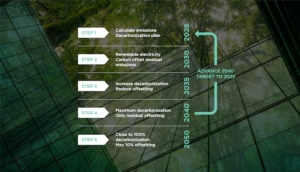
Radisson’s net zero model follows a structured decarbonization system developed with industry partners. It is designed to measure, reduce, and gradually eliminate emissions across hotel operations.
The process involves several steps:
- measuring carbon fully,
- switching to renewable electricity,
- electrifying heating and cooking, and
- upgrading efficiency in water, waste, and energy use.
Over time, the goal is to reduce reliance on carbon offsets and focus on real emissions cuts.
The Manchester and Oslo hotels show how this works in practice. Both properties switched to renewable electricity, removed fossil fuel systems, and added low-carbon changes. These include electrified kitchens and waste reduction programs.
Radisson says these pilot hotels cut emissions by about 60%. This shows that significant reductions are possible in existing buildings.
Big Targets, Real Progress: Radisson’s Carbon Cuts
Radisson has set measurable climate targets aligned with global climate frameworks. The company aims to reduce Scope 1 and Scope 2 emissions by 46% by 2030, compared with a 2019 baseline. It also targets a 28% reduction in Scope 3 emissions by 2030, which includes supply chain and outsourced activities.
The group has already made measurable progress. By 2023, Radisson achieved a 35% reduction in carbon footprint per square metre compared to 2019 levels. Over the past decade, it has also improved energy and water efficiency by around 30% across operations.
The company works in over 100 countries and manages more than 1,500 hotels. This makes its decarbonization effort one of the biggest in the global hospitality sector.
Industry Shift: Hotels Move Toward Low-Carbon Operations
The hotel industry is increasingly under pressure to reduce emissions. Hospitality is energy-intensive because of heating, cooling, laundry, food services, and continuous building operations.
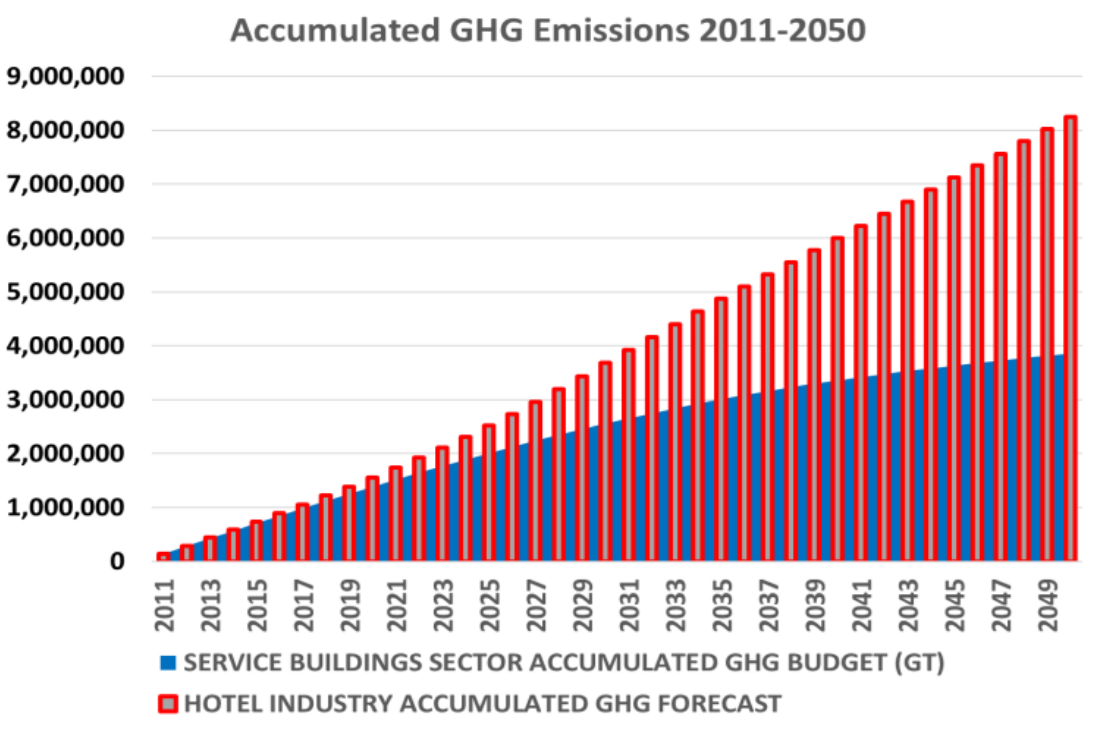
Hospitality accounts for ~1% of global carbon emissions and ~7.8% of water use worldwide. The sector’s energy intensity averages 200-800 kBtu/sq ft annually, with heating/cooling consuming 50-60% of total energy.
Emissions breakdown by source:
- Building energy: 60-70% (HVAC, lighting, hot water)
- Food/beverage supply chains: 20-25%
- Waste management: 10-15%
Hotels are now focusing on electrification and using renewable energy. They are also upgrading efficiency to cut their carbon footprint and journey toward net positive hospitality.
Radisson is joining a trend toward verified net-zero hotels. These hotels need to cut emissions and get third-party checks. This approach reduces uncertainty in sustainability claims and improves transparency for investors and customers.
Independent verification systems are now widely used to confirm emissions reductions. They help make sure that net zero claims are credible and comparable across the industry.
The standard third-party verification:
- Green Key/SGS: Verify WTTC Hotel Sustainability Basics (12 criteria)
- TÜV Rheinland: Certifies Radisson’s net zero hotels
- Cornell Hotel Sustainability Index: Benchmarks 1,307 global markets
The Net Zero Race in Hospitality: Radisson vs Marriott vs Accor
Radisson Hotel Group, Marriott International, and Accor Hotels all follow long-term net-zero goals. However, their timelines and strategies differ.
-
Radisson Hotel Group
Radisson Hotel Group aims for net zero across Scope 1, 2, and 3 emissions by 2050. It has a near-term target to cut Scope 1 and 2 emissions by 46.2% by 2030 (2019 base year) and reduce Scope 3 emissions by 27.5%.
Radisson has also launched “Verified Net Zero” hotels powered by 100% renewable electricity and low-waste operations. It is adding energy-saving upgrades. This includes LED lighting, smart heating and cooling systems, and building retrofits throughout its portfolio. It also pushes waste reduction programs, including food waste tracking and recycling systems in many hotels.
-
Marriott International
Marriott International also targets net zero across its value chain by 2050, with science-based approval. It plans to reduce Scope 1 and 2 emissions by 46.2% and Scope 3 emissions by 27.5% by 2030 (2019 baseline). It is investing in large-scale renewable electricity procurement through long-term power purchase agreements.
Marriott is also improving building efficiency with smart energy management systems across thousands of properties. Marriott is also promoting low-carbon supply chains. They are working with suppliers to reduce packaging and use more sustainable materials.
-
Accor
Accor also targets net zero by 2050, with a strong focus on operational efficiency and procurement reform. It is upgrading hotels with energy-efficient systems and expanding renewable electricity use across its brands.
Accor is also reducing food-related emissions by increasing plant-based menu options and cutting food waste. However, it provides less detailed interim emission reduction percentages than Radisson and Marriott. It focuses more on operational efficiency and engaging suppliers to make progress.
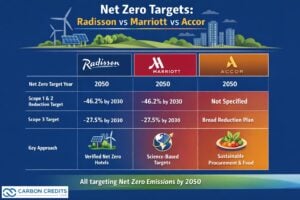
Overall, all three groups are moving toward net zero, but Radisson and Marriott show more defined short-term emissions targets. In contrast, Accor focuses more on operational changes and supply chain improvements.
ESG and Sustainable Hospitality: Green Travel Is No Longer Optional
Sustainability is becoming a stronger factor in travel decisions. More guests now prefer hotels that show clear environmental performance and use verified sustainability systems.
Corporate travel buyers are also adding ESG requirements to hotel contracts. This includes emissions reporting, renewable energy use, and waste reduction commitments. As a result, sustainability is becoming a competitive factor in hotel selection.
The global hospitality sector is adopting structured plans for decarbonization. This includes energy efficiency upgrades and using renewable electricity. Digital tracking of emissions is also becoming more common, especially for large hotel groups.
Radisson’s net-zero hotels are part of this shift. Sustainability-focused hotels can boost guest engagement and enhance brand positioning. This is backed by industry case studies. These strategies help hotels stand out in competitive markets.
The Hard Truth About Scaling Net Zero Hotels
Scaling net-zero hotels globally is complex. One major challenge is the cost of retrofitting existing buildings. Many hotels require major upgrades to heating, cooling, and kitchen systems to reduce emissions.
Another challenge is uneven access to renewable electricity across regions. Some markets still rely heavily on fossil fuels. This limits emissions reductions, even when hotels switch to cleaner operations.
Supply chain emissions also remain difficult to control. These include food sourcing, construction materials, and outsourced services. Tracking and reducing Scope 3 emissions requires coordination across many suppliers.
Finally, implementation varies by country due to differences in regulation, infrastructure, and energy systems. This creates uneven progress across global hotel portfolios.
Can Net Zero Become the New Hotel Standard?
Radisson’s plan to reach 100 net-zero hotels by 2030 marks a significant step in hospitality decarbonization. If achieved, it would create one of the largest verified net-zero hotel networks globally.
The strategy also supports its long-term goal of achieving net zero emissions across its entire value chain by 2050, aligned with global climate targets.
Future progress relies on quicker electrification of hotel operations, broader access to renewable energy, better ESG reporting, and ongoing investment in low-carbon technologies.
If done right, net-zero hotels could be the norm in global hospitality within the decade. This would change how hotels run and compete in international travel.
- READ MORE: The Net Zero Game: Are Hotels and Restaurants Truly Committed to Reducing Carbon Emissions?
The post Radisson Hotel Group Ramps Up Net Zero Push by 2030: How Does it Compare with Marriott and Accor? appeared first on Carbon Credits.

What auditors actually test, where projects actually fail, and the contract clauses that protect you before signature.
The meeting happens about fourteen months after the contract was signed. Your assurance provider has reached the nature-based investment line in your Scope 3 file, and the partner across the table has exactly two questions. How do you know the reductions happened? And how do you know they would not have happened anyway?
The first question is MRV: measurement, reporting, and verification. The second is additionality. Between them, they decide whether your nature-based investment counts, in your inventory, in your disclosure, and in front of your board. Everything else in the project documentation is supporting material for these two answers.
This article walks through what each question actually tests, where projects most commonly fail, what digital MRV has changed (and what it has not), and the contract clauses that protect you. The goal is to give you the diligence framework before you sign, because after the credit issues is the wrong time to discover the answers were weak.
What MRV actually verifies
MRV is the machinery that turns a field intervention into a defensible number. Measurement covers the data: biomass surveys, soil sampling, remote sensing, activity records from participating farms. Reporting covers the translation of that data into claimed reductions under a recognised methodology. Verification covers the independent check: an accredited third party tests the reporting against the methodology and the evidence.
The methodologies live in registries. Verra’s Verified Carbon Standard and the Gold Standard are the two largest for nature-based projects, and each publishes the methodology documents, monitoring requirements, and verification protocols that a project must follow. The ICVCM Assessment Framework now sits above the registries, assessing whole methodologies against the Core Carbon Principles and granting the CCP label to those that pass.
For a buyer, the practical questions are concrete. What is the monitoring frequency, and is it specified in the project design document or left vague? Who is the verifier, how were they selected, and how often do they rotate? What raw data do you, the buyer, get access to, and in what format? A project that answers these in writing is a different procurement than one that answers them in a sales call.
What additionality actually proves
Additionality asks whether the intervention caused the reduction, or whether the reduction would have happened anyway. The test is a counterfactual: what would this landscape, this farm, this forest have done without the project’s money?
Three forms matter in practice. Financial additionality asks whether the project needed the carbon revenue to proceed. Regulatory additionality asks whether the activity was already required by law. Common-practice additionality asks whether the activity is already standard in the region, in which case paying for it buys you nothing the world was not getting for free.
The reason additionality dominates audit conversations is recent history. Research published in 2023, including the Science paper examined at length in our piece on conventional offsets and boardroom credibility, found that a large share of REDD+ credits failed the counterfactual test because baselines were inflated. The market response was a wave of methodology revisions at Verra and the arrival of independent ratings agencies whose entire business is re-testing additionality claims. The Carbon Credit Quality Initiative publishes transparent scoring of methodologies on exactly this dimension, and it is free to consult before you sign anything.
Where projects most commonly fail the test
Five failure modes account for most of the wreckage.
- Inflated baselines. The counterfactual assumes more deforestation, more degradation, or lower yields than the evidence supports. The claimed reduction is the gap between reality and the baseline, so an inflated baseline manufactures reductions from nothing.
- Unaccounted leakage. The project protects one forest and the logging moves to the next valley. The methodology is supposed to net this out; weak projects estimate it optimistically.
- Thin permanence protection. Nature-based carbon can reverse: fire, pest, drought, or a change of landowner. Buffer pools and insurance mechanisms exist for this, but their adequacy varies enormously between projects.
- Attribution and double counting. In supply chain settings, the same reduction can be claimed by the supplier, the buyer, and a credit purchaser unless contracts prevent it. Our Insetting vs Offsetting piece covers the inventory rules; the point here is that the auditor will ask who else is counting this tonne.
- Stale monitoring. Data collected at validation and never refreshed. The IPCC AR6 Working Group III land-sector chapter documents how quickly carbon stocks respond to disturbance; a three-year-old measurement is a historical artifact, not a current claim.
What digital MRV changes, and what it does not
Digital MRV is the genuine improvement in the field. Satellite remote sensing, including the free archives at NASA Earthdata, allows biomass and land-cover change to be monitored continuously rather than at multi-year verification intervals. Soil carbon models calibrated with physical sampling reduce the cost of agricultural measurement. The practical effect is more frequent data at lower cost, which compresses the window in which a problem can hide.
What digital MRV does not change is judgment. Baselines are still human decisions about counterfactuals. Additionality is still an argument, not a measurement. Research groups such as the Oxford Smith School have been clear on this point: better sensors improve the M in MRV, but the integrity questions live in the assumptions, and assumptions need governance, not gadgets.
For a buyer, the test is simple. Ask the provider what is measured by instrument, what is estimated by model, and what is assumed by methodology. A provider who can answer that question crisply understands their own evidence chain. A provider who cannot is selling you their confidence rather than their data.
What to require in your contract
The diligence above converts into five contract clauses.
- Monitoring cadence and buyer data access, specified by dataset and frequency.
- Verifier independence, named accreditation, and rotation terms.
- Baseline revision triggers, so the counterfactual updates when the methodology or the evidence changes.
- Reversal liability and buffer adequacy, with the mechanism named and sized.
- Documentation handover in audit-ready form, so the evidence file your assurance provider needs already exists.
None of these clauses is exotic. All of them are absent from weak contracts, and their absence is the most reliable early signal that the MRV and additionality answers will be weak too.
If you are evaluating a nature-based investment and want the MRV and additionality stress-tested before signature rather than after, the carbon and sustainability experts at Carbon Credit Capital can run that review against any project on your shortlist, and design nature-based supply chain investments where the evidence chain is built audit-first. Schedule a consultation.
Sources and further reading
- ICVCM: Core Carbon Principles Assessment Framework
- Verra: Verified Carbon Standard
- Gold Standard for the Global Goals
- Carbon Credit Quality Initiative: Methodology quality scores
- University of Oxford Smith School: Sustainable finance research
- IPCC AR6 Working Group III, Chapter 7: AFOLU
- NASA Earthdata satellite remote sensing archive
EU Directive: Empowering Consumers for the Green Transition (ECGT)
The EU Directive, Empowering Consumers for the Green Transition (ECGT), takes effect on September 27, 2026.(1) The goal of ECGT is to protect consumers by ensuring that environmental claims are fair, understandable, and reliable. This regulation does create a new compliance requirement for businesses, but it also provides sustainability and marketing teams with important guidance that helps create consistency in sustainability communications.
Key takeaways
- ECGT takes effect September 27, 2026, and prohibits claims that a product or service has a neutral, reduced, or positive environmental impact based on offsetting alone.
- Named example phrases the regulation prohibits include climate neutral, CO2 neutral certified, carbon positive, climate net zero, climate compensated, reduced climate impact, and limited CO2 footprint.
- ECGT does not want to deter investment in carbon credits. It wants companies to communicate the real benefits of the projects they support instead.
- SBTi’s guidance recommends framing carbon credits as taking responsibility for ongoing emissions, not as making a product or company neutral.
- Voluntary carbon projects deliver real climate progress: reducing super-pollutants, protecting and restoring ecosystems, and supporting communities.
Regarding carbon credits specifically, voluntary carbon projects deliver important climate progress and environmental benefits that provide many talking points for companies. They reduce climate super-pollutants by removing industrial emissions like methane, N2O, HFCs and others. They protect and restore valuable ecosystems and carbon sinks like forests, mangroves and grasslands. They help communities by reducing local pollution, creating employment opportunities, improving access to healthcare, and more.
The Science Based Targets Initiative (SBTi), a global leader in business climate action, concludes that alongside aggressive decarbonization, we should also use high quality carbon credits to take responsibility for our ongoing emissions. SBTi recognizes that carbon credits are important “to help limit temperature overshoot, mitigate transition risks, and support climate solutions.”(2)
ECGT language on carbon offsetting says that they do not want to deter investment in carbon credits. They just want companies to focus on communicating the benefits of the projects they support and avoid claims beyond the scope of carbon credits, which is good for everyone, companies and consumers alike.
The regulation reinforces that carbon credits do not change the sustainability of your products, so carbon credit buyers should not suggest that their products are more sustainable because of carbon credits. Instead, companies need to promote their climate contributions as a way to compensate or take responsibility for their carbon emissions by supporting projects that do great things like reducing global carbon emissions, reducing pollution, preventing deforestation, restoring forests, and more.
ECGT language related to carbon offsetting
The regulation is particularly focused on prohibiting claims, based on offsetting greenhouse gas emissions, that a product or service has a neutral, reduced, or positive impact on the environment in terms of greenhouse gas emissions. These claims are prohibited in all circumstances because they mislead consumers into believing the claim relates to the product itself, or to how it was made and supplied, or into thinking that using the product carries no environmental impact at all.
Named examples of prohibited claims include:
- climate neutral
- CO2 neutral certified
- carbon positive
- climate net zero
- climate compensated
- reduced climate impact
- limited CO2 footprint
These claims are only allowed when they rest on a product’s actual lifecycle impact, not on offsetting emissions outside that product’s value chain, since the two are not equivalent. This prohibition does not stop companies from advertising their investments in environmental initiatives, including carbon credit projects, as long as they present that information in a way that is not misleading and that meets the other requirements of Union law.(1)
SBTi also provides guidance on climate contribution language in its Corporate Net Zero Standard Version 2.0 Draft for Second Public Consultation, November 2025. While the SBTi language is fairly technical, it has a good framework for crafting a climate contribution message.
SBTi Language for Carbon Credits(3)
- Take responsibility for ongoing emissions by delivering mitigation impact contributions
- Carbon credits certify the mitigation outcomes of projects that reduce, avoid, or remove carbon emissions
- Activities that reduce emissions from emission sources not located within the company’s value chain
- Activities that conserve, protect, and enhance natural carbon sinks
- Activities that capture and store carbon in storage pools
SBTi’s draft standard also walks through sample claim language for this kind of contribution. In general, the samples move from a simple percentage statement, to naming a specific verified tonnage tied to that percentage, to a fuller statement that breaks the tonnage into reductions versus removals. Across all three, the framing stays consistent: a company took responsibility for a defined share of its ongoing emissions over a set period, by funding a specific, verified amount of mitigation, achieved through emission reductions or removals.(3)
FAQ: ECGT and Carbon Credit Claims
When does the ECGT directive take effect?
The rules apply across the EU from September 27, 2026, after member states transposed the directive into national law by March 27, 2026.
Does ECGT ban carbon offsetting?
No. It bans specific marketing claims that a product or service is environmentally neutral, reduced impact, or positive based on offsetting. Advertising investment in carbon credit projects themselves is still allowed if it is not misleading.
What phrases does ECGT specifically prohibit?
Named examples include climate neutral, CO2 neutral certified, carbon positive, climate net zero, climate compensated, reduced climate impact, and limited CO2 footprint, when those claims are based on offsetting rather than a product’s actual lifecycle impact.
How should a company describe its carbon credit purchases instead?
SBTi’s guidance recommends stating the specific verified tonnage of emissions reductions or removals funded and describing that as taking responsibility for a defined share of ongoing emissions, rather than claiming the company or product is neutral.
Does this rule apply to company level sustainability claims too?
ECGT is focused on claims about specific products and services in consumer marketing. Broader company level sustainability communication is a separate matter still governed by other existing rules.
While ECGT does add a new compliance burden for businesses, it helps create consistency in sustainability messaging that is important to building confidence in voluntary carbon projects and scaling the industry to help us achieve progress on global carbon emissions.
Disclaimer: Terrapass does not provide legal or regulatory advice. Any interpretation of regulation must be approved by your legal representative.
References:
(1) https://eur-lex.europa.eu/eli/dir/2024/825/oj
(2) https://files.sciencebasedtargets.org/production/files/Corporate-Net-Zero-Standard-version-2.pdf
(3) https://files.sciencebasedtargets.org/production/files/CNZS-V2-Second-Consultation-Draft.pdf
The post The EU’s New Green Claims Rules and Carbon Credits appeared first on Terrapass.

Most businesses that decide to act on their net-zero targets reach the same point of friction. Buying carbon credits has meant tracking down brokers, sitting through sales calls, and requesting a quote just to learn a price, sometimes with limited proof of what you are buying.




-
Climate Change1 year ago
Guest post: Why China is still building new coal – and when it might stop
-

 Greenhouse Gases2 years ago
嘉宾来稿:满足中国增长的用电需求 光伏加储能“比新建煤电更实惠”
-
Greenhouse Gases1 year ago
Guest post: Why China is still building new coal – and when it might stop
-

 Climate Change2 years ago
嘉宾来稿:满足中国增长的用电需求 光伏加储能“比新建煤电更实惠”
-

 Renewable Energy11 months ago
Sending Progressive Philanthropist George Soros to Prison?
-
Climate Change2 years ago
Bill Discounting Climate Change in Florida’s Energy Policy Awaits DeSantis’ Approval
-
Greenhouse Gases1 year ago
嘉宾来稿:探究火山喷发如何影响气候预测
-

 Carbon Footprint2 years ago
US SEC’s Climate Disclosure Rules Spur Renewed Interest in Carbon Credits