Connect with us

Published

on

Lindsay Fenlock is a senior researcher in the Climate and Energy Program at the Center for International Environmental Law (CIEL). Nikki Reisch is a human rights lawyer and social justice advocate who leads the Climate & Energy Program at CIEL.

Much has been written about when fossil fuel companies knew their products cause harm to the climate, public health, and the environment. Less attention has been paid to just how long governments have known, too, and what they did or failed to do with that knowledge. That information is not just a matter of historical record – it’s a matter of legal responsibility.

A year ago this month, the world’s highest court affirmed that countries have been under an obligation to curb climate change since they knew about the foreseeable risks it posed and to remedy its harms. This historic advisory opinion opened the door for States to be held accountable not only for failing to act on climate change, but also for making it worse by perpetuating its primary cause: fossil fuel production and use.

While the ruling is clear about the content of climate duties under international law, it is silent on when those duties first applied to specific countries or how long they have been breaching them. The earlier governments knew about the drivers and dangers of climate change, the longer they have been under an obligation to prevent it, and the greater their potential liability for the resulting harms.

Once they were informed of the risks fossil fuels posed to the climate, States had a duty to do everything in their power to prevent those risks from materializing – and at a minimum, to refrain from exacerbating them. But, as trends in fossil fuel dependence and climate destruction make clear, they did not.

    Early knowledge

    A new report from the Center for International Environmental Law shows that the governments of many major emitting countries have known since at least the 1960s that fossil fuel use was warming the planet and, if continued, could lead to dire impacts – including melting of the polar ice caps, catastrophic sea level rise, and extreme heat.

    Yet some of the countries responsible for the largest cumulative shares of carbon emissions have claimed that global awareness of climate change emerged only in the late 1980s, around the time the Intergovernmental Panel on Climate Change (IPCC) was established and negotiations of a climate convention began.

    Loss and damage fund delays first project approvals as needs dwarf resources

    Why? Because admitting that they have known about the chief causes and foreseeable consequences of climate change for the better part of a century would mean they had a duty to prevent it that they’ve been flouting for decades.

    Drawing on a wide range of publicly available government records and scientific studies, CIEL’s research exposes when knowledge of climate change made its way onto policymakers’ desks and into public discourse. The report synthesizes some of the groundbreaking research by scholars such as Naomi Oreskes on the history of American climate science, putting their findings into a legal context and broadening the discussion to other countries.

    First findings in 19th century

    The origins of the climate harms the world is experiencing today – more extreme storms, deadly heat waves, floods, and sea level rise – stem from around 1850, when industry began burning so much fossil fuel that the concentration of carbon dioxide in the atmosphere began to rise.

    Scientists figured out quite quickly that the release of these ancient carbon stores could warm Earth. The first paper that modeled the potential warming impact of fossil fuel use, for example, came out in 1896, while the first studies that confirmed global temperatures were rising came out before World War II.

    Government records show international cooperation on climate change research picking up around 1957, when countries worldwide coordinated funding for thousands of research projects as part of the International Geophysical Year (IGY).

    The IGY spawned the world’s first program to monitor atmospheric carbon dioxide levels, and the 69 participating governments were apprised of the results. By this time, governmental scientific organizations in most of the world knew that continued fossil fuel use could heat the planet dramatically, with potentially significant adverse impacts. Many countries also became aware of industry research on climate change during this decade through their state-owned oil companies.

    Big emitters knew

    In the 1960s, the world’s top atmospheric scientists, chemists, and geophysicists concluded that fossil fuel emissions not only could warm the earth, but they were already doing so. They also concluded that continuing to release carbon dioxide into the atmosphere was likely to cause serious harm to food systems, ecosystems, human health, and communities, including through sea level rise and deadly extreme weather events. By the 1960s and 1970s, many governments had ample warning that continued reliance on fossil fuels could have profoundly dangerous global consequences.

    Evidence indicates that this information reached public officials — in some cases at the highest echelons of government. In the United States – the largest historic emitter of carbon dioxide – White House officials exchanged memos over what to do about the “carbon dioxide problem” during the 1960s and a presidential report published in 1965 unequivocally attributed warming to fossil fuels and warned about catastrophic levels of temperature and sea level rise if trends continued.
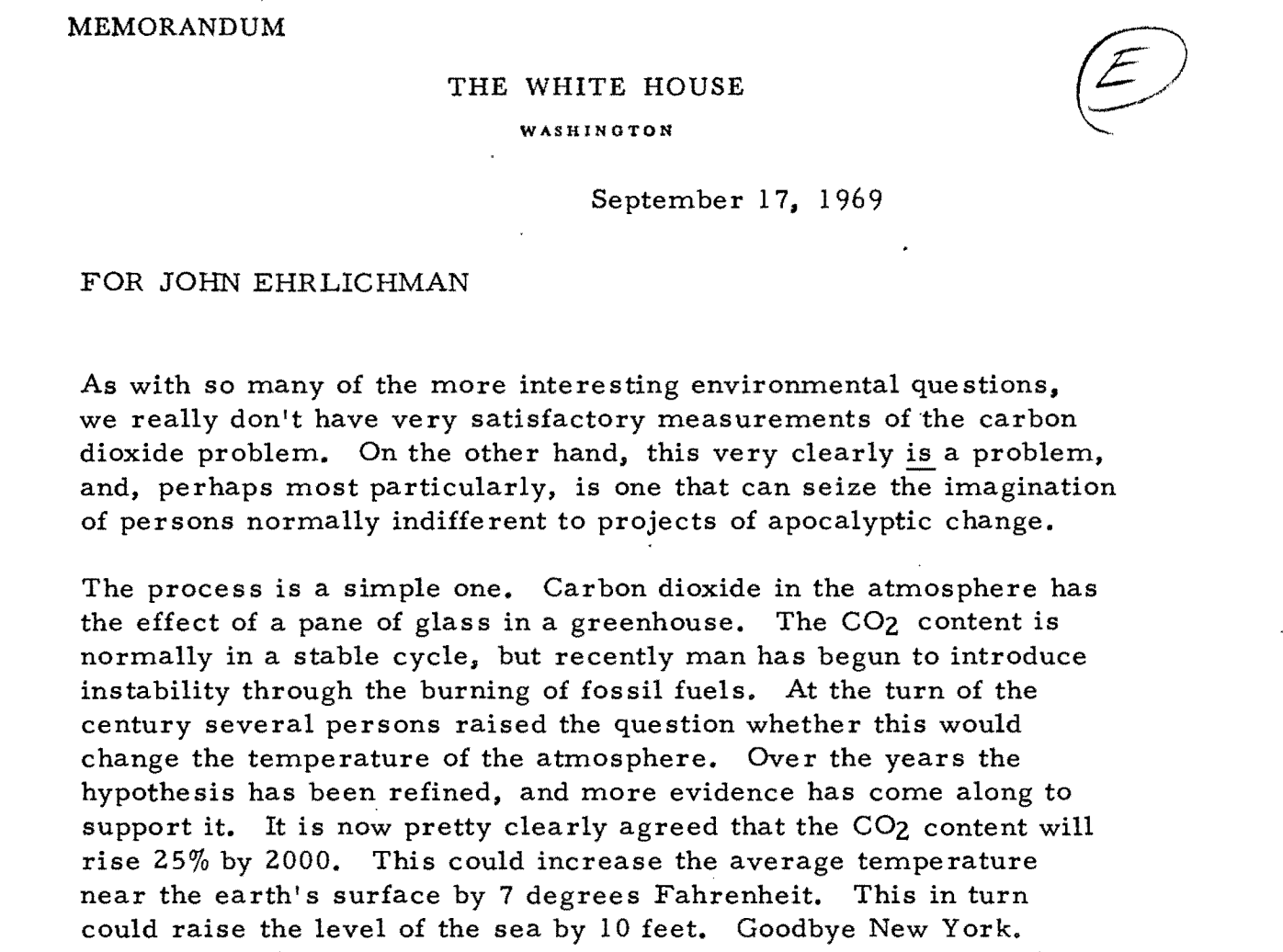
    Excerpt from a letter sent by US diplomat Daniel Moynihan to President Richard Nixon’s administration

    Excerpt from a letter sent by US diplomat Daniel Moynihan to President Richard Nixon’s administration

    In the United Kingdom, the greenhouse effect was first raised in a parliamentary debate in 1969, and in France, a state-owned oil company published a magazine article about the dangers of atmospheric carbon dioxide in 1971, while the Canadian environment ministry regularly published articles about climate change in its employee magazine throughout the 1970s and 80s.

    Even the most generous reading of this information shows that many of the world’s largest contributors to climate change, including the United States, Canada, Germany, and Australia, knew enough to change course over two decades before the first meeting of the IPCC in 1988, if not far earlier.

    The story does not end there. As an illustrative compilation of publicly available, English-language evidence, CIEL’s report is not a complete survey of what all major emitters knew. And facts about what a given country knew are not, on their own, sufficient to secure accountability. But, together with evidence about how that knowledge was subsequently acted upon – or, as was often the case, denied, dismissed, and distorted – and about how climate impacts have unfolded, they solidify foundations for climate justice and repair.

    The post Major emitting countries knew of climate risks decades earlier than claimed appeared first on Climate Home News.

    Major emitting countries knew of climate risks decades earlier than claimed

    Continue Reading

    Climate Change

    South Africa’s offshore oil push meets grassroots resistance in court

    Published

    on

    Layers of red dust coat South Africa’s Saldanha Bay, a legacy of the one billion-plus tonnes of iron ore exported from what was once a quiet coastal fishing town in the 1970s. Now the government wants to turn this area into the “oil and gas hub of South Africa”, but opposition from local communities and civil society could force a change of plan.

    Since 2014 South Africa has developed a strategy for taking “full advantage” of its marine resources, known as Operation Phakisa. It has resulted in the mapping of more than 95% of the country’s nearly 3,000-kilometre coastline for offshore oil and gas exploration.

    The plan seeks to “drill 30 exploration wells in 10 years”, which it estimates could lead to the production of an average of 370,000 barrels of oil and gas per day over 20 years, with Saldanha Bay earmarked as a key logistics hub. It also aims to develop other marine sectors like aquaculture, maritime transport and ocean tourism.

    However, two major court cases against the government and oil giants Shell and TotalEnergies have challenged those plans, as coastal residents, allied with national civil society groups, have pushed back against oil concessions held by the multinationals, arguing they were not consulted, and that towns like Saldanha Bay could face social and environmental harms from the fossil fuel extraction.

      Melissa Groenink-Groves, programme manager at legal nonprofit Natural Justice, said the cases in South Africa could set a precedent for the whole region. “When communities win in the courts, the successes serve as inspiration for other communities to advocate [for] their rights in their own contexts,” she explained.

      She added that the legal challenges to Operation Phakisa also develop climate litigation in the African context, and could impact how environmental impact assessments are conducted going forward.

      Globally, as the oil and gas industry sets its sights on the ocean, with over 85% of new discoveries in 2024 made offshore, scientists and activists warn it could threaten marine life and coastal communities, and weaken the ocean’s ability to trap excess heat from the atmosphere, fuelling planetary warming further.

      A demonstration against TotalEnergies' offshore oil exploration effort in South Africa.
      A demonstration against TotalEnergies’ offshore oil exploration effort in South Africa. (Photo: Ashraf Hendricks/GroundUp News)

      Taking oil companies to court

      About 300 kilometres north of Saldanha Bay, the Aukotowa Fisheries Cooperative, backed by nonprofits The Green Connection and Natural Justice, has taken TotalEnergies to court over its plans to drill for oil and gas in a 30,000-square-kilometre block off South Africa’s west coast.

      The oil exploration block is in a biodiverse marine area bordering Namibia and South Africa known as the Orange Basin, which is a “highly relevant” sanctuary for endangered species, according to Nelson Mandela University’s Institute for Coastal and Marine Research.

      Among other grievances, the cooperative maintains that the company’s environmental impact assessment was flawed, failing to consider the project’s contribution to climate change, and that the government “placed the profits of a multinational corporation above the livelihoods of vulnerable coastal communities”. The Western Cape High Court concluded hearings in late March and is expected to deliver a ruling later this year.

      Walter Steenkamp, chairperson of the Aukotowa Cooperative, is concerned that the oil and gas drilling will lead to increased inequality, asking “for whom is the development? Definitely not for us.”

      In a written statement, TotalEnergies told Climate Home News that it “is a responsible operator fully committed to complying with all applicable South African legislation”.

      Southeast Asia’s fragile grids threaten billions in clean energy investment

      Communities and climate impacts at stake

      On the other side of the country, along South Africa’s eastern coastline, community-based nonprofit Sustaining the Wild Coast and partner organisations challenged Shell and Impact Africa’s exploration permit, arguing that the firms had failed to consult impacted communities – a legal requirement under South African law.

      Co-plaintiff Sinegugu Zukulu also said in 2022 that “oil and gas will lead to more emissions, and in the face of climate change, this is wholly irresponsible”.

      Following two rulings against the companies by lower courts, the case is now before South Africa’s highest Constitutional Court, which has reserved judgment since September 2025. A ruling against the companies would be final, effectively ending the exploration permit.

      Legal expert Groenink-Groves said oil exploration applications under Operation Phakisa have been “granted largely without properly assessing the devastating impact an oil spill could have on small-scale fishers, the risks of drilling in ultra-deep waters, [and] without accounting for climate change impacts associated with oil and gas exploitation”.

      She added that exploration applications have often failed to consider coastal management laws and in some cases, cross-border and regional environmental risks.

      Shell and South Africa’s Department of Mineral and Petroleum Resources did not respond to written requests for comment.

      Co-plaintiff in the case against Shell Sinegugu Zukulu.
      Sinegugu Zukulu, co-plaintiff in the case against Shell. (Photo: Tom van der Schijff)

      South Africa’s offshore oil ambitions

      Fishers around South Africa, many of whom have for generations relied on marine resources for survival, say the country’s offshore oil and gas push is sacrificing their livelihoods for profit.

      “Why do they want to destroy our heritage? We can’t afford to say yes to oil and gas because the ocean is our source of life,” said Carmelita Mostert, a member of advocacy group Coastal Links and third-generation Saldanha Bay fisher.

      Yet with unemployment above 30%, alongside high levels of poverty and wealth inequality, the government sees Operation Phakisa as a vehicle for socioeconomic development.

      South Africa’s Minister of Mineral and Petroleum Resources Gwede Mantashe has described the court cases as “anti-development”, and claimed that the environmental organisations are funded by the CIA.

      Sifiso Dladla, a campaigner with human rights organisation groundWork, argued that the close relationship between the government and the fossil fuel industry – including its 3% contribution to gross tax revenue – limits the potential success of movements pushing for an inclusive energy system. Politicians “need money to win elections. Mining companies need the government to protect them,” he said.

      Patrick Bond, a political economist and sociology professor at the University of Johannesburg, said Operation Phakisa only makes economic sense if its social and environmental harms are ignored, adding that “if a genuine social cost of carbon analysis were done in any African fossil fuel project, there would be few – if any – able to justify the projects economically”. 

      At a global scale, Bond said oil multinationals have the financial backing of European governments – including France’s $2.8 billion stake in TotalEnergies – which can help make local resistance more effective where it has international allies to amplify the messages.

      For Saldanha Bay fisher Mostert, the fight is about protecting the livelihoods of coastal communities. “It is my hope that we can stand strong and protest,” she said. “If oil and gas is not allowed, our lives will be much easier and better – but if oil and gas goes ahead we will be in absolute agony.”

      The post South Africa’s offshore oil push meets grassroots resistance in court appeared first on Climate Home News.

      South Africa’s offshore oil push meets grassroots resistance in court

      Continue Reading

      Climate Change

      Millions of kilograms of marine life taken from Australia’s marine protected areas every year, FOI finds

      Published

      on

      SYDNEY, Tuesday 11 August 2026 — New data obtained by Greenpeace Australia Pacific has found millions of kilograms of marine life are being taken from Australian marine parks by commercial fishers annually, as the government begins its review of the country’s Marine Parks Network.

      The data, released to Greenpeace in response to a Freedom of Information request, relates to 18 of Australia’s 60 Commonwealth marine parks, and shows almost 2.2 million kg of marine life is being fished each year, raising concerns about the true catch numbers across all marine protected areas.

      Greenpeace is calling for the Labor government to use the once-in-a-decade Marine Parks Network review, announced last fortnight, to ban industrial activities, including bottom trawling, longlining and oil and gas mining, from Australia’s Marine Parks Network, and increase fully-protected ocean sanctuaries within the network.

      Elle Lawless, Senior Campaigner at Greenpeace Australia Pacific, said:

      “It’s chilling to think of the true scale of destruction happening inside all of Australia’s marine parks, and how much of our precious ocean wildlife, like dolphins, turtles or seabirds, could be pulled out of protected areas as bycatch.

      “We’re talking about 6,600 kilograms of wildlife in one day, and that does not include what’s caught in the other 42 marine parks, many of which allow destructive fishing like longlining.

      “Australia has made significant progress in securing 52% of its oceans in marine parks; however, this intent is undermined by zones that allow damaging industrial fishing activities, such as bottom trawling and longlining. The review of Australia’s Marine Parks Network is a critical opportunity to fix what isn’t working and finally give our oceans the real protection they deserve.

      You wouldn’t expect someone to bulldoze a national park on land, so why should they be allowed to trawl in a marine park?”

      “Greenpeace Australia Pacific welcomes the Albanese Government’s review of the Commonwealth Marine Parks Network as a rare opportunity to strengthen our marine parks and ban industrial fishing in Australia’s marine protected areas.”

      The documents reveal that the south-west network has the largest catch volume, at 887,160kg per year, followed by the Coral Sea network, which extends out from the Great Barrier Reef, losing significant wildlife at 808,840kg annually.

      —ENDS—

      Notes:

      • More than half of Australia’s Marine Parks Network allow extractive industries, including industrial fishing and oil and gas mining.
      • The data, supplied by the Department of Agriculture, Fisheries and Forestry, does not specify how much of the catch is fish or bycatch, like non-target fish, turtles or seabirds, and is available on request.

      Millions of kilograms of marine life taken from Australia’s marine protected areas every year, FOI finds

      Continue Reading

      Climate Change

      Marine Parks Explained

      Published

      on

      Australia’s network of marine parks is the largest in the world, covering more than half (52%) of Australia’s Commonwealth waters. You could be forgiven for assuming that a marine park is much like a national park on land: a highly protected place where people can enjoy nature while conservation efforts help habitats recover and wildlife thrive. You wouldn’t expect someone to bulldoze a national park, so why should they be allowed to bottom trawl in a marine park?

      The reality is that not all marine parks are equally protected. Australia’s Marine Parks Network is divided into different zoning categories, with each zone determining which activities are permitted and the level of protection provided.

      More than half of the Commonwealth Marine Parks Network allows industrial activities like oil and gas mining, and industrial fishing.

      Our survival, and the survival of our planet, depends on the ocean. The ocean produces more oxygen than all of our forests combined, sustains communities and regulates the earth’s temperature. It’s home to wondrous wildlife and important ecosystems like coral reefs and kelp forests.

      We love our big blue backyard

      Australia’s ocean is teeming with life that is found nowhere else on earth. Schools of colourful fish, vibrant coral reefs, endemic shark nurseries, pods of dolphins, families of whales, playful seal pups and threatened Jurassic-era turtles call Australian waters home.

      Since time began, from the turquoise waves to the deep blue, the ocean has connected our shorelines and communities, fed us, guided us and grounded us. We are intrinsically connected to our big blue backyard – more than 85% of us live within 50km of the shoreline. For tens of thousands of years, people have lived in harmony with the ocean and the wildlife within it, caring for and being sustained by its rich waters. Australia’s waters are some of the most unique and abundant places on Earth but our Marine Parks Network is falling short to properly protect them. 

      Australia’s marine parks aren’t living up to their name

      © Greenpeace / Harriet Spark

      The Australian Commonwealth Marine Parks Network covers commonwealth waters 5.5km from the coast. The network is divided into 7 regional management areas, overall the network contains 60 marine parks. Zoning types determine what activities are allowed in each area. Over half of the network allows industrial activities, risking our most precious and threatened ocean wildlife.

      Within many of our marine parks, destructive industries are allowed to fish, trawl, dig and mine using barbaric and cruel methods. Here are some of the zones explained:

      • Bottom Trawling: Special Purpose (trawl) zones allow bottom trawling. This covers 10 marine parks totalling almost 13 million hectares. Bottom trawlers bulldoze the seafloor with weighted nets, deforesting our underwater forests; a cruel, indiscriminate and inefficient way to fish.
      • Other Industrial Fishing: Includes “Habitat Protection Zones, ““Multi Use Zones” and “Special Purpose Zones.” Fishing methods vary from park to park but many marine parks in these zones allow industrial fishing like longlining. Longlining involves setting lines that can be 100km long, bristling with deadly hooks designed to catch a specific fish species. But longlining is not a selective method of fishing – significant numbers of sharks, rays, turtles, dolphins and seabirds can be harmed or killed as bycatch in the process.
      • Oil and Gas Mining: Many “Special Purpose” and “Multi Use” zones allow seismic blasting and oil and gas mining. 30 marine parks or 65 million hectares of Australia’s highest conservation value areas for ocean wildlife are open for mining and exploration of oil and gas.
      • Ocean Sanctuaries: National Park and Sanctuary zones are fully and highly protected marine parks designed to conserve wildlife and their habitat, where fishing, mining, and other industrial activities are not allowed.

      Industrial fishing is one of the biggest threats to the ocean

      Marine parks on the east coast that allow bottom trawling. 10 marine parks across the whole network allow bottom trawling totalling almost 13 million hectares of ocean habitat for precious wildlife.

      In May, Greenpeace Australia Pacific sailed our campaigning vessel Oceania through some of Australia’s most beautiful and threatened marine parks. Our crew visited Jervis and Hunter marine parks to document their beauty, showcase what’s at risk and aim to expose the industrial fishing activities in these protected waters. Both of these marine parks allow bottom trawling and longlining methods of industrial fishing.

      Industrial fishing is ripping the ocean apart across the planet. Longlining, also known as longline fishing, is an industrial fishing method that involves the use of a fishing line with thousands of baited hooks. These fishing lines can stretch over 100 kilometers in length and are set to capture a fish species, often tuna or billfish species. But it is not a selective method of fishing  and often results in significant bycatch. This includes a range of non-target species like sharks, rays, sea turtles, marine mammals, and seabirds which are often injured or killed as bycatch.

      Bottom trawling involves dragging heavy weighted nets along the ocean floor. This fishing method is popular with commercial fishing companies, because it makes it easy to catch large quantities of fish in one go. But it also damages the seafloor, releasing carbon and can kill or injure non-target ocean life like coral, fur seals, dolphins and seabirds. You may have watched the reality of bottom trawling (and the benefits of ocean sanctuaries) in Ocean with David Attenborough, if not, add it to your watch list!  

      Fully protected ocean sanctuaries that ban industrial fishing and mining can protect ocean wildlife and underwater wonderlands for generations to come. Vast, robust sanctuaries create blue havens where ocean wildlife are safe from nets and hooks, and can truly rest, recover, thrive and replenish out into the surrounding waters. Ocean sanctuaries ensure a healthy ocean full of life.

      A once-in-a-decade chance to fix what’s falling short

      We have a unique opportunity to turn the tide.

      The Australian Government is asking for your feedback on how our Commonwealth Marine Parks Network is managed. This is our once-in-a-decade chance to protect ocean wildlife, ban industrial fishing and create more ocean sanctuaries.

      As part of the review the Government is asking for submissions from the public to hear from you on what improvements are needed to better protect our vast network of marine parks. Writing a submission is a powerful way to influence government decisions and create real change.

      This is the moment to ban industrial activities like bottom trawling and oil and gas mining. But only if they hear from YOU. Add your name!

      Greenpeace is calling on the Australian government to:

      1. Ban industrial activities from Australia’s Marine Parks Network: Ban industrial activities, such as industrial fishing, seismic blasting and oil and gas mining, from Australia’s marine parks.

      2. Create more ocean sanctuaries: Increase fully protected sanctuaries in Australia’s marine parks based on science principles.

      3. Connect Australia’s Marine Parks Network to the High Seas: mCreate seascape connectivity by linking Australian marine parks to new high seas ocean sanctuaries.

      References

      Substantiation that more than half of the Marine Parks Network permits industrial activity comes from a peer-reviewed systematic literature review (Phillips et al. 2025, PLOS One, https://doi.org/10.1371/journal.pone.0307324). The study found that within the Commonwealth Marine Parks Network specifically, “all zones are considered partially protected areas, meaning areas where extractive activities are permitted, except ‘Pink zones’ (Preservation Zones; IUCN Ia) and ‘Green Zones’ (IUCN II).” In other words, every Commonwealth marine park zone type other than the network’s strict no-take sanctuary and national park zones (IUCN Ia and II) permits some form of extractive industrial activity. Since no-take zones are the minority zone type across the network by area, this supports the conclusion that the majority of the network’s area is zoned to permit industrial activity.

      DCCEEW Australian Marine Parks spatial dataset (https://fed.dcceew.gov.au/datasets/erin::australian-marine-parks/explore), filtered by zone type. This confirms that 38.43% of the network’s area is zoned as Sanctuary or National Park zones (IUCN Ia and II). These are the no-take categories excluded from the peer-reviewed study’s definition of partially protected/industrial-permitting zones. The remaining 61.57% of the network falls within the zone categories the study classifies as permitting industrial activity (per The MPA Guide definition of “industrial” applied in Phillips et al. 2025), directly corroborating the peer-reviewed finding with current Commonwealth-specific spatial data.

      For further information on activities permitted within the Marine Parks Network Zoning, you can refer to the Management Plans zoning and rules for each Marine Parks Network area, for example: Temperate East, Coral Sea, North.

      Marine Parks Explained

      Continue Reading

      Trending

      Copyright © 2022 BreakingClimateChange.com