

The UK’s incoming prime minister Andy Burnham has remained tight-lipped on his views on climate change during his leadership campaign.
When asked his views on reversing Labour’s manifesto pledge to stop new North Sea drilling in June – a move that the oil-and-gas industry and right-wing media have pushed for in recent months – he said he had “something of an open mind” on the issue.
But a trawl of Burnham’s past comments about climate change, net-zero and fossil fuels reveals a different picture.
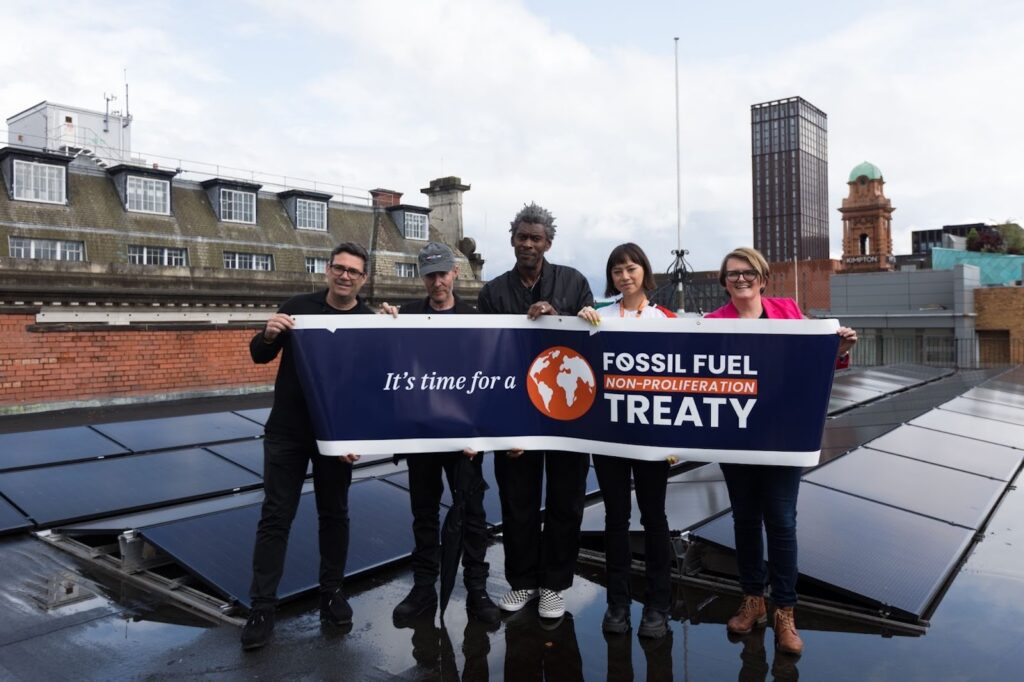
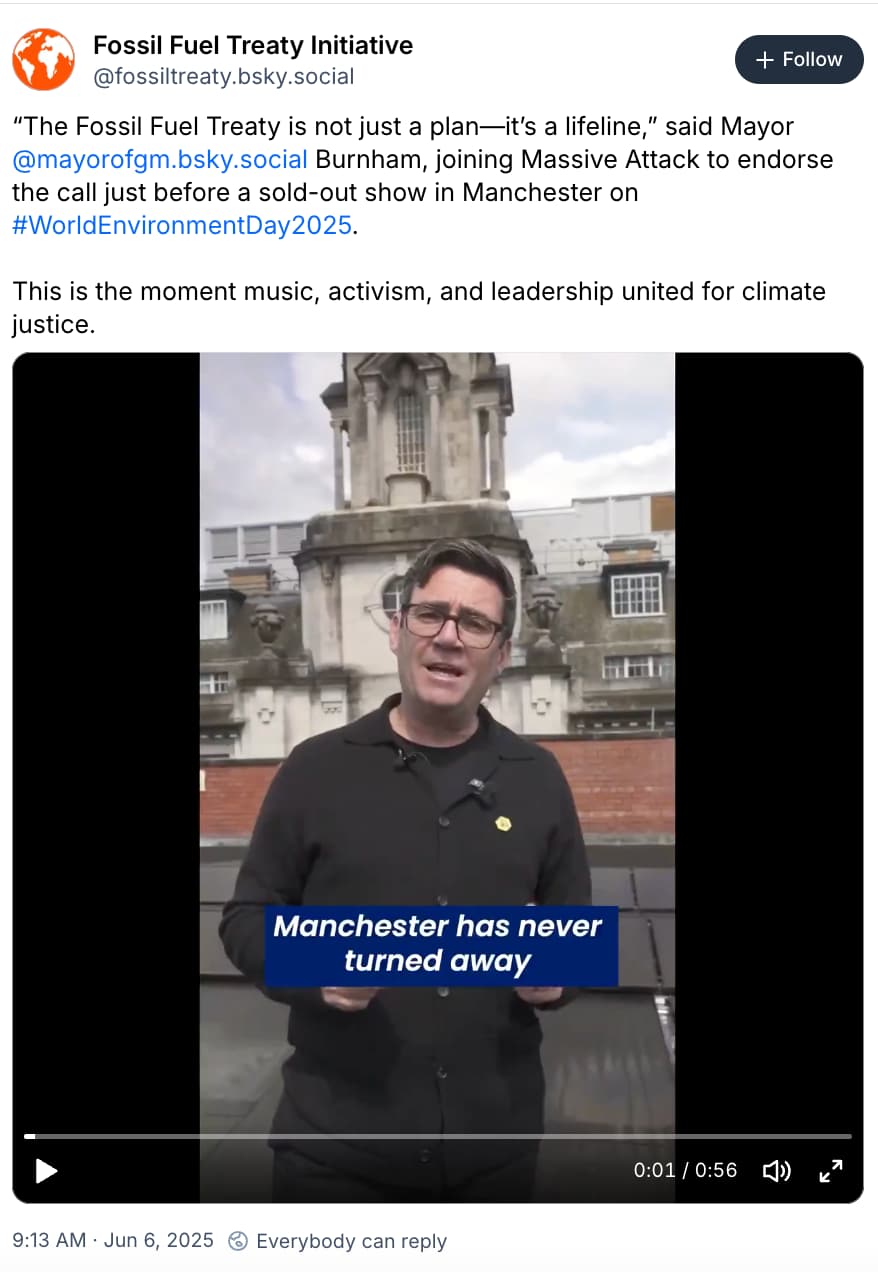
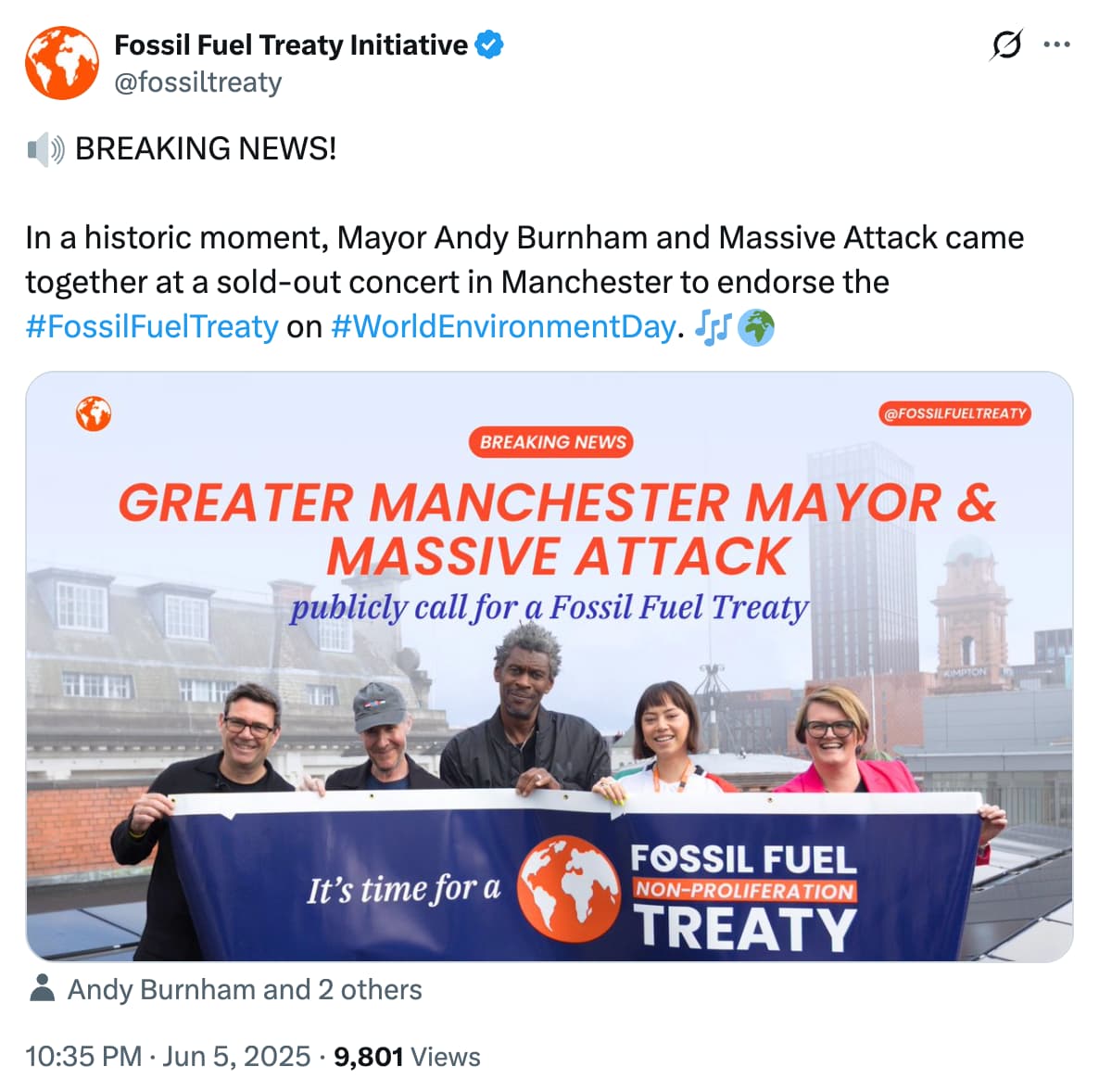
Just a year ago in June 2025, Burnham, while mayor of Greater Manchester, gave his support to the fossil fuel treaty – a proposed international pact on phasing out coal, oil and gas – calling it a “lifeline” that “all governments” should join.
In a video message endorsing the treaty, he also said that “there should be no turning away from net-zero”.
During his last bid to be Labour leader in 2015, he used similar language, saying:
“Labour under my leadership will never turn our back on either our duty to tackle climate change or the prospects offered by the green economy.”
Burnham has spoken about the threat of climate change since at least 2008, noting in 2021 that accelerated action could “create thousands of good jobs”, but also warning that net-zero risked becoming the “next Brexit”.
Burnham is yet to appoint his cabinet, but there is much speculation that he will select current net-zero secretary Ed Miliband as his chancellor – with their ally Miatta Fahnbulleh having a “strong chance” of taking Miliband’s former position.
Below, Carbon Brief recounts 28 things that Burnham has said about climate change, net-zero, fossil fuels, energy and transport.
Climate change
“Tackling climate change isn’t just about protecting the planet – it’s a powerful opportunity to build a fairer, greener future for our communities and businesses.”
Calling for local councils to be given more power and money for climate action, 29 November 2025
“There is little doubt that Greater Manchester’s biodiversity has taken a hit over the years, with habitats being lost, destroyed and becoming less diverse due to the impact of development, climate change, pollution and invasive species…We are committed to delivering a city-region for all residents to enjoy – a fairer, greener and more prosperous place for everyone.”
Statement after Greater Manchester declared a “biodiversity emergency”, 25 March 2022
“Over the next decade, if we accelerate our response to the climate crisis, we can create thousands of good jobs, improve homes, overhaul our transport system and make [Manchester] an even better place to live.”
Greater Manchester Green Summit, 18 October 2021
“The environment has never been higher on the national and international agenda.”
Statement after visiting a peat bog restoration project in England, 9 January 2020
“I think climate change [action] will be driven more quickly from the bottom up, if I’m honest. It’s the will of evolution if you wait for the government to act…When governments aren’t listening you get out and get your voice heard…so I think [climate protesters] deserve our encouragement, not our criticism.”
Speaking to Manchester Evening News at a student climate protest in Manchester, 24 May 2019
“Labour under my leadership will never turn our back on either our duty to tackle climate change or the prospects offered by the green economy.”
Labour leadership candidate speech, 15 July 2015
“Climate change can seem a distant, impersonal threat – in fact the associated costs to health are a very real and present danger…We need well-designed climate change policies that drive health benefits.”
Speaking to the Guardian about a study on climate and health, 25 November 2009
“The Stern report on the economics of climate change has changed the debate, in this country and around the world. It made it clear that the people who could suffer most from a failure to tackle climate change, or from a lack of ambition in our approach to it, are those living in the developing countries. They are the most vulnerable…[and] Stern said that the cost of not acting would be large. That is why the government took various measures in the recent spending review to ensure that we are prepared to face the challenges posed by climate change.”
Speaking in the UK parliament on the economic impacts of climate change on his final day as chief secretary to the Treasury, 24 January 2008
Net-zero
“There should be no turning away from net-zero.”
Speaking after giving his support to the fossil fuel treaty – a proposed global pact to introduce laws to phase out coal, oil and gas – on behalf of Manchester, 6 June 2025
“An opportunity is opening up for Britain as other countries move away from net-zero. We should seize that…We can make Britain a green leader. This is not the time to tiptoe, it is the time to commit to this path.”
Speaking at Innovation Zero World Congress in London, 29 April 2025
“[We] need a government that fully buys into the 2038 vision because the UK will not get to 2050 unless places like Greater Manchester are freed up to go faster – and we’re ready to go faster.”
Speaking about Greater Manchester’s aim to reach net-zero by 2038, 19 October 2022
“In Greater Manchester we have plans to build 30,000 net-zero social rented homes because we recognise that a successful city region needs good quality, affordable accommodation for everyone.”
Speech on the future of cities, 24 June 2022
“By building a broad consensus behind the drive to net-zero, we can ensure that the transition is a fair one that delivers social justice as well as climate justice. This is an opportunity for all of us to show how cutting carbon emissions in our cities can make a real difference to our communities – away from the abstractions and rooted in the real world.”
Panel discussion in Glasgow during the COP26 climate summit, 12 November 2021
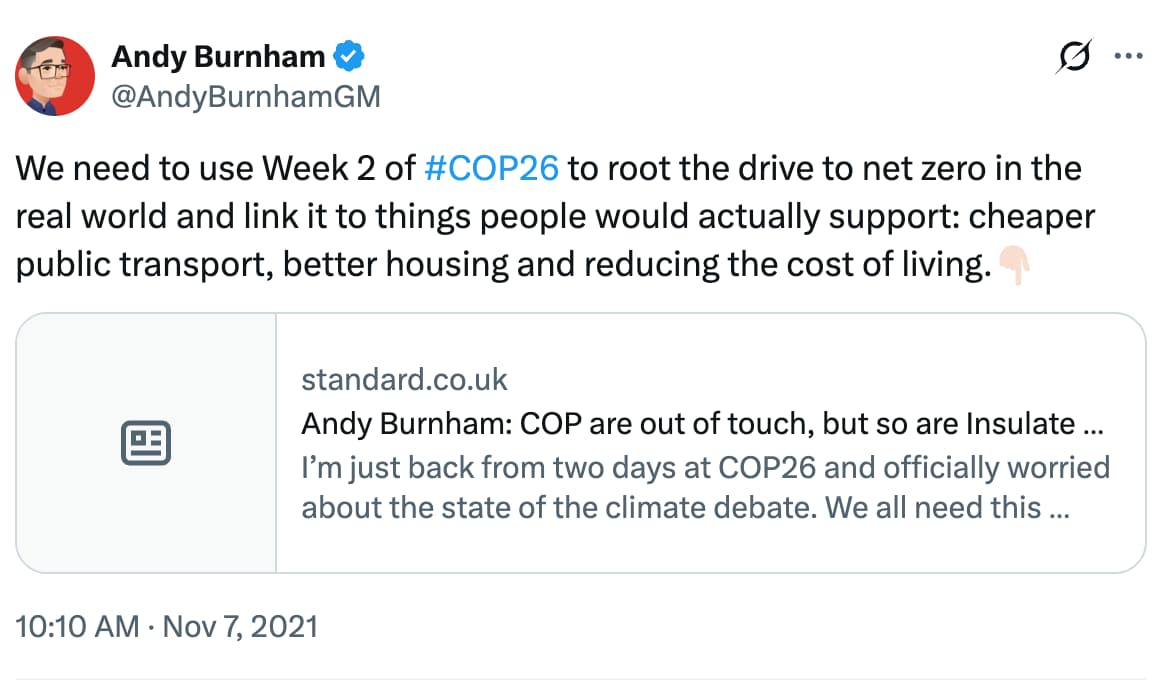
“To the extent that people have picked up anything from COP26, it’s a sense that the drive to net-zero will mean cost and inconvenience for ordinary people and offsetting for the wealthy and entitled. All of a sudden, you can feel how net-zero could become the new Brexit – a debate that gets very divided on class grounds…This has got to be a wake-up call. We cannot let this happen. We need to act now to build a broad social consensus behind the drive to net-zero. How to do that? It starts with taking control of the climate narrative from those steering it in the wrong direction and turning it around…We must show how, if done in the right way, the drive to net-zero is actually an opportunity to reduce the cost of living; to make people’s lives better and society fairer.”
Writing for the London Standard, 5 November 2021
“The drive to net-zero is a chance to re-industrialise the north of England, this time in a clean way. Create really good jobs, future-facing jobs for people, better public transport, improve people’s homes…If we go quickly towards net-zero, it’s the quickest way to level up the country.”
ITV interview at COP26, 1 November 2021
“If we really embrace the drive to net-zero, that is the route to level up the country…But it needs substantial investment, upfront, now, of the kind that Rachel Reeves, shadow chancellor [and chancellor under Keir Starmer’s government], has been talking about. We need long-term predictable funding.”
Interview with GB News at COP26, 1 November 2021
“I would have preferred to hear slightly less about carbonated wine and much more about a decarbonised economy.”
Referencing a UK budget, which included tax cuts for sparkling wine and other drinks, 28 October 2021
“Decarbonising is not just about lowering costs on to people. It’s the route to get better, cheaper public transport. It’s the route to getting homes that are cheap to run. It’s actually the way we can create thousands of good jobs for the people who live in Greater Manchester. This is the route to levelling up the country by going further and faster on decarbonisation.”
Speaking to Manchester Confidential, 20 October 2021
“[I am] asking people to stop seeing the environmental agenda as a cost and a burden agenda. I think this is a barrier that we’ve got to get over. Already in the media interviews I’ve done today, people are saying ‘can you afford it?’, ‘can it be achievable when times are tough?’.
“My answer to that is, at some point in the 21st century, all homes will be zero-carbon. At some point in this century, all buildings of any kind will be zero-carbon…All cars will be zero-carbon, all public transport will be zero-carbon…The question is: when? And surely the places that embrace those things first are putting themselves in a position of economic strength when it comes to facing up to the future. Rather than seeing the whole agenda as a burden, we’ve got to see it for the benefits that it can bring.
“There may be a greater upfront cost in a zero-carbon home, but let’s stop thinking, as we tend to do in Britain, of the short-term, the short-termist approach to life. Surely let’s start talking to the public about the lifetime cost.”
Greater Manchester Green Summit, 21 March 2018
Fossil fuels
“I’ve got something of an open mind, you know. I don’t have a sort of fixed position.”
Speaking on the issue of new North Sea oil and gas in a New Statesman interview, 3 June 2026
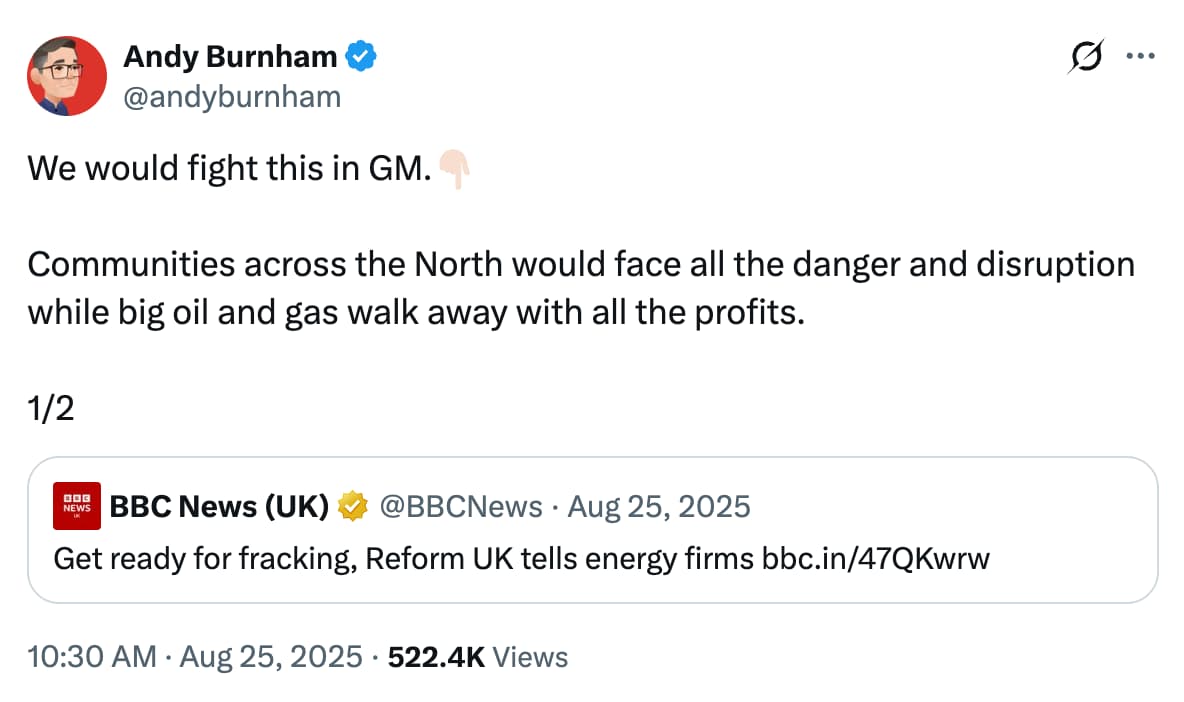
“We would fight this in GM [Greater Manchester]…Communities across the north would face all the danger and disruption while big oil and gas walk away with all the profits.”
In response to Reform’s call for fracking, on X, 25 August 2025
“I am proud to endorse the fossil-fuel treaty proposal today on behalf of Greater Manchester. It’s not just a plan – it’s a lifeline. It’s a call to end coal, oil and gas, hold polluters accountable…I urge all governments, nationals and subnationals to join this fight.”
Statement upon endorsing the fossil-fuel treaty, 5 June 2025
“Fracking is the past, it is not the future.”
Speech at London climate protest, 20 September 2019
“I have called for a moratorium on fracking. Far too many potential risks and unanswered questions.”
On X, 22 June 2015
Energy and transport
“What I would do, if successful, is lay out a plan for more public control over water, energy, transport, so that over the period we can get those bills down, fares down, and give people and give businesses breathing space.”
LBC interview, 2 July 2026
“I am all in favour of tough decisions at a national level. I don’t believe there should be a third runway at Heathrow, for instance. But I think those are decisions for national government.”
Guardian interview, 13 June 2019
“There is a debate to be had about aviation, isn’t there? There are changing public attitudes about aviation. Rather than just saying no to people flying, don’t we need to accelerate research into low and zero-carbon forms of aviation?”
Guardian interview, 13 June 2019
“Today, I stand alongside the mayors of some of the greatest cities in the world. I’m committed to a cleaner, greener and healthier future for Greater Manchester. Around a third of greenhouse gas emissions in our city-region come from transport.”
When signing the C40 Fossil-Fuel-Free Streets Declaration, which includes support for zero-emissions vehicles and walking and cycling, on behalf of Manchester, 14 September 2018

The post 28 quotes from next UK leader Andy Burnham on climate, net-zero and fossil fuels appeared first on Carbon Brief.
28 quotes from next UK leader Andy Burnham on climate, net-zero and fossil fuels

June Rubis is a steering group committee member for the Cali Fund, from Sarawak in Malaysian Borneo.
At COP16 in Cali, governments made a significant commitment: at least half of the funding from the new Cali Fund should support the self-identified needs of Indigenous Peoples and local communities, including women and youth. It was a watershed moment for multilateral benefit-sharing.
The challenge now is to translate that commitment into access arrangements that recognise the different institutions, priorities and decision-making processes of Indigenous Peoples and local communities.
For generations, biodiversity and traditional Indigenous knowledge have provided significant value to companies who depend on nature’s genetic diversity to discover new drugs that fight diseases, create products that improve health, and grow crops resilient to extreme heat and flooding events. While some compounds are sampled directly from the source country, increasingly the digital blueprints are held in online public databases which are freely accessible to use for innovation and research.
Countries urged to ramp up “insufficient” nature policies at COP17
The Cali Fund was established at COP16 to encourage commercial users of Digital Sequence Information, or DSI, to share benefits arising from its use. Estimates suggest it could generate over $3.5 billion a year – a stark contrast to the modest $10,656 currently committed to the fund from just five SMEs, underlining how much progress must be made at COP17 over the next two weeks.
The COP16 decision that set up the fund offers two routes for money to reach Indigenous Peoples and local communities: through government authorities, and through direct payments to institutions identified by Indigenous Peoples and local communities themselves.
Varied ways of organising
Indigenous Peoples and local communities organise through a wide range of institutions. Some have national or regional organisations experienced in managing international grants. Others work through territorial organisations, customary institutions, community associations, cooperatives or networks. Some have professional finance teams and audited accounts; others have extensive experience governing territories, collective resources or conservation work without having been organised around international funding requirements.
For direct access, some questions are already apparent. Which institutions should be able to receive funds? How should they be identified? What fiduciary standards should apply? How should safeguards and accountability work where institutional capacities differ? What support may be needed where institutions have strong community mandates but less experience with international finance?
Comment: Protecting nature is a public duty, not a Wall Street profit opportunity
If access is designed mainly around institutions that already meet the expectations of large international finance mechanisms, early funding will tend to favour those already familiar to funders. They will gain further experience and become better positioned for future funding, while institutions with less administrative capacity may remain outside the system despite strong community mandates and long histories of stewardship.
These first decisions matter most, because they set the terms for everyone who follows.
The role of intermediaries requires care. Some Indigenous organisations may want a fiscal host to hold and manage funds on their behalf. Communities may choose to work through an NGO they trust. Government-facilitated arrangements may work well in particular national contexts.
What matters is the function an intermediary performs and the authority that comes with it. Providing administrative support is different from deciding which Indigenous organisations qualify, which priorities can receive support, or how success will be assessed. Direct access means communities keep that decision-making authority.
Decision-making power
The COP16 decision refers to institutions that Indigenous Peoples and local communities identify. But authority among Indigenous Peoples does not sit in one kind of body. It may sit with territorial organisations, customary institutions, community associations or combinations of these. Legal recognition and customary authority do not always align neatly.
Global deforestation slowed in 2025 but Brazil’s election could undo “fragile” gains
An important feature of the Cali Fund’s governance is that Indigenous Peoples and local communities participate as full members of the Steering Committee, rather than as observers. Seven Indigenous Peoples and local community representatives, one from each of the seven socio-cultural regions, participate in consensus-based decision-making alongside representatives of governments and UN entities. Six additional representatives from civil society, scientific institutions and the private sector participate as observers.
That representation carries responsibility. Institutional legitimacy, access and representation take different forms across the seven socio-cultural regions. Indigenous Peoples and local communities members therefore have an important role in bringing those differences into the Fund’s governance and in ensuring that arrangements developed for one context do not become the assumed model for everyone else.
Safeguards and clear responsibilities
COP17 can establish the core principles and direction, while allowing operational pathways to develop in ways that respond to different regional contexts. The decisions countries take in Yerevan will shape how that flexibility is realised in practice.
The choices made around access will influence which institutions are able to participate, which routes become established and which forms of authority are recognised within the funding architecture. The aim should be an architecture with enough structure to maintain confidence while allowing for different forms of Indigenous and community governance.
A credible direct-access pathway will need safeguards, financial oversight and clear responsibilities. This would give the 50% commitment a stronger institutional foundation.
The Cali Fund’s importance will ultimately depend not only on how much funding reaches Indigenous Peoples and local communities, but on whether they are able to determine how the money is accessed, governed and used. This requires access pathways that recognise their institutions, priorities and decision-making processes, rather than requiring them to conform to a single predetermined model.
The post COP17 must settle who decides how Cali Fund money is disbursed appeared first on Climate Home News.
COP17 must settle who decides how Cali Fund money is disbursed
The UK government has approved extraction at the Jackdaw gas field in the North Sea, despite acknowledging that this decision could make it harder for Britain to convince other countries to move away from fossil fuel production.
UK energy secretary Miatta Fahnbulleh approved the drilling on Wednesday after months of high-profile debate, fuelled in part by interventions from US President Donald Trump. She argued that the project would boost energy security in the wake of the Middle East fossil fuel crisis, protect hundreds of jobs and add £2.9 billion ($3.88bn) to the UK economy.
She said Jackdaw’s gas would be cleaner than imported gas and would not prevent the UK from meeting its legally-binding carbon targets and its goal of net zero by 2050. As the field is already licensed, she said extraction was consistent with the Labour Party’s 2024 manifesto promise not to issue any new oil and gas licenses.
The same morning, the government announced a new Energy Wealth Fund to reinvest oil and gas revenues in the climate transition. It will start with £2 billion ($2.67bn) from the government and be topped up over time with tax revenues from offshore oil and gas production.
Climate campaigners in the UK and abroad were quick to condemn the decision, while a leading legal expert told Climate Home News it goes against the advice of the International Court of Justice. Meanwhile, the government’s own documents reveal that it recognises the drilling could damage the UK’s reputation and its ability to push forward the global transition away from fossil fuels.
“Climate leadership” blow
The 92-page decision document says Fahnbulleh “acknowledges that international standing on climate is important and accepts that a decision to grant consent may not further the UK’s international climate leadership.”
It adds: “She acknowledges concerns about the potential implications for the UK’s credibility and influence – including the difficulty inherent in encouraging other states to move away from fossil fuel production while the UK continues, in a limited and transitional way, to draw on its own domestic resources.”
While noting that Jackdaw has not been issued with a new license – just permission to extract gas – the document says Fahnbulleh “accepts this does not fully resolve the underlying tension in the UK’s position” but “considers this alongside the substance of the UK’s wider record [on emissions reduction], which remains significant”.
It continues that she accepts these concerns are “legitimate” and weigh against approving gas extraction, but only gives this argument a “moderate negative weight” set against the benefits of gas production.
“Huge” wrong signal
In international climate talks, the UK has long supported the transition away from fossil fuels and is one of very few major oil and gas producers to ban new licenses. Across the North Sea, the Norwegian government continues to make offshore areas available for oil and gas exploration through annual licensing rounds.
Climate experts and campaigners shared the concern, acknowledged in the decision document, that approving Jackdaw could set a precedent for fossil fuel production elsewhere. Sam Fankhauser, professor of climate change economics at Oxford University, said the direct climate impact of Jackdaw is “much smaller than the debate around it would suggest” but the “wrong signal it sends, however, is huge”.