

The US and Israel’s war on Iran has caused oil and gas prices to soar, with the world now preparing for the possibility of another energy crisis.
The conflict, which has seen Iran respond with missile strikes across the region, has killed more than 1,000 people so far and sent global markets into disarray.
With shipping through the critical Strait of Hormuz paralysed and direct attacks by both sides on fossil-fuel infrastructure, some of the world’s biggest oil and gas facilities have paused production.
On 9 March, oil prices soared above $100 per barrel for the first time since Russia’s invasion of Ukraine in 2022, amid fears of long-term disruption to global energy supplies.
While US president Donald Trump has said that rising oil prices are a “very small price to pay” for “safety and peace”, the conflict is already pushing import-dependent countries to invoke emergency measures to protect consumers.
In this Q&A, Carbon Brief looks at how the war has disrupted energy supplies, the impact on oil and gas prices, which parts of the world are being hit hardest and what it could mean for efforts by some to transition away from fossil fuels.
- How has the Iran war disrupted energy supplies?
- How has the Iran war impacted oil and gas prices?
- Which parts of the world have been most affected by the crisis?
- What does the Iran war mean for efforts to transition away from fossil fuels?
How has the Iran war disrupted energy supplies?
On 28 February, the US and Israel launched a large-scale military attack on Iran, which has responded with counterattacks across the region.
On 2 March, Iran said that it would attack any vessel travelling through the Strait of Hormuz, a narrow waterway used to transport around a quarter of global seaborne oil trade and a fifth of the world’s liquified natural gas (LNG) supply.
According to the UK’s maritime security agency, UKMTO, around 10 vessels have been attacked in or near the Strait of Hormuz since Iran’s threat.
Ship traffic through the Strait of Hormuz has since come to a “virtual standstill”.
While Saudi Arabia and the UAE can reroute some of their crude oil production via pipelines to avoid the strait, Kuwait, Qatar and Bahrain have no alternatives, according to Bloomberg.
As a result of the effective closure, oil storage facilities in the region are filling up. Saudi Arabia has started to reduce oil production, as there is limited storage and limited export options due to the strait remaining closed to shipping, reported Bloomberg.
Other energy infrastructure has also been caught in the crosshairs of the conflict, leading to site closures at a number of oil and gas facilities.
For example, Iranian drones targeted the giant Ras Laffan gas facility in Qatar, which is responsible for about a fifth of global LNG supply. The QatarEnergy facility subsequently paused production and “will take weeks to restart”, reported Reuters.
Additionally, Saudi Aramco paused work at one of its refineries due to a fire caused by debris from an intercepted drone attack. One of the largest oil storage terminals in the UAE halted operations and a range of other energy sites across the Middle East have ceased operations.
The combination of the effective closure of the Strait of Hormuz and disruption to energy infrastructure in the region has led to oil and gas prices surging to their highest levels in several years.
How has the Iran war impacted oil and gas prices?
Global oil and gas prices have been rising since the first US and Israel attacks on Iran in late February.
On 2 March, the Guardian reported that Brent crude – the global oil price benchmark – had risen by up to 13%, standing at a “14-month high” of $82 (£61) a barrel.
Experts at that stage warned that a prolonged closure of the Strait of Hormuz could continue to push up prices and lead to a “1970s-style energy shock”, according to CNBC.
By Monday 9 March, oil prices had soared above $100 (£74) per barrel for the first time since Russia’s invasion of Ukraine in 2022.
Prices hit $119 (£88) a barrel at one point on Monday, as shown in the chart below, amid fears of long-lasting disruption to global energy supplies.
US president Donald Trump called rising oil prices a “very small price to pay” for “safety and peace”, reported the Independent.
By Tuesday 10 March, the Guardian reported that the price of a barrel of oil had “tumbled” to around $91.70 (£68), after Trump suggested the war could end “very soon”.
(The Islamic Revolutionary Guards Corps said it would “determine the end of the war”, not “American forces”, reported France24.)
The price of gas has also risen across Europe and Asia.
Prices “soar[ed”, reported Al Jazeera, after LNG production was halted by Qatar’s state-run energy company. (See: How has the war disrupted energy supplies?)
This led to gas price jumps “amid concerns about supplies”, said the New York Times.
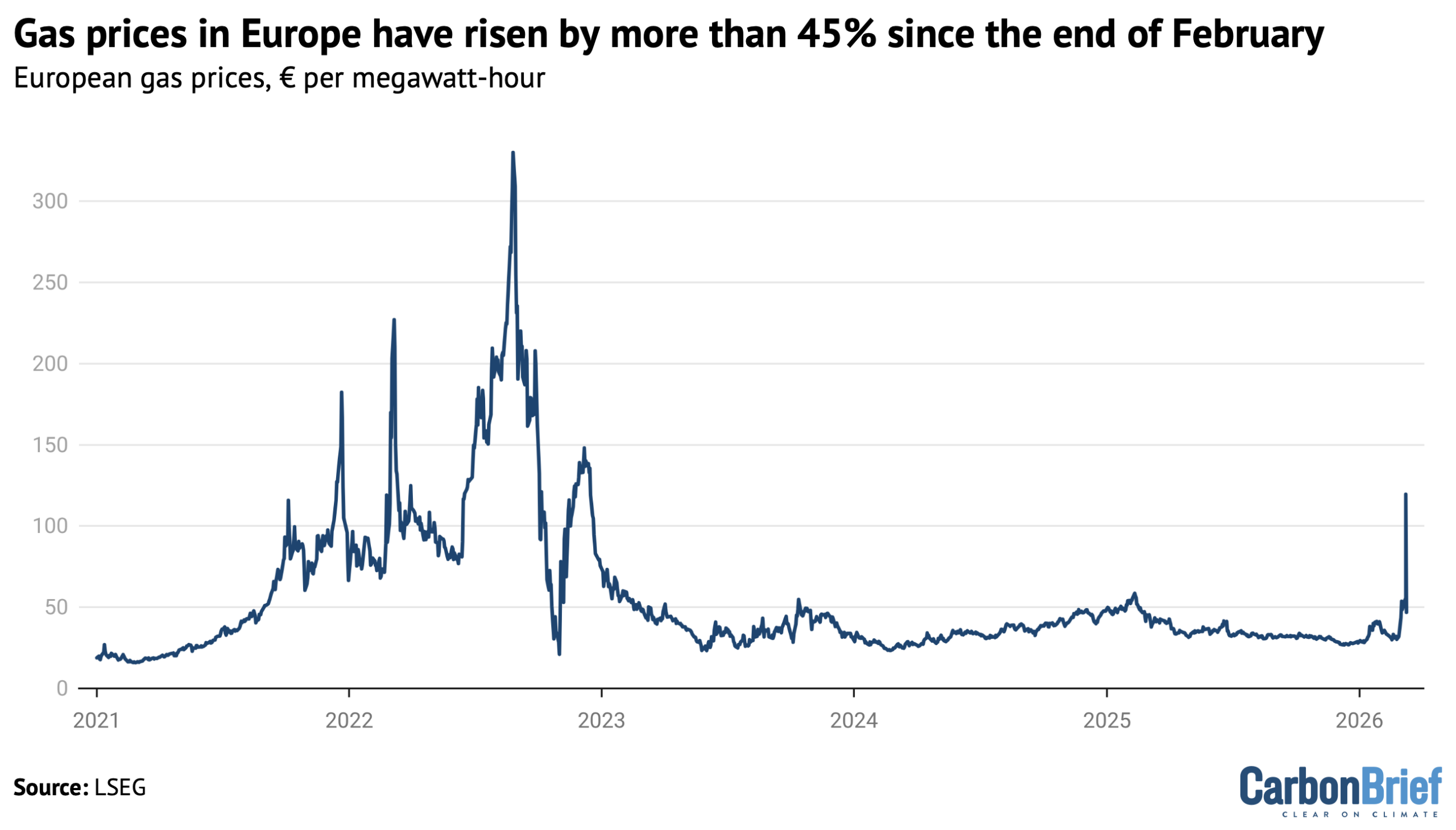
Subsequently, the price of gas in Europe rose by up to 45% to around €46 (£40) per megawatt hour (MWh) on 2 March.
European gas price futures increased by as much as 30% on 9 March, according to Bloomberg. Prices stood at around €60/MWh (£52/MWh) compared to a past peak in 2022 of above €300/MWh (£260/MWh), said the outlet.
Bloomberg noted that “prices are still well below the records reached” after Russia’s invasion of Ukraine in 2022, as highlighted in the chart below.
Gas prices in Asia have more than doubled since 28 February, with some countries “struggling to find prompt” supplies.
In the UK, the price of gas has doubled since the start of the current conflict, although it has subsequently fallen back to around 75% above pre-crisis levels.
While domestic consumers are currently protected by the price cap for gas and electricity, some forecasts suggest bills could hit £2,500 a year – a rise of 50% – when the cap is updated in July. (There is currently no cap for consumers of heating oil.)
In the US, gas prices have only risen by 11% since the end of February, according to the Wall Street Journal. The US gas market is relatively insulated from global price spikes because it has limited export capacity. (The Wall Street Journal attributed this instead to “record” domestic production “cushioning” the country from the price jumps in other parts of the world.)
Meanwhile, the price of petrol (or “gas”, as it is known colloquially) in the US has increased by 19%, noted the New York Times. Even though the US is a net oil exporter, it is still affected by international price spikes, as the market for oil is globally interconnected.
The crisis has also raised the price of electricity, heating fuel, fertilisers, food and other products in many parts of the world.
Which parts of the world have been most affected by the crisis?
The impact of the Iran war has been felt around the world, in particular in areas reliant on oil and gas imports.
Below, Carbon Brief looks at how different regions have responded to the conflict so far.
Asia
Asia’s biggest economies are “highly dependent” on oil and gas imports that transit through the Strait of Hormuz, reported the Financial Times, adding that they are now “racing to secure new sources”. About 80% of all oil volumes through the strait go to Asia, according to the International Energy Agency (IEA).
East Asian nations, such as South Korea and Thailand, “have been hit especially hard” and have already announced measures such as capping petrol prices, according to BBC News. It said Vietnam plans to temporarily remove taxes on fuel imports and the Philippines has announced plans for a four-day working week for most public offices.
Reuters noted that Bangladesh “relies on imports for 95% of its energy needs” and has announced the early closure of all universities as part of emergency measures to conserve energy. The newswire says the country also halted operations at nearly all its state-run fertiliser factories, redirecting gas to power plants.
Myanmar, meanwhile, has announced a “sweeping fuel rationing system for private vehicles”, said another Reuters article.
On 9 March, China announced its “biggest retail fuel price cap increase in four years” for retail petrol and diesel, said Reuters. Additionally, diplomatic sources cited by Reuters said that China is “in talks with Iran to allow crude oil and Qatari liquefied natural gas vessels safe passage” through the Strait of Hormuz.
China is the main buyer of Iranian oil and has funded gas facilities in Qatar, meaning “billions of dollars are at risk from a widening war”, according to the New York Times.
However, India could be the “most vulnerable” to the war’s energy supply shock, according to the Hindustan Times.
On 3 March, India’s petroleum and natural gas minister Hardeep Singh Puri was quoted by the Economic Times saying that “India has sufficient reserves of crude oil and petroleum products to manage short-term disruptions”.
Three days later, the Hindustan Times reported that the US announced a “temporary 30-day waiver to Indian refineries” to continue to purchase Russian oil “already stranded at sea”. However, the Financial Times reported that analysts said that the crude oil freed up by this is a “drop in the ocean”, equivalent to only four days’ of Indian demand. (The New York Times said that the “dramatic change in energy markets could not have come at a better time for President Vladimir Putin of Russia”.)
India has invoked emergency measures to redirect supplies of liquefied petroleum gas “away from industrial users to households”, reported Bloomberg. Cooking gas supply and fertiliser plants have been given top priority, said the Times of India.
Middle East
Beyond the impact on energy, air and drone strikes in the Middle East have damaged key infrastructure, including water desalination plants.
The region is dependent on desalination plants for much of its drinking water. The Associated Press reported that, “in Kuwait, about 90% of drinking water comes from desalination, along with roughly 86% in Oman and about 70% in Saudi Arabia”.
It adds that “hundreds of desalination plants sit along the Persian Gulf coast, putting individual systems that supply water to millions [of people] within range of Iranian missile or drone strikes”.
The Financial Times noted that climate change is exacerbating water security concerns in the Gulf, where temperatures can exceed 50C in summer and there are “no permanent rivers”. It adds that climate change is “driving erratic rainfall patterns and contributing to low water storage” in the region.
The Middle East is also one of the world’s largest producers of fertilisers. Around 35% of the world’s exports of urea – a nitrogen fertiliser that “underpins around half of global food production” – passes through the Strait of Hormuz, according to the Financial Times.
As a result, the newspaper said that “granular urea prices in the Middle East have risen by about $130 to around $575-650 a tonne”.
The spike in the price of gas – a key element in fertiliser production – is also affecting fertiliser prices.
Europe
The disruption to global oil and gas supplies is driving up energy prices across Europe.
“The EU imports more than 90% of its oil and around 80% of its gas, making European countries highly exposed to fluctuations in global oil and gas prices,” according to Reuters. Europe’s gas market is particularly vulnerable at the moment, because it is emerging from winter with storage tanks depleted.
Bruegel said that Europe is “far less dependent on Gulf oil and LNG than China, India, Japan or South Korea”. However, it said that it is “not insulated”. It added:
“Oil and LNG are global markets: any blockage of the Strait of Hormuz could trigger immediate price spikes that would hit Europe regardless of its limited physical imports.”
The Financial Times reported that “European electricity prices are swinging wildly from daytime to evening as the Iran war’s disruption to gas supplies accentuates growing volatility in Europe’s power markets amid the rise of renewables”.
Petrol prices are also surging. UK average diesel costs have hit a 16-month high and the French government is asking a watchdog to check that petrol stations are not unfairly raising prices to profit from a rush for fuel.
Euronews reported EU leaders are “considering reviewing taxes, electricity network charges and carbon costs tied to energy prices as a quick fix for struggling industries”.
Meanwhile, EU economy and finance ministers gathered in Brussels to discuss how to respond to surging energy prices. According to Euronews, ministers have discussed the possibility of releasing oil reserves, but say that it is “not yet the right time”.
Other regions
Africa
In Africa, oil-producing Nigeria, Angola and Ghana are well-positioned to benefit from surging global prices, although the gains may not be evenly distributed. However, importing countries, such as South Africa, Kenya and the Democratic Republic of Congo, are at risk.
Every “$20 a barrel jump in Brent” could cause “a knock” of about 1% and 3% on South Africa and DRC’s GDP, respectively, according to Bloomberg analysis. Trade bottlenecks and the lack of refinery capacity in these countries could also lead to fuel shortages, it said.
While oil exporters could see windfall gains, “most African households will have to grapple with higher costs of living” since “most food and goods” are transported by road across the continent, noted the Associated Press.
The crisis, however, “may reinforce calls for African nations to diversify their energy systems and reduce dependence on imported fuels” through “long-term investments in renewable energy”, said Dr Kennedy Mbeva, research associate at Cambridge’s Centre for the Study of Existential Risk, as quoted in the story.
Australia
While Australia is a key gas and coal exporter, its dependence on petrol and diesel imports could leave it vulnerable, especially its agricultural and mining sectors.
The Australian Financial Review reported that Australia’s biggest gas producers – Santos and Woodside Energy – are “cashing in on the conflict…with deals struck at more than double recent market rates”.
Latin America
Major Latin American economies are “cautiously watching” the war’s impact on energy prices on their economies, reported El País.
The newspaper cited experts saying that for Venezuela – whose “modest but strategic share” of oil production is now under “direct scrutiny from the White House” – the crisis might result in additional revenues, to the tune of “around $2.4bn”.
It also quoted Mexico’s president, Claudia Sheinbaum, reassuring citizens that “compensation mechanisms [are] in place to prevent price increases from impacting” them.
While Brazil’s state-owned Petrobras “could benefit” from the crisis, said Reuters, the conflict “may spark grain contract cancellations and fertiliser shortages”.
Finally, a comment in Colombia One argued that the country’s “energy importance” could translate into “fiscal breathing room” and that oil gains could “financ[e] renewable energy without undermining fiscal stability”.
What does the Iran war mean for efforts to transition away from fossil fuels?
The rise in global fossil-fuel prices as a result of the war has prompted some leaders to recommit to boosting their energy sovereignty through the deployment of renewables.
Yet, the conflict has also been taken as an opportunity by supporters of fossil fuels to argue for more domestic oil-and-gas production, as a way to boost energy security.
In response to the crisis, Teresa Ribera, the executive vice-president of the European Commission who oversees the “clean, just and competitive transition”, said in a statement that the “answer is not new dependencies, but faster electrification, renewables and efficiency”, adding:
“The real risk is not moving too fast on clean energy, but too slowly. The clean transition is Europe’s shield against volatility.”
According to the South Korean newspaper Chosun Daily, the country’s president Lee Jae Myung said the crisis presented a “good opportunity to swiftly and extensively transition to renewable energy”.
In the UK, where there has been mounting pressure to relax government restrictions on the expansion of fossil-fuel extraction in the North Sea, prime minister Keir Starmer used a speech responding to the conflict in the Middle East to say:
“We…have the right plan for our energy supplies. Building up clean British energy like never before, decreasing our dependence on volatile international markets and creating the energy security and independence we need.”
Simon Stiell, the UN climate chief, said the crisis “shows yet again that fossil fuel dependence leaves economies, businesses, markets and people at the mercy of each new conflict or trade policy lurch”.
According to the Guardian, he added:
“There is a clear solution to this fossil-fuel cost chaos – renewables are now cheaper, safer and faster-to-market, making them the obvious pathway to energy security and sovereignty.”
UN secretary-general António Guterres said in a statement that renewable energy offers countries an “exit ramp” away from fossil-fuel dependence. He added:
“Homegrown renewable energy has never been cheaper, more accessible or more scalable. The resources of the clean-energy era cannot be blockaded or weaponised. There are no price spikes for sunlight and no embargoes on the wind.
“The fastest path to energy security, economic security and national security is clear: speed up a just transition away from fossil fuels and toward renewable energy.”
Dr Markus Krebber, chief executive at the German energy giant RWE, wrote on LinkedIn that the crisis raised the importance of “fixing the grids”, electrifying “everything that makes sense” and “relentlessly scaling renewables”. He said:
“The imperative of our time: The more we electrify, the less we import fossil fuels. The less we import, the more resilient we become.”
BusinessGreen reported on how the disruption to energy supplies is “pushing up petrol prices – and boosting the case for electric vehicles”, citing analysis of potential costs for UK drivers by the Energy and Climate Intelligence Unit (ECIU).
News outlets have cited Nepal and Ethiopia as examples of countries that rely on fossil-fuel imports, which have taken steps to accelerate the electrification of their road transport.
Some commentators noted that the rhetoric around boosting energy sovereignty through renewables matched narratives seen following Russia’s invasion of Ukraine.
While European countries have cut their dependence on pipeline gas from Russia, much of that dependence has instead moved to imports of LNG from the US. Prof Jan Rosenow, energy programme lead at the University of Oxford, told a recent briefing for journalists:
“There’s a lot more LNG in the mix. But when you look at the dependency rate of Europe on oil and gas, it hasn’t really gone down. We have diversified, but we haven’t really managed to scale the alternatives fast enough and I think now we pay the price for that.”
Despite this ongoing reliance on fossil fuels, there has been growth in wind and solar capacity both in Europe and elsewhere in recent years. There has also been rapid growth in some developing countries.
Some analysis has pointed to the example of Pakistan, which massively increased its use of solar power amid a surge in LNG prices linked to the war in Ukraine, as a possible model for other countries. This could be particularly appealing for other countries that rely heavily on fossil-fuel imports – and are, therefore, exposed to price spikes.
Isaac Levi, an analyst at the Centre for Research on Energy and Clean Air (CREA), told Heatmap News:
“This is the first oil and gas crisis-slash-pricing scare in which clean alternatives to oil and gas are fully price-competitive…Looking at the solar booms, we can expect this to boost clean-energy deployment in a major way, and that will be the more significant and durable impact.”
The solar panels driving such “booms” are cheap imports from China. Some experts have noted how China is well-placed to navigate a new energy crisis. Prof Jason Bordoff and Dr Erica Downs, both from the Center on Global Energy Policy at Columbia University, wrote in Foreign Policy that the Iran war “could consolidate China’s energy dominance”. They wrote:
“Rapidly expanding grids or deploying large volumes of solar, wind and storage is exceedingly difficult without deepening reliance on Chinese firms and materials.”
Tom Ellison, deputy director of the Center for Climate and Security and a former member of the US intelligence community, wrote in Sustainable Views that reliance on the “autonomous electricity production” of wind and solar would be preferable to fossil fuels:
“They do not rely on continuously operating pipelines, ports or shipping lanes that can be switched off, blockaded or hit by a hurricane. There is no Strait of Hormuz or Nord Stream II for clean energy.
“That is not to say clean energy is risk-free. No system is. But the challenges of clean energy, including China’s dominance of key material and mineral supply chains, are more manageable than those of fossil fuels.”
King’s College London researchers writing in the Conversation considered the geopolitics of a similar conflict in a world “powered by renewables, not fossil fuels”. They noted that renewable construction depends on critical minerals, adding:
“While mineral supply chains remain uneven…they do not converge on a single chokepoint.”
Some analysts noted that increases in fossil-fuel prices and the benefits of a cleaner energy system would not necessarily guarantee a surge in low-carbon investment.
Bloomberg cited David Hostert, global head of economics and modeling at BloombergNEF, who explained that higher energy prices could spark inflation, leading to higher interest rates and, therefore, higher costs to deploy clean energy.
According to Morningstar equity analyst Tancrède Fulop, this was part of the reason why the last energy crisis did not lead to a universal surge in renewable capacity. “Renewable companies materially under-performed because of those high interest rates,” he told Climate Home News.


The post Q&A: What does the Iran war mean for the energy transition and climate action? appeared first on Carbon Brief.
Q&A: What does the Iran war mean for the energy transition and climate action?

Scientists have vowed to keep working on the next flagship set of reports for the Intergovernmental Panel on Climate Change (IPCC), after a political row over the timeline for their release saw its latest session suspended on Friday evening without agreement.
During the weekend, government officials and scientists alike expressed disappointment over the inability to reach a compromise before some delegates from developing countries and small island states had to leave the week-long meeting in Ethiopia to catch flights home.
The disagreement – which has persisted since early 2024 – turns on whether the three key parts of the AR7 assessment should all be published before the conclusion of the UN’s next Global Stocktake of global climate action, which is due to be completed in late 2028.
The IPCC issued a statement after the close of the session, saying that “key agenda items” – the timelines for the three AR7 reports, as well as the IPCC budget – remain open and under discussion. It said the IPCC’s plenary session and its deliberations on the pending agenda “will resume at the earliest opportunity”, giving no further details of when.
IPCC Chair Jim Skea told delegates in closing remarks that recent months had been some of the most turbulent for the climate science panel and that, if there were stronger words than “profound disappointment” he would use them, according to a summary published by the Earth Negotiators Bulletin (ENB). IPCC discussions happen behind closed doors.
IPCC scientists remained committed
In an open letter, issued on Monday, a group of nearly 120 scientists – from a total of 664 AR7 authors – said they “stand committed to continue working to deliver the AR7 reports in a manner that is rigorous, timely and inclusive, in line with our mandate to be policy-relevant”.
“An assessment that arrives after the decisions it is meant to inform cannot serve its purpose,” they emphasised. “The second Global Stocktake in 2028 is such a decision point, and the world should not have to face it without the IPCCʼs latest assessment.”
Europe, small islands and the least developed countries, plus many Latin American and developed nations, want the IPCC to meet this deadline, arguing that the findings from the UN climate science body are irreplaceable in the UN climate policy-making process.
However, around a dozen developing countries plus Russia have argued that the reports should come later in order to allow for greater research input from the Global South – something that, in their view, would make the findings fairer. They also claim that a shorter timeline would put excessive pressure on experts.