

- Formal negotiations
- Turkish and Australian leadership
- Cover decision
- COP reform
- Adaptation
- Finance
- Just transition work programme
- Loss and damage
- Gender
- Article 6
- Agriculture and food security
- Mitigation work programme
- Response measures
- Action for climate empowerment
- Trade
- Second global stocktake
- Long-term goal review
- Around the COP
- Fossil fuels
- Action agenda
- Global leaders
- Electrification
- China at COP31
- Ocean
- Deforestation
- Methane
- New climate science
- Food and water
- NDCs
- Protests and access
- Road to COP32 and beyond

The general public often underestimate support for climate action, while overestimating the real-world actions taken by other people to address the problem, according to new research.
The study, published in Nature Climate Change, explores the differences between people’s support for climate change, their behaviour and their assumptions about other people’s behaviour.
It is based on multiple surveys of more than 5,000 people across Germany and the US.
The study expands on previous research on how the general public systematically underestimate the climate commitment of their peers.
The difference between actual and perceived support for climate action among the public is sometimes known as a “perception gap”.
The surveys tested how people’s perceptions of climate attitudes and behaviours relate to their own willingness to contribute and undertake “climate-friendly” actions.
One of the authors tells Carbon Brief that this perception gap is not due to “ignorance or bias”, but because “people are just not good at making good estimations”.
The research also reveals that people’s opinions and behaviours are more “nuanced than previously assumed” and suggests that simply “correcting misperceptions” does not automatically lead to greater climate action.
Measuring climate actions
The study notes that correcting the perception gap is often seen as a “cost-effective” way to promote public engagement and drive action to reduce the intensification and impacts of climate change.
Most studies that explore the perception gap have primarily focused on surveys that have asked people to report their willingness to support climate change.
In other words, researchers have relied upon people saying they would support efforts to tackle climate change, rather than measuring people’s real-world actions, such as financial donations, attending protests or changing their behaviour.
To fill this gap, the researchers behind the new study surveyed a total of more than 5,000 people in Germany and the US over 2024-25. Surveys were split across five different experiments, each focused on public perceptions of climate attitudes and how they relate to individuals’ actual behaviour:
| Experiment | What they did |
| Survey one | Participants were asked if they were willing to donate 1% of their household income to WWF – and then were given the chance to do so. Follow-up questions asked participants to predict how many of their peers said “yes” and how many actually donated to the charity. |
| Survey two | Participants read a constitutional complaint against the German government, led by Greenpeace, which demands for stricter climate policies. They were asked if they were willing to participate as a claimant and/or donate to the cause – and then were given the chance to do so. Follow-up questions asked participants to predict how many of their peers said “yes” and how many went on to support the complaint. |
| Survey three | Participants were requested to complete an online “work for environmental protection task” where the more “pages” they completed resulted in more donations to WWF. They then predicted how many pages their peers completed. Participants also rated their individual behaviours and support for eight climate policies and then estimated the same for other people. |
| Surveys four and five | Participants were split into three groups that were either informed that 4% of participants had donated 1% of their household income to WWF, that “68% were willing to contribute” or given no information. They then had to state whether they were willing to support WWF and then were given the opportunity to do so. |
The authors note that Germany and the US are two of the “top 10 CO2 emitters” and are places where climate action is “especially necessary”. However, they add that the two countries are not reflective of “diverse cultural contexts” and further research is needed across the world.
The perception gap
The researchers find that most of their participants supported climate action, but much fewer actually performed verifiable behaviours.
For example, survey one finds that 37% of participants said they were willing to donate to WWF, yet just 4% did when given the opportunity.
Participants generally overestimated the climate actions of their peers, predicting that 23% of other people donated. Willingness, on the other hand, was slightly underestimated with respondents averaging around 34%.
The results from survey three suggest that this perception gap is likely due to general cognitive processes within the human brain that make accurate estimations about large groups difficult, say the authors.
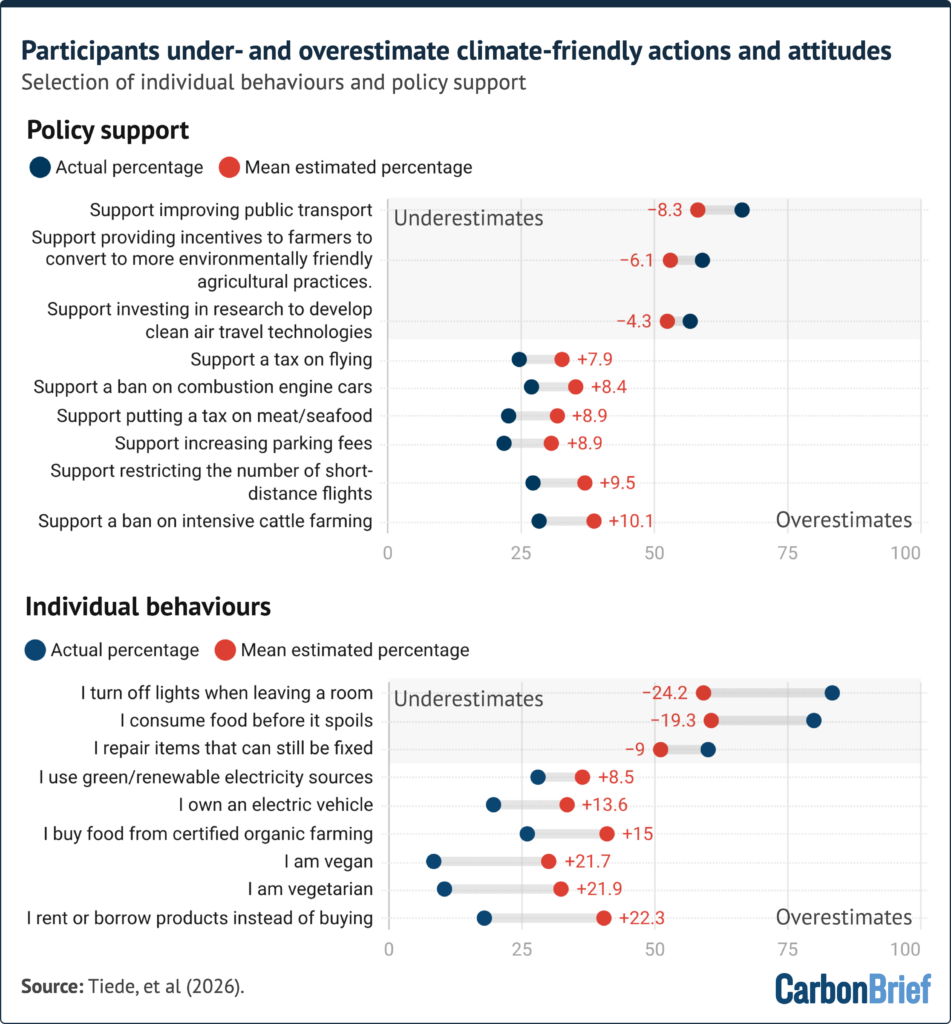
The chart below shows the actual percentage of people who supported different environmental policies and performed climate-friendly behaviours (blue dots) compared to average predictions from the surveys (red dots).
They reveal a “consistent pattern” where “small proportions were overestimated and large ones were underestimated”, the authors say, driving predictions towards the middle. This phenomenon is known as “regression to the mean”.
In other words, where public support for a policy was high, participants in the survey estimated it was lower than it was. When the support was lower, estimates would be higher.
The study finds that individual and environmental factors played a role in shaping people’s perceptions of their peers’ climate actions, which were distinct from general misestimations.
For example, people who were already involved in climate action, had more frequent climate discussions and consumed more climate-focused news and media predicted a higher proportion of climate support “across the board”.
The results from the fourth and fifth surveys show that knowing the context of other people’s beliefs and behaviour in surveys can impact the attitudes of participants.
Participants that were told that 68% of people were willing to donate 1% of their household income to the WWF were more willing to donate.
In contrast, participants that were told that 4% of people actually donated did not report more willingness to “discuss climate change, sign petitions or donate” than the control group.
However, there was no obvious impact on actual donations for any of the three groups, the study notes.
Lead study author Dr Kevin Tiede, scientific managing director of the Institute for Planetary Health Behaviour at the University of Erfurt, tells Carbon Brief that the findings suggest that “just telling people how many people support climate action is likely not enough to really change something”.
However, Tiede adds that “direct comparability” between people saying they would donate and actually donating is “limited” and that giving people more time to answer and autonomy over where to donate might result in more people taking action.
‘Pluralistic ignorance’
Tiede explains that the study findings demonstrate the existence of “pluralistic ignorance”, where a person believes their own views differ from the majority.
For climate change, this means that the “vast majority of people around the world support climate action, but people considerably underestimate the extent of this support”, the study says.
However, the surveys reveal that pluralistic ignorance “in the climate domain” is more nuanced than previously thought, say the authors.
Prof Madalina Vascleanu, an assistant professor at Stanford University’s Doerr School of Sustainability, who was not involved in the study, tells Carbon Brief that encouraging climate action is complex.
It may take multiple and repeated “attempts” at effective communication, or for people to directly “experience” the “norm” that climate change is widely supported, she says, rather than simply being told.
“Observable” behaviours, such as “identity signalling” – which could involve anything from protesting to vegetarianism – might have more of an impact on encouraging climate action among peers than “private behaviours like donations”, she adds.
The study is a “great addition to the literature”, Vascleanu says, because “correcting” the perception gap did not have an effect on climate-friendly behaviour, as “scholars had previously assumed”. She adds that it has “sparked several new hypotheses” that her “lab is now working on”.
Prof Mauro Bertolotti, associate professor of social psychology at the Università Cattolica del Sacro Cuore, explains that the “attitude-behaviour gap” revealed by the research is a “rather common finding”.
However, he is “sceptical” of the “simplified and abstract” measures, warning that experiment environments often come with “assumptions and expectations” that are different from real life.
As a result, they might not “replicate” the process people go through when choosing to “make a donation to an environmental cause”, he says.
‘Targeted’ communication strategies
The researchers argue that it is more effective to focus on “targeted” communication strategies – encouraging climate-friendly behaviours that aim to reach the majority who already support climate action, rather than trying to convert climate sceptics.
They call for attention to be paid to the attitude-behaviour gap between people saying they support efforts to tackle climate change and following up with real-world climate actions.
The study suggests strategies for decision-makers to reduce the attitude-behaviour gap, such as “facilitating climate-friendly behaviour” with “convenience and subsidies”. They also recommend ensuring environmental policy prioritises fairness to gain visible and widespread public support.
They add that the public would benefit from understanding the “effectiveness and co-benefits” of climate action.
Tiede, K.E. et al. (2026) People systematically under- and overestimate public engagement in climate action, Nature Climate Change, https://doi.org/10.1038/s41558-026-02668-z
Related
Scientists are ‘most trusted’ source of climate information in global-south survey
Survey: ‘Very few’ Africans place responsibility for climate action on ‘rich nations’
Guest post: How public attitudes towards ‘CO2 removal’ differ in the UK and US
Guest post: How ‘discourses of delay’ are used to slow climate action
The post Correcting climate ‘misperceptions’ may not boost climate action appeared first on Carbon Brief.
Correcting climate ‘misperceptions’ may not boost climate action
Continue Reading
The COP31 climate talks in Antalya, Turkey, have failed to reach agreement on a “pact” that lacked clear references to curbing fossil fuels or scaling up climate finance.
The “Antalya pact”, proposed by the joint Turkish-Australian presidency, was rejected in the final hours by the EU, the UK and several climate-vulnerable nations.
Meanwhile, many developing countries criticised the lack of progress on climate finance and indecision on a proposed $120bn target for funding climate adaptation.
With stark divisions preventing agreement on the presidency-led pact, UNFCCC chief Simon Stiell expressed “deep disappointment”, speaking of “scope to improve, modernise and reform” the UN climate process.
Despite a chaotic endgame that saw the overrunning COP become the longest in history, it did not end in complete failure, with many items adopted in the closing plenary.
These included fairly limited or procedural outcomes on a new “mechanism” for global “just transitions”, plus support for countries struck by climate disasters.
There was some progress beyond the negotiations, though, with growing coalitions of nations championing “roadmaps” for “transitioning away” from fossil fuels.
With the presidency promoting “electrification” as a key theme, around 80 nations also signed up to a global target of securing 35% of final energy consumption from electricity by 2035.
Here, Carbon Brief provides in-depth analysis of all the key outcomes from Antalya, both inside and outside the COP31 negotiations.
(See Carbon Brief’s coverage of COP30, COP29, COP28, COP27, COP26, COP25, COP24, COP23, COP22, COP21 and COP20.)
- Formal negotiations
- Turkish and Australian leadership
- Cover decision
- COP reform
- Adaptation
- Finance
- Just transition work programme
- Loss and damage
- Gender
- Article 6
- Agriculture and food security
- Mitigation work programme
- Response measures
- Action for climate empowerment
- Trade
- Second global stocktake
- Long-term goal review
- Guidance on NDCs
- Rio synergies
- Around the COP
- Road to COP32 and beyond
Formal negotiations
Turkish and Australian leadership
Turkey and Australia presided over the longest COP in history – and failed to find consensus on their proposed “cover decision”, exposing deep fractures between countries on key issues such as fossil fuels and the need for developed nations to meet climate-finance pledges.
Experts told Carbon Brief that, strictly, the talks did not “collapse” as several negotiated items were still adopted.
Rather, the rejection of the cover decision represented, for the first time, “those who want a higher level of ambition actively reject[ing] the lowest common denominator on offer”, said one veteran observer.
Dispute over who would host COP31 – representing the “western Europe and other states” region – had gone on for three years.
In the end, the two main rivals, Turkey and Australia, agreed to a deal last year at COP30 that the summit would take place in Antalya, Turkey, with Australia acting as “president of negotiations”.
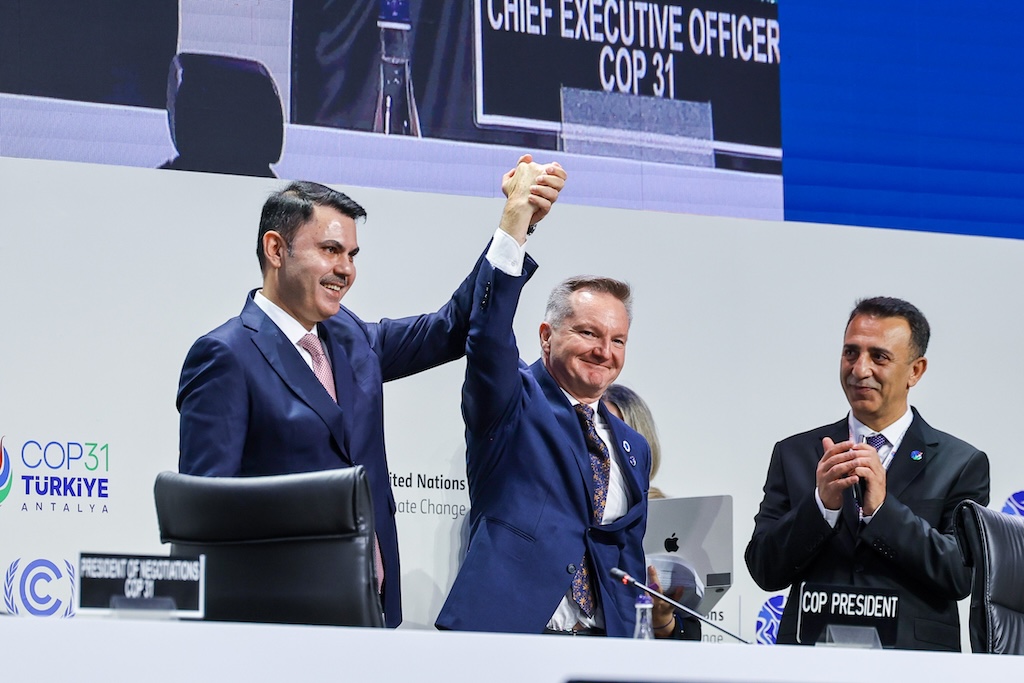
Critics questioned whether either country was well-placed to host, given their ongoing fossil-fuel expansion.
Turkey faced criticism for announcing the discovery of two new oil fields on the eve of the summit, while recent Carbon Brief analysis found that Australia is the third-largest CO2 exporter in history because of its fossil-fuel production.
Ahead of the summit, the presidency released four official letters outlining a vision for COP31.
The first letter, written by COP31 president Murat Kurum in April 2026, confirmed the appointment of Australian climate minister Chris Bowen as “president of the negotiations” and announced that a pre-COP would be held in Fiji in October.
The second letter, authored by both Kurum and Bowen from the Copenhagen climate ministerial in May, said that “COP31 presents a vital opportunity to further accelerate…in the areas of clean energy, electrification and resilient infrastructure”.
The third letter, published in August 2026, gave more details on the presidency’s plans for the “action agenda” – the part of the UN process that mobilises coalitions of nations and non-state actors to push climate action further.
This letter also introduced a key aim from the presidency to get countries to agree to increase electricity’s share of final energy consumption to 35% by 2035 (often referred to as “35 by 35”). (See: Electrification.)
The final letter, published in October ahead of the pre-COP in Fiji, said that the presidency would centre on “delivering a COP focused on accelerating implementation, electrification and resilience in an uncertain world”.
It added that “many parties have emphasised the importance of reviewing and continuously improving UNFCCC processes, to ensure it remains fit for purpose, sustainable and focused as negotiations evolve over time”, adding:
“At COP31, we will hold presidency consultations to hear parties’ views on how to strengthen UNFCCC processes, to ensure growing demands are met and to effectively deploy resources.”
The pre-COP in Fiji was held from 5-8 October and was attended by 3,000 people.
In this somewhat intimate setting, Bowen announced that Turkey and Australia had agreed to negotiate a “presidency-led” cover decision at COP31.
He added that revealing this before COP was part of the presidency’s “upfront, transparent and consultative approach”.
Later that month, the presidency named the five ministerial pairs from developed and developing countries that would take key negotiation issues forward at COP31. These issues were mitigation, adaptation, finance, just transition and oceans.
COP31 kicked off on 9 November, with climate negotiations scholar (and Carbon Brief contributing editor) Dr Joanna Depledge noting that it was clear from the summit’s opening ceremony that “Australia [was] the junior partner” in the presidency.
COP’s opening day ran late into the night as the presidency worked to avert a fight over proposed changes to the summit’s negotiations agenda.
Agenda adopted! Moments ago in Antalya, Turkey, COP31 president Murat Kurum outlined how an “agenda fight” has been averted, despite various proposals for additions to proceedings. This came after a short delay, while a series of huddles took place on…
 Simon Evans
COP31: Agenda adopted!

The next day, in plenary, Kurum announced that a resolution had been found.
He said that calls for new agenda items on adaptation finance and trade were rejected, whereas an item on a new climate finance “work programme” had been added. (The EU expressed “deep concern” about the addition.)
Kurum added that two extra proposed items on mountains and climate change – made more poignant by recent catastrophic floods in Nepal – were also not added to the agenda. However, he said that the presidency would instead hold consultations on the topic.
Though an early scrap over the agenda was avoided, the summit’s opening days were plagued with logistical problems.
Attendees were forced to spend hours navigating traffic and queues just to get into the venue – sparking serious access concerns.
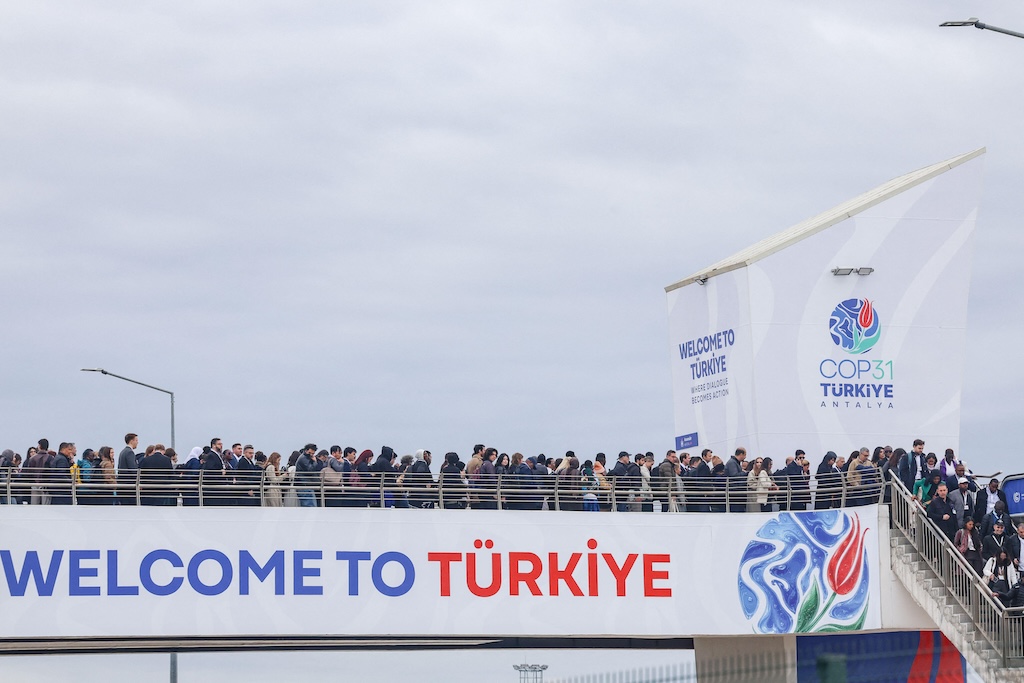
The problems persisted into the first day of the world leaders’ summit on 11 November, when delegates were informed that they should travel between the hours of 5-7am to secure access to the venue. Ire only grew when security staff still let people in after this time.
On Friday morning, the presidency released a “reflections” text from its consultations with countries on what they would like to see in a cover decision. This was an “informal note” with a bullet-pointed list of topics that might be included.
On Saturday evening, Kurum told a press conference that “around 30 countries” had indicated support for the 35 by 35 pledge.
However, he had little to share on progress in the negotiations and eluded questions on how he planned to include “fossil fuels” in the cover decision.
In the small hours of Sunday morning, half-way through the summit, Kurum announced presidency and ministerial consultations on “outstanding political issues”.
He also invited ministers to a “divan” – a group meeting, not a daybed – to discuss cross-cutting issues.
On Monday afternoon, the presidency dropped an 18-page first draft of its proposed cover decision – along with a short “presidency note” explaining that all elements were still in play, including whether or not they should appear in a final text. (See: Cover decision.)
At a press conference, Bowen told journalists that the presidency decided to release the text “early” to allow parties to debate on it for as long as possible and acknowledged that it would need to be “refined” down.
On Wednesday evening, the presidency held its divan, where delegation heads sat in a circle and were asked to share their priorities for finding consensus in the negotiations.
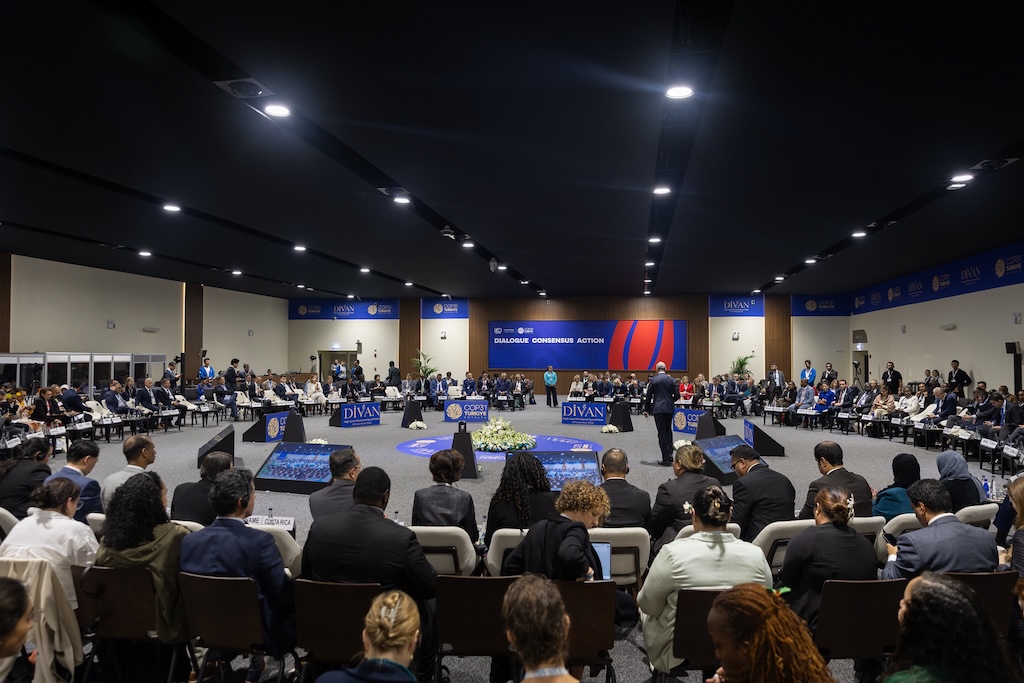
Speaking at the divan, Kurum told parties that the second draft cover decision would be published that evening.
In the end, the second draft cover decision was published on Thursday.
Later that day, Kurum and Bowen spoke at a press conference, talking up their latest draft with lofty claims that it could “achieve [the] covenant of 1.5C and nothing more”.
However, the second draft was rejected by countries and civil society alike. (See: Cover decision.)
On Friday – the summit’s last scheduled day – the mood at COP soured. With few official updates, delegates relied on ever-changing rumours about when a new text might emerge.
Negotiations on other key issues also remained stuck, as civil society dubbed it the “worst COP in history” at a press conference attended by Carbon Brief.
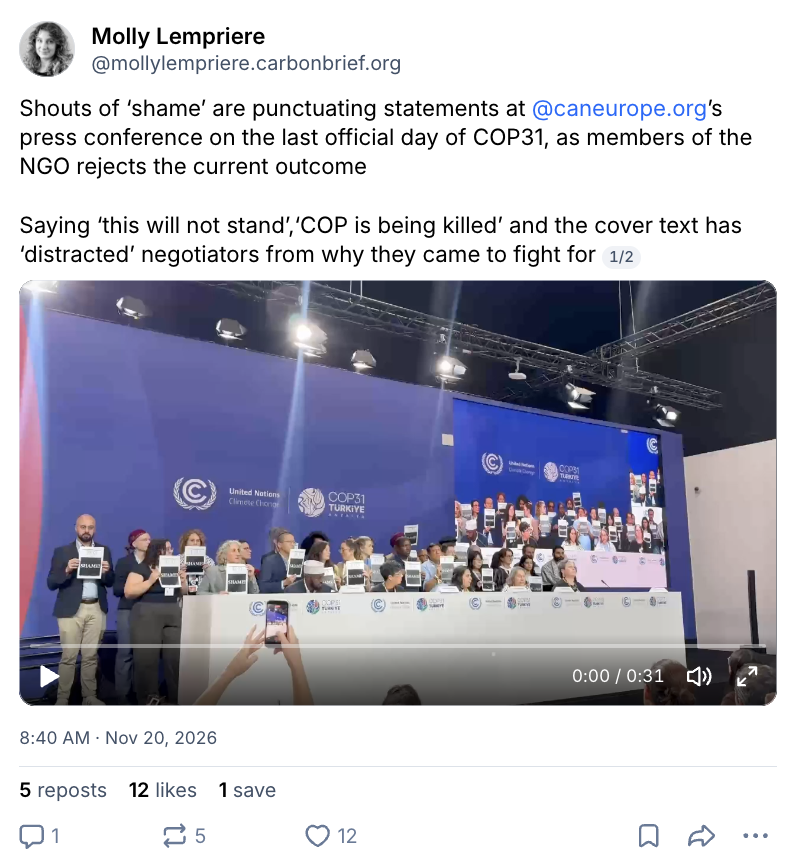
In the evening, the presidency opened the closing plenary to gavel through non-contentious items – and announced that a new text would not be released until Saturday morning.
They were interrupted by a protester wearing a shirt that said “you are killing the future” and with a red noose around their neck.
As talks ran into overtime on Saturday, any kind of official update failed to arrive.
An open letter signed by 100 civil society organisations told the presidency it was “on course to preside over one of the most disappointing COPs the UNFCCC has ever had”.
As Turkish support staff started packing down the party pavilions, behind-the-scenes disputes between country ministers intensified.
Carbon Brief understands that 126 countries – made up of the EU, UK, the Alliance of Small Island States (AOSIS), the Independent Association of Latin America and the Caribbean (AILAC), the Umbrella Group (UG) and least-developed countries (LDCs) – approached the presidency as a united front to demand changes to the cover decision.
These changes included on how it referenced transitioning away from fossil fuels, adaptation finance and carbon capture and storage. (See: Cover decision.)

A new draft cover decision did not arrive until the early hours of Sunday morning.
With official updates still few and far between, rumours swirled that many countries were still not happy with this iteration of the text and planned to reject it.
Later that day, another version of the text arrived – but it contained only minor changes.
In a fiery final plenary session on Sunday afternoon, several countries rejected the cover decision – citing reasons including its failure to respond to humanity’s overshoot of 1.5C of global warming, its failure to clearly mention fossil fuels and its lack of clear figures for adaptation finance. (See: Cover decision.)
While countries rejected the cover decision, they did find consensus on other texts, including for the just transition work programme, the global goal on adaptation, the climate finance work programme, carbon markets, long-term finance and “Article 2.1c”.
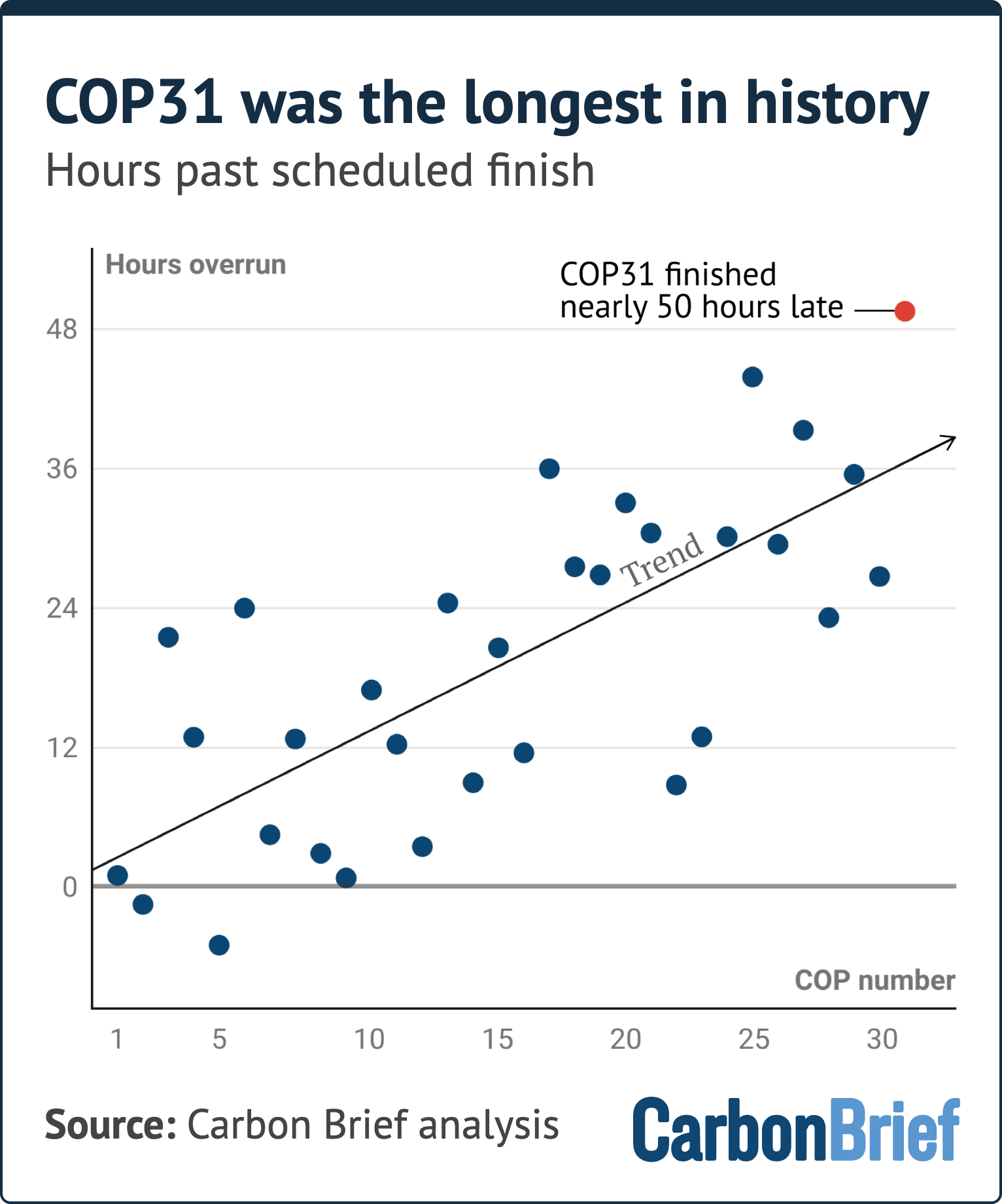
The final gavel came down at 7:33pm local time – nearly 50 hours after the summit’s scheduled end. This makes COP31 the longest in history.
Cover decision
The final draft of a COP31 “cover decision” was rejected by at least 32 counties during a chaotic – and, at times, acrimonious – closing plenary in Antalya.
Towards the end of the summit, Kurum had told a press conference attended by Carbon Brief that he wanted the cover decision to be known as the “Antalya accord”. (This was later amended in the last formal draft to be the “Antalya pact”.)
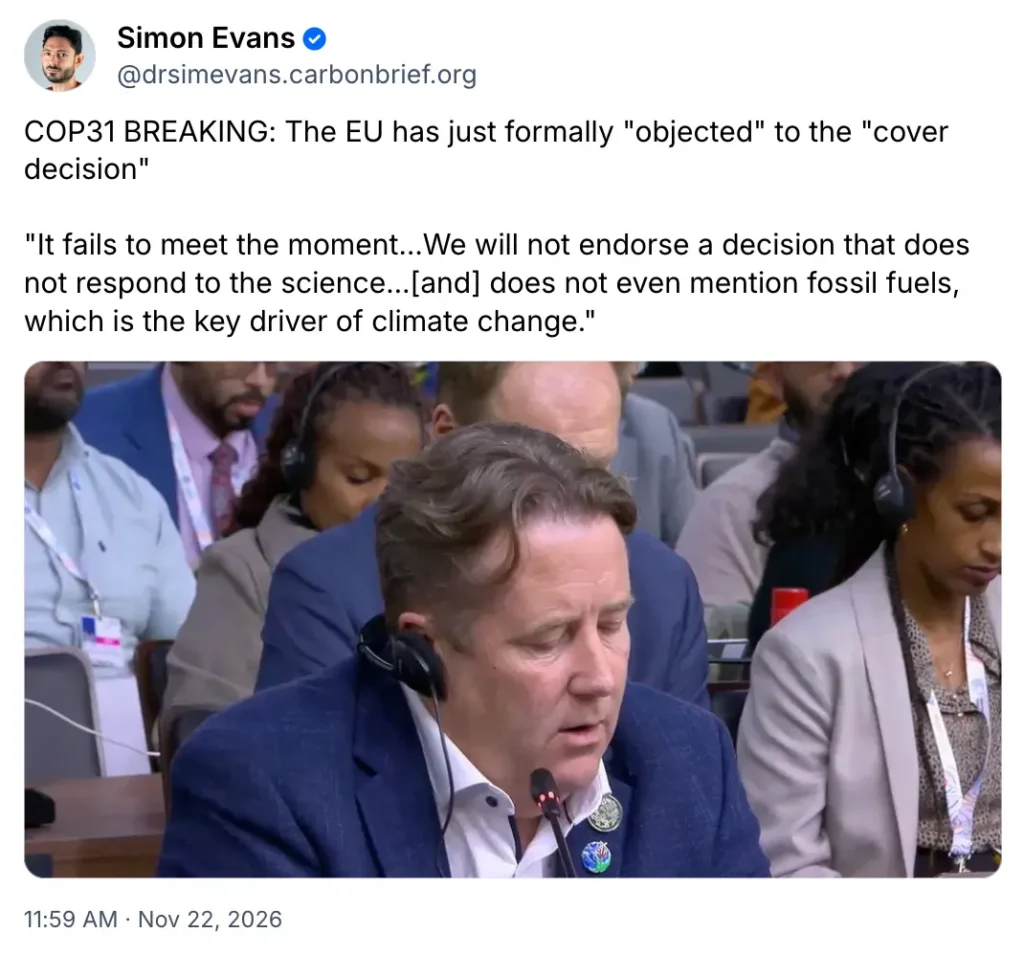
But, in the closing plenary, the EU told the assembled delegates:
“We will not endorse a cover decision, or an Antalya pact, that does not even mention fossil fuels, which is the key driver of climate change.”
According to Carbon Brief’s tally during the closing plenary, the agreement was also explicitly rejected by Panama, the Marshall Islands, Belize, Norway and Vanuatu.
After it was clear that the pact would not be adopted, the 44-member LDCs, the UK, South Korea and Japan all said that consensus had not been reached, a softer form of indicating dissent. The six-member environmental integrity group (EIG) also registered its “concerns” with the text.
For months ahead of the summit, the Turkish and Australian presidencies had been talking up the idea of a COP31 cover decision – an overarching political statement.
Indeed, Bowen had publicly raised the idea of a COP31 cover decision at last year’s COP30 in Brazil, even before the agreement to act as joint president with Turkey had been finalised.
In his opening speech in Antalya, Bowen said that he had agreed with Kurum to take forward a “presidency-initiated, party-driven [cover] decision for COP31”. He had said at a pre-COP in Fiji:
“There is a clear expectation that COP31 must respond to the global moment – to send a clear message to accelerate implementation…And to demonstrate our continued commitment to multilateralism, to international cooperation and to the Paris Agreement.”
Bowen stressed that this should not lead to a “lengthy political statement”, but that he wanted it to respond to the imminent “overshoot” of 1.5C, the “catastrophic impacts” of warming and the “tangible progress” being made in the energy transition.
For Turkey, the cover decision became a vehicle to promote what had started out as its voluntary target for electricity to make up 35% of global final energy by 2035. (See: Electrification.)
While early on, Russia publicly challenged the legal basis for a cover decision, given it was not on the official agenda, these procedural objections fell away as the summit continued.
Many other recent COPs have issued cover decisions, setting a firm precedent.
Carbon Brief understands that legal advice from the UNFCCC secretariat confirmed the broad authority of the presidency to initiate a cover decision in Antalya.
Nevertheless, many parties remained unhappy about the existence of the cover decision, the process by which it was put together and the impact it had on time for other negotiations.
For the LMDCs, India told the closing plenary:
“We are also acutely aware that [the cover decision] has taken away our attention from the mandated items of the agenda, which we had to deliver.”
It had quickly become clear that Bowen’s ambitions for a brief cover decision would be in vain, when a lengthy 144-paragraph “reflections” text was released on 16 November.
Today, Friday 13 November, the COP31 presidency published a “reflections” text on consultations it has been holding with heads of national delegations on a potential “cover decision”. This is not a fully formed draft text, but instead contains an organised…
Simon Evans
NEW: COP31 cover decision ‘reflections’ text

This document was a compilation of all the issues that parties had put forward for inclusion, ranging from quantified climate-finance goals through to firm timelines for the next assessment report from the Intergovernmental Panel on Climate Change (IPCC).
Other ideas included that developed countries should reach net-zero emissions by 2030, that certain trade policies should be “phase[d] out” next year and that the largely defunct Kyoto Protocol should be resurrected, with binding carbon targets for developed nations.
The text also included the presidencies’ favoured “35 by 35” electrification target, as well as language on the transition away from fossil fuels. (See: Fossil fuels).
A second iteration – in reality, the first fully formed draft cover decision – was published on 19 November, consisting of just 80 paragraphs.
This version was immediately criticised for having excised any mention of fossil fuels, as well as deleting the $120bn adaptation-finance target wanted by developing countries. (See: Adaptation.)
It retained the “35 by 35” target, but only as one of a menu of options, listed as areas for “global cooperation” to “keep 1.5C within reach”.
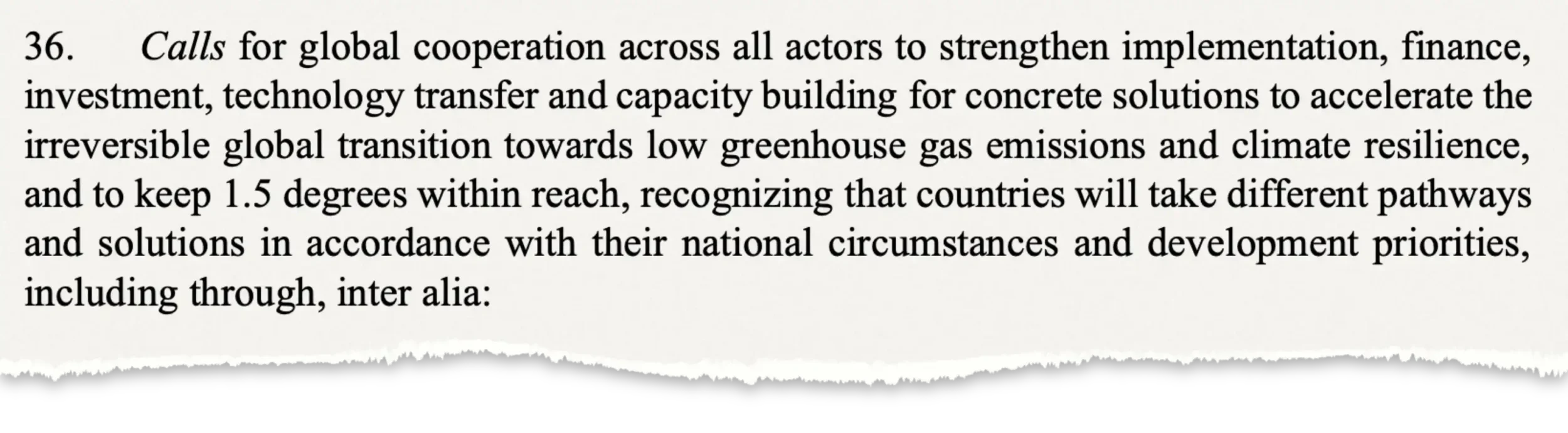
Controversially, this menu of options – indicated by the wording “inter alia”, meaning “among other things” – also included numerical targets for carbon capture, utilisation and storage (CCUS), apparently as “quid pro quo” for the quantified electrification target.
The same day, in a highly unusual move, Panama issued an open letter stating that it would “formally object” to any decision not meeting demands including a “cap on oil production”.
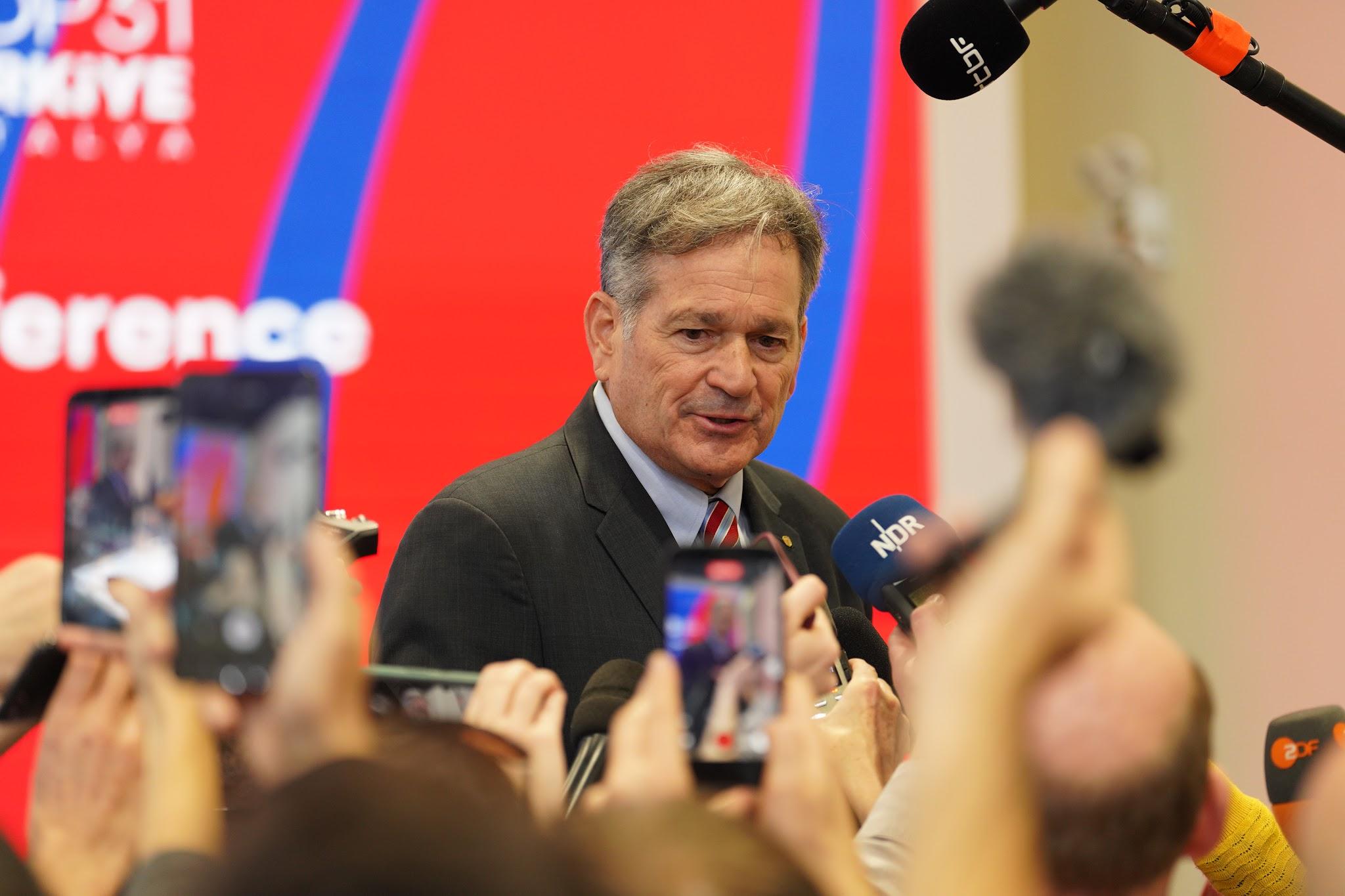
A third and supposedly “final” version of the cover decision was published at around 3am local time on Sunday 22 November, already deep into overtime at the summit.
This still did not make any direct reference to fossil fuels or the $120bn adaptation finance target. It also removed language that had called for the next IPCC reports to be published ahead of the second “global stocktake”.
Carbon Brief has seen proposed revisions presented to the presidency by a 126-nation coalition of countries, including the EU, LDCs, AOSIS, AILAC, EIG and Umbrella groups.
They asked for the paragraph above – numbered 36 in the second draft and 40 in the third – to be replaced with a direct link to the first global stocktake, which included the transition away from fossil fuels. (They did not suggest an explicit use of the words “fossil fuels”.)
The group also wanted the sub-paragraph with numerical targets for CCUS to be deleted.
However, a fourth and final version of the “Antalya pact”, published a few hours later, made only minor changes, softening language on CCUS to “increasing” rather than “accelerating”, while also weakening the language around the timeline for the next IPCC reports.
On the last scheduled day of negotiations, Bowen had told journalists: “The world is wondering whether multilateralism can deliver. I think it can.”
But the presidencies’ efforts to secure a cover decision were, ultimately, unsuccessful.
The UK told the closing plenary:
“What is before us is not commensurate with the urgency of overshoot, the scale of the climate crisis or the impacts already being felt…It is the lowest common denominator…[rather than presenting] bold collective ambition on climate action.”
Not all parties were opposed to the Antalya pact. Ghana, for the African group, said it could support the decision, despite the lack of specificity on topics including adaptation finance and trade measures.
Saudi Arabia, for the Arab group, said that they had continued to “engage constructively” on the cover decision, “despite all of the issues that were taken off the table”, including on finance and historical emissions. It also said:
“We cannot reconcile a position that stated so publicly that we need to keep 1.5C within reach and, yet, calling CCUS technologies greenwashing.”
Russia explained its steadfast opposition to “any wording on fossil fuels” – despite the wording agreed by consensus at COP28. It criticised “slogans” around the use of fossil fuels, arguing that even in 1.5C pathways, there was an ongoing role for oil and gas.
While the failure to adopt a cover decision has been widely compared to the collapsed Copenhagen climate talks in 2015, experts told Carbon Brief this comparison was flawed.
Nevertheless, they said it could end the recent trend of COPs attempting to secure a cover decision, as well as sparking renewed reflections on how to reform the process.
Paul Watkinson, former EU climate negotiator at Paris COP21, told Carbon Brief:
“This time it is the political bet of the presidency on a cover decision that has not worked…I think this needs a deeper reflection on what we are trying to achieve – there are limits to political signals in a decision – and we ought to think [about] what we can achieve through the COP and how to make it work better.”
COP reform
As COP31 ended without agreement on the proposed “Antalya pact”, much of the immediate response focused on perceived shortcomings in the UN climate process.
In his closing remarks, UNFCCC executive secretary Simon Stiell said there were “lessons that must be learned” for the consensus-driven process:
“Clearly, there is also scope to improve, modernise and reform. But not only because of what happened here. But also because we must evolve in this era of implementation.”
In fact, one of the COP31 presidency’s stated priorities had been reforming COPs – or what they described as “strengthen[ing] UNFCCC processes”.
COP reform was discussed during the summit, including at a press conference where Panama environment minister Juan Carlos Navarro told journalists:
“The COP has become an exercise in futility…192 countries will not agree on every single comma and every single period…especially those countries that produce carbon-based fuels.”
In practice, such bombastic statements were far removed from the on-going discussions and country submissions on COP reform, which had already begun in Brazil last year.
These discussions were integrated into the formal negotiations under the heading of “arrangements for intergovernmental meetings” (AIM).
At the Bonn climate talks in June, Australia, along with Turkey, offered to conduct informal consultations on increasing UNFCCC “efficiency” at COP31.
The African group asked for legal clarity and cautioned that “efficiency should not be equated with reducing budgets or removing agenda items” necessary to tackle climate change, according to the Earth Negotiations Bulletin.
Early in the talks, the COP31 presidency published a concept note calling for “forward-looking and exploratory” discussions on what a “strong and effective UNFCCC process” could look like. It also initiated “presidency consultations” on the matter, despite the lack of a clear mandate for doing so.
In the presidency consultations, responses included multi-year planning, retiring old agenda items and “avoiding unnecessary cover decisions”.
Several countries – including Russia, the African group, AILAC and the LMDCs – questioned the need for separate discussions and whether these were solely for the cover decision, given they were already underway in the AIM negotiations.
Russia said it “did not consent to elevating this discussion to high political level” and that it was unclear “why such a significant amount of negotiating time [was] being devoted” to these roundtables without a clear objective.
Drafts of the presidency’s failed cover decision included “high-level consultations” under COP presidencies on “strengthening the UNFCCC process”.
During the final plenary, Peru, for AILAC, called for a “clear rule on votes” and an independent review of the COP process’s efficiency. Peru’s environment director Andrés Martín Garrido Sánchez said:
“To negotiate in good faith is not a courtesy; it’s an obligation. It means not using delays as a strategy. It means negotiating text in the room in the view of everyone, with every party being heard before a decision is gavelled. It means not taking issues hostage…We are not proposing matters against the consensus. This way of negotiating is not leading us to where the world needs us to be.”
With the Antalya pact rejected, these discussions will still continue under AIM in Bonn in 2027.
Adaptation
While efforts to specify that tripling adaptation finance meant $120bn by 2035 failed to make it into any final texts, COP31 did see a breakthrough on channelling carbon-market revenues into the UN adaptation fund.
Disagreements over finance dominated negotiations within the “global goal on adaptation” (GGA).
This followed a “call for efforts” to triple adaptation finance by 2035, which was agreed last year at COP30.
That target was originally proposed by the LDCs as a “tripling of grant-based adaptation finance by 2030 to at least $120bn”.
Last year’s final agreement was considerably weaker and lacked key details – including the baseline for tripling and what kinds of funding would be counted towards it.
Ahead of the start of COP31, the African group requested that the tripling goal be added to the agenda, providing a potential space to discuss these outstanding issues.
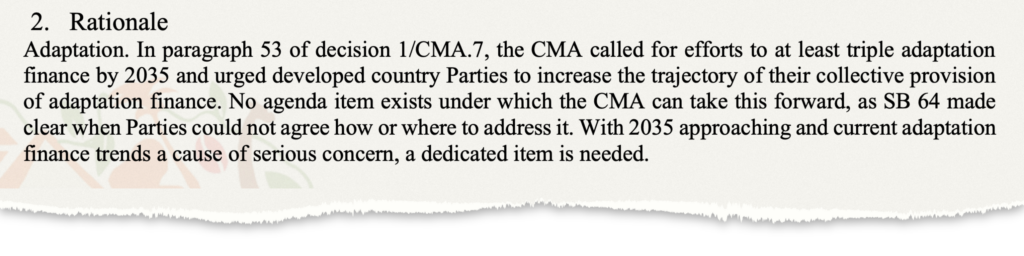
This request was rejected. As a result, the question of where the goal should be discussed quickly arose as a fault line. It was debated within the GGA, the climate finance “work programme”, as well as the proposed “cover decision”.
As negotiations got underway, the G77 and China coalition of developing countries argued that adaptation finance should be discussed in the GGA rooms.
The EU, UK, environmental integrity group (EIG), Norway and Canada all wanted adaptation finance discussed under the climate finance work programme. This would place the tripling goal within the broader $300bn target for 2035 – meaning adaptation finance could come from a wide variety of sources, not just developed-country grants,
Over the first week of negotiations, two GGA draft texts were released, both of which included specific references to tripling adaptation finance to $120bn per year by 2035.
This would use a baseline of 2025, when the previous target to double adaptation finance to $40bn per year came to an end.

Over the second week of COP31, parties continued to disagree over the home and baseline for the tripling target.
The first draft text on the cover decision – reflecting ideas put forward by parties – included relatively ambitious language that tripling finance for adaptation “should reach at least $120bn”. However, the “$120bn” was absent from the next draft and an accompanying GGA text.
NGO network Climate Action Network (CAN) reported that France – as co-chair of the ministerial climate-finance negotiations – had proposed a 2019 baseline, which would reduce the tripling target to just $60bn a year by 2035.
For context, the latest UNEP report on adaptation suggests that developing countries will need a total of $305bn every year by 2035 to meet their adaptation needs.
Ultimately, neither the GGA, the climate finance work programme nor the failed cover decision specifically contained a baseline or target figure for tripling adaptation finance.
Bethan Laughlin, senior policy specialist at ZSL (Zoological Society of London), told Carbon Brief that the failure to agree a baseline does a “colossal amount of damage, because it is a continued betrayal of promises for finance of all types”.
Beyond finance, parties worked to establish an expert taskforce that could refine the set of 59 “indicators” for the global goal on adaptation, which had been agreed at COP30, as part of the two-year “Belém-Addis vision”. These are the metrics that countries will use to assess their progress in adapting to climate change.
Speaking to Carbon Brief, Emilie Beauchamp, senior adaptation expert at International Institute for Sustainable Development (IISD), highlighted that the indicators had been pushed through in Brazil without full engagement from parties. She added:
“It ties into the bigger picture, which is that [the] Brazilian presidency’s cover decision didn’t leave any space for countries not to adopt these 59 indicators. These are complex and incomplete, which means most countries aren’t happy with them.”
Parties agreed on the need for a “two-tier” approach to resolving this, with a taskforce undertaking technical work on the indicators and then a policy alignment process for testing them. However, the composition of the taskforce quickly became a sticking point, just as it had in Bonn earlier in the year, according to ENB.
The 19 November draft GGA text still contained three options on the taskforce’s composition, including a mix of experts nominated either by regions, the chairs of the UNFCCC subsidiary bodies or by UN organisations and other non-party stakeholders.
Parties also disagreed on references in the GGA text to the Paris Agreement and “common but differentiated responsibilities and respective capabilities” (CBDR-RC), plus on recognition of the importance of the 1.5C goal in limiting the need for adaptation.
While the final decision agreed at COP31 does not mention overshoot or 1.5C, it does provide clarity on the taskforce.
It “agrees” that six experts will be nominated per UN regional group, in addition to three experts nominated by the LDCs and three by small island developing states.
With so much time and focus given to the finance question, smaller technical aspects of the GGA negotiations struggled to find consensus across the two weeks of COP31.
Laughlin said:
“I think we are seeing these big-number finance issues as absolutely fundamental, but we’re also seeing the technical elements of the process, where the real work of implementation is done, be significantly challenged and, in my view, denigrated into obsolescence.”
Observers told Carbon Brief that there had not been sufficient time given to the GGA, as well as items such as national adaptation plans (NAPs). One said that more than double the negotiating time had been devoted to the cover decision than to mandated items, such as the GGA, MWP and JTWP, over the first week.
Beauchamp told Carbon Brief she hoped that COP32 president Ethiopia would “break this pattern”.
Beyond the GGA, other adaptation items also proved challenging at COP31.
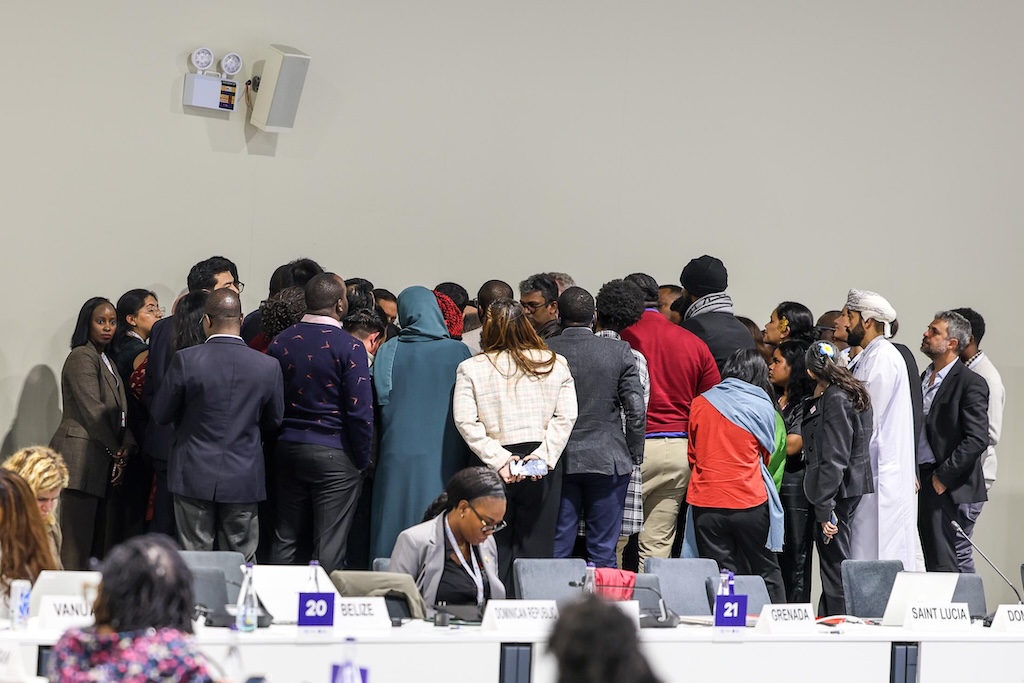
The adaptation fund is the oldest dedicated UN climate fund and was set up as part of the 1992 UN climate convention. Now, it is in the process of transitioning to exclusively serve the 2015 Paris Agreement. This will allow it to access 5% of the revenues generated by the agreement’s Article 6.4 carbon market.
This process has previously been delayed by disagreements over the makeup of the fund’s board.
Under the Paris Agreement, the board would have set quotas for “developed” and “developing” nations – the terms used in the treaty – instead of “Annex I” and “non-Annex I” nations, as it has done in the past.
Some parties see this distinction as important, because the UNFCCC annexes clearly separate a small group of predominantly European and industrialised states from other nations, whereas the “developed-developing” division is less clearly defined.
Joe Thwaites, international climate finance director at Natural Resources Defense Council, told Carbon Brief that parties “can’t access” the Article 6.4 “share of proceeds” until this is resolved.
A draft text released on 18 November continued to include references to both “developed countries” and parties “included in Annex I to the convention” within square brackets.
Ultimately, the final decision adopted “developed” and “developing country” language, but it also confirmed that developing countries will continue to have a majority of seats on the board.
Thwaites described the resolution of the adaptation fund negotiations as “one bright spot” from the climate summit, noting:
“The decisions at COP31 enable the fund to receive a share of carbon-trading proceeds under the Paris Agreement crediting mechanism, which will not be subject to the politics of national budget processes.”
Negotiations on NAPs, adaptation communications and adaptation committee discussions all ended with procedural conclusions, meaning no substantive agreement was reached.
One adaptation area with more progress was “matters relating to the LDCs”, an agenda item where parties discuss support and adaptation planning for the 44 LDCs.
Despite “difficult negotiations”, on the second Wednesday of COP31, parties agreed to a decision that establishes a “LDCs national adaptation plan implementation platform” under the LDCs expert group.
ENB quoted a delegate saying: “This decision may not make the headlines, but it means a lot for the more than one billion most vulnerable people who benefit from the work under this agenda item.”
Finance
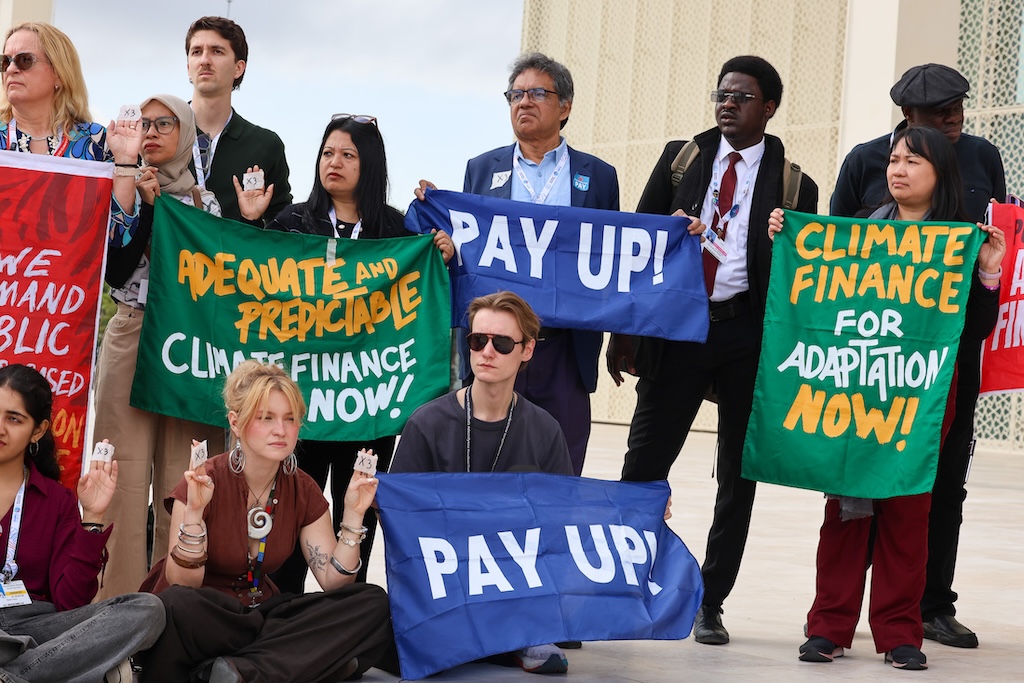
As COP31 ended in disputes and finger-pointing, a major complaint by many parties was the failure to agree progress on climate finance.
In their closing speeches, several developing-country figures expressed “profound concern”, accusing developed countries of “refusing to engage” on this “essential” issue.
Finance talks ended with little – beyond decisions to hold more meetings. There was no progress on “tripling adaptation finance”, despite efforts to flesh out this goal. (See: Adaptation.)
Finance negotiations took place amid major aid cuts by developed countries and, as revealed by Carbon Brief, a corresponding 70% drop in the amount of public climate funding being pledged.
COP31 co-president Australia drew heavy criticism from NGOs for failing to commit new funds, along with other major donors, such as Germany, France and Japan.
Meanwhile, pledges to UN climate funds fell to their lowest levels in years, with few new commitments in Antalya.
Two years ago, nations agreed on a “new collective quantified goal” (NCQG), which involves developed countries “taking the lead” in raising $300bn in climate finance a year by 2035.
A variety of sources are expected to feed into this goal, including multilateral development banks, UN climate funds and private finance “mobilised” by public investments.
In recent years, roughly a third of total climate finance has been public finance from developed countries. The provision of funds by these nations now looks less certain, amid economic struggles and pressure to raise military spending.
Developing countries, therefore, came to COP31 looking for assurances.
Finance was discussed across most rooms in Antalya, but negotiations around a climate finance “work programme” – set up at COP30 last year – were the main venue for this push.
Developing countries had wanted to create this space to discuss finance “provision” under Article 9.1 of the Paris Agreement, which says developed countries “shall provide” finance. This is taken to mean public funding – such as aid spending – from developed countries.
(The NCQG, on the other hand, is a “mobilisation” goal, meaning it covers various funding sources, including private finance “mobilised” by public investments.)
This came amid concerns that developed countries were trying to transfer responsibility onto others. Abdulkani Barrow, Somalia’s lead negotiator, told Carbon Brief:
“Africa does not want developed countries’ historical financial responsibilities to become diluted by a general expectation that private investors, developing countries and other financial actors should provide the money.”
However, due to pressure from developed countries, the work programme was set up with a broader remit, including Article 9.1 “in the context of Article 9…as a whole”.
Following initial talks in June, the programme was only added to the COP31 agenda due to a continued push by developing countries. The EU remained “deeply concerned” about its inclusion.
Coming into COP31, developing countries continued to insist that the work programme should focus exclusively on Article 9.1.
Some developing-country groups, notably the Like-Minded Developing Countries (LMDCs) and the Arab group, said it should consider ways to secure more from developed countries, including “burden-sharing arrangements”. They also argued for an extensive new set of talks and other activities.

Such ideas were unacceptable for developed countries, who generally wanted a far more limited set of actions that were “non-prescriptive” and “non-punitive”.
They argued that the talks should be based on the existing $300bn mobilisation goal, stressing that they were already contributing tens of billions a year.
Prior to COP31, Wopke Hoekstra, European commissioner for climate, told Bloomberg that “any conversation on new fresh money is dead in the water”. (This statement – and choice of words – sparked outrage among civil society and was even quoted by India’s Amandeep Garg in the closing plenary.)
Speaking at the climate summit, Hoekstra told Carbon Brief:
“We made a deal with the whole world community on financing…We don’t think there is any merit in opening it.”
(The work programme was established “without prejudging the process for the implementation of the NCQG”.)
There were a few finance-related issues that the EU and their allies were happy to discuss, including “broadening the contributor base” to include wealthier developing countries.
Developed-country groups also said they wanted the discussions about “tripling adaptation finance” to take place within the work programme, as part of the NCQG. This would mean adaptation finance coming from both their public spending and other sources.
In particular, the EU, the UK and others said they wanted to discuss “access” – helping small islands and other low-capacity nations to better get hold of the finance that already exists.
Ilana Seid, chair of AOSIS, told Carbon Brief that this focus on access presented small-island states with “an interesting dilemma”, because they also needed more finance, noting: “The whole machinery needs to move.”
The developed countries’ stated focus on access amounted to little, with no mention in the final finance decision. The Australian presidency was set to launch an “access declaration” for small islands and LDCs at COP31 – but the event was cancelled, partly due to lack of signatories.
After drafts circulated, the first official work programme text landed at the start of the second week. It contained two lengthy, opposing sets of “options”, which broadly reflected the competing priorities of the developed and developing-country blocs.
The first official draft of text for the climate finance “work programme” has just dropped. There are major divisions between developed and developing countries, including over whether the programme has already started. It follows a proposed text that was being…
 Josh Gabbatiss
NEW: First official climate finance text drops

The EU, Switzerland and New Zealand reportedly argued that a “no text” option should be on the table. This was reflected in the next iteration, which had a set of brackets around the entire document.
NGOs said the EU was acting as a “villain”. Sehr Raheja, deputy programme manager at the Centre for Science and Environment, told Carbon Brief:
“If they’re derailing the negotiations on this work programme, then that commitment to the NCQG – in my mind – is questionable.”
Co-chairs of the finance negotiations attempted to combine the work-programme discussions with another set of talks on Article 2.1c of the Paris Agreement – which relates to “making finance flows consistent” with climate goals.
Developing countries objected to this effort. They wanted to keep discussions focused on the responsibilities of developed countries, rather than broadening them to all “finance flows”.
As COP31 drew to a close, it became clear that a stripped-back outcome was likely for both the work programme and Article 2.1c negotiations, with nothing substantial on finance provision, tripling adaptation finance or any other stated party priorities.
This was reflected in the final decisions, which contained largely procedural outcomes. Notably, parties did agree to continue discussing finance under the work programme until 2028, rather than ending next year as some developed countries preferred.
Less high-profile finance texts, such as the Standing Committee on Finance, also finished with largely procedural outcomes.
Just transition work programme
Discussions on how to create a new “just transition mechanism” (JTM) proved one of the most controversial aspects of COP31 and were, ultimately, deferred to COP32.
At COP30 last year, negotiations under the broader “just transition work programme” (JTWP) had agreed to launch the mechanism, a decision seen as a key “legacy” of the summit.
At COP31, parties were expected to agree on the form and function of the mechanism, to allow it to start working.
Following work in Bonn in June and a workshop in Sydney in the autumn, parties began negotiations in Antalya productively, with general consensus emerging on a two-tier structure for the mechanism. This would include a political and governance body, as well as a technical operational arm, according to Earth Negotiation Bulletin (ENB).
Similarly, despite some divergences on the duration and scope of the work programme, there was broad support for the continuation of the JTWP beyond 2026.
This initial work suggested that the JTM – referred to as the Belem-Antalya Mechanism (BAM) by civil society – would have a similar format to that previously suggested by NGOs and academics.
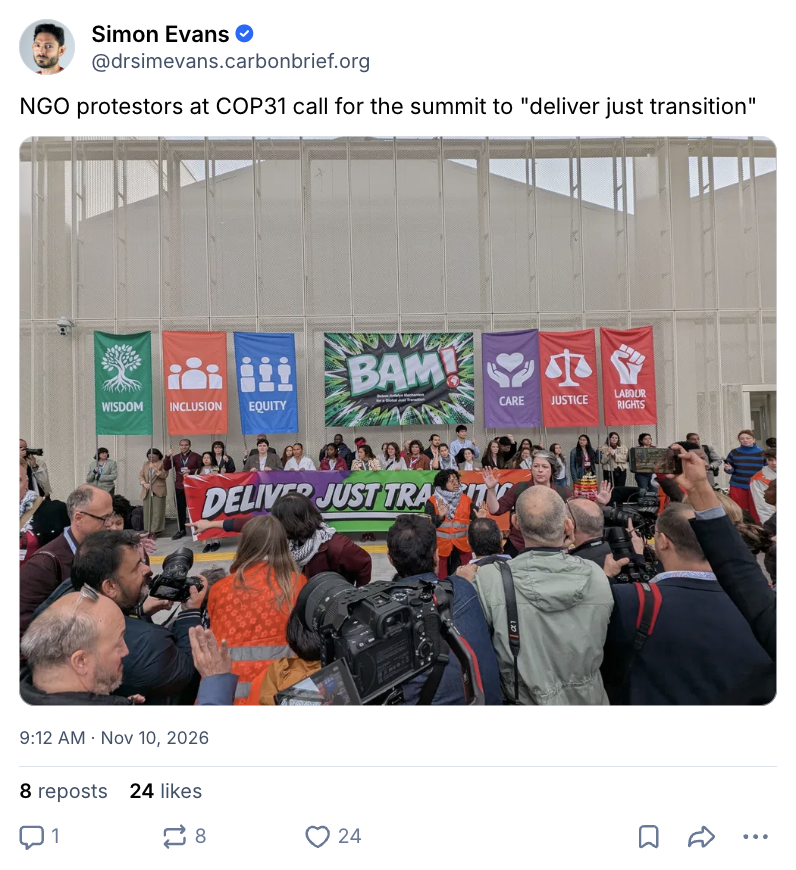
However, a draft text prepared at the end of the first week of negotiations was met with criticism from civil society, due to its lack of substantive detail on the mechanism.
They told Carbon Brief in statements that it was “hollow”, “watered-down” and an “insult to the principles parties agreed in Brazil”, adding that the “exciting potential for COP31 to deliver a real just transition mechanism is hanging by a thread”.
Speaking to Carbon Brief, Dr Leon Sealey-Huggins, a senior campaigner at the charity War on Want, said there had been a “steep decline” in negotiations.
He added that developed parties, such as the EU, Norway and the UK, were pushing for the mechanism to run dialogues, produce reports and connect people. He said that while this was “fine”, it is largely already happening in the JTWP and would have little impact on implementation. Sealey-Huggins continued:
“G77 and China have been really strong on pushing back on that in various different ways. [They are] united in the call for some kind of institutional arrangement that will have longevity, that will have power to implement work and that will do the work of scaling up means of implementation [and] support.”
Over the second week, the key areas of focus became who would set up and run the mechanism, the involvement of non-party stakeholders and how it would be financed.
The G77 and China, African group and LDCs shared proposals on how the mechanism could deliver implementation. The EU and EIG highlighted the role of non-party stakeholders.
Anabella Rosemberg, senior advisor on just transition at NGO umbrella group CAN International, told Carbon Brief that the arrival of ministers in the second week put a “cold wind in our room”.
She said that what should have been a “relatively easy win” for COP31 was disrupted by disagreements in other areas, including finance and mitigation.
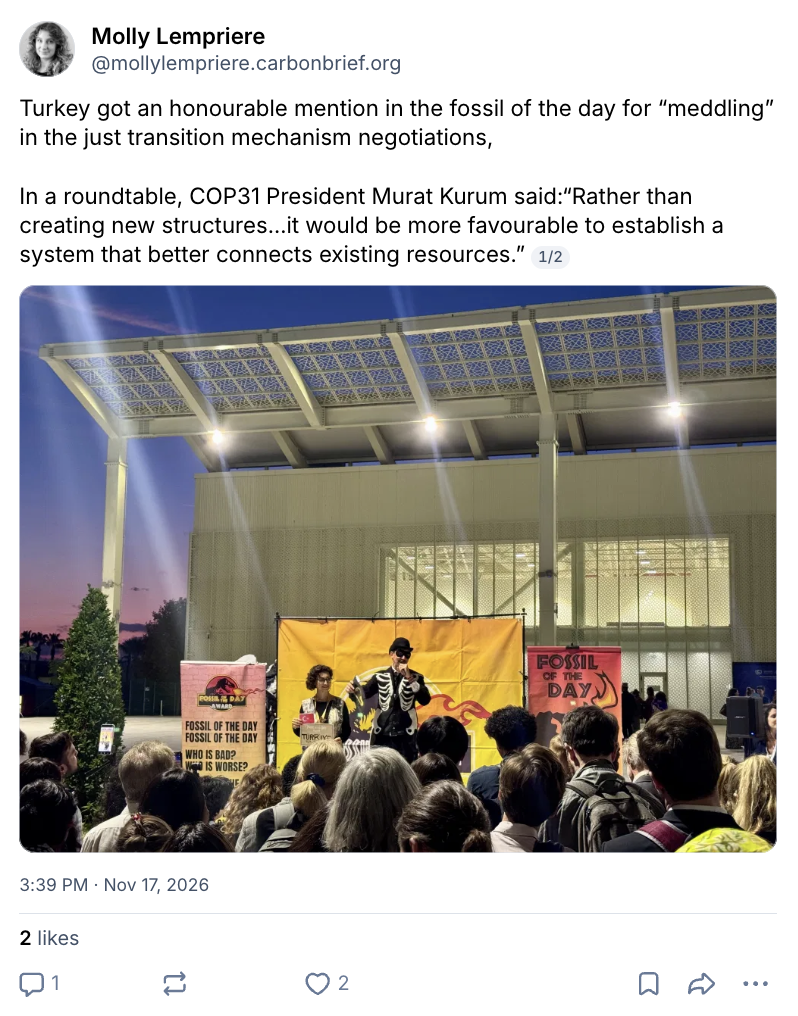
Throughout the second week, there was also criticism of the Turkish presidency’s involvement in the JTWP. On 17 November, it was given a “dishonourable mention” in CAN’s “fossil of the day” award. This followed COP31 president Murat Kurum saying during a ministerial roundtable:
“Rather than creating new structures, it would be more favourable to establish a system that better connects existing resources.”
Parties and civil society were quick to criticise the statement, which they viewed as breaching presidential neutrality.
As the summit progressed, negotiations became further mired in disagreement. Rosenberg told Carbon Brief they were hampered by the focus on the cover decision, which “basically captured the oxygen of the negotiations”.
On 19 November, a new JTWP draft text was published. However, the entire body of it was contained within square brackets. Key issues, such as the institutional arrangements for the new mechanism, were still only mentioned as “options”.
A call from the G77 and China for the mechanism to be a “constituted body”, meaning a specialised subsidiary that would house work on the mechanism would be established under the UNFCCC, was not included, observers told Carbon Brief.
Civil society – who originally proposed the mechanism – became increasingly vocal as COP31 moved into its final scheduled day. At a packed press conference attended by Carbon Brief, speakers said it had been “possibly the worst COP in history” and that they “unequivocally reject” the outcomes as they stood.
As we await new draft texts for the cover decision, just transition work programme, global goal on adaptation and more at COP31, civil society has just held a hectic press huddle to condemn the lack of process here in Turkey.…
 Molly Lempriere
Civil society hits out at ‘terrible COP’ that is ‘abject failure’
The final decision, published late on 21 November, sets out a phased approach to setting up the new just-transition mechanism.
It says that in Bonn next year, parties will work out what the mechanism will do and how it will work, with a view to this being formally agreed at COP32 in Ethiopia in November 2027.
In a statement, Gina Cortés Valderrama, political strategist at 350.org said civil society and developing countries “stood firm in the face of a weak” mechanism, which “rich nations were trying to throw over the edge”. She added:
“Damage control is not a victory at this point. This is a failure of ambition and leadership, particularly from the so-called ‘developed countries’, who obstruct the provision of support, and of the COP31 presidency, who sidelined the united calls from 135 countries – almost 80% of the global population.”
Beyond the mechanism, parties discussed a review of the JTWP and the key messages that emerged from the fifth and sixth just-transition “dialogues” held in 2026.
Over the two weeks of negotiations, parties disagreed on language around agriculture and other topics, as well as the inclusion of references to transitioning away from fossil fuels and trade – neither of which made it into the final decision.
At COP30 last year, references to minerals had been included in earlier drafts on the JTWP – the first time they had appeared in a text within the UNFCCC process. However, this did not make it into the final decision in Belém.
At COP31, “critical minerals” were referenced in a COP decision for the first time.
In a statement, Angela Asuncion, Asia-Pacific coordinator and transition-minerals focal point at the Resource Justice Network, welcomed the inclusion as a “notable step”, but added that “the decision by parties to eliminate human rights due diligence across critical mineral supply chains is unacceptable”. She added:
“Stripping away these fundamental safeguards is a profound failure of leadership. By failing to operationalise the BAM and removing human-rights safeguards in critical-mineral operations, governments have once again abandoned frontline communities.”
Loss and damage
Negotiations on “loss and damage” resulted in few substantial outcomes at COP31 and only limited recognition of the gap in funding to aid victims of climate disasters.
On top of finance to support emissions cuts and climate adaptation, developed countries are expected to take the lead on this issue.
Loss-and-damage funding has been particularly in the spotlight since the devastating Himalayan floods over the summer.
The Nepali government subsequently requested $20m from the UN fund for loss and damage, which was established with much fanfare at COP27 in 2022.
So far, predominantly developed nations have pledged just $342m to the fund, a fraction of the $2.8bn in funding requests that developing countries have submitted.
The fund’s board does not plan to start distributing finance until December, despite pressure to begin fast-tracking applications in response to urgent needs.
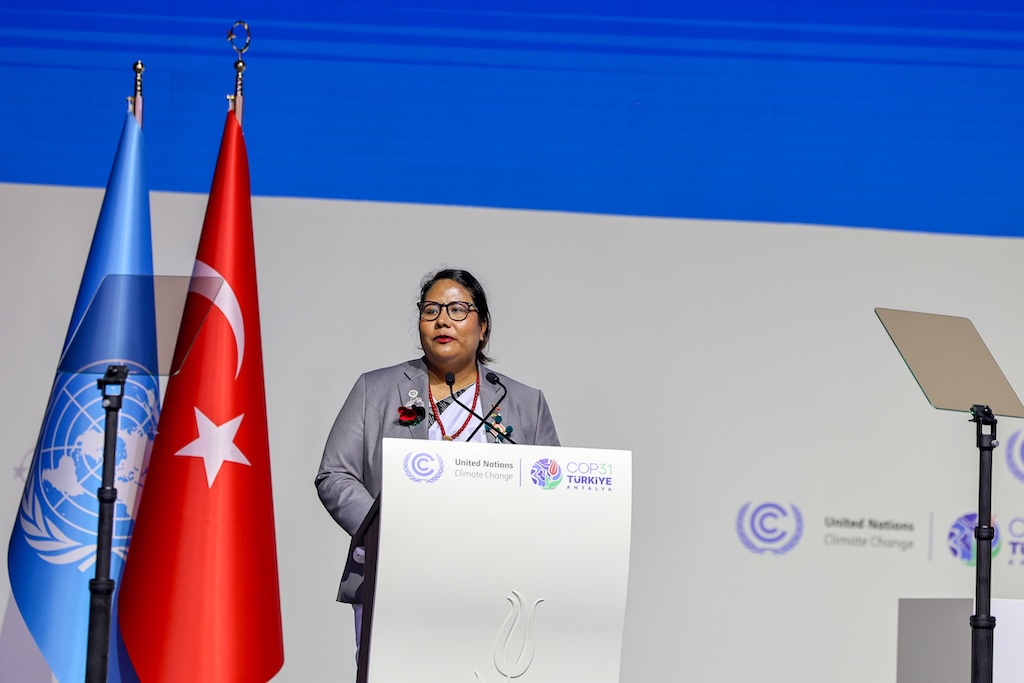
Speaking at a COP31 side event, Nepali environment minister Gita Chaudhary said “disasters do not wait for the paperwork and neither can survivors”. She added:
“The gap between the scale of loss and damage and the resources available in the fund is enormous and growing, so Nepal, therefore, strongly urges developed country parties to honour their commitments.”
Unlike previous years, very little new loss-and-damage funding was announced at COP31 – limited to €15m ($16.5m) from Spain, plus Italy and the EU formalising previous pledges. The fund’s first replenishment process is due to start in 2027.
In negotiations, parties were tasked with discussing a report on the loss and damage fund and deciding what guidance – if any – they wanted to provide for its operation.
Explaining why such guidance might be necessary, Liane Schalatek, an associate director and climate-finance expert at Heinrich Böll Stiftung, told Carbon Brief:
“From developing countries, there have been concerns about things that are happening in the board meetings…There is no sense of urgency from developed countries to figure out how and when we do resource mobilisation.”
An initial text presented two options. The first – favoured by the African group, LDCs and AOSIS – laid out six pages of guidance for the fund, “noting with concern” the gap between funding available and requests made.
The alternative, supported by the EU and Japan, simply stated “no guidance”. They cited concerns about “micromanaging” the fund’s board
The final text “noted” the loss-and-damage finance shortfall, but contained relatively weak language about the need to scale up funding. One exception was a line “urg[ing] the conversion of pledges as soon as possible”, referring to promised funds that have not yet been paid out.
Meanwhile, there were technical discussions at COP31 involving the joint annual report of the executive committee of the Warsaw International Mechanism (WIM) and the Santiago Network, plus the governance of the WIM.
These two bodies are involved in research and helping developing countries access technical assistance to deal with loss and damage.
One key dispute in these negotiations concerned WIM governance, which has gone unresolved for several years, but has not prevented the body from undertaking its work.
In the end, parties decided to simply defer the issue again, with a footnote in the final decision stating that this does not “prejudge outcomes” on WIM governance.
Gender
There was limited progress on negotiations on gender in Antalya, as a small number of parties once again pushed back on language on inclusion.
At COP30 last year, parties agreed on the Belém gender action plan (GAP), which set out specific actions for ensuring gender-responsive climate action and indicators for measuring parties’ progress on gender-related issues.
This year’s summit was expected to be a “simple procedural negotiation”, with parties meant to discuss several reports that were deliverables under the GAP, said Bridget Burns, executive director of the Women’s Environment and Development Organization (WEDO).
However, she told Carbon Brief:
“Our experience has shown us that even the most insignificant procedural negotiations can also get quite derailed and that’s somewhat what happened here.”
During the first consultations, on 10 November, the co-facilitators sought parties’ views on three reports prepared by the secretariat, according to Earth Negotiations Bulletin (ENB).
ENB said that several negotiating groups used their time to highlight the need for finance, capacity-building and technology transfer in order to effectively implement the GAP.
The first draft of the text, released late that day, “welcome[d]” the three reports and the work conducted under the GAP during its first year. It also “t[ook] note” of a report on addressing reported cases of harassment at the UNFCCC, but did not significantly mention the need for additional means of implementation.
On the second day of consultations, the G77 and China reportedly asked for stronger language on finance, which was reflected in brackets in the text’s second draft, as shown below.
![A paragraph recognising the need for support for developing countries to implement gender action. The text says: "11. [ Recognizes the continued need for scaled-up support for developing country Parties
to implement the enhanced Lima work programme on gender and the Belém gender action
plan as well as the need for the provision of support to national gender and climate change
focal points in particular, considering their central role in implementing the Belém gender
action plan] [, and the need for direct and locally accessible financing approaches that
respond to the priorities of women and girls, including those in women-led and community based organizations]. ]"](https://www.carbonbrief.org/wp-content/uploads/2026/11/gender-and-climate-change-2500x778.webp)
Later in the first week, several parties objected to the use of inclusive language. They also disagreed over whether they should “welcome” or “take note” of the secretariat’s reports. (The latter is considered to be weaker language.)
As at last year’s summit, Argentina, Paraguay, Russia and the Holy See – the government of the Vatican – raised objections over the use of previously agreed, gender-inclusive language in the draft.
Burns told Carbon Brief that it was “continually jarring” to see the Holy See “huddling with Russia in almost every negotiation stream”. She added:
“The Holy See has been specifically vocal in these negotiations…and, in my opinion, [are] disastrously using the moral capital that they have to drive this process into procedural negotiations that are meaningless to actually changing what has been [previously] adopted in this process.”
The final text, published on 14 November, reflected the lack of consensus, simply saying that the SBI had “considered” the reports and “acknowledged” the work being done to implement the GAP.
Noemi Grütter, head of advocacy and partnerships at the Global Alliance for Green and Gender Action, told Carbon Brief that, despite the lack of progress on the agenda item, important work on implementation is still happening on the ground. She added:
“There is also the reality that we need to build power outside of UNFCCC, because it’s not fast enough. There are countries that are willing [to do that], and I think we need to work with them.”
According to the Guardian, Argentina and Paraguay both intervened over the definition of gender in the plenary during the adoption of the standing finance committee decision in the early hours of Sunday morning.
Article 6
Negotiations at COP31 on carbon trading under Article 6 of the Paris Agreement reopened many familiar arguments over how tightly such activities should be regulated.
Beatriz Granziera, senior policy adviser at The Nature Conservancy (TNC), told Carbon Brief:
“Discussions repeatedly came back to familiar trade-offs: practicality versus conservativeness; flexibility versus oversight; and how to scale much-needed participation and investment while maintaining environmental integrity.”
Agreement was, ultimately, reached on both bilateral trading under Article 6.2 and the international carbon market under Article 6.4.
Carbon trading between countries under Article 6.2 is only subject to light-touch rules, such as reporting on the use of the process and a “technical expert review” of national reports.
Across 16 national reports checked so far, these reviews found 543 “inconsistencies”, 115 of which were “significant”. None of the reports were found to be without issue.
An initial draft text at Antalya “note[d these issues] with concern”, adding that “many…are significant” and relate to “environmental integrity” – in other words, whether or not emissions are actually being cut. It asked parties to address issues “at the earliest opportunity”.
However, this entire paragraph disappeared in the final, agreed text. Instead, the decision “takes note” of the information in the technical reports, without asking for any response.
Given its confidentiality provisions, campaign groups have long described Article 6.2 as a “wild west” for carbon trading and the COP31 outcome does nothing to tighten the rules.
Separately, parties were unable to reach agreement at COP31 on how to fund the processes needed to run Article 6.2. Instead, they agreed to continue discussions next year, requesting a technical paper on how “fees or other funding arrangements” would work.
On Article 6.4, negotiations began against a backdrop of calls for a “course correction” on the way the international carbon market is operated.
This came in an open letter from the Project Developer Forum and the International Emissions Trading Association (IETA), saying market rules were too “conservative”.
Andrea Bonzanni, senior director at IETA, told Carbon Brief that the “current version of [the market] is failing to attract investment in carbon projects”.
The requests in the open letter appeared in early draft text, after being taken up by the like-minded developing countries and others.
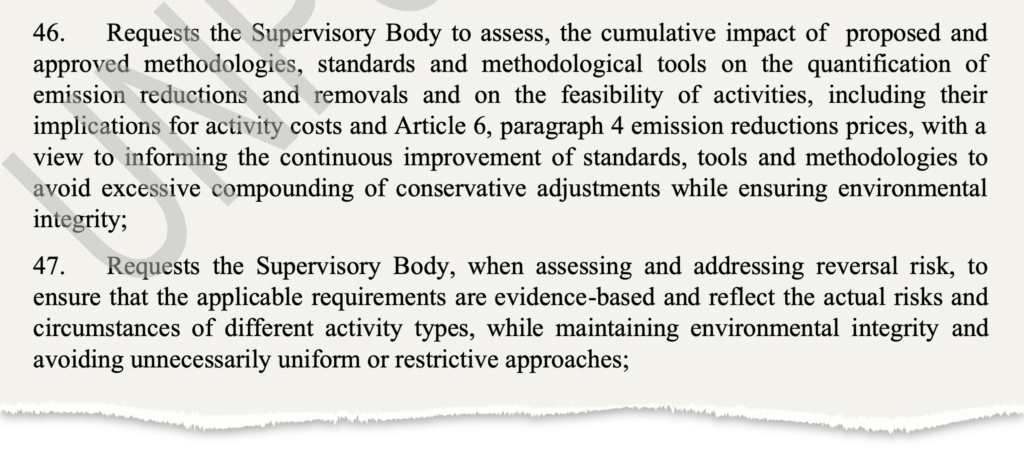
A 14 November draft “request[ed]” the supervisory body to “assess the cumulative impact” that its rules and standards have on the “feasibility” and “cost” of carbon-credit schemes.
It said this was to avoid “excessive compounding of conservative adjustments”, in what amounted to asking that the rules for the Article 6.4 market not be too stringent.
Isa Mulder, at Carbon Market Watch, told Carbon Brief that this looked like market proponents “chipping away at the standards that have been set out”. She added:
“The goal [of Article 6] was to enable higher ambition, not to enable [carbon-trading] activities.”
However, after pushback from the EU and others, the final text adopted at COP31 no longer asks for a formal assessment of the “cumulative impact” of the rules.
Instead, it asks that the supervisory body “take into account” the way different standards “operate together” when making or revising provisions.
Towards the end of the summit, 45 scientists signed an open letter saying that the Article 6 rules “must be consistent with the science”.
With those rules set for a review starting in 2028, Granziera told Carbon Brief:
“Ultimately, the debate [at COP31] reflected different views on what is needed for Article 6 to deliver more effectively as a tool for achieving the goals of the Paris Agreement, which will likely come back to light in 2028.”
Agriculture and food security
For the second year in a row, negotiations on the Sharm el-Sheikh joint work on agriculture (SJWA) collapsed without parties reaching an agreement.
SJWA is where formal negotiations around climate change and agriculture take place under the UNFCCC.
Part of SJWA’s mandate is to synthesise information about work being done in the agricultural space – under both the UNFCCC and other international bodies – in an annual report.
SJWA also held two workshops – one on holistic approaches to agriculture and one on “means of implementation”, usually taken to mean finance – where countries and other partners could share their experiences, as captured in summary reports.
At this COP, parties were meant to discuss the conclusions of these reports and, time permitting, decide on the future of the agricultural workstream under the UNFCCC. (The four-year mandate of SJWA was set to end at COP31.)
Many observers were hopeful of agreeing a text that recognised agroecology as beneficial for humans, climate and biodiversity.
However, in the first negotiating session, on 10 November, the Arab group expressed its view that fertilisers are vital for food security and fertiliser exports are being impacted by the EU’s carbon border adjustment mechanism (CBAM). Therefore, it said, the agriculture talks needed to discuss CBAM and other trade measures.
Teresa Anderson, global climate-justice lead at ActionAid, called this a “total curveball” in the negotiations. She told Carbon Brief:
“Everybody’s faces just dropped…Suddenly we knew that the chances of agroecology having a chance had been pretty elegantly spiked by putting in this really complicated political issue into the middle of the agriculture discussions.”
Other observers also expressed frustration to Carbon Brief that the group had brought CBAM into the negotiations, noting that trade measures are being discussed elsewhere in the COP.
At the end of this session, parties were asked to submit their views in writing for consideration, with the LMDCs proposing an extension of SJWA to COP32.
A draft text circulated on the evening of 12 November – after the scheduled start of the negotiations that evening – left many parties unsatisfied, with several stating that elements of the text crossed their “red lines”. The draft presented parties with four options, including “no text”.
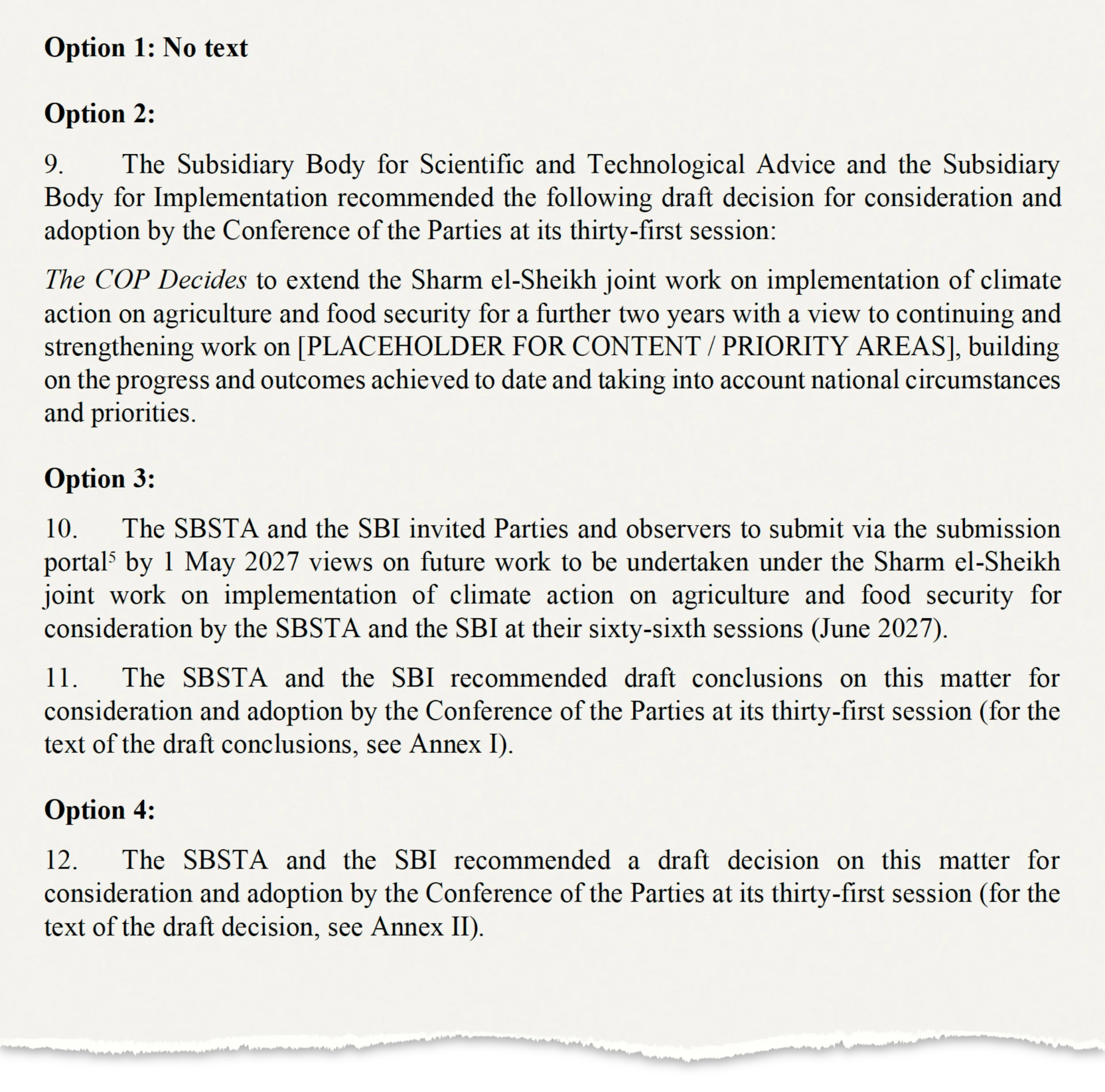
Although various parties objected to many parts of the proposed text – including agroecology (opposed by India), CBAM (opposed by the EU) and “food systems” language (opposed by the G77) – the underlying issue was a lack of finance, observers told Carbon Brief.
Marie Cosquer, advocacy analyst at Action Against Hunger, said:
“The main issue is not bad-faith negotiating; it’s the fact that across the UNFCCC, the countries that have a climate debt are not paying it…Unless they move on finance, there is nothing in this negotiation for global south countries.”
With no sight of agreement on the horizon and the scheduled negotiating time drawing to a close, parties suggested that the negotiations end with a procedural text. The co-facilitators put such a text forward on 14 November.
This final text says only that parties “continued consideration” of SJWA and have “requested the subsidiary bodies to continue consideration” of SJWA at the mid-year intersessional meetings in Bonn. The subsidiary bodies are then “requested” to report back at COP32.
Mitigation work programme
Despite work in the “mitigation work programme” (MWP) stalling repeatedly over the two weeks of COP31, parties ultimately agreed to continue it up to 2030.
The MWP – the only formal agenda item at the annual COP that is specifically focused on cutting greenhouse gas emissions – was set to come to an end in 2026.
As such, parties have been wrangling with an existential question over the past year – both regarding the continuation of the programme and what it should work on.
Both in Bonn and at COP31, divisions arose over the challenge of ensuring the MWP is “facilitative and non-prescriptive and…drive[s] greater urgency on mitigation ambition and implementation”, as the Center for Climate and Energy Solutions noted.
At the Bonn intersessional meetings in June, countries were unable to agree on how to balance these two aspects and negotiations were subject to “rule 16”, meaning there was no outcome and discussions were knocked over to the next session.
In the run-up to COP31, submissions from parties made it clear that there was support for the continuation of the programme.
According to Earth Negotiations Bulletin (ENB), as negotiations got underway on 10 November, parties diverged on the duration of the programme – with suggestions including out to 2030 or 2040 – and on a review of the purpose of MWP.
Additionally, Switzerland proposed establishing a permanent mitigation committee that would be similar to standing bodies in other areas of the UNFCCC process. This was opposed by the Arab Group.
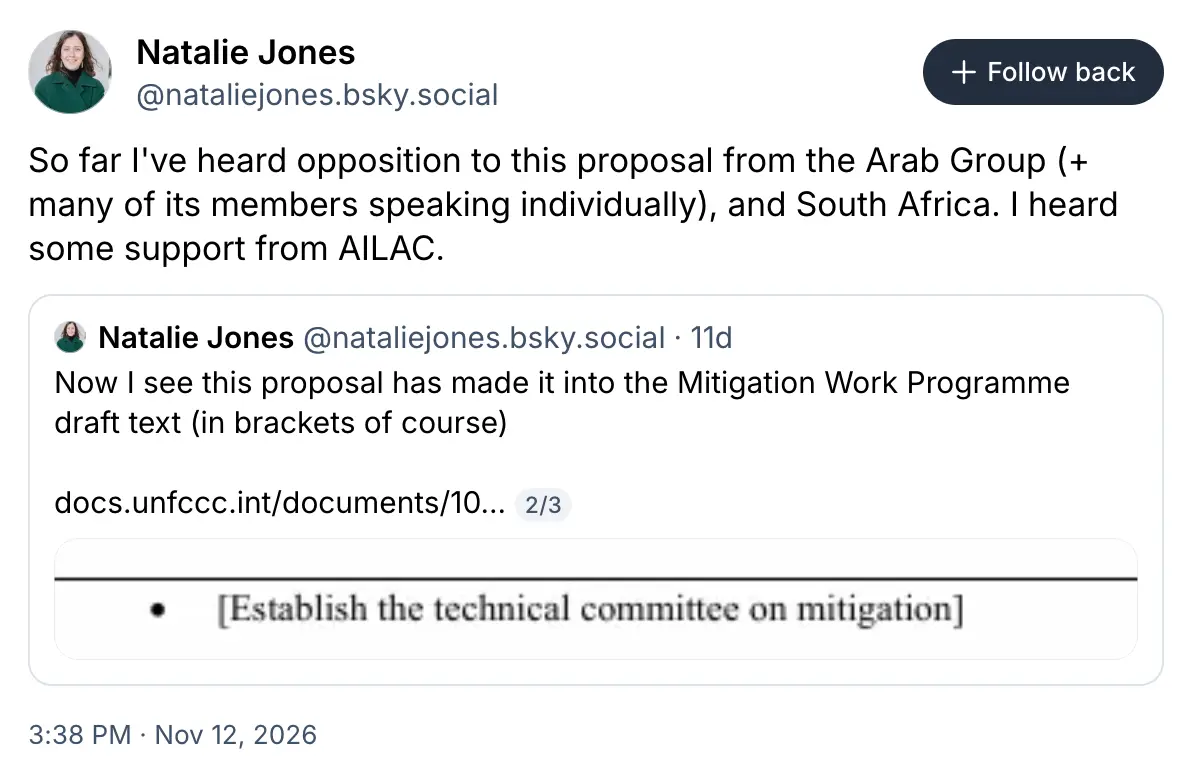
Speaking to Carbon Brief, Lola Vallejo, diplomacy and partnerships director at the European Climate Foundation (which funds Carbon Brief) and former co-chair of the MWP, said the proposal raised an “interesting question”.
She noted that, alongside the climate finance “work programme”, there is a standing committee focused on finance, but there has not been one proposed for mitigation previously.
Vallejo added that while finance discussions may not be “getting the political traction” many wanted at COP31, “at least there’s no shortage of spaces to discuss”, unlike mitigation, which solely has the work programme.
Observers told Carbon Brief that there was pushback against this proposed mitigation committee, on the basis that there is not a lack of institutions or bodies to tackle the issue, rather, there is a lack of finance and support.
Areas of divergence between parties included connection (or not) to the “global stocktake”, connection to NDCs or other collective goals, mentions of the IPCC and to what extent the “action agenda” can be brought in, according to Vallejo.
Various designs for the continuation of the MWP were proposed in subsequent negotiations, including multi-year work plans and introducing more “focused, solutions-oriented global dialogues” to facilitate implementation.
The extent of the disagreements was evident in a draft text published at the end of the first week of COP31, which contained 177 square brackets and 12 “options”.
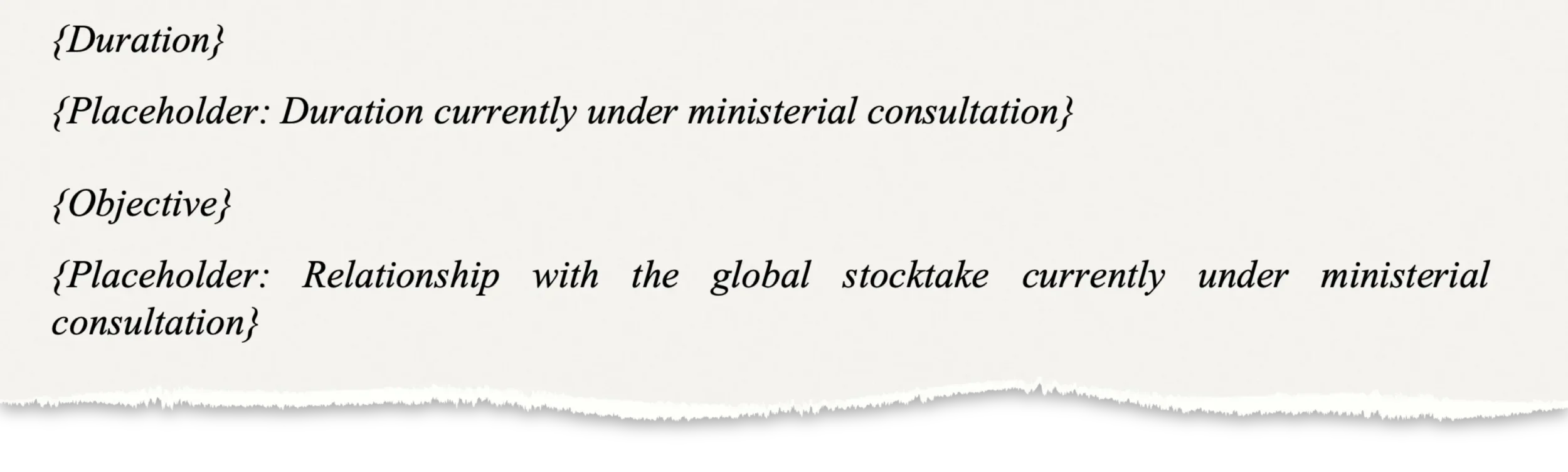
In the second week in Antalya, progress continued to stall in the MWP negotiations. A new draft text released on 18 November highlighted that the duration of the programme, links to the GST and the potential for a committee remained contentious.
While it was cut down from the previous iteration, this was, in part, because contentious issues had been replaced by placeholders without any content, as shown below.
Natalie Jones, senior policy advisor on energy at the International Institute for Sustainable Development, told Carbon Brief that some parties were pushing to weaken language around the MWP’s original mandate to “accelerate action in this critical decade”, as well as language linking the work programme to the global stocktake (GST). She said:
“Some parties want to limit what the GST can say on mitigation. Basically, they want to avoid another sort of transitioning away from fossil fuels (TAFF) situation at COP33 and avoid any more top-down or sectoral targets or whatever, and they fear that they could come out of the MWP into the stocktake.”
The next day, another draft text was published. This was close to agreement, with just two outstanding options: whether the MWP should take into account any “mitigation-related outcomes” of each stocktake when planning its activities or dialogues, or to have no text on the matter.
The draft text “decides” that one global dialogue will be held every year from 2028 under the MWP, leaving the door open for additional in-person or hybrid dialogues. Furthermore, it decides that the work programme will be extended until the end of 2030 and be renamed the “Sharm el-Sheikh-Antalya mitigation ambition and implementation work programme”.
Speaking to Carbon Brief, Fernanda de Carvalho, head of policy for climate and energy at WWF International, welcomed the continuation of the MWP as “better than nothing”, but said the process needed to be “significantly strengthened to deliver on its mandate”.
She added:
“The work plan will be negotiated by parties, which will be as difficult as everything negotiated here. The scope of topics and subtopics is too limited. A few parties keep pretending the link between this process and the GST doesn’t exist; they should just look at the decision that created the MWP.
“One potentially good thing is the investment-focused events happening at COPs. All big actors on this attend them, so there are chances they may finally result in the funded partnerships civil society has been calling for since the MWP started.”
Response measures
Talks on “response measures” were some of the least contentious at COP31, however, the final plenary still rejected a draft decision on the topic.
At UN climate talks, “response measures” is a forum for discussing the effects of carbon-cutting policies on countries. They are particularly relevant for nations where controls on emissions or deforestation pose a risk to communities and the economy.
In recent years, the forum has been where trade and climate issues have been discussed.
In 2024, COP29 in Baku established a four-year work plan on response measures, including the “cross-border impacts” of climate-change measures. This created a formal space to discuss and assess trade-related climate measures in UN climate talks.
COP30 in Belém established a two-day “global dialogue” on response measures each year from 2026-29. The first was in Bangkok from 21-22 September 2026, focusing on economic diversification and on how to manage impacts on vulnerable populations.
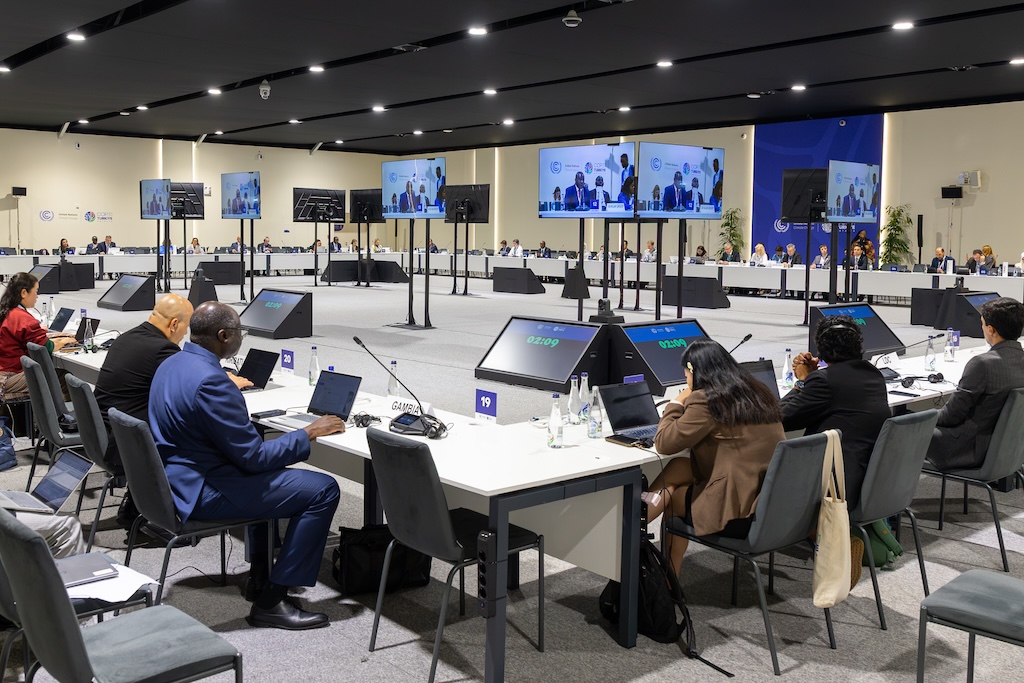
In Antalya, three key disputes emerged. The first was on what activities the forum would undertake in 2027 and, second, how it would consider recommendations from its Katowice Committee (KCI) of experts. The third was on whether – and how – response measures would inform the second “global stocktake”.
At the start of negotiations, countries – including the African group, AOSIS, South Korea and China – called for a wide range of activities next year. One of these included a new “cross-border” impact assessment of response measures.
On 16 November, the EU suggested removing an activity that refers to Article 3.5 of the 1992 UN climate convention, covering trade and an “open international economic system”.
Eventually, countries settled on four different activities. These include a workshop next June for the most affected countries to learn how to report these impacts, plus another workshop at COP32 on “technological solutions” to reduce climate impacts.
As work on the second global stocktake (GST2) gets underway, countries disagreed on how response measures would feed into it. As of 19 November, the same four options remained on the table, including one with “no text”.
One option, supported by G77 and China, “decide[d]” that all of the outputs of the forum – dialogues, workshops, technical reports and case studies – would serve as substantive inputs to GST2.
This option “urged” that the cross-border impact assessment be conducted “before and during” GST2, including metrics such as inflation, trade flows, household income, employment and debt.
Canada and the EU warned that this would change the global stocktake’s “well-established function”, reported Earth Negotiations Bulletin.
However, Switzerland, Norway, EU and the UK supported a compromise option – where countries could submit their views on the “social and economic impacts of response measures” as input to GST2.
Eventually, the option explicitly containing a cross-border impact assessment as an input to GST2 was deleted from the final draft.
Instead, the text “recognises” that inputs to GST2 are “non-exhaustive” and “affirms” that all the forum’s outputs will feed into the stocktake’s technical assessment. This includes work on cross-border impacts – including trade measures – and how to report and analyse them.
At the same time, it “invites” countries to submit their views on the “social and economic consequences” of response measures by 28 February 2027, which would also inform the stocktake.
During the final plenary, the EU told delegates it objected to the adoption of the decision on response measures, on the grounds that it “contains provisions that are highly problematic”, as well as “the lack of recognition of the best available science”.
This was supported by Canada and the UK, with the latter adding:
“We cannot accept any outcome that seeks to undermine and unduly influence the next global stocktake.”
Brazil and Saudi Arabia both expressed their disappointment with the rejection of the text.
Brazil said that the draft “excludes the voices of developing countries, the very countries that struggle to address the social and economic impacts of mitigation measures”. It asked for a formal note that the role and mandate of the forum were being “undermined”.
Action for climate empowerment
A draft decision on “action for climate empowerment” (ACE) had been set for adoption at COP31, but was unexpectedly torpedoed by Russia in the closing plenary.
This area of the negotiations aims to encourage people to engage in climate action in different ways – through education, training, public awareness and access to information.
COP27 had agreed to a four-year “action plan” on ACE that ends this year. COP31 was due to have agreed a new plan for 2027-2031, with some parties wanting it to address “misinformation and disinformation” related to climate change.
During the Antalya talks, Russia, along with Saudi Arabia and Paraguay, objected to including a reference to countering climate-related “misinformation and disinformation”, reported ENB. It added that Russia described this as amounting to the censorship of other scientific views.
Russia also made repeated efforts to replace previously agreed language on “gender-responsive” action with the phrase “gender-sensitive”.
A draft decision, proposed by the presidency on 21 November, “note[d] the need to enhance efforts to promote and support the integrity of information on climate change”.
The proposal also “recognise[d] the centrality of equity and the best available science for effective climate action and policymaking, as provided by the IPCC”.
It then set out an action plan for continued work from 2027-2031. Notably, while references to “misinformation” had been removed, it still talked of “ensuring that the public has access to reliable, accurate climate information and is equipped with adequate climate literacy skills”.
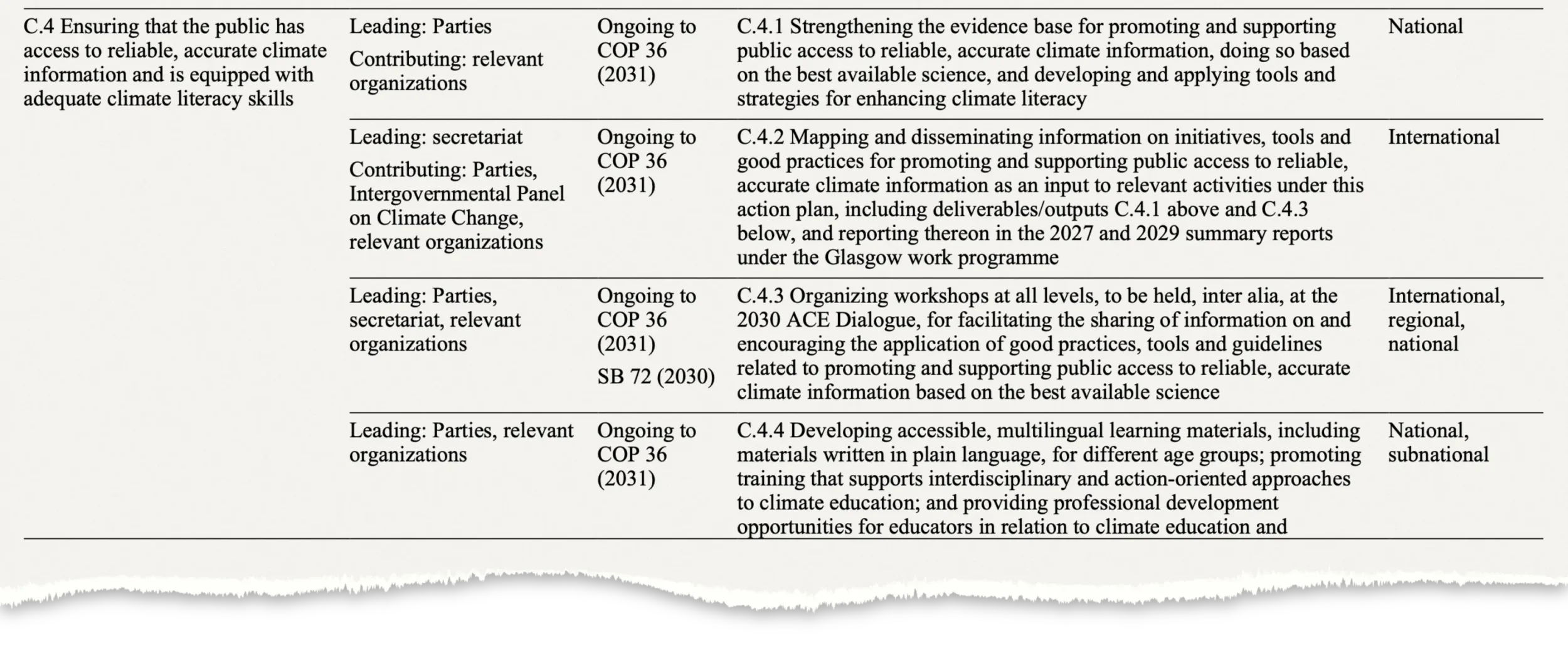
During the closing plenary, however, Russia said it “reject[ed]” the “censorship of science” and that it “objected” to the draft text on action for climate empowerment. It said discussions had been “held hostage by considerations which are not part of the climate process”.
The EU and the UK for the Umbrella group expressed their “surprise” at Russia’s objection. The UK said this topic was “very important for our group” and that “respect for gender equality and all identities is core to an effective, inclusive and meaningful process”.
The COP president told the plenary that, “in light of the objection from the Russian Federation”, the issue of action for climate for empowerment would be deferred until the Bonn talks in June 2027.
In a statement, campaign group Climate Action Against Disinformation said:
“The ACE action plan should have been a milestone for truth at COP31. Instead, the Russian federation – the epicentre of climate disinformation – blocked its adoption, standing alone against 193 other[s].”
Trade
After the creation of three annual “dialogues” on trade within the COP30 Belém “global mutirão” decision, the topic was not expected to feature on the official agenda, even if it was likely to come up in other negotiating tracks.
But, in the end, the rejection of not only the cover decision, but also agreements on “response measures” and agriculture, meant that trade was entirely missing from the COP31 outcome. (See: Response measures and Agriculture.)
(A request from the African group to add trade to the COP31 agenda was also rejected.)
Trade and climate featured strongly in the first “reflections” text on a cover decision, which was a compilation of suggestions from parties.
Paragraph 119 of the first draft “call[ed] on” developed countries to “phase out unilateral…trade-restrictive measures” by the end of 2027. Commonly cited examples of what this might refer to include the EU’s carbon border adjustment mechanism and deforestation law. (See: Agriculture and food security.)
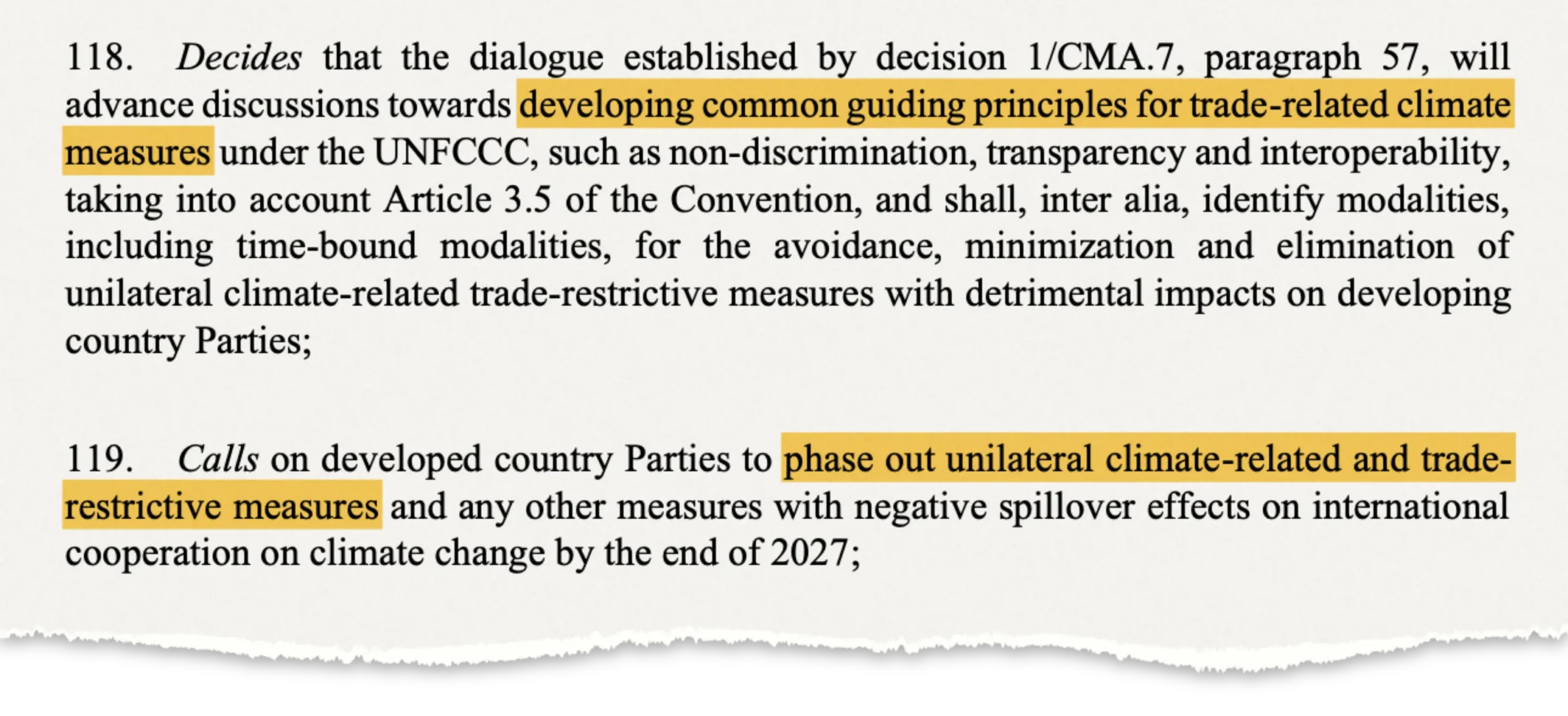
The phase-out call was, expectedly, cut from the second iteration of the cover text.
Speaking to Carbon Brief, global policy advisor at Greenpeace East Asia Yao Zhe said:
“No one thought it would survive, probably even the ones [who] proposed it. But I see it as an indication that [countries] are persistent in pushing the trade angle.”
Yao added that she expected China, with the African group, to “aim for higher” on trade at next year’s COP32 summit.
In the end, with the “Antalya pact” failing, none of the references to trade survived the conference.
In the closing plenary, Russia, Venezuela, Brazil, Iran, Kenya – with the Arab and African groups – lamented how the issue of trade was treated in the talks, with Saudi Arabia saying developing countries were told “this is a matter that is completely off the table”.
Russia’s representative remarked that “climate policy should not turn into trade policy by other means”, calling customs tariffs on “green” supply chains “old colonial distribution of labour under a new green banner.”
Ghana and Kenya both flagged the lack of “firm treatment” of trade measures and hinted that it would be a priority for them at COP32. Kenya’s delegate said:
“Unilateral trade measures are only noted. African economies bear their costs, while the decision merely notes their views.”
Second global stocktake
Against a backdrop of fraught negotiations, the second “global stocktake” (GST) was launched at a high-level event in the middle of the second week of COP31.
The GST is the Paris Agreement’s five-yearly “reality check”, measuring whether the world’s collective efforts are enough to sufficiently cut emissions and prepare for climate impacts.
The first stocktake culminated in Dubai at COP28 in 2023, resulting in the first-ever global commitment to “transition away from fossil fuels”, among various other pledges.
GST2 will run until 2028, meaning COP33 will have to address the likely shortfall between the Paris Agreement’s goals and reality.
An important question hanging over this process is whether parties will have access to the latest IPCC science in time for the second GST, as a small group of countries push for the next IPCC report to be published after the stocktake. (See: Cover text.)
COP31 also featured a “dialogue” on how the lessons of the first GST could inform countries’ future NDCs.
Parties such as the EU and climate-vulnerable nations argued for a more substantial outcome that included guidance for the second GST and references to the 1.5C target. This was opposed by many developing countries.
In the end, parties decided on a procedural outcome without any of the more ambitious language that had appeared in previous drafts.
Long-term goal review
COP31 was unable to agree on whether to start a third “periodic review” of the UN climate convention’s long-term goal and progress towards meeting it.
The goal of the 1992 convention is to avoid “dangerous” climate change, a target that was defined at COP16 in 2010 as a warming limit of 2C.
COP16 also said that this goal – and progress towards meeting it – should be subject to “periodic review”. The first review, in 2013-2015, helped secure the Paris 1.5C limit.
At the start of the second review at COP25, some parties disputed the need for the process, given the existence of five-yearly “global stocktakes” of progress under the Paris Agreement.
Underlying this disagreement is the fact that the convention has distinct country requirements for developed and developing parties, whereas the Paris regime does not.
Discussions on a third review stalled at COP29 and continued at COP30. Some developed countries said it was “redundant”, while developing countries wanted it to continue.
In Antalya, countries were split over whether to begin a third periodic review, whether to delay it until publication of the next IPCC report, or whether to discontinue the process.
The final COP31 text “notes the consideration” of the matter and decides to continue talking at COP32 next year.
At the first closing plenary, China, along with India for the LMDCs and Saudi Arabia for the Arab group, expressed their “concern” over the lack of agreement. China said:
“We are seriously concerned that some developed country parties…in the name of streamlined process…substantively tried to terminate this mechanism.”
For AOSIS, Palau “regret[ted]” the lack of progress on what it said was the “only dedicated space to reflect on the 1.5C limit on the basis of substantive scientific input”.
Guidance on NDCs
COP31 was unable to agree on further guidance for countries when preparing their climate pledges under the Paris Agreement, known as nationally determined contributions (NDCs).
This issue has been disputed in the past, with talks also failing at COP29 in Baku two years ago. In Antalya, parties were once again split over whether to issue further guidance
Developed and vulnerable countries – including the EU and small island states – want more guidance, to prompt stronger implementation and more transparent pledges.
The LMDCs, the Arab group and African group, prefer to avoid what they see as prescriptive further guidance that could impinge on the “nationally determined” nature of the documents.
The negotiations were subject to “rule 16”, meaning they ended without agreement and will resume at the next session of the talks in Bonn next June.
Rio synergies
To the dismay of many countries, negotiations on the need for “synergies” between the three Rio conventions of climate change, biodiversity loss and land desertification ended with the adoption of just a one-line text.
The text simply states that, during negotiations under this item – known as “cooperation with other international organisations” – there was an “exchanges of views” and an agreement to “continue consideration at the next session”.

On 10 November – the second day of COP – ENB reported that Russia, supported by the Arab group, “opposed continuing the discussion” on Rio synergies.
Speaking on the behalf of 14 small island developing states in plenary on 14 November, Fiji said it was “deeply disappointed” by the outcome. It told delegates:
“We came to Antalya ready to advance cooperation across Rio conventions and to foster synergies in national implementation. That is what all parties agreed to do when we left Bonn. We did not do that. Not because the issues were too difficult, but because we were never permitted to discuss them in the way we intended to do so.
“At the very first informal consultation, before a single substantive proposal had been heard, the intention to invoke ‘rule 16’ was announced by one group of party. We offered repeatedly to address any and all concerns. That offer was not taken up. Substantive discussion was blocked from the very first hour to the last.”
The EIG, Panama for AILAC, the UK for the Umbrella group and the EU all expressed similar disappointment.
Around the COP
Fossil fuels
The issue of “transitioning away from fossil fuels” dominated again at COP31, with countries leaving the talks still deeply divided on how it should be taken forward.
Including “transitioning away from fossil fuels” in the cover decision was one of the key asks of a group of 126 countries spanning Europe, the small island states, parts of Latin America and the Caribbean and other major developed countries.
In the end, several countries rejected the proposed cover decision over its lack of a clear reference to fossil fuels, with the EU saying:
“We will not endorse a cover decision or an Antalya pact that does not even mention fossil fuels, which is the key driver of climate change.”
Fossil fuels also featured prominently on the sidelines at COP, with more than 80 side events and talks dedicated to the topic, Carbon Brief understands.
In addition, eight European and small island nations announced intentions to release national roadmaps away from fossil fuels – bringing the total number with such plans up to 27.
The first major event on fossil fuels took place on the summit’s second day, when the Brazilian COP30 presidency formally presented its global fossil-fuel roadmap to a packed-out plenary room.
Hi, I’m Daisy Dunne, one of Carbon Brief’s associate editors. I’m reporting from a plenary session at COP31 in Turkey, where the Brazilian COP30 presidency has just officially presented its global roadmap for transitioning away from fossil fuels. COP30 president…
 Daisy Dunne
Fossil-fuel roadmap presented at COP31

(The COP30 presidency agreed to bring forward a voluntary roadmap after countries failed to agree to one by consensus at the Belém summit last year.)
In Antalya, COP30 president André Corrêa do Lago told delegates that the roadmap is “not a mandate” and “not related to the negotiations”.
Instead, he said, “it’s contribution and input for the implementation that we need to do”.
The session featured key figures, including UN secretary general António Guterres, UN climate chief Simon Stiell, COP26 president Alok Sharma and former US climate envoy John Kerry. However, COP31 presidents Kurum and Bowen were conspicuously absent.
The next day, during his speech at the world leaders’ summit, Brazilian president Luiz Inácio Lula da Silva called on Turkey and Australia to “ensure that the recommendations contained in [the roadmaps] are disseminated and incorporated into the next global stocktake”.
On Friday morning, the presidency released a “reflections” text from its consultations with countries on what they would like to see in a cover decision.
This included a bullet point saying some parties would like to see “transition away from fossil fuels in energy systems” included in the text. (This language was first agreed by countries as part of the first global stocktake at COP28 in Dubai in 2023.)
On the same day, Irene Vélez Torres, Colombia’s former environment minister, told journalists that a mere repetition of language agreed in Dubai would not represent progress for many parties.
Vélez Torres co-led a first-of-its-kind conference on transitioning away from fossil fuels in Santa Marta in April this year, which was attended by 57 countries.
She told the huddle that, regardless of what is agreed by consensus on fossil fuels at COP31, countries committed to transitioning away would continue to take action, saying:
“Consensus as a method is not going to stop us anymore…we know it has limited ambition. It is limiting implementation, but this is not going to stop us.”
On Monday 16 November, the presidency dropped an 18-page first draft of its proposed cover decision – along with a short “presidency note” explaining that all elements were still in play, including whether or not they should appear in a final text.
One part of this draft “call[ed] for accelerated action to phase out fossil fuels, including through the immediate transition away from fossil fuels in energy systems”.
Another part of the text also “welcome[d]” the Brazil-led global roadmaps on the transition away from fossil fuels and on ending deforestation.
The next day, a group of European and small island state ministers held a press conference on the need to transition away from fossil fuels.
Denmark, Spain, Portugal and Luxembourg announced that they intend to release new national roadmaps away from fossil fuels.
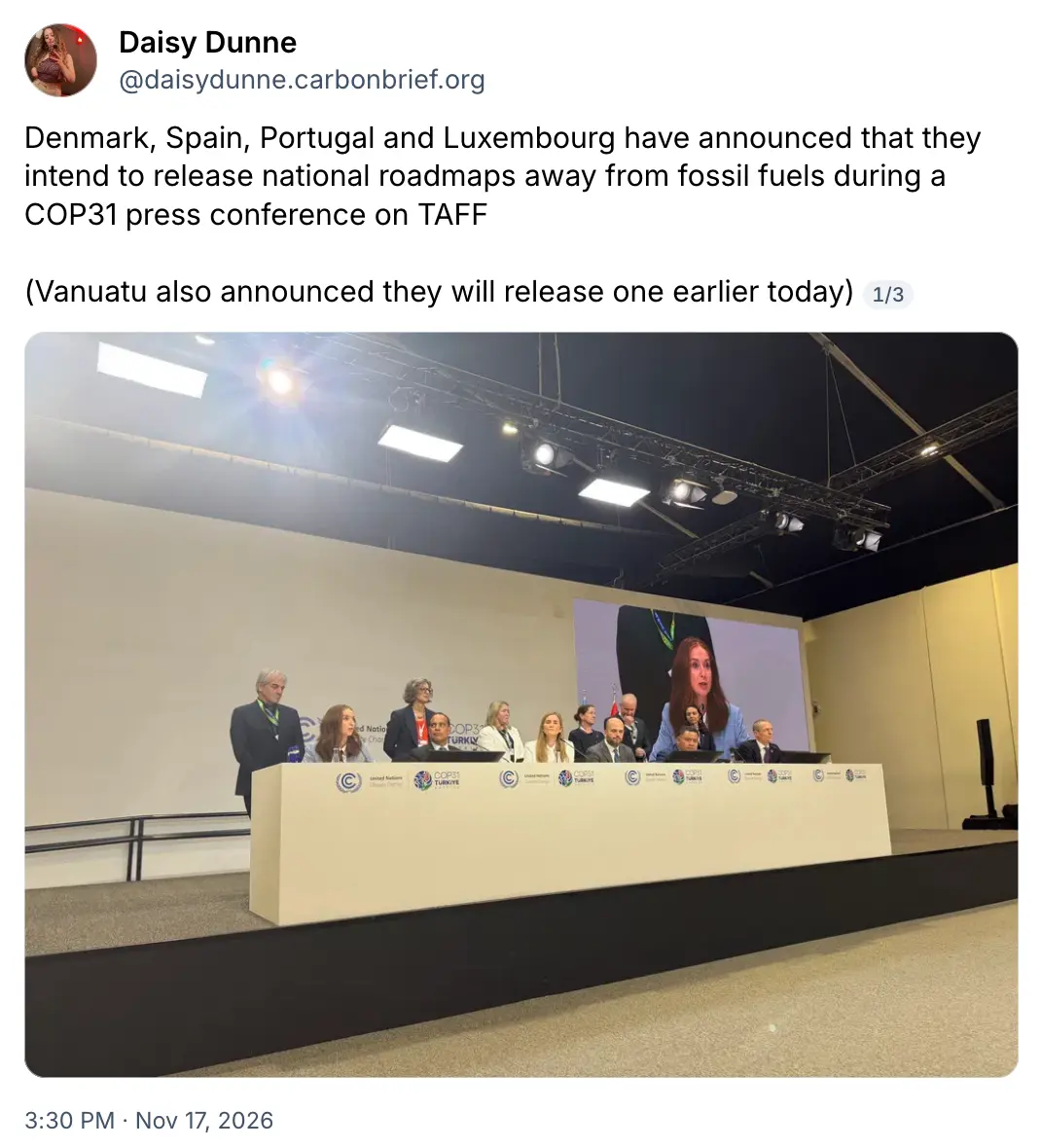
(Earlier that day, Vanuatu had announced its own national roadmap and the development of a Pacific regional roadmap away from fossil fuels.)
Speaking as a united front, the group of ministers called for the language on fossil fuels contained within the first draft to be strengthened and given more prominence.
However, Carbon Brief understands that, behind-the-scenes, hopes that any kind of fossil-fuel language would survive into the second draft cover decision were fast evaporating.
On 18 November, a group of global-south ministers held a press conference, attended by Carbon Brief, to show their support for transitioning away from fossil fuels.
At the event, Saint Vincent and the Grenadines and Guatemala announced that they were joining the fossil fuel treaty, an initiative to develop a legal instrument to control fossil fuels. This brought the total number of countries supporting the treaty up to 30.
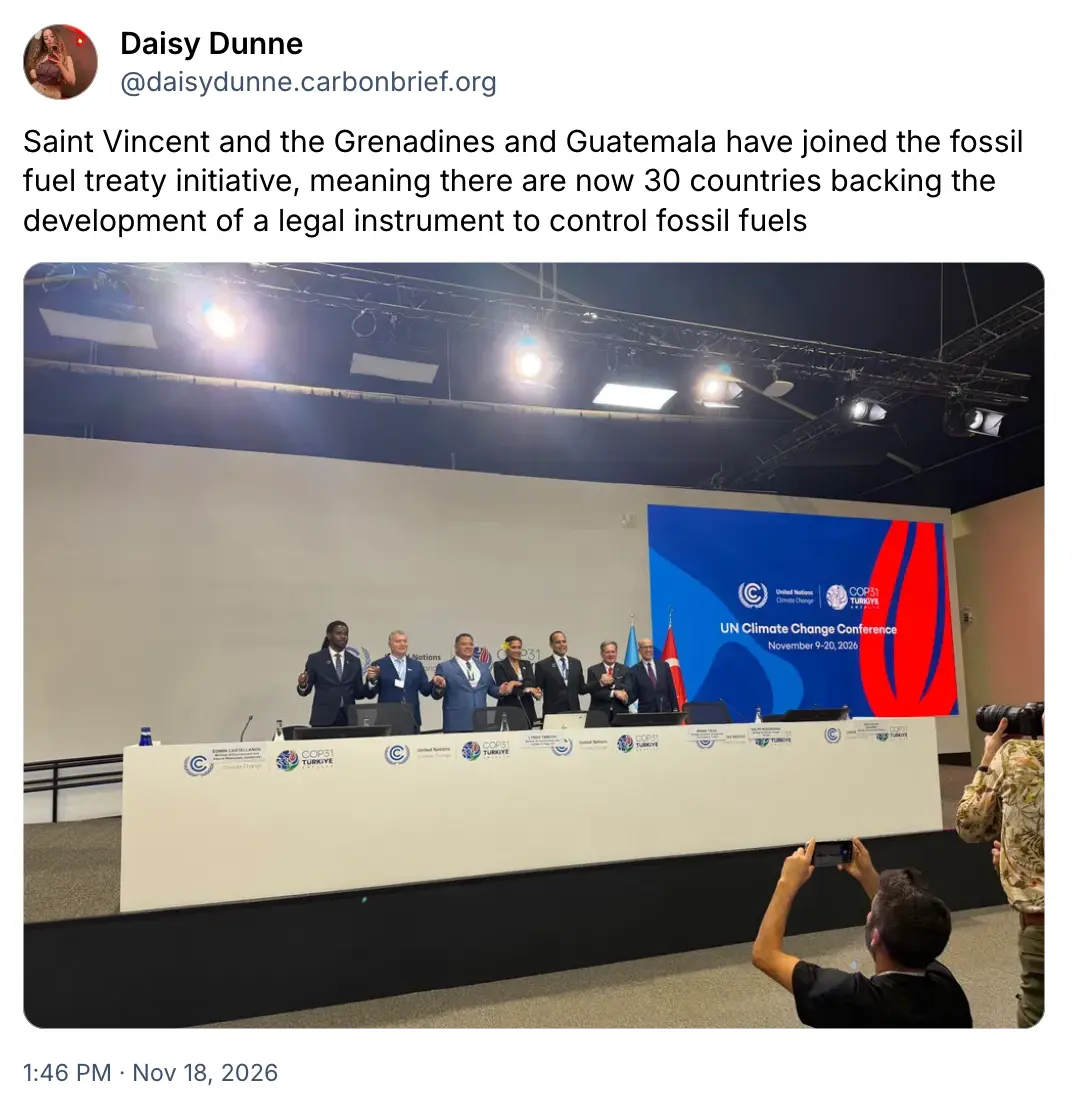
During the press conference, Panama environment minister Juan Carlos Navarro made headlines with an explosive speech, telling journalists that the world is “being held hostage by the petroleum mafia”.
The next day, the co-hosts of the second transitioning away from fossil fuels conference – Tuvalu and Ireland – held a press conference.
They confirmed that a pre-conference on transitioning away from fossil fuels would be held in Dublin in May, with the actual conference taking place in Tuvalu in July.
Speaking at the press conference, Tuvalu climate minister Maina Talia publicly acknowledged he was not expecting to see transitioning away from fossil fuels in the second draft of the cover decision.
The co-hosts also confirmed that a third transitioning away from fossil fuels conference will be held in 2028. (Lula told civil society at COP that Brazil was keen to host it. Carbon Brief understands Cambodia and Ghana are also interested.)
Later that day, a second draft cover decision was published. It did not mention “fossil fuels” at all, nor “paragraph 28 of decision 1/CMA.5”, the passage of text from the first global stocktake that calls for countries to contribute to “transitioning away from fossil fuels”.
In the evening, Kurum and Bowen held a press conference to defend their second draft and tried to bat away questions from journalists about whether the removal of fossil-fuel language represented “backsliding”.
Both presidents cited their push to get countries to sign up to electrification as complementary to transitioning away from fossil fuels, with Bowen telling journalists:
“The world agreed at COP28 to transition away from fossil fuels. What we’re about is practical ways to do that. There’s no better way than electrification.”
However, it was widely understood that many countries were not happy with the omission of fossil fuels.
Ministers and envoys from 23 countries – as counted by Carbon Brief – have just held a press conference at COP31 to call for “transitioning away from fossil fuels” to be re-added to the summit’s negotiated cover decision. The group…
Daisy Dunne
23 countries call for COP31 cover text to include ‘transition away from fossil fuels’
The following morning, 23 countries held a press conference calling for transitioning away from fossil fuels to be re-added to the text.
The group was fronted by Netherlands climate minister Stientje van Veldhoven, who said she represented the views of Germany, France, Denmark, Panama, Brazil, Luxembourg, Ireland, the UK, Sweden, Indonesia, Iceland, Finland, Marshall Islands, Tuvalu, Vanuatu, Portugal, Norway, Fiji and Spain. Guatemala, Belgium and Switzerland were also on the stage.
As talks ran into overtime on Saturday, any kind of official update on the state of the text failed to materialise.
Tuvalu’s Talia told a cramped press huddle that Pacific island nations had been waiting for the text since last night and were still willing to fight to get transitioning away from fossil fuels back in.
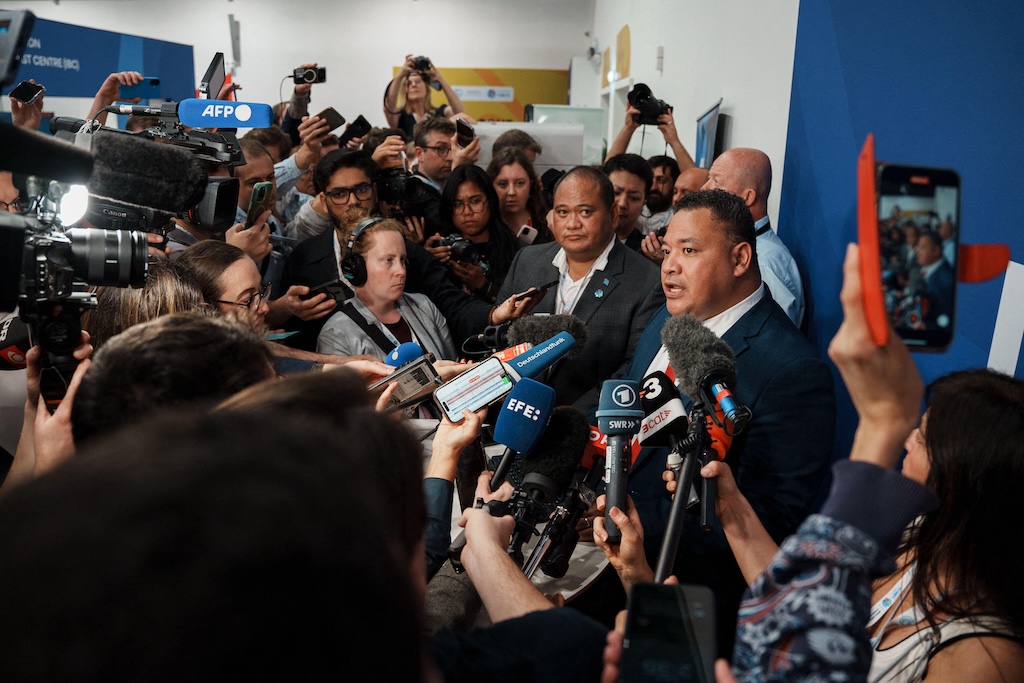
On Saturday evening, the fallout over fossil fuels intensified.
Carbon Brief understands that 126 countries – made up of the EU, UG, AOSIS, AILAC and LDCs – approached the presidency as a united front to demand that transitioning away from fossil fuels featured in the final cover decision.
One observer told Carbon Brief that such close cooperation between the EU and AOSIS is “unprecedented” at COP.
They added that it might reflect the fact that Ireland, which currently holds the EU presidency, is working closely with Tuvalu on holding the second transitioning away from fossil fuels conference next year.
A new draft cover decision did not arrive until the early hours of Sunday morning.
This one also did not directly mention fossil fuels. However, it did “recall” the COP28 UAE consensus “in its entirety”, which itself includes a reference to a “just, orderly and equitable” transition away from fossil fuels.
Carbon Brief contributing editor Dr Joanna Depledge wrote on LinkedIn that this oblique reference was “near meaningless”.
In a fiery final plenary session on Sunday afternoon, many countries rejected the text – citing its failure to clearly reference transitioning away from fossil fuels as one of the key reasons. (See: Cover decision.)
Action agenda
Many issues that were intensely negotiated at COP31 – including the electrification goal and fossil-fuel phaseout – also featured in the “action agenda”.
This is the part of the UN climate process that involves mobilising real-world climate action from non-state actors, including businesses, investors and civil-society groups.
It also covers voluntary actions taken by groups of countries beyond the COP negotiations.
When the “Antalya pact” failed to materialise, the presidency’s action agenda package was one of its more substantial outputs.
In this closing remarks at COP31, after the headline negotiated outcome had collapsed, UNFCCC executive secretary Simon Stiell reminded delegates:
“This COP process has two tracks. And across the action agenda, COP31 has delivered real progress and concrete results.”
With Australia overseeing negotiations, the action agenda was instead a priority for the Turkish presidency, which used COP31 to launch a variety of new projects and “compacts”.
In a phrase familiar to attendees of previous COPs, Turkish COP31 president Murat Kurum said he wanted an “implementation COP” that would leave people saying: “Something changed in Antalya.”
Amid global conflict, struggling multilateralism and the imminent breaching of the 1.5C Paris Agreement goal, UN climate talks have repeatedly failed to reach consensus on vital issues.
Some have, therefore, welcomed what the Brazilian COP30 presidency called “two-tier multilateralism”, in which parties try to find consensus where they can and, where they cannot, coalitions of willing nations and groups push more ambitious action forward.
Kaveh Guilanpour, vice president for international strategies at the Center for Climate and Energy Solutions (C2ES), told Carbon Brief:
“There’s a lot of inertia in the formal way of negotiating and we’re trying to find our way to whatever that new thing is, given the foundational era of negotiations is over.”
Last year, the Brazilian presidency consolidated hundreds of existing climate initiatives – including many launched at previous COPs – into a streamlined set that could be supported and tracked under the action agenda.
This included setting out more than 120 “plans to accelerate solutions”, to advance everything from phasing out coal to ending food waste. Tracking by UN Climate Change found that 104 of these plans had seen progress over the past year.
By the end of COP31, the total number of plans had increased to 136, with new ones filling “important gaps”, such as early warning systems.
Crucially, the plans were structured to align with the global stocktake outcomes from COP28 – such as curbing fossil fuels and tripling renewables – which all nations agreed on.
In this way, the revised action agenda is intended to explicitly support negotiated outcomes.
Turkey announced 10 “priority themes” for the COP31 action agenda, fitting them into the existing framework. By far the most high profile was the “electrification” focus. (See: Electrification.)
A book distributed at the summit by the Turkish presidency stated that a “large number of events, declarations and partnerships does not by itself constitute implementation success”.
Nevertheless, the presidency did launch many new initiatives, including six voluntary 2035 targets that countries and non-state actors could sign up for.
These included “compacts” to curb the “energy intensity” of buildings by 25% and increase the use of “circular materials” in manufacturing to at least 15% by 2035. These initiatives attracted dozens of backers, but gained far less support than the electrification goal.
Other notable initiatives pushed by the Turkish presidency include a domestic pledge for “zero waste districts” and an “Antalya artificial intelligence (AI) pledge”, which focused on curbing data-centre emissions while advancing “AI solutions for climate action”.
COP31 also saw progress on two initiatives launched by COP30’s “global mutirão” decision that are relevant for the growth of the action agenda. The first was the “Belém mission to 1.5”, which identified key priority areas for countries to meet their climate goals.
The second was the “global implementation accelerator”, which was formally established at COP31. This involves presidencies and experts choosing two action-agenda plans each year that are best placed to drive “positive tipping points” for climate action.
Cosima Cassel, E3G climate diplomacy lead, told Carbon Brief that this focus, “based on science, not just on the presidency’s priorities…is an extra step in the evolution of the action agenda”.
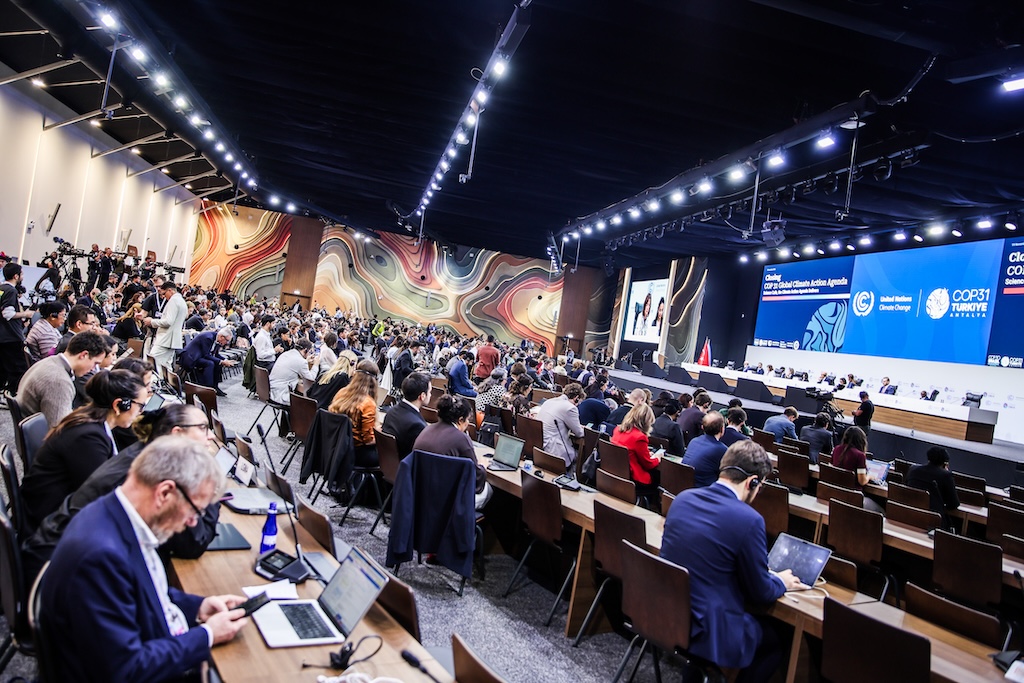
During a COP31 session on the “accelerator”, COP30 strategy director Túlio Andrade said the Brazilian team wanted it to advance the transition “from a negotiation-focused regime to one very much focused on implementation”.
The Turkish presidency also announced a new project called the “climate implementation bridge”, while pledging an initial $3m to support its operations.
In partnership with the UN Development Programme, the bridge’s goal is to turn nations’ climate plans into “bankable projects” and connect them with finance.
Together, the “mission”, “accelerator” and “bridge” form part of a wider “ecosystem” that supporters hope will identify and support priority areas of climate action.
However, the growing profile of the action agenda has resulted in pushback, with India and the Arab group arguing against any mention of it in formal negotiations. In contrast, Brazil accused the presidency of failing to significantly acknowledge these “concrete instruments and initiatives” in the proposed “Antalya pact”.
Some parties and observers are concerned that the action agenda is a diversion from parties’ obligations under UN climate treaties, such as providing climate finance.
Arguing that the focus should instead be on reforming the COP process, Vanuatu climate minister Ralph Regenvanu told Carbon Brief:
“Unfortunately, the action agenda has not necessarily led to action. It is indicative, again, that the COP process is broken. While people innovating and coming together to take action is good, it cannot take the place of negotiations.”
Developing countries, which often have far fewer delegates, also struggle to follow all the additional activities. In a closing session, Stiell invited parties to nominate focal points so that the UN could help to “connect them with action agenda opportunities all year round”.
Guilanpour noted that while “everybody says they want to focus on implementation”, within the traditional COP process this can only apply to “a very rarefied subset of obligations”, such as submitting revised NDCs. He added:
“When the rest of the world hears implementation, they want to see pollution in their city going down, their energy bills going down…and that sort of implementation is in the action agenda.”
Global leaders
COP31’s world leaders’ summit took place during the conference’s first week from 11-12 November.
Brazilian president Luiz Inácio Lula da Silva – whose recent re-election was widely interpreted as a timely boost for climate action and multilateralism by delegates – gave a blistering speech in the summit’s opening ceremony. He told other world leaders:
“We have started talking more about weapons and tariffs than about the survival of future generations…But the planet cannot be left at the mercy of hegemonic disputes.”
He told leaders that he wanted COP30, which took place last year in the Brazilian city of Belém, to be remembered as the “COP of truth” – but that “science and multilateralism remain under attack”, adding:
“It is not by chance that the incorporation of IPCC contributions into the COP negotiation process is in question. Nor is it a coincidence that climate agreements are the favourite targets of reactionary forces at COPs.”
He also touted Brazil’s newly released global roadmaps on fossil fuels and deforestation, urging COP31 co-hosts Turkey and Australia to “ensure that the recommendations contained in these documents are disseminated and incorporated into the next global stocktake”.
In one of his final addresses in the role, UN secretary general António Guterres said that the “brutal truth is that the climate crisis is outrunning us”, adding:
“Leaders – and, in particular, those from developed countries – cannot keep expanding fossil-fuel production while claiming to be committed to 1.5C.”
Turkish leader Recep Tayyip Erdoğan used his address to call on developed countries to “take greater responsibility for emission reductions and financing” and to call out “ecocide” in Gaza.
(Erdoğan faced criticism for announcing the discovery of two new oil fields in Turkey on the eve of the summit.)
Barbados prime minister Mia Mottley cited Carbon Brief analysis to reprimand developed countries in her address to the world leaders’ summit, telling the room:
”My friends, let us be clear: pledges are not payments. But even the promised pledges are now 70% below previous levels.”
UK prime minister Andy Burnham, the only G7 leader to attend the summit, said that electrification is “how we make clean power cheap power”. He also announced the appointment of the country’s first special representative on climate security.
In total, around 70 world leaders spoke at the summit – with many major polluters missing.
For the second year, the US did not send any delegates to COP. (Donald Trump took the US out of the Paris Agreement and the UN climate treaty after returning to office.)
However, success for Democrats in the US midterm elections, shortly before COP31, lifted hopes that the world’s second-largest emitter could one day return to the talks.
“America is all in” – a coalition of mostly Democratic governors, Congress members and local mayors – had a pavilion at COP31 and brought around 120 delegates (a figure larger than many official country delegations).
Speaking on 16 November at a pavilion event attended by Carbon Brief, Jared Huffman, a Democratic Congressional representative from California, said that the midterm results were a “clear rejection” of Trump’s “climate denial” and “wrecking ball to climate and energy policy”. He added:
“The next time that we are here at a COP, it will be different…We will be an official Congressional delegation led by the leadership of the House of Representatives. And soon after that, this yellow part of our lanyard that says ‘observer’ will change and the US will truly be officially back in as part of the negotiati[ons].”
Other countries without delegations at the talks included Myanmar and Israel, according to Carbon Brief analysis.
Electrification
Amid a global energy crisis driven by disruption in the trade of fossil fuels, one of the biggest themes of COP31 was electrification.
Much attention was focused on which nations had signed up to a voluntary pledge to “increase the share of electricity in final energy consumption to 35% by 2035”.
For much of COP31, this was expected to be one of the main outcomes in the “Antalya pact” cover text, which ultimately failed to find agreement among parties. (See: Cover decision.)
Nevertheless, some countries made public pledges of support for the target during the COP, including in a joint China-Australia statement.
COP31 president Murat Kurum told the closing plenary that “around 80” countries were behind the goal, but a full list was never published.
The pledge was launched earlier in the year as a “flagship initiative of the COP31 presidency’s action agenda” – part of its wider goal to “electrify the world”. (See: Action agenda.)
As explained on CB Connect, it drew from analysis by the International Renewable Energy Agency (IRENA), which was explicitly designed to align with the 1.5C target and support the Brazilian COP30 presidency’s “roadmap” for transitioning away from fossil fuels.
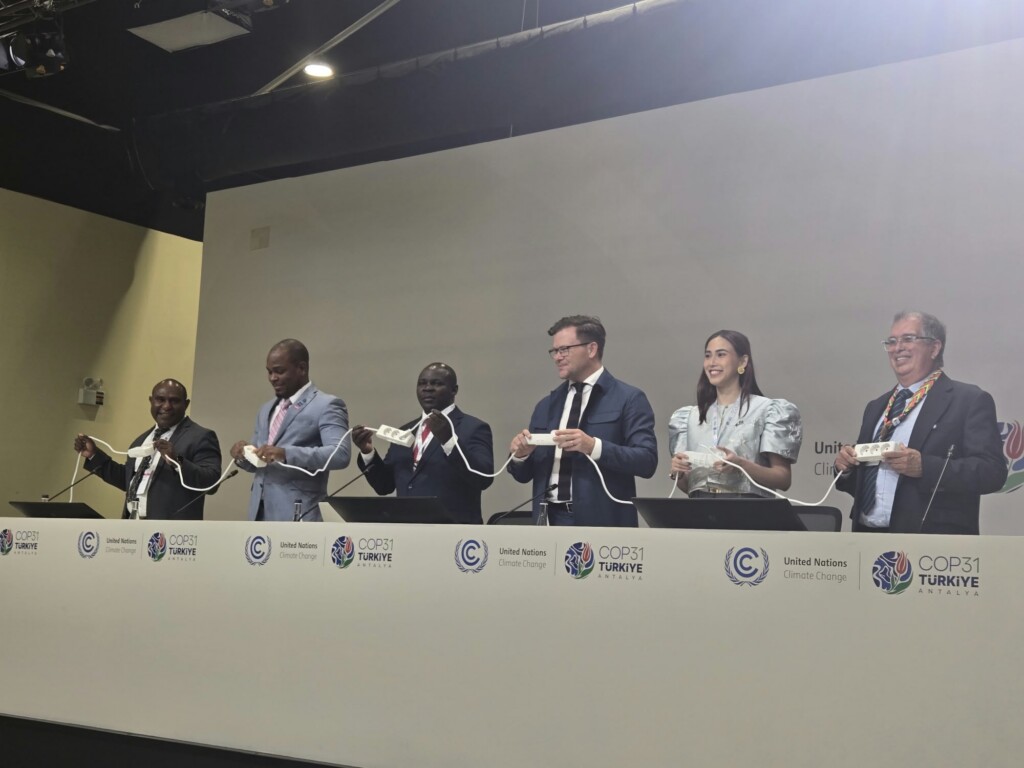
Towards the end of COP31, the presidency launched its “electrification delivery package”, capturing 14 newly announced international initiatives and other relevant projects.
Among them were an industry-backed “maritime electrification goal” to increase electricity’s share of shipping’s final energy demand to 20% by 2035, as well as projects to boost grid investment, renewables in small-island states and transitions away from coal.
One notable initiative was the Electrify Now Finance Coalition – launched with the backing of the COP31 and COP32 presidencies – to “mobilise over $1.2bn for clean electrification projects” in developing countries.
At a coalition launch event, featuring ministers from Ethiopia, Germany, Pakistan and several other nations, Bruce Douglas, chief executive of the Global Renewables Alliance, told attendees that at least 25 nations had already put in place policies to drive electrification since the start of the “Hormuz crisis”. He said:
“We now have the formula for success: renewable energy plus electrification equals secure, affordable and clean energy for all consumers.”
China at COP31
Closing COP31 with a signal of “solidarity and multilateralism” was “more important than specific problems”, said China at the opening plenary of the summit.
Its climate officials said repeatedly that not every COP required a “new outcome” and noted the need to “manage expectations”.
These comments seemed prescient when negotiations broke down at the end of COP31 over the cover decision.
China had outlined its key aims for COP31 in a press conference held by Li Gao, vice-minister of ecology and environment and delegation head, in late October.
These were primarily to commit developed countries to do more on mitigation and finance, as well as to address “unilateralism and protectionism” in the trade of clean-energy technologies.
But Li also “commend[ed]” the presidency’s call for countries to pledge to achieve a 35% share of electricity in global final energy consumption by 2035.
One of the biggest questions hovering over the COP was whether China would officially support the pledge, which was incorporated into the failed cover text.
While observers had told Carbon Brief from early in the negotiations that it would be very likely that China would support the pledge in some form, the strongest signal came from a joint statement published with Australia in the second week.
In it, the two countries “welcome[d] growing international ambition and cooperation on electrification…on a voluntary basis”, mentioning the 35 by 35 goal, as well as recognising various climate, social and economic benefits from the transition. (See: Electrification.)
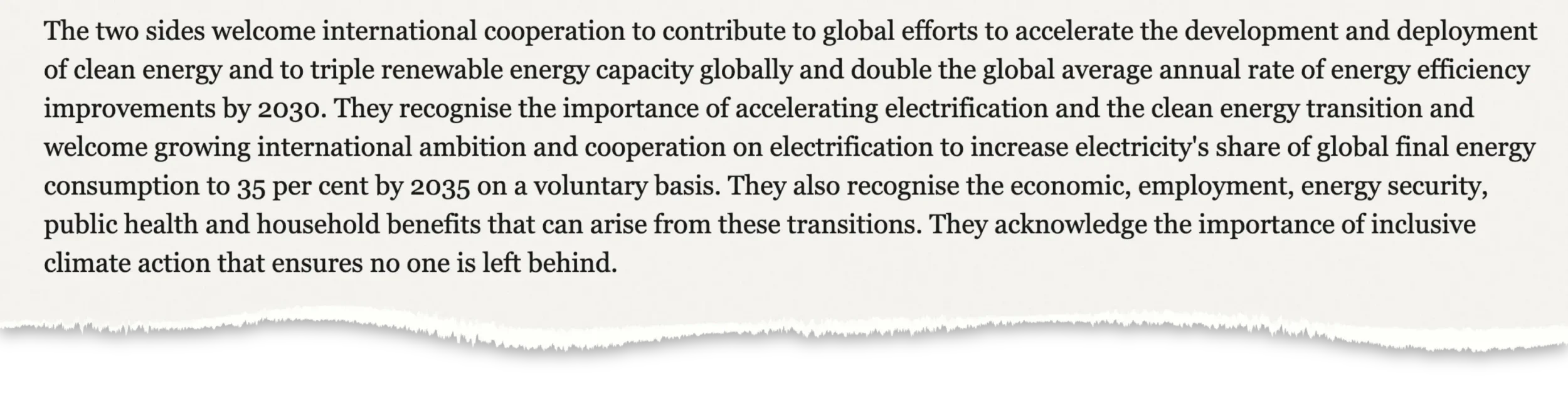
The cover text had similarly sought to “recognise that electrification has significant benefits in terms of emission reductions, energy security, energy efficiency, economic development and energy access”.
The joint statement, however, did not explicitly mention fossil fuels, rather it noted “countries have different transition pathways” and the “importance of secure, affordable, reliable and resilient energy systems during the transition”.
Li Shuo, director of the China Climate Hub at the Asia Society Policy Institute (ASPI), told Carbon Brief that the “carefully curated” language helped “firm up” support for the electrification pledge – and broader language around energy – in the final draft.
China had published a joint climate statement with the EU ahead of COP30, as well as ones with the US ahead of COPs including COP21, COP26 and COP28.
But, unlike these agreements, the Australia-China joint statement “mostly confirms existing relatively unambitious negotiation points and does not advance ambitions” on issues including fossil fuels and decarbonising trade, argued Prof Christoph Nedopil Wang at the University of Queensland.
He told Carbon Brief: “Symbolically, it would have been more meaningful to sign a more ambitious statement before COP negotiations began.”
As talks broke down at the closing plenary, China endorsed the cover text’s final draft, noting that, although it has “some concerns about the content”, it chose to accept the decision to “push forward our process and show a message of unity and collective efforts”.
On 23 November, China’s foreign ministry issued a statement saying:
“We express our disappointment regarding this outcome, but believe that confidence in the multilateral process should not be lost as a result.”
“China was not the main blocker for the text”, said ASPI’s Li.
He added that, in his view, even if language around transitioning away from fossil fuels had been made stronger, China would have found it acceptable.
China also tried to preserve the mitigation work programme (MWP) at the closing plenary. (See: Mitigation work programme.)
In negotiations, China joined other developing countries in supporting the work programme’s extension through to 2030.
Speaking on behalf of the LMDCs, China emphasised the value of the MWP, but said it needed to “focus on how to eliminate barriers of implementation”, according to Third World Network.
These included developed countries’ lack of mitigation action and financial support, as well as unilateral trade measures, it added.
China, on behalf of the LMDCs, tried to build consensus around the MWP at the closing plenary by suggesting deleting references to the first global stocktake. However, the suggestion was rejected by Russia.
Meanwhile, China continued to emphasise the need for a gradual transition away from fossil fuels throughout the COP.
“‘Phasing out fossil fuels’ [淘汰化石燃料] is merely a proposition of a small number of countries and has never constituted a consensus”, climate envoy Liu Zhenmin told the Paper.
He added that the energy transition required “gradually replacing fossil fuels” with clean energy over the course of “decades” and that phasing out fossil fuels should not “become a focal point of COP31 negotiations”.
A few days later and thousands of miles away, the presidents of China, the US and Russia declared at the APEC Summit that the three countries “plan to increase the production and supply of refined petroleum products” in response to global energy shocks. The China delegation office at COP31 did not respond to Carbon Brief’s request for comment on this matter.
An early push to get trade on the agenda came not from China, but from the African group. In the end, the item was not included on the agenda, though it was raised by China in negotiations on the just transition work programme, adaptation fund and standing committee on finance.
The China-Australia joint statement notes “measures taken to combat climate change should not constitute a means of arbitrary or unjustifiable discrimination or a disguised restriction on international trade”.
Prof Nedopil Wang told Carbon Brief that Australia would be more open to compromise on language with China around cleantech trade than the EU or US, as its economy has few “domestic substitutes for China’s manufactured products”.
Text on trade measures were included in the cover decision drafts, though not adopted by parties.
China did also focus significant attention on the just transition work programme, which was successfully passed. (See: Just transition work programme.)
Speaking at a ministerial roundtable, environment vice-minister Li said that the “just transition is one of the most important agenda items of COP31” and must be operationalised.
In negotiations, China called for the mechanism to recognise the “north-south development gap” and a dedicated body to manage the programme – opposed by the EU.
More broadly, the LMDCs urged that the work programme “avoid policy prescriptions” and not be linked to the global stocktake, which they argued would risk creating new obligations.
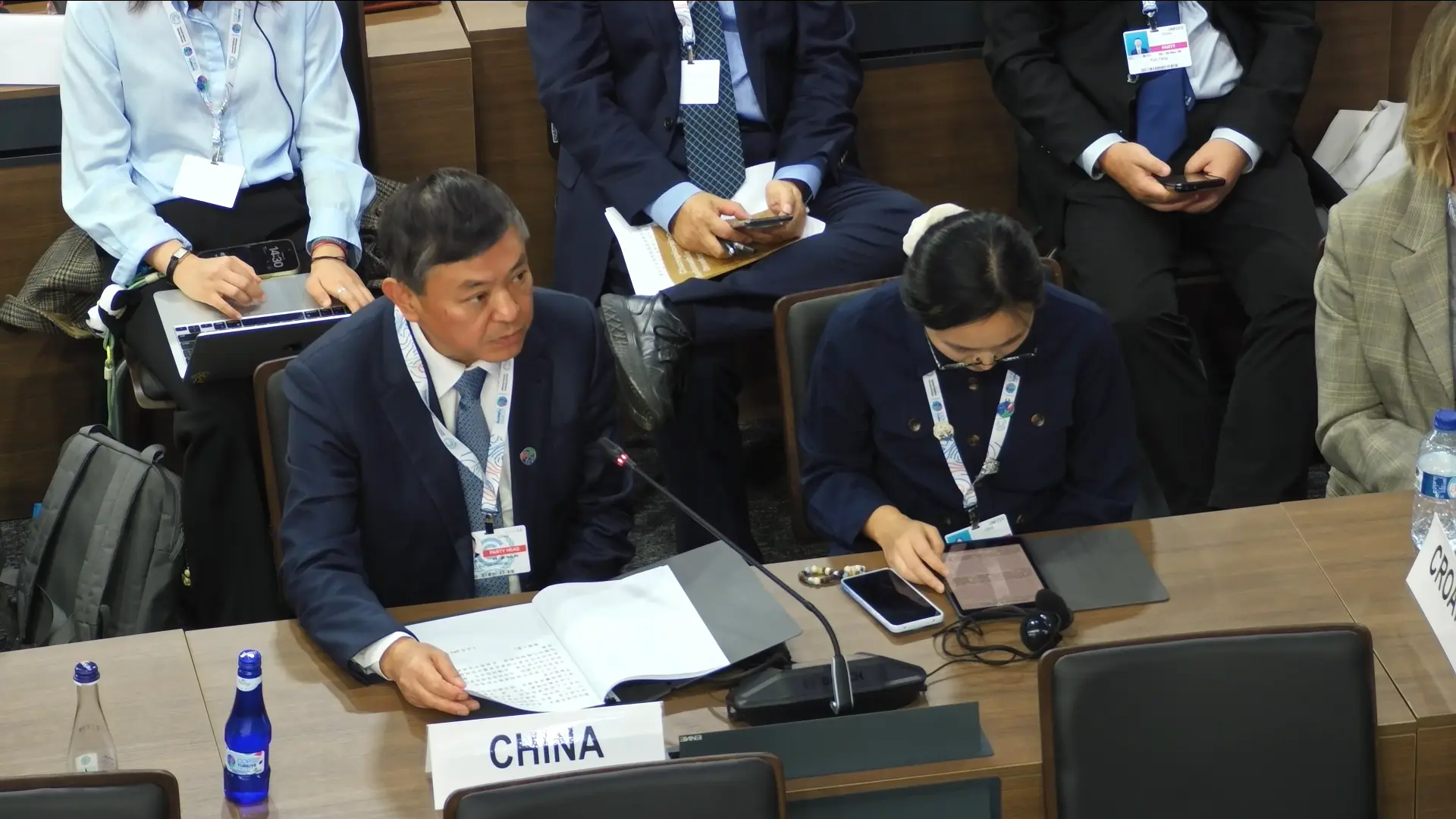
Meanwhile, at a high-level dialogue on climate finance, watched by Carbon Brief, environment minister Huang Runqiu said that developed countries’ “climate finance commitments must be honoured and the financing gap narrowed”.
Huang called for the new collective quantified goal (NCQG) to be “effectively implemented”, as well as for “establishing a common definition” for climate finance and improving accounting methodologies.
He additionally highlighted the need to improve the “quality of finance”, such as providing more grants and highly concessional loans, support for adaptation and easier access to climate finance.
This was echoed by BASIC, who said that “developed countries must set a pathway towards the NCQG goal of $300bn annually” and triple adaptation finance. BASIC also said the climate finance work programme (CFWP) must “operationalise Article 9.1”.
The final CFWP text was passed, but only focused on procedural matters, with mentions of tripling adaptation finance and “burden-sharing” in earlier drafts removed. Requests to expand the donor base were also deleted.
China maintained its emphasis on Article 9.1 in a number of workstreams, notably through the CFWP and standing committee on finance.
Carbon Brief understands that China was also one of two nations driving efforts to ensure that a dialogue on Article 2.1(c), which ensures finance flows are “consistent” with climate action, remains open and non-binding.
On adaptation finance, China underscored on behalf of the LMDCs the need to triple funds, calling for a “clear roadmap and timeline to increase the share of grants, as well as a progress-review mechanism”, said Third World Network.
But, in general, ASPI’s Li says, “China’s position was right in the middle of the political spectrum” on most of the issues being negotiated, maintaining a “quiet, but self-assured posture”.
An early point of discussion among delegates had been whether China could have signalled greater leadership at COP, such as by announcing a bid to host COP33.
News emerged at COP31 that China had, after “months” of consideration, decided not to do so.
Prof Hu Bin, associate professor and director of global climate governance research at Tsinghua University’s Institute of Climate Change and Sustainable Development, told Carbon Brief that “China, politically, is still very hesitant” to claim the role of the leading country on climate. Instead it is focusing on leading in terms of the transition on-the-ground he said, adding:
“I still think the reason China doesn’t want to bid for COP33 is internal pressure – the economy is slowing down, local governments are facing lots of pressure for employment and for economic growth.”
Another way in which it was suggested China could display leadership was by helping create consensus around the IPCC’s AR7 report being published in time for the second global stocktake.
At an event at the China pavilion attended by Carbon Brief, Laurence Tubiana, key architect of the Paris Agreement, said she will “count on China to be the torchbearer for the world’s science at the second global stocktake”.
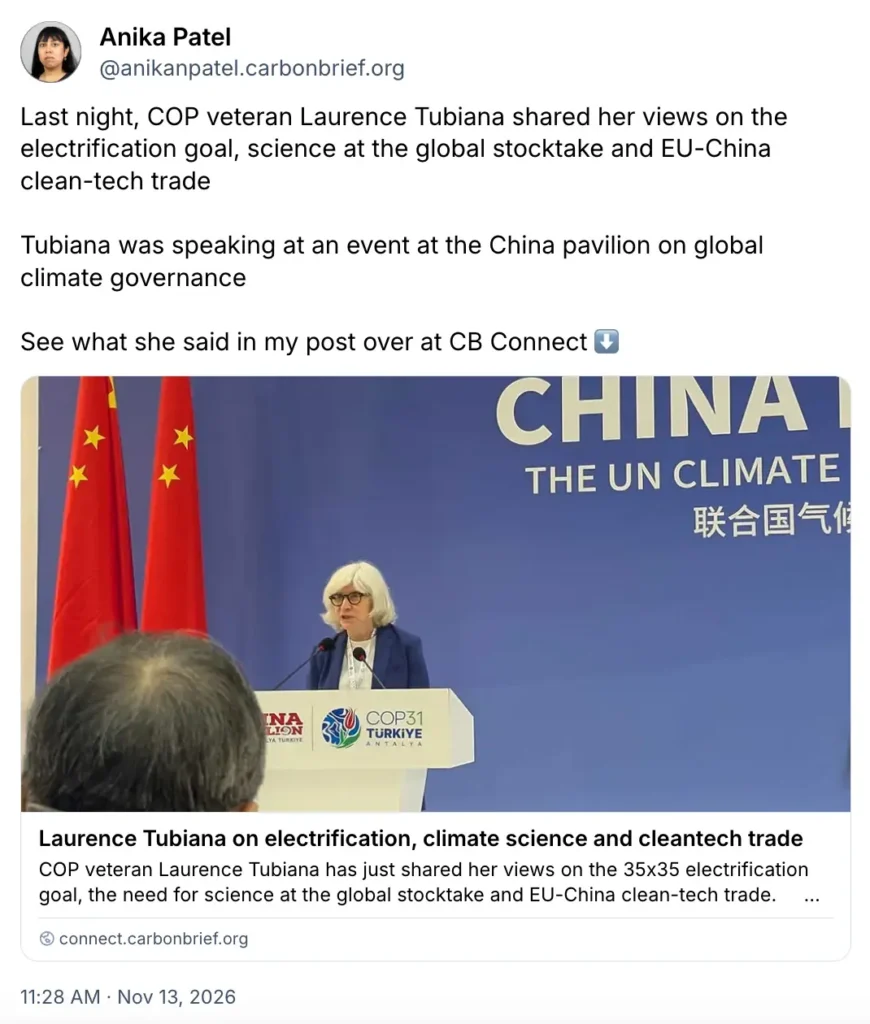
But, at the same event, Prof Wang Yi argued that IPCC reports from AR1 to AR6 were “unequivocal that global warming is caused by human activity”. Wang is a professor at the Chinese Academy of Science and a lead advisor to the China delegation.
This means the science is clear, “no matter” when AR7 is published, he added.
China instead continued to position itself as a champion of the global south, both in negotiations and around the COP.
In negotiations, it consistently aligned itself with developing country parties and groups, calling for solutions that would not “widen” the north-south gap.
South-south cooperation was the subject of a high-level forum at which China’s vice-president Han Zheng spoke.
Han emphasised that “China will vigorously deepen south-south cooperation” and formally announced a new global south climate leadership training programme, according to a recording of the speech obtained by Carbon Brief.
China also signed an agreement with Turkey to invest $15bn in developing 7GW of solar and wind power and 4GW of transmission capacity.
This deal “could be seen as part of China’s own contribution to climate finance and accelerating the global energy transition”, even if it’s not “formally accounted”, said Kate Logan, director of the China Climate Hub and climate diplomacy at ASPI.
She added that, at a broader level, it shows that “China will continue exercising its influence through real-economy actions, even while its negotiators press for developed country accountability on finance”.
Ocean
Ocean advocates had several outcomes to celebrate at COP31 – and also some disappointment.
Before the summit started, observers – and many parties – were hopeful of securing a strong outcome for the ocean, especially in light of the pre-COP meeting held in Pacific island states.
A letter sent to the COP31 presidencies on 8 October – signed by the African group, the EU (along with its member states) and 24 other countries – called for the COP to “move sustainable ocean-based climate action from recognition to implementation”.
It said that such a move should be “backed by a clear political signal, a coherent plan for integration into the Paris Agreement ambition cycle and its existing means of implementation”.
Analysis published by the World Resources Institute (WRI) on 15 November found that 95% of coastal and island countries included “at least one ocean-based action” in their national climate plans. However, it added that “more than 60% of ocean-commitment implementation depends on receiving some form of external support.”
Two days later, on the “ocean, seas, nature and land use” thematic day, ministers from France and Brazil announced the launch of the “Blue NDC Challenge implementation task force” at a side event. They also welcomed 10 new countries as members of the Blue NDC Challenge – a group launched at the UN Ocean Conference in Nice, France, in June 2025 to “advance ocean-based climate action”.
The same day, the COP31 presidency published the “Antalya Ocean and Seas Compact”, a high-level declaration that it said drew on feedback from parties and discussions at several events, including the UN General Assembly and the Pacific pre-COP.
The document highlights the impacts of climate change on the ocean, recognises the ocean’s importance in climate action and invites parties to strengthen their ocean work.
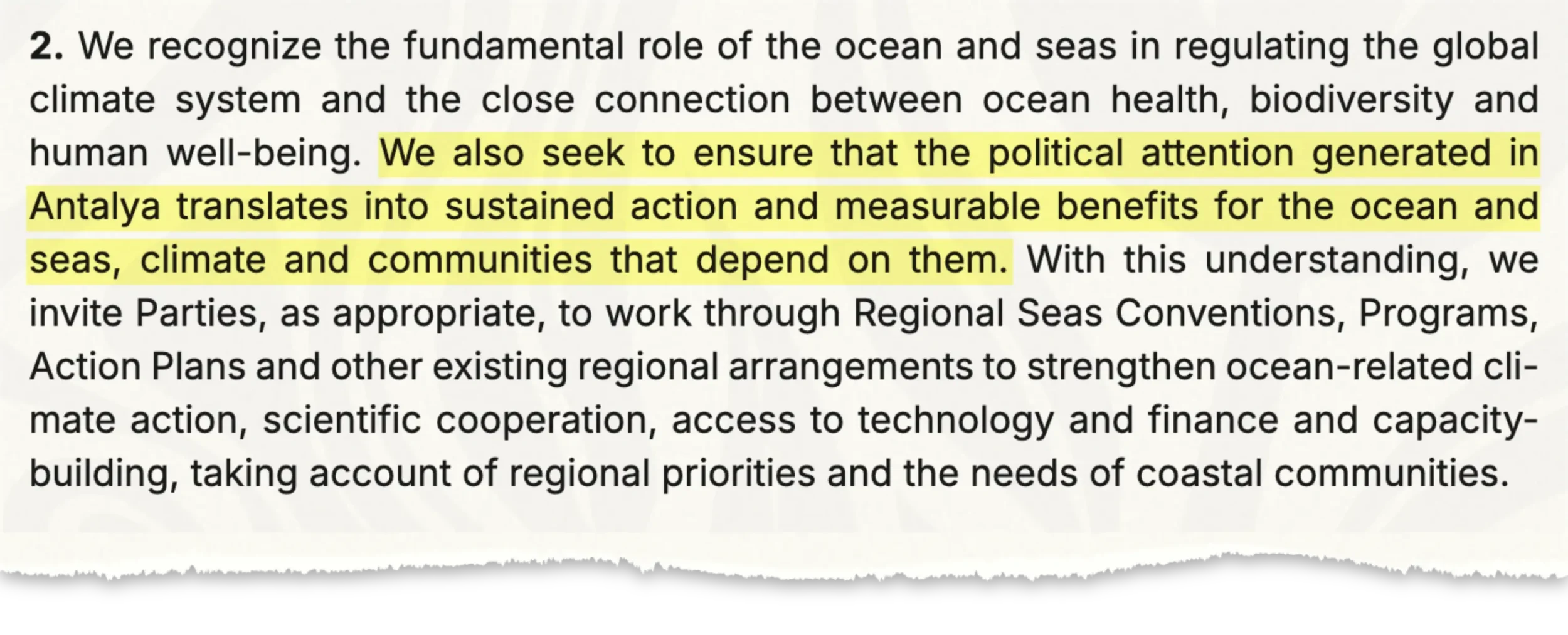
Dr Tom Pickerell, global ocean programme director at WRI, told Carbon Brief:
“It was more of a platform for collective ambition and political alignment, rather than any targets or finance coming through. We wouldn’t say no to it, but if we’d left just with that, it would have been a little bit sad.”
Also on the ocean thematic day, the UK government announced a new £20m ($26.2m) funding commitment to marine protection. This comprised £11.8m ($15.5m) to the Global Fund for Coral Reefs and £9m ($11.8m) to the Global Ocean Accounts Partnership, which helps countries measure their progress towards sustainable ocean development.
Towards the end of the summit, the “high-level climate-resilient coral reef commitment” gained six new signatories: Colombia, Haiti, Jamaica, Niue, Samoa and Tuvalu. These governments “commit to protect[ing] reefs identified as having greater potential to persist through climate change”, according to a press release announcing the new countries.
In the formal negotiation rooms, ocean groups were closely following discussions around the cover decision, hoping to see the ocean featured prominently there. (See: Cover decision.)
Draft versions of the cover text “invite[d]” the development of a multi-year plan for future ocean and climate change dialogues, to be called the “Antalya ocean current”. It also asked for the results of these dialogues to be summarised, along with the “best available science” on the ocean, in a synthesis report that would act as an input to the second global stocktake.
However, the cover decision was rejected during the closing plenary. Multiple parties used their interventions during the plenary to express their regret that the work that had been done on the ocean and climate change in the cover text would not move forward.
Pickerell told Carbon Brief that while “it wasn’t a ‘blue COP’ after all”, there were still positive takeaways for the ocean. He said:
“We’ve left with maybe nothing in writing, but I think we have left with genuine momentum. There does seem to be this shared ambition, to move beyond just the recognition of the ocean…There’s lots of opportunities to take this forward.”
Deforestation
COP31 was relatively quiet on forests, compared to last year’s summit in Belém.
The presidency held a forest leaders’ summit on 11 November, which was attended by the presidents of Brazil, the Democratic Republic of the Congo and the Republic of the Congo, along with the prime ministers of the Netherlands and Norway.
Much of the summit dwelled on the Brazil-led Tropical Forest Forever Facility (TFFF).
Delegates speculated that the summit would yield major new pledges for the fund.
However, only $88m from philanthropies emerged as new contributions at the event. Several countries reiterated past and recent pledges.
Plenary Akdeniz was ringing with applause and chants of “Olé, olé, olé, olé, Lula, Lula!” as Brazil’s president approached the stage for the forest leaders’ summit yesterday evening. Lula – who told the crowd he had lost his voice –…
 Aruna Chandrasekhar
Forest funding pledges fall short

At the summit, Jonas Gahr Støre, Norway’s prime minister, said:
“I am hopeful we can reach our collective goal of mobilising the initial $10bn dollars and to increase from there through next year and, with this, Norway is ready to contribute up to 20% of that total.”
Norway’s “up to $3bn” loan to the fund is conditional upon it hitting the $10bn mark by the end of 2026. At the same time, Støre acknowledged that “it will take some time before payments reach the tropical forest countries and the key people who we want to support”.
Speaking at the Association of Southeast Asian Nations summit in Manila on 15 November, Canadian prime minister Mark Carney pledged “an initial contribution of up to” $393m over four years to the TFFF.
This means the fund has – so far – mobilised $8.2bn from different international partners, mostly as conditional loans. This leaves it $1.8bn short of a $10bn target for public and philanthropic capital for this year.
Political economist Max Alexander Matthey told Carbon Brief that less capital to invest and fewer risks taken will “lead to a fund that will not be able to deliver on the initially promised $4 per hectare” of protected forest in participating countries, even in a best-case scenario.
Although significant attention was paid to the fossil-fuel roadmap at COP31, far less focus was given to the deforestation one.
Chris Dragisic, managing director for global policy at the National Audubon Society, told Carbon Brief that, nonetheless, there were “a couple of countries” that committed to producing national forest roadmaps. She added:
“Many others have said, ‘we have a national strategy already’, and they’re looking at this really as an option to accelerate progress…What, for me, is the more interesting thing is that the roadmap recatalysed political will across the board for forests, where these had fallen a little bit off the political radar.”
Other forest-related commitments made at COP31 included Bolivia and Indonesia joining the Forest & Climate Leaders’ Partnership and Brazil’s announcement that it is working on an Indigenous peoples’ roadmap.
The COP31 presidency also launched the voluntary “Antalya action plan” on global wildfires, which it said would help a “community of countries” to “cooperate on prevention, early warning, landscape resilience and access to resources”.
On the penultimate scheduled day of the summit, more than 100 organisations – including Indigenous groups, civil society and research institutions – signed an open letter calling on countries to take the work of the deforestation roadmap forward. It also called for an “international convening” on deforestation to occur in 2027.
While an initial draft of the cover text “welcome[d]” the Brazil-led roadmap on deforestation, this was subsequently cut.
The final cover text – which was rejected during the closing plenary – did retain wording on deforestation agreed by countries in the global stocktake at COP28 in Dubai. The text had also included a recognition of nature-based solutions as “essential climate solutions”, although there is significant controversy over their use.

Methane
Cutting emissions of methane, the potent but short-lived greenhouse gas, appeared to have a renewed push at COP31.
This is partly due to the recent confirmation of an “inevitable” overshoot of the 1.5C global temperature target. (See: Cover text.)
Inger Andersen, chief of the UN Environment Programme (UNEP), referred to this at a COP31 methane event:
“[Methane] leaves the atmosphere quickly, so cutting its emissions is our emergency brake to slow warming.”
It is “one of the fastest, cheapest and most effective ways to check global heating in the near-term”, said UN climate chief Simon Stiell at a 12 November event on non-CO2 greenhouse gases.
At this event, UNEP announced that its methane alert system has flagged five methane leaks across Canada, Iraq, Kazakhstan and Mexico since June 2026, allowing those countries to mitigate 125,000 tonnes of methane.
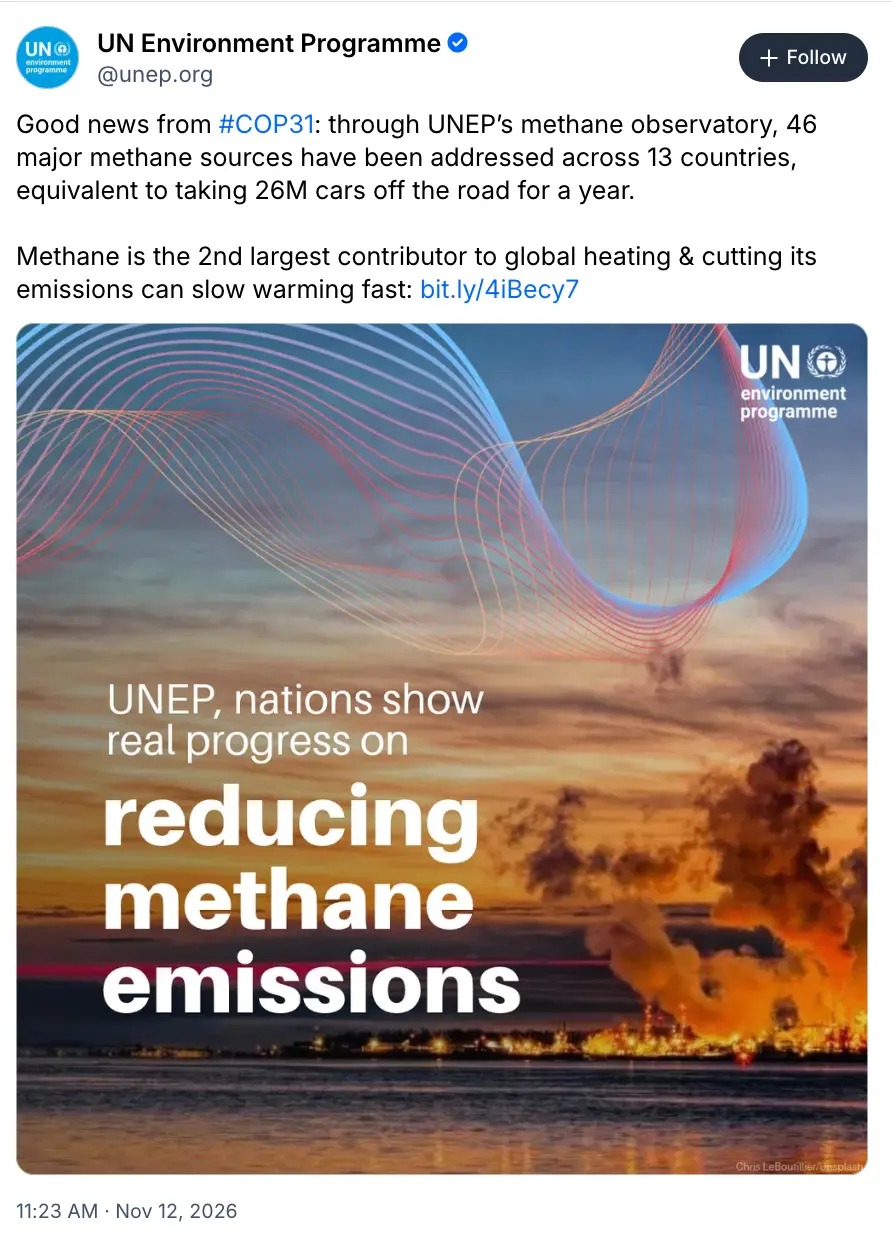
New private funding of $480m (£366m) was also pledged for action on methane and other “super pollutants”.
Nine of the 159 countries who backed a 2021 Global Methane Pledge reaffirmed their aim to reduce methane emissions by at least 30% by 2030 at the event, which was co-hosted by Brazil, China and the UK.
Belgium, Canada, France, Germany, Indonesia, Micronesia, Norway, the Netherlands and the UK endorsed this “ministerial declaration”, committing to accelerate action towards the 2030 goal.
Separately, Australia endorsed a COP30 statement on reducing methane emissions from fossil-fuel production.
At the beginning of the second week of COP31, Mia Mottley, the prime minister of Barbados, launched a petition calling to “reduc[e] methane emissions to near zero”.
On 11 November, the daily COP31 theme centred on “zero waste”. Emine Erdoğan, the Turkish first lady and chair of a UN advisory board on waste, launched a “global zero waste alliance”.
This aims to “build a strong foundation for cooperation where countries learn from one another” on cutting waste, said Erdoğan at the launch event.
Despite this focus, the Guardian reported before COP31 that Turkey has some of the “world’s worst landfill methane leaks”.
New climate science
On day one of COP31, the World Meteorological Organization (WMO) presented its State of the Climate 2026 update – the latest in its annual series of reports unpacking key climate indicators.
The report finds that 2026 will be one of four warmest years on record. The global average surface temperature for January-September 2026 was about 1.47C above the pre-industrial average, says the report.
It adds that El Niño is forecast to continue into early 2027, further boosting global temperatures.
At a press conference to launch the report on 9 November, WMO secretary general Prof Celeste Saulo warned that “this 2026-27 El Niño is