

The spiking price of oil helped increase global sales of electric cars in the second quarter of 2026 despite total car sales falling, a new International Energy Agency (IEA) report shows.
The IEA’s latest update on the market for electric cars said sales increased by 4% in the second quarter, after the war between the US, Israel and Iran disrupted oil supplies around the world and caused oil prices to jump at the end of February.
The increase in electric car sales was achieved despite customers buying fewer vehicles in total due to economic problems and, in China, a reduction in government subsidies for cheap cars. Total car sales fell 5% globally in the first half of 2026.
“While a lag in consumer responses and policy implementation means the full effects will take time to materialise, the crisis has clearly reinforced the case for [electric vehicles] as a way to address energy security and fuel cost concerns,” the IEA’s report said.
-
Chinese EV brands woo Yemen’s wealthy elite as war prompts solar boom
For the well-off few, buying an EV is the next step in a solar revolution that has helped Yemenis weather years of power outages and high fuel prices -
Charging worries, high prices put brakes on EV growth in Bangladesh
Sales of e-bikes and rickshaws are up amid queues at fuel stations, but a lack of charging infrastructure and high prices still deter many Bangladeshis from going electric -
Nepal’s EV revolution pays off as oil crisis causes pain at the pumps
Import subsidies, abundant hydropower and charging investments have spurred EV adoption, with electric vehicles now making up about three-quarters of new car sales


The IEA predicts that sales of electric cars will speed up in the second half of the year, increasing by 10% for 2026 in total compared to 2025. Electric car sales will be 29% of total car sales over the full year, it forecasts, up from 24% in the first half.
The IEA expects sales of fossil fuel-reliant internal combustion engine vehicles to continue declining, as they have been doing for a decade because of economic shocks like the COVID-19 pandemic and, since around 2020, the rise of electric cars.
Road transport – which also includes two- and three-wheeled vehicles like scooters and rickshaws – currently accounts for half of global oil use. The oil industry has been trying to expand markets in newer, growing sectors like plastic to replace its declining business in petrol and diesel for road transport.
Pro-EV policies
As well as the higher oil price, the IEA said this year’s electric car boom is being driven in some countries – particularly in Europe and Southeast Asia – by government policies that have been put in place since the Iran war blocked shipping of oil and other commodities through the Strait of Hormuz.
It highlighted the Netherlands and Ireland, which have both announced subsidies for scrapping old internal combustion engine cars and replacing them with electric ones.
Australia, Spain, Chile, Vietnam and the US state of California have introduced, or are introducing, tax benefits for electric cars.
Australia, the UK and Hungary have announced funding or support for charging infrastructure, while Cambodia, Brazil and Kenya have reduced taxes on imports of electric vehicles.
Growth in electric car sales was particularly strong in Europe, Brazil, Australia, India, South Korea, Vietnam, Colombia, South Africa and New Zealand.
On the other hand, electric car sales fell 16% in China – the world’s biggest electric car-buying country – in the second quarter. This was driven by a decline in total car sales, which was more extreme for internal combustion engine cars than electric ones.
In the US, electric car sales rose 20% in the second quarter compared with the first quarter of 2026. But this was about 25% less than in the same period of 2025, when Americans were taking advantage of expiring Biden-era federal tax credits.
These statistics back up Climate Home News’ reporting from the ground since the oil price spiked. As we reported from Yemen in May, the IEA data shows Chinese electric car companies are having success in the Middle East.
And as our correspondents found in Nepal and Bangladesh, there has been a surge of interest in electric vehicles across Asian countries outside of China. Yet while EV adoption in Nepal has been enabled by investments in charging and import subsidies, drivers in Bangladesh have been put off by a lack of chargers and high prices for electric two-wheelers.
The post Hormuz crisis speeds up transition to electric cars, IEA data shows appeared first on Climate Home News.
Hormuz crisis speeds up transition to electric cars, IEA data shows

Canada and the European Union’s commitment to strengthen cooperation on energy security and the energy transition lays the foundation to put clean growth and climate priorities at the heart of their alliance, according to experts.
In a seven-page joint statement agreed at the end of a two-day summit in Montreal on Friday, both sides committed to work more closely on investment in critical minerals, green grids, energy sources, battery storage and the protection of energy infrastructure.
They agreed to assess opportunities for long-term energy connectivity across the Atlantic, including through a feasibility study on liquefied gas (LNG) exports to Europe. The statement also includes a pledge to “deepen targeted industrial cooperation” on technology value chains and “address bilateral trade barriers”.
“Canada and the European Union have sent a clear and unwavering signal that closer cooperation on decarbonisation and climate resilience will be central to their new strategic alliance,” said Canadian Climate Institute president Rick Smith. “The task now is to turn talk into action.”
Foundation for climate action
The EU and Canada’s “alliance for the future” aims to deepen their partnership across investment, trade and economic security to weather geopolitical tensions and global threats, including “the existential threat of the interdependent crises of climate change, biodiversity loss, ocean and land degradation, and pollution”.
These threats are “increasingly impossible to ignore as the impacts of extreme heat, wildfires, floods, and other disasters become more disruptive and expensive,” Smith said.
-
New Zealand accused of breaching EU trade deal over climate rollbacks
The EU’s climate trade rules face their first major test after a green group alleged New Zealand violated binding environmental provisions under its trade deal with the bloc -
Tensions set to flare over trade at COP31 as China makes it a priority
After difficult talks in Belém last year, trade is likely to remain a sticking point at COP31 despite Brazil’s efforts to contain the issue to a series of dialogues -
International trade linked to 20% of global emissions – but imports ignored
Researchers say governments should discuss how to tackle emissions linked to globally traded goods and services, especially in large importing countries


The statement reaffirms existing commitments established by the Canada-European Union Green Alliance, which both parties described as “our compass for advancing decarbonisation while also strengthening competitiveness, affordability, and economic security”.
Investment in critical minerals
During the summit, the European Investment Bank (EIB) announced a “new chapter” for its presence in Canada, beginning with accelerated investment in critical minerals.
“At a time when both sides of the Atlantic are working to reduce strategic dependencies, we want to turn our partnership into investment in real projects, from mining and processing to recycling,” EIB Vice-President Nicolas Beer said in a statement. “That is how we build supply chains that are not only more secure, but more competitive too.”
Joanna Kyriazis, director of policy and strategy at Clean Energy Canada, welcomed the EIB announcement as a “bright spot of the summit” and “one of the few tangible actions”.
“As the EU and Canada seek to advance a partnership anchored in ensuring mutual security and navigating an uncertain world, it is essential that electrification remains a north star… one of the greatest ways we can advance both short- and long-term affordability, competitiveness, and energy security,” she said.
Feasibility of Canadian LNG exports to the EU
In addition, the agreement calls for a joint long-term feasibility study on LNG exports to Europe, although no immediate investment was announced to support this.
A media briefing circulated by climate advocacy groups in advance of the summit had warned that a call for such a study would support Canada’s efforts to rebrand gas, a highly polluting fossil fuel, as a reliable, low-carbon energy source.
Yet, the agreement was interpreted by some observers as a Canadian concession following more than a year of rhetoric predicting a boom in Canadian gas exports to the EU and elsewhere.
-
National climate plans now promise half the emission cuts expected by UN
The US exit from the Paris Agreement and weak new pledges leave 2035 emissions just 6% below 2019 levels, against 12% projected last year -
Why COP31 needs to start talking about just transition finance
Funding that helps workers and communities navigate the clean energy switch remains overlooked, splintered and poorly tracked – a blindspot that could undermine climate goals -
Turkish giant sponsoring COP31 cut climate goals then cashed in on oil boom
COP31 sponsors should be screened for “climate integrity”. Yet Koç Holding has become a top partner while its oil refiner runs flat out and its climate targets slip
“What is clear is that the EU is reducing its gas consumption drastically,” Adrian Hiel, director of the Brussels-based Electrification Alliance, told the Globe and Mail. “The long-term trend is clear and by the middle of the next decade, Europe should be out of the LNG game.”
Last year, The Energy Mix and Berlin-based Clean Energy Wire reported on mounting doubts that serious European demand for additional gas supplies would ever materialise after Energy and Natural Resources Minister Tim Hodgson touted LNG exports to Germany in “as little as five years”.
Rapprochement on a ‘trade irritant’
In the lead-up to the summit, the Canadian Broadcasting Corporation reported that Canadian iron, steel, fertiliser and aluminium would not be exempt from carbon tariffs under the EU’s Carbon Border Adjustment Mechanism (CBAM), as it moves toward full implementation in 2034.
The CBAM is a trade tool designed to protect the continent’s domestic industries from competitors in countries with less stringent carbon controls.
Unlike other non-EU members like Switzerland, Norway, Iceland, and the UK, Canada is unlikely to be exempted from the CBAM because there are no plans to link its carbon market to Europe’s.
However, at the end of the Montreal summit, Canadian Prime Minister Mark Carney and EU Commission President Ursula von der Leyen told a press conference they had made progress on finding joint solutions to the issue, which von der Leyen described as a “trade irritant”.
Canada’s EU ambassador, Jonathan Wilkinson, formerly the environment and climate minister, said Canada sees it as a problem that the CBAM “did not acknowledge Canadian producers were doing their part to reduce their greenhouse gas footprint by paying an industrial carbon price”.
He “confirmed diplomatic talks are heading in the right direction but not resolved”, CBC reported.
A longer version of this story was originally published by The Energy Mix as part of its partnership with Small Change Fund.
The post Canada, EU agree deeper cooperation on energy and cleantech supply chains appeared first on Climate Home News.
Canada, EU agree deeper cooperation on energy and cleantech supply chains
This is a republication of November’s edition of The Climate Agenda – a subscriber-only newsletter designed to keep you informed of the key events, negotiations and announcements happening every month. If you want to receive The Climate Agenda straight to your inbox at the start of each month, sign up as a subscriber today.
COP31 begins in one week, and we’ll have five specialist reporters on the ground in Antalya, Türkiye, bringing you every development as it happens. From the negotiations to leaders’ speeches and side events, we’ll be there to dissect what it all means for international climate policy on electrification, just transition, adaptation finance and much more.
Here’s what you need to know for November, why it matters and what to expect.
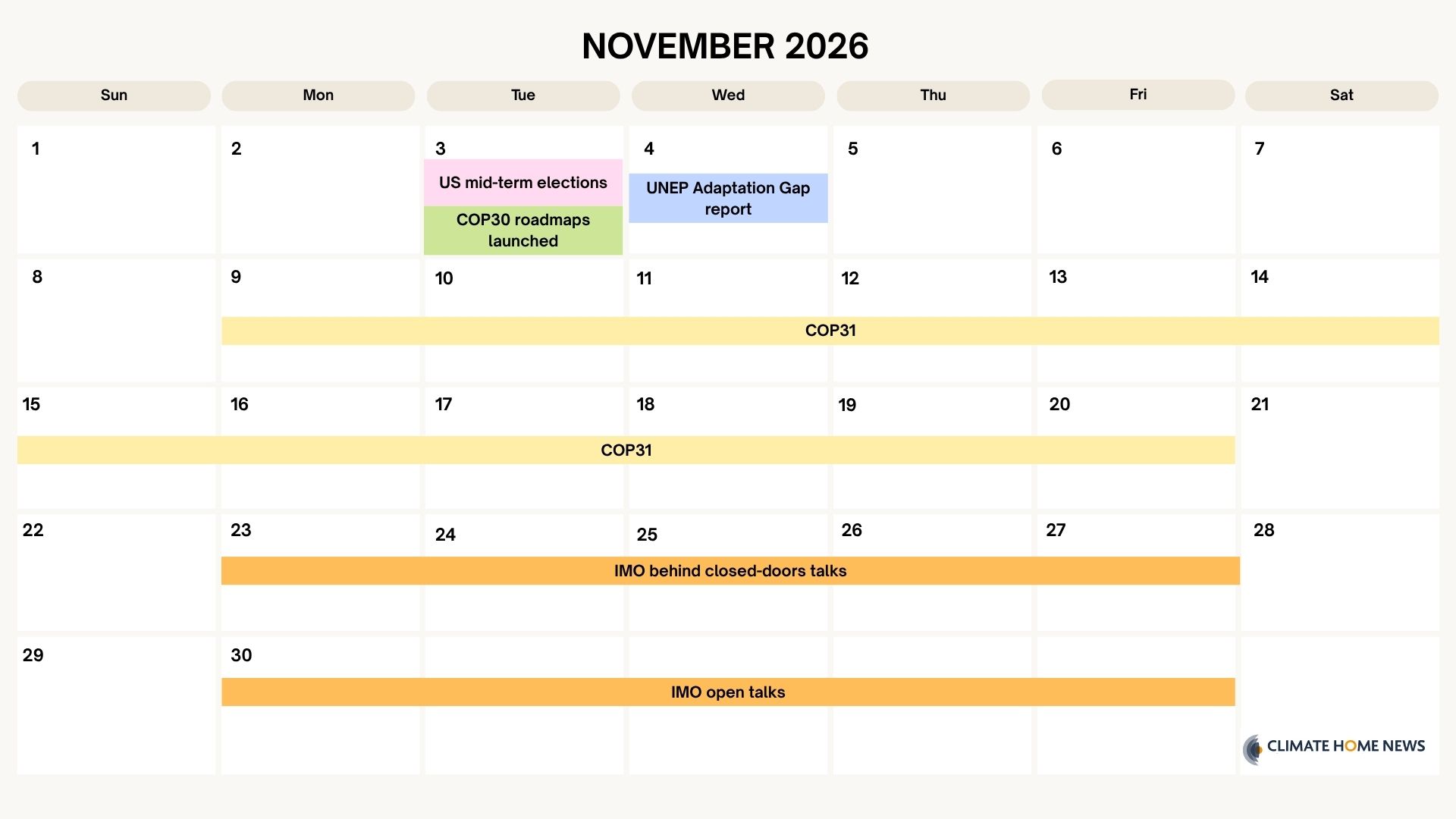
US midterm elections
Tuesday 3 November – United States
The geopolitical highlight for the first week of November is the US midterm elections, which will show whether American voters are in any mood to forgive President Donald Trump for failing to bring down the cost of living. From an energy perspective, his pro-oil and gas stance hasn’t led to cheaper prices for consumers, pushed up by the US-instigated Iran conflict. And his diesel deal with Russia won’t yet have made a difference at the pump.
The key issue for climate and energy policy is whether the Republicans hold onto their governing trifecta. If so, then expect continued dismantling of regulations that protect the environment, as well as strong backing for fossil fuel production. If the Democrats regain control of Congress, which polls suggest is possible, it could trigger a push to restore Biden-era clean energy tax credits, and support states wanting to restart mothballed wind and solar projects.
Data centres have been a hot-wire issue, with growing community opposition to their expansion – partly due to concerns over rising utility bills as the facilities gobble power. Whether Republicans or Democrats win Congress, both are likely to make tech firms pay for the extra electricity production they need, with the latter favouring renewable sources.
Governor races are also taking place in key states for climate issues, including Democrat-run California, which has used the courts to fight Trump’s attacks on clean energy.
Read more: National climate plans now promise half the emission cuts expected by UN
Read more: The more Europe relies on the US for energy, the more it’s vulnerable to pressure by Trump

COP30 Deforestation and Fossil Fuel Transition Roadmaps
Tuesday 3 November – Brazil
Brazil is set to unveil two global roadmaps: one for transitioning away from fossil fuels, the other for ending deforestation.
The COP30 presidency promised them in the dying hours of the Belém summit last November as a last-minute fix to break a political impasse. Since then, it has been consulting with countries, experts and campaigners around the world to gather ideas and sketch out the elements to include in these blueprints.
Don’t expect the roadmaps to offer any new global targets or give direct instructions on what countries must do, either to cut fossil fuel production and consumption or better protect forests. Rather, Brazil has said the documents will identify barriers and priority actions, highlight existing mechanisms and present a