

After lengthy and heated negotiations, diplomats have largely agreed on a draft framework for a new UN fund to help nations recover from the “loss and damage” caused by climate change.
Last year’s COP27 summit in Egypt marked a victory for developing nations when they secured agreement on this fund – an idea many had been advancing for decades.
A transitional committee composed of members from developed and developing countries was tasked with discussing everything from who would pay into this fund to where it would be located, ahead of a final decision due to be taken at COP28 in Dubai next month.
Meetings overran this year as members clashed over long-standing grievances. Developing countries did not want to see the fund based at the US-dominated World Bank and wanted to ensure it was accessible for as much of the global south as possible.
Developed countries wanted to see funds coming from sources besides their public coffers, including those of the wealthiest developing nations, such as China and Saudi Arabia.
In the end, the final committee meeting held last weekend in Abu Dhabi settled on a draft proposal that would see the new fund housed at the World Bank for at least four years.
Neither developed countries nor anyone else would be obliged to pay into the fund.
This proposal will now form the basis of a final decision by leaders at COP28.
While the committee’s recommendations were adopted by consensus, a last-minute objection from the US provides an early indication that those talks at the UN’s upcoming climate summit may not progress smoothly.
- What is ‘loss and damage’ and what was agreed at COP27?
- What progress has been made in setting up a loss-and-damage fund since COP27?
- Why are countries divided over the new fund?
- How much money is needed to deal with loss and damage?
- What options are being considered to raise money for loss and damage?
- How could countries claim money from the loss-and-damage fund?
What is ‘loss and damage’ and what was agreed at COP27?
“Loss and damage” is a term used to describe how climate change is already causing serious and, in many cases, irreversible impacts around the world – particularly in vulnerable communities.
For example, more intense and frequent extreme weather events are causing the loss of human life and damages to properties and cropland.
The issue is recognised in Article 8 of the Paris Agreement, which says parties “recognise the importance of averting, minimising and addressing loss and damage associated with the adverse effects of climate change”. However, the Paris text did not commit countries – developed or otherwise – to providing funds for loss and damage.
At UN climate talks, the term is often used by nations and organisations to argue for developed, high-emitting nations to be held responsible for losses incurred in poorer regions, which are the least responsible for climate change. (Because of this, the term “loss and damage” is sometimes described as meaning “climate reparations”.)
At the COP27 climate summit, all countries agreed to set up a fund to pay for loss and damage. This came after a 30-year fight for such a fund led by small island states and developing countries.
After much back and forth between developed countries and the G77 and China – a major group of developing countries representing six out of every seven people in the world – a text was produced close to the end of the summit that “decided” to establish a new loss-and-damage fund.

This same text said that a “transitional committee” should be established, dedicated to coming up with a plan for how the fund would work in practice.
It added that a decision “related to the new funding arrangements” should be adopted “no later than at COP28”.
It was also decided that the committee should be composed of 24 members, including 14 members from developing countries and 10 from developed nations.
What progress has been made in setting up a loss-and-damage fund since COP27?
The transitional committee held four scheduled meetings and two workshops in Egypt, Germany, Thailand and the Dominican Republic during March-October 2023.
After the failure of the fourth meeting to reach consensus, it also held an emergency fifth meeting in Abu Dhabi from 3-4 November 2023.
The committee’s task was to come up with a series of recommendations for the loss-and-damage fund that could then be approved by leaders at COP28.
This included establishing which financial sources would feed into the fund, what kind of activities it could support and how it would work alongside existing funds. The recommendations also covered where the fund would be located and how it would be structured and governed.
Over the course of these meetings, nations and civil society groups submitted proposals for the fund. These ideas were assessed by the committee and, ultimately, fed into a series of documents that were subject to further scrutiny and debate.
As talks entered extra time in Abu Dhabi, the committee co-chairs presented members with what one of them, Outi Honkatukia of Finland, called a “take it or leave it package”. This attempted to distil all the competing views into a viable set of recommendations that could form the basis of a COP28 decision.
After passing up opportunities to object earlier on, US committee member Christina Chan raised a last-minute concern about language “urg[ing]” developed countries to support the fund.
Throughout the talks, the US had consistently pushed back against any language that compelled developed countries to pay into the fund. (While “urge” is towards the stronger end of the lexicon of UN legal drafting, it does not, in fact, imply compulsion.)
Chan asked for this text to be bracketed, indicating it had not been resolved.
The co-chairs reasoned that all members had objections to the final text for various reasons, but the committee had already reached consensus and it was too late to reopen negotiations. “Once we start bracketing, that doesn’t stop,” Honkatukia told the meeting.
Given this, Chan said the US did not view the final decision as reaching consensus. Teresa Anderson, global lead on climate justice at ActionAid International, tells Carbon Brief that the US’s “forceful objections to the transitional committee’s recommendations suggest that this text might not sail smoothly through COP28”.

Why are countries divided over the new fund?
Tensions ran high throughout the five transitional committee meetings as long-standing arguments between representatives from developed and developing nations were revisited.
Developing country committee members reportedly threatened to walk out, accusing a small group of nations – particularly the US – of pushing them into a “Faustian bargain”, involving many compromises, in order to make progress on the loss-and-damage fund.
Below are some of the key areas that sparked divisions within the committee.
Who would receive money from the fund?
At COP27, nations agreed to create the fund to assist “developing nations, especially those that are particularly vulnerable” to climate change. However, the interpretation of “particularly vulnerable” remained a point of contention.
EU committee members, for example, suggested that the fund should only serve least developed countries (LDCs), small-island states and “other particularly vulnerable countries based on specific eligibility criteria”.
Members of the G77 and China resisted what they perceived as efforts to narrow the focus of the fund. In a statement released towards the end of the fourth meeting, Cuban G77 chair Pedro Pedroso Cuesta said:
“We must ensure that the administrative arrangements of the fund do not impede direct access to all developing countries particularly vulnerable to climate change.”
Sherry Rehman, former climate minister of Pakistan and G77 chair at COP27, told a press conference that the fund should be “more inclusive” – citing flood-struck Pakistan and Libya as middle-income nations that might not be able to access it, should more limited criteria be adopted.
The final text agreed by the committee does not specify which countries would be eligible to receive funds. Instead, it says the fund’s board would develop a “resource allocation system”, based on the available evidence and with a minimum percentage allocated to LDCs and small islands.

Who would contribute to the fund?
Currently, only a small group of “Annex II” countries, which were deemed “developed” when the original UN climate treaty was agreed in 1992, are obliged to provide climate finance.
These parties have consistently failed to meet their existing climate-finance pledges to developing countries.
However, neither the 1992 climate convention nor the Paris Agreement say who should give money to pay for climate change loss and damage.
The US and European nations have stressed the need to share the burden with wealthier emerging economies – specifically singling out China and Gulf states, such as Saudi Arabia. UK climate minister Graham Stuart told a UN ministerial meeting in September:
“It will simply not be possible to deliver what is needed if we stay trapped in outdated categories from decades ago and we must break out of this to get a positive outcome at COP28.”
Developed countries also say that scaling up the fund sufficiently would mean opening it up to contributions from non-government sources, including the private sector and humanitarian groups. (See: What options are being considered to raise money for loss and damage?)
Developing countries are not entirely opposed to drawing finance from this “mosaic” of funding sources. However, as one joint submission by committee members from developing countries states, they want to keep the focus primarily on grant-based finance from developed countries.
Referencing climate finance more broadly, the Saudi Arabian government voiced its concerns in a statement delivered at the pre-COP event in Abu Dhabi and seen by Carbon Brief. The statement said Saudi Arabia expected “those who have clear obligations to own up to them and not attempt to pass on the baton to other countries or entities outside the process”.
Brazilian diplomat Matheus Bastos, representing the G77 and China, called for language reflecting the “principles and provisions” of the UNFCCC and the Paris Agreement.
He said the function of this would be to make it clear, as those treaties do, that developed countries are obliged to provide climate finance. In the view of the G77, this extended to the “full costs incurred” in developing countries, including not only mitigation and adaptation but also loss and damage, Bastos added. The US said it would not accept this text.
Ultimately, the final recommendations would not oblige developed countries to pay into the fund. They also mention a “wide variety of sources of funding”.
Developed countries are asked to “take the lead” in providing start-up finance for the fund, rather than loss-and-damage relief.
In addition, the recommended text “urge[s]” developed countries to “continue to provide support”, while other countries would be subject to a weaker exhortation “enourag[ing]” them to do the same “on a voluntary basis”. (This is the element that the US raised its last-minute objection to as the meeting came to a close.)

Where would the fund be located?
One major issue blocking progress was the location of the loss-and-damage fund.
The US and the EU wanted to see the fund hosted by the US-based World Bank, a proposal that G77 and China members strongly opposed.
They argued that World Bank finance is based not on grants but on loans, which are not desirable for debt-burdened countries in the global south. They also said the bank is not set up to allow fast, direct access of the kind required when dealing with climate disasters.
In addition, they said it would not be accountable to all parties, due to the dominance of the US – its largest shareholder – and other major donors in decision-making.
Diann Black-Layne, a committee member representing the Alliance of Small Island States (AOSIS) said the World Bank would charge a hosting fee of 17%, which she described as “highway robbery…pure gangster behaviour”:
“[That] means that the biggest beneficiary of this fund will be the World Bank. The 10,000 employees of the World Bank will get more money from this fund than the 63 million people of the population of AOSIS countries.”
(This sum, which others have placed at 24%, refers to administration costs taken from the fund’s secretariat and is, therefore, not a portion of the total money flowing into the fund. According to the Loss and Damage Collaboration, it would amount to 1-2% of total funds.)
A coalition of nearly 70 US NGOs wrote an open letter to the US negotiating team stating that “the world does not need yet another channel for international finance that is donor-driven and unaccountable to communities in the global south”.
The World Bank issued a statement pushing back against such criticism and emphasising that it could be flexible in how it allowed countries to access loss-and-damage funds.
(This dispute recalls arguments at the 2009 COP15 climate talks in Copenhagen. There, the so-called “Danish text” – which was never adopted – would have “hand[ed] effective control of climate change finance to the World Bank”, the Guardian reported at the time.)
Developing countries argued instead for a new, independent entity operating under the financial mechanism of the UN climate convention itself.
This would be similar to the Green Climate Fund (GCF), which is overseen by a 24-person board that includes an equal number of developed and developing country representatives.
After this dispute prevented consensus at the fourth committee meeting, developing countries came to the final meeting stating that they would accept the World Bank as the host on an “interim” basis. Committee members stressed that they were making a “huge concession” in doing so.

Some developed country members also said they wanted to see a clear pathway to move the fund out of the bank within two years.
In the end, the committee agreed to a text that would establish the World Bank as an interim host of the fund for four years. It included conditions such as allowing communities to access small grants and providing access to countries that are not World Bank members.
Laura Schäfer, a senior advisor in climate risk management at Germanwatch, tells Carbon Brief that while these elements are promising, they should also be “basic conditions” for a loss-and-damage fund.
She says there remain concerns that the World Bank will end up being the fund’s permanent home, an issue that has faced other funds that were meant to be housed there temporarily:
“There is no exit strategy defined in the text, so this basically means if the World Bank performs well and fulfils all the conditions set, it will be the host even after four years.”
One of the key demands of developing countries was that, wherever the loss-and-damage fund ended up being based, it would have the status of a standalone entity under the UNFCCC. However, civil-society groups said the final language on this in the text was unclear.
The GCF, seen by some as a model for the new fund, is clearly designated as an “operating entity” under the UN climate convention’s financial mechanism. By contrast, the proposed text for the World Bank-based loss-and-damage fund describes it only as being “entrusted with the operation of the financial mechanism”.
This “somewhat murky” language is expected to face legal scrutiny in the weeks ahead of COP28.
Other issues
In an earlier draft text released at the fourth meeting, developing-country committee members disputed a line stating that the fund “does not involve liability or compensation”.
This has long been a fundamental issue for the US, in particular, because it does not want to be held legally accountable for its high historical emissions.
US committee member Chan told other members it was “absolutely unacceptable” that this was viewed as “a point of contention”:
“This was a key piece of the understanding that led to the agreement for this agenda item at Sharm el-Sheikh.”
She said that if this text was removed, “we don’t see a pathway to an outcome” on the fund overall. This language remained in the final recommendations.
Civil society groups also raised concerns about the removal of language committing to human-rights protections from the final recommendations.
How much money is needed to deal with loss and damage?
Developing-country transitional committee members made a submission in September calling for “at least” $100bn a year in loss-and-damage funding by 2030.
They cited a UN-commissioned report by the Independent High-Level Expert Group on Climate Finance, which says “recent events suggest [costs] could be as high as $150-300bn by 2030 to cope with immediate impacts and for subsequent reconstruction”.
The expert report also emphasises the uncertainty of these figures, adding that climate models “likely underestimate” loss-and-damage costs in developing countries.
Indeed, the expert group’s figures are towards the lower end of existing estimates. Their report cites other studies as placing the costs of “residual damages” from climate hazards far higher – as much as £290-580bn annually in developing countries by 2030.
With this in mind, developing country representatives emphasised that a £100bn goal “is not meant as a ceiling, but rather as a minimum commitment.”
By contrast, US and EU submissions did not back any specific targets.
A draft of the final outcome, released at the fourth meeting in October, included a section titled “scale”, with the developing countries’ proposal in square brackets, meaning it had not yet been agreed by all parties.

However, US committee member Chan said that she would not accept such a figure in the document. “This is not part of our mandate, it’s not part of what is in the Sharm decision,” she said.
Ultimately, any reference to the scale of funding was scrubbed from the final recommendations.
What options are being considered to raise money for loss and damage?
One of the transitional committee’s goals was to “take into account the landscape of institutions and solutions relevant to responding to loss and damage”.
As part of the deal that emerged from COP27, countries commissioned the UNFCCC secretariat to review existing loss-and-damage funding and identify “gaps existing within the landscape”.
The secretariat released a synthesis report summarising its findings in May 2023, which has fed into the decisions made by the committee.
It identifies a variety of existing sources that are relevant for tackling loss and damage, including adaptation funds and insurance facilities.
Meanwhile, scientists and civil society groups have proposed alternative sources for loss-and-damage funds, such as taxes or levies on fossil fuels and global shipping.
One paper suggests allocating hundreds of billions of dollars in “climate reparations” charges to fossil-fuel majors such as, for example, Saudi Aramco and ExxonMobil.
Earlier versions of the transitional committee’s recommendations reflected a variety of potential sources, again in square brackets. These included private entities, NGOs and “special drawing rights (SDRs), levies, voluntary carbon market or international pricing mechanisms”.
However, the question of funding sources is contentious as, broadly speaking, developing countries have tried to keep the emphasis on grant-based finance from developed countries.
Developed countries, meanwhile, say that “innovative” new sources must be explored to raise money on a sufficient scale.
Speaking at the fourth committee meeting for the G77 and China, Brazilian diplomat Bastos told fellow committee members that they had “repeatedly asked for deletion” of language around raising money for the fund from the voluntary carbon market and other pricing mechanisms.
The final recommendation text does not include much detail on types of funding, but mentions a “wide variety of sources”, as well as saying it will be open to public, private and “innovative” contributions. It also specifies that it should be open to receiving funds from philanthropic foundations.
It says the fund’s board will prepare a strategy to “mobilise new, additional, predictable and adequate financial resources from all sources of funding”.
How could countries claim money from the loss-and-damage fund?
As with many aspects of the fund, the question of how countries could actually claim money after experiencing loss and damage is still far from being answered.
Traditionally, countries access UN climate funds by filing lengthy project proposals in a process that typically takes several years.
For the loss-and-damage fund, some countries are instead calling for a “trigger-based mechanism” to allow them to claim funds immediately in the wake of extreme weather events, explains Zoha Shawoo, a scientist working on loss and damage at the Stockholm Environment Institute (SEI). She tells Carbon Brief:
“Something like that could work if there is an immediate recovery and relief window. But we know that developed countries have been saying that that is largely covered by humanitarian aid, so maybe the fund should focus more on medium- and long-term recovery.”
There are also still question marks around what sort of losses and damages countries would be able to claim for.
Loss and damage can be caused by immediate climate impacts, such as more intense and frequent extreme weather events, as well as impacts that gradually worsen over time, such as sea level rise and the retreat of glaciers.
The study of how climate change is affecting the likelihood and severity of extreme weather events is known as “attribution” science.
Attribution is playing an increasingly important role in proving liability in climate court cases. For example, a recent landmark court case won by young climate activists in Montana relied heavily on attribution science.
This has prompted some to question whether attribution could play a role in helping countries to make claims from the loss-and-damage fund.
However, Shawoo notes it may not be preferable for developed or developing countries to use attribution science in deciding who should access loss-and-damage funding:
“First, developed countries may not be comfortable with being held liable for particular losses. But then I think it could potentially also be a burden on developing countries to have to prove that a certain event is due to climate change. So I don’t think either side would want that.”
There still could be a role for attribution science in helping to provide evidence for the claims of developing countries however, she adds:
“Rapid attribution studies could provide additional evidence that developing countries could use to back up their claims and access funding. Not a formal requirement, but just something to give them additional leverage.”
So far, there has been little cross-talk between attribution scientists and those involved in the UN process for operationalising the loss-and-damage fund, Dr Izidine Pinto, a scientist from the World Weather Attribution initiative, tells Carbon Brief:
“Right now we’re separate because no one knows how the loss-and-damage fund is going to work.”
He adds that attribution may only be able to play a limited role in determining how much money countries should be able to claim from the loss-and-damage fund:
“Attribution studies are just one side of the coin. Attribution is saying that the amount of rainfall or heat was made more likely by climate change. But vulnerability is the other side of the coin, because the same amount of rainfall can destroy a house in region A but not B. So it’s very tricky to just focus on attribution without looking at vulnerability and exposure.”


The post Q&A: The fight over the ‘loss-and-damage fund’ for climate change appeared first on Carbon Brief.
Q&A: The fight over the ‘loss-and-damage fund’ for climate change

Climate Change
Loss and damage fund agrees $20m for Nepal but rich nations warn it should not set precedent
The board of the UN’s Fund for Responding to Loss and Damage agreed on Thursday to set aside $20 million to help Nepal recover from the devastating climate-driven flood it suffered in August.
At an extraordinary online meeting, board members unanimously invited Nepal’s government to submit a proposal for how to use the money, which will be considered at a future board meeting.
The board’s co-chair Camila Minerva Rodriguez described the decision as “truly historic” as it is the first time the new fund has allocated any money since it was set up three years ago. It is expected to approve its first set of projects at its next board meeting in December.
Maheshwar Dhakal, a senior official at Nepal’s climate ministry, told the meeting the decision was “a powerful expression of humanity, compassion, solidarity and hope” and, for the flood victims, a “recognition of their suffering, respect for their dignity and hope that they are not alone in their darkest hour”.
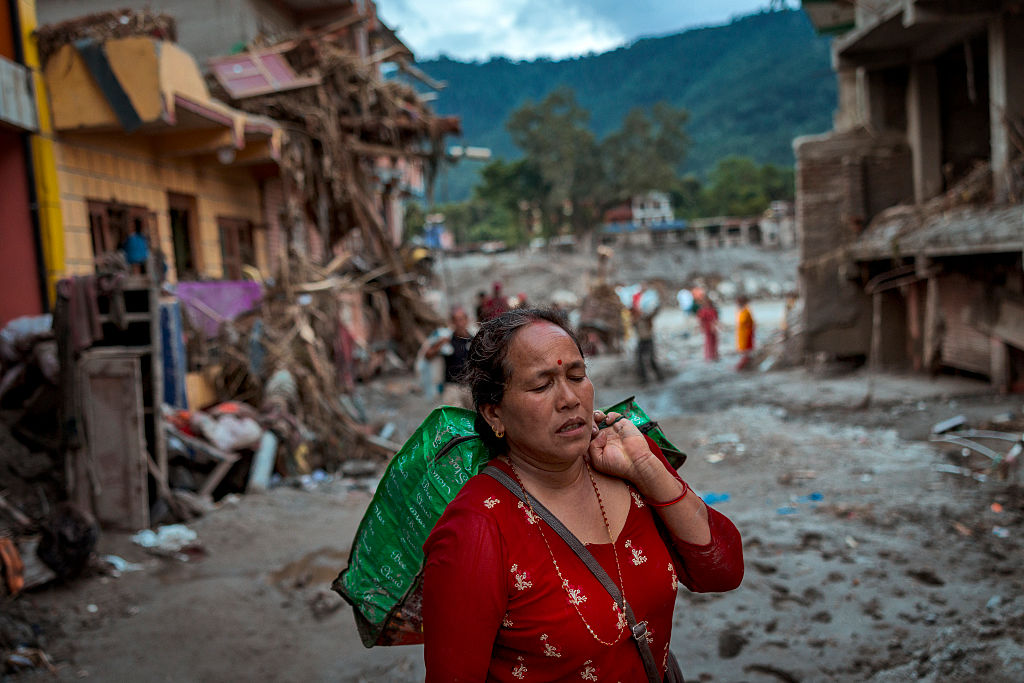
While board members were united in approving the $20 million, plus $1.6 million of administrative costs, representatives of developed and developed countries were divided over the extent to which the decision should set a precedent for the fund’s long-term way of operating.
Germany and Czechia’s board members said it should not set a “precedent” while Japan’s representative said the decision is “truly exceptional” and that the fund’s support must be “in accordance with established rule and procedure”.
Learning the lessons?
Responding, Pakistan’s Ali Sheikh said the lessons from the Nepal case should “feed the long-term model and its work on rapid disbursement” of funds.
He added that he had heard Jan Dusik, Czechia’s board member saying that “we are open for learning but not in setting precedent”. “Please do not define the boundaries for learning,” he emphasised.
Sheikh complained that the decision approved by the board – the result of negotiations between a group of four developed and four developing-country representatives – was narrower than developing countries had hoped for.
“We are saying it is a one-time and Nepal-only window, a sentiment against which many developed countries have raised their voice,” he said, adding there had been no time to review the decision.
Walter Schuldt from Ecuador echoed Sheikh, saying “we should not put limits on lesson learning”. He said the decision, which he was involved in negotiating through “intense exchanges”, tells the fund’s staff to assess the lessons learned.
The fund is currently in a start-up phase and the board will debate its long-term model – including whether and how to rapidly disburse funds in response to climate-driven disasters – at its next board meeting in the Philippines in December.
At Thursday’s meeting, several developing-country board members called for wealthy nations to put more money into the fund. Recovery and reconstruction from Nepal’s flood alone is estimated to cost $4.8 billion – in comparison, the fund has only around $350 million to allocate, with a current cap of $20 million per project.
The post Loss and damage fund agrees $20m for Nepal but rich nations warn it should not set precedent appeared first on Climate Home News.