

China’s central government listed “boosting consumption…and stimulating domestic demand” as its first “major task” for 2025, at the recently closed “two sessions”.
As part of this focus – and amid slowing economic growth – the State Council made specific mention of China’s “two new” (两新) policy.
The policy was first announced in 2023, but was heavily promoted last year. President Xi Jinping reportedly “stressed the importance” of a national recycling company as part of the policy in 2024, because it “facilitates green, low-carbon and circular development”.
Carbon Brief explains what the policy is, how it works and what its impact will be. An abridged version of the article appeared in China Briefing on 20 March.
What is ‘two new’?
The “two new” policy is short for “large-scale equipment upgrades and trade-in of consumer goods”. It is designed to boost domestic demand to prop up growth, at the same time as improving the efficiency of equipment so as to lower emissions.

According to the Communist party’s leading magazine on ideology Qiushi, the idea was first raised in 2023 at an economic conference held by the State Council for “improving technology, energy consumption, emissions and other standards”.
It became well-known after Xi reiterated the idea in early 2024. In March 2024, the policy then became an “action plan – a document illustrating specific methods for executing a political goal.
Prof Bai Quan, director of energy transition at the Academy of Macroeconomic Research – a research institution under the direct supervision of the State Council – told Carbon Brief in 2024 that there are four aspects of “two new”:
- Updates to equipment such as large boilers, turbines, heat pumps and lighting used for manufacturing;
- Trade-in of consumer goods, including fridges and air conditioners;
- Recycling of old or high-emission items;
- Improving standards for product efficiency and emissions, as well as for recycling, “to prevent people from re-purchasing outdated equipment with low energy efficiency”.
He added that the first three aspects directly “promote carbon reduction” and the last one “indirectly serves energy saving and carbon reduction goals”.
Under the policy, government subsidies are provided for manufacturers and consumers to trade-in old inefficient goods and purchase new ones. Other financial and tax support is given to recyclers to increase recycling.
-
Sign up to Carbon Brief’s free “China Briefing” email newsletter. All you need to know about the latest developments relating to China and climate change. Sent to your inbox every Thursday.
In 2025, the State Council updated the “two new” policy and increased the funds available to consumers and businesses.
It also expanded the range of trade-in products, adding more and older petrol cars for instance, as well as pledging to release a more detailed trade-in standard covering 294 items by the end of the year.
Li Gang, an official from the Ministry of Commerce, is quoted by the state news agency Xinhua saying at the press conference on the expansion that it would “help stimulate consumer spending and boost domestic demand. All enterprises, domestic or foreign-funded, private or state-owned, are welcome to participate in the scheme.”
How does equipment upgrade work?
A fundamental mechanism of “two new” is providing funding that enables consumers and businesses to trade-in and upgrade goods, as well as recycling the old equipment.
For example, under the policy, a consumer can trade in an old, inefficient petrol car and receive subsidies to upgrade to a new electric vehicle (EV) instead.
The government “work report” delivered by premier Li Qiang at the “two sessions” says that “ultra-long special treasury bonds totaling 300bn yuan ($41bn) will be issued to support consumer goods trade-in programmes” in 2025.
Meanwhile, another 700bn yuan ($96bn) will be allocated for a sister programme, known as “two major [projects]” (两重), which supports infrastructure construction, including roads and railways.
In a more detailed “two new” paper, the State Council says it will provide about 90% of the funds and the rest shall be covered by local governments.
A sum of cash will be given when old “high-emission” goods, such as ships, trucks, tractors and buses, are sent for recycling, depending on the age and emission levels. Some discounts will also be given when purchasing new lower-emission replacements.
Separately, companies can apply for a low-interest loan for large-scale equipment upgrades.
The State Council paper also eases the rules around low-interest loans for equipment upgrades, making it easier for small and medium-sized enterprises to access them.
According to the paper, projects that can apply funds from the cash pool include “equipment renewal in the field, as well as energy conservation, carbon reduction and safety transformation in key industries”, such as transports and agriculture.
The policy also allocates around 7.5bn yuan ($1bn) for the “recycling and treatment of waste electrical and electronic products”. This extends beyond the list of trade-in items.
How does ‘two new’ support recycling?
As the world’s largest renewable energy producer, China has so far built some 1,408 gigawatts (GW) of wind and solar capacity. About 35m tonnes of waste from decommissioned wind and solar equipment will need to be recycled in China by 2030.
A research paper in the journal Waste Management suggests building up sufficient capacity to recycle this waste could generate “significant economic benefits”.
However, Shanghai-based outlet the Paper reports that only a limited number of recyclers are on the market, due to the high costs and long payback periods.
Despite Beijing issuing policies in 2023 and 2024 to encourage businesses, a stronger recycling market is needed for “advancing” the “two new”, according to prof Du Huanzheng, director of the Circular Economy Research Institute of Tongji University.
In 2024, a state-owned recycling company, China Resources Recycling Group, was established to handle scrap steel, EV batteries and decommissioned renewable energy equipment.
But “challenge[s]” remain for private recyclers, Bai told Carbon Brief. One obstacle is missing a “first receipt”, which is the purchase receipt from manufacturers that enables recyclers to claim value-added tax deductions, he said.
A supporting policy for the “two new” from 2024 allows qualified recyclers to use their purchasing invoice in place of “first receipt” for tax claims.
Bai said this policy “solved the problem” and “is a very important incentive to meet the 2027 goals” of the “two new” policy.
The 2027 goals, written by the State Council, include a 25% increase in new equipment investment across key sectors and a doubling in the share of cars being recycled:
“By 2027, the scale of equipment investment in industries such as industry, agriculture, construction, transportation…will increase by more than 25% compared with 2023; the energy efficiency of major energy-consuming equipment in key industries will basically reach the energy-saving level, and the proportion of production capacity with environmental protection performance reaching Class A will be greatly increased…The amount of scrapped cars recycled will increase by about one-fold compared with 2023.”
How does trade-in work under ‘two new’?
Li Shuo, director of China Climate Hub at the Asia Society Policy Institute (ASPI), tells Carbon Brief that this is not the first time China used subsidies and “similar initiatives” to “stimulate consumption, address product oversupply and enhance energy efficiency”.
In 2025, the categories of eligible trade-in goods under “two new” is expanding from eight to 12, including mobile phones and fridges that are closely related to daily usage. Up to 500 yuan ($70) subsidies apiece can be applied when purchasing new digital products from 2025.
Electric vehicles (EVs), which can greatly decarbonise road transport, remain on the list. In addition, scrappage subsidies have been extended to more and newer types of petrol cars – including cars registered from 2012-14 rather than 2011-2013.
Li adds that the latest expansion of the policy “highlights the rapid pace of industrial upgrades in China and the mutually reinforcing dynamics of industrial productivity, a favorable regulatory framework, and the sheer scale of the Chinese market”.
Bloomberg says that “the cash-for-clunkers program gave a big boost to sales – especially of EVs and hybrids – after its introduction last year” and “manufacturers and investors had been eagerly waiting to see whether the subsidy” would be renewed in 2025.
The buyer rebates for vehicles, including EVs and more efficient petrol cars, remain at the same level as in the second half of 2024, after a rise last August.
Buyers can receive up to 20,000 yuan ($2,730) for EVs and plug-in hybrids or 15,000 yuan ($2,073) for petrol cars with an engine smaller than two litres.
(The Chinese EV industry receives a complicated range of subsidies, read more in Carbon Brief’s Q&A on the sector.)
What is the impact?
Xinhua says that the trade-in scheme boosted sales of cars in 2024, with new energy vehicles (NEVs, mainly EVs and plug-in hybrids) accounting for more than 60% of the new vehicles bought under the initiative in 2024.
Meanwhile, products certified with the “highest energy-efficiency level” made up more than 90% of sales by revenue under the home appliance trade-in scheme, adds the report.
An analysis by Goldman Sachs says the trade-in subsidies have “accelerated” the rising share of NEVs in Chinese car sales. It says the policy will help raise the NEV share from 48% in 2024 to about 60% in 2025.
Subsidies for NEVs under “two new” have amounted to 90bn yuan ($12bn), accounting for about 60% of the total “trade-in money”, according to Goldman Sachs.
In his 2024 analysis for Carbon Brief, Lauri Myllyvirta, lead analyst at the Centre lead analyst at the Centre for Research on Energy and Clean Air (CREA), wrote that the trade-in subsidy scheme would “free up household cash for other types of spending, but it also directs household spending in the most energy-intensive direction”.
He tells Carbon Brief that the policy, after the 2025 expansion, is still a “much more limited measure than the kinds of income transfers that would be needed to substantially boost the role of household consumption in driving economic growth”. He adds:
“[It] targets the most energy-intensive part of household spending, purchases of energy-intensive manufactured goods, while leaving out spending on services and other less energy intensive sectors.”
Lynn Song, chief economist for Greater China from market research firm ING, tells Carbon Brief that it is “hard to quantify [the impact of ‘two new’] until we have more specifics rolled out such as what level of subsidies will be applied”. He says:
“The 300bn budget for the programme sounds a little small at first thought – under 1% of total retail sales last year – but it will boost sales beyond the 300bn [yuan] spent, so it should result in a fairly significant bump in my view.
“Looking at last year’s performance once the policies started ramping up in the second half of the year, we saw autos and home appliances easily outperform the headline retail sales growth.”
Song adds that the trade-in subsidies under “two new” can “lead to improved demand for these categories this year”.
In his 2024 interview with Carbon Brief, Bai called the “two new” a “sign” of the government using policy support to stimulate lower-carbon consumption. He added:
“Another vital policy is the ‘guidelines to ramp up green transition of economic, social development’… It is a blueprint of China’s transition in industry, building [construction], transportation, energy and many other areas. Together with the ‘two new’, which is an implementation document for this top-level design, we now have both a direction and a manual for the energy transition.”
The guideline aims to “achieve ‘remarkable results’ in the green transition” by 2030 and establish a “green, low-carbon and circular development economic system” by 2035.
(Read more about the guideline in China Briefing.)
An official release says that the “two new” policy “saved about 28m tonnes of standard coal and reduced carbon dioxide [CO2] emissions by about 73m tonnes” in 2024. It says the “effect” of supporting the low-carbon transition was “obvious”.


The post Q&A: How China’s ‘two new’ policy aims to help cut emissions appeared first on Carbon Brief.
Q&A: How China’s ‘two new’ policy aims to help cut emissions

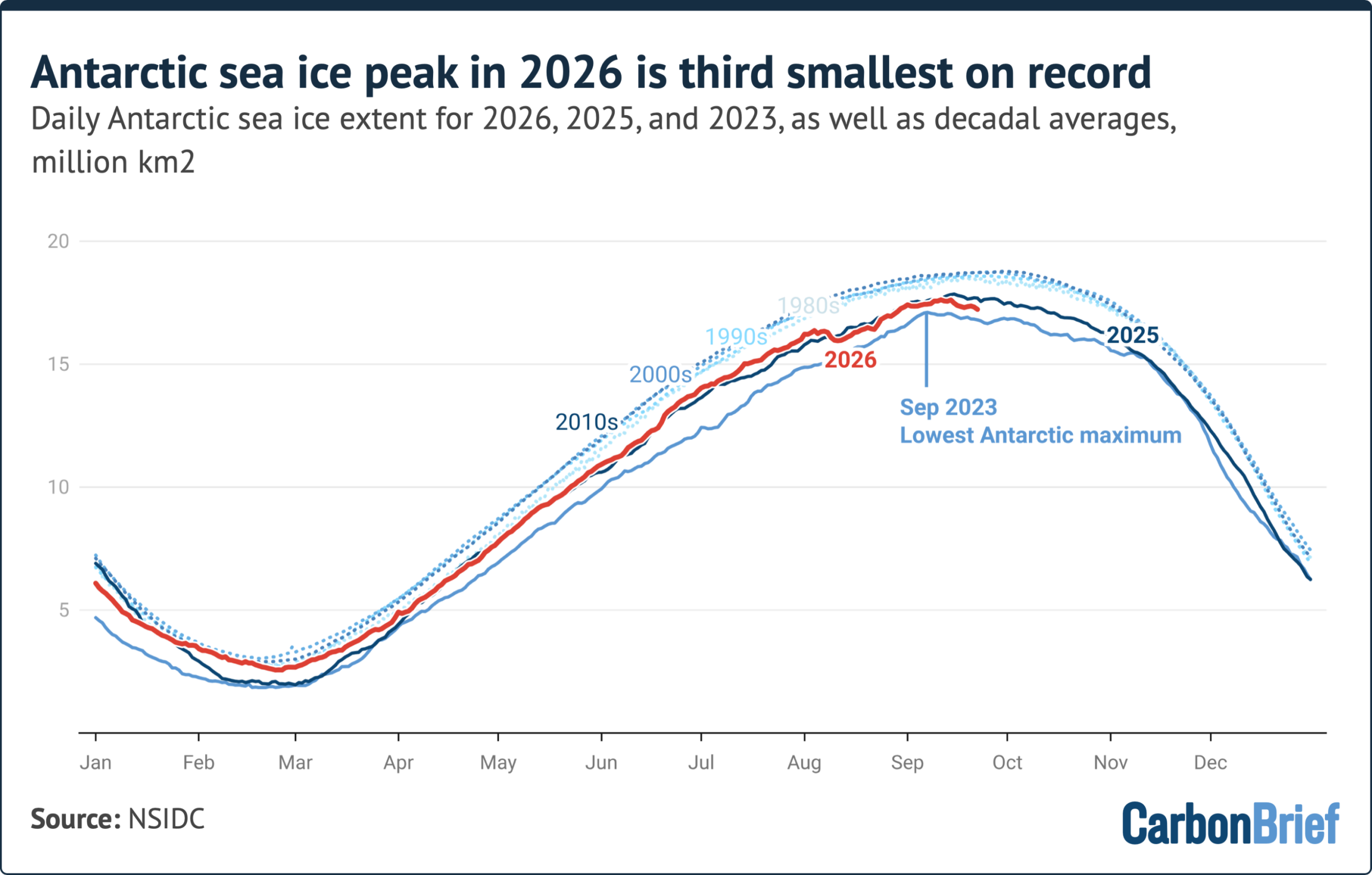
Antarctic sea ice has recorded its third-smallest winter peak extent since satellite records began 48 years ago, new data reveals.
Provisional data from the US National Snow and Ice Data Center (NSIDC) shows that Antarctic sea ice hit its annual winter peak on 14 September, with an extent of 17.59m square kilometres (km2).
The organisation notes that the data is still preliminary, adding that “large fluctuations in extent are typical of Antarctic sea ice near the seasonal maximum”.
One expert tells Carbon Brief that it is “concerning to see these low values persisting”, but says that scientists need more time to determine whether this represents a “structural shift” in Antarctic sea ice extent.
Meanwhile, at the Earth’s other pole, Arctic sea ice reached its annual minimum on 12 September, ranking as the joint-10th lowest in the satellite record.
The NSIDC notes that the last 20 years have seen the lowest 20 Arctic sea ice extents in the satellite record.
Antarctic peak
Dr Lettie Roach, a polar climate scientist at the Alfred Wegener Institute in Germany, tells Carbon Brief that this year’s Antarctic sea ice maximum was “well below average for the season”. She warns that, “after several decades of stable or increasing winter Antarctic sea ice conditions, it is concerning to see these low values persisting”.
She adds:
“Compared with the Arctic, it’s less clear how recent changes in Antarctic sea ice are attributable to human-caused warming vs natural variability. We need more years of observations to better understand whether this is truly a structural shift.”
Dr Clare Eayrs, a postdoctoral researcher at the Korea Polar Research Institute (KOPRI), tells Carbon Brief that, since recording a “near-average February minimum” extent, Antarctic sea ice has “returned to unusually low winter coverage”.
She notes that Antarctic sea ice extent in July and August this year were the fifth and fourth lowest on record, respectively, adding that “all five of the lowest July extents have occurred since 2022 and all four of the lowest August extents since 2023”.
The chart below shows Antarctic sea ice extent in 2025 (dark blue) and 2026 (red) so far. For comparison, the chart shows decadal averages (dotted lines) as well as 2023 (mid blue), the year of the smallest winter sea-ice maximum on record.
Eayrs tells Carbon Brief that the regional pattern of Antarctic sea ice cover “changed substantially during the growth season”.
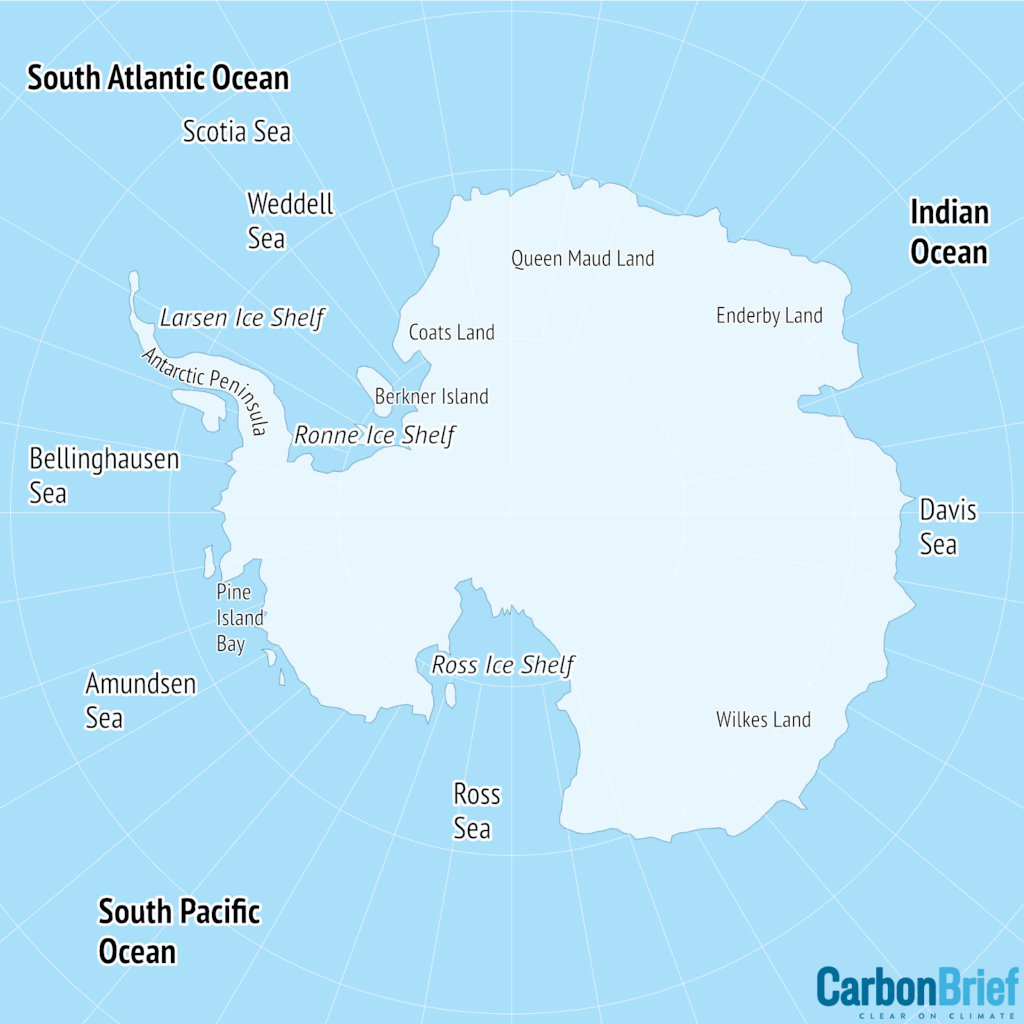
For example, she says that “in April, the Bellingshausen Sea remained almost entirely ice-free, while the neighbouring Amundsen Sea had more ice than usual”.
However, by late August, changes in atmospheric pressure and wind meant that “the Bellingshausen deficit had largely recovered, while ice was unusually scarce in the Amundsen Sea and across much of East Antarctica”.
Arctic minimum
Meanwhile, the Arctic recorded its minimum summer sea ice extent on 12 September. At 4.60m km2, this year ties with 2025, 2010 and 2008 as the 10th-lowest sea ice extent on record.
The chart below shows Arctic sea ice extent in 2025 (dark blue) and 2026 (red) so far. For comparison, the chart shows decadal averages (dotted lines) as well as 2012 (mid blue), the year of the smallest summer sea-ice minimum on record.
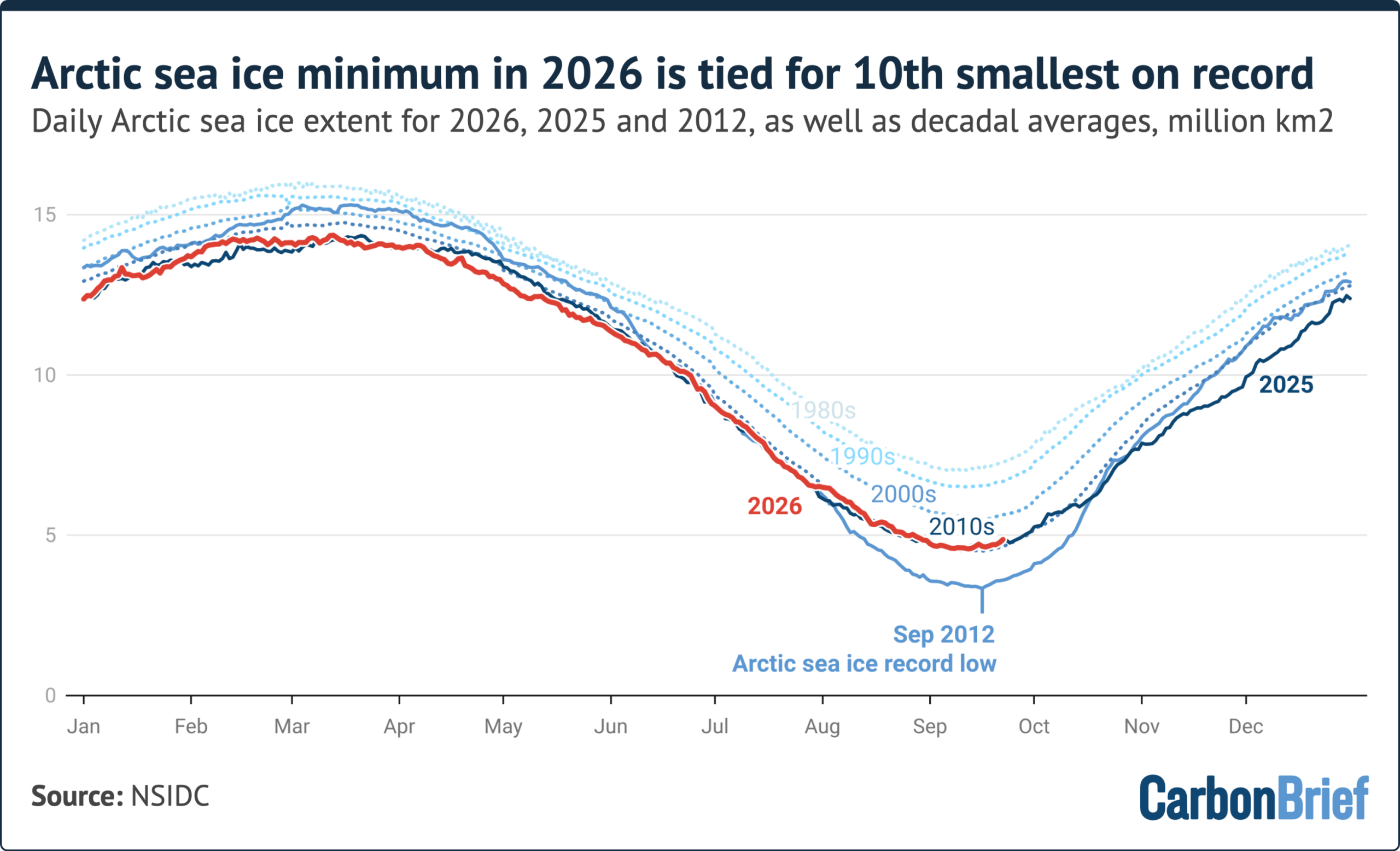
Roach tells Carbon Brief that although this minimum is not “record setting”, it is still “lower than any sea ice minimum before 2007”. She adds:
“Human-caused climate change has reduced Arctic sea ice cover and thickness, so the region is fundamentally different compared to a few decades ago.”
Scientists have been tracking Arctic sea ice thickness using a reanalysis produced called the Pan-Arctic Ice Ocean Modeling and Assimilation System (PIOMAS) since 1979.
In March 2026, the National Oceanographic and Atmospheric Administration (NOAA) terminated a global dataset of air pressure that scientists relied upon to produce PIOMAS, forcing both datasets to stop publishing updates.
The PIOMAS website says it will take “considerable effort and time” to find alternative data to use in their reanalysis. It adds that “we don’t yet have a good sense if that’s possible with available funds and if so, when we will be able to resume production of a new PIOMAS timeseries”.
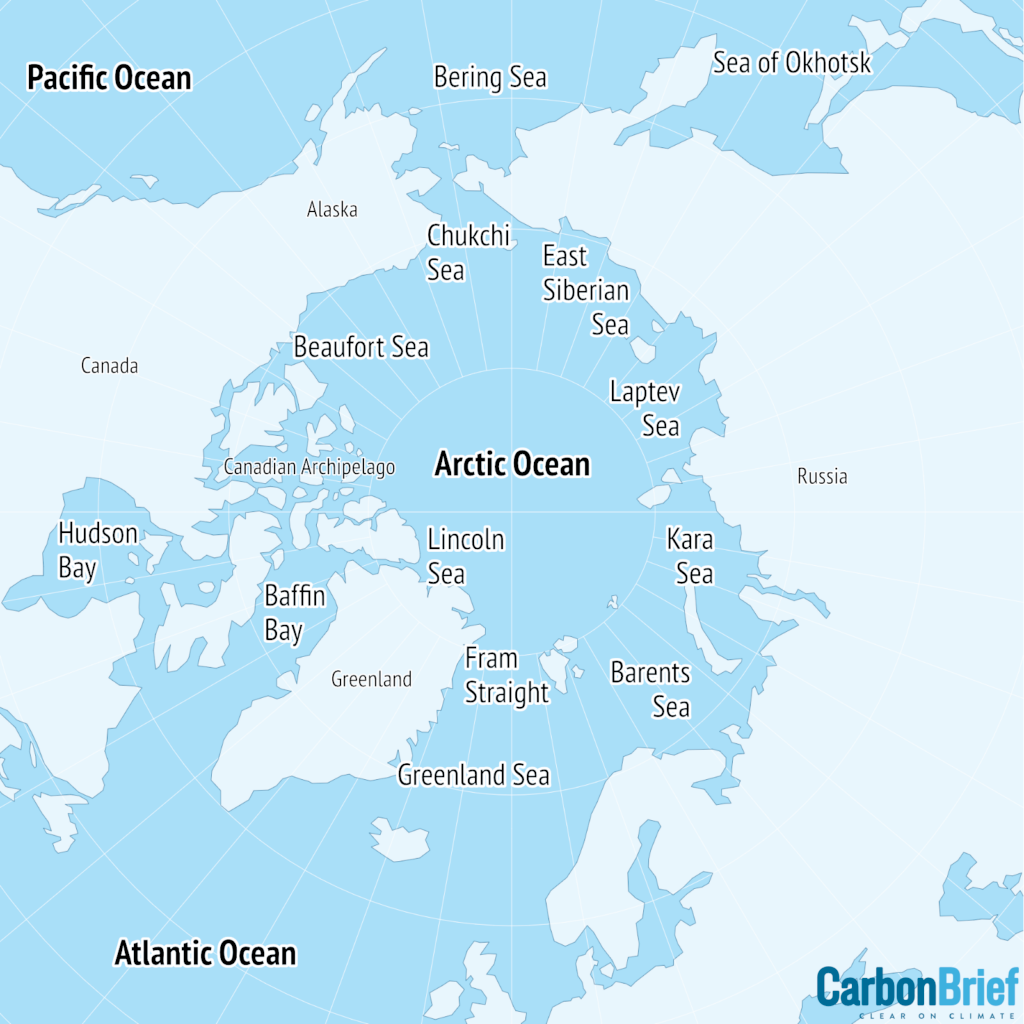
Roach also notes that August saw record-breaking heat sweep across much of the world, explaining that high temperatures “extended into Arctic coastal regions, close to regions with substantial sea ice loss – particularly the Barents-Kara and East Siberian seas”.
Dr Zack Labe, a scientist at Climate Central, tells Carbon Brief that the absence of a new record does not mean that ice cover is becoming more “resilient”. He says:
“Local weather patterns across the Arctic play a really important role in year-to-year sea-ice extent, even as the long-term trend is clearly downward.”
Labe tells Carbon Brief that weather in the Arctic this summer was “influenced mainly by lower pressure toward the central Arctic, which brought cloudier and cooler conditions that limited surface melt and delayed the start of the melt season”.
He explains that this “was most obvious across parts of the Beaufort and Chukchi seas, where the melt season didn’t really kick off until after early July, which was more than two weeks later than normal”.
In contrast, he says, the Atlantic side of the Arctic “had a much more extreme summer”, with sea ice in the Barents Sea recording its “earliest melt-out on record”.
This was partly due to “unusually warm air and ocean temperatures”, Labe says. He notes, for example, that parts of western Siberia saw unusually persistent temperatures more than 5C above the 1981-2010 average for much of the summer, which extended out over the Kara Sea and contributed to substantial ice melt in this area”.
Labe tells Carbon Brief that, going forward, scientists need “more data and observations of other sea-ice metrics, like ice thickness, which may give us better insight into the overall condition of the ice pack, especially during years like 2026 when it is very fragmented”.
(In March 2026, Arctic sea ice reached its peak extent for this winter, clocking in as the joint-smallest in a satellite record going back almost half a century.)
Related
Guest post: Climate change has caused one-fifth of Pine Island glacier retreat
‘Very alarming’ winter sees Arctic sea ice hit record-low for second year running

Q&A: How Trump is threatening climate science in Earth’s polar regions

Limiting warming to 2C is ‘crucial’ to protect pristine Antarctic Peninsula
The post ‘Concerning’ low sea ice persists as Antarctic hits third-lowest winter peak appeared first on Carbon Brief.
‘Concerning’ low sea ice persists as Antarctic hits third-lowest winter peak
Participants at COP31 in Antalya will have a “duty” not to interfere in Türkiye’s internal affairs under the country’s hosting deal with the UN, reviving a clause dropped for last year’s climate summit in Brazil that human rights groups warn could put activists at risk.
Türkiye has faced growing criticism from human rights groups over the jailing of opposition figures, journalists and activists and imposed a blanket protest ban around July’s summit of the NATO military alliance in Ankara.
The contested provision is included in the binding agreement between the UN climate secretariat and the Turkish government that sets out responsibilities over logistical arrangements and details participants’ rights and obligations.
The document, signed in June but only made public on Wednesday, gives accredited COP31 attendees immunity from legal action over what they say, write or do in connection with the conference. Climate Home News understands that this safeguard can be applied to what takes place both inside and, in certain circumstances, outside of the UN-controlled COP “Blue Zone”. For the first time, this protection explicitly continues after the summit ends.

But participants enjoying these “privileges and immunities” also have a duty to respect Türkiye’s laws and regulations and not to interfere in its internal affairs, the agreement states. Rights groups fear its wide-ranging formulation could be used to discourage criticism of the host government.
Climate Home News understands that whether an action is covered by the immunity or infringes on the host’s internal affairs would be evaluated on a case-by-case basis, with close coordination between the country’s authorities and the UN climate change body.
A separate provision states that immunity shall be waived where the UN believes it would “impede the course of justice”.
‘Chilling effect’
Those same provisions featured in the host country agreements for COP28 in the United Arab Emirates and COP29 in Azerbaijan, both regarded as authoritarian regimes, before being dropped for COP30 in Brazil.
Ann Harrison, climate justice policy advisor at Amnesty International, said it is “extremely disappointing” that the COP31 agreement re-introduced clauses that could “hinder the ability of human rights defenders and civil society organisations to conduct their work safely”.
COP31 electrification pledge leaves out clean power commitment
She added the provisions could have a “wider chilling effect” on rights to freedom of expression and peaceful assembly, given concerns over the human rights situation in Türkiye, including laws that “have shrunk civic space” and their “abusive” implementation by authorities.
The UN climate change body declined to comment.
Rights groups have documented blanket protest bans, unlawful use of force by the police and prosecutions of journalists, human rights defenders and lawyers across Türkiye in the last year.
Arrests and protest bans
Last July, environmental activist Esra Işık was sentenced to more than two years for “resisting” a public official over what Amnesty International described as a peaceful protest against an urgent expropriation order linked to the expansion of coal mining in south-western Türkiye. She is appealing the conviction.
Ahead of a summit of the NATO alliance in the capital Ankara in July, authorities put in place a 13-day blanket ban on demonstrations, citing “national security”, and arrested over 200 people. Human Rights Watch said the crackdown showed Türkiye’s “ruthless intolerance of freedom of speech and assembly”.
Earlier this month, Turkish police detained dozens of people as part of what rights groups described as the government’s widening crackdown on LGBTQ+ activists and venues.
Questioned by media as to how he would guarantee the right to protest at COP31, Kurum said earlier in September that his team would “try to meet” any request they receive from civil society and give them “a free space to express themselves”.
“Don’t worry, thinking you will not be able to voice your opinions or really share your thoughts,” he said in an attempt to reassure campaigners, adding that he had put former deputy environment minister Mehmet Birpinar in charge of liaising with civil society.
Civic space needed
Camilla Pollera, human rights and climate change campaigner at the Center for International Environmental Law (CIEL), said meaningful participation at COP31 is fundamental to the legitimacy of climate action.
“At a climate summit, civil society participation necessarily includes being present, speaking out, scrutinising governments’ decisions and climate policies, and advocating for communities most vulnerable to climate change,” she added.

At last year’s COP30 summit, thousands of Indigenous people and climate activists peacefully marched through the Amazonian city of Belém in the first major demonstration outside the UN venue in four years. Smaller-scale demonstrations were largely confined to the “Blue Zone” at COP27 in Egypt, COP28 in the UAE and COP29 in Azerbaijan.
In two other separate incidents in Belém, members of the Munduruku tribe blocked access to the conference centre for hours, demanding an end to development projects in their ancestral land, and protesters stormed through the venue clashing with UN security officials.
The COP31 hosting agreement keeps some of the safeguards previously hailed by civil society groups. The government and the UN secretariat commit to upholding “the fundamental human rights” of all participants in the agreement’s preamble.
Under the deal, Türkiye also needs to ensure that security personnel follow “the highest ethical and professional standards and are expected to behave with integrity and respect”.
The post COP31 attendees told not to interfere in Türkiye’s “internal affairs” appeared first on Climate Home News.
COP31 attendees told not to interfere in Türkiye’s “internal affairs”
As rising seas submerge growing swathes of land, countries that lose territory should still keep their national boundaries, sovereign rights and UN membership, according to a political declaration adopted at the UN General Assembly in New York on Thursday.
The declaration, which was championed by climate-vulnerable small island states, affirms “the presumption in favour of continued statehood” in the face of sea level rise fuelled by climate change, and urges countries to work together to assist communities affected by encroaching oceans.
Speaking at a high-level UN meeting to address the existential threats posed by sea level rise, Cabo Verde’s Prime Minister Francisco Carvalho, one of the initiative’s co-facilitators along with Australia, said the adoption of the text by consensus sends “a message of hope”.
“This declaration has a very special meaning. For us, sea level rise is neither a distant threat nor a theoretical concern,” he said, adding that rising seas put at risk key infrastructure, water resources and economic growth in small island states.
In the Pacific, sea levels have risen at twice the global rate, dramatically increasing coastal flooding events from two to 20 a year in the Republic of the Marshall Islands, and from zero to 102 events per year in American Samoa, according to the World Meteorological Organization (WMO).
Surangel Whipps Jr., president of the Pacific island of Palau, said the summit in New York represents a “moment of international solidarity”, and highlighted that small island states will remain permanent members of the UN.
-
Push for cooking to be part of COP31’s electrification agenda
The President of Kenya and the British climate envoy said Africa should use the global electrification push to roll out clean cooking -
Germany unveils plan to end use of fossil fuels in energy sector by 2045
Germany became the third country to publish a roadmap to phase out fossil fuels after France and the Netherlands, as the UN chief calls on all governments to follow -
UN Climate Summit: UN chief says world has tools to end fossil fuel age
At the UN Secretary-General’s climate summit in New York, countries shared their energy transition plans while Nepal and island nations advocated for more international support

Declaration recognises statehood
An advisory opinion by the world’s top maritime court, the International Tribunal on the Law of the Sea (ITLOS), first upheld in 2024 that countries do not have to shrink their maritime borders even if they lose land territory due to sea level rise. This was reiterated by the International Court of Justice in last year’s landmark ruling on the climate obligations of states.
The new declaration endorsed by all governments at the UN General Assembly stresses that sea level rise “is not a distant scenario but a real and lived experience for many”, and notes that international law must be implemented in global responses to rising seas.
UN Secretary-General António Guterres said the “milestone must now be translated into action”, adding that the declaration should encourage an “ongoing dialogue” at the “highest possible level” leading to practical outcomes. Pacific islands have proposed an international treaty on sea level rise that would provide more legal certainty.
“Those on the frontlines must be front and centre on every decision. We cannot allow countries and cultures to vanish beneath the waves,” he said. “The SOS has gone out. The world must answer.”
At regional summit, Pacific islands ask for COP31 support for clean energy and finance
Goodwin Friday, prime minister of St. Vincent and the Grenadines, said measures to protect vulnerable states will require adequate finance. “Investing in resilience now is more cost-effective than paying the far greater price for loss and damage later,” he added.
Championed by Australia’s COP31 co-presidency, Pacific islands have sought to put adaptation to sea level rise and ocean conservation at the top of the political agenda by inviting world leaders to attend the pre-COP31 summit co-hosted by Fiji and Tuvalu in October.
Tuvalu will also host the second global fossil fuel phase-out summit in April 2027, after around 60 governments met this year in Santa Marta, Colombia, to discuss ending their dependence on coal, oil and gas.
“Our coastlines, our reefs and our communities are living with the consequences of fossil fuel dependence every day, and our people have earned the right to help shape the way forward,” Lynda Tabuya, Fiji’s climate minister, said in a statement announcing details of the conference.
Ocean monitoring gets a boost in New York
Amid record-breaking marine heat and seas rising at unprecedented speed, governments in New York announced new commitments to protect the world’s ocean, as efforts to bolster marine ecosystems and coastal communities rise up the political agenda.
On Wednesday, the EU and Canada announced more funding for a new Europe-led ocean monitoring system called OceanEye, launched in the aftermath of a failed attempt by the Trump administration to dismantle the largest existing network of deep-sea observatories.
During an event at UN headquarters in New York, EU President Ursula von der Leyen and Canadian Prime Minister Mark Carney announced around $163 million in new funding for the initiative, with the EU pledging €92 million ($105m) on top of existing seed funding and Canada pledging C$82 million (US$58m) over five years.
According to an EU statement, while OceanEye will collaborate with the Global Ocean Observing System, that network “remains vulnerable to financial shortfalls and geopolitical disruptions”. A group of 30 countries from Europe, Africa and the Americas joined an international initiative in support of OceanEye, including large coastal nations like Brazil, Namibia and Mexico.
Von der Leyen said OceanEye “can make us the leading ocean data provider in a matter of years”, including by launching new satellites and installing new observatories in the deep ocean. “From outer space to the deepest ocean, our funding helps us keep watch beneath the waves,” she added.
Carney said the initiative would help protect Canada’s Arctic region with real-time monitoring operating year-round. “We can’t protect what we can’t see,” he said, also highlighting that Canada had expanded conservation of its ocean territory from 1% a decade ago to 15% now.
In New York, a group of 19 countries said they are either developing or implementing plans to sustainably manage all of their ocean territory, with 12 new nations joining the initiative. In a joint communiqué, they called on more countries to sign up ahead of COP31.
Warnings of El Niño-fuelled extreme heat
Scientists and world leaders have raised the alarm over this year’s record-breaking marine temperatures, which have persisted above historical peaks for more than 100 days as the naturally occurring El Niño phenomenon intensifies in the Pacific.
Extreme ocean heat could become a threat to coastal ecosystems and communities, experts fear. Water temperatures 1.5C above normal levels have also rapidly fuelled a strong hurricane in the Pacific in recent days.
Despite scientific calls for additional ocean conservation efforts, a report launched this week in New York warned that efforts to protect ocean ecosystems are lagging behind, with only 10% of the global ocean covered by conservation areas and just 3.5% designated as “effectively protected”.
The post Threatened by rising seas, small islands secure right to keep their statehood appeared first on Climate Home News.
Threatened by rising seas, small islands secure right to keep their statehood



-

 Greenhouse Gases2 years ago
嘉宾来稿:满足中国增长的用电需求 光伏加储能“比新建煤电更实惠”
-
Climate Change1 year ago
Guest post: Why China is still building new coal – and when it might stop
-
Greenhouse Gases1 year ago
Guest post: Why China is still building new coal – and when it might stop
-

 Climate Change2 years ago
嘉宾来稿:满足中国增长的用电需求 光伏加储能“比新建煤电更实惠”
-
Climate Change2 years ago
Bill Discounting Climate Change in Florida’s Energy Policy Awaits DeSantis’ Approval
-

 Renewable Energy11 months ago
Sending Progressive Philanthropist George Soros to Prison?
-
Greenhouse Gases1 year ago
嘉宾来稿:探究火山喷发如何影响气候预测
-

 Climate Change2 years ago
Analysis: China’s CO2 falls 1% in Q2 2024 in first quarterly drop since Covid-19