

Palantir Technologies Inc. (NASDAQ: PLTR) released its financial results for the fourth quarter ending December 31, 2024. The company showed strong growth in key areas. Its success mainly came from its artificial intelligence (AI) solutions, which integrate advanced technology into commercial and government sectors.
Their core work revolves around combining AI and machine learning, helping clients analyze data more efficiently and make smarter decisions. They work closely with the U.S. Department of Defense, intelligence agencies, and global allies to improve data management, strengthen decision-making processes, and enhance security. This is how it plays a vital role in both the public and private sectors.
Alexander C. Karp, Co-Founder and Chief Executive Officer of Palantir Technologies Inc. said,
“Our business results continue to astound, demonstrating our deepening position at the center of the AI revolution. Our early insights surrounding the commoditization of large language models have evolved from theory to fact. I would also like to congratulate Palantirians for their extraordinary contributions to our growth. They have earned every bit of the compensation from the delivery of their market-vesting stock appreciation rights (SARs).”
U.S. Market Fuels Palantir’s Strong Q4 Performance
Palantir’s fourth-quarter results reflected significant growth in the U.S. market.
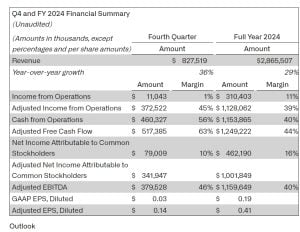
- Total revenue reached $828 million, a 36% year-over-year increase and 14% growth from the previous quarter.
- U.S. revenue alone surged 52% compared to the prior year, hitting $558 million.
In the commercial sector, U.S. revenue climbed 64% year-over-year, reaching $214 million, while government revenue grew by 45% to $343 million. The company also set a record by closing $803 million in total contract value (TCV) for U.S. commercial deals, marking a 134% increase year-over-year.
Karp also noted,
“The demand for large language models from commercial institutions in the United States continues to be unrelenting. Every part of our organization is focused on the rollout of our Artificial Intelligence Platform (AIP), which has gone from a prototype to a product in months. And our momentum with AIP is now significantly contributing to new revenue and new customers.”
Financial Highlights in Q4
The company achieved impressive operational and financial results during the quarter which further indicated a strong performance. The key success parameters were:
- Generated $460 million in cash from operations, reflecting a healthy 56% margin. Additionally, its adjusted free cash flow climbed to $517 million, with a higher margin of 63%.
On the earnings front, Palantir reported a GAAP net income of $79 million, equivalent to $0.03 per share. When excluding one-time stock-related expenses, net income significantly increased to $165 million, or $0.07 per share. Furthermore, the company’s adjusted earnings per share (EPS) rose to $0.14, which drove its shareholder value.
Expanding Customer Base and Key Deals
Palantir added new customers at a rapid pace, with its customer base growing 43% compared to the previous year. The company closed 129 deals worth at least $1 million, 58 deals valued at $5 million or more, and 32 deals exceeding $10 million.
The company’s remaining deal value (RDV) for U.S. commercial contracts rose to $1.79 billion, nearly doubling from the prior year. These figures highlight Palantir’s growing influence across industries.
Fiscal Year 2024 Was All About Sustained Growth
Palantir delivered strong results for the full year, with total revenue reaching $2.87 billion—an impressive 29% growth compared to the previous year.
The U.S. market played a key role, contributing $1.9 billion to the total. Commercial revenue saw remarkable growth, surging 54% to $702 million, while government revenue increased 30%, reaching $1.2 billion.
Other significant revenue drivers were:
- Robust cash flow that generated $1.15 billion from operations with a solid 40% margin.
- It reported an annual net income of $462 million. It reflected a 16% margin with sustainable profitability.
- With $5.2 billion in cash and short-term investments, Palantir envisions growth and expansion in the future.
Palantir’s 2025 Outlook: Strong Growth Ahead
The company is already envisioning strong financial expectations for 2025, projecting solid growth across several key areas. For the first quarter of 2025, the company anticipates:
- Revenue between $858 million and $862 million.
- Adjusted operating income between $354 million and $358 million.
For the full year 2025, Palantir anticipates total revenue between $3.741 billion and $3.757 billion, driven by a growth rate of at least 54% in U.S. commercial revenue, which is expected to exceed $1.079 billion.
The company is also projecting adjusted operating income to range between $1.551 billion and $1.567 billion, with adjusted free cash flow between $1.5 billion and $1.7 billion. It will also continue to report GAAP operating income and net income each quarter, ensuring transparency while navigating the ambitious targets.
Palantir’s Commitment to Net Zero
Palantir Technologies UK achieved carbon neutrality in 2023 which was a significant milestone in its sustainability journey. The company retired carbon credits to offset all remaining emissions, aligning with its 2021 Climate Pledge.
Committed to achieving Net Zero, Palantir is focused on reducing emissions further and aligning with the UK Carbon Reduction Plan that focuses on limiting global warming to 1.5°C.
Total Carbon Emissions 2023
While Palantir acknowledges that its direct emissions—Scope 1, 2, and 3—are relatively small on a global scale, it believes its greatest contribution lies in empowering its customers. In this perspective, the company helps businesses track and reduce emissions, particularly within complex supply chains.
Its tools are already enabling companies to transition to clean energy and adopt e-mobility solutions, paving the way for a Net Zero future.
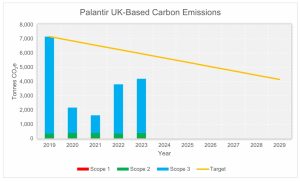
- In 2023, Palantir reported emissions totaling 4,196 tCO2e, a significant drop from its baseline year emissions of 7,161 tCO2e in 2019.
Renewable Energy Goals
Palantir has joined forces with leading organizations to accelerate global sustainability efforts. The company plays a vital role in helping its partners decarbonize supply chains, enhance grid resilience, and roll out EV networks. Its innovative Agora platform, launched in 2022, enables global commodity companies to track and reduce emissions across the value chain.
The company also supports renewable energy projects and uses digital twin technology to improve efficiency in energy-intensive industries.
Mitigating Cloud Compute and Data Center Emissions
Cloud computing has been one of Palantir’s biggest sources of carbon emissions. However, advancements in cloud efficiency and the use of sustainable energy by partners like AWS, Microsoft Azure, and Google Cloud have significantly reduced this impact.
- In 2023, Palantir cut cloud-related emissions by 32% compared to the previous year.
This progress came from improved compute efficiency in its platforms—Foundry, Gotham, Apollo, and the Artificial Intelligence Platform (AIP)—along with ongoing engineering efforts.
The company’s teams are continuously finding new ways to optimize cloud usage. By balancing efficiency with business growth, Palantir stays on track with its sustainability goals.
Slashing Travel Emissions with SAF
As a global company, business travel is essential to Palantir’s operations which also impacts its Scope 3 emissions. To reduce this impact, Palantir encourages employees to opt for virtual meetings when possible and carefully considers the need for in-person meetings to balance environmental and business needs.
In 2023, Palantir also continued its partnership with United Airlines’ Eco-Skies Alliance, committing to the use of sustainable aviation fuel (SAF) for its air travel. This initiative aims to lower its travel-related emissions while still supporting face-to-face collaboration.
Palantir’s impressive financial results in 2024 along with its reduced carbon emissions, highlight its commitment to both growth and sustainability. The company is on track to continue innovating and expanding, setting itself up for long-term success.
The post Palantir Reports Record-Breaking Q4 and Net Zero Success appeared first on Carbon Credits.

EU carbon credit claims changed on 27 September 2026, the day the Directive (EU) 2024/825 began to apply across the European Union. The change is narrow. It changes how a company can talk about the credits it buys. A product can no longer be called neutral on the strength of compensation alone; however, every specific, evidenced statement about what a company measured, reduced, and funded stays fully available.

The post Promoting Improved Cooking Practices in Nigeria appeared first on Terrapass.



-
Climate Change1 year ago
Guest post: Why China is still building new coal – and when it might stop
-

 Greenhouse Gases2 years ago
嘉宾来稿:满足中国增长的用电需求 光伏加储能“比新建煤电更实惠”
-
Greenhouse Gases1 year ago
Guest post: Why China is still building new coal – and when it might stop
-

 Climate Change2 years ago
嘉宾来稿:满足中国增长的用电需求 光伏加储能“比新建煤电更实惠”
-

 Renewable Energy12 months ago
Sending Progressive Philanthropist George Soros to Prison?
-
Climate Change2 years ago
Bill Discounting Climate Change in Florida’s Energy Policy Awaits DeSantis’ Approval
-
Greenhouse Gases1 year ago
嘉宾来稿:探究火山喷发如何影响气候预测
-

 Climate Change2 years ago
Analysis: China’s CO2 falls 1% in Q2 2024 in first quarterly drop since Covid-19