Connect with us

Published

on

A “collapse” of key Atlantic ocean currents would cause winter temperatures to plunge across northern Europe, overriding the warming driven by human activity.

That is according to new research, published in Geophysical Research Letters, which looks at the combined impact of the shutdown of the Atlantic Meridional Overturning Circulation (AMOC) and global warming on temperatures in northern Europe.

Scientists have warned that human-caused climate change is likely causing AMOC to weaken and that continued warming could push it towards a “tipping point”.

The study suggests that, in an intermediate emissions scenario, greenhouse gas-driven warming would not be able to outweigh the cooling impact of an AMOC collapse.

In this modelled world, one-in-10 winters in London could see cold extremes approaching -20C.

Winter extremes in Oslo in Norway, meanwhile, could plummet to around -48C.

The cold temperatures are projected to be driven by the loss of heat transfer from the tropics via ocean currents, as well as the spread of sea ice to northern Europe in the winter months.

The research does not look at when AMOC might tip – instead, it focuses on scenarios in the far future when this has already happened, so as to explore what impact it would have.

Lead author Dr René van Westen, a researcher in oceanography at Utrecht University, says Europe might stand alone as the one region set to get “cooler in a warmer world”. He tells Carbon Brief:

“If the AMOC collapses, we need to prepare for substantially cooler winters. Winter extremes will be very substantial for some regions. Temperatures could go down to -50C in Scandinavia. At -40C and lower in Scandinavia – everything breaks down over there.”

The research is being published alongside an interactive map, featured below, which highlights how a collapsed AMOC under different warming scenarios could impact temperature averages, extremes and sea ice across Europe.

‘Will warming or cooling win?’

AMOC is a system of ocean currents which plays a crucial role in keeping Europe warm. It transports warm water northwards from the tropics to Europe and cold, deep waters back southwards.

The potential collapse of these ocean currents – caused by the influx of freshwater from melting ice as well as rising air temperatures – is seen by some scientists as a “tipping point” that, once triggered, would be irreversible on human timescales.

However, there is significant scientific debate around whether human-caused climate change is causing the AMOC to slow down – and whether and when it might “tip”.

(The “tipping” of AMOC is often referred to as a “collapse”, “breakdown” or “shutdown”.)

Some scientists have argued that ocean currents have been slowing down since the mid-20th century, whereas others say there has been no weakening since the 1960s.

On the risks of an approaching tipping point, some researchers have estimated a collapse could occur this century, but others have questioned the robustness of the early warning signals being interpreted as evidence of a forthcoming shutdown.

(Regular direct measurements of AMOC’s strength started in 2004. To estimate the ocean currents’ health prior to this, scientists turn to a number of methods, including looking at palaeoclimate records, running climate model “hindcasts” and analysing historical patterns in sea surface temperature.)

A paper published last year by van Westen and colleagues, which ranked second in Carbon Brief’s round-up of the most talked-about climate papers of 2024, found that the present-day AMOC is on a trajectory towards tipping.

That paper set out some of the climate impacts of such an event, including a 10-30C drop in average monthly winter temperatures in northern Europe within a century and a “drastic change” in rainfall patterns in the Amazon.

The scientist’s latest offering provides a more detailed look at how an AMOC tipping event might impact Europe, using simulations produced by the Community Earth System Model (CESM).

The research models the impact of an AMOC collapse in combination with the impacts of human-caused climate change, instead of looking at the collapse of the ocean currents in isolation.

Van Westen says the research was designed to answer the question of how warming from greenhouse gas emissions could offset cooling from an AMOC shutdown. He tells Carbon Brief:

“[A question we wanted to address was] what would happen in a scenario where we have climate change and an AMOC collapse. Will it get cooler over Europe, or will it get warmer? Will regional warming win or will the cooling win?”

Simulating AMOC ‘collapse’

To answer this question, the scientists run a raft of climate simulations, exploring different combinations of global temperature rise and AMOC collapse.

Specifically, the scientists explore the collapse of AMOC under three scenarios:

  • An “intermediate” climate scenario (RCP4.5), which is in line with current global climate policies.
  • A very high-emissions scenario (RCP8.5) where warming hits 4C above the pre-industrial average by 2100.
  • A “pre-industrial” scenario, without any human-caused global warming.

Across all three scenarios, the researchers run multiple simulations 500 years into the future, stabilising global temperature rise at 2C and above 4C from 2100 onwards. The researchers explore scenarios where AMOC is stable and when it has tipped.

The paper does not discuss the level of warming at which AMOC might tip – instead, it focuses on a point in the future after it has occurred, when the ocean currents and the climate have “equilibrated to a new background state”.

To simulate an AMOC collapse in the climate model under the two warming pathways, the researchers apply high levels of freshwater forcing to the north Atlantic.

Van Westen acknowledges the level of freshwater forcing applied to the model to create an AMOC shutdown is “unrealistic”, but says the adjustment is necessary to override a “bias” in climate models. He explains:

“[Climate models] have an overly stable AMOC. So, we need to add this kind of freshwater flux to get the AMOC in a more unstable regime which corresponds to actual observations.”

The paper focuses largely on impacts under the intermediate scenario with AMOC collapse. Under this combination, AMOC shutdown causes some global cooling, resulting in a world that is around 2C warmer than pre-industrial levels.

Prof Stefan Rahmstorf, a professor of physics of the oceans at Potsdam University who was not involved in the research, tells Carbon Brief the new study is “highly welcome”. He explains that “not many” studies have investigated the combined impact of global warming with AMOC collapse since a paper he co-authored in 1999, and adds:

“[The new study] uses a sophisticated climate model with good regional resolution – far better than what was possible 26 years ago. The model confirms the long-standing concern that an AMOC collapse would have massive impacts on European climate, in this case focusing on temperature extremes.”

Dr Alejandra Sanchez-Franks, senior research scientist in the marine physics and ocean climate group at National Oceanography Centre, who was also not involved in the research, says the study’s conclusions should not be used to explain how the European climate will respond in the near-term to changes in the strength of AMOC. She tells Carbon Brief:

“The study uses an idealised experiment with unrealistic freshwater changes to force an AMOC collapse. Very importantly, the author’s conclusions refer to the European climate 200 years after an AMOC change and do not describe what will happen to European temperatures and sea ice in the years and decades following an AMOC collapse.

“Therefore, the study does not serve to tell us how an AMOC tipping point or collapse will affect us immediately.”

‘Out of the freezer and into the frying pan’

The most “striking” finding of the paper, according to van Westen, is that an AMOC collapse in a world that is 2C warmer will result in a Europe that is cooler than it is today.

The research notes that – under this scenario – north-west Europe is set to face “profound cooling”, characterised by more intense winter extremes.

Summer temperatures, on the other hand, would be expected to remain just slightly cooler than they would in a pre-industral climate – meaning that Europeans would experience dramatic swings in temperatures throughout the year.

Increased winter storms and greater day-to-day temperature fluctuations are also expected in this scenario. This is due to a greater temperature contrast between northern Europe and southern Europe, which would be less impacted by a weakened AMOC.

The research notes that cooling from the reduced heat transfer from ocean currents would be amplified by “extensive” sea ice expansion to the coasts of north-west Europe. (Sea ice reflects incoming solar sunlight, resulting in less heat uptake and cooler temperatures overall.)

The map below shows the extent of sea ice in February under the scenario where AMOC collapses and the world is 2C warmer. It shows how Arctic sea ice – when at its yearly maximum – would cover the coasts of Scandinavia and much of the island of Great Britain.

February sea-ice extent under RCP4.5 and AMOC collapse
February sea ice extent under an intermediate emissions scenario (RCP4.5) and AMOC collapse, where the blue line indicates the extent of sea ice. Credit: Amended from van Westen et al (2025).

Prof Tim Lenton, chair of climate change and Earth system science at the University of Exeter, who was not involved in the study, tells Carbon Brief it is “hard to over-stress how different” the climate simulated by the model is from present-day conditions. He says:

“The extreme winters would be like living in an ice age. But at the same time summer temperature extremes are barely impacted – they are slightly cooler than they would be due to global warming, but still with hotter extremes than the preindustrial climate.

“This means the seasonality of the climate is radically increased. In extreme years it would be like coming out of the freezer into a frying pan of summer heatwaves.”

The research also looks at the impacts of a shutdown of AMOC in a world that is 4C warmer.

It suggests that, under this scenario, cooling related to the shutdown of ocean currents would not outweigh global warming. Northern Europe would not experience extensive sea-ice expansion or the strong cooling projected under the 2C scenario.

Instead, temperatures would be expected to increase throughout the year and particularly in the summer months. However, northern Europe would be expected to see warming below the global average.

Frigid cities

While the paper itself uses the Dutch town of De Bilt as a case study, the researchers have published projections for a range of European cities under the scenarios explored in the study.

For example, the data shows that, under AMOC collapse in a 2C-warmer world, London could experience an average winter temperature of 1.9C, roughly 17.6 freezing days each year and one-in-10-year cold extremes of -19.3C.

In the Norwegian capital of Oslo, average winter temperatures are projected to plunge to -16.5C, with maximum daily temperatures not surpassing 0C for almost half the year, or 169 days. The research suggests the Norwegian city could experience cold extremes of -47.9C.

The map below shows projected cold extremes under 2C of warming and AMOC collapse in cities in Belgium, France, Ireland, the Netherlands, Switzerland and the UK. It shows how temperatures could drop to -29.7 in Edinburgh, -19.3C in London and -18C in Paris.

Cold extreme under RCP4.5 and AMOC collapse
Cold extremes – defined as temperatures that could occur once every 10 years – under AMOC collapse and around 2C of warming (“RCP4.5”). Credit: Amended from van Westen et al (2025).

Van Westen says the findings are “highly relevant for society and policymakers” because they “shift the narrative” about the direction of Europe’s future climate. He explains:

“Parts of the Netherlands and parts of the UK will experience spectacular cold extremes down to -20C or even lower. Our societal structure and our infrastructure is not built for these cold extremes.”

The paper is being published alongside an interactive map, shown below, that shows ice cover, temperature averages and extremes across Europe under five of the scenarios explored in the study. These are: a pre-industrial world with a stable AMOC, a pre-industrial world with a collapsed AMOC, a 2C world with a stable AMOC, a 2C world with a collapsed AMOC and a 4C world with a collapsed AMOC.

Future research

Scientists not involved in the study said the work would need to be followed up with further exploration of the interplay between global warming and potential AMOC collapse.

Dr Bablu Sinha, leader of climate and uncertainty, marine systems modelling at the National Oceanography Centre, told Carbon Brief:

“Given that observational data is limited, theoretical climate modelling approaches need to be taken to properly investigate this topic. Van Westen and Baatsen motivate the need for more detailed investigation into the combined impacts of global warming and AMOC decline on European extreme temperatures.”

Dr Yechul Chin, researcher at Seoul National University’s climate system lab, tells Carbon Brief:

“Although [this research] demonstrates the potential for more extreme weather under combined global warming and AMOC collapse scenarios, significant uncertainties remain that must be resolved before we can quantify risks or devise robust mitigation strategies.

“Projections about AMOC have a large spread and it means that alternative AMOC trajectories and different levels of warming could substantially widen the range of possible outcomes.”

His comments are echoed by Rahmstorf from Potsdam University, who points out that the “exact outcome” for Europe hinges on the development of “two opposing trends” – global warming due to greenhouse gases and regional cooling due to AMOC weakening. He says:

“The balance between those two will depend on the speed and extent of these trends and will, therefore, depend on the emission and AMOC weakening scenarios.

“Therefore, the more scenarios will be explored with different models in future, we will see a range of different outcomes for Europe as well as other parts of the world. A large uncertainty in this respect will remain.”

The post Ocean current ‘collapse’ could trigger ‘profound cooling’ in northern Europe – even with global warming appeared first on Carbon Brief.

Ocean current ‘collapse’ could trigger ‘profound cooling’ in northern Europe – even with global warming

Continue Reading

Climate Change

UK withdraws millions in funding from world’s second-largest rainforest in Congo 

Published

on

The UK has abandoned projects worth tens of millions of pounds that were meant to help protect Congo rainforests and support local people.

Together, these initiatives would have made up around half of the £200m that the UK pledged to support conservation in the Congo basin – the world’s second-largest rainforest.

When it hosted COP26 in Glasgow, the UK led a new initiative to end forest loss, which included a collective pledge by 12 donors of “at least” $1.5bn (£1.1bn) for Congo rainforest nations by 2025.

Development minister Jenny Chapman revealed last week that, as of 2024, the UK had only provided £39.8m towards this goal.

Alongside the US and much of Europe, the UK has significantly cut its aid budget in recent years, leading to much of its Congo rainforest spending being cancelled or reappraised.

The government says it still plans to “prioritise” rainforest regions, including the Congo basin, but civil society groups and MPs are concerned about the lack of “ring-fenced” forest funding in the UK’s new aid strategy.

COP pledge

At COP26, the UK – led by then prime minister Boris Johnson – launched the “Glasgow leaders’ declaration”, with a goal to “halt and reverse forest loss” by 2030. This was backed by more than 140 nations.

The UK also made various funding pledges, including £200m to protect the Congo basin, £350m for tropical forests in Indonesia and “up to £300m” for the Amazon.

These commitments target the world’s three largest rainforests, all of which face major forest loss due to threats such as agriculture, logging and climate change.

The Congo basin is the planet’s largest forested carbon sink. Yet, its six host nations are among the poorest in the world and face significant funding barriers.

This has global ramifications. An official UK assessment warned that “degradation or collapse” of the Amazon or Congo rainforests “threaten UK national security and prosperity”.

Forest cuts

Following successive aid cuts introduced by both the Conservative and then Labour governments – tracking a global trend – the UK’s Congo funding is under threat.

The Congo basin forest action programme (CBFA) was launched by the UK at COP27. It was explicitly set up to provide “roughly half” of the UK’s £200m Congo pledge.

CBFA set out to “empower central African nations”, such as the Democratic Republic of the Congo (DRC), with support for “community forests” and other measures to curb forest loss.

Now, after reporting delays, the UK has slashed the CBFA as part of the Labour government’s recent aid cuts, intended to free up money for defence spending.

Its original £90m budget has now been reduced to £18.8m. Government data shows that £15m of this has already been spent.

This is not the only Congo project that has been dropped due to this latest round of aid cuts.

The Congo part of the biodiverse landscapes fundchampioned by the previous government and worth at least £12.3m – has been closed, just two years into its seven-year schedule.

Government documents reveal more Congo forest funding is at risk as the UK scales back its aid budget, including the UK’s two largest remaining projects in the region.

One initiative, intended to “incubate forest-friendly enterprises” in DRC, faces “reduc[ed] budgets”. Officials working on the other, while more optimistic, reported that the project may be forced to operate in fewer countries as the cuts set in.

Documents also reveal the difficulties that come when operating in the Congo, including “complex political economies and, in Gabon, a military coup – which “complicated matters”.

‘Breaking promises’

Damian Fleming, a senior director of forests at WWF International tells Carbon Brief:

“Tropical forest countries are making long-term policy and development choices in expectation that international partners will honour their commitments.”

In a series of recent parliamentary responses, Chapman revealed that the UK had only spent £39.8m on Congo forest finance, as of 2024. (She declined to provide any information on the Indonesia and Amazon regional goals.)

Despite being presented as the UK’s “contribution” to the £1.1bn-by-2025 global goal agreed at COP26, the £200m target has a deadline of 2029.

Therefore, while the collective goal has been met, the UK’s contribution so far has been relatively small.

Zac Goldsmith, a former Conservative minister who oversaw the forest targets at COP26, tells Carbon Brief that, in his view, the UK has “discarded” its regional pledges:

“We have gone from being perhaps the leader on protecting nature internationally to breaking promises to countries around the world for whom the environment is an existential issue.”

Future targets

The Labour government says it has met the five-year “climate finance” target of £11.6bn that expires this year.

Ministers also say the government has met “and exceeded” the £3bn and £1.5bn sub-goals for “preserving nature” and forests, respectively, within the £11.6bn. These are the funding streams that include support for the Congo basin and other rainforests.

The UK has funded a variety of projects in line with its forest goals, including mangrove restoration in Indonesia, support for carbon-offsetting projects in Brazil and promoting “forest stewardship” among farmers in Cameroon.

Chapman has stated that the UK will continue to “prioritise” the Congo rainforest, in line with its new plan for aid spending in Africa. The UK even helped to launch a new “call to action” for Congo basin funding at COP30 last year.

The UK government also says it supported the creation of Brazil’s flagshipTropical Forest Forever Facility” (TFFF). However, so far it has not provided any funding for the facility.

When the government announced a new climate finance pledge for 2026 onwards, it stressed that nature would still be a “focus” and said it would also generate billions in “climate and nature positive investments”. Nevertheless, it dropped the “ring-fenced” amounts for nature and forests that had appeared in its previous pledge.

The UK, alongside other developed countries, has pledged to provide biodiversity finance to developing countries, under the Kunming-Montreal Global Biodiversity Framework (GBF) – a non-binding global pact to halt and reverse nature loss by 2030.

Sarah Champion, chair of the international development committee of MPs, says “sub-pledges” for nature and forests are a “cost-effective and impactful” way to ensure this finance is provided, alongside climate finance. She tells Carbon Brief that she was “concerned” about the move away from this approach:

“When the minister recently appeared before the international development committee, I was concerned to hear her characterise this shift as a ‘gamble’.”

A government spokesperson tells Carbon Brief:

“We remain committed to providing finance for forests, including in the Congo basin, as a core element of our overall climate funding.”

A shorter version of this article was first published in Cropped, Carbon Brief’s fortnightly newsletter that provides a digest of food, land and nature news, on 15 July 2026. Subscribe for free.

The post UK withdraws millions in funding from world’s second-largest rainforest in Congo  appeared first on Carbon Brief.

UK withdraws millions in funding from world’s second-largest rainforest in Congo 

Continue Reading

Climate Change

Cropped 15 July 2026: Uganda starves | Trump opens endangered habitats | UK cuts rainforest aid

Published

on

We handpick and explain the most important stories at the intersection of climate, land, food and nature over the past fortnight.

This is an online version of Carbon Brief’s fortnightly Cropped email newsletter.
Subscribe for free here.

Key developments

Global drought and heat

DRY THEN WET: A recent heatwave and months of low rainfall has led to a prolonged drought for Uganda, resulting in at least 16 deaths from hunger and significant crop losses, reported BBC News. Bastille Post Global suggested that “a developing El Niño later this year could bring heavier rainfall to parts of the region, raising the risk of flooding in areas now struggling with drought”.

FUNDING FOOD: The UN Food and Agriculture Organization (FAO) and the World Food Programme (WFP) have appealed for $200m in funding to help African nations deal with the impact of El Niño, stated Deutsche Welle. This would target 22 high-risk countries with measures, including “cash transfers, climate-resilient seeds, livestock protection and flood control.” The Guardian explained how El Niño could still “cause a severe shock to global food prices lasting into 2028”.

FARMING FEARS: Extreme weather has devastated agriculture across the world. India saw its driest June in 12 years, reported BBC News, and France has had a “double-digit production” decline, according to Le Monde. The Financial Times reported that farmers in the UK are mitigating the impacts of extreme heat by eliminating “chemicals and intensive ploughing to improve soil quality so it retains water”.

EURO FIRES: Wildfires have spread across Europe, with Spain reporting at least 12 deaths so far, according to the Guardian, and France experiencing road closures, said Reuters. Wildfire Today reported that the most extreme conditions are “across France, Spain and northern Portugal, the Alpine arc extending into northern Italy, the south of the UK and south-east Ireland”. CNN explained how “the climate crisis is driving hotter, drier weather, which is setting the stage for fiercer fire seasons”.

Endangering species

REDEFINING HARM: The Trump administration “reversed decades of longstanding environmental law protecting endangered species…opening up sensitive habitats…to drilling, mining, farming and real estate development”, reported CNN. According to the story, the change “redefines what constitutes ‘harm’” to endangered species, which historically prohibited habitat modification or degradation. Agence France-Presse reported that US environmental groups sued the Trump government over the move, arguing that it had violated “common sense, biological science and federal law”.

OPEN SEASON: Reuters reported that the change “limits the reach of the 50-year-old Endangered Species Act” (ESA), which is a “key regulatory consideration” when granting permits for “oil and gas, mining, electric transmission and ​other operations on federal lands and water”. Legal scholars told the New York Times the US government “was acting without conducting scientific research into the impact” of the change, while the National Mining Association “applauded the announcement”.

News and views

  • INTERNATIONAL WATERS: After a significant delay, the UK ratified the Biodiversity Beyond National Jurisdiction Agreement (BBNJ), also known as the High Seas Treaty. Oceanographic detailed how this will allow for “marine protected areas across international waters for the first time”, but also stressed that the “hard part” starts now. 
  • SCOPE-FREE: The world’s largest meat supplier JBS “scrapped a key climate goal” in its net-zero plan that accounts for its suppliers’ emissions, “which make up the vast bulk of the company’s environmental footprint”, reported the Financial Times. The company told the paper it was difficult to control these “indirect” emissions.
  • DEEP TROUBLE: Pacific gray whales are facing a “catastrophic die-off” as sea-ice loss threatens their food sources, said the Guardian. Separately, conservationists warned that more than half of all molluscs that “cluster around underwater vents” could face extinction from deep-sea mining, reported Reuters.
  • ETHANOL PUSHBACK: India’s new rules to promote 100% ethanol fuel and make ethanol-blended fuel mandatory at pumps “triggered a political row”, reported the Times of India. While the Indian government defended the push to automobile owners, a Hindu editorial and an Indian Express comment warned against incentivising fuels made from “water-intensive” sugarcane and rice. 
  • AMAZON ACTION: Deforestation in the Brazilian Amazon fell to its lowest level in a decade, but president Lula’s plans to “end illegal deforestation by 2030” could be hampered if he is not re-elected, reported Al Jazeera. Meanwhile, Colombia’s outgoing environment minister warned of greater environmental and climate risk under the incoming government, said the Associated Press
  • WAR WORRIES: The International Energy Agency (IEA) warned of the impact of the Iran war on Africa’s clean cooking efforts as disruption in the strait of Hormuz has stunted supplies and increased prices of liquefied petroleum gas (LPG), explained Climate Home News

Spotlight

UK ‘discards’ Congo rainforest funding

Amid worldwide cuts to aid spending, Carbon Brief explores how the UK is backtracking on funding for the Congo basin – the world’s second-largest rainforest.

The UK has abandoned projects worth tens of millions of pounds that were meant to help protect Congo rainforests and support local people.

Together, these initiatives would have made up half of the £200m that the UK pledged to support forest conservation in the Congo basin.

When it hosted COP26 in Glasgow, the UK led a new initiative to end forest loss, which included a collective pledge of “at least” $1.5bn (£1.1bn) for Congo rainforest nations by 2025.

Development minister Jenny Chapman revealed last week that, as of 2024, the UK had only provided £39.8m towards this goal.

COP pledge

At COP26, the UK – led by then prime minister Boris Johnson – launched the “Glasgow leaders’ declaration”, with a goal to “halt and reverse forest loss” by 2030.

The UK also made various regional funding pledges, including £200m for the Congo basin, £350m for tropical forests in Indonesia and “up to £300m” for the Amazon.

All of these rainforests face major forest loss. The Congo basin is the planet’s largest forested carbon sink, but its six host nations are among the poorest in the world and face significant funding barriers.

This has global ramifications. An official UK assessment warned that “degradation or collapse” of the Amazon or Congo rainforests “threaten UK national security and prosperity”.

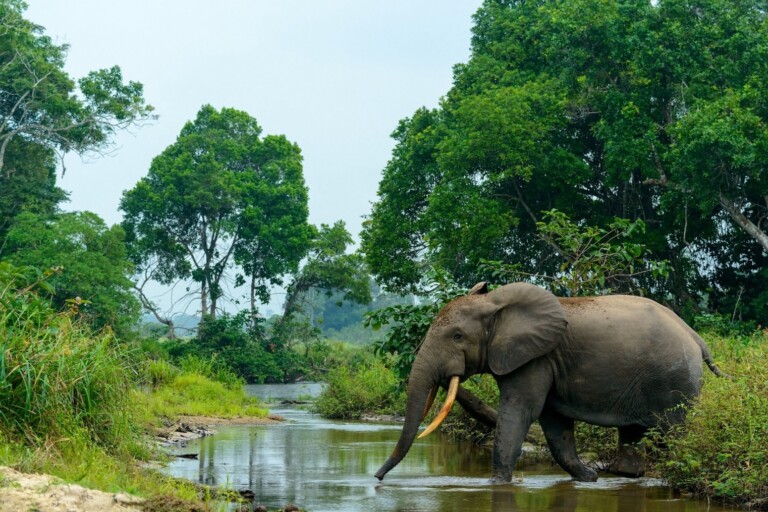
African elephant pictured in Congo.
African elephant pictured in Congo. Credit: BIOSPHOTO / Alamy Stock Photo

Forest cuts

Following successive aid cuts introduced by both Conservative and Labour governments – tracking a global trend – the UK’s Congo funding is under threat.

The Congo basin forest action programme (CBFA) was explicitly set up to provide “roughly half” of the UK’s £200m Congo pledge.

Now, after reporting delays, the UK has slashed the CBFA as part of the Labour government’s aid cuts. Its £90m budget has been “quietly reduced by 79% to £18.8m”, according to the Times.

This is not the only Congo project that has been dropped due to aid cuts. The Congo part of the biodiverse landscapes fund – worth at least £12.3m – has closed five years early.

Official documents reveal more Congo forest funding is at risk, including the UK’s two largest remaining projects in the region. One initiative, intended to “incubate forest-friendly enterprises” in DRC, faces “reduc[ed] budgets”.

Documents also show the difficulties operating in the Congo, including “complex political economies and, in Gabon, a military coup – which “complicated matters”.

‘Breaking promises’

Damian Fleming, a senior forests director at WWF International told Carbon Brief:

“Tropical forest countries are making long-term policy and development choices in expectation that international partners will honour their commitments.”

In a parliamentary response, Chapman said that the UK had spent £39.8m towards its £200m Congo target, as of 2024.

Despite being described as the UK’s contribution to the £1.1bn-by-2025 global goal agreed at COP26, the £200m target has a deadline of 2029. Therefore, while the collective goal has been met, the UK’s contribution was relatively small.

Zac Goldsmith, a former Conservative minister who oversaw the forest targets at COP26, told Carbon Brief that, in his view, the UK has “discarded” its regional pledges:

“We have gone from being perhaps the leader on protecting nature internationally to breaking promises to countries around the world.”

The Labour government says it has met its overarching “climate finance” goals and still intends to “prioritise” the Congo rainforest.

However, civil society groups and MPs are concerned about the lack of “ring-fenced” forest funding in the UK’s new aid strategy.

Watch, read, listen

TOXIC TROUBLES: DeSmog unpacked a new report that said Northern Ireland is being turned into a “toxic” pig and poultry farming “sacrifice zone” to satiate the UK’s meat appetite.

NEED TO NOAA: Laid-off scientists from the US’s National Oceanic and Atmospheric Administration (NOAA) launched Climate.Us – an independent, public-backed version of the climate information website shut down by Trump last year.

DRY FRUIT: A Dialogue Earth long read looked at how climate change is impacting apricot harvests in the “stark, high-altitude desert” region of Ladakh, India.

READING ALOUD: A London Review of Books podcast discussed Robin Wall Kimmerer’s influential book “Braiding Sweetgrass”, weighing its compelling themes and where it veers into “scientific overreach”.

New science

  • Climate change could cause Indigenous peoples in the Amazon to lose 28-34% of their plant species and 18-23% of their associated services | Nature
  • Biodiversity in forests can act as a “buffer” against compound extreme weather events | Nature Communications
  • Zero-deforestation commitments in Indonesia’s palm oil sector have had “no additional impacts” on reducing forest loss | Proceedings of the National Academy of Sciences

In the diary

This edition of Cropped was written by Jess Milligan, Josh Gabbatiss and Aruna Chandrasekhar. Cropped is edited by Dr Giuliana Viglione. This edition was edited by Daisy Dunne. Please send tips and feedback to cropped@carbonbrief.org.

The post Cropped 15 July 2026: Uganda starves | Trump opens endangered habitats | UK cuts rainforest aid appeared first on Carbon Brief.

Cropped 15 July 2026: Uganda starves | Trump opens endangered habitats | UK cuts rainforest aid

Continue Reading

Climate Change

Campaigners oppose Dangote’s planned Kenya refinery over climate and ecological risks

Published

on

Climate and environment campaigners have urged the Kenyan government to halt plans for a proposed 700,000-barrel-per-day oil refinery backed by Africa’s richest man, Aliko Dangote, warning the project threatens one of East Africa’s most ecologically sensitive coastlines. 

The refinery, which is planned to be situated in Lamu County on Kenya’s northern coast, will be East Africa’s largest refining project and is expected to take up to three years to build. Once finished, it would supply refined petroleum products to Kenya, Uganda, Tanzania and Rwanda, among others, helping to reduce the region’s dependence on imported fuels.

Campaigners are questioning the viability of such a large refinery at a time when renewable energy and electric transportation are expanding rapidly.

Mohamed Adow, director of a Kenya-based climate and energy think-tank Power Shift Africa, said the decision to give Dangote the green light for the refinery is “an extraordinary act of environmental recklessness and economic short-sightedness”, arguing it would tie Kenya to “yesterday’s energy system” just as global demand for petroleum products faces increasing uncertainty. 

    Campaigners argue the refinery risks coming online just as transport – the largest market for petrol and diesel – is beginning to electrify across the continent.

    Kenya launched a National Electric Mobility Policy earlier this year to speed up the uptake of electric vehicles (EVs) and reduce the country’s roughly $5 billion annual fuel import bill. Ethiopia has already banned imports of non-electric vehicles and now has more than 100,000 EVs on its roads, while Rwanda is expanding its electric mobility programme with plans to convert its fleet of around 100,000 motorcycles to electric.

    Adow said the project risks billions of dollars in investment in infrastructure that could become obsolete as the world moves away from oil.

    “Building a refinery today assumes decades of robust demand for fuels that much of the world is actively trying to phase out,” he said in a statement. 

    Ecological concerns

    Lamu – the proposed site for the project – is home to the UNESCO World Heritage-listed Lamu Old Town and an archipelago containing extensive mangrove forests, coral reefs and seagrass beds that support fisheries, tourism and coastal livelihoods.

    Locating the refinery in Lamu would “place one of Africa’s largest fossil fuel developments in one of the continent’s most ecologically sensitive and culturally significant coastal regions,” Power Shift Africa said.

    Major emitting countries knew of climate risks decades earlier than claimed

    Sherelee Odayar, oil and gas campaigner at Greenpeace Africa, warned that a refinery of this scale could increase the risk of habitat destruction, marine pollution, oil spills and air pollution in one of East Africa’s most fragile coastal ecosystems.

    She said the risks stem not only from the refinery itself – including storage tanks, pipelines and fuel handling facilities – but also from the large volumes of crude oil that would need to be shipped into Lamu and refined products exported by sea. Increased tanker traffic and fuel transfers, she said, would raise the likelihood of accidents in ecologically sensitive coastal waters.

    Odayar added that Lamu’s low-lying, flood-prone coastline could compound those risks by damaging infrastructure and carrying contaminants from storage facilities into nearby fishing grounds and marine ecosystems.

    “Lamu’s mangroves, coral reefs and seagrass beds are not expendable; they support fisheries, livelihoods and coastal protection,” Odayar added.

    She said Kenyan authorities should suspend any approvals until an independent environmental and social impact assessment is completed, with genuine public participation and transparent scrutiny of the long-term economic, health and ecological risks.

    “Any review must assess cumulative impacts on Lamu’s mangroves, coral reefs, seagrass beds and fishing livelihoods, alongside the wider economic risk of locking Kenya into costly fossil fuel infrastructure as the global energy transition accelerates”.

    Dangote Group declined to answer questions from Climate Home News when contacted by phone.

    Technological change threaten project’s future

    The Kenya refinery would replicate Dangote’s 650,000-barrel-per-day refinery in Lagos, currently Africa’s largest, which has plans to more than double capacity to 1.4 million barrels per day by 2028.

    Adow of Power Shift Africa said projects like this represent “a breathtaking failure to recognise where the global economy is heading”, pointing out that the East African refinery risks arriving when Africa is experiencing an unprecedented clean energy boom. 

    Referencing Africa’s solar boom, global electric vehicles uptake and the International Energy Agency’s projection that global oil demand is set to enter a decline later this decade, the think-tank founder said African governments risk anchoring the continent’s future to an industry facing mounting economic uncertainty.

    Loss and damage fund delays first project approvals as needs dwarf resources

    The organisation said the project faces a bigger threat aside from environmental opposition and that is technological change. “The danger is not simply that the refinery will pollute, it is that it will become obsolete long before it has paid for itself,” he added.

    Kenyan President William Ruto said the project will create about 60,000 jobs for Kenyans and supply refined fuel to eight East and Central African countries.

    GreenPeace Africa’s Odayar said the promise of ‘thousands of jobs’ cannot be used to hide the true cost of the investment which is that large fossil fuel projects often create temporary jobs while undermining existing livelihoods in fishing, tourism and small-scale local economies.

    “The enormous capital required for a project of this scale could instead help accelerate Kenya’s renewable energy future through solar, wind, geothermal, storage and better energy access,” she added.

    The post Campaigners oppose Dangote’s planned Kenya refinery over climate and ecological risks appeared first on Climate Home News.

    Campaigners oppose Dangote’s planned Kenya refinery over climate and ecological risks

    Continue Reading

    Trending

    Copyright © 2022 BreakingClimateChange.com