This story was supported by the Pulitzer Center
Fourteen years after the Fukushima disaster, Japan is restarting its nuclear reactors – and two wind-blown near-deserted fishing villages on the northern island of Hokkaido could be the destination for all their radioactive waste.
But, while some residents of Suttsu and Kamoenai welcome the government money that volunteering to store the waste will bring, others are fiercely opposed due to fears that the nuclear waste will contaminate their land and water.
The controversy could delay Japan’s goals to use carbon-free nuclear energy to replace electricity generation from expensive imported fossil fuels and cut greenhouse gas emissions on the way to net zero by 2050.
Takeshi Kuramochi, a climate policy researcher at the NewClimate Institute, called the nuclear waste issue a “showstopper” for nuclear development. He added that, if Japan fails to meet its nuclear targets, it will likely resort to fossil fuels to fill the gap as the country has been “very slow on implementing renewable energy.”
Japan’s nuclear history
Japan first started using nuclear power to generate electricity in the 1960s and, by the twenty-first century, it was one of the nation’s main energy sources. As the island nation lacks fossil fuels and relies mostly on imports, nuclear power was seen as a path to energy independence as well as to reining in climate change.
But everything changed in 2011 when a powerful earthquake and tsunami disabled the Fukushima nuclear power plant’s cooling systems, causing nuclear fuel in three of its reactors to overheat and melt down, releasing radioactive materials into the air and ocean.
While no one was killed by the nuclear disaster directly, over 150,000 people were evacuated and some severely ill hospital patients did not survive their relocation. All of Japan’s nuclear power stations were shut down while new safety standards were drawn up. Well over a decade on, only 14 of its 54 reactors have been restarted.
Without electricity from these power stations, Japan resorted to increasing its use of gas and coal. While the EU, US and UK all more than halved their coal emissions between 2011 and 2023, Japan’s stayed the same.
But as memories of Fukushima fade for some, and global fossil fuel prices skyrocket, support for nuclear is again growing in Japan. In 2014, polls suggested 16% of Japanese people wanted an immediate phase-out of nuclear power but in 2024 that figure was just 5%.
With this in mind, earlier this year Japan announced a contentious plan to boost nuclear energy in its mix from the current level of 8.5% to 20% by 2040 – back up to its pre-Fukushima levels – as the country strives to realise its net-zero goal by 2050.
Nuclear waste storage
Standing in the way of those ambitions is nuclear energy’s Achilles heel – radioactive waste storage. When used up, the uranium rods that produce nuclear energy need to be disposed of. The spent rods are highly radioactive and hot, so they are usually buried — permanently — deep underground.
Jacopo Buongiorno, professor of nuclear science and engineering at the Massachusetts Institute of Technology said that, although storing waste is “actually pretty straightforward”, it is also often highly controversial around the world. He emphasised that current technology can prevent leakages of high-level waste after they are put underground, as long as the assessment for a site is done right.
Japan’s waste is currently being stored at an interim facility on its main island in Aomori Prefecture — despite some local opposition. This facility can only house the waste for 50 years and, as of 2023, 80% of its storage space was filled up.

There was a government plan to reprocess the waste to recycle the energy. But a plant designed to do so has been delayed and research took a hit after Fukushima, casting doubt on the technique.
Japan, like other producers of nuclear energy, now has the urgent and challenging task of looking for a site to permanently store such waste.
To convince local governments to volunteer to store it under their land, the Japanese government offered two billion yen ($14 million) to any village that consented to literature surveys of key criteria, including past earthquake records.
If the survey found them suitable, a further seven billion yen ($49 million) would be the reward for entering the four-year second stage of the selection process involving a site study. The last stage, which lasts for 14 years, would see a more detailed assessment with test tunnels and mock facilities, but the amount of subsidy for that has yet to be determined.
The only municipalities through to the second stage so far are two tiny fishing villages in Hokkaido. Suttsu and Kamoenai are both within an hour’s drive of the Tomari nuclear power plant and have ageing populations, as in many of Japan’s rural areas.

Villages of Suttsu and Kamoenai
Climate Home visited both villages in spring and heard that the nuclear waste issue was at the top of people’s minds, although opinions on it differed sharply. Dotted with worn houses along a wavy coastline, the streets of Kamoenai looked grey and were near-deserted. Most residents were tight-lipped about the issue.
At the tourist information centre where she works, Toritani Taeko told Climate Home that “nuclear waste isn’t a big deal, but it has to be safe”. Besides, she said, “it’s set in stone already so no point in opposing”.
Sato Tazunori, a silver-haired sushi chef, said that the two billion yen ($14m) for the first stage helped with the repair of the fishing pier. Living near the Tomari nuclear plant for years has made locals accustomed to staying near nuclear facilities, he added.
But an hour’s drive away in Suttsu, where one of Japan’s first wind farms was built, opinions were more polarised. Electrical store owner Tana Noriyuki said the money helps the village pay for resources like a dormitory for nursing workers and a school.

However, Nobuka Miki, co-chair of a group fighting against nuclear waste and mother to a teenage daughter, said a potential underground disposal site there could harm future generations, while the seafood produced in the village could suffer.
Suttsu’s nuclear fate will effectively be decided in November’s Mayoral elections. The current pro-waste mayor, who declined to speak to Climate Home, is likely to be challenged by anti-waste 41-year-old Shingo Ogushi.
Ogushi came to Suttsu in his early 30s to study the local cherry trout, but in 2020, in order to challenge the mayor’s decision to volunteer for the site study, he quit and intends to run against him in this year’s mayoral election. He told Climate Home that a pier might have to be built to transport nuclear waste to the village. If so, he said this could disturb the marine ecosystem and the fishing industry.


Pro-nuclear voices argue that more needs to be done to win public support for nuclear energy and nuclear waste, while critics argue the technology should be dropped – at least in earthquake-prone Japan.
Indigenous rights: Ainu people
Nuclear waste storage is also controversial among the Indigenous people of Hokkaido – the Ainu. Although there are no current Ainu communities in either of the two villages and less than 20,000 Ainu on the whole of Hokkaido, they were the almost sole inhabitants of the island until the Japanese took over in the 19th century.
ann-elise iewallen, a professor at the University of California specialising in indigenous and environmental rights said that, because of the lack of Ainu consent for nuclear waste storage on Hokkaido, Japan is engaging ini “energy colonialism”.
iewallen – who decapitalises her name as a gesture towards resisting hierarchy – warned of the risk that “part of Hokkaido can be carved out as a kind of nuclear extractive zone”.
The names Suttsu and Kamoenai come from the Ainu language, according to Hiroshi Maruyama, director of Japan’s Centre for Environmental and Minority Policy Studies. Ainu people “feel closer to the land than Japanese settlers”, he added.


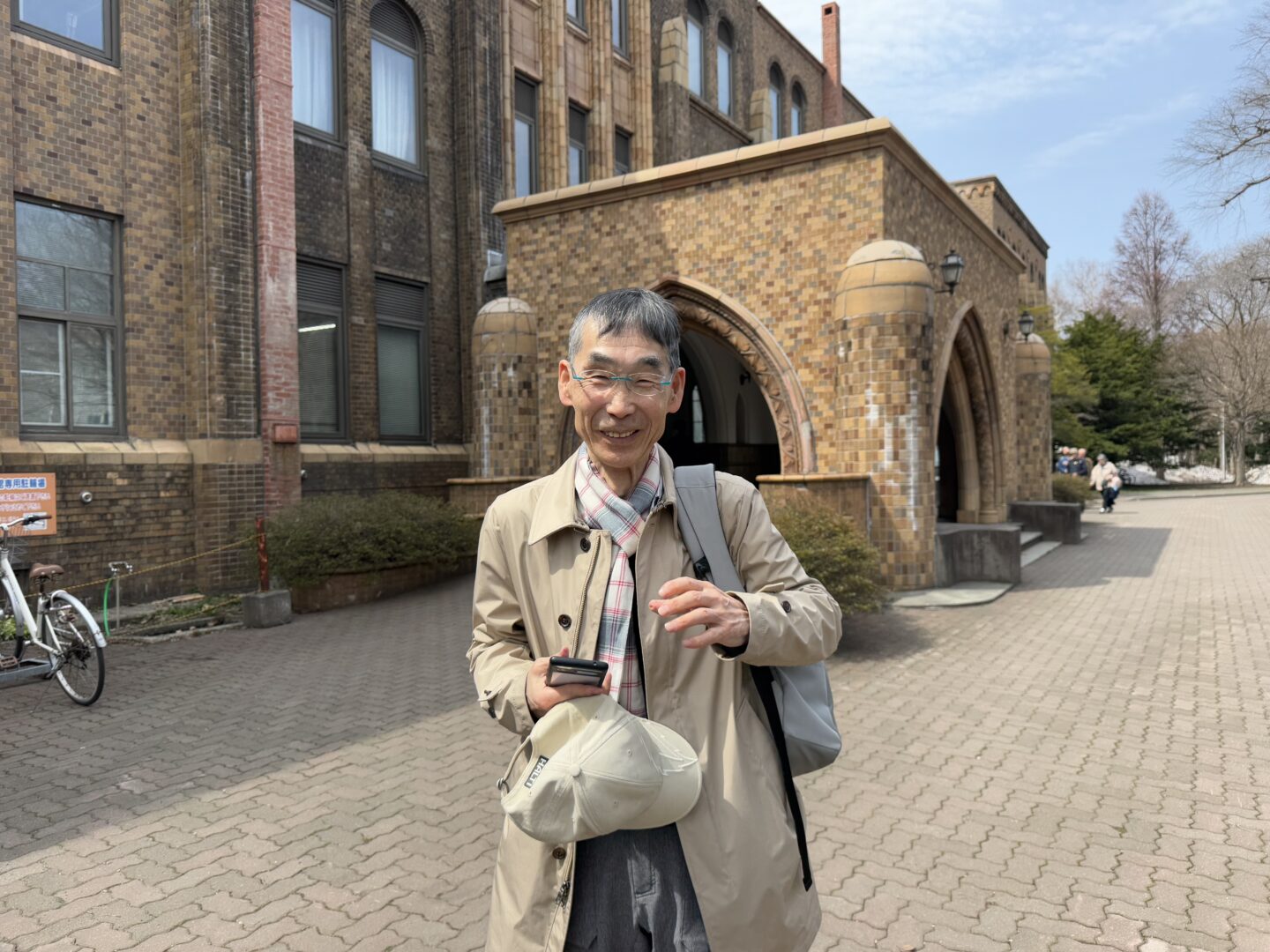
Fumio Kimura, an Ainu activist in Hokkaido, said that “any nuclear waste on our land is horrible and our right to the land shouldn’t be neglected”. “Japanese people robbed our land, so why can’t we voice it out?” she asked.
Ainu musician Oki Kano told Climate Home that nuclear waste is regarded as “poison” in Ainu’s philosophy, which seeks a balance between human and nature.
But Kazuaki Kaizawa, secretary general of the government-funded Ainu Association of Hokkaido, said that while nuclear energy and other modern technologies are traditionally regarded as unnatural in Ainu philosophy, those principles can not be fully applied in the modern world. He added that, as Hokkaido has been part of Japan for over a hundred years, Indigenous land rights are no longer practical.
In 2007, Japan was among the 143 countries that voted in favour of the United Nations Declaration on the Rights of Indigenous People. The declaration states that governments shall “take effective measures” to “ensure that no storage or disposal of hazardous materials shall take place in the lands or territories of indigenous people without their free, prior and informed consent.”
But the declaration is non-binding and Japanese law does not currently recognise the Ainu peoples’ rights to Hokkaido’s land, although a court case over salmon fishing rights may change this.
A way forward
Takatoshi Imada, a professor at the Tokyo Institute of Technology who has published research on public opinion of the nuclear waste system, said that, to avoid the division seen in Suttsu, an organisation outside of government should select 20 or so sites and engage their communities in “deliberative dialogue” to win their support for waste storage.
But New Climate Institute’s Kuramochi said that finding a storage site far away from people will be next to impossible in Japan – and that nuclear energy should not be relied on as legal battles, local opposition and safety inspections will slow down its deployment.
“There’s a huge risk of spending so much money on nuclear and nothing coming out of it at the end,” he said. “If you are betting on nuclear, then that means they are not committing fully to this more fully modernised grid network that can accommodate a large amount of renewables”. That, he added, “delays the whole transition of the entire electricity system.”
Buongiorno argues the opposite, saying that nuclear can provide the around-the-clock clean power that solar and wind – when the sun doesn’t shine and wind doesn’t blow – cannot. Therefore, he said nuclear power enables a clean renewables-based electric grid.
Nobuyuki Kawashima, spokesperson for Japan’s nuclear waste authority NUMO, agreed, telling Climate Home that nuclear power “will lead to both ensuring a stable supply and decarbonisation”. “Final disposal needs to be carried out step by step, with the understanding of the public,” Kawashima added.
Translator Zhao Yang contributed to this report. A version of this story was co-published with Japan Times
The post Nuclear comeback? Japan’s plans to restart reactors hit resistance over radioactive waste appeared first on Climate Home News.
Nuclear comeback? Japan’s plans to restart reactors hit resistance over radioactive waste

Climate Change
“Sink or swim”: WA Gov hugely underestimating decline in regional gas demand while sleeping on green exports, new report finds
PERTH, Tuesday 13 October 2026 — A new report from Greenpeace Australia Pacific and Springmount Advisory reveals green commodity exports are an untapped economic opportunity for Western Australia in a declining Asian gas market, while offering a genuine solution for decarbonising Asia.
From Gas to Green: Building Western Australia’s Future State is a comprehensive analysis of the declining gas market in Asia, and the untapped economic opportunity for WA to become a global leader in green commodity exports while driving the regional shift away from fossil fuels.
The report offers key recommendations for the WA Government to support regional decarbonisation through an orderly phase out of gas exports in favour of green iron and other green exports. It comes as global climate leaders from across business, politics and advocacy prepare to meet for the Global Citizen Now: Perth event focused on decarbonising WA.
Key findings:
- Gas demand is falling across WA’s core markets in Asia: Gas demand fell in 2025 and is projected to continue to decline, driven by a combination of global geopolitical factors and domestic concerns.
- Policy shifts in key markets since the war on Iran now prioritise renewables and nuclear over gas: Japan, South Korea and China have legislated energy plans that prioritise renewables and nuclear over gas.
- New WA gas would arrive in a saturated, uncertain Asian market filled with cheaper gas: The US is now the world’s largest liquefied gas producer and plans to double its capacity as it also targets Asian markets.
- Green commodities offer a real solution to sustain WA’s economy: WA can lead Australia’s green commodity exports, which by 2060 could be worth almost a trillion dollars.
- Exporting more WA gas is likely to delay or impede Asia decarbonisation: Despite claims by the gas industry, there is no evidence that WA gas is displacing coal in Asia, and in fact diverts resources from genuine decarbonisation options.
Geoff Bice, WA Campaign Lead at Greenpeace Australia Pacific said: “As our export partners in Asia shift away from expensive and polluting gas, the WA Government has a golden opportunity to pivot our economy to green exports, like green iron, which is the most effective way to help our region to decarbonise.
“The writing is on the wall: gas is in decline, renewables are our future. In this context, it makes zero sense for the government to encourage high risk projects like Woodside’s reckless Browse gas proposal at Scott Reef.
“This report clearly shows that the WA Government faces a choice: sink or swim. They can either allow the gas industry to keep ripping off West Australians and continue propping up its decline, or choose the path that will deliver enormous benefits to the state and the world by becoming a leader in the rapidly expanding green economy.”
Tom Quinn, Managing Director of Springmount Advisory: “Western Australia prospers when it looks to the future and builds for future demand. Twenty years from now, what the world needs is green commodities made using WAs abundant renewable resources. Just like it did with iron ore in the 1950s and gas in the 1970s, WA should look to the future and build what the world will need, not sunsetting industries like gas that are already past their peak.”
-ENDS-
Media contact
Kate O’Callaghan on 0406 231 892 or kate.ocallaghan@greenpeace.org
Lucy Keller on 0491 135 308 or lucy.keller@greenpeace.org
A report from Greenpeace Australia Pacific and Springmount Advisory reveals the untapped green economic opportunity for Western Australia in a declining Asian gas market, which also offers a genuine solution for decarbonisation in Asia.
Is Western Australia clinging to a fading gas industry while a thriving green future passes it by? As major Asian trading partners rapidly pivot away from volatile gas imports toward cheap solar and battery storage, this report exposes a high-stakes choice: risk becoming stranded in an oversupplied fossil fuel market, or harness WA’s unmatched sun and wind to lead the global clean energy transition.

Summary
From Gas to Green: Building Western Australia’s Future State reveals that Western Australia (WA) faces a critical juncture as falling Asian gas demand, geopolitical gas supply volatility and accelerating renewable energy deployment undermine the long-term economic viability of gas exports. By harnessing its world-class wind and solar resources, the report demonstrates that WA can execute an orderly phase-out of gas and pioneer a green commodity export economy that could generate $987 billion in economic value by 2060, create 24,000 ongoing jobs, and drive a 9.6% reduction in global greenhouse gas emissions.
Key Findings
- Gas demand is falling in Asia – WA can no longer rely on gas exports: Gas demand in core Asian markets fell in 2025 and is projected to continue to decline in 2026. Legislated energy plans in Japan, South Korea, and China now prioritise renewables and nuclear over gas.
- Asia is increasing renewables, importing gas just gets in the way: Evidence from markets like Thailand suggests that gas imports are increasingly crowding out cheaper renewable energy investments and battery storage rather than displacing coal, locking in more emissions over time.
- Green commodities offer a real solution to decarbonise Asia – this is a major win for WA: With world-class renewables, WA can lead Australia’s green commodity exports, which by 2060 could be worth almost a trillion dollars ($987 billion) and support a genuine 9.6% reduction in global emissions.
Recommendations to WA government
Recommendation 1: Plan an orderly gas phase-out aligned with a trading partner pivot plan
Implement a managed, orderly phase-out of gas exports aligned with trading partners’ decarbonisation pathways, rather than waiting for demand to collapse, by:
- Developing and implementing a staged phase-out of gas facilities aligned with feedstock supply expiry or typical end of facility lifespans.
- Committing to no new gas development for gas expansion, including Browse and Kimberley fields.
- Developing new, reciprocal trade relationships with existing gas trade partners, structured to progressively replace gas exports with green commodities – integrated with recommendation 2.
Recommendation 2: Develop an integrated green commodity export strategy, positioning WA as a global green iron manufacturing hub
Establish an integrated green commodity export strategy that immediately prioritises green iron development, positioning WA as a global green iron manufacturing hub, by:
- Committing to green commodity export targets to give industry and investors a clear demand signal.
- Prioritising green iron as the lead sector within the broader green commodity strategy, given WA’s iron ore endowment and first-mover potential.
Recommendation 3: Reject false solutions such as carbon dumping (CCS) and blue hydrogen
Reject carbon dumping (also described as carbon capture and storage, or CCS) and blue hydrogen as viable decarbonisation technologies, and prioritise green hydrogen and proven renewables for clean energy and fuel production by:
- Excluding blue hydrogen projects (and CCS-dependent projects) from all government support programs.
- Requiring existing hydrogen-based production (including ammonia, methanol, synthetic fuels) to have clear, near-term transition timelines to switch to green hydrogen production.

What you can do
Together, we can push for a prosperous green future.
You can help by:
- Sending an email to Environment Minister Murray Watt and Prime Minister Anthony Albanese, calling on them to reject Browse.
- Sharing this story to help more Australians understand what’s at stake.
- Encouraging your friends and family to take action.
REPORT: “From Gas to Green” Building Western Australia’s Future State
Cleaner cooking projects in the UN carbon market will have to set aside a share of their credits to insure against the risk that the trees they save are lost to fire, drought or logging, after the market’s regulator rejected calls to exempt the sector.
The requirement is part of a new rulebook that the Paris Agreement carbon market regulator – the Article 6.4 Supervisory Body – approved last Friday for programmes that aim to cut emissions by distributing new and cleaner cookstoves in regions that still burn wood or charcoal for cooking.
These are the UN mechanism’s first rulebooks for cookstoves, one of the carbon market’s most popular credit types and also one of its most criticised for overstating climate benefits.
They consist of two methodologies: one for programmes that aim to cut greenhouse gas emissions by distributing more efficient cookstoves that burn less wood or charcoal, and a separate methodology for projects shifting households to lower-emissions cookers running on electricity or liquid petroleum gas (LPG).
Mkhuthazi Steleki, the South African chair of the Supervisory Body, said “this decision gives cleaner cooking projects a new pathway under the UN carbon market, with clear rules to ensure that each credit represents a real and credible emission reduction”.
Industry and NGOs lobby to weaken UN carbon credit rules in “coordinated” push
In copycat submissions and a private briefing to government officials, the groups have opposed a proposal to tighten safeguards for emissions offsets