

John Taukave is technical and cultural adviser to Pacific delegations of the International Maritime Organization (IMO), a Rotuman performing artist and a doctoral researcher at the University of Amsterdam.
When a little-known UN agency meets in London this month to adopt a deal to cut shipping emissions, it will be up to governments to turn July’s groundbreaking ruling by the International Court of Justice (ICJ) into concrete climate action.
For us, people living in small island states across Oceania, shipping is not a distant, abstract sector – it is our lifeline. Vessels bring medicine and food, while ensuring a connection with the rest of the world. But global shipping is also a major source of emissions, which the International Maritime Organization (IMO) has a duty to address.
October’s IMO meeting is a critical test of whether countries will heed the ICJ ruling by embedding its principles into the Net-Zero Framework, a legally binding regulation that represents the world’s first truly global emission pricing mechanism.
In April, the IMO made world headlines when governments agreed the draft Framework after a long and painstaking negotiating process, and the agreement now needs to be formally adopted in October for it to enter into force in 2027.
Gaps and loopholes
Despite marking a huge achievement in global cooperation and multilateralism, there are still many gaps in the Framework that need to be clarified for it to deliver on the climate action we need, however.
The deal has been criticised by our countries – which abstained in the vote in April in protest – and climate experts, who have said it is too weak, too slow and riddled with loopholes.
-
Shipping’s climate deal sets up battle over pollution calculations for gas and biofuels
The IMO will set emissions intensity levels for different fuels that decide how ship owners will be rewarded or penalised for using them in new green push -
Governments agree green shipping targets and fees for missing them
Ship owners who fail to reduce emissions intensity 30% by 2035 will have to pay into a “net zero fund” to clean up shipping through green fuels


Some critics have argued that the Framework risks becoming a “pay-to-pollute” system, allowing wealthy operators to carry on business as usual while we continue to bear the brunt of rising seas.
Oceania states have long been pushing for a flat emission fee on shipping, or a carbon levy, at the IMO, which would bring this sector much closer to the Paris Agreement as well as help drive the most cost-effective clean energy transition.
A first step
But if the scheme is flawed, the answer is not to undermine it, but to strengthen it – in the spirit of the ICJ ruling, which we will carry with us at the IMO. I believe the IMO Net-Zero Framework, if adopted, is just a first step.
The most important element is to guarantee shipping’s green transition is fair and equitable. This will require that the revenues collected from the carbon pricing, worth up to $15 billion a year in 2030, are allocated in a way that prioritises climate-vulnerable countries and those most affected by the impacts of climate change and can help us build climate-resilient transport and shipping systems we can depend on.
The Framework must also incentivise real, long-term clean energy solutions, like renewably produced e-fuels and wind technologies. Without these incentives, the IMO risks locking shipping into cheap and unsustainable alternatives like high-risk biofuels or climate-heating liquefied natural gas (LNG).
Rising seas and climate reality
International climate negotiations are often riddled with the challenge of bringing our stories and perspectives to a rigid world of suits, spreadsheets and square brackets. By participating in climate diplomacy events, I share the voices of my Temamfua – ancestors in the native Rotuman language – and share with them about my Ö’hön, which means both mother and Mother Earth, and how we keep mistreating our Ö’hön, yet she keeps loving us back.
Climate change is a lived reality for us, the people of Oceania.
-
Vanuatu pursues new UN resolution to turn ICJ climate opinion into action
The Pacific island nation, which led a campaign for the International Court of Justice (ICJ) to clarify states’ climate duties, said the legal opinion must not be “left on paper” -
Mottley’s “legally binding” methane pact faces barriers, but smaller steps possible
A group of countries acting nationally on methane is more likely than a global Montreal Protocol-style deal as proposed by Barbados’ leader – at least to start -
Global renewables goal slips off course after Trump, China moves
The IEA downgrades its forecast for renewables growth due to the US cutting renewable tax credits and China’s electricity market reforms


When I followed the proclamation of the Hague court’s ruling in July, I thought of our family house in Malha’a, on my home island of Rotuma, Fiji, and the vast nearby beach that has steadily disappeared under the waves over the years. I thought of children in Kiribati studying the maps of islands they can no longer walk upon, and of the saltwater in our wells and reefs bleaching.
That is why the ICJ’s ruling was a moral victory that affirmed what we have always known and fought for: climate action is a binding legal obligation for all states. High-emitting countries have the responsibility to mitigate climate change and can no longer hide behind claims of sovereignty or economic difficulty.
When we meet in London again this month, I hope delegates remember that behind their debates and arguments on metrics and fuel standards stand real islands, real peoples and real futures. The ICJ has given us legal recognition. Whatever IMO member states decide, I will stand strong with fellow peoples of Oceania to remind states of their obligations under international law.
The post Landmark ICJ climate ruling must be turned into concrete action on shipping appeared first on Climate Home News.
Landmark ICJ climate ruling must be turned into concrete action on shipping

For the first time, new-energy vehicles (NEVs) made up 67% of new car sales in China in September, according to the latest data from the China Passenger Car Association (CPCA).
The figures show that NEVs, which include battery electric cars and plug-in hybrids, captured a record share of sales, even though fewer were sold than last year.
This is because sales of combustion-engine cars are falling steeply, a trend that the CPCA has attributed to rising petrol prices following the start of the Hormuz crisis.
Indeed, sales of fuel-only cars were down 31% year-on-year in the first nine months of 2026, with plug-in hybrid sales down 26% – whereas battery EV sales were only down 4%.
One analyst tells Carbon Brief that China’s rapidly growing EV fleet has offset demand for 143m barrels of oil since the start of the Hormuz crisis.
Another says that the crisis is “reinforcing China’s electrification of road transport”.
Meanwhile, amid slowing domestic sales, Chinese carmakers’ exports of NEVs more than doubled [in 2026 to date / in September] from a year earlier.
NEV record
A record two out of every three cars sold in September in China were NEVs, according to CPCA data, as shown in the figure below.
(NEVs predominantly include battery electric vehicles – BEVs – and plug-in hybrids – PHEVs. BEVs only run on electricity, whereas PHEVs also have a combustion engine.)
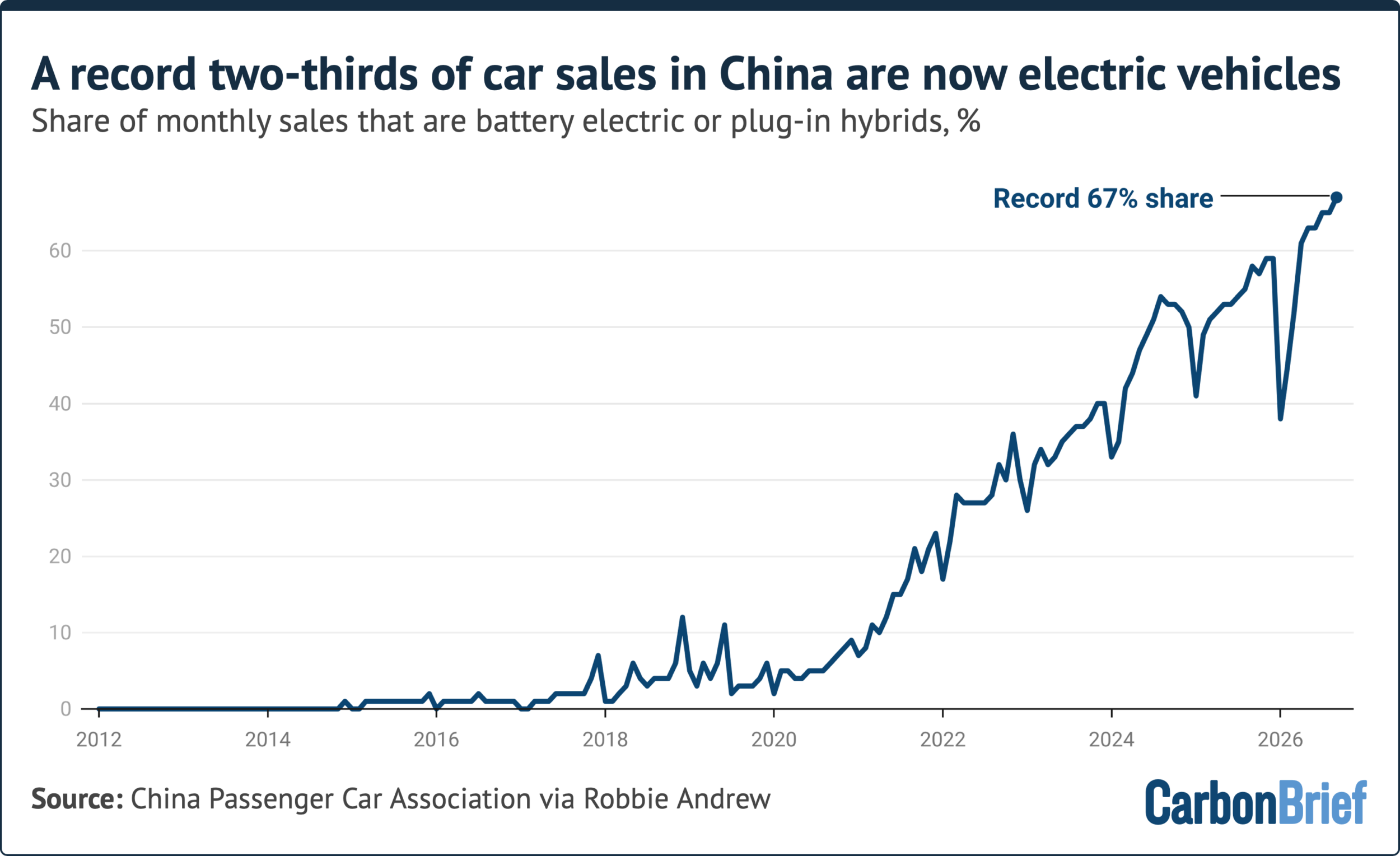
This marks a rapid rise for NEVs from just 6% of new car sales in 2020 up to 58% in 2026 to date – and a record 67% in the month of September.
This year, NEVs’ share of sales has also bounced back from a low of 39% in January, after the full purchase tax exemption that had been in place for more than a decade came to an end in December 2025.
The gain in NEV share in 2026 has come amid a slowdown across the wider domestic passenger-car market, which has hit sales of combustion-engine vehicles particularly hard.
This September, passenger-car retail sales across all categories declined, with overall sales volumes falling 28% year-on-year.
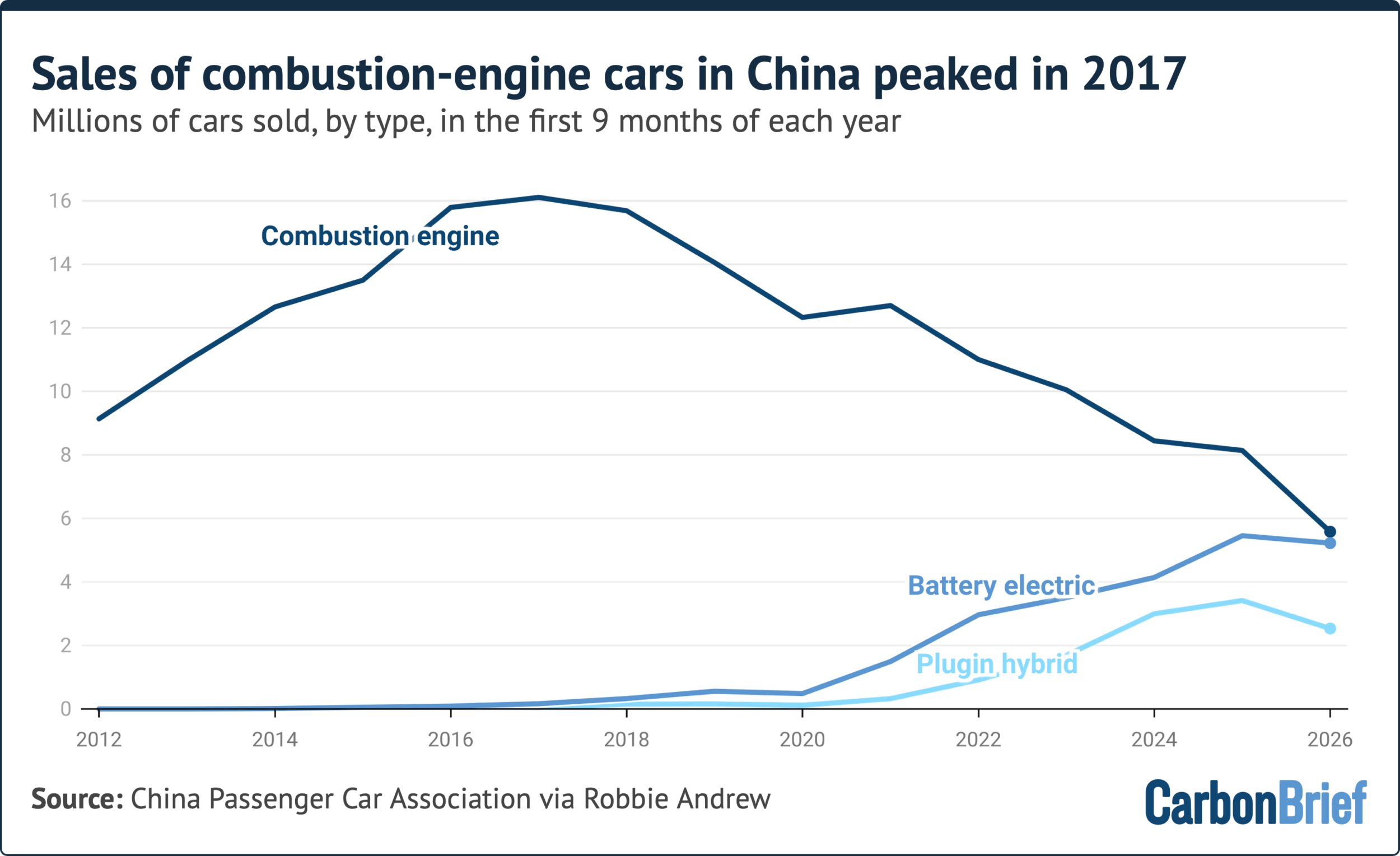
The contraction was led by combustion-engine vehicles, which saw sales fall 43% year-on-year in September and 31% in 2026 to date.
However, sales of PHEVs also fell by 36% year-on-year in September and by 26% in 2026 to date. By comparison, BEVs performed better, although sales still declined 8.5% from a year earlier in September and 4% in 2026 to date.
As a result, NEV sales overall fell by 17% in September and 13% in 2026 to date.
While the market changes in 2026 to date were particularly dramatic, they reflect a broad continuation of trends seen over the past decade.
Indeed, sales of combustion-engine cars in China peaked in 2017 and they have been declining ever since, shown in the figure below.
Impact of Hormuz
Part of the reason for the advance of NEVs in 2026, said Chinese technology news outlet OFweek, was petrol cars “giving up market share” as they were outperformed by electric alternatives.
Cui Dongshu, secretary-general of the CPCA, cited higher petrol prices as an explanation for September’s weak combustion-car sales, in comments to financial news outlet National Business Daily.
Imports of oil into China in January-September have fallen 15% compared to 2025, equivalent to 470m barrels, as ongoing conflict tightened supply and drove up prices.
China’s passenger-car NEV fleet has displaced 143m barrels of oil so far during the strait of Hormuz crisis, Euan Graham, senior energy analyst at thinktank Ember, tells Carbon Brief.
EVs “accounted for 12% of the decrease in China’s oil use post-Hormuz”, according to an estimate provided to thinktank the Brookings Institute by an unnamed analyst.