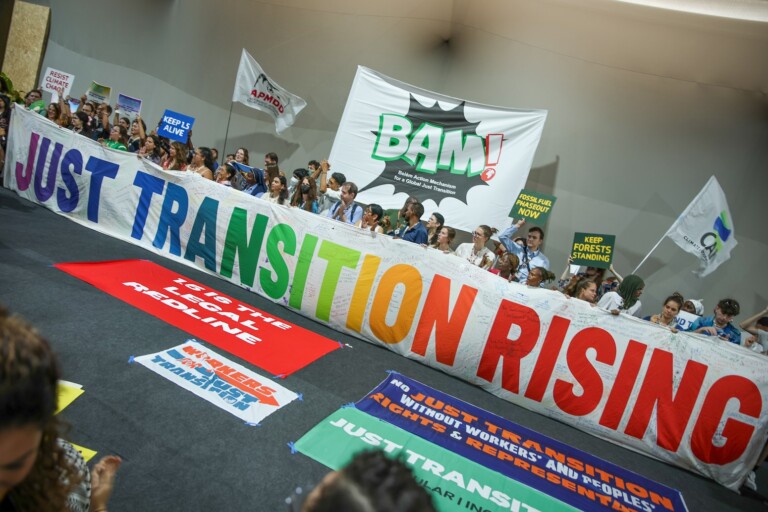
Climate Generation is excited to introduce our delegation of climate leaders from across Minnesota that will attend the UN’s international climate negotiations (COP28) in Dubai this November.
We’ve assembled a diverse group of youth, educators, farmers, artists, authors, and advocates who are passionate about addressing climate change and working towards an equitable future.
At COP28, world leaders will continue to strategize on the implementation of the Paris Agreement, which was ratified and signed in 2015. Particular to this COP, the negotiations aim to solidify national commitments to limit warming to 1.5 degrees, build climate resilience through loss and damage funding, and mobilize finance overall at scale. COP28 will also be the culmination of the two-year Global Stocktake; looking at where the world stands on climate action and support, identifying the gaps, and working together to agree on solutions pathways to 2030 and beyond.
Our Delegation’s Goals
At COP28, our delegation will be actively engaged in civil society events and partnership to humanize the climate conference experience, shedding light on the stories that so often don’t make it into mainstream media during the two-week event. We are also excited to be supporting the first ever Entertainment + Culture Pavilion, which will highlight the importance of climate storytelling while featuring an amazing lineup of artists and entertainers, including our own delegates!
Meet the Delegates

Sofía Mulholland Cerkvenik
she/her/ella
Saint Paul Public Schools
Sofía Mulholland Cerkvenik
she/her/ella
Saint Paul Public Schools

Keith M. Dent
JUST B SOLAR
Keith M. Dent
JUST B SOLAR

Sabrina Deriche
she/her
Stanford University, Student
Sabrina Deriche
she/her
Stanford University, Student

Denise Fosse
she/her
Climate Generation
Denise Fosse
she/her
Climate Generation

Makayla Freeman
she/her
Youth N’Power and MN Interfaith Power & Light
Makayla Freeman
she/her
Youth N’Power and MN Interfaith Power & Light

Abby Hartzell
she/her
Fridley High School
Abby Hartzell
she/her
Fridley High School

Yvonne Mongare
she/her
Sophomore Honors Nursing Student at the University of Minnesota- Twin Cities
Yvonne Mongare
she/her
Sophomore Honors Nursing Student at the University of Minnesota- Twin Cities

Carolina Ortiz
she/her
COPAL MN, University of Minnesota
Carolina Ortiz
she/her
COPAL MN, University of Minnesota

Analyah Schlaeger dos Santos
she/her/ela
Youth N’Power and MN Interfaith Power & Light
Analyah Schlaeger dos Santos
she/her/ela
Youth N’Power and MN Interfaith Power & Light

Erin Sharkey
she/they
The Fields at Rootsprings Retreat Center, Minnesota Prison Writing Workshop, Free Black Dirt
Erin Sharkey
she/they
The Fields at Rootsprings Retreat Center, Minnesota Prison Writing Workshop, Free Black Dirt

Ramiro Vazquez, Jr.
he/him
Climate Generation
Ramiro Vazquez, Jr.
he/him
Climate Generation

Ramier Villarama
he/him
Macalester College, Student & Artist
Ramier Villarama
he/him
Macalester College, Student & Artist

Diane Wilson
she/her
Full-time Writer, Speaker and Educator
Diane Wilson
she/her
Full-time Writer, Speaker and Educator
Register now to meet our delegates and special partners from the Entertainment + Culture Pavilion in a Pre-COP28 livestream on November 20, 11:30 CT.
Follow Along with the Window into COP28 Digest
Throughout COP28, our email digest will provide regular updates and insights from our delegation, as well as accessible policy summaries of what is happening during the negotiations.
Follow social media channels and subscribe to the every-other-day COP28 Digest to stay informed about the latest developments and our delegates’ on-the-ground experience in Dubai. By subscribing for the Nov 30–December 12 program, you will:
⭐ Understand climate change action on a global scale
⭐ First access to videos, blogs, and interviews with leaders around the world
⭐ Gain the language and tools to talk about climate change with your community or students
Are you an educator? Join us November 15 at 5:00PM CT, for our Teach Climate Network Workshop: Using the Power of Education to Create Climate Action in your Community featuring both of our educator COP delegates! Register here.
Engage your students in global climate policy and action during this year’s COP28 in Dubai, United Arab Emirates! Climate Generation’s newly updated COP Educator Toolkit provides a general history and overview of the international climate negotiations (and related activities).


The post Introducing Climate Generation’s COP28 Delegation appeared first on Climate Generation.

More than 92,000 people have registered to attend the COP31 climate summit in Antalya, Turkey, potentially making it the largest COP in history.
Carbon Brief analysis of the provisional lists of delegates, published by the United Nations Framework Convention on Climate Change (UNFCCC), reveals that more than 14,000 delegates have been registered as “host country guests”.
For comparison, the provisional list for COP30 in Belém, Brazil, last year included only around 1,000 delegates in this category.
As with COP30, Donald Trump’s US government has not sent a delegation. Other no-shows include Israel and Myanmar.
It was reported ahead of the summit that Taliban officials from Afghanistan had been registered for the event as observers; however, there are no delegates from observer states in the provisional lists.
With more than 3,000 “virtual” delegates signed up to attend the summit online, the total number of people registered for the event surpasses 95,000.
Further analysis of the participant lists will be added to this article in due course.
Party delegates
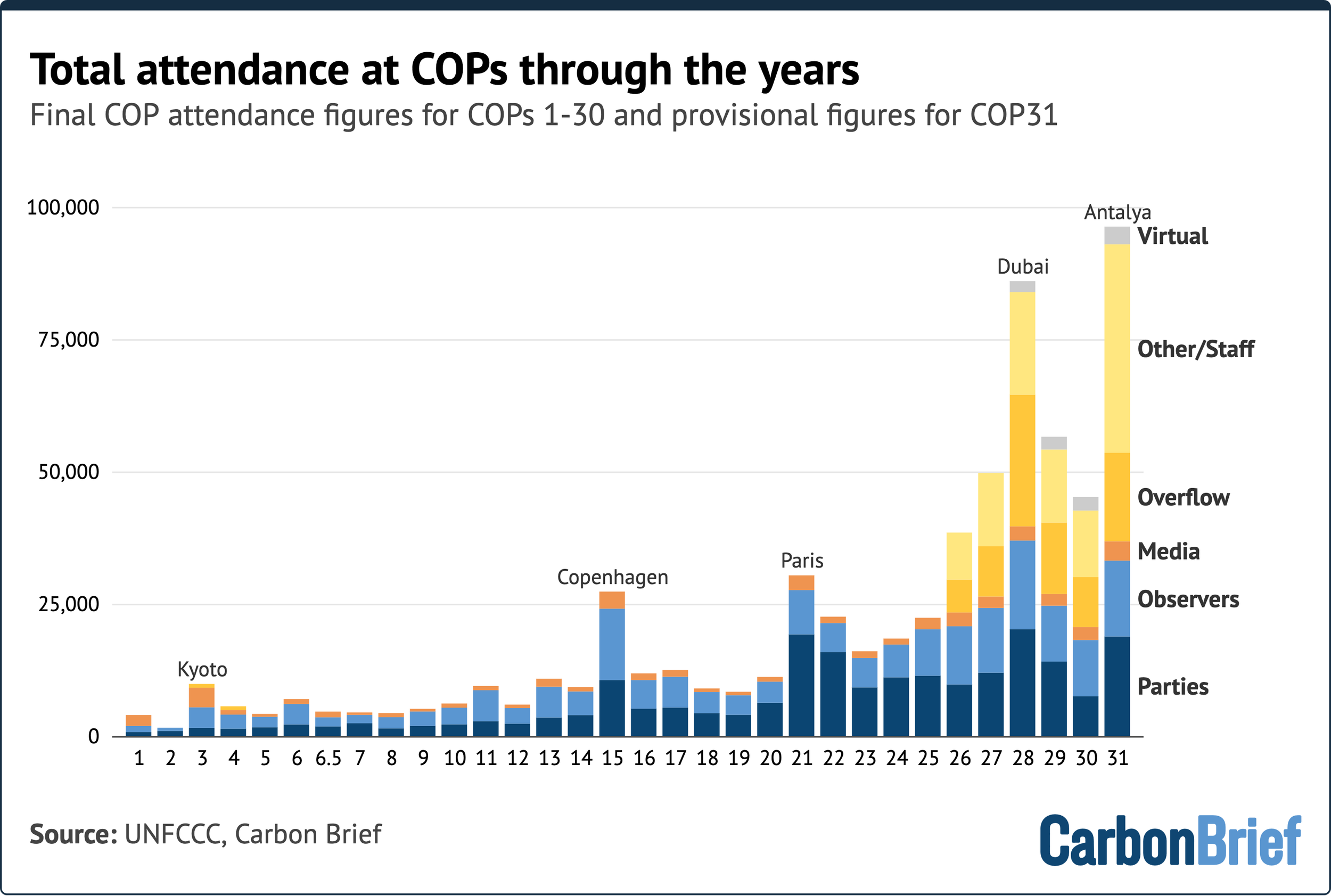
With 92,934 participants registered, COP31 is provisionally the largest COP in history – topping COP28 in Dubai, which was attended by more than 80,000 people.
This total is based on the delegates that have registered to be at the summit in person. The UNFCCC releases the final figures – based on participants collecting a physical badge at the venue – after the summit has ended.
The chart below shows how the provisional figures for COP31 compare to the final totals in previous COPs – going back to COP1 in Berlin in 1995.
The participant lists provided by the UNFCCC are divided between the different types of groups and organisations attending the summit. The largest group at COP31 is for delegates representing parties. These are nation-states, plus the European Union, that have ratified the convention and play a full part in negotiations.
This group adds up to 18,812 delegates – the second largest after COP28.
Membership
Support award-winning climate journalism
(In keeping with recent COPs, the UNFCCC has published spreadsheets that name every single person that has registered for the summit – excluding support staff. Previously, COPs have typically included thousands of “overflow” participants in which countries and UN agencies could nominate delegates without their names appearing on their official lists.)
For consistency with Carbon Brief’s analysis of previous COPs, the above chart includes overflow delegates as a single group. However, the participant lists do divide the overflow delegates between parties and observer groups. Including the overflow numbers takes the total for party representatives to more than 34,000.
Nations
The map and table below present the delegation size – split between party and overflow badges – for all the countries registered for COP31. The darker the shading, the more delegates that country has signed up. Use the search box to find the data for a specific party.
Unsurprisingly, host nation Turkey has registered the largest delegation for COP31 – with 2,950 people.
Following behind are Brazil (1,994 people), Nigeria (1,506), China (1,021) and Indonesia (978).
The rest of the top 10 is made up of Australia (835), Uganda (627), Italy (607), Japan (588) and Kazakhstan (557).
The UK comes someway down the list with a delegation of 255.
The smallest delegation comes from North Korea (two), followed by Eritrea and Nicaragua (three) and San Marino and Trinidad and Tobago (four).
(It is worth noting that some countries – such as Brazil – allocate some of their party badges to NGOs, which can artificially inflate the size of their official delegation.)