

Farmers around Europe are dealing with the aftermath of a summer of extreme heat, drought and wildfires that were exacerbated by climate change.
Human-caused climate change is increasing the severity and likelihood of many extreme weather events around the world, which is increasing volatility for food producers.
This summer resulted in, for example, shrunken potatoes in the Netherlands, reduced carrot harvests in France, dried-up rice fields in Italy and scorched olive groves in parts of the Mediterranean region.
Global food prices are currently at their highest level since early 2023 due to “heatwaves and energy price dynamics”, according to the UN Food and Agriculture Organization.
Other factors such as blocked fertiliser supplies in the Strait of Hormuz and high fuel costs have also played a role in this year’s agricultural outputs.
In the six charts below, Carbon Brief provides a snapshot of the impact this summer’s extremes are considered to have had on crop production and yields across Europe.
1. Most EU countries expect to see declines in cereal production this year
2. Most countries are recording reduced crop yields
3. Around €2bn worth of cereal losses after June heatwave
4. UK yields of wheat, barley and oats are all due to drop in 2026
5. Maize production in France is due to hit a four-decade low
1. Most EU countries expect to see declines in cereal production this year
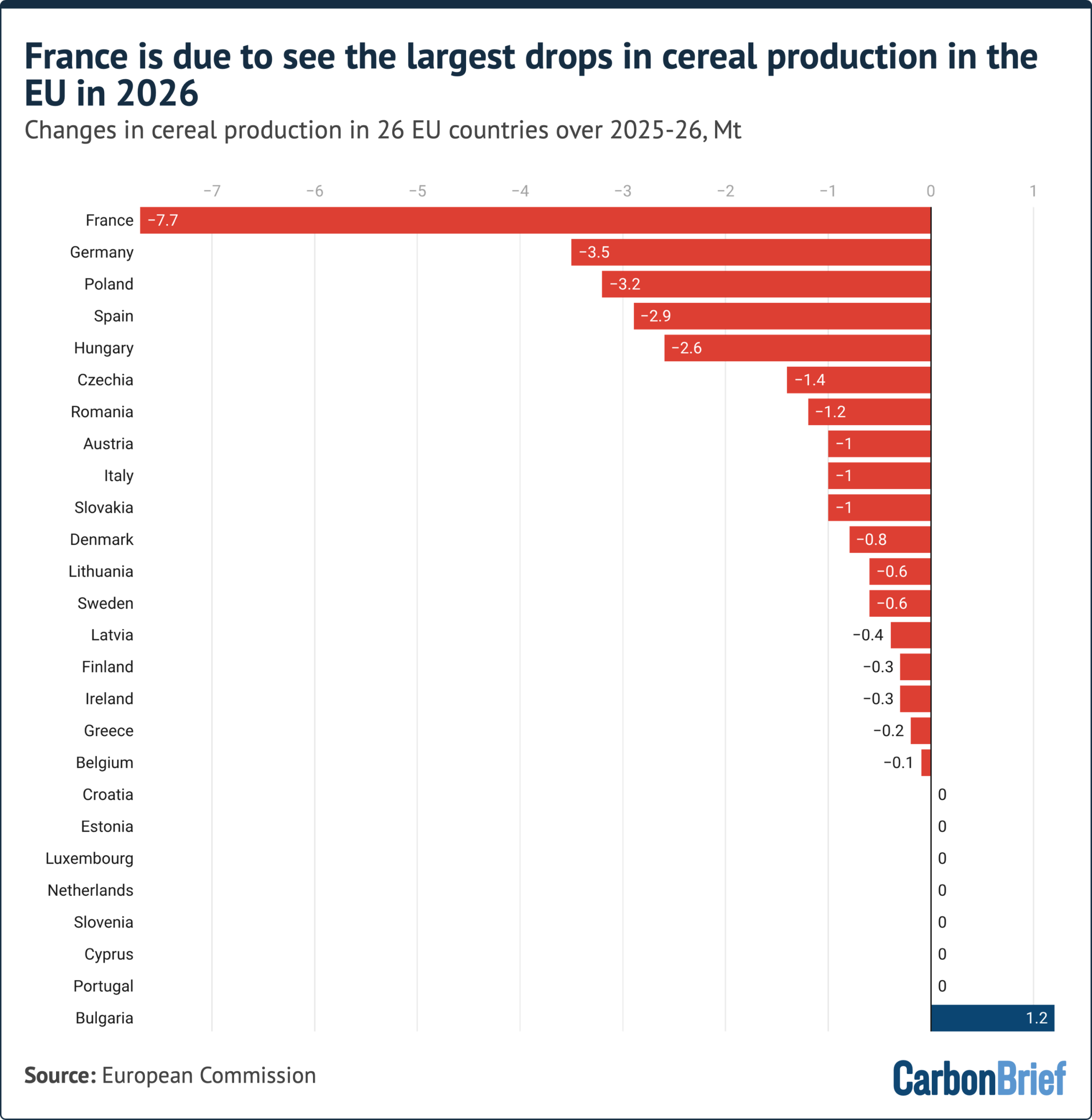
France, in particular, will see heavy losses in the amount of cereals – such as wheat, barley and oats – it produces this year, according to European Commission data.
French cereal production is expected to drop by almost 8 megatonnes (Mt) in 2026, compared to 2025.
The chart above shows that most European countries, aside from Bulgaria, will also see production losses this year.
Germany is due to see the second-largest losses in production, dropping by almost 4Mt compared to 2025.
Prof Til Feike, a cropping systems expert at the Julius Kühn-Institut, says many areas in Germany and Austria, as with other parts of Europe, have been “hit hard by a long-lasting dry period in combination with record-high heatwaves”.
This has resulted in dry grassland for animals and lower yields of maize, which is a “key fodder crop” for livestock. He tells Carbon Brief:
“In the long run, farming must adapt better to more extreme weather conditions, not only heat and drought, but also prolonged wet periods. So, there is no one-fits-all solution for climate change adaptation.”
2. Most countries are recording reduced crop yields
Heat and a lack of water have “substantially worsened” crop expectations this summer in western and most of central Europe, according to a recent bulletin from the EU Joint Research Centre.
Yields are expected to be “significantly reduced”, with local crop failures “likely” in areas such as France, southern Germany, northern and central Italy, and Hungary, it added.
The chart below shows that yields of cereal grains – which, here, refers to the tonnes of a grain grown per hectare of land – are expected to fall in most EU countries in 2026.
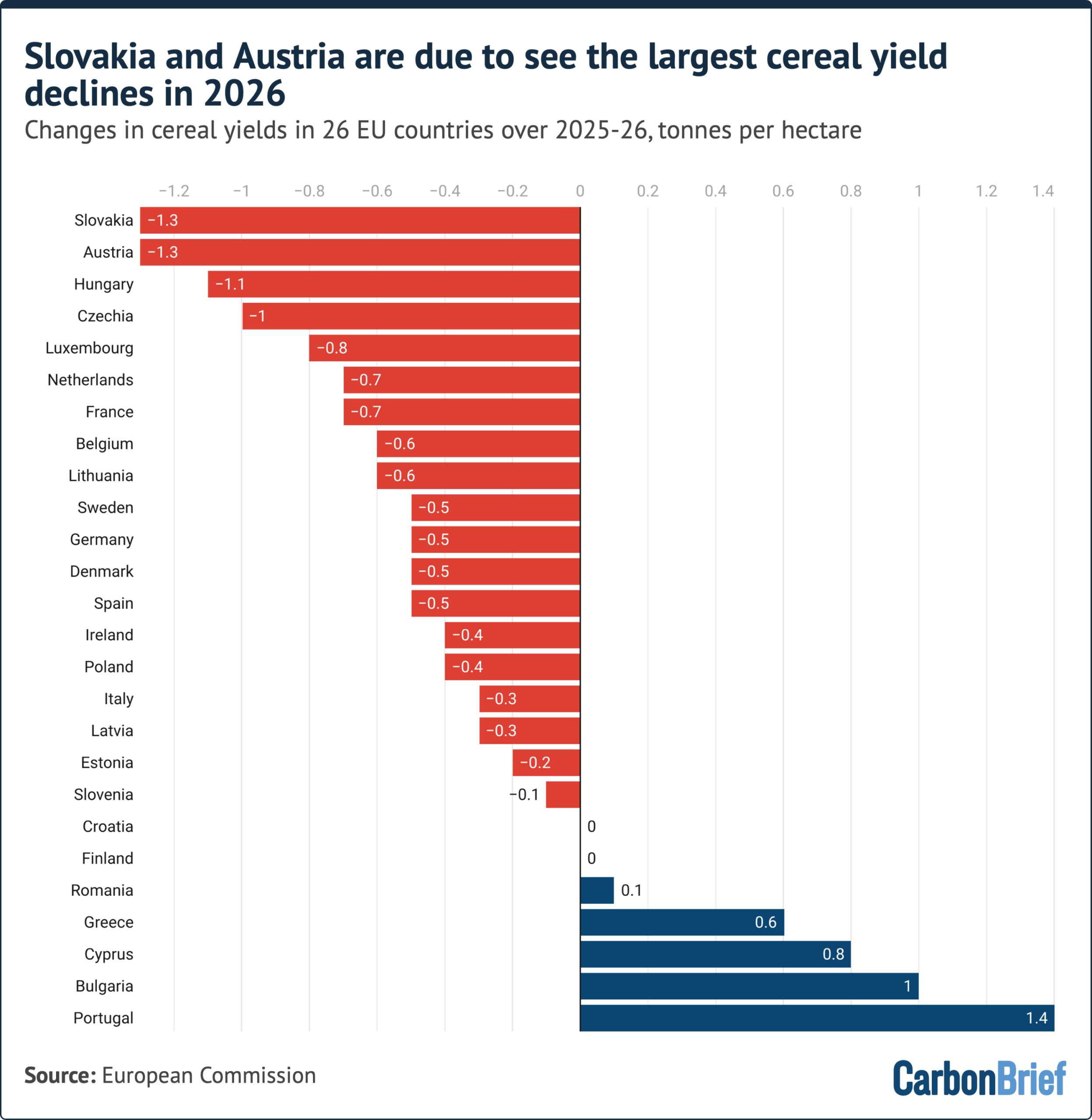
Slovakia, Austria and Hungary are expected to see the largest declines in cereal yields, reducing by more than one tonne per hectare in 2026 compared to 2025.
The recent EU bulletin noted that irrigated crops performed well in Portugal this summer – the country with the largest yield increases. Other crops relying on rainfall showed growing signs of heat stress, it added.
3. Around €2bn worth of cereal losses after June heatwave
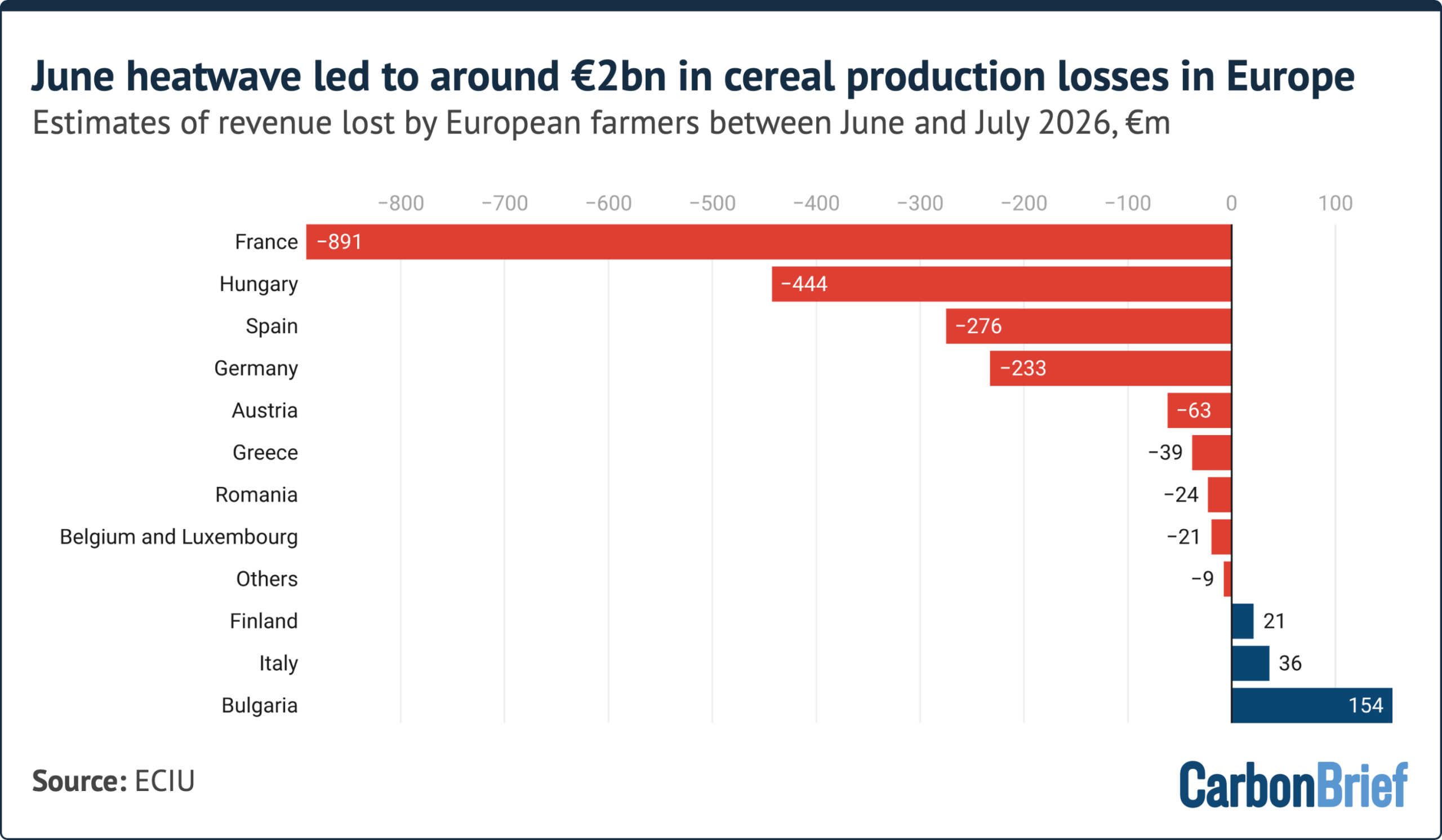
The record heatwave that hit many parts of Europe in June contributed to an estimated €2-2.3bn in cumulative grain production losses, as shown in the chart below.
The intense June heat in western Europe would have been “virtually impossible” just 50 years ago, according to a rapid climate attribution study. It was the region’s hottest June on record.
The Energy & Climate Intelligence Unit (ECIU) thinktank analysed June and July 2026 grain forecasts from Coceral, a European grain traders association.
ECIU estimated lost supply by multiplying the change in tonnes of grains between these two months by prices for harvest delivery in 28 European countries.
Major grain producers France, Germany, Hungary and Spain accounted for 86% of the lost revenue, according to the ECIU.
Extreme heat is also expected to have a wider economic impact across the continent. Analysis from Triodos Bank found that this summer’s extreme weather could reduce the EU’s gross domestic product (GDP) by around 1% this year, or around €180bn.
4. UK yields of wheat, barley and oats are all due to drop in 2026
If current trends continue, the average yields for cereals and oilseeds will result in the UK’s worst harvest since detailed records began in 1984, according to ECIU.
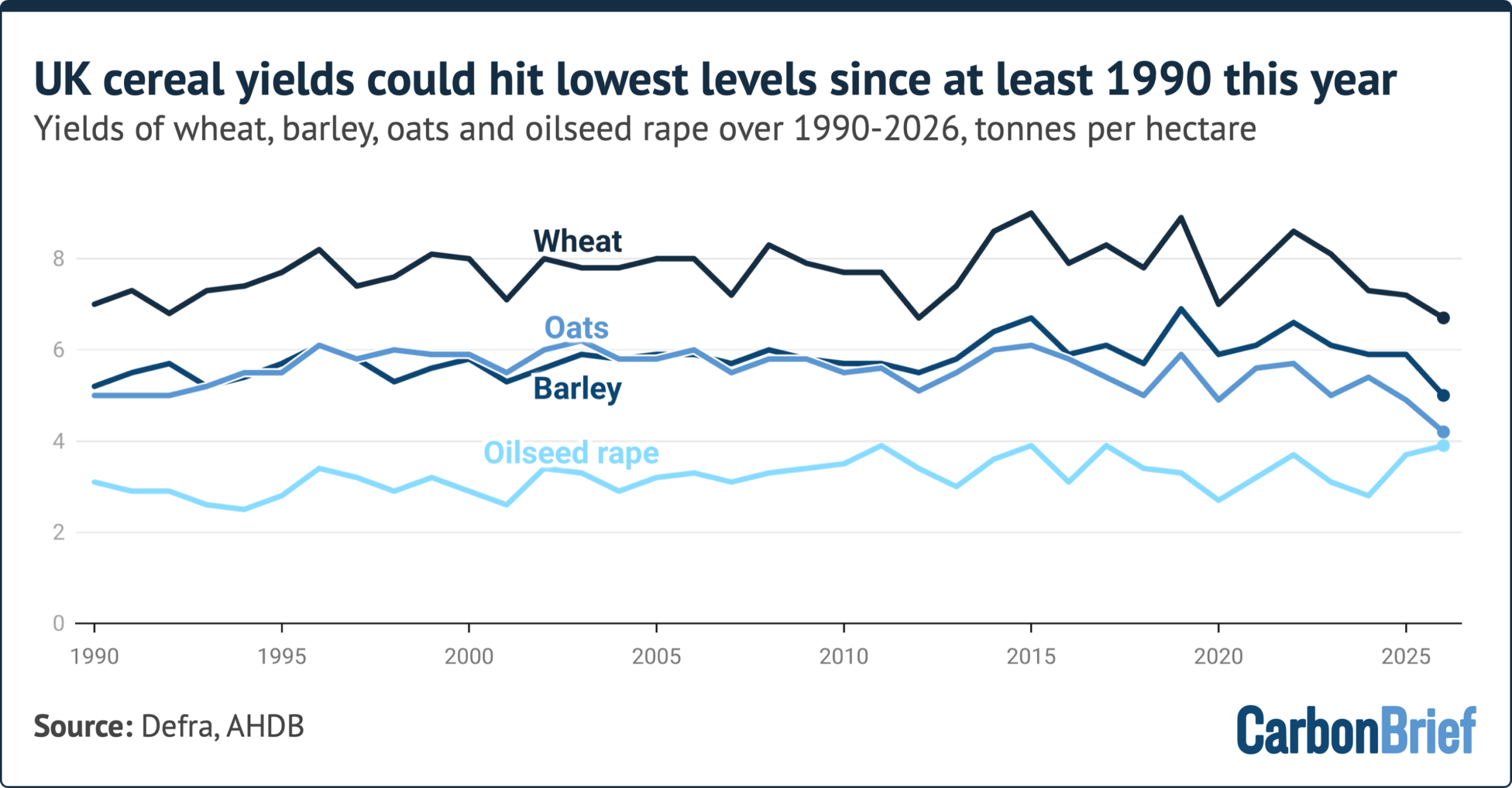
Barley yields could fall by 15%, oats by 14% and wheat yields by 6% year-on-year, according to 2026 harvest surveys from the Agriculture and Horticulture Development Board, a non-departmental public body that provides agricultural data to the UK government.
ECIU said that, even if the situation improves, this year is still expected to be one of the five worst harvests on record. This means that four of the five worst harvests in the UK have occurred in the past decade.
Consumers will likely see higher prices and/or smaller vegetables in supermarkets as a result, Tim O’Malley, chairman of UK company Nationwide Produce, told BBC News in August.
Other crops, such as berries, have grown successfully in the extreme heat. But the Guardian noted fears this could dip later this year “as plants become exhausted from heavy cropping during the heatwave”.
5. Maize production in France is due to hit a four-decade low
France has been acutely affected by this summer’s extreme weather, with more than 7,300 excess deaths during heatwaves and a record number of weather stations recording temperatures of above 40C.
The country is the EU’s largest agricultural producer, but heat, drought and wildfires have affected many crops.
The chart below shows that maize production is set to drop by more than one-third (35%) year-on-year.
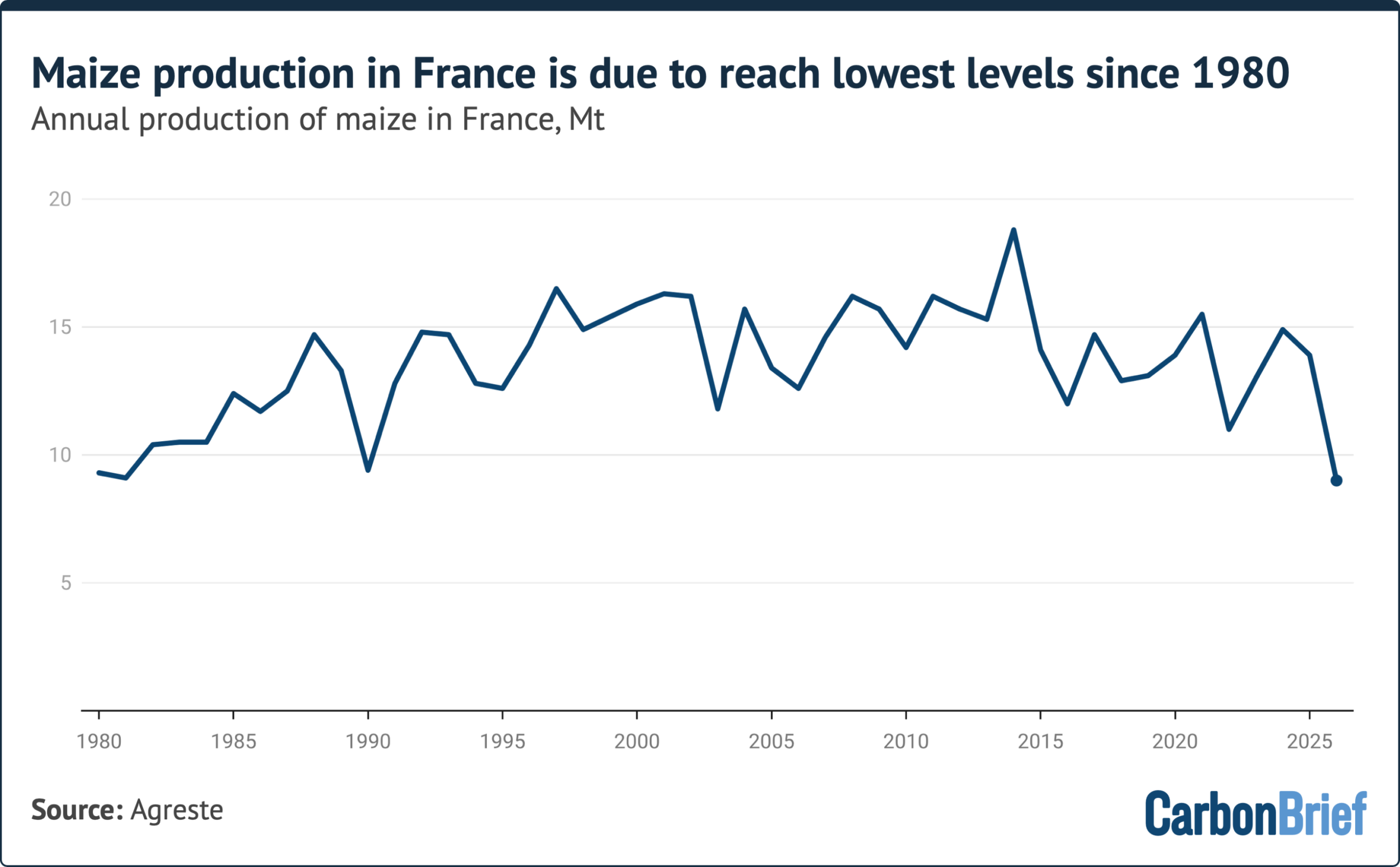
This could result in France’s lowest maize production since 1980, according to data from Agreste, the country’s agriculture ministry’s statistics service.
Due to the heat, “record-early” grape harvests have also been recorded in various parts of the nation since mid-July, reported Le Monde. In some cases, this means “smaller, less juicy grapes, which will yield less wine”, explained the newspaper.
6. Declines in EU grains since 2025
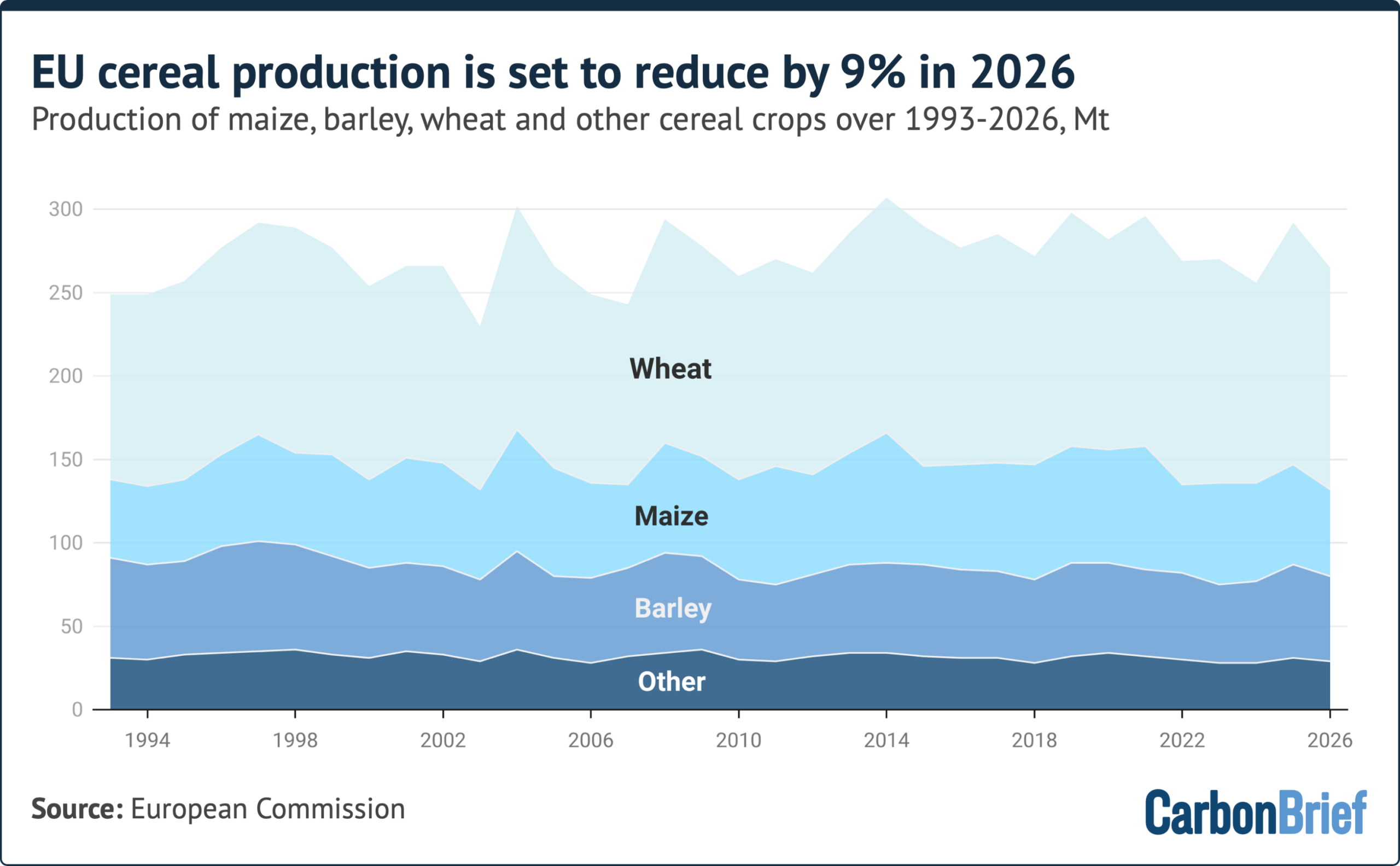
Overall in the EU, data and projections indicate declines in the output of cereal grains this year.
Cereal production is set to fall by 9% compared to 2025, according to the European Commission.
Just one year in the past decade – 2024 – recorded lower production levels.
Maize production is set to be particularly affected, with projections indicating a 13% drop, to 52Mt – the lowest level in the EU since 2007.
The post How this summer’s heat and drought impacted crops in Europe – in six charts appeared first on Carbon Brief.
How this summer’s heat and drought impacted crops in Europe – in six charts

Climate Change
Large flotilla brings Pacific voices and message to leaders at Pre-COP meeting: Keep 1.5C Alive
NADI, FIJI Wednesday 7 October 2026 — Around 80 people including Pacific and Torres Strait community members, Elders and youth activists travelled as part of a colourful flotilla past the Pre-COP venues with a message for leaders: ‘Keep 1.5°C Alive’.
High res footage and images available here
The large flotilla included traditional Fijian voyaging vessel the Uto Ni Yalo, six 6-person outrigger canoes, and Greenpeace campaigning vessel the Oceania which sailed from Sydney to the Pre-COP in Nadi. On board were Elders, climate-vulnerable communities members from across the Pacific and Torres Strait, youth activists and poets, and campaigners and climate experts from across the region.
Messaging on canoes and banners said ‘Hold the Line at 1.5°C’ and ‘Keep 1.5°C Alive’ — a reminder to leaders that the climate limit established under the Paris Agreement is a non-negotiable survival line.
Shiva Gounden, Head of Pacific at Greenpeace Australia Pacific, said: “People from across the Pacific and Australia have come together today to make sure the voices of our communities are heard by leaders meeting here in Nadi for the Pre-COP climate talks. The Taku Pakasoa Declaration adopted here at Pre-COP means ‘Strength in Unity’, and that’s how we’re coming together today.
“Our message is clear: Hold the Line on 1.5°C and centre those most impacted by the climate crisis in your decision-making. Our children’s futures must not be stolen away so that polluting nations can continue down the fossil-fuel path.
“Limiting global heating to 1.5°C is a non-negotiable survival line for Pacific communities and for humanity. Every cyclone, every storm now blows with the deadly force of accumulated emissions and gives a warning of what is to come as we face a dangerous summer of climate-fuelled extreme weather. Do not ignore our voices.”
On board, Aigagalefili Fepulea’i-Tapua’i, Pacific youth climate advocate and poet from Aotearoa Climate Action Network, said: “To hold the line on 1.5C for our Pacific family, New Zealand, as the only country where the connection between environmental protection and indigenous rights is legally validated by our constitutional document, must protect the rights of Māori.”
ENDS
Media contact: Kate O’Callaghan in Nadi on +61 406 231 892 (Whatsapp/Signal)
Large flotilla brings Pacific voices and message to leaders at Pre-COP meeting: Keep 1.5C Alive
Climate Change
A ‘victory’ for communities as High Court rules climate impacts from coal and gas must be considered even where fossil fuels are exported
SYDNEY, Wednesday 7 October 2026 — In response to the landmark High Court ruling that climate impacts of fossil fuel projects must be considered by NSW planning authorities, the following lines can be attributed to Joe Rafalowicz, Head of Climate and Energy at Greenpeace Australia Pacific
“The High Court decision today is a victory for communities that bear the brunt of the storms, bushfires and extreme weather fuelled by Australian fossil fuel corporations.
“Coal and gas companies have claimed they are not responsible for their pollution because it happens overseas, but today Australia’s highest court sided with common sense and scientific evidence to find that every new coal and gas approval in this country could put us at risk, no matter where it is sold or burnt.
“As leaders meet at the Pre-COP talks in Fiji this week, Pacific communities are reaffirming the importance of the 1.5C temperature limit as a survival line for humanity, and is a scientific, moral and legal obligation as affirmed by the landmark Pacific-led ICJ Advisory Opinion. The highest court in the world, and now in Australia, have been clear: it is legally imperative that all of the pollution from fossil fuel projects be considered before approving a new project.
“Now is the moment for the Australian Government, as COP31 President of Negotiations, to find the courage, leadership and grit our country is known for to chart a new course away from fossil fuels. This begins with showing leadership at home by ending new coal and gas approvals.”
-ENDS-
After witnessing the effects of sea-level rise in the low-lying island nation of Tuvalu, Pacific leaders on Tuesday used the pre-COP31 summit in Fiji to voice their frustration at the difficulties they have experienced in tapping the global climate finance system.
A small group of government leaders, climate negotiators and heads of development banks and climate funds took a trip to Tuvalu’s Funafuti atoll on Tuesday morning, travelling by road over land just 10-20 metres wide to visit a project that is building barriers to keep the sea from the land.
They then flew to Fiji for the pre-COP summit, where several Pacific leaders said they had been let down by the insufficient quantity, bad terms and slow speed of international finance to help them adapt to a warming climate that is bringing higher oceans, drought and more powerful storms to their shores.
“Right now, our islands are like a canoe that has been rammed by a massive foreign ship. Our canoe is taking on water, we are sinking, and what is the world’s response?” asked Palau’s President Surangel Whipps Jr.
“They hand us a tiny patch to cover a gaping hole,” he continued, “but the bureaucratic process just to receive that patch is so slow that the water fills the hole while we wait. Then to rebuild the vessel so that we can survive the next storm, we are offered loans, debt that adds weight to a sinking boat packaged in red tape so thick we can barely access it. And while we wait, the water continues to fill.”

Pacific leaders and Australia called again on governments to invest in the new Pacific Resilience Facility (PRF), which has been designed by the Pacific Islands Forum and is seeking $500 million in investments by COP31 in November.
It has around $180 million so far, but did not receive additional pledges during the UN General Assembly in New York. The PRF aims to invest to generate annual returns which it can give to projects like water tanks for drought-hit communities.
Witnessing sea level rise
The annual pre-COP gathering is usually a low-profile technical meeting of climate negotiators. But this year, Australia – which is the president of negotiations at COP31 – partnered with the Pacific to introduce a “leaders segment” in an attempt to shine a spotlight on climate issues affecting the region.
Fourteen government leaders – from Australia, Timor-Leste, Mauritius and the Pacific – made the trip. They were joined by the European Union’s climate commissioner Wopke Hoekstra, the heads of the Green Climate Fund and the Asian Development Bank and former Australian prime minister Julia Gillard.
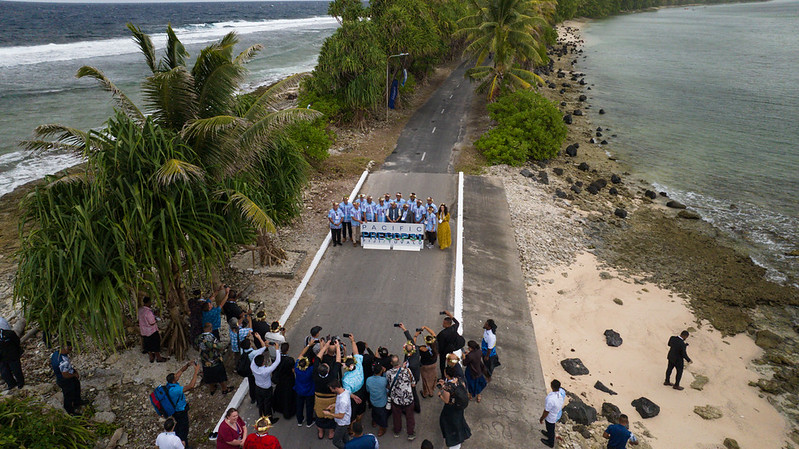
On their return to Fiji, Solomon Islands Prime Minister Matthew Wale told the pre-COP leaders roundtable that the sea level rise they had witnessed was personal for him.
“Tuvalu was not just a site visit for me. I saw the story of my own saltwater people,” he said, adding that he, his daughter and his grandfather had lost their houses to sea level rise and that three-quarters of his electorate live on land that will be underwater in the next 30 years.
From the other side of the world, Antigua and Barbuda’s environment minister Michael Joseph said Tuvalu’s problems felt similar to those of his own Caribbean islands. “I saw vulnerable communities… just metres from the sea and people determined to remain on their land, preserve their culture and way of life,” he said.
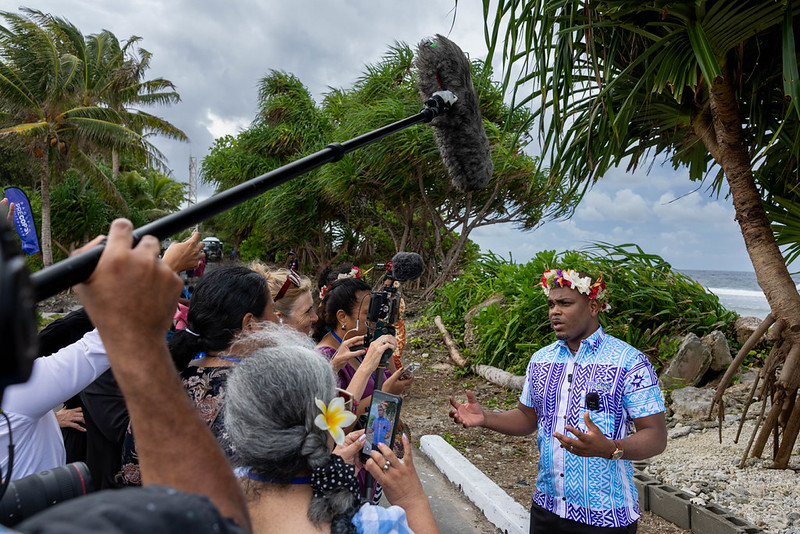
A group of Fijian schoolchildren told the leaders it was not just sea level rise the Pacific struggles with but also heatwaves, droughts and storms, which worry their families and prevent them from learning.
Climate finance red-tape
Several Pacific leaders criticised the world’s leaders for not doing enough to combat climate change. Cook Islands Prime Minister Mark Brown expressed disappointment that only two non-Pacific leaders had come to the pre-COP, a fact Australian media widely picked up on to label the event a flop and question its A$20 million (US$14m) price tag.
“We’ve heard a lot of numbers these last two days,” Brown said. “Let me share one of my own. More than 50 invitations extended to world leaders… to see for themselves what high emissions are doing to our nations and our ocean – an ocean that covers nearly one-third of the Earth’s surface.”
-
Pacific islands seek backing for new regional fund ahead of COP31
Pacific leaders will appeal for pledges to a new regional fund designed to swiftly channel climate finance to local communities -
The Pacific made history in the courts – now we must do it in the negotiations
Legal clarity alone will not lead to reduced emissions, more finance or stronger national climate plans – political will is key to meeting states’ obligations -
Civil servants warn fossil fuel exploration could harm New Zealand’s climate reputation
Advice to politicians says revoking a ban on oil and gas drilling could damage relations with Pacific neighbours and risk lawsuits
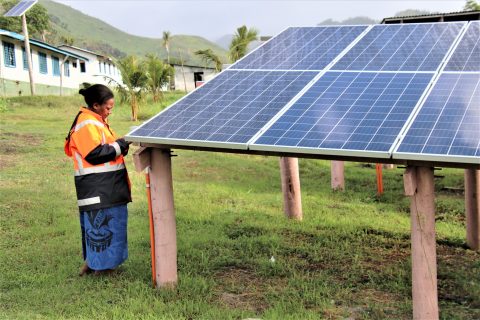


He called for more climate finance for the Pacific, asking “if the world is prepared to assess our suitability for climate finance, why is it not equally prepared to scrutinise whether those responsible for delivering it are meeting their obligations?”
Like Palau’s president Whipps, Naoero’s President David Adeang criticised the red tape that is hindering access to climate finance as well as a lack of money, complaining especially about “complicated procedures, heavy reporting, delays in approval and disbursement”.
Adeang added that “the way we assess vulnerability matters”, adding that it should be measured by more than income. Naoero, for example, is classified by the World Bank as high-income, restricting which climate finance it is eligible for.
Action plan to improve access
On Thursday, the Australian government will present a statement and action plan on improving access to climate finance for small island developing states and least developed countries, which it is asking other countries and organisations to endorse.
The statement addresses some of these Pacific complaints as well as acknowledging that progress has already been made on simplifying access by multilateral development banks and climate funds.
In Fiji, Asian Development Bank head Masato Kanda said his institution is “tailoring our finance and operations to island realities” because “your children and their children should be able to grow old in the countries their ancestors have called home for millennia”.
The executive director of the Green Climate Fund (GCF), Mafalda Duarte, said that the GCF-backed coastal adaptation project leaders visited in Tuvalu shows that “climate finance works” although – as the project took eight years to implement – “it takes time, and therefore we have no time to waste”.
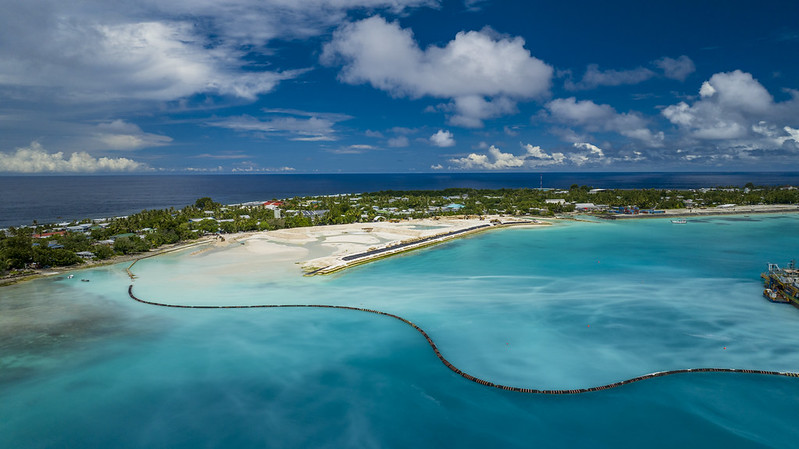
Australia calls for optimism
While Pacific leaders expressed concern that the world is set to blast past its agreed 1.5C warming limit, endangering their nations, Australia’s Prime Minister Anthony Albanese called for “optimism”. “If people think there is no hope, then they will not strive to get the change that we need,” he said.
He said that when he attended his first COP in 2005, Australia’s renewable energy target was 2%. Its target is now 82% renewable electricity by 2030.
While Albanese promoted Australia’s success at electrifying homes and businesses and rolling out renewables, he has been criticised by climate campaigners for extending the production of fossil fuels, including coal – largely for export.
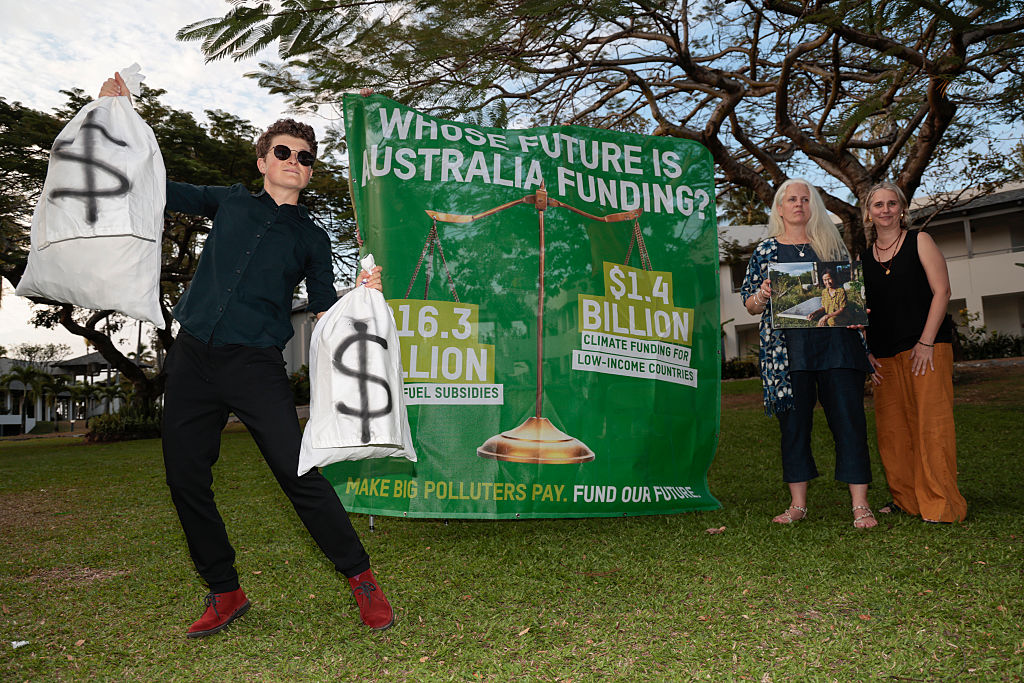
France’s Minister for Ecological Transition Monique Barbut defended the European Union’s climate action at the pre-COP meeting. She said the continent was heating up and reducing emissions faster and providing more climate finance than anywhere else in the world.
“It is time for all major emitters to step up and do their fair share” on climate finance, she said. Most developing countries with large emissions have fiercely resisted joining the club of climate finance donors, arguing they have played a disproportionately small historic role in causing climate change.
Barbut, as well as Palau’s president Whipps, called for the next flagship scientific assessment report of the Intergovernmental Panel on Climate Change (IPCC) to be finished by COP33 in 2028, in time to inform the next global stocktake of national climate action.
This timeline has been opposed by countries like India, Saudi Arabia and China, who argue it would put an unfair burden on developing countries. Barbut said countries should “support the work of the IPCC rather than sabotage its calendar”.
Barbut said that governments should agree at COP31 to aim to raise the share of “clean electricity” in final energy consumption to 35% by 2035. The Turkish and Australian governments have pushed for this goal although without specifying that the electricity should be “clean”. Barbut added that COP31 should also agree to cut emissions of methane, a particularly potent greenhouse gas.
The post Pacific leaders rail at climate finance failures after pre-COP trip to Tuvalu appeared first on Climate Home News.
Pacific leaders rail at climate finance failures after pre-COP trip to Tuvalu

Large flotilla brings Pacific voices and message to leaders at Pre-COP meeting: Keep 1.5C Alive
A ‘victory’ for communities as High Court rules climate impacts from coal and gas must be considered even where fossil fuels are exported

Indoctrinating Children into Religion
-
Climate Change1 year ago
Guest post: Why China is still building new coal – and when it might stop
-

 Greenhouse Gases2 years ago
嘉宾来稿:满足中国增长的用电需求 光伏加储能“比新建煤电更实惠”
-
Greenhouse Gases1 year ago
Guest post: Why China is still building new coal – and when it might stop
-

 Climate Change2 years ago
嘉宾来稿:满足中国增长的用电需求 光伏加储能“比新建煤电更实惠”
-

 Renewable Energy12 months ago
Sending Progressive Philanthropist George Soros to Prison?
-
Climate Change2 years ago
Bill Discounting Climate Change in Florida’s Energy Policy Awaits DeSantis’ Approval
-
Greenhouse Gases1 year ago
嘉宾来稿:探究火山喷发如何影响气候预测
-

 Climate Change2 years ago
Analysis: China’s CO2 falls 1% in Q2 2024 in first quarterly drop since Covid-19