

The Indian government weakened rules to curb pollution caused by its expanding coal industry after lobbying by top producers, even as it agreed internationally to phase down the use of coal, an investigation by Climate Home has found.
India’s coal giants pushed back hard against environmental regulation meant to tighten up the disposal of fly ash – a byproduct of coal-fired power plants known to harm both humans and the environment if not managed properly.
Letters sent by coal companies to the Indian government – and accessed by Climate Home News through freedom of information requests to government agencies – reveal lobbying efforts to weaken federal rules between 2019 and 2023.
The state-run firms involved were Coal India Limited (CIL), the world’s third-biggest coal mining company, and National Thermal Power Corporation (NTPC) Limited, one of the top 10 coal-fired power companies globally.
Top management at the coal giants claimed their organisations would not be able to comply fully with the government regulations, aimed at controlling fly ash disposal after decades of public health impacts for local communities. Even after the rules were approved, the companies continued efforts to weaken them, in some cases successfully.

Residents of Kuruvimedu village in Tamil Nadu show coal dust and fly ash on 10 March 2017 (Photo: Sajan Ponappa/Greenpeace)
NTPC argued financial constraints would keep them from meeting the new requirements to clean up waste accumulated over decades and prevent further ash pollution, according to the accessed documents.
In some cases, lobbying got results and regulations were eased, with the environment and power ministries drawing on arguments from both companies in official correspondence between government agencies.
Climate Home contacted the two coal companies and India’s Ministry of Environment, Forest and Climate Change for comment on the issues raised in this article but did not receive a response.
COP26 commitment
In 2021, while the proposed fly ash mandates were under discussion in India, the country was negotiating the COP26 climate pact in Glasgow, which calls on all governments to take action “towards the phase-down of unabated coal power”.
At those UN talks, India rejected stronger language on a global shift away from coal, but it agreed to scale back unabated coal power, which is produced without technology to reduce its climate-heating emissions.
Despite this deal, coal infrastructure around the world has since grown, mostly driven by added coal mining and power capacity in India, China and Indonesia.
The Indian documents obtained by Climate Home reveal that the South Asian nation’s coal companies lobbied against regulations on fly ash pollution while expanding coal production at record speed.
In their correspondence with ministries, they argued that high fines for non-compliance with waste disposal rules were a risk to their financial sustainability and raised the prospect of coal-fired power plants being shut down, triggering a power crisis in the country.

A letter from the NTPC’s director of operations to the environment ministry on February 8, 2022. Highlights by Climate Home News
Fly ash pollution
When thermal power plants burn coal for energy, the fly ash they generate as a byproduct is dumped in water-filled, dam-like structures called dykes.
Old “legacy” dykes store ash from previous decades and are a major source of pollution for nearby communities, explained independent air pollution analyst Sunil Dahiya. Wet ash can leach into groundwater, while dry ash can blow away, causing air pollution and damaging crops.
Functioning disposal sites are also vulnerable to heavy rains, as they can overflow and pollute nearby settlements. This happened on at least three occasions between 2019 and 2021, according to a 2021 report by the NGO Fly Ash Watch Group.
To minimise the impacts of fly ash, companies can recycle it into products like bricks, cement sheets, panels and other construction materials – a process known as “utilisation”.

Children playing beside one of the many ash dykes of the NTPC Sipat Thermal Power Plant on March 11, 2017 (Saagnik Paul/Greenpeace)
Sehr Raheja, climate change officer at the Indian think-tank Centre for Science and Environment (CSE), highlighted the need to utilise “legacy” ash given “the enormous quantity”, adding there are risks involved with it staying underground, such as water and soil pollution.
As of 2019, the amount of accumulated unused ash in the country was about 1.65 billion tonnes, according to a CSE report, with newer estimates suggesting even more, she said.
“Loophole” in regulation
Fly ash regulation – known officially as the Fly Ash Notification – has been in place in India since 1999. But it was not until a 2021 update to the rules that fines were introduced for failing to comply with proper waste disposal, following the ‘polluter pays’ principle.
The regulation also imposed a mandate on thermal power plants to ensure 100% utilisation of accumulated old fly ash, as well as fresh ash produced by ongoing operations.
Documents accessed by Climate Home show that NTPC exchanged letters with government agencies asking for elimination of the mandate to clean up accumulated ash.
“It is proposed that the provisions for utilization of old legacy ash may be dropped,” reads a 2021 letter from NTPC to the Ministry of Environment, Forests and Climate Change.

A letter from NTPC’s managing director to the environment ministry on June 11, 2021. Highlights by Climate Home News
The 2021 rules were nonetheless passed, and they did introduce strict fines for coal companies. However, they also included what experts called a “loophole”.
The fly ash regulation exempted power plants from having to find a use for their old legacy ash as long as the ponds where it was stored were considered “stabilised”, meaning they had been secured against leakage. But the technical specifications of how that should be done were not defined, leading to concerns that arbitrary exemptions could be granted.
Yet even after these revamped regulations came into force in late 2021, lobbying intensified.
Persistence pays off
In 2022, NTPC was still concerned by a deadline of 10 years to utilise all legacy ash accumulated over decades, according to a letter addressed to the environment ministry. This would force them to transfer large quantities of fly ash to end users like brick-making kilns or ceramic product makers – or pay fines.
NTPC met with regulators at the Ministry of Power and agreed an extension to the period for stabilising old ash dykes from one to three years.
In the case of “operational” ponds, officials were persuaded not to label them as legacy ash, exempting them from the requirement for full utilisation. These changes were included in a 2022 amendment to the rules.

A civil servant’s notes from a meeting between government officials and the NTPC on 5 July 2022. Highlights by Climate Home News
Shripad Dharmadhikary, who leads civil-society research group Manthan Adhyayan Kendra and has worked on fly ash management, said the unclear definition of stabilisation and longer time-frame for doing it provided “a loophole for power plants to evade use or proper disposal of legacy ash”
The lack of technical parameters meant government authorities could struggle to guarantee that no more leaks would occur even if they certified the ponds, he added.
“Threat” to coal industry finances
The powerful companies also managed to limit the level of fines for non-compliance in a prolonged effort that began in 2020, when the first draft proposal on the new fly ash rules was circulated among coal companies.
That included a fine of Rs 1,500 (about $17.80) per tonne, which was cut to Rs 1,000 ($11.90) in the final 2021 rules after NTPC and other coal companies opposed it and asked for it to be removed entirely.
Even after this, executives from both Coal India and NTPC expressed alarm about the financial implications of the fines.
Sign up to get our weekly newsletter straight to your inbox, plus breaking news, investigations and extra bulletins from key events
In a February 2022 letter to the Ministry of Environment, for instance, NTPC’s then director of operations Ramesh Babu V. wrote that the company could end up paying Rs 76,000 crores ($9 billion) over a decade – an amount “significant enough to threaten financial viability of NTPC and country’s thermal sector alike”. He warned that the penalties could make large power stations at mining pit heads commercially unviable, leading to a “power crisis”.
Similarly, in a 2023 letter, CIL chairman and managing director Pramod Agrawal estimated that the “financial penalty” on only one of its subsidiaries (NCL) for failure to comply with the regulations could cost the latter Rs 38,145 crores (at least $4 billion) for just the 2022-2023 financial year.
Coal expansion
However, the threats the executives outlined to their companies’ bottom lines do not appear to have translated into lower capacity to mine coal and produce thermal power, as both were ramped up drastically during and after discussions on the Fly Ash Notification.
Expansion efforts were redoubled especially after an unprecedented power crisis in late 2021, which was attributed to logistical issues causing a shortage of coal supply.
In a January 2024 conference call with investors, NTPC’s management said it was considering awarding thermal power capacity of 15.2 gigawatts (GW) in the near future, on top of the 9.6 GW thermal capacity already under construction for the group.
CIL, in its latest annual report, announced plans to increase coal mining capacity to 1 billion tonnes by the financial year 2025-26.
G20 waters down experts’ climate finance report, despite UN pressure to act
A previous investigation by Climate Home News showed that European asset managers invested substantially in both NTPC and CIL, helping India’s coal industry to grow rather than phase down in line with international commitments.
Air pollution expert Dahiya said that, while India has lower historical emissions than countries in the Global North and requires flexibility to meet its energy needs, as well as international support to move away from fossil fuels, that did not mean coal companies should be “free to pollute”.
Raheja, of the CSE, said better controls on pollution were also a matter of justice for those living near coal-fired power plants.
“The environmental regulations are critically important for maintaining the health of the environment and of communities residing near coal facilities – even of people far away – as pollution, both through air and water, can be carried to a distance,” Raheja told Climate Home News.
(Reporting by Akshay Deshmane; editing by Sebastian Rodriquez, Megan Rowling and Joe Lo; fact-checking by Matteo Civillini)
The post Indian coal giants pushed for lax pollution rules while ramping up production appeared first on Climate Home News.
Indian coal giants pushed for lax pollution rules while ramping up production

Climate Change
Large flotilla brings Pacific voices and message to leaders at Pre-COP meeting: Keep 1.5C Alive
NADI, FIJI Wednesday 7 October 2026 — Around 80 people including Pacific and Torres Strait community members, Elders and youth activists travelled as part of a colourful flotilla past the Pre-COP venues with a message for leaders: ‘Keep 1.5°C Alive’.
High res footage and images available here
The large flotilla included traditional Fijian voyaging vessel the Uto Ni Yalo, six 6-person outrigger canoes, and Greenpeace campaigning vessel the Oceania which sailed from Sydney to the Pre-COP in Nadi. On board were Elders, climate-vulnerable communities members from across the Pacific and Torres Strait, youth activists and poets, and campaigners and climate experts from across the region.
Messaging on canoes and banners said ‘Hold the Line at 1.5°C’ and ‘Keep 1.5°C Alive’ — a reminder to leaders that the climate limit established under the Paris Agreement is a non-negotiable survival line.
Shiva Gounden, Head of Pacific at Greenpeace Australia Pacific, said: “People from across the Pacific and Australia have come together today to make sure the voices of our communities are heard by leaders meeting here in Nadi for the Pre-COP climate talks. The Taku Pakasoa Declaration adopted here at Pre-COP means ‘Strength in Unity’, and that’s how we’re coming together today.
“Our message is clear: Hold the Line on 1.5°C and centre those most impacted by the climate crisis in your decision-making. Our children’s futures must not be stolen away so that polluting nations can continue down the fossil-fuel path.
“Limiting global heating to 1.5°C is a non-negotiable survival line for Pacific communities and for humanity. Every cyclone, every storm now blows with the deadly force of accumulated emissions and gives a warning of what is to come as we face a dangerous summer of climate-fuelled extreme weather. Do not ignore our voices.”
On board, Aigagalefili Fepulea’i-Tapua’i, Pacific youth climate advocate and poet from Aotearoa Climate Action Network, said: “To hold the line on 1.5C for our Pacific family, New Zealand, as the only country where the connection between environmental protection and indigenous rights is legally validated by our constitutional document, must protect the rights of Māori.”
ENDS
Media contact: Kate O’Callaghan in Nadi on +61 406 231 892 (Whatsapp/Signal)
Large flotilla brings Pacific voices and message to leaders at Pre-COP meeting: Keep 1.5C Alive
Climate Change
A ‘victory’ for communities as High Court rules climate impacts from coal and gas must be considered even where fossil fuels are exported
SYDNEY, Wednesday 7 October 2026 — In response to the landmark High Court ruling that climate impacts of fossil fuel projects must be considered by NSW planning authorities, the following lines can be attributed to Joe Rafalowicz, Head of Climate and Energy at Greenpeace Australia Pacific
“The High Court decision today is a victory for communities that bear the brunt of the storms, bushfires and extreme weather fuelled by Australian fossil fuel corporations.
“Coal and gas companies have claimed they are not responsible for their pollution because it happens overseas, but today Australia’s highest court sided with common sense and scientific evidence to find that every new coal and gas approval in this country could put us at risk, no matter where it is sold or burnt.
“As leaders meet at the Pre-COP talks in Fiji this week, Pacific communities are reaffirming the importance of the 1.5C temperature limit as a survival line for humanity, and is a scientific, moral and legal obligation as affirmed by the landmark Pacific-led ICJ Advisory Opinion. The highest court in the world, and now in Australia, have been clear: it is legally imperative that all of the pollution from fossil fuel projects be considered before approving a new project.
“Now is the moment for the Australian Government, as COP31 President of Negotiations, to find the courage, leadership and grit our country is known for to chart a new course away from fossil fuels. This begins with showing leadership at home by ending new coal and gas approvals.”
-ENDS-
After witnessing the effects of sea-level rise in the low-lying island nation of Tuvalu, Pacific leaders on Tuesday used the pre-COP31 summit in Fiji to voice their frustration at the difficulties they have experienced in tapping the global climate finance system.
A small group of government leaders, climate negotiators and heads of development banks and climate funds took a trip to Tuvalu’s Funafuti atoll on Tuesday morning, travelling by road over land just 10-20 metres wide to visit a project that is building barriers to keep the sea from the land.
They then flew to Fiji for the pre-COP summit, where several Pacific leaders said they had been let down by the insufficient quantity, bad terms and slow speed of international finance to help them adapt to a warming climate that is bringing higher oceans, drought and more powerful storms to their shores.
“Right now, our islands are like a canoe that has been rammed by a massive foreign ship. Our canoe is taking on water, we are sinking, and what is the world’s response?” asked Palau’s President Surangel Whipps Jr.
“They hand us a tiny patch to cover a gaping hole,” he continued, “but the bureaucratic process just to receive that patch is so slow that the water fills the hole while we wait. Then to rebuild the vessel so that we can survive the next storm, we are offered loans, debt that adds weight to a sinking boat packaged in red tape so thick we can barely access it. And while we wait, the water continues to fill.”

Pacific leaders and Australia called again on governments to invest in the new Pacific Resilience Facility (PRF), which has been designed by the Pacific Islands Forum and is seeking $500 million in investments by COP31 in November.
It has around $180 million so far, but did not receive additional pledges during the UN General Assembly in New York. The PRF aims to invest to generate annual returns which it can give to projects like water tanks for drought-hit communities.
Witnessing sea level rise
The annual pre-COP gathering is usually a low-profile technical meeting of climate negotiators. But this year, Australia – which is the president of negotiations at COP31 – partnered with the Pacific to introduce a “leaders segment” in an attempt to shine a spotlight on climate issues affecting the region.
Fourteen government leaders – from Australia, Timor-Leste, Mauritius and the Pacific – made the trip. They were joined by the European Union’s climate commissioner Wopke Hoekstra, the heads of the Green Climate Fund and the Asian Development Bank and former Australian prime minister Julia Gillard.
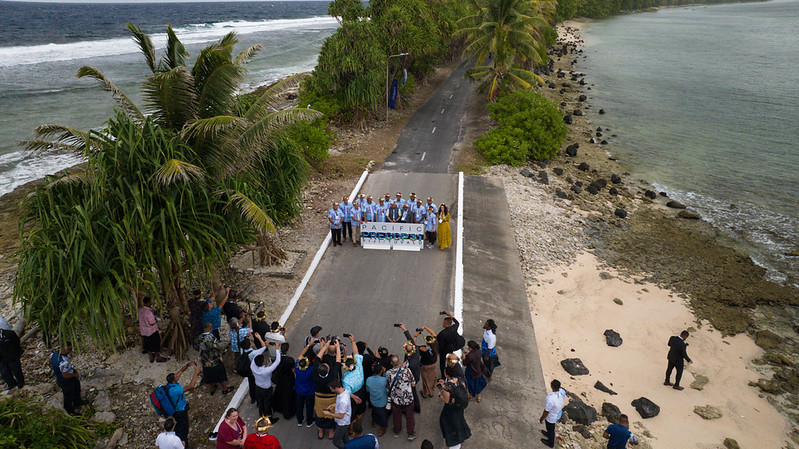
On their return to Fiji, Solomon Islands Prime Minister Matthew Wale told the pre-COP leaders roundtable that the sea level rise they had witnessed was personal for him.
“Tuvalu was not just a site visit for me. I saw the story of my own saltwater people,” he said, adding that he, his daughter and his grandfather had lost their houses to sea level rise and that three-quarters of his electorate live on land that will be underwater in the next 30 years.
From the other side of the world, Antigua and Barbuda’s environment minister Michael Joseph said Tuvalu’s problems felt similar to those of his own Caribbean islands. “I saw vulnerable communities… just metres from the sea and people determined to remain on their land, preserve their culture and way of life,” he said.

A group of Fijian schoolchildren told the leaders it was not just sea level rise the Pacific struggles with but also heatwaves, droughts and storms, which worry their families and prevent them from learning.
Climate finance red-tape
Several Pacific leaders criticised the world’s leaders for not doing enough to combat climate change. Cook Islands Prime Minister Mark Brown expressed disappointment that only two non-Pacific leaders had come to the pre-COP, a fact Australian media widely picked up on to label the event a flop and question its A$20 million (US$14m) price tag.
“We’ve heard a lot of numbers these last two days,” Brown said. “Let me share one of my own. More than 50 invitations extended to world leaders… to see for themselves what high emissions are doing to our nations and our ocean – an ocean that covers nearly one-third of the Earth’s surface.”
-
Pacific islands seek backing for new regional fund ahead of COP31
Pacific leaders will appeal for pledges to a new regional fund designed to swiftly channel climate finance to local communities -
The Pacific made history in the courts – now we must do it in the negotiations
Legal clarity alone will not lead to reduced emissions, more finance or stronger national climate plans – political will is key to meeting states’ obligations -
Civil servants warn fossil fuel exploration could harm New Zealand’s climate reputation
Advice to politicians says revoking a ban on oil and gas drilling could damage relations with Pacific neighbours and risk lawsuits



He called for more climate finance for the Pacific, asking “if the world is prepared to assess our suitability for climate finance, why is it not equally prepared to scrutinise whether those responsible for delivering it are meeting their obligations?”
Like Palau’s president Whipps, Naoero’s President David Adeang criticised the red tape that is hindering access to climate finance as well as a lack of money, complaining especially about “complicated proce