

As COP29 wound up in the early hours of Sunday, India’s fierce objection to the climate finance deal that was the summit’s main outcome showed its resolve to act as a voice for the Global South in wanting more international support to step up climate action, diplomats and policy analysts said.
In a statement described as “bold” and “historic”, India rejected the rushed approval of the new finance goal for 2026-2035, arguing that due process had not been followed, and sought “much higher ambition” from rich nations.
“The Global South is being pushed to transit to no-carbon pathways even at the cost of our growth… other measures are being imposed by developed country parties to make this transition really not easy,” Chandni Raina, an advisor with India’s Department of Economic Affairs, said in an impassioned speech. “This amount is a paltry sum and not something that will enable conducive climate action,” she said of the hard-fought deal on climate finance after it was gavelled through.
Rich nations on Saturday agreed to channel at least $300 billion a year by 2035 for developing countries to ramp up climate action, after bad-tempered talks in which the most vulnerable pushed for a bigger slice of the pie.
Fractious COP29 lands $300bn climate finance goal, dashing hopes of the poorest
The new goal replaces the existing annual target of $100 billion, which was met two years late in 2022 and is widely seen as insufficient to meet rocketing needs among poorer nations for transitioning to clean energy and adapting to extreme weather and rising seas.
In Baku, poorer countries had pushed for that amount to be raised to at least $1 trillion, with most of the money provided as grants.
The far lower final offer of $300 billion, whose provision will be led by rich governments, is part of a wider effort agreed at COP29 to scale up finance to at least $1.3 trillion per year by 2035 “from all public and private sources”.
“We are disappointed in the outcome which clearly brings out the unwillingness of the developed country parties to fulfill their responsibilities. We cannot accept it,” Raina told the final plenary, drawing loud cheers. Delegates from Cuba, Nigeria, Malawi and Bolivia also outlined their disappointment and frustration after the decision had been approved.
Champion for the Global South
“It is important when India speaks up. It reflects our views – those of the least developed countries (LDCs),” said Hana Hamadalla of Sudan, who was part of a delegation of least-developed countries that on Saturday walked out of consultations in protest at an earlier version of the deal.
She told Climate Home she found Raina’s emphasis on the $300bn figure not being enough for poor nations to fight climate change “to the point” and reflective of Sudan’s views.
“India has been and wants to continue to be a champion for other Global South developing countries,” said Sandeep Pai, director for research and strategy at Swaniti Global, a social enterprise that works on climate action and policy.
In Baku, wealthy nations first put on the table an annual sum of $250 billion by 2035, which was rejected by climate campaigners and poor countries. They then increased their offer to $300 billion by that date. A high-level group of economists has recommended that level should be reached five years earlier and then raised to $390 billion a year by 2035.
As climate-vulnerable countries, we know what kind of finance we need
India, for its part, had called on rich nations to pledge $600 billion a year in grants. The final deal in Baku – half of that – did not specify how much of the core public finance goal should come as grants and cheap loans.
Pai described the COP29 finance deal as “grim”. “At this point everyone knows money is not coming unless it is for something that would make sense commercially,” he told Climate Home.
With Donald Trump’s election as US president, the money will likely also be less than promised, Pai added, especially if the country withdraws from the Paris climate agreement as Trump has threatened to do.
That could leave a finance hole that European nations, Japan and other wealthy governments may be unwilling to fill, boosting pressure on richer, big-emitting developing countries to dig deeper.
Voluntary contributions
Industrialised countries before and during COP pushed hard to expand the donor base for climate finance to include richer developing countries such as China and oil-rich Gulf states, a proposal fiercely rejected by India, the world’s most populous nation.
“Indian negotiators are articulating a long-held stand, so they (wealthy nations) don’t start counting India as a developed nation, expected to pay,” said Pai.
Analysts said there had been no formal ask for India to join the contributor base for the new goal. But New Delhi has pushed back strongly against changes that could shift the parameters of the global climate agreements governing the negotiations, particularly those that could blur the line on who shoulders the greatest responsibility to act on climate change.
The final deal only “encourages” developing countries to make contributions to the new finance goal “on a voluntary basis”.
But on Sunday, within hours of COP29 finally reaching a deal, Jennifer Morgan, Germany’s special envoy for climate, posted a statement on X saying: “We stand to give more, if those who have grown significantly since 1992 – in wealth and emissions – are ready to step up as well. The target we have put forward demonstrates our seriousness.”
While China, the United States, India and the EU currently make up the world’s largest emitters, India ranks lowest in terms of per-capita emissions, according to World Research Institute analysis. The United States and Russia have the highest per-capita emissions.
India’s Raina told the final CO29 plenary that developing countries are now being seen as contributors to finance climate action, and India was opposed to it.
Less finance, weaker NDCs
In the negotiating rooms in Baku, India led the conversation on the NCQG from the Global South, and its opposition to the agreed goal could signal that developing countries may submit weak national climate plans (NDCs) next year, analysts warned.
Sanjay Vashist, director of Climate Action Network South Asia, said developing countries such as India may not slow down their efforts to adapt to climate shifts, but their actions and ambitions will not be reflected in the NDC they submit.
“We are answerable to domestic monitoring systems not international. Now you are not under obligation,” he said, referring to the shortfall in finance.
India’s strongly worded objection at COP29 was also regarded as significant because it sends a strong signal “that a deal cannot be done” without countries being heard, said Srestha Banerjee, director of just transition at the International Forum for Environment, Sustainability and Technology (iFOREST), a research and policy think-tank.
The critical voices, not just of India but also other countries including Colombia’s environment minister, “should be a wake-up call for rethinking the UNFCCC [process] and how it can truly deliver cooperative action”, Banerjee said.
(Reporting by Roli Srivastava; editing by Megan Rowling)
This article was produced as part of the COP29 Cross-Border Energy Transition Reporting Fellowship, a programme organised by Clean Energy Wire and the Stanley Center for Peace and Security.
The post India fires warning shot with rejection of finance deal at COP29 appeared first on Climate Home News.
India fires warning shot with rejection of finance deal at COP29

After witnessing the effects of sea-level rise in the low-lying island nation of Tuvalu, Pacific leaders on Tuesday used the pre-COP31 summit in Fiji to voice their frustration at the difficulties they have experienced in tapping the global climate finance system.
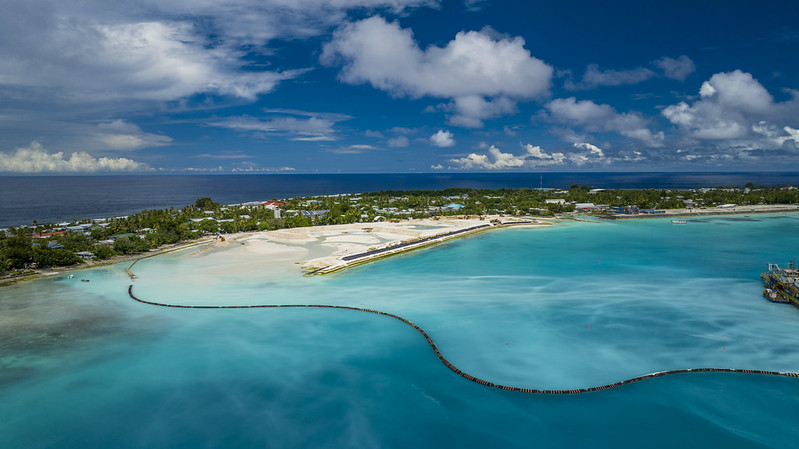
A small group of government leaders, climate negotiators and heads of development banks and climate funds took a trip to Tuvalu’s Funafuti atoll on Tuesday morning, travelling by road over land just 10-20 metres wide to visit a project that is building barriers to keep the sea from the land.
They then flew to Fiji for the pre-COP summit, where several Pacific leaders said they had been let down by the insufficient quantity, bad terms and slow speed of international finance to help them adapt to a warming climate that is bringing higher oceans, drought and more powerful storms to their shores.
“Right now, our islands are like a canoe that has been rammed by a massive foreign ship. Our canoe is taking on water, we are sinking, and what is the world’s response?” asked Palau’s President Surangel Whipps Jr.
“They hand us a tiny patch to cover a gaping hole,” he continued, “but the bureaucratic process just to receive that patch is so slow that the water fills the hole while we wait. Then to rebuild the vessel so that we can survive the next storm, we are offered loans, debt that adds weight to a sinking boat packaged in red tape so thick we can barely access it. And while we wait, the water continues to fill.”
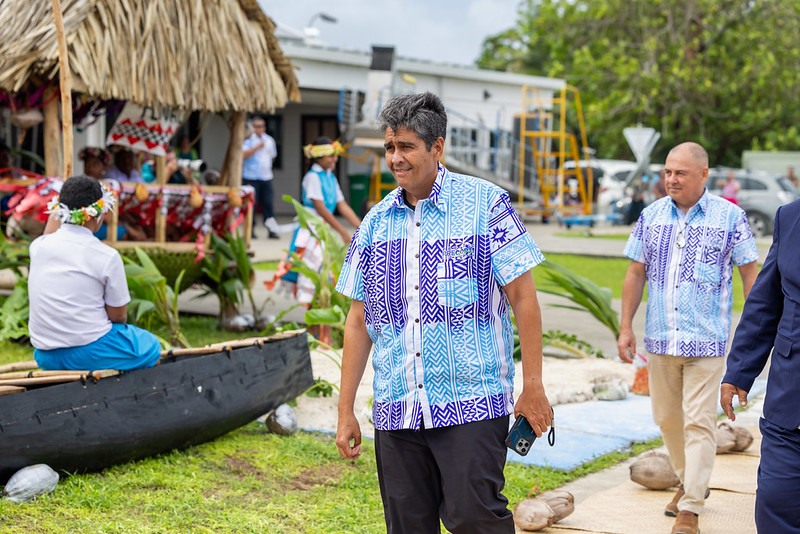
Pacific leaders and Australia called again on governments to invest in the new Pacific Resilience Facility (PRF), which has been designed by the Pacific Islands Forum and is seeking $500 million in investments by COP31 in November.
It has around $180 million so far, but did not receive additional pledges during the UN General Assembly in New York. The PRF aims to invest to generate annual returns which it can give to projects like water tanks for drought-hit communities.
Witnessing sea level rise
The annual pre-COP gathering is usually a low-profile technical meeting of climate negotiators. But this year, Australia – which is the president of negotiations at COP31 – partnered with the Pacific to introduce a “leaders segment” in an attempt to shine a spotlight on climate issues affecting the region.
Fourteen government leaders – from Australia, Timor-Leste, Mauritius and the Pacific – made the trip. They were joined by the European Union’s climate commissioner Wopke Hoekstra, the heads of the Green Climate Fund and the Asian Development Bank and former Australian prime minister Julia Gillard.
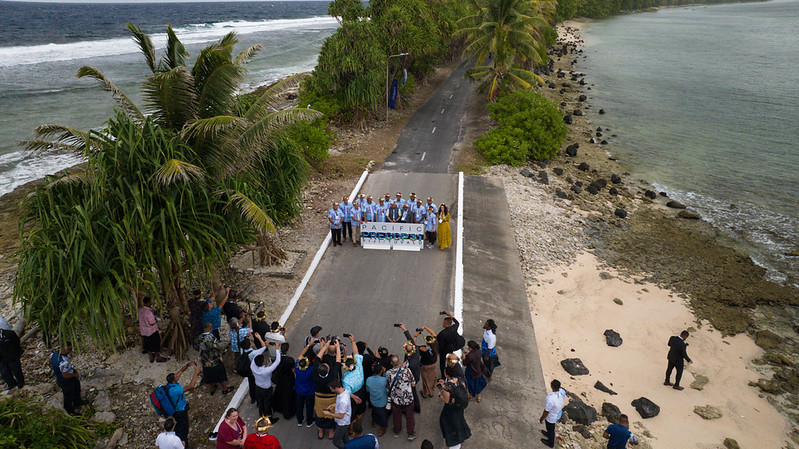
On their return to Fiji, Solomon Islands Prime Minister Matthew Wale told the pre-COP leaders roundtable that the sea level rise they had witnessed was personal for him.
“Tuvalu was not just a site visit for me. I saw the story of my own saltwater people,” he said, adding that he, his daughter and his grandfather had lost their houses to sea level rise and that three-quarters of his electorate live on land that will be underwater in the next 30 years.
From the other side of the world, Antigua and Barbuda’s environment minister Michael Joseph said Tuvalu’s problems felt similar to those of his own Caribbean islands. “I saw vulnerable communities… just metres from the sea and people determined to remain on their land, preserve their culture and way of life,” he said.
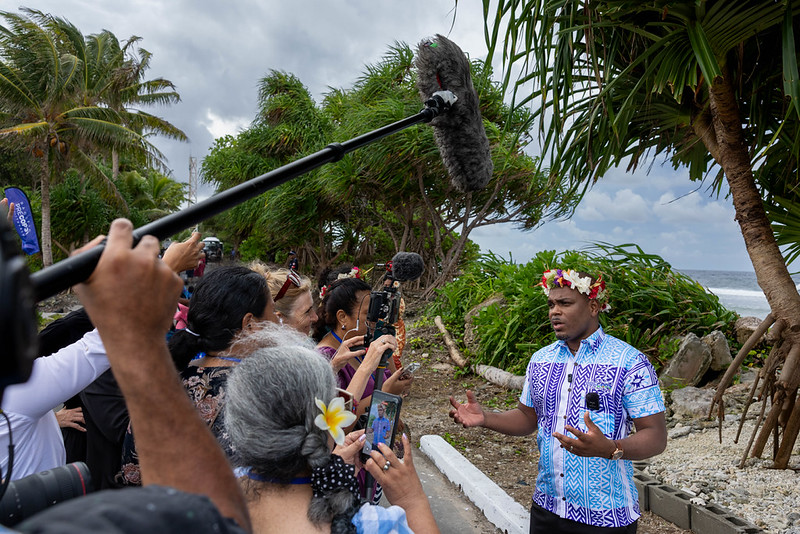
A group of Fijian schoolchildren told the leaders it was not just sea level rise the Pacific struggles with but also heatwaves, droughts and storms, which worry their families and prevent them from learning.
Climate finance red-tape
Several Pacific leaders criticised the world’s leaders for not doing enough to combat climate change. Cook Islands Prime Minister Mark Brown expressed disappointment that only two non-Pacific leaders had come to the pre-COP, a fact Australian media widely picked up on to label the event a flop and question its A$20 million (US$14m) price tag.
“We’ve heard a lot of numbers these last two days,” Brown said. “Let me share one of my own. More than 50 invitations extended to world leaders… to see for themselves what high emissions are doing to our nations and our ocean – an ocean that covers nearly one-third of the Earth’s surface.”
-
Pacific islands seek backing for new regional fund ahead of COP31
Pacific leaders will appeal for pledges to a new regional fund designed to swiftly channel climate finance to local communities -
The Pacific made history in the courts – now we must do it in the negotiations
Legal clarity alone will not lead to reduced emissions, more finance or stronger national climate plans – political will is key to meeting states’ obligations -
Civil servants warn fossil fuel exploration could harm New Zealand’s climate reputation
Advice to politicians says revoking a ban on oil and gas drilling could damage relations with Pacific neighbours and risk lawsuits
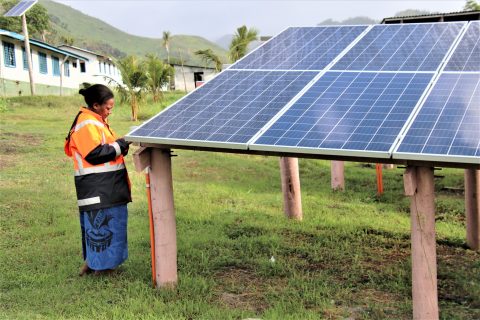


He called for more climate finance for the Pacific, asking “if the world is prepared to assess our suitability for climate finance, why is it not equally prepared to scrutinise whether those responsible for delivering it are meeting their obligations?”
Like Palau’s president Whipps, Naoero’s President David Adeang criticised the red tape that is hindering access to climate finance as well as a lack of money, complaining especially about “complicated procedures, heavy reporting, delays in approval and disbursement”.
Adeang added that “the way we assess vulnerability matters”, adding that it should be measured by more than income. Naoero, for example, is classified by the World Bank as high-income, restricting which climate finance it is eligible for.
Action plan to improve access
On Thursday, the Australian government will present a statement and action plan on improving access to climate finance for small island developing states and least developed countries, which it is asking other countries and organisations to endorse.
The statement addresses some of these Pacific complaints as well as acknowledging that progress has already been made on simplifying access by multilateral development banks and climate funds.
In Fiji, Asian Development Bank head Masato Kanda said his institution is “tailoring our finance and operations to island realities” because “your children and their children should be able to grow old in the countries their ancestors have called home for millennia”.
The executive director of the Green Climate Fund (GCF), Mafalda Duarte, said that the GCF-backed coastal adaptation project leaders visited in Tuvalu shows that “climate finance works” although – as the project took eight years to implement – “it takes time, and therefore we have no time to waste”.
Australia calls for optimism
While Pacific leaders expressed concern that the world is set to blast past its agreed 1.5C warming limit, endangering their nations, Australia’s Prime Minister Anthony Albanese called for “optimism”. “If people think there is no hope, then they will not strive to get the change that we need,” he said.
He said that when he attended his first COP in 2005, Australia’s renewable energy target was 2%. Its target is now 82% renewable electricity by 2030.
While Albanese promoted Australia’s success at electrifying homes and businesses and rolling out renewables, he has been criticised by climate campaigners for extending the production of fossil fuels, including coal – largely for export.
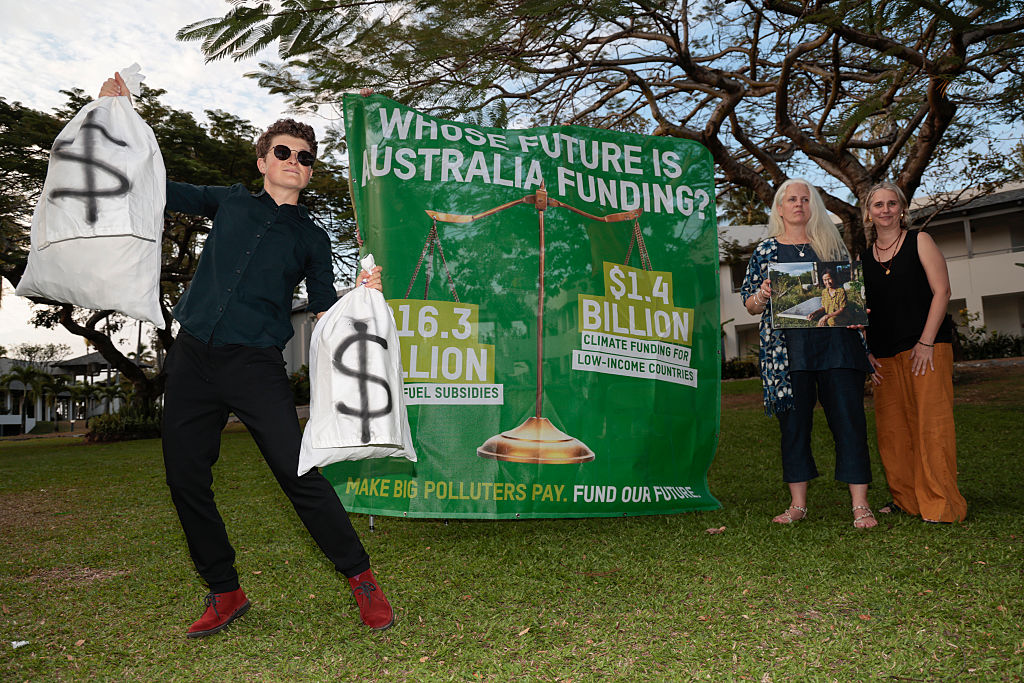
France’s Minister for Ecological Transition Monique Barbut defended the European Union’s climate action at the pre-COP meeting. She said the continent was heating up and reducing emissions faster and providing more climate finance than anywhere else in the world.
“It is time for all major emitters to step up and do their fair share” on climate finance, she said. Most developing countries with large emissions have fiercely resisted joining the club of climate finance donors, arguing they have played a disproportionately small historic role in causing climate change.
Barbut, as well as Palau’s president Whipps, called for the next flagship scientific assessment report of the Intergovernmental Panel on Climate Change (IPCC) to be finished by COP33 in 2028, in time to inform the next global stocktake of national climate action.
This timeline has been opposed by countries like India, Saudi Arabia and China, who argue it would put an unfair burden on developing countries. Barbut said countries should “support the work of the IPCC rather than sabotage its calendar”.
Barbut said that governments should agree at COP31 to aim to raise the share of “clean electricity” in final energy consumption to 35% by 2035. The Turkish and Australian governments have pushed for this goal although without specifying that the electricity should be “clean”. Barbut added that COP31 should also agree to cut emissions of methane, a particularly potent greenhouse gas.
The post Pacific leaders rail at climate finance failures after pre-COP trip to Tuvalu appeared first on Climate Home News.
Pacific leaders rail at climate finance failures after pre-COP trip to Tuvalu