

Avinash Persaud is special advisor to the president of the Inter-American Development Bank on climate change and an architect of the 2022 Bridgetown Initiative. Emily Wilkinson is director of the Resilient and Sustainable Islands Initiative (RESI) at ODI Global.
Many communities are vulnerable to climate shocks – from the urban poor in Brazil to smallholder farmers in Africa’s Sahel region. But few are more vulnerable than those living in Small Island Developing States (SIDS) around the world, from the Caribbean to the South Pacific.
Storms and rising sea levels present an existential risk. They can wipe out annual incomes several times over. We don’t yet know the full extent of the damage wrought on Jamaica by Hurricane Melissa – the strongest hurricane to hit the island since records began – but they are expected to run into tens of billions of dollars, and recovery will take at least a decade.
These nations are the “canaries in the coal mine”, signalling the dangers that lie ahead. In 2022, the world set out a plan to tackle the threat. Economists, nonprofits and nation states got behind the Bridgetown Initiative, spearheaded by Barbadian Prime Minister Mia Mottley.
It has historically been difficult and expensive to finance the projects many nations need to cope with our changing climate. Yet much progress has been made on the Bridgetown Initiative’s five-step plan to reform the global financial system.
We have seen wider adoption of pause clauses in debt arrangements aimed at taking the pressure off countries when they face disasters. These clauses were used for the first time by Grenada and St. Vincent and the Grenadines in the aftermath of Hurricane Beryl in 2024. In 2023, countries agreed to unlock $100 billion in Special Drawing Rights, an international reserve of assets held by the International Monetary Fund (IMF), scaling up states’ efforts to build resilience to climate change.
More recently, progress has been made to reduce the cost of capital and currency volatility, two other major brakes on resilience investments. Brazil, the COP30 host nation, has just launched the Eco Invest programme with the Inter-American Development Bank (IDB), which will mobilise significant new private and public finance to restore degraded rural areas, produce clean energy and create green jobs.
Closing the yawning climate finance gap
These measures have helped to close a yawning climate finance gap, but more action is needed.
Global average temperatures continue to rise, and we are close to biophysical tipping points with disastrous consequences. For many climate-vulnerable countries, investing in resilience is the best response. Climate adaptation technologies have improved substantially and countries can now build heat-ready homes and schools, while coastal defences can withstand Category 5 hurricanes like Melissa. Every dollar spent on adaptation saves up to $10 on avoided losses.
-
Global South’s climate adaptation bill to top $300 billion a year by 2035: UN
Warning over massive shortfall in climate adaptation funding comes days before COP30 in Brazil, where the issue is set to be a major theme -
UN calls for faster emissions cuts for 2035 as first global estimate disappoints
UNFCCC “calculations” suggest a 10% drop in global emissions, but delays by many countries in submitting NDCs cloud official review of climate pledges -
Political backing more important than money for new forest fund at COP30, Brazil says
The Tropical Forest Forever Facility is seeking $25bn in startup capital from donors but doesn’t need to hit this goal before its launch in Belém, Brazil’s finance ministry tells Climate Home event


The investments that have the greatest savings tend to be public goods, such as sea walls and flood defences, with few capturable revenues for private investors. The private sector has an important role to play in developing resilience technologies and implementing resilience investments, but 90% of the time, the public sector ends up paying.
Many call on rich nations to provide more grant support for the climate vulnerable. But grants are shrinking, so we must consider other ways to unlock more investment.
Climate adaptation can’t be just for the rich, COP30 president says
First, the major players who influence debt sustainability – ratings agencies such as Fitch and Moody’s, private investors, the IMF, the World Bank and other multilateral development banks (MDBs) – could change their approach. Too often, the risks of climate shocks are priced into debt repayments without considering the opportunity to gain by making countries more resilient to them. This makes it harder for countries to do the right thing.
Second, the most climate-vulnerable nations will need new borrowing instruments that are low-cost, long-term and flexible, for example ensuring that debt interest repayment timings can be adjusted if a disaster such as a devastating hurricane strikes.
Because of their AAA credit ratings, MDBs like the World Bank are best positioned to help. Small island nations require an estimated $36 billion for adaptation efforts but received a fraction of that last year, and the World Bank and Inter-American Development Bank (IDB) have committed to raising their adaptation finance portfolio overall to 50% of climate finance, up from 30%.

Third, climate-vulnerable countries are still paying a huge portion of their tax revenues in servicing debt. More can be done to break this vicious cycle, and one solution is something called a debt-for-resilience swap. That’s when a AAA-rated guarantor guarantees the debt of a climate-vulnerable country, allowing it to borrow at significantly lower interest rates. The proceeds are then used to buy back expensive debt – keeping the level of debt unchanged, but re-routing interest savings for resilience investments. Barbados, the Bahamas and Ecuador have done debt-for-climate swaps, but guarantors are in limited supply.
Comment: Can COP30 mark a turning point for climate adaptation?
To tackle this challenge, the IDB and other MDBs are developing the first-of-its-kind Multi-Guarantor Debt for Resilience Facility, where multiple guarantors work together to unlock more debt swaps on a larger scale.
In these difficult times, when climate change is driving ever more dangerous and unpredictable impacts in vulnerable places, we must press forward with further reforms. Bridgetown has already channelled hundreds of billions into building stable countries with a secure future – something that benefits all of us. Now we all need to raise our adaptation ambitions.
The post Hurricane Melissa’s destruction shows need for climate resilience push appeared first on Climate Home News.
Hurricane Melissa’s destruction shows need for climate resilience push

Three countries have been named by the Paris Agreement’s compliance committee for failing to submit a nationally determined contribution (NDC) and repeatedly snubbing offers of help with their climate plans.
After months of internal debate over whether to identify serial non-responders, the Paris Agreement’s Implementation and Compliance Committee (PAICC) named the three countries which have failed to engage with it over their NDCs on Friday.
It named Democratic Republic of Congo, Senegal and North Korea in a footnote of its annual report, adding that it decided to name them “with a view to facilitating engagement”, adding that representatives of the three nations had been invited to its meeting in early 2027 “with the purpose of identifying any challenges and constraints”.
“The Committee noted the importance of Parties engaging with the Committee in a timely manner, while noting that some delays may be due to the national capabilities and circumstances of the Parties”, the report said.
-
Under US pressure, World Bank says it will back gas “where appropriate”
The US wants the World Bank to expand its gas support while climate campaigners are pushing for it to end – its head spoke this week of limited backing for the fossil fuel -
IPCC scientists vow to press on with climate reports despite political deadlock
After governments again failed to agree a timeline, nearly 120 IPCC authors pledged to complete their assessment on time and with full scientific rigour -
Paris Agreement committee snubbed over missing NDC climate plans
Many governments have still not submitted a nationally determined contribution to the UN, breaching a key requirement of the Paris Agreement

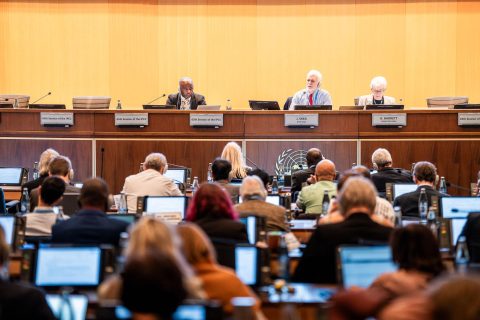

In July, PAICC said 12 countries had ignored its repeated attempts to discuss why they had not published an NDC as required every five years under the 2015 Paris accord.
Members of the committee had been divided over whether to name them, but at a September meeting decided to do so in their annual report to the annual climate COP summit.
By the time the report was published on Friday, only Congo, Senegal and North Korea “had not communicated an NDC or submitted a [Biennial Transparency Report] and had not yet responded to any of the Committee’s notifications, despite several reminders issued by the Committee in this regard”.
Rainforest and renewable energy ambitions
The silence from Congo and Senegal is notable because the former is home to much of the Congo Basin rainforest while the latter has sought billions of dollars in climate finance to support its renewable energy ambitions.
After Brazil, Congo has more rainforest than any country in the world. This forest, and the country’s peatlands, absorb huge amounts of greenhouse gas but are fast being lost to expanding farmland, charcoal production, logging and mining.
Senegal signed a Just Energy Transition Partnership with Canada and wealthy European nations in 2023, to help it meet its renewable energy targets under the-then government of Macky Sall. It was chair of the Least Developed Countries group between January 2022 and December 2023.

Tejas Rao, who is researching the PAICC as part of a doctoral thesis at Cambridge University, said the governments of the three countries should engage with the committee.
“Engagement costs these governments very little and the committee has shown it will listen,” he said.
“Silence leaves the committee with no basis to help, and it leaves the [governments] exposed to the narrative that they are simply disengaged,” he told Climate Home News.
Paris Agreement requirement
The 2015 Paris Agreement requires all parties to publish an NDC every five years outlining their emissions reduction targets, with each plan meant to be more ambitious than the country’s last NDC.
The latest set – the third round of plans, with new targets for 2035 – was due in February 2025. While most countries missed this deadline, all but around 30 – mostly small emitters but including Egypt, Vietnam and Argentina – have now submitted them.
Over the year, the PAICC – which is made up of government climate officials from developed and developing countries – has been communicating with governments that have not submitted NDCs and trying to overcome barriers to them doing so.
Some nations have cited exceptional circumstances as the reason for not submitting an NDC, a process that requires a significant amount of work in tracking emissions and consulting on how to curb them across the economy. For example, a letter from a Sudanese official to the PAICC, seen by Climate Home News, said that the country’s civil war had led to the suspension of its NDC preparation.
-
IPCC scientists vow to press on with climate reports despite political deadlock
After governments again failed to agree a timeline, nearly 120 IPCC authors pledged to complete their assessment on time and with full scientific rigour -
Under US pressure, World Bank says it will back gas “where appropriate”
The US wants the World Bank to expand its gas support while climate campaigners are pushing for it to end – its head spoke this week of limited backing for the fossil fuel -
Who shapes climate science? The equity question facing the IPCC
Early completion of the next global climate science assessment reports risks excluding research from the Global South, which is key to ensuring the findings are fair
The US and Iran are not signed up to the Paris Agreement and so do not have active NDCs, nor does Taiwan, which is not a UN member state.
Rao said that because the PAICC is “facilitative and non-punitive”, naming the countries “is meant to open a door, not close one – the invited consultation is the point”.
“In recent months, governments that explained their constraints, whether capacity, finance or domestic process, have been met with follow-up and support rather than sanction, and the number of silent governments has fallen sharply,” Rao said.
The post Paris Agreement committee names three countries snubbing it over NDCs appeared first on Climate Home News.
Paris Agreement committee names three countries snubbing it over NDCs