

Government negotiators at the International Maritime Organization (IMO) are likely to agree next week to put a price on at least some shipping emissions, with most of the money going to subsidise clean fuels and help ports and workers adjust to their use, sources close to the talks told Climate Home.
The negotiations in London run until April 11 – and nothing has yet been finally agreed. But governments are discussing the details of a proposal put forward by the talks’ Norwegian chair Sveinung Oftedal in an attempt to reach a compromise on the first such system for a global sector.
The proposal says that revenues raised for the new IMO Net Zero Fund should be spent within the shipping sector and its fuel supply chain.
It specifies that the money should be allocated to green fuels and the infrastructure and workers needed to transition to them, to protecting the maritime industry from climate change, and to addressing negative impacts from a carbon price on shipping emissions, such as food inflation caused by rising shipping costs.
A source with knowledge of the IMO discussions told Climate Home that “the predominant view is that how the revenue is spent has to be somehow connected to the sector”.
Climate campaigners – and some countries, particularly small island and African nations – had hoped that at least some of the revenue would be spent on climate action in developing countries outside the shipping sector, on things like solar panels, drought-resistant seeds and rebuilding roads destroyed by floods.
Last week, Kenyan climate envoy Ali Mohamed wrote in a piece for Climate Home that the money raised should “transcend the maritime sector” and support “broader climate projects” including in landlocked states.
But some other developing countries do not want this money – much of which will be paid by shipowners in their nations – to replace the climate finance that rich governments are supposed to provide under the UN climate convention.
Friederike Roder, director of the secretariat for the Global Solidarity Levies Task Force, a multi-government initiative looking into international taxes to support climate and development, told Climate Home, “we need a solidarity contribution” from shipping.
“Negotiations are still under way,” she said, adding that the IMO “still has the possibility to deliver a historic agreement which doesn’t leave anyone behind”.
Size of fund up for debate
While negotiators agree that international shipping emissions should be priced, they remain sharply divided on how much of a ship’s greenhouse gas pollution should be covered and how high the price should be. This will determine how much money goes into the IMO Net Zero Fund.
Shipowners will have to pay if they don’t reduce emissions by a certain percentage by set years.
The chair’s proposal is to use the targets agreed for global shipping in 2023 – a 20% reduction in emissions by 2030 and 70% by 2040.
Loss and damage fund proposes helping governments first, local communities later
If a ship does not meet these targets, it will have to buy a permit known as a “remedial unit” from the IMO’s Net Zero Fund. This is likely to be several hundreds of dollars per tonne of carbon dioxide equivalent (CO2e) emitted above the agreed level.
There is likely to be another, more ambitious stretch target. This could be the emissions goals that governments agreed to “strive” for in 2023 – 30% by 2030 and 80% by 2040.
The penalty for not meeting these stretch goals will be much less than not meeting the basic goals. Fees of between $50 and $150 per tonne of CO2e have been discussed.
Price on all emissions?
The Marshall Islands wants these stretch goals to be 100%, starting as soon as the rules come into place in 2028 so that all emissions would be subject to a charge from that year. The Pacific nation’s envoy for maritime decarbonisation Albon Ishoda said a tax on all shipping emissions “remains on the table – and that’s essential”.
The Amazon rainforest emerges as the new global oil frontier
Some fossil fuel-reliant nations and shipping-dependent emergent economies like Brazil, China and Saudi Arabia do not support such a levy, and last week island nations expressed fears that the EU was backing away from the idea.
“A growing bloc of countries, particularly from Africa, the Caribbean, Central America, and the Pacific, is united in its focus on delivering ambition and equity for the Global South,” Ishoda added. “But when it comes to equity, our voices continue to be ignored. I have real concerns that the package being shaped may not be one that truly protects the most vulnerable or ensures no one is left behind.”
The post Hopes fade for climate cash from carbon price on shipping appeared first on Climate Home News.

Hello, I am Jimmy and the Captain of Oceania. I learnt to sail in my hometown of Hobart, Tasmania. I’ve spent years navigating Tasmania’s wildly spectacular coastline, and crossed Bass Strait many times, including the Sydney to Hobart yacht races. My first time sailing with Greenpeace was in 2017 as a volunteer on the Rainbow Warrior.
It is a privilege to be a part of the Oceania project, and I hope we can achieve many things with this beautiful ship.
https://www.greenpeace.org.au/team/jimmy/
I’m Steve the Engineer onboard. My happy place is on or under the ocean – offshore sailing, Surf Life Saving, scuba diving and ocean swimming .
I love adventure, problem solving and getting my hands dirty.
I’m excited to see Oceania on the high seas and promote and defend our magnificent oceans.
As an engineer it’s my job to keep everything running from the engine to the water and the bathrooms, (make cups of tea) and help sail the boat.
https://www.greenpeace.org.au/team/steve/
Anne Jellema is executive director of 350.org; Mads Christensen is executive director of Greenpeace International; and Amitabh Behar is executive director of Oxfam International.
On Monday, global petitions with a collective total of more than 2 million signatures were presented to the United Nations, calling on governments to introduce binding mechanisms to make fossil-fuel companies and the super-rich contribute to the costs of the damage they have created.
The petition signatures were received by Selwin Hart, the UN Assistant Secretary-General for Climate Action, in New York during the UN General Assembly, sending a clear message to governments: there is no more room for excuses.
If governments are serious about resilience, energy security and protecting people from an increasingly unstable world, they must make the companies profiting from the fossil-fuel economy pay their fair share. Because the crisis we are facing is no longer some distant threat. It is unfolding in real time, and it is exposing the extraordinary costs of an economy still built around fossil fuels.
-
Climate change and energy transition rise up national security agenda
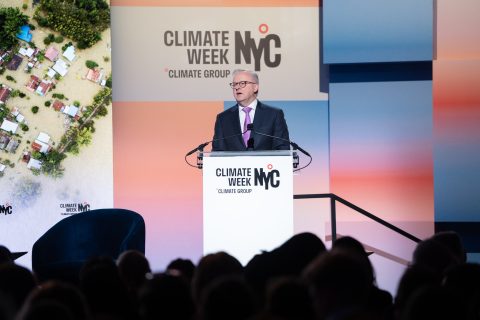
Leaders highlighted the national security risks posed by global warming and fossil fuel dependency at New York Climate Week -
COP31 presidency announces AI pledge as UN climate chief says Big Tech ‘on thin ice’
Turkish minister Murat Kurum said AI companies should be transparent about their energy use and power their data centres with clean energy
For more than six months, the Strait of Hormuz, the channel through which a fifth of the world’s oil once flowed without a second thought, has been closed, contested or effectively unusable. Tankers sit at anchor. Insurance premiums have gone through the roof. Petrol pumps from Los Angeles to Lagos have felt the tremor. It has taken a war to remind the world just how much of our daily lives still rests on a single, fragile artery of fossil fuels.
At the other end of the same emergency, a glacier came down on the Nepal–China border in the last week of August. A wall of ice, rock and water tore through the Bhote Koshi and Langtang valleys. It has been described as one of the deadliest disasters in the region’s modern history, unfolding in a landscape where the world’s glaciers are retreating and destabilising at a pace scientists have been warning about for years.
And this came only weeks after hundreds of thousands of people were displaced — not by ice, but by fire. Europe has experienced its worst wildfire season in more than a decade. Homes have been lost across Spain, Portugal, France, Greece and the UK. Firefighters and civilians have been killed battling the blazes, while damage and reconstruction costs continue to reach extraordinary levels.
These are not separate crises. They are different expressions of a world becoming more volatile, while the fossil-fuel economy continues to generate enormous profits for those at the top and pushes the costs onto everyone else.
Communities absorbing cost
Because the crisis we are facing is no longer some distant threat. It is unfolding in real time, and it is exposing the extraordinary costs of an economy still built around fossil fuels. One thread runs through all of these events: a global economy still organised around the profits of a fossil fuel industry that has known, for decades, exactly what it was doing to the planet.
At a moment when governments are gathering in New York for the UN General Assembly to talk about security, resilience and economic competitiveness, it is worth spelling out what “security” – or the lack of it, driven by our economy’s dependence on oil – actually means this year for ordinary people around the world: 35,000 excess deaths in Europe due to heat; the highest food prices in three and a half years; $700 billion in economic losses, threatening countless jobs and livelihoods, from a war and a closed oil chokepoint whose consequences are nowhere near over.
Meanwhile the companies that extracted, refined, shipped and sold the fuel behind all of this continue to report extraordinary profits. Households are paying more for energy. Governments are spending billions on disaster response, on reconstruction, on emergency deployments of firefighters and aid. Communities are absorbing the cost of a system they didn’t design and don’t control. We pay. They profit.
This is not a coincidence, and it is not inevitable. It is a political choice, repeated year after year, to let the companies most responsible for the climate crisis hoard the wealth they generate while the rest of us carry the risk.
Taxes and fines needed
That is why, together with communities and campaigners in dozens of countries have spent the last three years building the case for a simple, overdue idea: polluters should pay for the damage they have caused. Not through voluntary pledges or distant net-zero promises, but through binding mechanisms, climate damages taxes, surtaxes on fossil fuel profits, and fines ring-fenced for recovery and adaptation that put real money where the harm actually is. This is how we take the profit out of destruction and protect the generations to come.
The response has told us we are not alone in thinking this. Our petitions calling on governments to make polluters pay have now gathered a collective total of over 2 million signatures from people across every region of the world.
The case for making polluters pay has moved into the mainstream
That is not a fringe demand. It is what happens when people watch a choke-point war spike their fuel bill, watch a glacier take a thousand lives, watch their own summer holidays rearranged by fire. They draw the obvious conclusion: the people who caused this should be paying for it – not profiting from it.
We hear the objection already forming: that this is not the moment, with wars underway and economies fragmenting, to burden industry further. We would say the opposite is true. If governments can mobilise trillions for war, for bailouts and for new fossil fuel infrastructure, they can mobilise the political will to tax the companies that caused this crisis.
Money for clean energy and resilience
That money can go straight to the people paying for it, through cheaper, cleaner, more secure energy, and through funding for communities on the frontline of floods, fires and glacial collapse. There isn’t an excuse left. There is only a choice about where power and money go next. Every dollar we don’t spend now on adaptation, resilience and cutting emissions, we burn many times over later: on disasters we could have prevented and economies we scramble to fix too late.
This year’s UNGA should be the moment that choice gets made in public. Governments arriving in New York will talk about resilience, about energy security, about protecting their citizens from an unstable world. Let them explain on the record why a fossil fuel industry that has spent decades profiting from that instability should not be the one paying to fix it so wrecking the planet no longer pays off.
The fires, floods and storms won’t just go away. The system that keeps producing these disasters, and keeps paying the same companies for the privilege, will not change itself unless political leaders step up. It is on all of us to make sure they hear, as loudly as possible, that the time for excuses has run out.
The post After Hormuz, Nepal and wildfires, people demand action to make polluters pay appeared first on Climate Home News.
After Hormuz, Nepal and wildfires, people want action to make polluters pay


-

 Greenhouse Gases2 years ago
嘉宾来稿:满足中国增长的用电需求 光伏加储能“比新建煤电更实惠”
-
Climate Change1 year ago
Guest post: Why China is still building new coal – and when it might stop
-
Greenhouse Gases1 year ago
Guest post: Why China is still building new coal – and when it might stop
-

 Climate Change2 years ago
嘉宾来稿:满足中国增长的用电需求 光伏加储能“比新建煤电更实惠”
-

 Renewable Energy11 months ago
Sending Progressive Philanthropist George Soros to Prison?
-
Climate Change2 years ago
Bill Discounting Climate Change in Florida’s Energy Policy Awaits DeSantis’ Approval
-
Greenhouse Gases1 year ago
嘉宾来稿:探究火山喷发如何影响气候预测
-

 Carbon Footprint2 years ago
US SEC’s Climate Disclosure Rules Spur Renewed Interest in Carbon Credits